Showing posts with label Knightmare. Show all posts

Wednesday, December 7, 2016

Knightmare: Won! (with Summary and Rating)

Does that mean there's no more show?
   
Knightmare
United Kingdom
Mindscape (developer and publisher)
Released in 1991 for Amiga and Atari ST
Date Started: 6 November 2016
Date Ended: 5 December 2016
Total Hours: 55
Difficulty: Very Hard (5/5)
Final Rating: 29
Ranking at Time of Posting: 123/232 (53%)
Ranking at Game #460: 262/460 (57%)
  
I have never come as close to needing therapy because of a video game as I did in the final stages of the aptly-named Knightmare. I blame commenter Quido. If he hadn't sent me his maps and notes, I would have gotten stuck early in the final level, quit in frustration, and published a quick GIMLET. But since I had his materials--and, all kidding aside, they're a brilliant set of maps, with absolutely everything carefully annotated--I was motivated to keep playing. For 30 hours after my last post. That's right: the final level is bigger, longer, and harder than all the previous ones combined. The difficulty increases so much, in fact, that it essentially becomes a different game. I was leaning towards liking it after Quest #3; now I just want to forget it. [Update: Quido gave permission to share his maps. Here they are. Note that the Excel commenting doesn't work in the browser window; you'll have to download the workbook and open it in Excel.]

Quest #4 comprises around 4,000 squares of small maps interconnected by teleporters, portals, pits, and ladders. Here's a summary: illusory doors, spinners, radiation squares that deal constant damage, walls that disappear and reappear when pressure plates are stepped on, doors that respond to keys, doors that respond to levers and pressure plates and "open" spells cast from afar, pressure plates that you have to get monsters to walk onto, pits, hidden buttons, buttons that you have to press or shoot from moving vehicles, pressure plates you have to throw things onto, teleporters that don't alert you you've been teleported, enemies that spawn when you step on pressure plates, invisible pressure plates, invisible swamps to sink into, boats, water, fireball launchers, halls that rotate, and monsters, oh so many monsters, that you must waltz, waltz, waltz all night because they're capable of stoning and blindness and aging and crippling and if any of these happen to you, you might as well be dead.
    
The game has never featured quicksand before, but boy is it about to.
   
Knightmare is far harder than Chaos Strikes Back, which is celebrated for its difficulty but at least offers you that hint disk. No such luck here. It is the first game to get a full 5/5 on the "difficulty" scale, and I honestly question whether it's possible to win it without hints. I guess Quido must have, although I'm guessing--hoping, really--that he built his walkthrough off some previous, less thorough version, or perhaps the official hint guide.

At first, I was determined not to use Quido's maps, which would have been a shame because they deserve to be looked at. After all, I'd gotten through Levels 1-3 without a lot of difficultly, and I arrived at Level 4 healed up with a full stock of rabbit pies. It didn't start out so hard. Near the beginning of the level is a series of four gated rooms where enemies continually respawn. The game calls them "training rooms." Here, you can grind to your heart's content--not that it really does you any good.
  
Quido's detailed maps of the fourth quest.
    
As I began this session, I was sick of picking up missile items all the time, so I stopped using my rear characters as archers and started using them more for their core strengths: spells. This meant resting a lot more than I'd been doing before, but really I was being stingy about resting. It has virtually no penalty. Around the middle of the level, when combat became so hard I figured I must be doing something wrong, I watched a YouTube series for a little while. (The 15-hour series comprises 100 videos, more than 60 of them in the fourth level.) Not only did they put my fears to rest, I saw that the player was routinely resting every minute or so.

Anyway, the level didn't start out hard: a few pressure plate puzzles, a variety of keys opening a variety of locks, and so forth. I got some weapon and armor upgrades early on, including a chainsaw and various pieces of plate armor. I finally figured out the magic system and had my wizard and priest dual-wielding wands of different types. The combats were hard but the usual tricks got me past them.
   
Groovy.
    
One aspect of the level promised to be easy and indeed remained so: food. Near the starting area is a ladder leading to a small map of constantly-respawning spiders, which drop edible spider's legs. Between those and frequent grapes and apples scattered throughout the level--plus a portal back to the forest you encounter about halfway through--starvation was never a threat. I guess the developers felt you needed to focus on the hard stuff.

My first obstacle was a series of pressure plates that served as a "conveyor," yanking my party up and down a hallway with no easy way to stop it and get to the end. After trying everything I could think of, I capitulated and looked at Quido's maps. The solution was to throw a "spanner"--an object found in an earlier section--on a particular plate. Nowhere else in the game so far had specific objects been required to trigger the pressure plates (at least, I don't think so; if there were such puzzles, they were obvious), and of course using a wrench by throwing it is unintuitive. Even if I'd hit upon this solution, I probably would have given up after throwing it on a couple of the plates and seeing no result (it has to land on one particular one).
    
Do you see a button on any of those walls?
    
Shortly after this puzzle, I encountered another one that I couldn't solve. The area of the map was labeled "target practice" and it consisted of a wagon on a track flying past a series of 7 hedges with walls on the other side. The game had offered a bow and set of arrows shortly before I entered this area, so I understood the basic gist of what it wanted me to do--but there were no obvious "targets." I mean, it turns out that one of the 7 wall squares--which you zoom past too fast to look at, let alone from two squares away--has a button, and throwing or shooting something at the button causes a wall to open. But you have to know it's there, and then hit it from a moving vehicle, and between the two I don't know how you'd solve it without some spoiler at least telling you the particular wall section to aim for. In the meantime, you have to contend with snakes that spawn every time you miss and hit a different bit of wall.

By this time, the dam had broken and I had a hard time not using Quido's walkthrough quite liberally. I never would have survived without it. There are several places in which you have to cast an "open" spell on a door you can't even see, or fire a missile onto a pressure plate that's also out of visual range. Sometimes, I couldn't tell what a button or lever did, largely because it affected a remote area of the dungeon. One button, towards the end of the dungeon, lowers a wall that took me more than 20 minutes to fight my way back to. Without consulting Quido's map, I would have had to explore nearly the entire dungeon to find out what had changed.
   
In that darkness is a door, and behind that door is a pressure plate. So all I have to do is fire an "Open" spell ahead of me, followed by a missile, and I'm all set. But how would you have figured this out without a hint?
   
The worst part, though, was the increasing difficulty of the enemies. Certain monsters, like knights and large dragons, were taking me nearly 15 minutes per enemy to waltz around and kill. Then the game started serving up enemies with special abilities: medusas who can stone you; wizards who can blind, age, and cripple you; demons who can do all of those things. Killing them was taking so long that I wondered if I could just run past them instead. The problem was, maybe 5% of creatures carry a key or some other quest item that you really need. Hence, I started consulting Quido's sheet to see what enemies I really had to kill and which I could avoid--provided the layout of the corridors allowed me to avoid them.
   
I'll be waltzing around this guy for 15 minutes or more.
    
Quite often, the sheer density of enemies, or the corridor configurations, makes waltzing impossible and you have to fight them head-on. In such situations, your party members' lives depend on how quickly you can shift the healer back and forth, casting spells to undo the damage. If the healer's points run out--which happens pretty fast--you're screwed.

One particular area had me nearly give up in despair. There was a succession of 3 or 4 rooms with unavoidable pressure plates, and stepping on those plates causes three spellcasting enemies to spawn. These guys are nearly impossible. Not only do they have spells that age you, cripple you, and turn you into a moron, draining your attributes to about 10 each, but they have a particularly annoying spell that causes you to turn 90 or 180 degrees and waste your next spell or attack on a blank wall. I had to try luring them one by one into an area where I could escape via a ladder if necessary. Waltzing each one took about 20 minutes, meaning killing all the mages in the area took about 4 hours of gametime on its own. The area is so ridiculous that the developers stuck a couple of mages that cast healing spells in a nearby corridor. One of them randomly casts "Youth" (reverses aging), "IQ" (reverses dumbness), "de-cripple," and 5 spells that restore attributes drained by these spells. I had to park my characters in front of him for almost an hour before everyone was healed.
     
These guys are going on the "most annoying" list.
    
There were several areas that featured a similar puzzle: a series of buttons or levers that caused 4 corridors surrounding a central square to rotate clockwise. Some of these squares would have doorways, and each set of corridors interlocked with two or more central hubs. Passing through the areas meant pushing or pulling in the right order to "pass" doorways between hubs and create chains of open spaces leading to where I wanted to go. The problem was, I had no idea what the corridors looked like on the other side. I had to guess (or use Quido's maps). I liked the puzzles--they involved a lot of deduction--but even with maps, figuring out the correct order of levers was challenging.
   
One such area. different levers rotate the corridors around hubs 1, 2, 3, and 4."D" represents doors, and the other corridors are blank wall. I have to pull the levers in the right sequence to line up the doors so I can get to Point X.
    
A few other notes:

  • Apparently, if you're unencumbered, you can run across a single square of water. There were several areas in which this was necessary.
  • A lot of enemies have dialogue or hints if you take a second to click on them in the middle of battle.
    
It's nice to have goals.
   
  • My characters capped the game at "doyen" in their respective classes. I'm not sure if there's a higher level.
      
It would take too long to recap the dozens and dozens of puzzles on the map, but they all come together to open a wall not far from the entrance. Passing through there takes you down a ladder and into a room full of demons, whom I simply ran past (apparently missing a second chainsaw and an "aqualung" of unknown use). A ladder from there takes you to the large final area.
     
Not doing so well against some demons.
    
I had assumed that I'd find the crown in the level, then take it back to the beginning, and then fight Lord Fear (the manual hinted at that sequence of events), but it turns out Lord Fear has the crown and is found in the final area. I first had to kill his demon ally--about 20 minutes of waltzing--to get a key. This opened the door to Lord Fear's chambers and the final battle was on.
    
     
It took longer than some entire games. Fear is capable of all of the previously-mentioned spells, including blindness, stoning, and crippling. You simply cannot let him hit you. He also bounces spells back at you, so your melee fighters have to carry the day. There's no other solution except to waltz him to death. The one saving grace is a nearby portal where you can recuperate in a safe area in case he does happen to zap you with something bad.
     
My lead character after a few unlucky breaks.
    
It took me 430 hits to kill him, representing over an hour of waltzing and retreating, saving every 5-10 minutes, and reloading if things got too hopeless. (Completely healing a single character who's been hit with "stone" and "lame" might take 15-20 minutes by itself between the casting and resting; I typically reloaded rather than go through it.) I won late last night and my hands are ruined today.
    
Picking up the crown after killing Lord Fear.
   
Lord Fear leaves the crown when he dies. I had to make my way past the demons to finally get out of the dungeon and back to the starting area, where a pressure plate waited to receive the crown.
    
   
Tossing the crown on the plate opened the way to another pressure plate, which brought me to the endgame: a graphic of a trophy, a congratulations screen, and an advertisement for Antony Crowther's other games.
     
This was not, in fact, the title of Captive 2.
    
Oh, I'm sure there are plenty of players who love the challenge inherent in these puzzles and this style of combat. As for myself, if for some reason I had to play this game again to continue my blog, I'd give up the blog. These last 30 hours have been excruciating. This simply is not what I like about RPGs.
    
Knightmare is a rare game for which I would consider the hintbook a necessity.
    
This post is already long, but I want to GIMLET this and be done with it:

  • 2 points for the game world, which is confusing and inconsistent. I'm not really sure where I'm supposed to be, or why I'm there, or how I got roped into defeating Lord Fear in the first place.
  • 4 points for character creation and development. The usual Dungeon Master system is in place. There are more races and classes than necessary, particularly since you're screwed if you don't have a mage and a healer. Development isn't very satisfying--you don't even find out when you've leveled, and the effects of leveling aren't palpable in combat. 
  • 1 point for NPC interaction, and I'm being generous in calling the heads on the walls "NPCs."
    
I think he actually had it.
    
  • 5 points for encounters and foes. For the enemies, we have the usual Dungeon Master nonsense where we don't even know the monsters' names. You figure out their special attacks and overall difficulty pretty fast, although I would have liked a hit point chart in the manual so I'd have some reassurance that they'd die eventually. Most of the points here go to the puzzles, which I rate as "encounters" in this type of game. Although I thought they were too hard, they were also highly original and constituted an impressive use of the engine.
     
I just wish the game didn't make the buttons so hard to discern.
    
  • 3 points for magic and combat. The old Dungeon Master mechanics reach their nadir in this game, where nothing you do really matters because you end up having to waltz every enemy to death anyway. The game doesn't even bother with the pretense that you can survive in a stand-up fight. The magic system, consisting of a variety of spells that seem to do the same thing, cast from different wands, is unimpressive.
  •  3 points for equipment. Weapons, armor, helms, pants, and boots are found at fixed locations. There are no rings or amulets as in Dungeon Master and only a few special items. As with character development, the nature of the combat system makes you feel that item upgrades hardly matter.

I like the way different weapons have different attacks depending on skill, but they didn't seem to make a lot of functional difference.
    
  • 0 points for no economy.
  • 3 points for a main quest in 4 stages with no choices or branches.
  • 6 points for graphics, sound, and interface. The graphics are decent, the sound even better, and the interface has more keyboard options than the typical Dungeon Master clone.
  • 2 points for gameplay. I found it too linear, too long, and too hard. I suppose for some people, the difficulty is a virtue, so add another 4 points if you really like to be challenged by pressure plates and buttons and moving walls and whatnot.
     
The final score is 29, quite a bit lower than I gave to Dungeon Master, Chaos Strikes Back, Captive, or Eye of the Beholder. But in a funny way, if you're a fan of those previous games and you like them better than most other RPGs, you might find Knightmare to be the pinnacle of this sort of game. I mean, there must be some players out there who love the mechanics of Chaos Strikes Back but think it's for "n00bs." Or those who have played it so many times that they want a fresh challenge. I'd love to hear opinions from players who prize this particular lineage.

As for me, at its best moments, the Dungeon Master line nears what I love about RPGs but doesn't quite reach it. In the original game, character development is highly satisfying and rewarding, and the combat and magic system are well-balanced between tactics and digital dexterity. Chaos Strikes Back increases the difficulty of the puzzles but not so much the encounters, making it a worthy successor. But I don't play RPGs for the puzzles--particularly this sort of puzzle--and I much prefer a more tactical, turn-based approach to combat. Captive and Knightmare both tip the balance so far towards speed and action in combat that tactics take a far back seat.

Still, I suppose the difficulty of Knightmare is in keeping with the difficulty of the television show, which only 8 teams won in 8 years. I have to admire the producers for maintaining such a high difficulty when there was no winner in Seasons 1 or 3. There must have been pressure to dumb it down. Reading more about the show, I see that the quest objects in the game--the Sword of Freedom, the Shield of justice, the Cup of Life, and the Crown of Glory--were in the show as well, and the screenshot of the trophy mimics the awards given to victorious players. Even Lord Fear appears in the show.
    
My in-game reward.
    
I think Computer Gaming World missed this one. Amiga magazine reviews of the time range from 64/100 (Amiga Joker) to 91/100 (Amiga Action). I've read a few of the higher reviews, and I'd bet real money that most of the reviewers never got to the fourth quest. (My own rating would likely be 7-10 points higher if it was based only on the first three quests.) Amiga Action manages to discuss the game and its changes from Captive without once mentioning Dungeon Master.

I have to quote this hilarious paragraph from the beginning of the Amiga Computing review:
   
Knightmare is that terrible show where they get four kids and blindfold one of them by sticking a massive helmet on top of his head. This normally happens to the smallest who is always called Colin or Jeremy. The other three kids get the chance to kill Colin by telling him to walk around a computer-generated world into traps and clutches of giants, witches, trolls, etc....The three kids aren't supposed to kill him, but most of them couldn't find their way out of Woolworth's, never mind a dungeon plagued with goblins and giants.
    
It goes on to make fun of the show for about 5 more paragraphs before spending a small part of the rest of the review on the game itself. The reviewer admits he hasn't finished the first quest yet when he gives the game 86%. Was there any sense of journalism among Amiga magazines of the 1990s? I mean, I don't always love Scorpia, but at least she finished the games before reviewing them.

This is an era of Mindscape ascendant. We've already played two of their games in 1991--HeroQuest and Moonstone--and we'll have Worlds of Legend: Son of the Empire and Liberation: Captive II coming in 1992 and 1993, respectively. I have to note that while I haven't rated their titles very high, I don't find them weird, so sometime between 1986 and 1991, the British Isles worked out the problem I highlighted in Heavy on the Magick.

We'll periodically check-in with Antony Crowther for the remainder of this blog's existence, starting with his Captive sequel next year. And of course the basic Dungeon Master style isn't going anywhere soon: we still have Dungeon Master II and the two Eye of the Beholder sequels to explore in the next 100 games or so. I'm still waiting for any of its clones or sequels to be as good as the original.

Tuesday, November 29, 2016

Knightmare: Almost Awake

This doesn't look so much like a Sword of Freedom as it does a Sword of Freedom cake.
     
I was hoping I could wrap up the last of Knightmare in one article, but it looks like I won't be that lucky. Either I have to write up things the way they are now, or I won't get another post out until next weekend. This will be short, but it represents about 6 hours of gameplay.

At the end of my last post, I was toying with taking a shortcut and going right to the final quest. I ultimately didn't do that because it seemed like bad form, plus killing the trees that block the quest entrances is hard. All your attacks bounce back on you. I finally gave up and tossed the Cup of Life at Tree #3 and entered the third quest.
   
Groups of floating skulls assailed me in the third quest. They were hard to defeat because their images have no side view, so it's impossible to tell which way they're really facing.
    
The third area consisted of three independent regions, roughly 20 x 30 each, and together I thought they made up the most satisfying map so far. Both puzzles and monsters got significantly more challenging, but in a fair way. Some memorable puzzles from the level included:

1. An area of 4 north/south hallways interlocked with 4 east/west hallways. At every intersection was a pressure plate that caused fireballs to simultaneously shoot towards the party from the north and west. (I'm assuming on the cardinal directions, since the game has no compass or method of determining your facing direction, but you get the idea.) I had to first find a safe alcove to dart into (after re-distributing inventory to make sure no character was overloaded) and then find a series of buttons that turned off some of the pressure plates, allowing limited movement in the area.

2. A 5 x 5 area with 9 moving walls. Moving walls by definition are hard to map, but I had to figure out their starting positions and ultimately push them in a way that allowed me access to each of the corners of the room. It took about 30 minutes of mapping, testing, and reloading to get this one just right and not block a necessary exit or something.

3. A teleporter maze with multiple teleporters going to nearly-identical areas (most consisting of a single square with teleporters in all four directions). Fortunately, I had been hoarding miscellaneous junk and was able to use items dropped on the floor to map the teleporter system.
    
A clue in case I couldn't figure it out for myself.

4. A ghost who couldn't be killed with weapons. I had to experiment a bit with spells to learn that the mage's "Dispel" was the key to making him go away. This is the first time that I've needed a particular spell to progress in the game. Are you simply screwed if you didn't get a mage? I suppose I could have led him to another area and locked him behind a door, but I think maybe he had a key or something.
  
I thought the art was pretty good here.
         
5. A room full of giant snakes who start behind walls. Stepping on a pressure plate (which you cannot avoid) abruptly removes the walls. This is one of the few places in the game so far where waltzing doesn't work and you just can't avoid a head-on fight. I had to heal the front characters frequently from the rear as I slew about 12 snakes.

6. A riddle: "when is a well not a well." This was given to me next to a well. When I couldn't figure it out immediately, I tried tossing every item I had into the well to no avail. But one of the items, recently acquired, was a Staff of Curing, and it led me to reason that a well is not a well when it's not well. I cast a curing spell on the well, and sure enough it opened into--actually, I don't know what. But walking into it teleported me to another area.

  
7. A roomful of dragons at the end of a long corridor where pressure plates shot fireballs down the corridor. This was another place where I couldn't waltz--there were too many dragons in the room--nor even back up, since I'd trigger the fireball plates.

This latter room put me face to face with a jester walking on his hands. I figured he wasn't an enemy and clicked on him instead of attacking him. He simply said, "I will pay you." I went through my inventory and reasoned that he might want something called a "Funny Staff" that I'd previously found.
  
   
As with the trees in the opening area, the game gives you only one way to "give" an object to an NPC: throw it at him. If it's the right object, the NPC will paradoxically dissolve into a puff of blood. That's what happened to the jester here, and his body left behind a coin. The coin later went to a Charon-like NPC in the game's final area. He gave me his boat.
  
Yes, sir!
    
The final area had some really tough battles, including a series of floating skulls (it's hard to waltz them because they always face you straight-on), witches on broomsticks, and whatever the hell this thing is supposed to be:
   
     
But it also produced some nice equipment. I'm pleased to report that finally, after three quests, my party members have several items of chain and plate mail plus...get this...a broadsword
    
I finally discover what would be starting armor in most games.
    
The quest rewarded me with the Sword of Freedom, which I owned proudly for about 30 seconds before I tossed it at the final tree to make him disappear and let me into Quest 4. I played around the starting area for a little while; it appears that the opening area allows for infinite grinding against creatures that keep respawning. Although I prefer games that give me the opportunity to grind, I really hope it isn't strictly necessary.
   
Moving on to the final area.
   
Only after I finished Level 3 did I begin to understand something about the game's magic system. For spellcasters to cast spells, they must find a wand, rod, or staff that goes with the spell class. My wizard found a "Wand of Magic" and my priest found a "Cross of Aid" early in the game. I found some items that went with other classes but was never able to develop any skill with them.

As I've been exploring, I've been finding other wands and staves. Quest 3 gave me a Wand of Pain and a Staff of Curing, and I didn't understand them. Finally, I realized that each spellcasting class has more than one associated object. The Wand of Pain, for instance, gives extra spells to the wizard. I'm pretty sure I deliberately left behind something called a Cross of Life because I thought it duplicated what I already had.
    
A very stereotypical witch attacks.
   
Other notes:

  • This nonsense comes up now and then here, just like it did in Captive. No idea what it's going on about.
    
     
  • This is a button! A random skull on the wall. How I ever knew to push it, I have no idea, but I'm glad I figured it out. (Is there another game with very similar buttons?) There were a few of these.
   
    
I'm surprised by how much I'm taking to the puzzles, particularly considering that I didn't love the ones in Chaos Strikes Back, and I generally consider them an optional part of an RPG at best. But the combat system is wearing me down, and I'm glad I'm approaching the final areas.

Time so far: 25 hours
Reload count: 19

Saturday, November 12, 2016

Knightmare: A Few We've All Had

You've spent 8 hours on a task only to find that you're only 25% done.
    
Ugh. I don't know about this one. At first, I was looking forward to some classic Dungeon Master-style gameplay, but Knightmare isn't satisfying that urge so far. In fact, it's doing a good job living up to it's name. Let's take a little tour.

You're starving and there's no food

If you've ever thought, "I really like Dungeon Master gameplay. If only it existed in a world where food is so sparse that you have to chase rabbits around the map for hours just to survive," this is the game for you.
    
The blue-ish shading on the character's torso and legs serves as a food meter.
    
I started the first quest without understanding the importance of food. I didn't even notice the "food meter" (admittedly, because I didn't read the manual carefully), which is actually a subtle shading of the character's paper doll in inventory view. Apparently, when the meter runs out, you no longer recover health, stamina, and magic when you rest. Meanwhile, if your stamina bottoms out, you start taking hit point damage every few seconds. Thus, a starving character finds himself in an inescapable death spiral unless he can get to some food. I had made it about halfway through the first dungeon before I realized what was happening, and I had to hightail it back to the forest to kill some rabbits before I died.

Fortunately, rabbits continually respawn, so getting enough food is just a matter of time. I didn't return to the dungeon until I had backpacks full of rabbit pies.

You're in front of a bunch of people in your underwear

I've never met a game stingier with inventory. That's not a complaint. It's just funny. As I noted last time, the characters apparently start nude because their inventory slots are soon equipped with t-shirts and shorts. Later, I found some sandals, blouses, and skirts. There was one baseball cap. That's as good as the armor ever got.
   
Weapons weren't much better. Most games would give you swords and maces right away, but after scouring the first dungeon, I discovered that the final room produced, as the ultimate reward....a kitchen knife. It replaced a regular knife I'd been holding in my off-hand.

You try to fight, but all your attacks are useless

More than both Dungeon Master and Captive (and Eye of the Beholder, for that matter), Knightmare relies on tricks to prevail in combat--tricks such as the much-maligned "combat waltz" and crushing enemies in closing doors. A head-on battle is suicide. At first, not even the waltz served me well. It would take forever to kill a four-pack of trolls. For most of the first level, I led almost every pack of monsters back to the nearest push-button door and slammed them in it repeatedly to kill them. There was also a fun corridor where pulling a lever caused a fireball to roar down it and kill everything in its path.
    
Crushing gnomes in a door while I fight them.
    
(If you're just joining us, games using engines like Dungeon Master's let you damage enemies with parts of the environment, including closing doors and grates. This usually does more damage than regular combat. The "combat waltz" is when you attack an enemy from the side, then turn and side-step before he can turn and attack you. When he walks into your previous square, you attack again, then turn and side-step. You continually walk boxes around the enemy this way until he dies, denying him the chance to attack head-on. It works as long as your digital dexterity holds out.) 

My strategy didn't work in a few places in the game where enemies occupy islands and you can't lead them to a door. It took forever to kill them. At least, at first. As time passed, I began to re-acquaint myself with the combat waltz, and I realized I'd been doing it too gingerly. You don't swipe once or twice between side-step turns: you line up a row of weapons for your first two party members and sweep across it, right-clicking that mouse furiously, giving yourself carpal tunnel syndrome in the process. If you're fast, you can do 100 points of damage per turn instead of just 15 or 20. I did much better in later combats.

Nothing works the way it's supposed to

I end this session not understanding a bunch of aspects of the game, and it's beginning to annoy me. My two rear characters, for instance, regain stamina extremely slowly when they sleep. In fact, sometimes they lose it for the first minute. (Sleeping can take a few minutes to restore everyone fully.) If they're almost out, they might lose the rest of it, then start taking hit point damage while they're sleeping specifically to recover health and stamina. It's not because they have no food. I've checked that.
    
Sleeping as Armea's stamina refuses to budge.
    
My priest has a staff that allows her to cast various spells, but the healing spells only ever seem to target the character in Position 2. And one spell, "Aid," which is supposed to cure injuries, doesn't seem to work at all. A couple of my characters have red boxes around some of their body parts, indicating an injury that doesn't heal over time. "Aid" is supposed to help with those, I think, but does nothing. If you see anything I'm doing wrong, please let me know.

You're drowning--in piranha-infested waters

I found out the hard way that walking into water is instant death. There were a number of water squares in the first dungeon, and the only way to cross them is to find a boat. If you do that, you're in good shape--except for the piranhas (or whatever--the enemies aren't named) that rear out of the water and do massive damage. Fortunately, they die in a few blows, but they can easily kill you in the meantime.
   
A piranha jumps out of the water and kills my front two characters.
    
Let me cover the first quest dungeon briefly. Like Captive, Knightmare packs a lot of enemies and content in a small space. The map below doesn't look very big, and indeed if it was a Fate map, I would have traversed it in 30 minutes. But in Knightmare, it took nearly 5 hours. One in three or four squares has something that slows you down: a monster, a button, a door, a pressure plate, a talking head, or some minor puzzle to solve. At the beginning, I was annotating grates in the walls and floors before I realized they were just environmental features.
    
The major part of the fist dungeon.
    
The level was very linear, and in retrospect I didn't need to map it at all, since each puzzle simply led to the next immediate area. To say "puzzles" is generous. Given the nature of the show, I was expecting some mentally-challenging obstacles. Instead, the puzzles were of the trite Dungeon Master sort: find a hidden button, weigh down a pressure plate, and so forth. These can be challenging if done well (cf. Chaos Strikes Back), but they were very easy and obvious here. Maybe the later levels get harder.

I didn't expect so many combats. Again, I thought it would stress puzzle-solving over fighting. But the dungeon was swarming with walking trees, gnomes, and trolls (again, I'm guessing at the names), some of whom took a long time to kill even with the standard strategies.

The game began in a small corridor with a key. Throughout the first dungeon, I routinely found keys right before the doors that they opened, so I won't mention this every time. There was also some kind of dancing plant in the corridor that a talking head told me was "the Sprig of Life and Death." I couldn't find anything productive to do with it. Maybe it resurrects people? I didn't try.
    
When a sign warns you not to do something, don't do it.
     
Further on was a corridor with a lever on the wall. A talking head warned, "Do not play with fire." I pulled the lever and a fireball came roaring down the hall, killing everyone. I later used this corridor to kill some difficult enemies.
     
Dungeon Master had all these puzzles without the hints.
   
Further along: a pressure plate with a talking head that said, "Keep the pad down." I had to toss some random item on it to open a secret area. Later, there was another pressure plate that toggled a hidden door on a nearby wall.

The tunnels led to a place labeled "sewer entrance." They seemed to dead-end in a 2 x 3 area, but a pressure plate opened a hidden wall and a bunch of enemies attacked. After I defeated them, I reached a 3 x 3 dead end, where another pressure plate opened another hidden wall, and I had many more enemies to fight.
     
This is a "first" for a Dungeon Master-style game.
    
Past them was a corridor full of water and a boat. Moving in the boat is no different than moving on land, but the corridors tended to be more restricted, and I had to fight enemies without doing the waltz. There were a few patches of land ringing the water area, with numerous trolls. There generally wasn't enough room to waltz them on land, so I took to fighting from the boat, darting up to them, attacking a few times, and backing away. It took a long time.

Getting out of this area meant finding three buttons to open hidden walls, and some of the buttons are very obscure. You basically have to turn, face, and study every wall. Eventually, I crossed through a small corridor to another boat, which dumped me off by a portal.
    
Would you have noticed that button?
    
The portal took me to a large area labeled "the prison" with a gated area in the middle. There was no obvious way to open the gates. After I'd mapped everything and checked every wall twice, finding no buttons, I sighed and started testing them for secret doors. You can do this one of two ways: by walking into them (taking damage) or by throwing something at them. When I saw a dart sail through one of the walls, I knew I had a secret door. Until this moment, I wasn't aware that such secret doors existed in this game, and now I wonder how many I missed in the opening area. Looking at the map, I guess I can only see a couple of areas where they would have fit into the empty wall space.

The secret door led to a button, which opened one of the prison gates. For the next 90 minutes, I killed every troll, gnome, and walking tree that came out of the prison. This wasn't helped by the fact that they had a tendency to wander into the portal going back to the sewers. So I'd think I had everything cleared, and then "bling!" another party would blunder back through the portal.

In the prison area proper, another button opened another hidden doorway that led me to the final area. Here, through a gate, I encountered the first "new" enemy in a long time--some kind of cloaked figure with a sword. At first, I tried fighting him while the gate crushed him, but he was too smart for that and went wandering away after a few rounds. So I had to chase him down and waltz him to death.
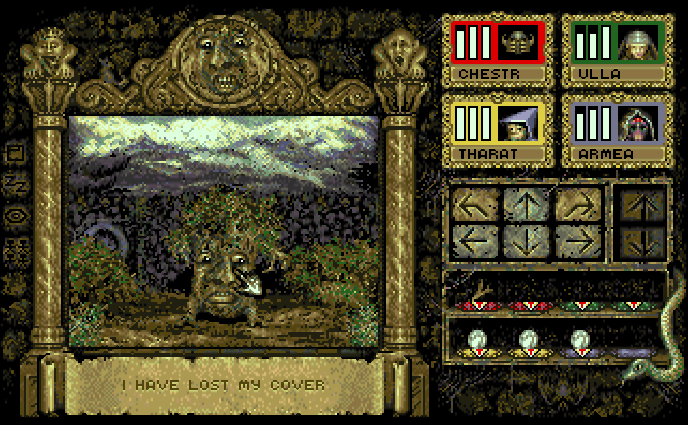
    
After a level of goofy-looking trolls and gnomes, this guy was a little terrifying.
    
Then, I faced the final enemy: some kind of troll blocking a corridor. He refused to budge, so no waltzing or door-crushing possible. After exhausting my missile weapons, I walked up and took him head-on. I had to retreat and heal a couple of times, but ultimately I killed him in regular combat.
     
This guy won't budge.
    
Just beyond the troll was a pressure plate. Stepping on it rewarded me of an image of a shield. The actual Shield of Justice was on the ground nearby, where a talking head said, "Well done! Quest One completed." Finally, a pit dumped me back in the forest. The game is clearly copying Chaos Strikes Back here, where finding every bit of Corbum Ore was followed by dropping through a pit to the starting area. There, the geography made sense, but here it doesn't.
     
It's a nice graphic, anyway.
    
Other notes:

  • Spellcasting is weird, probably because Captive didn't have a casting mechanic. You have to find wands specific to the spellcasting classes. When you first acquire them, you can only cast the most basic spells of that class. Practice allows you to cast higher-level spells. You can also vary the amount of power that goes into each spell, from 1 to 6. I find I'm only able to cast a few spells with each rear character before they need to rest. My rear characters spend most of the game not doing much of anything.
    
Setting the spell power and type.
   
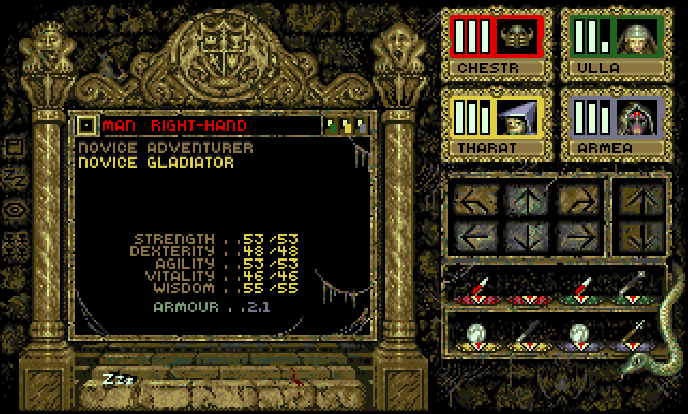
  • The more I think about it, the more I realize that Crowther pulled a fairly blatant ripoff of Dungeon Master for the character development system. Captive was clearly inspired by Dungeon Master but had a lot of its own mechanics; most of those are gone here, and the makers of Dungeon Master probably should have gotten a co-credit. In Captive, you had standard experience points that you spent on skills. In Knightmare, you advance in each of the game's classes as you use weapons and skills specific to those classes. Knightmare even copies Dungeon Master's hierarchy system: novice apprentice, adept, expert, and so forth.
   
My use of a variety of weapons has leveled me in several classes.
    
  • There is no economy in the game, and monsters generally don't drop anything at all.

I haven't tried yet, but I assume that the Shield of Justice is the "cover" that one of the trees is looking for, and the other two will be satisfied with the sword and cup. The final area will thus lead me to the crown, which makes sense because one of the squares in the outdoor area tells me to bring the crown there.

I really hope the puzzles get more complex in the rest of the quests, but perhaps buttons and pressure plates is all that this engine supports.

Time so far: 8 hours
Reload count: 8


Monday, November 7, 2016

Game 234: Knightmare (1991)

       
Knightmare
United Kingdom
Mindscape (developer and publisher)
Released in 1991 for Amiga and Atari ST
Date Started: 6 November 2016
    
We've seen it happen before and we'll see it again: A TV or film franchise is popular. Someone thinks it would make a good computer game. But time is of the essence--you have to catch fads while they're hot--so there probably isn't a lot of time to build an appropriate game engine from the ground up. A developer is contracted with a strict deadline. "Hey, why don't we re-use the Whatever engine that was so successful in Our Last Game?" they say. Boom. Three months later, you're playing Friends: The Official Game, which inexplicably has the six title characters repelling a demonic invasion of New York in the DOOM engine. ("Could you be any more dead?!" Chandler says every time he takes down a boss. It's funny the first time.)

Thus, when I first heard that Knightmare was both a) based on a British television show and b) was developed by Antony Crowther using his Captive engine, I was sure we had another such situation on our hands. I knew nothing about the plot of the TV show: I just couldn't imagine how it could possibly be served in the kind of plot-limited, Dungeon Master-inspired first-person gameplay featured in Captive.

Little did I realize that this is a rare case of the match-up making perfect sense. The original show takes place in a first-person view (for one player) and a quasi-first-person view for the rest. The Dungeon Master-inspired Captive engine, which already allows for a variety of navigation puzzles, probably works better than anything else available in 1991 to offer a combination of role-playing and puzzle-solving.

Having watched a few episodes of Knightmare (1987-1994) now, I first can't believe I'd never heard of the show before. It's a delightfully bizarre cross between a reality/contest show, a virtual reality experience, and live-action role playing. You have to watch it to do it justice, but the basic theme is that a team of 4 kids navigates a part-constructed, part-virtual reality dungeon, solves puzzles, slays monsters, casts spells, and whatnot, hoping to find a treasure. A host, named "Treguard of Dunshelm," sets up and moderates each episode, and other recurring "NPCs" occasionally appear to offer hints or challenge the players. Only one member of the team actually "navigates" the dungeon, wearing a "helmet" that restricts his or her view. The rest observe his or her progress and offer advice and encouragement. The quests are extremely hard, and in the eight-year history of the show, only eight teams won the game. 
   
A player tries to navigate around a cobra while his team members give him instructions on where to walk.
      
(As an aside, the kids on the show crack me up. I watched three episodes from different seasons, and I don't think a single one of them smiled or laughed the entire time. They were all deadly serious and somber, even when just stating their names and the towns they came from.)

The game manual similarly presents the party as composed of four English youths who have been camping and hiking all summer, hoping to find the way to Treguard's realm. Eventually, they come upon a portal that takes them to Dunshelm, where they are given a quest to retrieve four items--shield, sword, cup, and crown--from the castle's dungeons. Much as in Chaos Strikes Back, each item lies along a particular path with puzzles appropriate to one of the game's classes. Once the party has assembled all the items, they will use them to challenge Lord Fear and "banish him from this earth forever."
    
The introductory screens invite the player to a castle.
    
In creating a party of four characters, you choose one of 8 "breeds"--man, woman, goblin, ogre, ghoul, elf, troll, and insectole--and one of 6 classes--adventurer, gladiator, samurai, wizard, priest, and genie. Of the advantages and disadvantages of these breeds and classes, the manual tells you precisely nothing, nor does it attempt to reconcile such races with the backstory. You assign a name and title to each character, then select sex, breed, class, and dominant hand.
   
Character creation.
    
I went with a male adventurer, female samurai, an elf wizard, and an insectole priest. The game began!

I played Captive over two years ago (starting here) and left the impression that I didn't like it. It was the sort of game that's confusing on your first trip, and it wasn't until after I'd finished playing that I realized I liked it better than I thought and actually found myself missing it a bit, so I didn't approach this one with any kind of dread. The interface has been simplified--there are no "monitors" across the top of the screen, among other things--and this coupled with the medieval setting actually feels a bit more like Dungeon Master than the original Captive. The engine has been modified to allow more puzzles, and my understanding is the levels are all created by hand instead of procedurally-generated as in Captive. Even in the first area, it was clear that Knightmare allows more things in the environment than Captive.
   
Yes, I know some of you think it makes perfect sense that you take damage from walking into a bush. We'll never agree on this issue.
     
Unfortunately, just as in Captive, the party takes damage from walking into things, and there are more things in Knightmare's environment (like small bushes) that it looks like you ought to be able to move through. These bushes, I soon found, are used to create mazes in the outdoor areas.

Combat is much the same: each character has two hands and can hold a variety of weapons and magic wands or staves in those hands. Right-clicking activates the attack or item use. When you first find an item, the first time you right-click, the game asks what action you want to execute. It asks this even if there's only one possible action. You want to do this right away and not have the pop-up menu show up in combat. Annoyingly, every time you toss a throwing weapon, the action re-sets, so you have to specify it again every time you pick up and re-equip the weapons. As if picking up all your throwing weapons post-combat wasn't annoying enough.
    
The party fights some kind of troll thing with its fists after exhausting its balls.
    
The characters start the game with no equipment. The opening area was small and offered only a couple of faces in magic mirrors (or something), one of which said "Welcome to your knightmare" and the other said "return the crown here." Through a nearby portal, I found a cubbyhole with three balls that work like the superballs of Captive. Later, strewn across the ground, I found various items of "armor"--shirts, shorts, and sandals. This makes me wonder what my characters were wearing, if anything, when they went exploring in the first place.
     
My character assembles a basic outfit.
    
The opening area consisted of three small rectangles, 6-10 squares wide and 6-7 squares tall. They were connected by a track with a cart that moves automatically. I couldn't walk on the track itself and I took damage when I tried (was I hitting the third rail?). Exploring these areas meant jumping off the cart at strategic times in it's rapid back-and-forth movement.

There was one enemy in the area, some kind of troll thing. Just as in Captive, it's satisfying when enemies finally die in a puff of blood.

"Take this shortcut to the forest" a floating head said next to a portal. This led me to a much larger map, about 25 x 25. "Your quest starts here," a nearby head announced. At first, I was hemmed in by hedges, but a switch on a wall opened one of the hedge squares. A "twig" found near the entrance served as a crude weapon.
    
The forest. You start in the bottom-center.
    
The larger area was crawling with little gnomish creatures, flying tree heads, and little rabbits, the latter of which seemed non-hostile. As I explored, I found a couple of penknives to serve as better weapons.

Four exits from this area were blocked by living trees. After they thoroughly whomped me in combat (that I started), I realized that they're not even hostile. If you click on them, they talk. Lesson learned--don't just attack every creature on the screen. Each tree wanted something. "Have you seen my cup?" one asked. Another wanted his weapon, a third his "cover." None of these corresponded with items that I'd found.
    
      
The fourth said he was missing his "child." I tossed the twig at him and the tree disappeared, leaving a magic wand in his place. His disappearance unblocked a path to a portal. A nearby head announced that this was "Quest One, the Shield of Justice." I assume that on this quest path I'll find an object to give to the tree blocking Quest Two.
    
     
In the northeast corner of the map, I found an iron key. I nearly missed it; my colorblindness hurts me a bit in games with small items on top of such detailed features. Anyway, the key opens a door in the northwest corner, behind which three ogre-like creatures are lurking. They killed my party in a hot minute. I reloaded and tried combat-waltzing them, but one mistake led to the death of a character in one blow. I guess I'll save them for later.
   
I suppose this gate was probably closed for a reason.
     
When party members die, incidentally, their--yuck--hearts are left behind. I don't yet know if there's any way to raise them.
    
A gnome manages to kill two characters while I thought "pause" was active.
     
The manual for Knightmare is unforgivably sparse. In addition to not covering anything about races and classes, healing and resurrection, it doesn't indicate if there's any downside to resting or standing around (both of which, unlike in Captive, heal damage). It's very thin on how the magic and character development system work. Rather than offer skills and experience points as in Captive, the game seems to copy Dungeon Master by assigning skill levels to the various character classes and by leveling you up based on how you use those skills. Various weapons, wands, and staves are aspected to particular character classes.
   
My lead character has an adventurer and a gladiator level.
    
Finally, I'll note that after playing Fate, with its rich background sounds, Knightmare is a bit eerie in its silence. A jaunty tune based on the TV show theme plays when you first start the game, and there are sounds to accompany combat and accidentally walking into walls, but otherwise nothing. There won't be many more games that are so quiet during exploration.
    
The Quest One portal takes me into a more standard dungeon-looking terrain, and I suspect the puzzles there are going to get harder, so I'll leave off for now. It's not bad so far, but I wish I wasn't playing and mapping two large, first-person Amiga games at the same time.

Time so far: 3 hours