
 |
| The implications of requiring a hard drive didn't occur to me until now. This must have been a tragedy for C64 owners who'd enjoyed the previous three games. |
Pools of Darkness
United States
Strategic Simulations, Inc. (developer and publisher)
Released in 1991 for DOS, 1992 for Amiga and Macintosh, 1993 for PC-98
Date Started: 18 September 2016
Date Ended: 7 October 2016
Date Ended: 7 October 2016
Total Hours: 68
Difficulty: Hard (4/5)
Final Rating: 52
Ranking at Time of Posting: 211/228 (93%)
Ranking at Game #450: 436/450 (97%)
Ranking at Game #450: 436/450 (97%)
I feel like we've reached the end of something. Pools of Darkness is not the last Gold Box game, but it's the last of the original series--the last time we'll see Phlan and the Moonsea region. Names like Corymr and Hillsfar and Zhentil Keep won't appear again in CRPGs in our lifetime, unless I'm mistaken. (We will, of course, encounter Myth Drannor again, but that's better forgotten for now.)
Reflecting on the entire series, Secret of the Silver Blades seems the least "necessary" of the four; the appearance of Priam aside, there are the fewest plot ties to the other titles. It was important for character development and inventory (more on that below), but the cycle really could have been a trilogy. Between Pool of Radiance, Curse of the Azure Bonds, and Pools of Darkness, each title opens up more explorable area of the Moonsea and adds more to the "Banite" plot. I might even recommend that modern players approach it that way. You don't lose that much in the way of experience and character development; you'd hit encounters like the Cult of Moander, Myth Drannor, and Mulmaster while their prior references are fresh in your mind; and inventory acquisition in Pools would be much more meaningful.
 |
| Pools of Radiance let's you explore basically the northwest quadrant; Curse of the Azure Bonds takes place across most of the western half; this game doubles the map to the east. |
In an earlier post, I suggested that Pools might be the Gold Box game that finally surpasses Pool of Radiance in the GIMLET. I no longer think so. The primary problem with Pools is the lack of meaningful character development. In the first 10 levels of a first edition AD&D game, spellcasters learn most of the most valuable spells, fighters become notably more powerful and get a second attack, and clerics learn to turn just about every type of undead. The next 30 levels are boring by comparison. Sure, spellcasters get more and more slots and a few extra spell levels, but not enough to make a serious difference. In Pools of Radiance, each map might only have 3 or 4 safe resting spots, so you have to conserve spells in between and use every resource you have. In Pools of Darkness, each map has those same 3 or 4 resting spots, but this time you can't possibly cast even all of your "Delayed Blast Fireballs," let alone all your spells, before you have a chance to rest again.
Similarly, you gain very little in inventory development in Pools. I started the game with several +5 weapons and armor, but I think the highest I found in Pools was +4. For the most part, my characters ended the game with the same equipment they started with, excepting Vorpal Blades, Girdles of Giant Strength, and Boots of Speed, most of these items not appearing until the end of the final map.
Someone can correct me if I'm wrong, but I also think that this is the last time we'll see characters of this experience level in a D&D game. I think I got into the 20s in Throne of Bhaal, maybe around the same in all the expansions of Neverwinter Nights. Of course, in those games, high-leveled characters have a lot more to work with--feats and skills that don't exist in first edition AD&D--making them arguably more powerful. It's frankly bizarre that the game lets you get so high. Pool of Radiance is meant for Level 1-8 characers; Curse of the Azure Bonds caps out around Level 12; and Secret of the Silver Blades stops you at 15. If Pools of Darkness had ended at Level 20-22, it would have been enough to get into the highest spell levels but not so high as to create staggeringly overpowered characters. I guess the greater length required more levels.
I happened to watch Captain America: Civil War on a plane last night, and I began to think of parallels between the Avengers and my Pools of Darkness party. I thought about how eager everyone was to see us to a ship and send us to parts unknown. The game presents it as if it's some kind of reward, but in reality it seems like exile. But then again, what do you do with a bunch of Level 40 characters running around? My mages could level the city. Two of my fighters could defeat a phalanx of city guards. There are no Sokovia Accords in the Forgotten Realms. And my 6 characters aren't even all good by alignment (though none are evil). Perhaps it really was time for this group to retire.
This is particularly true when you consider that the party and its strength, in effect, caused the core crisis of the game. From the opening animations, it's clear that Bane is wreaking havoc on the Moonsea region specifically to punish the party for its previous successes. Like the Avengers with Ultron, we created our own enemy, and the world is paying the price. I'm not really fond of plots like this, where the world doesn't gain any net benefit and the heroes simply deal with a problem that they created.
 |
| Just a thought: maybe the powers of good should have stepped in now. |
I always like checking out the unused journal entries when I've completed a Gold Box game. There won't be many more of these. I counted 20 unused entries, but some of them might just have been entries that I didn't find. A couple were just nonsense tavern tales--one of them warning the party not to go through the "magical gates" because they deplete strength. Others hint at enemies that never show up--The Frostmaiden, the Red One, and some mysterious "rider in red." There's one fake entry that has Bane himself talking to the party, saying that the party is wasting its time defeating the lieutenants when in fact a "rider in red with a sword of flame" is the real enemy. Another tells the party to "seek out the Flaming Sword" to defeat Bane. Less obvious misleading stuff than in some of the earlier titles; there was probably a sense even among the "fake" journal entry authors that the journal's time was coming to an end.
Let's see how she rates:
1. Game World. In my final rating on Curse of the Azure Bonds, I discussed my basic problem with the Forgotten Realms, amounting to there not being any "there" there. For the era, the Moonsea is a reasonably well-defined place, with a variety of factions and each area steeped in lore. I liked all the call-backs to previous games and the ability to re-visit some memorable areas. On the other hand, as I note above, I didn't really care for the overall plot, particularly the end. Score: 6.
2. Character Creation and Development. Nothing new added in this installment except higher levels, which (as above) is a lot less rewarding than advancing in lower ones. Even dual-classing doesn't add much here because you get to Level 10 in the space of half a map. The title otherwise has the general AD&D and Gold Box strengths, although the level caps for non-human races become completely unworkable here. Pools seems to offer fewer encounters in which character race, sex, or class actually matters; the optional Dave's Challenge is the only place I can think of. Score: 6.
 |
| An end-of-game character sheet. |
3. NPC Interaction. There are some memorable NPCs--Nacacia, Shal, and Sasha stand out as "characters" more than any previous Gold Box denizens. I like the way that so many different NPCs can join you briefly for mini-quests and play out their own stories. On the other hand, the series refuses to advance at all when it comes to NPC dialogue and role-playing options. Score: 5.
 |
| The last we'll see of Sasha. |
4. Encounters and Foes. Again, we must reflect that the Gold Box series, in using the AD&D monster manual, is giving us a much greater variety of foes than just about any other title of the era. Practically every encounter is a mid-term exam that requires player to recall the strengths, weaknesses, and special attacks of the foes. (And as we saw, I often forgot some of them despite my experience with the titles.) There are a few original, high-level foes created just for this game. Many battles are preceded by some contextual text, which I always like. You can grind as much as you want. Oh, I found some of the enemies annoying, but really that's a minor complaint when you consider the breadth and depth of what's programmed here.
I'm sure the game has more monster types than any of its predecessors. The manual describes 40 monsters, the same as Secret of the Silver Blades, but it's missing a bunch, including 4 different types of vampires, wights, wraiths, all of the human enemies, and many of the animal enemies you fight outdoors and in Mulmaster at the end. This is the first time that I've noticed that the manual doesn't exhaustively catalogue every enemy in the game--did I just not check in previous titles?
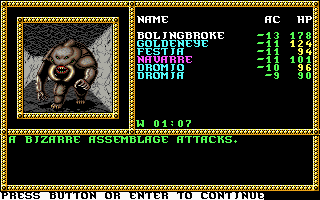 |
| A fitting pre-combat message. |
On the other hand, the series still hasn't managed to out-perform Pool of Radiance when it comes to non-combat encounters. When I think of true "role-playing" in the Gold Box series, I think of maps like the Zhentil outpost, the buccaneer base, or the lizard man village in the original game, where you could play the entire series of encounters in different ways depending on your preferred approach. I think of the final battle, where you can have your evil party members join Tyranthraxus. A handful of encounter options with gate guards and whatnot don't rise to that level of roleplaying. Score: 7.
5. Magic and Combat. In general, all of the strengths and weakness of the previous titles. I honestly love the Gold Box combat system, and I don't think I'll ever tire of it, but that doesn't mean I didn't tire of many of the battles. We've already talked in this series about how overpowered "Delayed Blast Fireball" is--and how it's almost impossible to force yourself not to use it regardless.
As many commenters have pointed out, combat in Pools of Darkness amounts largely to a "quick-draw" in which you have to hope you can blast a group of enemies with magic attacks before they blast you. Either way, combat is usually over within a few rounds. I miss the longer, grander battles of the early games in which making use of terrain, holding a line, concentrating physical attacks, exhausting all your spell options, and healing in battle really made a difference. (You could argue that the Moander battles meet these criteria, but the game ruins that by offering too many of them.)
One thing that I constantly wished for is the ability to revive unconscious characters and to cast "Resurrection" and "Stone to Flesh" in combat. That would have turned a lot of hopeless combats into real tactical challenges. I guess canonical spellcasting times would have made this impossible under AD&D rules.
All that said, the game is still significantly ahead of anything else in the era when it comes to the tactical nature of combat and spells in particular. Few other titles, before or after, can match Pools of Darkness in the variety, logistics, and utility of so many spells. For that alone, it deserves a high score, and nothing is going to surpass it until we get to an era of better enemy AI overall. Score: 7.
 |
| My party in the thick of the final battles. |
6. Equipment. The equipment system in general remains quite good in the Gold Box titles, and I appreciate the addition of helms to this outing. Melee weapons, missile weapons, ammunition, armor, rings, helms, boots, gauntlets, girdles all add to character development, and wands, potions, scrolls, and a few special items add to combat tactics. That said, this game offered fewer honest rewards than any of the previous Gold Box titles. I ended the game mostly equipped with the same items that I had at the end of Secret of the Silver Blades, which offered several +5 items, compared to what seemed to be a +4 cap in Pools. Making me wait until the last area of the last map to get a couple extra Boots of Speed and Girdles of Giant's Strength was a particular slap in the face. Score: 5.
 |
| My thief's inventory at the end of the game. |
7. Economy. I offered a double guest post on how much it "sucks," and I think that pretty well covers it. You only need to buy a few items (mostly Elixirs of Youth) in the game, and the developers could have saved everyone a lot of time by just making everything free. Score: 1.
8. Quests. Decent main quest. No opportunities for role-playing or alternate outcomes, but more than any previous title, we see a lot of optional areas and side quests. In fact, in general these side quests were better than the main plot. I particularly liked Myth Drannor and Dark Phlan, and it was fun to clear up little "pockets of evil" in between the marked places on the map. Score: 6.
9. Graphics, Sound, and Interface. The interface remains fantastic--supporting very intuitive keyboard, mouse, and joystick inputs. It's a model for others to follow. The graphics are getting dated. Although many of the cut scenes are well-composed and animated, the blank hallways and empty rooms are getting less defensible. The sound is probably the worst part of the game. Amidst a bunch of mediocre sound effects are a few that are so grating (the Wilhelm scream that accompanies the death of every enemy is the primary example) that I had to play most of the game with the sound off. Score: 5.
10. Gameplay. We had a little argument in my first post about whether the game is "linear." I maintain that it at least presents itself in a linear manner, meaning that you start in the northeast, end in the southeast, and there's an obvious sequence to your exploration by going counter-clockwise around the Moonsea. If you do that, you'll hit the main plot points in a sensible order (running right to the Moander dimension would be suicide, for example). I know that the game supports different orders, and indeed you can get quests from both underground Phlan and Arcam's tower if you don't approach things that way, but that doesn't change what 90% of players are going to do on a blind first run.
Still, given that there are some alternate dialogues and encounters to be found if you do things in a different order, that makes the game slightly replayable.
For difficulty, I rated it an average of "hard" above, which I don't mind, but what matters more than the average is the variance--and that, unfortunately, is quite significant. Deliberately nerfing characters by making them abandon their best equipment just before the hardest battles, and then removing spells--a huge part of the game--for the final battle are both a little hard to swallow. In general, the pacing is good, though I think it clocks in a little on the long side. Score: 4.
That give us a final rating of 52, not anywhere near the 65 I gave to Pool of Radiance, which I rated for a better story, better character development, better non-combat encounters, and a better (though still bad) economy. But it outperforms Secret of the Silver Blades (50) and puts the title in my top 10%. More important, it ends the overall series with honor. It's not a perfect game, but it's epic and ambitious and a worthy bearer of the Gold Box label.
My review aligns fairly well with Scorpia's December 1991 Computer Gaming World review. She disliked having to give up equipment at Limbo--calls it "idiocy," as a matter of fact--and has a lot of venom for the end of the game:
But aside from these flaws, she calls the title "otherwise the best in the Gold Box line to date." She loved the Moander portion.
Dragon gave it 5 stars on its usual scale of 5-5.
Amiga magazines, which always seem to favor graphics and sound over good RPG gameplay, were generally less charitable, offering scores in the 50s-80s (out of 100) on average. The worst comes from our old friends at Amiga Power (whose criminally incompetent review of Secret of the Silver Blades I covered in my final posting on that game). The reviewer, Dave Golder (a different one than the Secret reviewer) gave it 22/100. Among his complaints are a "plot so thin it makes Lena Zavaroni look like Mike McShane." This is a cringe-worthy simile, given that Ms. Zavaroni suffered from anorexia all her adult life and died in 1999, in part because of the disease. But it's also cringe-worthy because he clearly didn't play the game long enough to grasp the plot--he believes that it is "Lord Blane" (not kidding) who is jumping around using the Pools of Darkness. He complains about the speed of combat messages, apparently not bothering to note that you can slow it down, and the "sub-menus" of the interface. This is clearly someone who never played anything that wasn't an easily-controlled, first-person blobber (he praises Eye of the Beholder in the same review).
But the most mysterious comments are at the end: when you meet NPCs, he says, "you can't actually engage in a proper conversation with them, which goes completely against the spirit of role playing." I mean....okay, I guess I can't disagree, but what games was he playing in 1992 where you can have strong role-playing conversations with NPCs? I sure haven't run into them yet.
Despite Amiga Power's hope that this would be the last of the series, of course we still have Neverwinter Nights (1991), The Dark Queen of Krynn (1992), Treasures of the Savage Frontier (1992), and some Unlimited Adventures modules (1993) to check out. I'm sure I'll have a huge Gold Box retrospective some time next year, but for now, I'm sorry to be leaving the Moonsea for the last time. We had some unforgettable times in the Forgotten Realms.
 |
| I didn't take many screenshots of blank corridors even though they make up 80% of the game. This is supposed to be Gothmenes' "palace," and the text has to tell me that there's a pool in front of me. |
10. Gameplay. We had a little argument in my first post about whether the game is "linear." I maintain that it at least presents itself in a linear manner, meaning that you start in the northeast, end in the southeast, and there's an obvious sequence to your exploration by going counter-clockwise around the Moonsea. If you do that, you'll hit the main plot points in a sensible order (running right to the Moander dimension would be suicide, for example). I know that the game supports different orders, and indeed you can get quests from both underground Phlan and Arcam's tower if you don't approach things that way, but that doesn't change what 90% of players are going to do on a blind first run.
Still, given that there are some alternate dialogues and encounters to be found if you do things in a different order, that makes the game slightly replayable.
For difficulty, I rated it an average of "hard" above, which I don't mind, but what matters more than the average is the variance--and that, unfortunately, is quite significant. Deliberately nerfing characters by making them abandon their best equipment just before the hardest battles, and then removing spells--a huge part of the game--for the final battle are both a little hard to swallow. In general, the pacing is good, though I think it clocks in a little on the long side. Score: 4.
That give us a final rating of 52, not anywhere near the 65 I gave to Pool of Radiance, which I rated for a better story, better character development, better non-combat encounters, and a better (though still bad) economy. But it outperforms Secret of the Silver Blades (50) and puts the title in my top 10%. More important, it ends the overall series with honor. It's not a perfect game, but it's epic and ambitious and a worthy bearer of the Gold Box label.
 |
| This Drow woman featured prominently on the box cover and game ads doesn't actually appear in the game, unless she's one of the random Drow mooks in Kalistes' realm. |
My review aligns fairly well with Scorpia's December 1991 Computer Gaming World review. She disliked having to give up equipment at Limbo--calls it "idiocy," as a matter of fact--and has a lot of venom for the end of the game:
[Your party has] just finished a task whose proportions are almost immesurable, turning back, virtually single-handed, powers of darkness and defeating what is nothing less than a demi-god. What's the reward? Nothing. That's right, nothing... No cheering crowds, no banquets, no speeches not even a thank you. After all they've been through, there is nothing for your party to do except slip out quietly by ship, either for retirement or Dave's Challenge. What a downer!
But aside from these flaws, she calls the title "otherwise the best in the Gold Box line to date." She loved the Moander portion.
 |
| I'm still a little confused as to why we're just leaving. |
Dragon gave it 5 stars on its usual scale of 5-5.
Amiga magazines, which always seem to favor graphics and sound over good RPG gameplay, were generally less charitable, offering scores in the 50s-80s (out of 100) on average. The worst comes from our old friends at Amiga Power (whose criminally incompetent review of Secret of the Silver Blades I covered in my final posting on that game). The reviewer, Dave Golder (a different one than the Secret reviewer) gave it 22/100. Among his complaints are a "plot so thin it makes Lena Zavaroni look like Mike McShane." This is a cringe-worthy simile, given that Ms. Zavaroni suffered from anorexia all her adult life and died in 1999, in part because of the disease. But it's also cringe-worthy because he clearly didn't play the game long enough to grasp the plot--he believes that it is "Lord Blane" (not kidding) who is jumping around using the Pools of Darkness. He complains about the speed of combat messages, apparently not bothering to note that you can slow it down, and the "sub-menus" of the interface. This is clearly someone who never played anything that wasn't an easily-controlled, first-person blobber (he praises Eye of the Beholder in the same review).
But the most mysterious comments are at the end: when you meet NPCs, he says, "you can't actually engage in a proper conversation with them, which goes completely against the spirit of role playing." I mean....okay, I guess I can't disagree, but what games was he playing in 1992 where you can have strong role-playing conversations with NPCs? I sure haven't run into them yet.
Despite Amiga Power's hope that this would be the last of the series, of course we still have Neverwinter Nights (1991), The Dark Queen of Krynn (1992), Treasures of the Savage Frontier (1992), and some Unlimited Adventures modules (1993) to check out. I'm sure I'll have a huge Gold Box retrospective some time next year, but for now, I'm sorry to be leaving the Moonsea for the last time. We had some unforgettable times in the Forgotten Realms.


