Showing posts with label Champions of Krynn. Show all posts

Friday, September 6, 2013

Champions of Krynn: Final Rating

The flying citadel on the box is a bit of a spoiler.

Champions of Krynn
United States
Strategic Simulations, Inc. (Developer and Publisher)
Released 1990 for DOS, Amiga, Apple II, 1992 for PC-98
Date Started: 27 August 2013
Date Ended: 4 September 2013
Total Hours: 17
Difficulty: Easy-Moderate (2.5/5)
Final Rating: 56
Ranking at Time of Posting: 107/113 (95%)
Ranking at Game #403: 393/403 (98%)

Champions of Krynn is a good entry in a series that I've already blogged about fairly extensively, so this GIMLET isn't going to contribute worlds of new knowledge to our understanding of the Gold Box games. It makes effective use of a solid game engine, the lore and history of its campaign setting, and AD&D rules.

Because this game is essentially my only exposure to the Dragonlance campaign setting, it often felt very foreign to me, and it was always clear that Dragonlance fans (especially readers of the novels) would get more out of the game than casual players like me. Oddly, the game is probably more enjoyable to me in 2013 than it would have been in 1990, before I had the Internet to look up the characters and locations that the game uses. While this didn't make me go, "Wow! I'm actually adventuring alongside Tasslehoff Burrfoot! I'm never quitting this DOSBox session!," it did at least keep me from playing the entire game saying, "Who?"

The issue of difficulty was on my mind a lot as I played Krynn. The game strikes me as fundamentally too easy because, paradoxically, the battles are quite hard. When I played Pool of Radiance and Curse of the Azure Bonds, I adhered to my limited-save policy by which I saved at the entrance to each new map, but not after every combat or major event. This was the only way that I could preserve the edge-of-the-seat tactical tension of games like Wizardry and Might & Magic.

I started doing that with Krynn but soon realized it would be an exercise in frustration. The previous Gold Box games featured combats of relatively moderate difficulty (save for special examples, like the Beholder Corps), so there was a reasonable chance I could get through an entire map without having to lose my progress. Because Krynn's battles were so much harder, I realized I'd be tripling the time it took me to get through the game if I kept that save policy. So I did what almost every other player does and saved liberally throughout every map.

Doing so gave me a far different experience than I had with Pool or Curse. In those games, limited saving also meant limited resting, because I wasn't going to burn hit points and spells on random encounters unless I really needed the healing or the spell replenishment. I looked carefully for those rare spots in which the game told me it was safe to rest. In Krynn, on the other hand, I would take a chance on "Fixing" and sleeping in just about any corridor, and usually it was fine. As I discussed yesterday, the "Fix" command worked far more often than just sleeping, but even sleeping worked more often than it should have.

There's a special kind of challenge--a special kind of fun--that accompanies the navigation of foreign corridors at half your hit points and half your spells cast, when suddenly there's another attack by minotaurs, and you're carefully checking your spell and item inventories for anything that might help, because you've cast all your fireballs and lightning bolts and you've got one cure spell left and at least three people who need it. I missed that. I could have gotten it back by doing some tweaking, like setting the difficulty slider one setting lower and adopting a "save only twice per map" policy or something, but I'd rather the game didn't make me do such things. The Gold Box series could significantly ramp up the challenge by limiting either saves or rest breaks, and between the two, the latter makes the most sense. "Fix" shouldn't work where sleeping doesn't work, and you shouldn't be able to sleep except when you've cleared an area or have found a hidden location.

On a related note, an anonymous commenter had a good point a few days ago:

Your sentence about re-trying the fight with cold resistance spells memorized does sum up quite nicely what I dislike about AD&D2 magic. You can almost never react to a battle situation with minor spells without first casting power word: load.

I felt this more in Krynn than in previous Gold Box games. Most of the major fixed battles followed a predictable pattern for me: I'd first stumble upon them unaware, then get slaughtered, then reload and cast my buffing spells (including battle-specific protection spells) before trying again. It would be really nice if games didn't force you to break the illusion of continuity this way, perhaps by giving some alert that a major battle is about to happen in the next square. It's not like it's unrealistic. Chances are, if three dragons are milling around behind the next door, I'm going to be able to see something through the cracks.

I mean, honestly, how does this kind of thing happen as a surprise?

Aside from these minor complaints, the game was a lot of fun, and I expect it to do well on the GIMLET; I would expect it to come out slightly below Curse of the Azure Bonds, but not by much. In the review below, I'm including some intelligence I received via correspondence with developer Victor Penman.

1. Game World. Like the Forgotten Realms Gold Box games, it's hard to rate this area independently of the large mythos constructed by the books, gaming guides, and modules. What we can say is that the Dragonlance realm is certainly tighter than the Forgotten Realms setting, with a more cohesive history and more consistent characters. As I indicated in the first posting, to me it feels like it goes a little too far in the other direction. If we can fault the Forgotten Realms for being a confusing, inconsistent patchwork, we can perhaps fault Dragonlance for at times feeling a little too engineered.

The game itself does a decent job integrating itself with the Dragonlance mythology, something that developer Victor Penman tells me was strictly regulated by TSR--they required SSI to "faithfully adhere to the Krynn mythos." In general, the game made me feel that I was the protagonist and the canonical Heroes of the Lance were the supporting characters, though it did skirt the edge sometimes.

There was one notable regression from Pool and Curse: the overland map is meaningless. Unlike Pool (which featured similar movement), there is nothing to "discover" in the mountains and valleys of the map. Unlike Curse, there are no special encounters that take place only on the road. Unlike both, random encounters are few and far between. The game might as well have just given me a menu of places to go.

And so much of the travel is automatic anyway.

On the plus side, the series continues to do well by incorporating the events of the game into an evolving world. I fully expected that when I journeyed to Kernen after the end of the game, I'd encounter dragons and Draconians in the same way that in Pool of Radiance, I could keep returning to the castle to fight Tyranthraxus. But instead I found a group of knights sifting through the rubble, willing to pat me on the back and throw me a party. Tavern tales continually evolved to reflect the progress of the quest, and cleared areas remain cleared. It was so good, in fact, that when I tied up a cleric at one point after interrogating him, when I returned to the square hours later, I got a message that "a bound and gagged cleric glares at you." Score: 7.

And this after a battle with minotaurs outside the inn.

2. Character Creation and Development. Essentially, we can say the same thing about all games of this era based on AD&D: there is a satisfying but not earth-shattering level of customization during character creation; character progression happens often enough; and it's satisfying to watch the characters grow in spell and combat power. However, the games lack the customization of skills and abilities that we see in third-edition AD&D and in many other RPGs throughout the 1990s and 2000s. One solid advantage to Krynn over its predecessors is that characters gain experience even when they seek alternatives to combat; I just wish the game would tell you how much.

Krynn did have some changes from the previous games, predominantly in the introduction of the knight class, the associated promotion levels, and at least one quest (Sir Dargaard's tomb) in which the class really mattered. The clerical deities and division of mages into white and red were also new, though I can't say they added a lot to the gameplay. The moon phases and spell bonuses and penalties they conveyed added to tactical considerations. I didn't find the races to be significantly different from their Forgotten Realms counterparts. The game stripped evil alignments, but this seemed less like a real loss than an honest acknowledgement that it would make little sense to go through the plot in any meaningful way as an evil party. Score: 7.

Coral achieves her maximum level.

3. NPC Interaction. The game featured about the same NPC level as previous Gold Box titles, but (as usual) with no dialogue or role-playing options. The NPCs in Krynn had more interesting in-game stories than any we found in Pool or Curse--I'm thinking particularly of the ill-fated Sir Karl and his dragon girlfriend--but still not at the level where I felt any significant attachment. The "attitude" options (whether to parlay nice, haughty, sly, etc.) appeared less often than in the previous games, there were no hirelings, and you didn't even have the ability to reject NPCs who wanted to join the party (not that it would have made sense anyway). Altogether, I think the game's approach to NPCs was slightly less than Pool or Curse. Score: 5.

What's wrong with this description?

4.  Encounters and Foes. This category remains a strength of the Gold Box series. The menagerie of creatures is well-described in the game's documentation (and of course in plenty of other sources), and this is one of the few series of the era where knowledge of a foe's strengths and weaknesses radically changes your approach to combat. Of particular interest are the four Draconian species [Edit: As Victar points out, it's five], each with unique characteristics and special attacks. I really hated the Auraks, but in a good way--a way that recognized their unique challenge.

Mr. Penman told me that the development team faced a problem regarding the canonical monsters of the Dragonlance setting: "There were not enough monsters, of different levels, to give good challenges for all levels of parties." He says that TSR actually created new monsters "just so we could use them in the game," but overall the lack of a menagerie the size of Forgotten Realms Monster Manual was responsible for many of the issues I noted relating to combat balance. (He didn't specify which monsters were specifically created for Krynn, but my money is on "mobats" as one.)

The series also continues to show strengths in the numerous encounters, allowing the player to either avoid or pursue combat, to act slyly or bluntly, to favor brawn or intelligence, depending on his or her preference. A lot of the encounter options led to essentially the same outcomes, or offered choices between manifestly smart and dumb actions, but they still offered far more than most other RPGs. Such choices will become far more consequential in later games, and with a greater ability to really play a role, but they're still welcome here. Score: 7.

I'm not saying I agonized over this one, but it was nice to have the choice.

5. Magic and Combat. Yet another category for which it would make sense for me just to write a standard "Gold Box entry." I love the engine, it supports enjoyably tactical use of spells and melee attacks, and I could happily spend hours fireballing, lightning-bolting, and backstabbbing enemies. While the magic system doesn't break new ground, the list of spells is a good balance of offensive and defensive, and they must be used tactically to have a chance at victory. This game had harder combats than the previous two, but fewer large, long combats, which I missed a bit. I felt like too many combats in Krynn required "getting the jump" on the other party and wiping them out quickly, and fewer involved the types of long-term tactics that I loved in, say, the kobold battles in Pool of Radiance. Nonetheless, it remains an excellent combat engine and the primary reason to play a Gold Box game. Score: 7.

My Kender uses her "yell" ability, a new feature in this game.

6. Equipment. Another area that I could just copy and paste from my reviews of Pool or Curse. There are lots of weapons, armor, rings, girdles, gauntlets, wands, scrolls, bows, and other items to buy and find, and the game provides a solid "weapon upgrade" almost every map. The shop selection was smaller than in the previous games, but it's not like players were carefully weighing the choice between a glaive-guisarme and a guisarme-voulge anyway. I still don't like that the magic equipment all appeared in fixed positions, and there are no good item descriptions.

There were some small innovations in this game, such as the hoopak, the Solamnic plate, and the Dragonlance. I didn't miss ioun stones. Still no helms or boots. Score: 5.

Perhaps the best-equipped character I've ever had in any Gold Box game.

7. Economy. I've just entirely given up on the Gold Box series when it comes to this category. As usual, the game offered far more treasure than my characters needed for the few paltry things they could do with it. Training doesn't even cost anything in this game. The stupidity of "steel pieces" was balanced by the usefulness of the "vault," though I only ever made deposits. If it wasn't for the magic shops, there would be no reason to collect money at all, and the shops barely sold anything worth buying. (My characters are all going into Death Knights of Krynn with scores of arrows +1 and a few superfluous Wands of Magic Missile.)

I asked Mr. Penman about this, and he attributed this problem mostly to the AD&D rules, which gave experience rewards based on both enemy hit dice and the amount of treasure collected. Since TSR required SSI to use official rules for both experience and treasure, I guess I see how it went wrong, but I still think it should have been fixable somehow. My suspicion is that they just didn't consider it a problem. Penman somewhat brusquely told me that, "Following the rules and providing XP were our concerns, not what people spent money on." Score: 2.
 
8. Quests. The main quest of Krynn is more epic than the previous games, and perhaps a tad more confusing. I rather liked the low-key nature of the plots of Pool and Curse, in which you saved a city rather than the entire world, and I was sorry to see Krynn reverse this trend. Nonetheless, it's a decent story, well-framed within the Solamnic order, and I was never confused about what I was supposed to be doing. In addition to the main quest, the game had a few side quests, although I didn't realize they were side quests until I'd finished the game and looked at a walkthrough. Technically, the crypt of Sir Dargaard, the third outpost, the ogre base, and rescuing the slaves below Neraka were all optional. Score: 5.
 
Bit by bit, the quest unfolds.

9. Graphics, Sound, and Interface. The graphics are a little improved from the previous Gold Box games, which weren't so bad to begin with, with the exception of the bland and generic 3D-view corridors and rooms. We had pretty EGA cut scenes and animated monster portraits, and much better use of current sound hardware than I remember in Pool or Curse. The newly-installed mouse support made things worse, but it was easy to disable. Overall, I found the interface intuitive, but my complaints are still the same: unnecessarily having to choose "move" before moving in combat and having to re-select spells every time you go to memorize. I hear these elements get fixed later. Score: 6.

10. Gameplay. Krynn was much more linear than the previous games, though there were some minor choices in quest order during the mid-game. It was also shorter than the other two: 17 hours compared to 19 for Curse and 30 for Pool. I talked about the difficulty issues above; while I can't honestly say that they were worse in this game than the others, I did notice it more. It's "replayable" to the extent that different party combinations would alter the tactical challenge. Score: 5. 
 
This provides a final rating of 56, which is 4 points less than Curse (and 8 points less than Pool), but still my seventh highest-rated game. I swear, if any Gold Box game would simply retain Pool of Radiance's extensive side quests and nonlinearity, and then fix the economy, it would rocket to the top.
Since the ad mentions only Pool and Curse as previous SSI D&D games, I'm confident I'm playing the 1990 games in the right order.
 
Scorpia's review in the April 1990 Computer Gaming World is her usual mix of regurgitation of the manual, commentary, and blatant spoilers. She spends a lot of time complaining about how characters unconscious at the end of combat don't receive experience, which I agree is stupid, but it's been part of the game mechanic since Pool. She also complains a lot about how the Knights of Solamnia take away all the good equipment at the end of the game. Since I'm fairly accustomed to starting every sequel naked, I don't really see what the fuss is about. (Has there been a single sequel yet, other than The Bard's Tale II, in which equipment transfers from the first game?)

She has a good point that the copy protection system has you look at keywords from the journal entries, which you're not supposed to read ahead of time, but I didn't have a lot of trouble just counting the words while ignoring the text. Anyway, despite a review that mostly consists of complaints, she ends by saying, "actually, [it's] a pretty good game overall." Always one for le mot juste, that Scorpia.
 
MobyGames's round-up of both contemporary and current reviews suggests that it was regarded as a solid game in its own time and is remembered as a "classic" by modern reviewers. 

The SSI developers have always struck me as slightly more anonymous than those at other companies. You don't see names like Richard Garriott and Brian Fargo jump out from their credits; rather, they emphasize a "development team" and rely less on big personalities. In Krynn's credits, Victor Penman is the most prominent name, with sole credits as "project manager and developer" and "director" and co-credits as "original story" and "writing/dialogue/story," so it was to him that I chose to write, even though he credits Keith Brors and Paul Murray as the "creative and technical talents" behind the Gold Box games.

Penman's passion was wargames--in which, of course, SSI specialized--but by the late 1980s, the company thought that RPGs were the wave of the future and assigned Penman there. His history starts strong as one of two developers/designers for The Eternal Dagger (1987) and one of five developers on Pool of Radiance. Though he was almost absent (just "playtesting") from Curse of the Azure Bonds, but he comes in as the project manager for Secret of the Silver Blades, Death Knights of Krynn, and the two Buck Rogers games, and as the producer of Pools of Darkness. Basically, a lot of the Gold Box series games have his fingerprints. His last credited game is an action title called CyClones in 1994; since then, he's been a project manager on other software ventures.

The character on horseback on the hill announces the sequel.

I look forward to seeing how the Krynn saga continues in Death Knights of Krynn, but we'll have to wait until 1991. For now, after a brief return to the 1980s, I'm on to a dungeon-crawler called DarkSpyre.

Thursday, September 5, 2013

Champions of Krynn: Won!


When I wrapped up last time, I didn't realize I was as close to the end as I was. There were only three small maps and about half a dozen fixed battles.

Gold dragons had just delivered me to one of two skykeeps being operated by the forces of Myrtani. I battled my way through the first one, up a tower, and into a control room, where Tasslehoff took over the controls.


After a fight against some red dragons and Draconians, he crashed the skykeep into its sister.


We ended up in the courtyard of the other keep. The combined keeps were falling out of the sky, and our top priority was to get out of them. We worked our way downward and came upon a party of evil humans bickering about who was going to get off the keep first. We slaughtered them all and stole their uniforms. The game made a point of noting that since the enemy didn't have Kender among them, Tasslehoff and Coral would have to pretend to be prisoners.


When we reached the exit, a group of red dragons, noting our uniforms, gave us a ride down to the city of Kernen, where Myrtani had his headquarters.


I later read in a walkthrough that if I'd declined to put on the uniforms, I would have had to ride the skykeep down to the ground, suffering 30-180 hit points of damage per character (with no temple to raise anyone who died from this damage).

Wandering Kernen was fun. The main objective was to get through a gate into Myrtani's fortress, and I could do this by just charging the gate and fighting a horde of Draconians, or by slyly siphoning some of them away first. The game offered several opportunities to do this, including hooking up with my ogre allies...


...starting fires in Draconian barracks so that they'd be occupied fighting the fire...


...convincing a group of humans disillusioned with Myrtani's leadership to rebel...

I wonder what would have happened if I'd "warned the Draconians."

...and fooling an aged, senile red dragon into attacking the keep.


By the time I reached the gates, the guards had been reduced to a paltry group of one red dragon, one Sivak Draconian, and two Bozak Draconians.

There were a handful of other encounters in town in which my disguise fooled various human and Draconian parties, and I was awarded small amounts of experience for each successful deceit. Fortunately, one of the buildings in town contained a training barracks, or all the experience I'd been gaining since the Temple of Duerghast would have gone to waste.


One thing became clear as I explored the city, read the journal entries, and heard about the humans' (doomed) plot to overthrow Myrtani: Myrtani was a Draconian. I suppose this was obvious to everyone but me already. I don't know if I missed a key piece of intelligence earlier in the game, but I never heard it explicitly stated, and all of the screenshots that supposedly featured Myrtani also featured a bunch of other creatures so it wasn't possible to determine which one was him. For some reason, I had this idea that he was a human mage.


Once inside the keep, the battles increased in difficulty thanks to the appearance of Aurak Draconians. These bastards require a special strategy. If you don't damage them every round, they cast "Fire Shield" as their first spell. "Fire Shield" shrouds the caster in fire, and every attack against him returns double to the attacker. Since Auraks have permanent invisibility on them and thus cannot be targeted at range, once the fire shield goes up, the party either has to suck it up and take the damage (often resulting in death) or wait it out while the Aurak casts energy bolts and fireballs and uses self-immolation to damage everyone around him.

Once the Aurak dies the first time, he resurrects with 20 hit points and continues to use special attacks and melee attacks. When he's slain for the second time, he resurrects again, but this time invulnerable to all attacks for three rounds, at which point he explodes in a fireball. Fortunately, for most of the keep I had ogre allies with me, and they could take the brunt of the damage while my party members cleared out.

Sorry, Mr. Ogre. I'd warn you if the game gave me a mechanism to do that.

Thus, fighting Auraks is a process of killing their first two lives as quickly as possible, then trying to finish off their allies in the next three rounds so you can get away before they explode. I realized belatedly that "Detect Invisibility" probably would have allowed me to target them at range.

Myrtani's chambers had a trifling puzzle. To get by a "guardian" blocking the door to his inner chambers, I had to assemble a protective salve, first by finding a key in his bedroom, then using it to unlock a tome with the salve's recipe, then mixing the salve in an alchemy chamber. It didn't take long.


I lost my ogre allies when I broke into Myrtani's treasure vault and they began arguing over the treasure. It consisted of thousands of platinum, bronze, steel, and copper pieces that I would have had to be crazy to load myself up with. (Treasure weighs you down and reduces movement speed in combat.)

I feel like this is to make things more difficult for idiot players.

There were three difficult battles before the end. The first was with Myrtani's "Dragon Master," leading five red dragons. They wiped me out the first time, but after a re-load, I knew enough to cast "resist fire" on everyone before the battle. A hastened, blessed, high-level Dragonlance wielder is vital in this kind of battle, since he can theoretically kill four dragons in a single round.


The last two battles were back-to-back, first against Myrtani (an Aurak) and his Draconian allies, and second against three huge red dragons preparing to decimate the good armies. I lost both of these before I learned the proper combination of buffing spells and remembered I had a "Protection from Dragon Breath" scroll.

Buffed for the final battle.

Myrtani was as smug and obnoxious as all his underlings, pretending that my bringing the good armies to his doorstep was exactly what he wanted all along.


He had taken Maya prisoner after she foolishly attacked his base by herself, and he taunted me with her before attacking with three Sivaks (tough melee fighters), four Bozaks (spellcasters who explode for minor damage when slain), and five Baaz (pawns who turn to stone upon death and may trap your weapons). They seemed more immune to magic than the typical Draconian force, and my "Fireball" and "Ice Storm" spells didn't have the effect I'd hoped. But my buffed and hastened party was able to take everyone down with melee attacks and individual spell attacks eventually.


Afterwards, despite the fact that I saw him explode in the middle of the combat, Myrtani still had a smug death speech, indicating that the "messengers will still fly." The "messengers" were three large red dragons, whom I engaged before they could leave the base.

I don't really understand this plot point, but whatever.

I realized belatedly that since my leader, Midsummer, had the Dragonlance and the Scroll of Protection from Dragon's Breath active, she probably could have taken on all three dragons by herself while the rest of the party huddled in a corner. But it wasn't a big deal anyway. With "Resist Fire" active, all my characters could last at least one round, and I killed all three dragons with a combination of melee attacks, magic missiles, and lightning bolts.

They lined up just perfectly.

The endgame began with the least exciting message ever...

Not even an exclamation point?

...but then preceded to a more interesting group of screens and text, which in total, read:

The Solamnic knights arrive on dragon back. They land and bow before you. "You have prevented the destruction of our armies. Your valiant fighting and great wisdom are inspirations to us all."

"With the threat of evil abated in these lands, you can pass your responsibilities on to others. You may take a well deserved rest. You have given us the tools needed for the fight elsewhere."

You give your major items to the knights, to aid them in other battles.

Wait. What?
"Thank you again for your dedication to duty. You must accept these medallions. You are now members of the Special Solamnic Order of the Champions of Krynn. You will be honored in song and legend forever."

Maya is helped forward. She smiles. "I wanted to thank you personally for your heroism. You have honored the memory of Sir Karl. You are truly heroes."

In the distance beyond the cheering crowd is a single glowering figure. A whisper comes on the wind. "I am impressed. But do not think that this will help against me." Lord Soth turns and leaves. The knights fly you back to the outpost.

I guess the appearance of "Lord Soth" was supposed to be a bit of a shocking twist for Dragonlance fans, just like Thanos's cameo at the end of The Avengers was to Marvel fans. It was lost on me until I looked it up in the wiki and discovered that he's the epitome of the death knight, enemy of the Heroes of the Lance in the novels, who though evil is possessed with a sense of honor from his days as a Knight of Solamnia. He was so popular he apparently crossed into the Ravenloft setting for a time. I look forward to meeting him in Death Knights of Krynn.

I like that these knights aren't a bunch of stiff teetotalers like the paladins of the Forgotten Realms.

The game let me continue playing at this point, and I used the time to see if I was due any new levels (I wasn't), check out what equipment the game made me hand over to the knights (the Dragonlance, my Girdle of Giant Strength, both Gauntlets of Ogre Power, the Necklace of Missiles, several other things), identify the stuff I'd gathered in the keep, and I guess wander around and fight random encounters. I ended the game with all my characters one level below their maximums, which is good. I hate when I hit experience caps and feel like I'm fighting for nothing.

What I also like is that in the post-game wandering, the world acknowledges your victory and the changes you wrought on the landscape. There are parties in bars in the outposts, the commandants' offices have victory messages instead of quest logs, and if you take the time to haul your party all the way across the map to Kernen, the knights cleaning up the mess throw an impromptu celebration.

Note that there's no point to half the map.

As usual, I had fun reading the "false" journal entries at the end of the game. There were a lot of them that simply didn't make any sense; that suggested a context that never arose in the game, such as the party contemplating murdering the "odious minister" to a knight named Sir Era, and a whole series of them involving a vampire. There were a few meant to suggest that Maya was evil and had ensorcelled Sir Karl, and one that had the party "dooming" the outpost by killing the commandant. My favorite was this one, which would have led the player to make some horrible choices in Neraka:

As you work to free the slaves, their shackles seem to come off too easily. Before you can react, they whip out weapons and prepare to attack. One laughs, "The one you saw die before you was not Sir Karl, it was a Sivak. There are no slaves here. It was only a story to lure you to your doom. They begin to close in.

In general, there was a lot more disinformation in the fake entries than in the previous games, and any place in which the game offered a serious role-playing choice, there was a fake entry to mislead the player.

A few final notes before we wrap up:

  • Towards the end of the game, in contrast to my post a few days ago, my knights suddenly became a lot more effective. When they hit seventh level, they got two attacks per round, and both equipment and leveling upgrades put their THAC0s around 7 or 8. I think it would be a lot of fun--and a significant challenge--to replay the game with an all-knight party mowing through the enemies.
  • I think I said this in Curse of the Azure Bonds, too, but "Fix" and "Rest" clearly operate under different rules. In theory, "Fix" should just be a keyboard shortcut for memorizing all the "Cure [Whatever] Wounds" spells available, casting them, and re-memorizing the original spells. In practice, "Fix" usually works without any interruptions by enemy combats, even in the busiest places, when memorizing spells isn't otherwise remotely possible.
  • After I had won the game, I wanted to test the differences in the difficulty levels. The manual says that the level affects both the enemy's hit points and the experience you get for each battle, but in the few trials I attempted, it only affected hit points. Quite significantly, I should add: Myrtani had 27 hit points at "Novice" and 82 at "Champion." Anyway, the more interesting thing is that I apparently played the entire game on "Adept," the second-highest, despite the default supposedly being "Veteran," in the middle. I'm not sure how that happened.
  • Having two thieves was fantastic. I loved putting them opposite the same enemy; this virtually guaranteed a backstab each round.
  • I'm going to have an awfully cleric-heavy party going into the next game. Five of my six characters are capable of casting some level of clerical spells.

GIMLET time!


Tuesday, September 3, 2013

Champions of Krynn: We'll Keep on Fighting 'Til the End

This feels pretty epic for a first game in a series.

The city of Sanction ended up comprising three full map areas with multiple sub-areas. It was quite plot heavy and provided more magical treasure than the entire game so far.

Sanction had been fully taken over by Myrtani's forces, and the streets were crawling with mercenaries and minotaurs. A notice posted near the entrance advertised openings for "soldiers to wage the battle against the Solamnic usurpers of Krynnn" (this should have been the title of the game). I tangled with numerous minotaurs--they were hardy but not deadly; the battles were long rather than dangerous--before I learned I could get them to go away by parlaying "nice."

They seemed to arrange themselves perfectly for "Fireball."

The city had a training hall, a general store, and a magic shop that sold Wands of Magic Missile for 14,000 gold pieces. I liquidated some gems and jewels to buy a couple for my rear characters so that they'd have guaranteed-hit missile weapons. I've declined to complain about the horribly inflated economy in this game--it would just be redundant after my comments in Pool of Radiance and Curse of the Azure Bonds--but it says something that I happily paid the price instead of taking five minutes to go to Jelek and get them for less than 50% of what Sanction was charging. I wish the damned magic shops in this game would sell Wands of Fireball or Ice Storm (or, for that matter, Girdles of Giant Strength) instead. Those would be worth grinding for, though I guess they would probably unbalance the game.

I caught a couple of thieves trying to pick my pocket, and from them I learned that the evil troops were headquartered in the southwest corner. The headquarters was easy to find. When I arrived, the game told me that the party consisted of a "Dark Elf surrounded by fighters." I didn't realize that Dark Elves were part of the Dragonlance universe.

I hope that's not supposed to be the Dark Elf.

This was the first hint that I had somehow been playing into Myrtani's hands. Later journal entries suggested that Myrtani deliberately led the party on a wild goose chase after the Dragonlance so that they'd ignore Sir Lebaum's building of an undead army. That trope annoys me. Just once, I want to play a game where every time I defeat the evil villain's forces, he screams his rage at the sky and curses his luck that such an adept group of adventurers have decided to oppose him. I want his underlings to tell me that thanks to my ultra-effective questing, he's had to change all his plans and scale back his ambitions.

Anyway, after I defeated the evil troops, I chased the sounds of screams and found minotaurs dragging a woman into their barracks. I defeated all of them and learned from her that someone named "Laurana" sent her to check out the evil growing in Sanction. She said that dead bodies were being taken en masse to the nearby Temple of Duerghast and said I'd need to go through the tunnels of the Shadowpeople to get there.


(That one paragraph had me on the Dragonlance Wiki for a while, sorting out all of the related lore. Laurana turnes out to be Laurana Kanan, a Qualinesti elf, Hero of the Lance, and wife of Tanis Half-Elven. "Shadowpeople" are another name for the Shilo-Thahn, telepathic apelike creatures who live below Sanction and tried to stop the corruption of dragon eggs during the War of the Lance.)

She gave me a magic amulet that led me through a portal to the Temple of Huerzyd, a crumbling, dusty ruin beneath the city. Cutting through a few Draconian patrols, I made my way to some caverns, where a conclave of Shadowpeople contacted me mentally and told me that I could find the Dragonlance in the Temple of Duerghast, at the far end of the caves.

The mobats were pretty easy.

It was from the Shadowpeople that I first heard the term "death knight" and realized that's what Sir Lebaum was. I've been using phrases like "some kind of undead fallen knight" to describe him. I guess I should have put two and two together earlier, given that the second game is called Death Knights of Krynn.


The Temple of Duerghast was fun. First, I got the Dragonlance after a surprisingly easy battle against a handful of Draconians.

After all the trouble I went through on the last map, I figured the battle for the lance would involve more than eight Draconians.

Then, Skyla from Jelek showed up again, and I got to kill him.

He wasn't so smug a few minutes later.

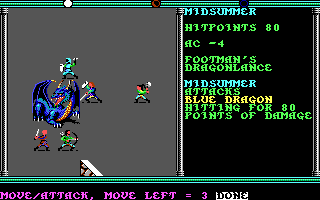
Then I got to use my new Dragonlance on a couple of blue dragons guarding a cache of copper dragon eggs. To dragons, the lance does as much damage as the current hit points of the wielder, so I gave it to my first knight, Midsummer, who has 80 of them.

I was just complaining in the last post about the dragons being too small. They got bigger just in time for me to get a weapon that kills them in one hit.

The culmination of the map was my confrontation with Sir Lebaum, the death knight. He was no pushover, capable of casting a fireball in a way that wasn't a "spell," so it couldn't be disrupted ahead of time. He gated in other undead and terrified everyone around him. Nonetheless, the fear didn't seem to affect me much, and his summoned undead fell easily to my clerics' turning. After all the build-up, I thought the battle with him was fairly abrupt and short.

You'd think that being an evil undead death knight would strip him of the "Sir" honorific.
 
The good armies showed up right after the battle, and gold dragons engaged red dragons in the sky. I had to fight a couple on the ground, too. At the end, the red dragons went buzzing back to their home base at Kernen, and the gold dragons asked me to jump aboard their backs and ride in pursuit. As we sped towards the enemy, we were joined by yet another Hero of the Lance, Tasslehoff Burrfoot.


When we reached the enemy base, it turned out to be a series of "flying citadels." The dragons landed on one of them long enough to let me off.


It feels like this is the end game area, especially since all of my characters are just one level from their maximums. I have to go on a long trip starting on Thursday, so I'm hoping to wrap this up before then. We'll see.

Monday, September 2, 2013

Champions of Krynn: No Bed of Roses

Karl's this 60-year-old guy and you're a silver dragon who looks like a gorgeous young elven maiden. It's Karl who would be embarrassed if the secret were revealed?

To recap the plot of the game, the War of the Lance has recently ended in victory for the good guys, but my party is among a group of Solamnic knights who have found evidence of a resurgence of evil in the northwest part of Ansalon. It seems that someone named Myrtani has re-discovered the methods necessary to corrupt good dragon eggs into Draconians and is raising an army. His ultimate aims are unknown, but he has a Dragonlance (a powerful weapon that can kill dragons) and one of his lieutenants is a possibly-undead fallen knight named Sir Lebaum. At the close of the last posting, I had been sent to an ogre base to see about an alliance between the good armies and the ogre king.

Yes, I actually take the time to use Adobe's text box tools to "check" the check boxes in the journal.

I arrived at the ogre base in the midst of a civil war. The ogre king, Gravnak, was contending with an upstart, Morog, who had hired a band of Draconian assassins to settle the conflict. As I explored the base, I ran into supporters of both contenders; those that supported Morog generally assumed that I was with the assassins and pointed me to their quarters.

Another role-playing choice. Do we slaughter the relatively defenseless ogre just because he's on the side of our enemy?

An encounter with an aged ogre led me to the locations where I could kill the Draconians and collect evidence implicating Morog. The Draconian battle gave me my first taste of combat with an Aurak Draconian, and I already hate them. You can't target them from a distance, they cast spells, they have breath and energy attacks that are not disruptable, and they come back to life twice after you've killed them. On their second resurrections, after a few rounds have passed, they explode into fireballs.

To be fair, I was making liberal use of my own fireballs.

After a long combat that nearly killed my party, I defeated the assassins. In another room, I killed some of Morog's allies and found documents implicating Morog. At the culmination of the map, I brought the evidence to a conference room where Morog and Gravnak were arguing.


The final battle, with half of the ogres fighting on my side, was relatively simple, but it made me remember how irksome it is to have a lot of allies on your side. You have to watch them dither around, trying to find a route to the enemy, for what seems like an eternity.

And most of them couldn't even get around me to reach the opposing side.

When I was done, King Gravnak ushered me into his office and offered an alliance to help defeat Myrtani. He said he'd come to my aid if I attacked Myrtani's base in Kernen.

I love the idea that a guy who wanders around in a loincloth has an "office" and speaks perfect English.

The next quest took me to an outpost of the Knights of Solamnia, from which a messenger had gone missing. From the moment I arrived, it was clear something squirrely was going on. The commandant refused to let me see the messenger, and every street had guard checkpoints where the guards demanded I leave. People stared at me in the street and guards kept stopping and checking up on me.

I KNEW it.

At last, I ran into a man wearing a tattered guard's uniform who told me what I already suspected: Draconians had conquered the outpost and imprisoned the real guards. The commandant was a Sivak Draconian (capable of altering their appearance), and most of the "guards" were soldiers of the enemy. The guard gave me a map indicating where the real guards were being held, including a secret door into the prison.


The guards in the prison refused to help until I released their children, being held hostage in one of the houses in the north. After slaughtering a secluded guard checkpoint, I freed the children, returned to the guards, freed them, and attacked the commandant in his office.

No one named "Jadefang" is good news.

The Draconian "commandant" wasn't very hard--he just had fighters with him--but in the room beyond, "Jadefang" turned out to be a green dragon, capable of breathing some heavy-damage poison. Fortunately, by this time my fighters were doing better with their THAC0s, and I was able to take him down in a single round. Oddly, the wizard who supposedly ran into this room never showed up in battle.


With the dragon slain, the real guards recovered control of the outpost. The game provided some nice touches to show the player effecting permanent change on the game world.


Overall, I liked the role-playing opportunities in this area. I could have just charged in swinging, attacking every guard post, like I did in the buccaneer base in Pool of Radiance, but I took the time to win the map through the more plot-heavy "stealth" method. As we've seen in other games like Dragon Wars, good role-playing choices aren't always about dialogue or single encounters, but rather about general approaches to maps and quests.

When I returned to the knights' outpost, I found it in near-ruins. Myrtani and his forces had led an attack on the place in my absence, and they had kidnapped Sir Karl. Maya was beside herself. Vowing to reclaim him, she asked if I would go with her to Neraka and help with the rescue.

What kind of player says "no" here?

While exploring Neraka, Maya never showed up in my party list, but she was always there at my back when combat began. The first such combat made clear what had been relatively obvious since Throtl: Maya was a silver dragon.

I'm just saying I wouldn't necessarily have revealed this secret for centipedes and rats.

Having her in the party was pretty useful. She had a high-level "Magic Missile" attack, did fantastic melee damage, and if I could get out of her way, her breath attack was devastating. In contrast to the NPC spellcasters in Pool of Radiance and Curse of the Azure Bonds, who didn't bother to check if any of the party members would be affected by their lightning bolts, fireballs, and cones of cold, Maya never breathed unless none of my characters were in the path.

Maya takes out a whole line of Draconians.

Neraka had two maps: a maze-like city and an underground prison. In the twisty passages of the city, I started to encounter desperate prisoners fleeing from Draconian patrols, and it was clear that the "Prison Lord" was running a Most Dangerous Game in the city. I defeated another green dragon in one of the city's rooms and plenty of groups of Draconians.

Bastards. I haven't lost The Game in months.

Finally arriving at the stairs down, I found a bloodied Sir Karl climbing up. He entreated me to rescue the prisoners below before dying. His last words were "remember me to Maya," apparently oblivious to the fact that Maya was right there with me. Grief-stricken, Maya collected his body and flew off.


The prison was full of more Draconians and guards, culminating in a battle with the Prison Lord, who was apparently Mola Ram:

"Drop them, Dr. Jones! They will be found. You won't!"

"Hold Person" made this battle relatively easy. After I defeated him, I explored the rest of the map and found one of the Heroes of the Lance from the books, Tanis, rescuing slaves. I joined him in defeating the rest of the enemy forces and freeing the captives.

I'll forgive you if you decide not to go with "Squirrel."

There were multiple rooms in the prisons in which slaves were being tortured, fed to animals, and suffering other unpleasantness. Every time I freed them, I got a special experience reward.

Note that there's no option to "Watch and Laugh."

In one of the cells, apparently occupied by Karl before his escape, I found a dead guard, a letter to Maya, and the silver rose that I'd obtained for him in Jelek. I admit this was a little sad.


There was a battle with two green dragons on the way out, but by now, killing dragons is basically a Tuesday afternoon.

Lots more notes:

  • I keep forgetting to mention the "area" maps. Mostly, I don't use them. They give you a sense of the surrounding terrain, but they don't track your own progress and they represent doors as walls. Theoretically, you can move via the maps instead of first-person view, but I'm hard-pressed to think of a reason why I would want to. Perhaps if I wasn't making my own maps. 


  • I'm trying to make greater use of bows in combat when it makes sense. However, I keep forgetting to un-equip them and re-equip melee weapons when necessary. I wish there was a faster way to do this.

&#$*&(@!

  • I thought I remembered that in Curse of the Azure Bonds, there was a "Center" command that you could use when targeting spells like "Fireball" so you could see which people on the screen would be affected. This command doesn't exist in this game, and I keep accidentally catching a character or two in the blast radius.
  • Dragons in this game are awfully small. They only take up two squares, suggesting they're about the size of two humans or a single ogre. In Curse and Pool, they took up four squares.
  • The game kept throwing centipedes and rats at me in Neraka. I'm not sure why. These enemies have an AC of 9, only 2 hit points, and they're so low-level that my fighters can wipe out 4 or 5 at once with the "sweep" attack. They were utterly unchallenging, and their presence was a bit of a mystery.
  • Here's a map of Neraka below. The Gold Box games always feature relentlessly bland first-person views of city streets and corridors, but usually the geography makes some sense. You can discern avenues, buildings, parks, and such. On this map, on the other hand, I have no idea what's going on. What would this twisty maze of corridors and rooms even look like in a "city"? Some kind of shanty town?


  • Intelligent enemies frequently "surrender" when I've killed most of their colleagues. I've always wondered what the game imagines that I do with them. Tie them up? Slit their throats? Accept their words of honor that they'll stay out of the battles to come?
  • But surrendering is far more preferable to the alternative: fleeing. There's nothing more annoying than an enemy who "flees in panic." He inevitably gets hung up in some corner, and I've got to chase him down. Since my characters are usually laden with equipment and money and enemies aren't, it takes me three or four rounds to catch up with them.

Stupid bat couldn't have just surrendered.

  • Still can't get enough of this:


  • I didn't realize until just before I wrapped up this entry that there's a vault, temple, and bar in every outpost. You access them from a "Next" menu option that I repeatedly overlooked. The vault helps a lot in storing my steel pieces and preventing me from being overweight.
  • Tavern tales in the outpost bars refer to recent events. For instance, when I returned from Neraka, they talked about the freeing of the slaves and the death of Sir Karl.
  • I'm finding the combats a little easier, but still challenging, now that I've increased a few levels and have both "Fireball" and "Lightning Bolt."

This never gets old.

The commandant who has replaced Karl has directed me to join the forces of good in an assault on the city of Sanction. Numerous journal entries and rumors suggest that Sanction is Myrtani's base of operations, that he took the Dragonlance there, and that Sir Lebaum is also headquartered there. For some reason, according to a couple of journal entries, Lebaum has bodies regularly delivered to him and prefers that their bones be intact. I can't wait to see what his secret is.

I don't even want to know who this note is directed to.