Showing posts sorted by relevance for query bloodwych. Sort by date Show all posts

Tuesday, August 21, 2012

Game 74: Bloodwych (1989)

I honestly don't know what this is, but it's the closest we get to a title screen.
       
Bloodwych
United Kingdom
Image Works (Mirrorsoft)
Released 1989 for Amiga, Atari ST, and DOS; 1990 for Amstrad CPC, Commodore 64, and ZX Spectrum
Date Started: 29 July 2012
     
In July, I attended ReaderCon in Burlington, Massachusetts, where every year they feature a "bad prose competition." They mostly draw their passages from science fiction and fantasy, but I wish I could convince them to include some selections from CRPGs. The Bloodwych manual introduces the game with all of the literary skill of a seven-year-old describing the plot of a movie to his mom:

You are one of the Bloodwych. You must take on the persona of one of the last sixteen champions of Trazere. You must first explore Treidwyl, recruiting more champions, and gathering items to aid your task. Once you are prepared you must get the four crystals of storing from the towers. Take them to the fifth tower and there destroy Zendick, and banish the Lord of Entropy to the realm of chaos. To do this you will have to defeat the agents of Zendick. The Lord of Entropy has transformed many of the citizens of Trazere into weird monsters, and twisted the minds of many into those of psychotic killers. Some of these citizens may aid you, but many will try to destroy you. Good luck in your mission, and remember the spirit of the Bloodwych is always with you.


Well. Glad we cleared that up. I think we're going to have our own "bad prose" competition on The CRPG Addict fairly soon.

Bloodwych's aspirations to be Dungeon Master are blatant from the outset. Where the earlier game began with a novelette by writer Nancy Holder, Bloodwych begins with a tract written by whatever Image Works intern displayed the greatest knowledge of Saturday morning cartoons. In it, we learn that there was once a "secret order of psychic mages" called...wait for it...the Bloodwych. Ruling from the city of Treihadwyl, they governed the land of Trazere in justice and peace. But one of them--you saw this coming--craved more power. This wizard, named Zendick, overthrew the Grand Dragon of the Bloodwych, cast his fellow mages into the astral plane, and summoned monsters to roam the once-peaceful streets. Now he seeks to summon the Lord of Entropy to unmake the universe so he can remake it in his own image. But somewhere in the astral plane, a couple of the Bloodwych have gotten their minds together and possessed one of the Champions of Trazere and are impelling him to recruit followers to defeat Zendick.

Thus, the game also copies Dungeon Master's odd framing device in which the on-screen characters are really being controlled or possessed by an off-screen mage. And, like the former game, you start by selecting pre-defined characters rather than rolling your own. There are 16 possible initial characters among four classes--fighters, mages, adventurers, and archers/assassins--with various inventories of items and spells, and various attributes of strength, intelligence, and charisma.

"Ulrich Sternaxe" sounds a lot like another name I've been hearing lately...

The characters are amusingly odd, including ones that look like an orc, a jawa, Wonder Woman, a lizard, and a skeleton. I nearly went with "Baldrick the Dung" who, despite his name and what appears to be a scrotum on his forehead...


...had the highest charisma, but ultimately I settled with "Eleanor of Avalon," who seemed like a well-rounded character. Whomever you choose, it appears that the other PCs are wandering around the starting area. Within moments after starting, I met the second guy in the top row, an orc-looking fighter named Astroth, and added him to my party.

Navigation and commands are also extremely similar to Dungeon Master, as you can see from the screenshots below, both offering battles with skeletons. The interface elements are in different locations, but both offer icons for moving and turning, combat and defense, and arranging party members information. There are status bars for each character's health, stamina, and magic.


Bloodwych has notably worse graphics and (at first glance) less complexity in combat tactics. You cannot assign individual fight commands to each character, for instance; you can only instruct everyone to fight. You also can't see each status for all characters; only one at a time.

At first, these "downgrades" from Dungeon Master had me longing for the earlier game, but slowly I started to encounter some of Bloodwych's unique charms. To start, there are actual NPCs and a dialogue system. As you encounter NPCs wandering around the dungeon, you can ask questions about locations and objects, and even recruit them to the party (at least, according to the manual, on the first level).

Slightly more advanced than "NAME! JOB! HEALTH!"

Second, the game has keyboard commands for movement, the lack of which was one of the things that bothered me most about Dungeon Master [Later edit: I misremembered; Dungeon Master had keyboard commands for movement. What bothered me was the lack of keyboard commands for other functions, like accessing inventory--something that hasn't changed in Bloodwych.] However, what it gains from these it loses from extremely small and numerous icons. This is not a game you can play on an airplane with your laptop's trackpad.

Third, you collect gold in the game, and the manual promises some sort of economy--again, something I found lacking in Dungeon Master.

Unfortunately, there are a number of things I already don't like. The sound, for instance. As far as I can tell, there isn't any--only music. The music is a relentlessly repeating passacaglia in some minor key that had me reaching for the mute button after only a few minutes. Neither combats nor opening doors produce any sound. I think it's a platform issue. I watched a quick YouTube video showing a C64 version with markedly worse graphics but some rudimentary sound.

In addition to the combat, the spell system is also significantly dumbed down from Dungeon Master. While spells do seem to be composed of a selection of runes, you can't choose them individually or experiment; you have to "know" the whole spell. You can, however, adjust the power of the spell before casting.

I haven't figured out what "magelock" does yet, but I suspect it locks doors.

In gameplay terms, I've explored the first level, killed a bunch of nameless monsters (like Dungeon Master, you don't get any clues as to the names of your foes), and collected a lot of treasure from bodies and alcoves. I've collected one NPC, but I know where there are more hanging around, and after I have a chance to evaluate them, I'll round out my party with four. I haven't seen any obvious level progression yet.

Fighting some guy who's not even facing me.

Much has been made in various online reviews about the two-player option in the game, which I admit is somewhat impressive. Two players can play cooperatively via a split-screen view in which the parties can see each other, fight the same monsters, trade equipment, and whatnot.

Two parties view each other with a skeleton in between.

The two players share the same keyboard: movement keys for the top party are on the right side and for the bottom party on the left side. Unfortunately, I can't figure out how to set it up so it recognizes a second mouse. I'd try harder, but I don't have anyone to play with anyway. That sounded sadder than I intended.

Before I go, I want to hypothesize the conversation that must have occurred amongst this group of mages.

Mage Leader: Well, we're a group of good mages who are going to rule the land in peace and justice. What shall we call ourselves?

Zendick: How about the BLOODwych?! Bwu-ha-ha-ha-ha!

Mage 2 (whispering to Mage 3): Do you think we're going to have problems with him later?


Monday, August 27, 2012

Bloodwych: Dead Ends

Nowhere left to go.

Shortly after the last time I blogged, I ran into a literal dead end with Bloodwych. Even after retracing my steps twice and sketching a crude map of the dungeon, I could only find one door I hadn't opened, and I couldn't find a key for that door.

I broke down and looked at an online map offered by a gentleman named Alan Chapman at one of the few online resources for Bloodwych. I'm glad I did, because that dead-end pictured above is actually supposed to be a set of stairs. This is apparently a well-known bug in the game (reader Leszek Wronski alluded to it on my first posting), called the "Welcome Back! bug" after a sign at the top of a nearby set of stairs. Owing to a certain dearth of solid material on Bloodwych online, it took me a while to solve. Someone had created a patch, but it only runs on 32-bit machines unless you use DOSBox, in which case you also need another file. I don't normally supply tech support on this blog, but for future readers who might come across this entry while having the same problem: you want to find the fix file called WBFIX.EXE somewhere online (it actually came with the version of Bloodwych I downloaded) and another file called CWSDPMI.EXE. Open DOSBox, run the latter first, then the former.

All of this raises the question about why I struggled so hard to fix a game I didn't really like when I had a perfect excuse to stop playing. The truth is, I took to heart the "RTFM" exchanges from back in March. The guy had a point. I bailed on the second two Bard's Tale games way too soon. I may not finish Bloodwych--it's extremely long and repetitive--but I want to make sure I fully explore it before I come to that decision.

Yesterday was an odd day. I've had a serious back pain problem for a few days, and since I didn't have to go anywhere yesterday, I loaded up on pain medication. In addition to doing a great job on my back, the medication made me disoriented and yet oddly obsessive about the task in front of me. I ended up playing Bloodwych for roughly 12 hours straight. I had nightmares about the game when I went to bed, and today I can't remember half of what I did.

Despite the investment of time, I didn't get very far: I explored one tower and recovered one of the five crystals I need to defeat Zendick. Halfway through the day, I began to seriously regret not mapping the levels, but I persisted in not mapping until the end. If I continue playing, I think I'll have to change my mind about this, as the levels are extremely complex, and missing a single item can cripple your progress.

20% done!

Character leveling was also very slow. When I began yesterday's gameplay, all four of my characters were Level 3. When I finished, three were Level 5 and one was Level 6. I can't imagine how slow it goes if you're playing in tandem with another player/party. I hate to keep comparing this game to Dungeon Master, but I miss the other game's leveling system, where you leveled up fairly regularly based on what skills you used rather than your starting class.

I do confess to some enjoyment of the equipment-based leveling. I like multi-character games in which there are several things to buy and wield, so that every hour or so, you find an upgraded pair of gloves, armor, a shield, or a weapon. Unlike in Dungeon Master, statistics make it immediately apparent how each item relates to the others.

Finding mithril plate is cool, even if it's a bit odd that my mage can wear it.

The game also follows Dungeon Master's tradition of telling you nothing about the foes you face--not even their names. Some are easily identifiable, of course--a dragon, a giant crab, a skeleton, and beholders among them--but I have no idea what some the humanoids are supposed to be.


Some of the foes encountered yesterday.

The culmination of the day was the achievement of the Serpent Crystal at the top of the Serpent Tower. Fighting my way to the top wasn't easy. First off, I rescind what I said yesterday about bobbing-and-weaving during combat as "quasi-cheating." When I said that, I was still capable of winning combats without resorting to such tactics. As I soon realized, simply standing face-to-face with most monsters is a death sentence, no matter how well-equipped you are, and no matter what tactics you use. The game seems to assume that you'll use guerilla-style combat to win most battles, and it occasionally has some fun with you by designing the levels in such a way that such combat is impossible. The entire top level was like that, with lots of  linear corridors, dead ends, and enemies coming from multiple directions. Surviving it took a lot of work, and yet I can't say it was "satisfying" work, because it relied on lots of luck and reloading rather than any real "tactics."

This wasn't nice.

When I left the Serpent Tower, I had a key to the Moon Tower, and thus settled on it as the next port of call. I took a 20-minute video illustrating various gameplay elements.


For those of you who don't like to watch narrated video, the major sections are:

1. Some introductory stuff and a tour of the interface.

2. Combat against a couple groups of beholders, illustrating the bob-and-weave method, how the resurrection room works, and what happens when you die.

3. Trying to sell excess items to shopkeepers. This process has been very frustrating, and they usually insult me rather than buy anything. I'm looking forward to getting the "alchemy" spell, which automatically converts extra items to gold. Gold is important because you need it to purchase new spells from the spell fairy every time you level up, and to buy potions from the occasional (actually, only one so far) potion shop.

4. Dispelling some illusory walls.

The only accessible room in the Moon Tower has a couple of gem-shaped receptacles on the walls, and I assume I need to fill these before I can progress forward. Unfortunately, I don't have any gems to put in them. Clearly, I overlooked them somewhere in the main tower or Serpent Tower, meaning I have to retrace my steps (and probably map this time) if I want to keep playing. I am seriously considering quitting on it, motivated primarily by Trudodyr's report that nothing really changes.

There are two lessons that I've learned the hard way:

1. Both "archers/assassins" and "adventurers" are kind of worthless. They both have lousy spell points (less than half of the mage) and also do lousy in combat (my fighter routinely scores hits in the 40-60 range while my adventurer rarely gets above 15). If I was starting over, I'd play with two fighters and two mages.

2. The CPU speed determines how quickly hit points, vitality, and spell points regenerate, but it also determines how quickly you get hungry. I used up all my food and was still starving before I thought to lower the DOSBox speed from the default of 3000 cycles to a more reasonable 700-800.

On the subject of dead ends, I've found through some of my research that Mirrorsoft, the company that produced Bloodwych (through its label, Image Works), has an interesting history. Headquartered in London, the company was a subsidiary of The Daily Mirror, a daily tabloid published since 1903. Mirrorsoft was founded as an educational software publisher, but its educational offerings were soon outstripped by its games, of which it published more than 50 between 1983 and 1991. Most are action games; Bloodwych is the only CRPG.

Mirrorsoft appears to have been the U.K. distributor for Dungeon Master, which partly explains the similarity in interface, although the company doesn't seem to have any ties to the specific developers. The developers of Bloodwych are collectively credited as TAG and seem to be Peter James and brothers Anthony Taglione and Philip Taglione. They created the original world of Trazere, in which Bloodwych and The Four Crystals of Trazere (AKA Legend) are set.

Bloodwych might have been better known if not for a financial scandal and collapse of Mirrorosoft following the death of Ian Robert Maxwell in 1991. Maxwell owned The Mirror, Mirrorsoft, several Scottish newspapers, several book companies (including Macmillan), and The New York Daily News. He was the Rubert Murdoch of his day. In 1991, however, he died under mysterious circumstances when he fell off his yacht off the Canary Islands. After his death, a former Israeli Mossad officer claimed that Maxwell had been an agent for the service, even while he served in the British parliament.

More important for our purposes, it came to light that he'd been embezzling money from his companies' pension funds and that his companies were under water in debt. By 1992, the media empire had collapsed, its subsidiaries sold to pay off debts. Mirrorsoft was sold to Acclaim Entertainment, which had its own credibility issues and went out of business in 2004. Taglione and James had just begun work on The Four Crystals of Trazere when Mirrorsoft collapsed, and apparently it wasn't far enough along to be part of the Acclaim deal. Instead, they pitched it to Mindscape, and it was accepted. I'll be playing that game in a couple of years.

Tomorrow, I'll make a decision whether to continue with Bloodwych or move on. There don't really seem to be any walkthroughs or full-length LPs online, so I have an urge to finish it just to document the ending. On the other hand, it really is excruciatingly boring, repetitive, and linear.

Tuesday, November 28, 2023

Game 499: Worlds of Legend: Son of the Empire (1993)

It was war last time, too.
       
Worlds of Legend: Son of the Empire
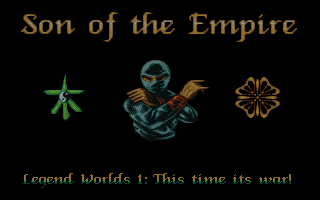
AKA Son of the Empire: Legend Worlds 1: This Time Its [sic] War! 
United Kingdom
Mindscape (developer and publisher)
Released 1993 for Amiga and DOS
Date Started: 19 November 2023 
     
Mindscape is one of my least favorite developers from this period. I say that with some sadness, because their games are always innovative. They just have a way of dragging on, getting too hard, and wearing me out. This is true of both the Anthony Crowther line (Captive, Knightmare, Liberation: Captive II) and the Anthony Taglione line represented in Bloodwych (1989), Legend (1992), and this game, meant to be the first in a line of Words of Legend titles.
 
(A quick note on the name: Both the game box and the manual give the title as Worlds of Legend: Son of the Empire, but the title screen, as you see, has the subtitle and main title reversed. My policy in such situations is to go with whichever title is most common among the three sources.)
      
This screen comes up while the game is loading.
       
Both Bloodwych and Legend are among the small percentage of games that I couldn't bring myself to finish. With both, I have occasionally toyed with the idea of trying again. Bloodwych was a superior Dungeon Master clone that featured a rare mechanism for cooperative two-person gameplay. Legend was an isometric game with a fascinating magic system. Both impressed me before, ultimately, exhausting me. I thus start this game in a pessimistic mood.
   
Bloodwych concerned the efforts of one or two parties to save the land of Trazere from the evil Zendick, a wizard who had seized control from the ruling council, called the Bloodwych. Legend--called The Four Crystals of Trazere in the U.S. release--has a party save the land of Trazere from the sorcerer king, Necrix. At the end of the game, the characters establish the Bloodwych, demonstrating that Legend is a prequel to Bloodwych
     
Even in a tavern, the barbarian doesn't put on a shirt and the assassin doesn't take off his mask.
       
Worlds of Legend lies somewhere in between, a sequel to a prequel. (Apropos of nothing, I was reminded the other day that the film The Scorpion King 4 is a sequel to a sequel to a prequel to a prequel to a sequel to a remake.) It adopts most of the mechanics of Legend, including the use of four defined characters: a barbarian, a runemaster, a troubadour, and an assassin. In Legend, these classes had been presented as coming from the north, south, west, and east, respectively. As the game begins, the victorious party is enjoying a drink in the "remote village of Brodfird" when a black-clad figure darkens the door. He brings a letter from the assassin's homeland, the Empire of the Moon. The assassin PC is apparently the son of the Emperor, who has just been assassinated. The letter comes from the emperor's sister and the PC's aunt, Sushiana. She begs the PC to return home to investigate. "I think that Ti-Mann MoChun is somehow connected," she writes; this is apparently the old emperor's sorcerer and aide.
         
Using an assassin to run an errand.
      
My party had actually consisted of four female PCs, named after New Orleans jazz musicians. You can import them into the game or create new characters. I have never seen a greater variance between imported and created characters in a sequel. The imported characters retain their levels (in my case, Level 7), attributes, gold, spells, runes, reagents, and inventories from Legend, and their hit points double. [Ed. All of this is true except for the inventories. You lose your inventory and get a basic set of starting gear. I wasn't paying attention.] New characters start at Level 1 with virtually nothing.
    
Either way, the party must consist of a berserker, a troubadour, an assassin, and a runemaster, each of which is restricted to specific weapons, armor, other items, and abilities. New characters have attributes (strength, intelligence, speed, dexterity, constitution, luck) fixed; the only things to change are names and sexes. You can also alter starting attributes by clicking on one of four buttons to indicate that the character is particularly attuned to earth, fire, air, water, or some combination of these. Each one raises some scores and lowers others; clicking on all of them results in the same statistics as if you had clicked on none of them.
     
Creating a new party.
       
The game begins at Sushiana's house in the city of Imperia, where she is happy that her nephew brought three friends to help. She suggests that the way to save the Empire is to bring her the four shards of the Eternal Amulet, which she can then reforge. In addition, Sushiana offers three services: the ability to rename characters, the ability to change their appearance ("reclothe"), and selling troubadour songs. I remember that "reclothing" was vital to my ability to actually discern my party members in the chaos of Legend's combat. As for learning songs, that's done in taverns in Legend, but the manual explains that taverns aren't as popular in the Empire. I still wonder why, given what's at stake, Sushiana won't teach us the songs for free.
      
The two lines of smoke from the incense in this scene are animated, as is the flag outside.
      
In the rest of Imperia, you can buy horses or "enter vaults." This last option has you threatened by Ti-Mann MoChun before you enter a two-level dungeon whose purpose, I can only imagine, is to get non-imported characters up to speed.
          
I guess there's no chance you were wrongfully accused, then.
         
The core of the gameplay takes place on these isometric planes that make up dungeon rooms. They look identical to those in Legend; as far as I can tell, nothing has changed in the interface or combat mechanics. You select an active character by clicking on his icon in the lower-left. You then select one of the commands on the bottom row or one of the icons in the lower-right to get the character to push something, take something, look at something, open something, shut something, use the character-specific tactic, use an item in the left hand, attack with the weapon in the right hand, or cast a spell. The fist (or whatever it is) causes the other party members to rally around the active character.
    
These combinations of commands are used for both combat and puzzle-solving, and the thing that I have difficulty remembering is that when targeting an enemy or object, you have to click the square at his base, not at the enemy or object directly. For instance, in the very first dungeon room, there's a notice posted to one of the pillars. Clicking on "Look" and then clicking on the notice directly causes nothing to happen; you have to click on "Look" and then the base square of the pillar to which the notice is attached.
    
The first dungeon room.
       
Combat is a chaotic free-for-all in which your party members act on their own except when given specific instructions. In my reviews of Legend, I made comparisons with the real-time-with-pause systems of Darklands and the Infinity Engine games (e.g., Baldur's Gate). But there are numerous problems with the system as implemented here, including an inability to see anything about your foes, even their names, so you have no idea which ones to prioritize. Pathfinding is also horrible, rendered worse by extremely crowded rooms, so it's hard to target a specific enemy unless you happen to be standing next to him already. 
    
With multiple foes on screen, I have difficulty telling enemies from characters.
     
The game is saved somewhat by its creative spell system, which I am going to have to re-learn. You mix spells by combining two types of runes: "director" runes and "effecter" runes. The latter specify what happens (e.g., healing, damage, teleportation) and the former specifies how the spell is cast (e.g., surrounding the caster, forward from the caster, as a missile that can go anywhere). Mixing a spell that uses "Surround-Healing" will heal all the people in the immediate area of the caster. "Target-Damage" is like a magic missile that streaks towards its target. But the particularly neat thing is that you can string together combinations of directors and effectors to create some spectacular effects, such as a targeted missile that itself spawns numerous missiles that fly in all directions, or a sequence that simultaneously casts every buffing spell on the party. In Legend, I admired these options but wasn't very good with them, and I ultimately quit playing when I simply couldn't survive any more combats no matter what tactics I used.
   
A new runemaster starts with only three runes--"Missile," "Damage," and "Healing"--which eases a new player into the system.  
     
A runemaster starts with various spells pre-mixed.
       
I'm not a fan of the interface. It essentially requires the mouse. There are keyboard backups for some actions, but they're relatively unintuitive. For instance, F1-F4 select the active character, which is fine, but F5-F10 control the actions at the bottom instead of more obvious selections like "L" for "Look" and "O" for "Open." The "ESC" key, which I'm always reaching for by accident, causes the party to engage in "flight" mode. "Pause" is mapped, for some reason, to the negative sign on the numberpad (and has no on-screen button, unlike most commands). There are no keyboard commands at all for two things that you want to do often: attacking and viewing the automap.
 
There are some passable sound effects--sword clangs, mostly--but you can't turn off music independently of sound, something that's basically unforgivable by 1993, so I'll be playing this one silent.
    
I played around in the dungeon for a while, reminding myself of the game's conventions. A sign at the entrance warned me that "fierce beasts" were roaming the halls of the imperial citadel. Decorations and furniture use Asian themes, such as taijitu (yin-yang symbols), little mini pagodas, and Buddha statues. You have to search every object in every room because any of them could contain treasures, including gold, weapon and armor upgrades, scrolls, potions, and keys necessary to progress in the dungeon. 
   
Each character has an inventory of 16 items, to include weapons, armor, boots, helms, and gloves. I remember that the equipment system was a good aspect of Legend and almost every few rooms, I got some kind of upgrade.
        
My early-game runemaster, carrying the bones of his slain companion.
       
I got frustrated with this game, though, when I lost one of my characters in the third combat despite healing him a couple of times. Given how much trouble I had with the predecessor, I'm tempted to use an imported party here, except that it feels like the imported party comes with far too many advantages, and I don't understand how the game could possibly be balanced. On the other hand, perhaps a little imbalance in my favor is what I'm looking for. I'm curious to hear the experiences of anyone who's played the game before I make a final decision.
   
Time so far: 1 hour
 

Friday, August 31, 2012

Bloodwych: More than I Wanted to Chew (Final Rating)

Note that the ad tells a slightly different back story than the game manual.

Bloodwych
United Kingdom
Image Works (Mirrorsoft)
Released 1989 for Amiga, Atari ST, and DOS; 1990 for Amstrad CPC, Commodore 64, and ZX Spectrum
Date Started: 29 July 2012
Date Abandoned; 31 August 2012
Total Hours: 21
Difficulty: Moderate-Hard (3.5/5)
Final Rating: 27
Ranking at Time of Posting: 42/66 (64%)
Raking at Game #455: 241/455 (53%)

All right, I'm going to spare us all and pull the plug. I'm prompted partly by an e-mail from a Bloodwych fan who estimates that I'm only about 20% through the game, mostly because "the Chaos Tower takes almost as long as all the other towers combined." I'm already into this game for 20 hours, and I honestly can't see putting another 80 into it. That would make my game time exceed even Rogue. You can't say I didn't give it a fair shake. The fan also told me that the rest of the five towers offer simply "more of the same," with some slightly more difficult puzzles. I've had enough of this unvarying gameplay.

Nothing significantly new happened since last time, so let's get to the GIMLET.

1. Game World. Bloodwych opens with the breathtakingly original plot of an evil sorcerer having taken over the land and summoning legions of demonic minions. The "world" in this case is the city/castle of Treidhadwyl, which is essentially a featureless dungeon. There is virtually no reference to the plot during the course of the game, making me wonder if the developers invented the back story after the game was developed. (Except for a final screen that I saw at the end of a YouTube video, it doesn't even appear that the word "Bloodwych" appears in-game.) The story is, in fact, such a carbon copy of Dungeon Master--right down to the champions being possessed or guided by the spirits of the exiled mages--that it nearly crosses the line from homage to plagiarism. I gave Dungeon Master a 6 in this category, but it had the whole order/chaos thing going on plus several in-game references to the plot. Score: 3.

Look at this screenshot from the ending. Shouldn't it be "THE Bloodwych ARE restored?" It's almost as if the game didn't know what "Bloodwych" was until the manual was written.

2. Character Creation and Development.  Like Dungeon Master (and I'm sorry to keep saying that, but it will happen again), you don't "create" your characters so much as simply select them. You don't even get the "reincarnation" option here, meaning you're stuck with the names and classes they start with. Leveling up is entirely within the class and seems to occur at odd intervals; it was maddeningly slow for the first half of my gameplay and more rapid after that; there is no progress meter or experience to indicate where you are in the leveling process. Leveling bestows attribute increases and an occasional new spell (the frequency of this is dependent on the class), but few choices on the part of the player. With different character choices, you'd have different levels of difficulty and perhaps some different tactics, but essentially the same game. Score: 3.

If I did have to play again, I'd play with Mr. Flay Sepulcrast. I understand he doesn't need to eat.

3. NPC Interaction. One improvement over Dungeon Master is that the game has NPCs, but they're not very good. You can theoretically ask any NPC, including monsters, about characters, objects, and lore, or trade with him or her. In practice, I never got them to tell me anything useful, and more than likely they'd start attacking me in the middle of the conversation, putting me at a tactical disadvantage. Except for the 16 potential starting characters, none of them even have names. I do have to give the game some credit for different disposition options (bragging, praising, insulting) and the ability to bribe and threaten NPCs, but in the end it doesn't amount to much. The interface was there for a decent NPC system, but the content wasn't. Score: 3.

...say the unidentifiable monsters just before attempting to slaughter me.

4. Encounters and Foes. Frustrating. The game doesn't bother to tell you the names of the monsters you fight, and I found the various humanoid monsters indistinguishable on visual inspection (my color-blindness might play a role here). Some of them cast spells, including an annoying "arc bolt" that goes around corners, but there's really no way to anticipate this until they start casting. There are no real "encounters" in the game, although I've taken to using this category to award points for puzzles, which is a kind-of encounter. Although these are basic, they do break the monotony a bit. Areas don't respawn, so there are no opportunities for grinding. Score: 3.

5. Magic and Combat. Combat is of the most basic sort. You wield weapons, enter "attack" mode, and start swinging. Your rear characters can't do much unless they have missile weapons, but if you're adept with the mouse, you can quickly swap positions to give lead characters a rest. There's a "defense" mode that you can theoretically use if you want to swap inventories or prepare spells, but I found that I usually died fairly quickly if I was trying to defend. Ultimately, the only viable combat technique is to use the terrain tactically to dance around your opponents and strike them at their flanks and rear. I found it tedious.

The magic system offers 32 spells grouped into four "schools." It's best to specialize in one or two schools because you can only get the higher-level spells after you've mastered some of the lower-level ones. I liked that you could adjust the power that you put into the spells, but overall I found them underwhelming. The buffing spells, even on high power, lasted only a couple of minutes, and you can only have one spell active at a time. Defensive spells take too long to prepare to be viable in the middle of combat. It never seemed to me that the offensive spells were doing much damage, even on max power. I never saw an enemy die from a spell, although I grant that I usually used them at the beginning of combat to soften them up. Finally, I didn't like that you were required to have two spells for the Moon Tower; since the game is linear and monsters don't respawn, failure to have the spells when you get to the right locations means that you have to start over. Score: 3.

Trying to cast a spell in the middle of combat often results in something unpleasant.

6. Equipment. As you progress, you find better weapons, armor, shields, gloves, rings, wands, potions, arrows, and food. It happens often enough that you feel suitably rewarded on a regular basis, and with the exception of some melee weapons, you can generally tell what items are best. It doesn't appear that there's any randomization to the items. The paucity of arrows throughout the game is a major problem, though, rendering the rear two characters useless most of the time. Score: 3.

7. Economy. Like the NPC category, I give the game credit for having an economy. It just isn't well implemented. You find gold on some NPC corpses, and I like that you can sell equipment (sometimes!) and use the "alchemy" spell to convert unneeded equipment to gold. I just never found much to buy with the gold. The weapons and armor shops never had better stuff than I had found, and while the potion shop was useful, I only ever found one and it was buried in an inconvenient part of the main tower. Even with the requirement to buy spells from the fairy on leveling up, I quit the game with nearly the maximum of gold in my backpacks (99 per character). Score: 3.

8. Quests. The game has a main quest; it's just boring and derivative. It progresses in five stages, as you collect the various gems from the various towers, and I guess there's a slight feeling of progress on the way, but not much. No side quests, no choices on the main quest. Score: 2.

9. Graphics, Sound, and Interface. Universally horrible. Again, my color-blindness may be playing a role, but I found the graphics confusing, ugly, and pixelated. I would have preferred the wire frames of Wizardry. There was nothing special about the sound effects, and since they're inseparable from the obnoxiously repeating music track, I left the sound off. I discussed my problems with the interface in an earlier posting. I find the buttons too small and inconveniently located, and the game requires too many clicks to perform simple actions. The keyboard is only good for some movement and saving the game. Some simple improvements, such as keeping the spellbook open to the last spell you used, or allowing the number keys to select characters, would have been welcome, but alas. Score: 1.

10. Gameplay. The gameplay is extremely linear and it lasts far, far too long. The need to find a bunch of keys--many of them virtually hidden in back corners--to progress makes it too easy to become a "walking dead" if you accidentally overlook or abandon a key. I couldn't imagine a single reason to replay the game after winning it once. Score: 1.

The game is at least consistent in its badeness. I ranked 7/10 categories at exactly 3, with a total of 25. However, we have to talk for a second about the multiplayer aspect of the game, which is remarkably innovative and, frankly, belonged in a better game.

Bloodwych is not the first game to feature cooperative multiplayer mode. The first I can recall is Zyll from 1984, followed by Swords of Glass in 1986. I find it odd and amusing that the only cooperative multiplayer CRPGs so far are comparatively obscure and not very good otherwise. Although I didn't have anyone to play with, I have to applaud the innovation that went into this addition to the game, and I'll award 2 bonus points for a true final score of 27. This still puts it in the lower tier of games (35% at the time of this posting).

Nonetheless, the game has a small but devoted cult following, and in preparing for this posting, I was astonished to find message boards full of players eager to try again with different characters or such. I find it a little baffling, but to each his own. There are several projects in the works to port the game to a new engine, and to make additional game levels using the original engine.

In Dungeons and Desktops, Matt Barton seems to agree with me, noting that: "[C]ritics mustered little praise for the game. Although the story and multiplayer options were admirable, the graphics were dull compared to Dungeon Master's, and the soundtrack was lamentable." But some contemporary reviews, especially in Europe, seemed to rank it quite high. I wonder if the version issue doesn't make a huge difference here. The game was big on the Amiga, and I can actually see where the game might be fun while played with a joystick next to a friend or sibling. Enough people liked it to support an expansion pack in 1990 (only for the Amiga and Atari ST, so I will not be partaking).

I can't find any full-length plays online. It looks like a YouTube user named jamesthebe [careful; some NSFW content there] got started with one, but gave up after 14 videos. Another user named ToricoUK, however, posted only the ending (only 36 seconds).

I assume that's Zendick.

Now, if you're frustrated that I ended this game too soon, take heart: the developers followed up with Hexx: Heresy of the Wizard, published by Psygnosis in 1994, which Wikipedia says was "basically the same game with updated graphics, a slightly modified cast of champions, and a greatly expanded magic system." We also have The Four Crystals of Trazere (1992) from the same developers, and ostensibly set in the same universe.

In 1993, Anthony Taglione gave an interview to an obscure U.K. gaming magazine called SynTax, in which he was frank about Bloodwych's origins in Dungeon Master. Recalling his time at a university in the late 1980s:

It just so happened that Dungeon Master appeared around this time on the ST and what a product that was! Three weeks later we'd played it to death, even taking just a party of short people. My own record is twelve hours with just two characters. I was talking with Mirrorsoft at the time and suggested that I could do a DM conversion for them on the C64. They ummed and arred a lot and Pete carried on drawing screens until they finally said 'Yes!' and I said 'No!  We've got a better design and it'll be two-player-simultaneous'. They said 'Ok but we want ST and Amiga as well'.

Throughout the rest of the article, he really does come off as a talented programmer, and I look forward to trying his later offerings.

For now, though, it's time to move on. I've decided to kick The Magic Candle down the list a bit and tackle it in December. Next up is Star Saga: Two!


Wednesday, August 29, 2012

Bloodwych: Inexplicably Still Eating

This was supposed to have been my clue to remove a blue gem from the Serpent Tower.

Continuing to play Bloodwych is a bit like eating something abominable--circus  peanuts, say, or those awful wasabi snack mixes they have at some bars--for no other reason than a bowl of it is sitting in front of you. In a meta-cognitive way, I'm fascinated by my refusal to give up on it. Two days ago, I thought it was just the drugs. Now, I don't know. I only know that some part of my brain wants to continue playing it. I think it's the same part that continues to click on links on Reddit when it's 3:00 A.M. and the rest of my brain is screaming, "WHY did you click another link?! It's time to GO TO BED! Seriously, just get up right now--NOW--and GO TO BED! AAAARGH! You just clicked on ANOTHER one! Are you trying to kill us?!" Only in the case of Bloodwych, my brain is screaming about The Magic Candle.

This was almost your last Bloodwych screen shot before The Magic Candle welcome screen.

Since my last posting, I've encountered about 12 moments in which I thought I simply couldn't progress any further--delighting the more rational half of my brain--only to discover a solution just as I was about to quit. I was about to give up on finding the gem needed for the Moon Tower when I finally discovered it back in the Serpent Tower. On Level 2 of the Moon Tower, I discovered the only way I hadn't gone was through a locked door for which I didn't have the key. I was about to give up when I remembered that Helm said "magelock" was needed in the Moon Tower. Sure enough, it worked on the door that no key would unlock (usually, doors that respond to "magelock" also respond to generic keys). Another impassable door was opened by a key that was practically invisible on the floor next to a pillar. I had the perfect excuse there, but no, I just had to go and search one last time.

The bronze key here is so invisible (just above my cursor) that I couldn't remember why I took this screenshot and I nearly deleted it.
 
As I progress, I'm naturally encountering tougher monsters, and they're getting wise to the bob-and-weave trick. They like to wait until I'm at the end of a narrow corridor to pounce on me, or to outflank me in multiple groups. It annoys me that I can't tell what any of them are called. They are getting graphically more interesting.

And terrifying.

Also as I progress, the game is starting to make things interesting with more complicated puzzles. "Interesting," mind you, in the same way that Wichita is more interesting on Friday night than Thursday. But you take what you can get. Many of these puzzles involve spinners, and while I normally see them as a trite and tiresome dungeon-crawling clichés, I have to admit that Bloodwych does them right. In most games, spinners occur at spots where it's immediately apparent that you've stepped on them by the screen going all wonky. You just have to consult your compass to navigate them. Bloodwych, on the other hand, strategically places them at spots in which the surrounding area looks same from both directions, and then compounds the difficulty by having the compass only last a few turns after you cast it. Clever bastards.

A lot of the puzzles involve buttons and pressure plates that lower walls and pillars. Here's a complex example from the Moon Tower, Level 3, combining pressure plates, pits, a spinner, and anti-magic zones.


The pit at point (1) is unavoidable. You have to have the "levitate" spell when you reach this point to get over it. If you don't have it, you're rather screwed, because monsters don't respawn, so there's no opportunity to grind and level up to acquire it. Helm alluded to this in a comment a few days ago. It seems a little unfair on the part of the game.

Crossing point (1) puts you on pressure plate (2) even if you're levitating, which closes the southern door. At this point, you need to exit the room via the northern door.  Unfortunately, squares (9) are all anti-magic squares, which kill the levitation spell.

"Levitate" fails just when I most need it.
To get through, you need to step on pressure plate (4), which lowers pillar (8), allowing you to get around to pressure plate (7), which lowers the pillar south of (6) (I forgot to number it). Pillar (6) itself is lowered by pressure plate (5). Complicating things is the spinner at (3), which keeps making you go in the wrong direction. Once all of the pillars are lowered, you can edge around to the pressure plate between (6) and (9), which at last closes the pit at (10). I'm not saying it's going to compete with Myst for puzzle difficulty, but it was the most complex thing so far and thus a welcome surprise.

This was the game's hint on this puzzle.
A few other things I think I've neglected to cover so far:

  • I had my archer/assassin in a melee position for a while, and I noted that he makes backstabs when the enemy's back is turned. He's not as useless as I thought.
  • You can easily tell the worth of a bit of armor by its effect on your armor class, but weapons are more difficult to evaluate. I assumed a mithril axe was better than a regular axe, of course, but then I found a "troll axe" and wasn't sure whether to dump my mithral axe or not. Tracking and averaging hit point damages seems like a little too much investment. I've also found a couple of wands and rings for which I'm  not sure what they do. In these things, it shares another similarity with Dungeon Master.

Equipping a new weapon. Note the armor class ranking below my inventory.

  • The number of points required to cast a spell decreases with each casting. Late yesterday, I finally got the "alchemy" spell and was able to convert unneeded equipment into piles of gold--no more rude shopkeepers. It started off requiring 15 spell points but after about 20 castings, it was down to 8.
  • As I said above, monsters don't respawn. Or, if they do, it takes a long, long time. Dungeon Master had a few areas with constant respawns where you could grind.
  • The game is inconsistent about whether foes can open doors. The best I can figure, they can open wooden doors but not metal doors and grates. This gives me some breathing room if I want to prepare some spells to fire off when the door opens. It's not a big exploit because they can step in the doorway quite easily and block you from closing it.
The party steels itself for the monsters beyond.
 
  • There are no "extra" areas. Virtually every room and corridor must be traversed to get to your objectives, which means that the game is almost completely linear.

Another gem recovered. Now to find the resurrection chamber.

Plot-wise, my word-count-to-playing-hours ratio is quite low. In about six hours of game time since the last posting, I ascended the Moon Tower and found the Moon Crystal. There were other illusory walls and button/pressure plate puzzles on the way. Not much else to say about it except that unless the last three towers are exceptionally easy, I'm about 40% done. I'm not going to spend all of the long weekend on this, though, so one way or another I'll wrap up this game by Saturday.


Saturday, May 26, 2018

Legend: Summary and Rating

           
Legend
United Kingdom
Mindscape (developer and publisher)
Released 1992 for Amiga, Atari ST, and DOS
Published in the United States as The Four Crystals of Trazere
Date Started: 7 April 2018
Date Ended: 21 May 2018 
Total Hours: 33
Difficulty: Hard (4/5)
Final Rating: 37
Ranking at time of posting: 221/290 (76%)

I really struggled over whether to quit this one. On the one hand, it was getting a little better. On the other, it was simply exhausting. Combats in Kilijan's Dark Tower became difficult enough that each one was a nail-biting fight to the death, requiring all my best tactics and spells, and even then I had to reload half of them. Most RPGs give you maybe 10 throw-away battles punctuated by the occasional significant battle. In Legend, none of the battles are throw-aways. A random encounter in a corridor you just cleared can absolutely destroy you, with enemies pouring in from all sides, a new one arriving to replace every one you've slain. I swear, some battles go on long enough that the game decides to generate a new random battle while you're still fighting the old one.

My inventory got so overloaded during the third level of the Dark Tower that I decided to make the journey back to the main map, with all of the random combats in between, to sell the excess goods, donate money at temples to restore luck, and level up. I did all of these things, then couldn't force myself to re-enter the tower and wind all the way back up. I sat on it for a couple of days. Finally, I decided I'd quit if someone else online had documented the endgame.
               
As far as I made it: the stairs going up to Level 4 of the Dark Tower.
            
My, has someone. Starting in November 2011, a YouTube member named Dzyu played the game over 102 videos, ending in May 2013. His videos were invaluable in documenting the endgame. (Another worthy LP series was started in June 2015 by FSSZilla, but as of her 83rd video in November 2017, she hadn't won.)

The Dark Tower turns out to be five levels. At the top, the player defeats Kilijan (who is immune to "Disrupt" and "Paralyze") and gets his magic staff, either keeping it or turning it in to the Ancient for a reward. Somewhere in the Dark Tower, the player finds a skull key that opens up Levels 3 and 4 of Fagranc. Once you clear those, you have to visit taverns to hear of the discovery of a "power gem" in the sewers of Balenhalm by some "ratmen." Balenhalm is a single large level.

Next up are two levels of Moonhenge in the northeast corner of the map. It provides the keys necessary to explore Levels 5 and 6 of Fagranc, which in turn provides the items necessary for the two levels of the Unshrine (which jumps around the map), where the party contends with Tetrahagael, the Chaos Lord. This is apparently an exceedingly difficult battle, as the Chaos Lord has magical protections (which you have to dispel), immunities, and very high hit point total. The Chaos Lord has the key necessary for the eighth and final level of Fagranc.

While exploring the dungeons, the party members also find the titular four crystals of Trazere, each of which boosts the defenses of one of the towers on the overland map. Between dungeons, the party has to reconquer cities seized by the enemy and provide gold to boost staffing at the towers.
      
This is the kind of statement that would make a robot's brain explode on the original Star Trek.
       
After delivering the fourth crystal, the party discovers that King Necrix himself is responsible for the evil taking hold in the land. ("Necrix" always sounded like a suspicious name.) The party must assault the king's fortress, fight up three levels, and slay him at the top. It took Dzyu over half a dozen attempts. Watching this part of the video gives you a sense of the complete chaos that is combat in this game. Even watching instead of playing, I can't tell what's happening most of the time. Spells are exploding all over the place, characters die in seconds. It's so crazy that in the fight where he finally kills the king, he doesn't even realize it for a few seconds.
          
A typical shot from the final battle.
            
Even after killing the king, Dzyu has enough trouble with the chaos beasts that he runs into an adjacent room hoping for better terrain, and in the midst of combat accidentally reads a sign--and unwittingly concludes the game. (To his credit, he recorded a final video in which he completed the combat before reading the sign.) He's clearly let down by the lack of denouement after so many hours ("I think I would have preferred at least some artwork"), but he remarks that he should have expected it given the sparsity of story throughout the game.
             
The winning screen.
        
The sign, of course, confirms Legend as a prequel to Bloodwych, the idea being that the Bloodwych now take over in the place of Necrix, reign peacefully for a while, and are then usurped by Zendick in the first game.
           
Dzyu's late-game spellbook.
       
Throughout the videos, Dzyu clearly enjoys the game for its spells. A late game screenshot shows his current recipe list, which I make out as:

1. "Missile-Disrupt-Disrupt-Disrupt-Damage-Damage-Damage." An all-purpose "blast the hell out of a targeted enemy" spell. "Disrupt" is more powerful than "Damage" but some enemies are immune to it, so I'm sure the goal here was to have a spell that would devastate anyone.

2. "Surround-Damage-Damage-Damage-Missile-Damage-Damage-Damage-Surround-Damage-Damage-Damage-Missile-Damage-Damage-Damage." This one is similar to my "fill the room with fire" spell, but jacked up to the maximum possibility.

3. "Heal-Heal-Heal-Continuous-Heal-Heal-Heal." The best I can figure, this immediately triple-heals the caster, then creates a square of healing magic in the room that other characters can walk or teleport into.

4. "Missile-Surround-Vivify-Heal-Heal." This allows the caster to resurrect any dead characters in a 9-square radius and then immediately heal them a bit.

5. "Regenerate." His only single-rune spell lets the caster regenerate quickly.

6. "Missile-Teleport-Speed." Allows the caster to send one of his colleagues to another place in the room and simultaneously give him extra attacks.

7. "Teleport-Regenerate-Speed-Antimagic-Surround-Teleport-Regenerate-Speed-Mystic Weapon-Antimagic." A kind of holistic pre-combat spell that gives each character the most important buffs and allows him to place himself anywhere in the room at the beginning of combat.

8. "Missile-Forward-Missile-Teleport." No idea. I'm guessing this was a solution to his last puzzle somehow. He doesn't have any of these mixed, which bolsters my hypothesis.

9 & 10. "Missile-Paralyze" and "Missile-Dispel." Both quick spells to affect a single target.

Analyzing some of the videos, "Teleport" is the real workhorse, and it makes sense that "Cloud" objects (rings, potions, wands, helms), which cast the spell, are vital to the party's success. They're the key to placing characters in strategic positions at the outset of combat, and to ensuring that the assassin is well-placed to use his backstabbing abilities. The spell also gets wounded characters out of combat and to healing squares.

My GIMLET combines both my experiences and what I observed in Dzyu's videos.

1. Game World. Neither the game world nor the story is well fleshed out, consisting primarily of allusions rather than real descriptions and sensible bits of lore. The game's "twist"--Necrix being the evil lord behind the invasion--doesn't really make any sense. Why didn't he undermine the "good" armies? Why did he send the party to Fagranc? It's too bad, because the connections to Bloodwych would be more meaningful if the story in either game made more sense. Score: 3.

2. Character Creation and Development. There are limited options during creation, and I feel that the number of levels achievable during the game (about 12) is a little low given the difficulty of combats. You have no choices while leveling up--you just get a random selection of stat upgrades. On the plus side, each of the four characters plays a pretty stark role. You can't just treat them all like fighters. You have to carefully equip and position them in ways that call on the strengths of their classes. I also like that the four classes--berserker, troubadour, assassin, and runemaster--are just a bit different than the standard fantasy RPG roster. Score: 4.
             
A late-game troubadour, from Dzyu's LP.
         
3. NPC Interaction. I'll give a point for a few people in the various towns, but really those are more part of the "encounters" or "economy" than true NPCs. Score: 1.

4. Encounters and Foes. As a somewhat non-visual person, it particularly annoys me when games don't name their monsters or use color to distinguish types or difficulty, and this game does both. The monsters in the game are a varied selection of humanoids and beasts, some of which do physical damage only, some of which are capable of magic, some of which have magical immunities and protections. I suspect it becomes important to note which is which, and I don't like having to fill notebooks with things like "bluish guy that looks like a minotaur--can self-teleport." 

The other aspect to "encounters" is the puzzles. I ran hot and cold, as I do with almost any game that features these sorts of mechanical puzzles (cf. DarkSpyre, Chaos Strikes Back). I thought some were too difficult and others offered the right level of challenge. They seem to get pretty crazy towards the endgame. Score: 4, but those who like puzzle-oriented games might boost this to a 6 or 7.

5. Magic and Combat. The magic system is obviously the highlight of the game, offering potentially thousands of creative combinations. I would love to have this type of spell system, maybe with a few more effects, coupled with a proper tactical combat system--either turn-based like the Gold Box games, or real-time-with-pause, like the Infinity Engine games.

The combat system actually offered in Legend has too few tactical options for non-spellcasters, is too chaotic and confusing, in too tightly-confined territories, with poor pathfinding and AI. It undermines most of the positives of the magic system. Score: 5.

6. Equipment. A positive that I probably didn't focus enough time on. Each character gets a variety of weapons, shields, armor, helms, gloves, boots, amulets, rings, wands, potions, and special items like the troubadour's various instruments. Upgrades are fairly regular. For regular weapons and armor, you can easily see their effects on your various statistics. For magic items, you have to experiment and study the effects (or take them to the Ancient for identification), but the totality of the items allows all characters to wield some magic and thus increases combat tactics. I also like that the available items in shops changed throughout the game, and that the treasures were randomized rather than fixed. Score: 6.

7. Economy. Another strong point. Between equipment, leveling, runes, reagents, donating at temples for "luck," and fortifying towers, money remains relevant until the end of the game. Score: 6.

8. Quests. There's a main quest with multiple stages, but I don't think there are "side quests." One of the stages, at least, gives you a single choice, but in general you're on a linear rail throughout the game. Score: 3.
           
You have to love "I shall kill you all myself . . . Guards!"
          
9. Graphics, Sound, and Interface. I rather like the oblique-angle graphics and the various dungeon scenes they create, and I didn't have any problems with the interface, which offers redundant mouse and keyboard options--with the exception of targeting (sometimes). Sound, on the other hand, is only serviceable, consisting of the "ding-ding-ding" of weapons while the same troubadour tune drones endlessly in the background. Score: 4.

10. Gameplay. Here's where it all falls apart by hitting every element of the Unholy Quartet: too linear, too hard, not replayable, and above all, too long. I'll give a point in this category in recognition of the outdoor map, which allows relatively free exploration between the dungeons. Score: 1.

That gives us a final score of 37, just above my "recommend to check out" threshold, but not quite all the way to "good."

Anthony Taglione, responsible for both this and Bloodwych, is clearly a talented programmer with some good ideas. Both games started with a popular base (Dungeon Master in the case of Bloodwych) but brought their own innovations. Neither Bloodwych's cooperative multiplayer nor Legend's magic system have anything quite like it among their predecessors. But both games commit the fatal sin of not knowing when to quit. Neither 1989 nor 1992 was ready for 100-hour games; the hardware and software of the time simply didn't support enough content. Even today, I regard a game that requires 100 hours with a jaundiced eye, although I have no trouble with games that allow for that length. I trust you can see the difference.

Of course, even given any memory- and space-based limitations, this small series is still pretty paltry when it comes to actual story. And both games reward dozens of hours of gameplay with a single screen of text at the endgame. I would have shared Mr. Dzyu's expectation for at least some artwork, particularly since Legend featured an animated introduction.

Computer Gaming World overlooked this one, but Dragon got to it and gave them an uncharacteristically-low 3/5 stars, calling it a "decent effort" with an original magic system but "limited character creation," confusing combat, and an unintuitive interface. European reviews mostly ran in the 80s and 90s (though the German Play Time gave it a 56). Unfortunately, I can't quote any of them because the site I use to find full-text magazines from the period is down. Given the light standards of journalistic integrity that we've seen in most European Amiga magazines, it's hard to imagine that many (if any) of them made it to the end before reviewing the game, and I feel that the interminable length and abrupt conclusion are key parts of the game.

We aren't done with the world of Trazere. 1993 will bring Worlds of Legend: Son of the Empire. Judging by the screenshots and game description, it is simply Legend with different maps, featuring a quasi-East Asian theme. In 1994, we'll face Hexx: Heresy of the Wizard, which appears to be an updated variant of Bloodwych. Those will be our last experiences with Mr. Taglione, as the other offerings from both him and co-designer Peter Owen-James are action and adventure titles (1993's Bram Stoker's Dracula, 1997's Alpha Storm).

We'll clean up a couple of 1988 offerings before getting to the next 1992 game, starting (maybe) with Seven Little Horrors, a bizarre German game from Motelsoft. I'm having trouble with the interface and have written to the publisher for help. If I can't figure it out in time for an entry, we'll move on to the easy-but-bland Talisman, a roguelike for the Atari 800.

*****

I was really looking forward to trying the first version of the long-running UnReal World. Released in 1992, version 1.00b is completely unrecognizable to a player of later versions, with a vastly different interface, different rules, and a high-fantasy setting (rather than real-world Finland). But I can't get it to run. I can run the character creation program and the world setup program, but the main program offers four options, each tied to a function key, and none of them activate. I've verified that the function keys work in DOSBox with other programs. If I can't get 1.00b to run, I have to wait until 1994 for the next major release.