
 |
| It was war last time, too. |
Worlds of Legend: Son of the Empire
AKA Son of the Empire: Legend Worlds 1: This Time Its [sic] War!
United Kingdom
Mindscape (developer and publisher)
Mindscape (developer and publisher)
Released 1993 for Amiga and DOS
Date Started: 19 November 2023 Mindscape is one of my least favorite developers from this period. I say that with some sadness, because their games are always innovative. They just have a way of dragging on, getting too hard, and wearing me out. This is true of both the Anthony Crowther line (Captive, Knightmare, Liberation: Captive II) and the Anthony Taglione line represented in Bloodwych (1989), Legend (1992), and this game, meant to be the first in a line of Words of Legend titles.
(A quick note on the name: Both the game box and the manual give the title as Worlds of Legend: Son of the Empire, but the title screen, as you see, has the subtitle and main title reversed. My policy in such situations is to go with whichever title is most common among the three sources.)
 |
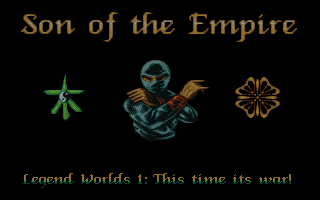
| This screen comes up while the game is loading. |
Both Bloodwych and Legend are among the small percentage of games that I couldn't bring myself to finish. With both, I have occasionally toyed with the idea of trying again. Bloodwych was a superior Dungeon Master clone that featured a rare mechanism for cooperative two-person gameplay. Legend was an isometric game with a fascinating magic system. Both impressed me before, ultimately, exhausting me. I thus start this game in a pessimistic mood.
Bloodwych concerned the efforts of one or two parties to save the land of Trazere from the evil Zendick, a wizard who had seized control from the ruling council, called the Bloodwych. Legend--called The Four Crystals of Trazere in the U.S. release--has a party save the land of Trazere from the sorcerer king, Necrix. At the end of the game, the characters establish the Bloodwych, demonstrating that Legend is a prequel to Bloodwych.
 |
| Even in a tavern, the barbarian doesn't put on a shirt and the assassin doesn't take off his mask. |
Worlds of Legend lies somewhere in between, a sequel to a prequel. (Apropos of nothing, I was reminded the other day that the film The Scorpion King 4 is a sequel to a sequel to a prequel to a prequel to a sequel to a remake.) It adopts most of the mechanics of Legend, including the use of four defined characters: a barbarian, a runemaster, a troubadour, and an assassin. In Legend, these classes had been presented as coming from the north, south, west, and east, respectively. As the game begins, the victorious party is enjoying a drink in the "remote village of Brodfird" when a black-clad figure darkens the door. He brings a letter from the assassin's homeland, the Empire of the Moon. The assassin PC is apparently the son of the Emperor, who has just been assassinated. The letter comes from the emperor's sister and the PC's aunt, Sushiana. She begs the PC to return home to investigate. "I think that Ti-Mann MoChun is somehow connected," she writes; this is apparently the old emperor's sorcerer and aide.
 |
| Using an assassin to run an errand. |
My party had actually consisted of four female PCs, named after New Orleans jazz musicians. You can import them into the game or create new characters. I have never seen a greater variance between imported and created characters in a sequel. The imported characters retain their levels (in my case, Level 7), attributes, gold, spells, runes, reagents, and inventories from Legend, and their hit points double. [Ed. All of this is true except for the inventories. You lose your inventory and get a basic set of starting gear. I wasn't paying attention.] New characters start at Level 1 with virtually nothing.
Either way, the party must consist of a berserker, a troubadour, an assassin, and a runemaster, each of which is restricted to specific weapons, armor, other items, and abilities. New characters have attributes (strength, intelligence, speed, dexterity, constitution, luck) fixed; the only things to change are names and sexes. You can also alter starting attributes by clicking on one of four buttons to indicate that the character is particularly attuned to earth, fire, air, water, or some combination of these. Each one raises some scores and lowers others; clicking on all of them results in the same statistics as if you had clicked on none of them.
 |
| Creating a new party. |
The game begins at Sushiana's house in the city of Imperia, where she is happy that her nephew brought three friends to help. She suggests that the way to save the Empire is to bring her the four shards of the Eternal Amulet, which she can then reforge. In addition, Sushiana offers three services: the ability to rename characters, the ability to change their appearance ("reclothe"), and selling troubadour songs. I remember that "reclothing" was vital to my ability to actually discern my party members in the chaos of Legend's combat. As for learning songs, that's done in taverns in Legend, but the manual explains that taverns aren't as popular in the Empire. I still wonder why, given what's at stake, Sushiana won't teach us the songs for free.
 |
| The two lines of smoke from the incense in this scene are animated, as is the flag outside. |
In the rest of Imperia, you can buy horses or "enter vaults." This last option has you threatened by Ti-Mann MoChun before you enter a two-level dungeon whose purpose, I can only imagine, is to get non-imported characters up to speed.
 |
| I guess there's no chance you were wrongfully accused, then. |
The core of the gameplay takes place on these isometric planes that make up dungeon rooms. They look identical to those in Legend; as far as I can tell, nothing has changed in the interface or combat mechanics. You select an active character by clicking on his icon in the lower-left. You then select one of the commands on the bottom row or one of the icons in the lower-right to get the character to push something, take something, look at something, open something, shut something, use the character-specific tactic, use an item in the left hand, attack with the weapon in the right hand, or cast a spell. The fist (or whatever it is) causes the other party members to rally around the active character.
These combinations of commands are used for both combat and puzzle-solving, and the thing that I have difficulty remembering is that when targeting an enemy or object, you have to click the square at his base, not at the enemy or object directly. For instance, in the very first dungeon room, there's a notice posted to one of the pillars. Clicking on "Look" and then clicking on the notice directly causes nothing to happen; you have to click on "Look" and then the base square of the pillar to which the notice is attached.
 |
| The first dungeon room. |
Combat is a chaotic free-for-all in which your party members act on their own except when given specific instructions. In my reviews of Legend, I made comparisons with the real-time-with-pause systems of Darklands and the Infinity Engine games (e.g., Baldur's Gate). But there are numerous problems with the system as implemented here, including an inability to see anything about your foes, even their names, so you have no idea which ones to prioritize. Pathfinding is also horrible, rendered worse by extremely crowded rooms, so it's hard to target a specific enemy unless you happen to be standing next to him already.
 |
| With multiple foes on screen, I have difficulty telling enemies from characters. |
The game is saved somewhat by its creative spell system, which I am going to have to re-learn. You mix spells by combining two types of runes: "director" runes and "effecter" runes. The latter specify what happens (e.g., healing, damage, teleportation) and the former specifies how the spell is cast (e.g., surrounding the caster, forward from the caster, as a missile that can go anywhere). Mixing a spell that uses "Surround-Healing" will heal all the people in the immediate area of the caster. "Target-Damage" is like a magic missile that streaks towards its target. But the particularly neat thing is that you can string together combinations of directors and effectors to create some spectacular effects, such as a targeted missile that itself spawns numerous missiles that fly in all directions, or a sequence that simultaneously casts every buffing spell on the party. In Legend, I admired these options but wasn't very good with them, and I ultimately quit playing when I simply couldn't survive any more combats no matter what tactics I used.
A new runemaster starts with only three runes--"Missile," "Damage," and "Healing"--which eases a new player into the system.
 |
| A runemaster starts with various spells pre-mixed. |
I'm not a fan of the interface. It essentially requires the mouse. There are keyboard backups for some actions, but they're relatively unintuitive. For instance, F1-F4 select the active character, which is fine, but F5-F10 control the actions at the bottom instead of more obvious selections like "L" for "Look" and "O" for "Open." The "ESC" key, which I'm always reaching for by accident, causes the party to engage in "flight" mode. "Pause" is mapped, for some reason, to the negative sign on the numberpad (and has no on-screen button, unlike most commands). There are no keyboard commands at all for two things that you want to do often: attacking and viewing the automap.
There are some passable sound effects--sword clangs, mostly--but you can't turn off music independently of sound, something that's basically unforgivable by 1993, so I'll be playing this one silent.
I played around in the dungeon for a while, reminding myself of the game's conventions. A sign at the entrance warned me that "fierce beasts" were roaming the halls of the imperial citadel. Decorations and furniture use Asian themes, such as taijitu (yin-yang symbols), little mini pagodas, and Buddha statues. You have to search every object in every room because any of them could contain treasures, including gold, weapon and armor upgrades, scrolls, potions, and keys necessary to progress in the dungeon.
Each character has an inventory of 16 items, to include weapons, armor, boots, helms, and gloves. I remember that the equipment system was a good aspect of Legend and almost every few rooms, I got some kind of upgrade.
 |
| My early-game runemaster, carrying the bones of his slain companion. |
I got frustrated with this game, though, when I lost one of my characters in the third combat despite healing him a couple of times. Given how much trouble I had with the predecessor, I'm tempted to use an imported party here, except that it feels like the imported party comes with far too many advantages, and I don't understand how the game could possibly be balanced. On the other hand, perhaps a little imbalance in my favor is what I'm looking for. I'm curious to hear the experiences of anyone who's played the game before I make a final decision.
Time so far: 1 hour


Wait, there were four(!) parts of 'The Scorpion King'?
ReplyDeleteAnd you bothered to watch them all?!
Ha, I had exactly the same thought. There's apparently *five* parts, although the fifth one was straight-to-video so a sure fire sign of quality!
DeleteI didn't say I watched it. I'm just aware of it.
Delete3, 4, and 5 are all hilariously bad low budget efforts. I have no idea why they were made
DeleteThere must be something to the really bad low budget movie scene... The Asylum either makes some money or gets the goods on tax dodges one!
DeleteI understand 100% that you question yourself whether to import the characters from the previous opus.
ReplyDeleteNow close the eyes and try to remember your experience of Legends... the 4 characters running in all directions without pause, the random encounters in rooms you had cleared that could wipe your parties,... the random encounters jumping on you while you were STILL fighting the previous encounters... the spells that were great on paper but never hit their targets properly... the random deaths... the savescumming...
Now reopen the eyes and look at this opus. Does it look like ANY of those issues was solved?
At this point, this question should be answered.
Make sure to check that importing a party does not balance opposition upward, though.
Alternate solution :
DeleteGive up this game, take a nice flight to Nice (France), then drive less than two hours to the real-world city of Imperia (Italy).
:D
Narwhal makes a compelling argument. My only counter is that I like the process of slow character improvement in RPGs (including finding equipment), so when an imported party is over-leveled, I cheat myself out of the only aspect of gaming that I really enjoy.
DeleteThis review on mobygames states that if you import your party, "the game is made harder", though it's not entirely clear to me this should be the case due to actual level-scaling which Narwhal above warned to check for - the reviewer just writes "no wandering around idly slaughtering millions of monsters".
DeletePerhaps more reliably, the 'Adventurer's Handbook' for the game (v1.4), a full solution written by a former tester of WoL, indicates: "By far the best advice is to import a successful party from 'Legend' if you can." For the reasons mentioned by Narwhal this sounds reasonable to me, too. Regarding character development, the same paragraph seems to indicate there is still enough room for imported parties (though of course you don't have the initial low-level progression again). As for (finding) equipment, I understand that while you keep spellbook, ingredients and runes, your weapons are not brought over.
I get stressed just looking at gameplay from this series
ReplyDelete>Sushiana
ReplyDeleteSeriously? I guess the uncle is called Tempurander then.
And their children are Sashimitsu, Sakeshi and little Wasabiko.
DeleteGlad to see I wasn't the only one rolling their eyes at this.
DeleteNever played this, but I gave up pretty quickly on it's predecessor when combat came around. And for the record I wanna like TAG's games (as Taglione styles himself), but outside of Bram Stoker's Dracula and the very buggy Hexx, none of them have combat that shouldn't be chucked in the nearest bin. (though I haven't played any pre-Bloodwych or post-Hexx games myself) I think you should just smooth it over as much as possible.
ReplyDeleteThat's a refreshing take. When I was playing Legend, I had a lot of commenters defending it.
DeleteThat many? I can only recall Pedro being a big fan of the game...
DeleteWhen, oh when, will emperors learn not to trust their sorcerers, aides, or (especially) viziers?
ReplyDeleteJafar wants a word with you...
DeleteHistorically...they simply don't. Even today the definition of coup should be "Trusted adviser not as trusted as previously thought."
DeleteSomething else that might bolster this trope: a wise ruler chooses an advisor whom everyone (court and people) absolutely hates. That way they're not going to have an easy time of pulling off a coup.
DeleteWell, there's more to that. A common setup also was to let the ruler claim all the popular events, acts, laws etc., while any unpopular measures were blamed on the second-in-command. Adding another level, the seconds regularly even kept the bad events away from the ruler on purpose (and the rulers clueless) - after all, it was part of their job description to make their boss look good.
DeleteTaking this into account, it's easy to see why the vizier-type guys were often badly liked and eventually quite eager to claim the throne themselves...
Just make sure your advisor has a low intrigue score and doesn't have the 'deceitful' or 'ambitious' traits.
DeleteBtw I'm curious, is Iznogud known outside Europe?
Deleteit took me an incredible time to realize that Iznogud spells out is no good... probably because I never read out or focus on names when I read
DeleteWell, I think I got the English name wrong, according to wikipedia it's Iznogoud.
DeleteI'm sure Goscinny meant the pun though, that sort of pun is all over Asterix. Like the Breton chief Zebigbos ("the big boss").
DeleteOh absolutely.
DeleteI took a look at old reviews on Kultboy. Power Play mentions that the difficulty is a bit lower in the sequel, and ASM states that the import makes the game a bit too easy. But I'm not sure how much one should trust these. There are a few comments on Abandonware sites from people who have pleasant memories of playing this for months and never finishing it...
ReplyDeleteI loved Legend and finished it. Never realised this existed, or it would have been an instant buy.
ReplyDeleteBards Tale 2 was one example of a game where you could start with a fully-levelled imported party from Bards Tale, or from scratch with L1 characters. But they had an accelerated starter dungeon that would take you to fully-levelled characters in about three floors.
I don't know what this game does (no doubt we will soon learn) but I guess it's possible they just scale the monsters and dole out the runes fast.
The funny thing about Bard's Tale 2 is that the lower levels of the starter dungeon are the most difficult ones combat-wise, before the final ones. But it sure is more fun that starting with an overpowered party.
DeleteYeah, both BT2 and BT3 had those intro dungeons to get a new party up to an imported party's level quickly. I'm not sure if the first dungeon in this game serves that role or not. It doesn't seem big enough.
DeleteThe intro dungeon in BT3 was . . . something. I don't know if I can say after all these years that it was particularly difficult, but, man, did it ever get tedious. I could be wrong--it's been decades--but as I recall, the worst part was not getting your party to the right level but getting your party to the right level and then getting a magic user with all the prerequisites to take the Chronomancer class.
DeleteI can't believe I did that. I can't believe I did that twice. All I can say in my defense is that I was a teenager with a lot of free time and only so many games with which to fill it.
Darn, I played this one way back on the Amiga. It looked good at the start, decent character creation but gameplay was difficult and frustrating. Especially considering during those days the save disk stuff and lack of learning from mistakes. Mindscape made some great games but not in this "genre".
ReplyDeleteI played the original Legend when it came out and I loved it (squishy wizard aside), I didn't get to play this sequel at the time.
ReplyDeleteMany years later I tried replaying Legend a few times and this one--which seemed to be identical with different graphics from the short time I played it.
As much as I loved the first one originally, I must say I did find it tiring nowadays, so while I may play darksun-shattered lands or even pools of radiance still, I can't get back into these.
It's one of those cases where the game actually seems to become more fun if you just hack the Luck value to an absurd amount effectively making yourself immortal.
DeleteI love Legend, but have no patience for "yay, here's another ambush"
I played this game extensively at the time, and many times several years since (along with the prequel) and my advice is just don't bother. Apart from a couple of quality of life improvements (like the berzerker auto-raging and the ninja auto-hiding when you click everyone to attack), this game is just more of what you got in the original. Both games are endless, and just not fun.
ReplyDeleteHi,
ReplyDeleteThis has nothing to do with the current game probably but do you know what the first RPG that lets players set traps of their own is? Seems to me like it might be Shadowrun MD or Tecmo's Deception but they seem relatively young. Maybe you could do something similar in Ultima Underworld?
I don't remember any kind of player setable traps in UUW, but that could just be in the magic department and I missed it. I wanna say Twilight 2000 is a good candidate, because I'm pretty sure that had landmines. Whether they worked properly is another question. ;p I think whichever it was, it was probably a modern set game or a roguelike, since those are the two most likely candidates to need a trap.
DeleteRoguelikes was a good guess as you can indeed set some types of traps in Nethack. If you find a bear trap or a land mine (Nethack loves anachronisms) you can try to disarm it and then carry it around, setting it somewhere else.
DeleteI don’t know when nethack got that feature but I doubt it is in the modern period so I’m going to guess early 90s
According to the Nethack wiki, the ability to disarm and reuse bear traps and landmines was introduced in nethack 3.2.0, in 1996: https://nethackwiki.com/wiki/NetHack_3.2.0
DeleteHowever, at least as far back as NetHack 1.3d, the very first public release in 1987, you could use a pick-axe to dig down and create a pit. That would count as setting a trap, I guess, since a pit is a trap if you didn't dig it, and monsters can fall into pits (I think). See line 401 here: https://nethackwiki.com/wiki/Source:NetHack_1.3d/apply.c
Delete"At least" because pick-axes and pits appeared in Andreas Brouwer's Hack 1.0.2, in 1985, but the wiki doesn't have the source code for me to check that you can dig down.
Hmm, I'm not sure if a comment got spam-filtered there (or if I just forgot to post it), but I had meant to say that settable bear traps and landmines were in nethack 3.2.0 in 1996.
DeleteIt's obviously later than NetHack in 1996, but Baldur's Gate had a Set Traps skill in 1998. They're very powerful but annoying to use. That might be one of the first examples of it being a whole game mechanic you can build a character around.
DeleteDoes Stinking Cloud count?
Delete@Tristan: Ha, good point if we include magically created 'traps'. Might encompass 'Cloud Kill' and 'Blade Barrier' as well then, though I don't recall if enemies actively moved into those in the Gold Box games.
DeleteHow about in Dungeon Master when you step on a pressure plate to keep a pit closed and then step off when the Rock Lobsters move into the pit square?
DeleteI remember playing Legend when it came out and I was equally fascinated by the magic system, and equally hating the chaotic, frustrating combat. In fact, I was just thinking about it the other day when thinking about old games to dig up (or not). However, I never finished it. Similar to your experience, perhaps, the game just got too hard to beat after a while without, likely, very clever uses of that magic system that I never quite mastered. Legend lies on the relatively slim stack of never-to-be-completed fantasy CRPG titles in my past.
ReplyDelete"and the Anthony Taglione line represented in Bloodwych (1989), Legend (1992), and this game"
ReplyDeleteYou thought you'd get away that easily heh? ;) Tag created a 4th game in the series called Hexx: Heresy of the Wizard (1994).
Interesting. I didn't realize that was in the same universe.
DeleteThe connection is so close that some magazines called it a remake of Bloodwych.
DeleteIt even features some of the same riddles iirc
DeleteTangential, but 'Bloodwych: We've all got to take a bite' is my probably my favourite subheader for an entry on this site.
Delete@chet Baldur's Gate 3 was just released on Xbox, FYI.
ReplyDeleteFor what is worth, it also made a sweep at The Game Awards (including best game) , which it is kind of impressive since it was running against usual fan and critics favorites like Mario and Zelda.
Between that and Starfield, I enjoy those cold winter nights in front of the fireplace--if I can ever catch up on my work.
DeleteI saw you added a link to (the) Retro Games Trove (games list) in the sidebar. For those wishing to limit the list to games qualified as RPG there, you can use this link (not sure how I did this back then, 'RPG' does not show up as genre to select currently).
ReplyDeleteIn any case, at the bottom of the page under 'Side Quests' one can find links leading to the site's 'CRPG Quest' inspired also by this blog (the first three links). To jump directly to the newest entry in said quest, this link will do the trick. (To see the list of entries in chronological order with their respective links, you have to go to the first link under 'Side Quests' and in the Excel document then switch to the other sheet through the rider at the top). This initial post explains a bit about the project, though same as with this blog here, there have been some later alterations / tweaks in procedure as can be seen in some blog posts.
When I first saw the picture of the retro gaming room set up for that site's (author's) endeavour, I thought to myself 'Professor6153' alias 'The Grey Wizard' is indeed taking this seriously from a 'logistical' gaming perspective and after currently over three and a half years and 259 entries (214 games), the blogging part appears to be running regularily, too.
Roadwarden is the most joy I've found in a CRPG in years. I don't expect your schedule to relax anytime soon, but I'm posting this here in the hope that its name will occupy some corner of your memory.
ReplyDeleteHere's some enticement. The game's three archetypes are Fighter, Mage... and Scholar. The character sheet tracks both combat and sewing ability. You have a single suit of armor for the entire game, a leather gambeson, which I grew to respect and cherish. There are melee weapon upgrades, whose value all pale in comparison with a block of soap. Every combat encounter is a distinct vignette, something like a hundred in total. Its text is solid and occasionally inspired, its characters rich and nuanced. It, um... will teach you new vocabulary. Okay, I'll stop there.
I bought Roadwarden, and it didn't really do it for me. That said, it's a good game and maybe I just really need to immerse myself.
DeleteSold me. Bought it. Good rec.
DeleteMerry Christmas you lot. Hope Santa had some RPGs in his sack. I think there was some confusion in my household. The game has ‘RPG’ in the title but one of the other words is ‘Mario’.
ReplyDeleteHappy holidays ho ho ho!
DeleteI got Final Fantasy XII the Zodiac Age in my stocking and I'm loving every minute of it!
Happy New Year, Chet and everyone!
ReplyDeleteMost important question: Is that generator installed already?
I technically already have one, which came with the house, but has never worked. I have a guy coming on Wednesday to try to fix it.
DeleteHappy new year Chet!
ReplyDeleteA berserker, troubadour, assassin, and runemaster? Isn’t that basically The Who?
ReplyDelete