Thursday, April 11, 2013

Knights of Legend: Who's the Monster?

To this band of heroes, it's all about the money.

If you haven't been following the comments, UbAh has me obsessed with the idea that in Knights of Legend, my party is actually evil. The evidence is as follows:

1. I frequently get quests to invade the homes of people described as "bandits" and "ruffians" and such, but half the time it's to recover some object that they just possess--as in, it's theirs, not something they've stolen from anyone. Sometimes the quest is explicitly to wipe them out and bring back some cherished possession as a trophy.

2. The missions involve prowling through their fortresses, barging into buildings and rooms, and mercilessly killing every last one of them.

3. If I fail and they defeat me, they don't kill me. They just loot me for my equipment and leave me alive--a courtesy that I don't extend to them.

Note that I'm only winded, not dead.

To this, we must add a fourth exhibit. After some training, I decided it was time to visit the arena and level up. The arena consists of one-on-one combat with some hapless monster while people watch and place bets. My opponent has no chance of getting out of the arena alive, whereas if I lose--you guessed it--I only lose my equipment.

This game is taking its toll on my conscience.

After my last posting, JasonL clued me in to the existence of a fourth quest in Brettle. Apparently, I missed some obscure dialogue with the mayor when I first visited, and he never repeated it. It was to him that I needed to give an intialism of the various guild passwords to get a quest to recover the Sword of Truth (I knew Terry Goodkind didn't make that up on his own), which had been stolen by some goblins. Or, more likely, the mayor sold it to the goblins, and now he wanted me to slaughter them and get it back so he could keep the gold.


Whatever the case, I asked around and found out that the goblins were hiding out on the south coast. The terrified little creatures were cowering in caves carved into the mountainside, and the resulting mission took a long time, as I slowly lured them out to face ambushes outside.

One-by-one, they chased my scouts from their caves and ran into a phalanx of fighters.

When I was done, the mayor apparently decided he couldn't look at the blood-stained artifact I had recovered, and he let me keep it. It's better than the standard greatsword, and I gave it to Moro, who has greatsword skill.


With nothing else to do in Brettle, I headed up the north road to the arena, but I was turned away. I was puzzled for a bit, since the elf trainer had explicitly told me to visit. Then I remembered that was before the ettins defeated me, and I never re-visited the trainer after I reloaded. Thus, I moved on to the next city upon the coast, called Htron.

Encountering a city on the road.

This is the third city I've visited, and it wasn't much different from the others. Each city has a variety of shops, some semi-colorful characters, and a castle. Each city seems to have one NPC with something to offer on Pildar (the putative villain in the game, though for all I know he's trying to bring democracy to Ashtalarea). In Htron, it was a hermit named Sam, and I thought I'd transcribe my dialogue with him to give you a sense of NPC interaction in the game.

All shop owners, inkeepers, bartenders, stablers, wizards, trainers, and other characters are also NPCs with whom you can have conversations. There are some NPCs who seem to have no purpose other than to talk. They're all in buildings--no one roams around outdoors in the towns--and when you first enter, you choose the party member who's going to represent your group.

My characters all have charisma scores, but as far as I can tell, this doesn't affect NPC interaction. The only thing that does is race and class; some NPCs will simply refuse to talk to you if they don't like your occupation or creed. Sometimes, they'll have slightly different greetings for men and women or for different classes, but these don't seem to affect the overall dialogue.

He probably doesn't support the E.R.A., either.

You can begin by choosing the "listen" icon to ask them for news or comments. Between that and the greetings they give you when you enter, you can usually pick out a keyword or two to ask about with the "talk" icon. Even if you can't, almost everyone responds to PILDAR, SEGGALLION, and the name of other NPCs in their cities.

When I visited Sam, the game introduced me with a little description and opening dialogue:

You see a large, old tree on the edge of the woods. It has a wide crack near the base. Out of the crack a strange old Elf appears. He looks at you, and smiles oddly.

"Eh, do you have the patience to sit on roots and talk with me of recent events? Which one needs help?"

I selected Coll, the Duke's Highwayman.

"What a strong one! Do you know the secret of the glowing blue blade? I know it not. What can I do for you?"

When I chose to "listen" to him, I got:

"It seems a strange thing, I'm sure, to see an Elf this far north. Yes, very strange."

Finally, I chose to "talk." These keywords produced the indicated dialogue:

ELF: "Come now, you couldn't tell me by my features? Perhaps you thought I was a Dwarf, no?"
DWARF: "Yes, small guys with a most obnoxious smell, and even a more repellent demeanor."
SEGGALLION: "Yes, I knew him. I believe it was three years ago now, why?"
PILDAR: "Him I knew as well. Although I can say I regretted that meeting! What a 'Stod ah tee'!"
STOD: "That is an Elven word for scum. Anyway, I just realized you are of use to me. I've been doing some research into what makes the dead come back to life. If I could figure this out, it might help us defeat Pildar! I've read that reanimation is controlled by an elixir made of Parth oil. Find me some of this oil, and I will reward you well!"

All NPCs have a stock response if you ask about something they're not specifically programmed to answer. In the case of Sam, it was: "Ah!! My book on Cliff Trolls! I've been looking for this for years!" And if you ask about a keyword known to another NPC in the city, you'll get, "I heard [other NPC] talking about that!" It was from this that I knew to ask Yommel more about the Parth Oil and thus get the location of the brigands.


You can see the Ultima influence on this approach to NPCs and dialogue, but it's not quite the same. That NPCs are only found in buildings gives a certain artificial quality to the interactions. Since the only gameplay mechanic outside of cities is fighting combats, most of what you hear from NPCs is window dressing, not intelligence that you'll actually use in the field. Contrast this to, say, Ultima V, where NPCs gave you coordinates for key items, mantras to use at the shrines, passwords to get into dungeons, and other things that you could use while adventuring. Nonetheless, I still like the way NPCs fill you in as to aspects of the land's history, and it's too bad more games of the era didn't use a similar approach.

I used the trainer in Htron to increase my ability with the warhammer and the mace. The city also produced two quests: the recovery of a lost crown for a Kelder named Biblik, and finding some "Parth Oil" for Sam the Hermit. Further investigations about town indicates that the crown is in a keep along the Tegal River and the oil is in a fortress off Berthand's Bay on the far south coast. Note that neither of these items were stolen or anything. The crown was lost and some "brigands" just happen to possess the Parth Oil. I still apparently have to kill everyone to get the items.

I wanted to return to the elf bow trainer, so after I visited him for the second time, I hit the brigands nearby with the Parth Oil.

The "fearsome creatures of my quest" are the cast of Zorro: The Gay Blade.

It was the most difficult battle I've faced yet, aside from the first combat where I didn't know what I was doing and lost. Two of my fighters were unconscious by the time I killed the last brigand. Their AI was much more sophisticated than previous enemies. They refused to be drawn into ambushes, preferred to hang back and shoot me with arrows, and weren't too proud to flee into the corners of their fortress when the battle turned against them. It didn't help them, though.

By this time, four of my characters had been instructed to visit the arena to level up, so that was my next stop after I returned to Brettle to sell excess equipment and save. The arena is an interesting experience. Each character fights one-on-one with a suitable enemy in a completely open area where there aren't many tactics to use. It was hardest for my archers. Both of them fought long combats against walbars in which they had to lead their opponents around the yard while shooting arrows into their anticipated squares of movement.

Just the message you want to get when you only have 20 arrows per combat. Note my own party member watching the gruesome match from the stands to my north.

In both cases, I ran out of arrows before killing my foe, but fortunately I'd knocked down their health enough that I could just run around until they keeled over from blood loss.

The poor creature, unable to comprehend why he's been enslaved and thrown into this pit, finally collapses before he's even had a chance to take a swing at my swift, cowardly archer.

The interesting thing is that each character not fighting can bet on the outcome of the duel, up to 99 gold pieces. You can bet on your friend to win or lose. Theoretically, this means could make almost 500 gold pieces per duel by throwing the match, and I'm not sure what the consequences of this would be if I first stripped the fighting character of equipment.
    
When I returned to Htron and gave Sam his oil, he told me to ask the pirates about Nobjor's Treasure. I'm not sure what this means yet, but I'm sure I'll figure it out by asking around.

I think I'd actually prefer gold or magic.

Some miscellaneous observations:

1. I've only been on a fraction of them,but all quests seem to follow a similar pattern: get the quest, ask around town for keywords to narrow down the location, wipe out the enemy, retrieve an item, return it, and get a little symbol in the "awards" screen for each participating character.

2. The ambush strategy seems the most viable way to win most battles, but it tends to make already-long combats excruciatingly long.

3. I'm beginning to wonder if there really is a "main quest" that has to do with Pildar, the missing duke Fuquan, and the missing knight Seggallion, or whether the backstory was just scenery in which to set a bunch of miscellaneous quests. Recent conversations in my comments suggest that there is an "ending" to the game, though, so perhaps the "main quest" path will become apparent soon.

4. The little screen on the left side of the wilderness map, indicating where you are and the time of day, has animated clouds. It's a cute and completely useless addition.


5. In fact, several of the screens are well composed. The game doesn't have a whit of sound, though.

A lot of work for a screen that comes up for just a second or two.

6. Standing in a doorway either makes you invincible to arrows or nearly so. My archer took out two brigands by herself without moving from this spot, as every shot fired at her went into the wall. Maybe they were just really unlucky.


Two quests in four days. I can't really say I'm flying through this game. But I am making progress, and getting a lot of TV watching done at the same time. Next time, I'll have some combat video and a full analysis of strategy and tactics for one mission.


Tuesday, April 9, 2013

Game 96: Fracas (1980)

     
Fracas
United States
Computersmiths (developer and publisher)
Released 1980 for Apple II
Date Started: 8 April 2013
Date Ended: 8 April 2013
Total Hours: 6
Difficulty: Moderate (3.0/5)
Final Rating: 16
Ranking at Time of Posting: 9/96 (9%)
Ranking at Game #455 : 94/455 (21%)
  
Developer Stuart Smith was unique in his era for his focus on classical mythology. While everyone else was creating clones of Middle Earth and Dungeons & Dragons campaign settings, Smith was developing games based on Arabian mythology in Ali Baba and the Forty Thieves (1981), Greek mythology in The Return of Heracles (1983), and Mesopotamian mythology in the Rivers of Light module to his Adventure Construction Set (1985).

His first game, Fracas, written for the Apple II, alas features no such setting, but it does offer an original gameplay mechanism that returns, I understand, in Ali Baba: a turn-based, multi-player mechanic that allows both competitive and cooperative modes. Up to eight characters in up to six "alliances," or factions, can explore the city of Faroph and its environs at the same time. There is no quest or ultimate goal, but the manual encourages you to set goals when you start the game: collect a certain amount of treasure, defeat a certain monster, get an attribute to a certain level, or just find each other and assemble at the town square (you have the option to start the game in a random place).

Faroph and some of its areas, including a mountainous area to the southwest, a forest to the southeast, and a crypt to the northeast. You have to use your imagination.

The game is low-res, with color-coded squares used to represent each PC or NPC's alliance (no NPC or monster ever has the same alliance as a PC) and piles of gold. Gameplay consists of moving about the map, finding treasure, navigating traps and teleporters, and fighting monsters--either individually or collectively with friends.
 
The game uses six attributes: strength, life force (or hit points), skill (basically dexterity), weapon skill, armor level, and movement speed. Each statistic except armor is on a scale of 1 to 100. Armor runs on a scale of 1 to 20 indicating how many hit points of damage it "absorbs," but it subtracts an equal number of points from both skill and movement speed, so you can't overload. The player has the option to let the computer roll the character or type in his own values. In the latter case, nothing stops you from creating a character with max everything, but since the game is essentially a multi-player game, it's expected that the various players will enforce rules about what they can and can't do in character creation.


As you enter each "room," the game tells you the name of the room, the number of "ducats" (gold pieces) in the room, and the visible monsters. Movement takes place in "turns" in which you have a varied number of actions based on your movement score. You can run, attack, retreat, or rest to regain hit points.

Entering a new area.

When combat arrives, your skill determines your chances to hit and dodge, your strength and weapon skill determine your damage, and your armor determines how much of your enemy's attack is absorbed.

Combat is fast and frantic in Fracas.

Both combat victory and finding treasure increases experience, and every once in a while you gain enough experience to improve your skill or strength by 1 point.


The neat thing is that all the options and features available to the PC are available to NPC monsters, too. They're not so much "monsters" as computer-controlled PCs. No two of them have the same name: when you encounter three rats in a granary, they're labeled "biggest rat," "fat rat," and "Speedy Gonzalez." They have the same attributes as the PCs. They'll attack other creatures of different factions. They can run away, rest, and regain health. They can pick up treasure. If they hit you enough times, or kill other creatures, or get enough treasure, they can gain experience and improve their statistics. I've encountered plenty of games in which monsters scale to the player's level, but I've never encountered any in which monsters are capable of gaining levels by defeating the player. This would be an awesome addition to modern games.

A wolf picks up some treasure, a vampire chooses to take a time out and gain his health back, and a guard improves his skill at my expense.

The game is deceptively large. When I first played, I thought it would be a quick matter to explore the map of Faroph (which is fixed, not randomly generated). But the crypt area ended up taking me to a large and confusing area of teleporters, hidden doors, and seemingly random rooms from which I had a tough time finding my way back to the city.

Chester gets swarmed with creatures in a confusing area.

There are also some fun variations in terrain. This area, predictably, is called "The Skull."

On the negative side, you don't actually have any equipment in the game. Your weapon is "assumed" from your weapon skill; so a character with a 13 skill is using a broadsword, and a character with a 19 is using a battleaxe. Movement uses a nonsensical arrangement of the number keys not found on any keyboard, though the game helpfully provides a little diagram while you're moving.

A regular number pad was not a staple of the Apple II.

There's no magic; the shrill, bloopish sounds are painful to the ears; and there's really no variation in gameplay once you have the hang of the limited interface. The only tactics I see are the order in which you tackle the areas, taking care to increase your skills against less difficult monsters before heading off to fight more deadly ones. That is, at least, in single-player mode; multiplayer mode, both cooperative and competitive, offers a neat addition to combat tactics. By playing each of multiple characters yourself and assigning them to the same alliance, you could create a "party" and plot battles that way.

A party of three joins Chester towards the end of his game.

In about six hours of gameplay, I managed to meet a goal of collecting 20,000 gold pieces and make it back to the Faroph town square, so I'm going to call that a "win." I don't think there's enough variety in gameplay for Fracas to be authentically "fun" today, but it would have been a joy when I was 9, playing with friends, letting our imaginations embellish what the screen was telling us. The manual even opens with a transcript of such a gaming session, involving two characters named Eldric and Mordella, "born of the computer's innards on a wintry Friday morning." The little story follows their adventures in their low-res world and speaks to the power of imagination--a power that was essential for true role-playing immersion in this early era.


No one seems to know what happened to Stuart Smith. His brief Wikipedia profile says that he took a job outside the gaming industry in the late 1980s "to provide more stability for his family." His name is so common that it's impossible to find him online. His company was originally Computersmiths in Meadow Vista, California, near Sacramento, but it changed to Quality Software for the publication of Ali Baba and was listed in Reseda, near Los Angeles. By the time Heracles came out, the company address was in Chatsworth. There, the trail ends. The guy couldn't be any more elusive if he was in the Witness Protection Program. [Later edit: He came out of hiding in this comment! It turns out I was wrong about Quality Software being Stuart's company.]

My understanding is that Ali Baba from 1982 expands upon the basic system of Fracas with better graphics, an economy and equipment, an actual quest, and other additions. I have it on my short list to check out. It's refreshing to see, in this early era of CRPGs, games that weren't just adaptations of Dungeons and Dragons.

Sunday, April 7, 2013

Knights of Legend: Hardly worth the BOTHR

So this didn't go very well.

Knights of Legend has prompted me to come up with an original concept that I'm calling the Bolingbroke Outcomes-to-Hours Ratio, or BOTHR. (Okay, technically, it might not be an original concept; I didn't bother to Google the synonyms.) The statistic is the number of hours you have to invest in a game before you get some kind of achievement, such as the next plot point, the end of a chapter, the completion of a quest, the attainment of some reward, or literally any shot in the arm that wants to make you keep playing the game.

I'm willing to be generous about what we call an "outcome." Gaining a level or finding a good weapon or armor upgrade qualifies, as does identifying a piece of unknown equipment or getting a scrap of intelligence. NetHack has a deceptively high BOTHR. Although you might have to invest thousands of hours to actually win the game, you can be certain that almost every level is going to give you some kind of reward.

The theoretical lower limit of the scale is 0, though you'd only actually have a 0 if there were no achievements at all. The DND series of games comes close: no way to win, and limited character development. Truly addictive games have a relatively high BOTHR of somewhere in the 2-4 range, which would represent an achievement for every 15-30 minutes of gameplay. This is why a game like Skyrim can be so addictive, because you're always on the verge of completing another quest, getting another perk, or forging a better weapon. When the BOTHR gets less than 1 (a score of 0.5 would mean some outcome every two hours), the game gets rather tedious.

Knights of Legend's BOTHR is one of the lowest I've ever seen. I've had random combats with six trolls in which it's taken me 15 or 20 minutes to kill each foe. It's taken me a week of playing at least an hour a day just to solve a quest. Everything takes forever in this game. Most of it I've covered in other postings, but just to recap:

  • When you first start the game and choose to "play," you select the lead character. Then, for every other character, you have to click the "party" icon, say yes, you want to load the character from the hard disk, scroll to the right character, and add him to the party. There's no way to save a party as a party. If you accidentally add people in the wrong order, you either have to save the character back to the disk (which costs gold) or just kill the game and restart. (There might be some way to rearrange party members that I just haven't found yet, though. Comments welcome.)
  • Moving a bit of equipment from a character's storage to his active weapon or to another character is a series of at least eight clicks with some annoying pauses in between.
  • There's no way to transfer gold from one character to another. If you want to buy equipment for one character and he doesn't have the gold, you have to have another character buy it and go through a lengthy transfer process. If the character without enough gold needs training or healing, you're screwed unless you want to have another character buy an item, give it to the character who needs gold, and have him sell it--but you lose some money during this process.
  • Conversation, otherwise a strength in the game, is rendered needlessly difficult because the game returns you to the main menu after every response. That means you have to click the "talk" icon in between every keyword.
  • Finding quest locations can be hard. In some cases, you're only given general areas, like the name of a forest, and you have to wander around--dealing with random combats on the way--to find the entrance to the quest-related battle.

The "Walbar" seems to be a cross between a walrus and an orc.
 
  • In combat, you have to move the party extremely slowly across the combat map. Telling a character to move one space to the north in a round involves at least six clicks to plan it, and then multiple clicks in a separate "execution" phase.
  • Finding enemies on the quest-based combat map can be extremely time-consuming. They don't come to you. They often hide in buildings and alleyways, and you've got to search them exhaustively to "clear" a map.

My party has dispersed to individually move around the map, hunting for the last enemy.

  • Even with a foe right next to you, combat can take a long time. The tactics of the game are such that you almost never want to simply repeat what you did in the last round (you want to see if you can assess the enemy's plan), so for each round, you have to set the type of attack, the area of attack, and the type of defense for every character, then confirm it, then execute it.
  • Even moving through the wilderness terrain is full of annoying pauses as the game switches images for the type of terrain, changes from day to night, and forces you to camp.

The staggering thing is that just a few obvious design changes could have made a lot of this bother go away, and the player would be left to enjoy a challenging game with unique and enjoyable combat tactics and an interesting (if repetitive) expedition-and-return quest system.

I talked before about how the limited ability to save makes it difficult to play the game in manageable chunks of time. This has happened before. I remember several nights in which I sent Irene to bed alone because I needed to play long enough to return to the inn and save in Might & Magic, but Knights of Legend beats any other game I've ever played. On Tuesday, I thought I'd get some playing done in the morning before a noon meeting. I started at around 09:00, and by 11:30, when I really needed to leave for the meeting, I was so close to the end of the combat (I thought) that I didn't want to sacrifice all that playing time by closing my computer (and thus killing DOSBox). I ended up being 40 minutes late to my meeting and I still ended up having to kill the game.

Consequently, I did what I should have done ages ago: I set up my older laptop in my office to use it for Knights of Legend exclusively. I can leave DOSBox and the game running constantly on it. That allowed me to invest more time, in smaller chunks, on Friday and Saturday. The only alternative I could see was to find a version of DOSBox that uses save states (I've heard they exist, in varying levels of stability), but I just know I'd end up abusing it, not just for this game but for many others. I am thus going to choose to remain ignorant about save-state versions of DOSBox.

The quest to retrieve the witch's magic quill from some ghouls took forever. The only clue I had as to their location was in a forest south of Brettle, which describes most of the land south of Brettle. I wandered around for a long time, despairing that I'd have to search every forested square, fighting off random combats every 10 steps. I finally got sick of all the random combats, and I started fleeing from every one, losing all my weapons, just so I could find the ghouls, reload, and journey to them for "real."

Seriously? For a random combat?

At length, I found an elf living in a tree who provided training in different bows, and somewhere west of him I found the ghouls' camp. On my first visit, I had been so weakened from random combats that I lost fairly quickly. I reloaded, revisited, and won on the second visit. It took about two hours. There were a lot of ghouls scattered about the map in inconvenient places. Finding the last one was about 30 minutes by itself.

Each map so far has provided an obvious place for my party to stage an ambush--provided I'm willing to expend the time necessary to lead each enemy back to it.

Returning triumphant to Brettle--fighting two random combats on the way--I presented the quill to the witch and got the password for her guild.


Determined to limit the random combats--or at least to only fight them when I felt like it--I had everyone buy horses at the stables. I had this idea that purchasing horses allows you to flee from every random combat. I soon found out that it only gives you the option to try to flee, but it fails about half the time--at least with the "draft horses" I purchased. I assume the chances increase with better breeds.
 
"Attempt" is the key word here.
 
At that point, I didn't think there was anything left to do in Brettle--I had solved all three of the quests--so I decided to head out to another town. First, I returned to the elf living in the tree and had him train my two archers about 10 points on their bow skills. At that point, he told me to progress any more, I'd have to go to "the arena." The manual mentions that, "to progress through the ranks, characters must periodically prove their worth by fighting in the arena." Unfortunately, neither the game nor the manual tells me where the arena is, and I don't see it on the map.
 
Increasing my longbow abilities.

I didn't have any strong opinion about where to go next, so I decided to head to the closest city: Shellernoon, which is notable for being just across the lake from the Dark Tower of the evil sorcerer Pildar. Shellernoon is a walled city with a couple of odd shops that sell items whose purpose is unclear to me.
 
What the hell am I supposed to do with any of this stuff?

The lord of Shellernoon, Norgan, is a milquetoast who spends his days hiding in his castle with fake guards on the walls.

The ruler of the largest city in the kingdom.

Neither he nor the rest of the townsfolk had anything for me in the way of quests, nor did the weapons trainer specialize in any of the weapons I was already proficient in--which was partly a good thing, because they refused to train my Dark Guard.

Aedd faced prejudice wherever he went.

Conversations referred me back to a bridge that I crossed on the way to get to Shellernoon. It turns out that each of the four corners of the bridge hold inhabited houses, and it was in one of these that I got a quest to destroy a band of ettins on Sheller Ridge.

Sheller Ridge plays an interesting role in the game's lore, as the site of a crucial battle in the first war against Pildar; a battle in which the normally-clever Seggallion was outmaneuvered by the enemy. A lot of soldiers died, and a lot of people still blame him for it, calling it "Seggallion's Folly."

I found the ettins in short order, but it was clearly too soon for me to be there. They hit hard, with most of their blows rendering my limbs useless and knocking the weapons out of my hands. Thanks to my archers, I managed to kill three of them, but I can't imagine that I have a chance in hell of winning this battle until later in the game.

This was the first blow struck in the ettin combat. It also incapacitated my left arm.

So my plan for now is to scout out the other cities in the land, see if I can find this arena and some more weapons training, and find quests that are a little easier.

A few other random notes:

  • I was worried for a while that the order of the quests might be very linear, but since I found a new quest almost immediately in the first city I visited, and since it's clearly too advanced for me, I'm now thinking you can probably do them in almost any order.
  • Selling weapons recovered after each battle continues to provide far more gold than any quest rewards. I've yet to find a post-battle weapon or piece of armor that improves upon what I already have.


  • The achievement of each quest has resulted in a little award symbol on a special screen for each character. I have three symbols now, and there appears to be space for about 24. That jives with VK's spoiler that there are "20-something" quests in the game. I wonder what they were planning to do on the expansions.

 
  • I bought spells for a couple of characters, but casting doesn't show up as an option in combat. Anyone know why? Do I need items from the "mage things" shop to cast the spells? The manual says nothing about this.
  • The NPCs continue to be interesting--just shy of crossing the line into the "absurd" territory of Origin's previous offering, Tangled Tales.

A crotchety old man named "Chauncy Lawnwatcher" lived here.

I'm not ready to quit on the game, but there's no way I can sustain it as my only primary game--not, at least, if I want to play anything else in the next four months. So expect to see me moving on to some other games while keeping Knights of Legend on the board as I dip into it for a quest or two a week.

Tuesday, April 2, 2013

Game 95: Maces & Magic: Stone of Sisyphus (1980)

      
Maces & Magic: The Stone of Sisyphus
United States
Chameleon Software (developer and publisher)
Released in 1980 for Apple II and TRS-80; 1981 for Atari 800
Date Started: 2 April 2013
Date Ended: 2 April 2013
Total Hours: 6
Difficulty: Moderate-Hard (3.5/5)
Final Rating: 14
Ranking at Game #404: 47/404 (12%)
    
The late 1970s and early 1980s are full of evolutionary dead-ends for CRPGs: paths that the genre could have taken but didn't. We had Space with its detailed character development and training followed by very odd quest scenarios; Dungeon Campaign and Wilderness Campaign in which you controlled an army rather than a "party"; Dunjonquest with its tabletop RPG-like room descriptions; the brief square-based Wizard's Castle line; and storytelling text adventure hybrids like Eamon and Maces & Magic. All lost out in favor of dungeon-crawling and monster-hacking for about half a decade, but as memory and disk space improved, some of the features of these early lineages began to make their way into the CRPG genre again.

A detailed inventory, including weapons and armor, distinguishes the Maces & Magic series from other text adventures, and gives the series its CRPG credentials.
 
Maces & Magic is what you get when you combine the irreverent text adventure style of Zork, a character sheet with attributes and inventory, and the limited selections that you'd find in a "Choose Your Own Adventure" book. Each screen presents you with a scenario and a series of options, from navigation to combat. There are several standard keys, like "I" for "Inventory," that work on all screens, and you have to type verbs when you want to use an item in your pack, but in general, you play the game by reading and pressing a number key, with the success or failure of your actions determined at least in part by your attributes and equipment.

 
Some of the encounters and options in Stone of Sisyphus.

The Maces & Magic series consists of three soundless text games, written in BASIC, initially released for the Apple II and TRS-80: Balrog (1979; also known as The Balrog Sampler), The Stone of Sisyphus (1980), and Morton's Fork (1981). They were developed by Chameleon Software and published by Scott Adams's Adventure International; they are the only games published by this famous adventure game developer that stray into CRPG territory.

I've been unable to find Balrog (one Italian site had what appeared to be TRS-80 disk images, but they didn't work for me), but the other two are available in several places, though perhaps in unplayable versions (see below). [Edit: Years later, I got hold of the earliest version, titled Dungeon, and played it. See that entry.]


Stone of Sisyphus doesn't start you with many ideas in the way of plot or quest--only that it's a "thinking man's dungeon; a subterranean world of monsters, magic, traps, and treasures [that] demands brains rather than luck to survive." You begin by naming a character (the game signals its humor by asking "what's your handle, good buddy?" instead of something more pedestrian like "character name") at which point you're presented with a list of attributes and gold pieces and given a choice to use the character or "reroll." I put that in quotes because the game doesn't really seem to use random rolls. Instead, you get the same three sets of statistics every time. The first character is smart and lucky and well-balanced in other areas but very poor; the second is very strong and smart but with low constitution and charisma; the third is dumb but attractive, lucky, and rich.

I never got to find what the "language level" does.
 
You use your available gold to purchase weapons from a list of a stunning 80 options, including some I'd never heard of, like a cinqueda (an Italian short sword), a kris (an Indonesian asymmetrical dagger), a terbutje (a piece of wood with embedded shark teeth), a bullova (a type of axe), and a list of pole-arms that puts Dungeons & Dragons to shame. The list of armor is no less complete, with cuirasses, sollerets, basinets, gauntlets, shields, and so forth, each with its own encumbrance level, allowing you outfit yourself as a quick and lithe swashbuckler or an armored knight. You have to be careful about getting too encumbered because you won't be able to carry any treasure.

Purchasing armor from a long list on multiple screens. You have to balance protection, cost, and encumbrance

After you equip yourself, the game starts you at the entrance to the dungeon, with a choice of two doors. Each branches into other passages, but the freedom of navigation is a bit illusory (as it is in many adventure games), since ultimately you have to go into one room to get some keys, unlock the door to another room to get a shovel, and dig with the shovel in a third area to find some silver bars before you can proceed by giving the silver bars to some trolls guarding a bridge (fighting them doesn't seem to be feasible), and so on.

The opening of the Stone of Sisyphus dungeon.

At any point, you can leave the dungeon with your accumulated treasure (which you automatically sell) and get your score. I'm not sure if there's an "ending" to the game other than to gather enough treasure to achieve this high score.

Maybe with another 60 points, I can qualify as a "dilettante!"

Theoretically, the game should distinguish itself from a text adventure through combat, where the attributes, weapons, and armor truly count. But a starting character in this game has virtually no chance of defeating any of the fixed or random monsters in the dungeon. I find it a bit mystifying because there's no indication that you gain "levels" or ever improve your base stats, so the only way I can imagine that combat becomes easier is through the purchase of better weapons and armor. But this equipment weighs you down so much that dungeon exploration essentially becomes impossible--there's no magical lightweight armor that offers good protection. The only way I could progress through the game was to avoid battles entirely.

Even the basest enemies were capable of killing me in a couple of hits.
            
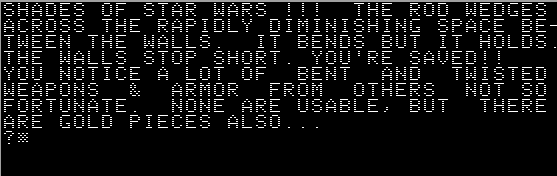
Amongst my adventures were some interesting encounters, including a safe for which a combination was found elsewhere in the dungeon, a bridge that collapsed if you tried to walk on it while heavily encumbered, and a trapped room in which the walls closed in on me, and I had to brace them with an iron bar I had thankfully picked up at the beginning. The game acknowledges its debt to Star Wars on that one.


Surviving that room rewarded me with over 500 gold pieces, which helped at a nearby machine that took 200 of them for a jewel. Unfortunately, in the next room I was killed by a hellhound.

The games support saving both the games-in-progress and the character files, although neither worked for me (every reload produced an error). The back of the box says that the "average completion time" for both Stone of Sisyphus and Morton's Fork is one month--a figure I was entirely prepared to trounce, but alas such disk problems prevent me from getting far in either game in my Apple II emulator. Aside from the reloading issue, Stone of Sisyphus randomly dumps me to the prompt with an error at unpredictable times, and Morton's Fork does so right at the outset. I thus can't seem to find stable versions of either game, but if you want to have a go, you can find them both at Virtual Apple II listed under their subtitles, not Maces & Magic.

There are occasional graphics in the game.

Chameleon Software (which developed no other games) was a side-project for three Indianapolis medical professionals, including X-ray technician Richard Bumgarner, who was the registered agent for the company and thus the person I was able to track down. (I'm happy to report that this posting will be the first time that Mr. Bumgarner is properly associated with the series on any web page.) He's no longer in touch with his co-developers and didn't know if they'd want to be associated with the games, so he declined to give me their names.


Now 68 and retired, Mr. Bumgarner has only foggy recollections of the events of 34 years ago, but he said that the trio was inspired by tabletop Dungeons & Dragons as well as a computer game whose name he didn't recall but what I suspect, based on the description, was the Dunjonquest series. He credits one of his colleagues, a doctor, for the exhaustive list of weapons (which he pulled out of a book), many of the story elements, and the game's titles.

The titles actually are quite clever. Stone of Sisyphus refers, of course, to the boulder that the mythological Greek king had to roll up a hill over and over, only to watch it roll back down every time. I wonder if it wasn't a metaphor for the game, in which you repeatedly enter the dungeon to find the same treasures. Morton's Fork refers to a kind of paradox in which two choices (or two lines of thinking) both turn out to have the same unpleasant outcome. It's named after a 15th-century Archbishop of Canterbury, who argued that a man living below his means was obviously saving his money, and could thus afford taxes, while a man living ostentatiously was obviously rich, and could thus afford taxes. It serves as a good metaphor for dungeon paths or roleplaying choices that ultimately converge on the same location or end in the same result.

I can cheerfully go along or I can threaten to turn him in--but either way, I end up with the damned quest.

Mr. Bumgarner recalls getting some threatening letters from TSR, the publishers of Dungeons & Dragons, which apparently regarded any two alliterative fantasy-sounding words separated by an ampersand as a threat to their trademark. Hence, most editions of the games emphasized the subtitles rather than Maces & Magic. He recalls that the trio had fun developing the series but it never made much money, and as amateur programmers, they felt unable to compete in an era in which every publisher seemed to want graphics. None of them worked on any games after this trilogy.

The games generated enough fondness for ports to the Atari 8-bit, along with some graphics by developer Dave Simmons.


Comparison of the Apple II and Atari 8-bit openings.

I made some efforts to play this version, but I'm having a miserable time trying to get an Atari 8-bit emulator to work, and I'm not sure that this is the game that I'm going to put in that kind of effort for.

It's startling how similar this game is to Eamon (which I just reviewed), which came out at the same time. They're both text adventure-CRPG hybrids, both featuring interactive story-telling with statistics-based combats, both allowing the player to amass gold, purchase equipment, and carry the same adventurer through multiple stories. And yet Eamon still has a dedicated fan following after 30 years, while Maces and Magic is so forgotten that, according to Mr. Bumgarner, in three decades no one has asked him about the game. (And there isn't a single fan page or walkthrough online.) The difference of course is that Eamon was designed as a construction set, with fans able to contribute their own adventures. But the quality of the writing and gameplay in Stone of Sisyphus seems promising, and I'm surprised there aren't more players who remember it fondly.

Back now to the interminable battles of Knights of Legend, but I anticipate several other early-game stopovers while I very slowly progress in Knights.

****

Further reading: Don't miss my entry on Dungeon, the first Maces and Magic title, published five years after this one.