|
| Woody Allen also said, "I don't want to achieve immortality through my works. I want to achieve it by not dying." |
Dungeon
AKA Maces and Magic: Balrog Sampler
United States
Chameleon Software (developer); Scott Adams International (publisher)
Released in 1979 for TRS-80, possibly Apple II
Date Started: 25 July 2018
Date Ended: 27 July 2018
Total Hours: 7
Difficulty: Moderate (3/5)
Difficulty: Moderate (3/5)
Final Rating: 20
Ranking at time of posting: 65/299 (22%)
To reclaim some momentum after my unintended hiatus, I decided to take another stab at a title that had vexed me in the past: the first title in the short-lived Maces and Magic series of text adventure/RPG hybrids. I previously wrote about the series back in 2013, when I was unable to get the first game, titled Balrog or Balrog Sampler (1980), to work. I ended up spending most of the entry on the second title, Stone of Sisyphus (1980), although even that game had bugs that prevented me from progressing far. I couldn't get Morton's Fork (1981) to load at all.
This time, I was more successful, thanks entirely to commenter Porkbelly, who dug up some original disks and posted detailed emulation instructions. Even then, it was tough going. I repeatedly ran into problems that caused me to have to restore a fresh disk. Sometimes new characters would be given only the small leftover gold piece totals of the previous characters. Sometimes the weapon or armor list would be empty. Sometimes the armor would disappear after I started the game. Sometimes the game would fail to initialize, and sometimes the emulator would insist that it couldn't find the file. It's a wonder I got as far as I did.
 |
| One of the earliest appearances of this famed publisher. |
But it was partly worth it, if only to discover that this initial entry was originally published in 1979, lacked the Maces and Magic umbrella, and was titled simply Dungeon. It also turns out to be among the first games published by Scott Adams' Adventure International (there were at least half a dozen others in 1979), and the only game from that publisher that aspires to RPG status.
In 2013, we learned that Chameleon Software was formed by three Indianapolis medical professionals, including x-ray technician Richard Bumgarner, whom I briefly interviewed. (He declined to give me his partners' names, not knowing if they wanted to be publicly identified with the endeavor.) Sharing a love of tabletop roleplaying, they decided to create what in retrospect is the first text/RPG hybrid, pre-dating Eamon by a year. A lack of graphics hurt sales even in these early days (though Sisyphus and Morton did have a few), and threatening letters from TSR killed the remainder of their enthusiasm for the company. They quit after just a few titles.
 |
| A genie breaks the fourth wall to discuss his creators. |
Dungeon isn't a great example of a hybrid. It lacks both the prose and complex puzzle-solving of text adventures like Zork and the combat and character development systems of a true RPG. The game has essentially no text parser: you navigate its roughly 100 "rooms" by choosing among numeric options. A handful of inventory and character options work in any location. Very rarely, you have to use an item from your pack, and the game forces you to type one or two words to indicate what you want to do. Such opportunities come along so rarely that it's easy to forget that they exist, particularly since most inventory items have no such creative uses.
 |
| This area offers 8 navigation options, plus the ability to (G)et the flask. |
 |
| A typical encounter menu in Dungeon. |
The quality of the writing isn't bad, but from the title screen with its Woody Allen quote, whimsy is the order of the day. When creating your character, you're asked "What's your handle, good buddy?" in the CB radio lingo popular in the day. Upon entering the "Spaghetti Maze," you're told that at least it's better than the "Linguini Maze." At one point you choose between two arches labeled "Lady" and "Tiger"; choose the former and you have to fight a tiger named "Lady"; choose the latter and you meet a lady named "Tiger." Steal a clock and you end up having to fight the "Roc around the clock." The dungeon has no interest in thematic consistency, managing to incorporate an Arabian desert, a hippodrome, and an Egyptian room. Dragons co-exist in the dungeon with pirates, robots, wizards, modern doctors, and poker players.
 |
| I don't think that's what "Manifest Destiny" refers to. |
The game begins by having you specify a name, after which you get a single random roll for strength, intelligence, luck, dexterity, constitution, charisma, and gold pieces. It's easy to get a unplayable character from the beginning. You need a certain strength to haul around all your items, and if your attributes roll too low, or you don't get enough gold to properly equip yourself, you won't survive your first combat. The "experience points" that you start with 0 of, seem to represent your accumulated scores from previous forays in the maze. They determine the name of your level--dilettante, novice, brawler, warrior 2nd class, warrior first class, master warrior, knight 2nd class, knight first class, and dreadnaught [sic]--but I don't believe they have any effect on combat, and there is no traditional "leveling" as in most RPGs.
 |
| Character creation. I didn't do too bad here. |
You then purchase weapons and armor from ridiculously long and mostly redundant lists. (When I interviewed him, Mr. Bumgarner said that one of his colleagues, a doctor, had an encyclopedia of medieval arms and armor.) You have to balance effectiveness with cost and weight. I suppose if you don't have enough gold at the outset, you could find some in-game, retire the character, restart him, and purchase better stuff. I didn't try that, mostly because the saving mechanism was so hit-and-miss. It's otherwise important to pick items carefully because you don't find any weapons or armor in-game.
 |
| Among the many weapon options. Doesn't "shotel" sound Hebrew? It's from Ethiopia, though. |
Gameplay starts in an outdoor area of about 25 squares. Two of these squares have openings to the dungeon, though one of them only goes to a small area where you can pick up a few equipment items. There's a river that you have to cross either by walking across some trees (risking instant death if you fail a dexterity check) or by paying a toll. If you try to attack the tollkeeper, you die instantly. If you try to swim the river, even after doffing all your equipment, you die instantly. There's a hermit who will give some advice if you pass an intelligence or language check. Already in this opening area, we see that the game is dedicated to traditional RPG attribute checks in some areas and capricious whimsy in others.
 |
| The outdoor area. Yellow squares mark the two entrances to the dungeon. |
The real entrance to the dungeon lies on the far east side of the outdoor map, near a shack where you can pick up some other adventuring supplies.
South of the dungeon entrance is a bank. (Trying to rob the teller is another instant death.) You can deposit gold here, but more importantly you get a personal vault where you can leave items. It becomes clear as the game progresses that the key goal is to bring treasure items back to the vault and drop them; you get points both for finding the treasures and for leaving them in the vaults. This trope, of course, goes back to Colossal Cave Adventure.
 |
| My vault, mid-game. |
The underground part of the dungeon consists of maybe 80 rooms, some with fixed combats, some with random combats, some with special encounters, but very few with anything we might think of as a "puzzle." Mostly, the outcome of encounters is entirely based on luck or the developer's caprice. Some examples:
- You enter a room with six levers labeled "Sweet," "Sour," "Hot," "Cold," and "Super." Choosing "sweet" causes a molasses flood. Choosing "sour" causes a creature called a "sour masher" to come and attack. Choosing "hot" lets you put your weapon in a slot, where there's a chance (based on a luck roll) of increasing or decreasing its effectiveness. Choosing "cold" causes a block of ice to fall from the ceiling (a dexterity roll determines whether it hits you); there are 10 gold pieces embedded in the ice that you can take if you wait for it to melt. Choosing "super" causes the dungeon's superintendent to appear and demand 10 gold pieces for wasting his time.
- A "wheel of fortune" has a chance of increasing or decreasing your luck.
- A room with four boxes. A sign says you can open one. The "poof" box releases a genie with several sub-options that don't work out for the player. The "fizz" box gives you a potion that increases strength by 2. The "skull" box gives you a necklace. (I think this is the one treasure I missed; see below.) The "flower" box decreases charisma by 2.
 |
| No logic or skill will get you through this one. |
- A machine takes 10 gold pieces and has a random chance of raising or lowering one of your attributes by up to 3 points.
- A "Hall of Warriors." You can push a button before any of eight statues. Attila the Hun tells you to make a wish at the waterfall. Genghis Khan bonks you in the head for a loss of 2 constitution. Alexander the Great gives you a clue about defeating a snake. William the Conqueror opens a trap door that damages you. Richard the Lionhearted releases a lion to attack you. Hannibal releases a herd of elephants, and you must make a dexterity check to avoid instant death. Conan warns you not to trust the advice of strangers and then tells you to push Hannibal's button. The Black Knight spits at you.
 |
| This dexterity roll went poorly. |
- A woman pans for gold at a stream. You can attack or talk to her. If you talk to her, she snarls at you and attacks. As she dies, she changes her mood and tells you that you can pan for gold in the river. If you then try to do that, you get attacked by piranhas.
 |
| This is one of the weirdest encounters I've ever experienced. |
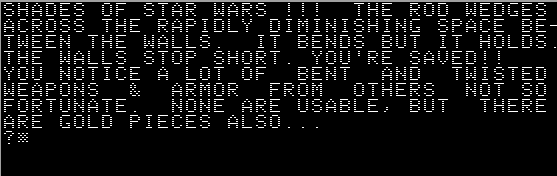
Getting through a few rooms successfully depends on having the right item in your inventory. Sometimes this is passive, such as when a stone mongoose scares away a giant snake, or a "witch protector cross" does its job against an old woman with a cauldron. (In one option tree, the witch transforms into Helen of Troy, and you can sleep with her for an increase in luck, perhaps the first RPG sex.) However, in a few other cases, you have to proactively use an item from your pack. Such occasions are so rare that it's easy to miss them, but the game generally does a good job cluing you in. For instance, when told about a high alcove, you use the ladder and specify CLIMB. When in a dark room, you use a torch and specify LIGHT and then notice a keyhole for which you use your keys and specify UNLOCK.
 |
| A snake reacts automatically to my mongoose. |
There are a few frustrating cases, though. Facing a rusty door and holding a jug of oil, I knew I wanted to use the latter on the former. OIL, GREASE, and LUBRICATE did nothing. I finally got it with OIL DOOR--the only place in the game that you specify a verb and a noun to complete an action. In one room with a giant oyster, you have to intuit that the solution is to BURN a lump of coal, thus heating up the water and causing the oyster to open its mouth and drop a pearl. I found no use for a ton of inventory items--shovel, iron rod, chain, coil of rope, wheel, and so on--but it's probable that there are some red herrings.
 |
| Selecting from my inventory options to solve a puzzle. |
The dungeon requires careful mapping. I was able to use Excel for the surface, but I switched to Trizbort for the underground, where directions are inconsistent between rooms. There are two mazes of note. The first, the "Spaghetti Maze," is I think all random. You just have to keep hitting random options until you find the exit. The second, the "Monster Maze," can be mapped by dropping inventory items.
 |
| The Monster Maze. |
Combat occurs randomly and rarely, except in specific rooms. Random foes are mostly silly, including black holes, speckled cruds, brain moles, and speed demons. Success is almost completely deterministic: at the beginning of combat, both you and your foe are given a combat score comprised of your attributes and weapon rating (80%) and a random roll (20%). The variance in scores determines damage. In most combats, you either win while taking no damage or die within a couple of rounds. Damage is done directly to constitution and heals over time.
 |
| Initial combat "options." |
 |
| A combat round. |
Because there are no real tactics in combat, a key early goal is to increase your attributes as much as possible via favorable encounters and use of the "personality-changing machine." I admit to a little save-scumming here, just so I could move forward and fully document the game.
Combat isn't the only random event. Occasionally, a pirate shows up, knocks you unconscious, and steals whatever treasures you're carrying at the time. You can only prevent this by frequently taking the treasures back to your vault, but you can "solve" the issue at the end of the game.
 |
| This bastard. |
Besides finding treasures to increase your score, much of your dungeon exploration is dedicated to finding the code to open a massive door near the starting area. This part is cleverly done, as you have to piece together clues that may seem nonsensical at the time. For instance, an oracle tells you that "at least a portion of what you seek contains a YAT." Two clues are found in rooms in the Monster Maze. The combination ultimately turns out to be SYNTAX.
 |
| This clue was more explicit. |
Opening the massive door leads you to a final series of rooms, culminating in an encounter with a baby chromatic dragon and then his "daddy." You kill the baby in regular combat, but the only way to defeat the "daddy" is to RELEASE some mice found early in the game.
 |
| The final encounter. |
Once the dragons are dealt with, you can enter their treasure cave and find the most valuable treasures in the game. Also, you get to fight the pirate who's been stealing from you and recover anything that he's stolen.
Once you've exhausted all options, you can end the game by taking the "Game Exit" from the bank. The game tallies your points and treasures and lets you save the character to play again. The best I could do was 1866 points out of 1951; I'm sure the missing points are caused by the fact that I opened the box that gave me the strength bonus instead of the one that contained the necklace. I'm going to go ahead and call that a "win" anyway, if you don't mind.
 |
| Good enough. |
The game earns a 20 in my GIMLET, doing best in "gameplay" (4) for being nonlinear and a good length for its content and "encounters" (3) for at least being interesting. It's not a great title, but it's an innovative game that does some interesting things, and it paved the way for better text/adventure hybrids down the road. Perhaps most important, it took exactly the length of a flight from CDG to JFK.
My experience with Stone of Sisyphus is that it offers the same basic game mechanics but with a new dungeon and a couple of graphics, but I didn't get very far and I might try again with a TRS-80 version now that I know a configuration that works. Thanks again, Porkbelly! This game deserved to be fully documented.
****
All of the games on my current and upcoming list require some serious work, so you may see me clean up a few more entries on the pre-1989 list before I tackle them again. If so, the next one ought to be the PLATO Camelot (1981).