Monday, November 4, 2019

Game 345: Challenge of the Five Realms: Spellbound in the World of Nhagardia (1992)

If you count the subtitle, I think this is the longest title so far.
        
Challenge of the Five Realms: Spellbound in the World of Nhagardia
United States
MicroProse (developer and publisher, under its Microplay label) 
Released 1992 for DOS
Date Started: 2 November 2019

I've been looking forward to Challenge of the Five Realms for a couple of years. The team behind it, working at Paragon Software, had been responsible for the 1990-1991 spate of licensed Games Designers' Workshop (GDW) disasters, including the two MegaTraveller games, Space 1889, and Twilight: 2000. Each of the games had its qualities, but in general, the sense was that Paragon had taken on too much too fast. The games' poor reviews and sales led to the collapse of Paragon and its purchase by MicroProse in 1992. Now, the team, working for more competent managers, was free to develop a game without any GDW restrictions. Would it be better or worse? I've been anxious to find out.

It takes a while to get into Challenge. It begins with a long, unintentionally hilarious, animated opening sequence with fully-voiced dialogue, the second 1992 game to do so (after Ultima Underworld). It accompanies a long backstory in the game manual. The two don't fully jibe with each other, but I'll do my best to summarize below. First, we get a female voice on a black screen welcoming us to the kingdom of Alonia, one of the titular five realms, "where folklore and myth are a way of life."
            
I know this isn't the only flat world we're going to see this year.
           
We have a brief glimpse of Nhagardia, a flat, oval world. Because it's flat and does not rotate, the parts that support life have always known eternal sun. This revelation sent me off on a bit of Googling. I have a basic understanding of why planets are naturally spheres due to the way they're formed by aggregating rotating collections of matter. I also understand how gravity favors orbs and thus works over time to turn any shape into a roughly-spherical one. What I wondered--and still wonder, since I couldn't find enough discussion on the topic to satisfy me--was whether the slow process of gravity pulling a large amalgamation of matter into a sphere necessarily outpaced the same processes that give the same body an atmosphere and the conditions necessary for life. That is, if some weird freak of accident did result in a flat-ish "planet" (I realize the definition of "planet" presupposes a sphere, but you know what I mean) in stable orbit around a sun, would it be possible for such an object to trap an atmosphere and create complex life before the natural tendencies of gravity made a sphere out of it? How would gravity even work on such an object? Could an atmosphere truly exist? 

Discussion welcome, but back to the game. We move from planet level to Castle Ballytogue, which must be based on Ballyutogue from Leon Uris's Trinity. It is the year 1000 "A.S." The pompous King Clesodor is haranguing his advisors for not allocating enough funds to the New Year's celebration. "I want this to be the greatest celebration in Alonia's history," he demands. The manual doesn't have any credits for the voice actors, but I'd swear that Clesodor is voiced by Maurice LaMarche, testing out a precursor to "The Brain" voice that he'd bring to Animaniacs the following year.
             
Clesodor meets with his advisors.
            
Clesodor takes some time out from his party planning to yell at his son, the Prince, for idly reading a book. "I swear, the boy is just like his mother. Witches and seers and myths. What kind of king will you make if all you care about are mindless stories? A king is a ruler, not a dreamer!" The first bit about the mother is all the more harsh if you've read the backstory and learned that Clesodor's wife, Queen Feya, is in fact dead, killed in a tragic accident at "the cliffs of Mahor."

(I had to take a break from the game at this point to call Patrick, the British friend that I've talked about before. Back in 2007, we were traveling along the west coast of Ireland. He happened to mention that the last time he was there, a few years prior, he'd heard on the news that a British tourist had been killed while falling from the Cliffs of Moher. The same night, we got into Galway, checked into a hotel, turned on the TV, and immediately caught the opening headline from the local newswoman: "Tragedy in County Clare today as a young man fell to his death from the Cliffs of Moher." Ever since then, we have this ongoing joke that every Irish television news broadcast begins with a report of yet another death at the Cliffs of Moher. Maybe you had to be there.)
              
The idle prince idles.
         
The perspective now shifts to the Prince, a complete milquetoast, who is reading a picture book that should be far below his age. It's called The Legend of Nhagardia. Recently, the Prince, worried for his father's health, had followed from the castle a mysterious stranger who had met with his father in private. The stranger turned out to be an ex-sorcerer named Shiliko who had been summoned to help stop the king's recurring nightmares. Unable to do anything, Shiliko had cast a placebo spell. When confronted by the Prince, Shiliko gave the boy the book.

The book tells the story of an ancient emperor named Shamar who, seeing that the end of his life was near, set off on a quest to extend it. Before disappearing, he divided his crown and power among his five territories. Alonia, the terrestrial realm, was given to King Adama. The elf Sandro took over Fraywood, the forest realm. Oberus ascended to rule the skies in Aerius. Lorelei, the (curiously male) king of Thalassy, took over the ocean. And inside the depths of the world, the gnome Hyke became the ruler of Alveola. Over time, the portals between realms closed and the rulers lost contact with each other. Clesodor is presumably a descendant of Adama.
           
The original must have been huge.
              
Suddenly, there's a disturbance by the window and a fearsome apparition appears. The cloaked, scaly, black-skinned creature introduces himself as Grimnoth. "Though I come to you now as a mere apparition, heed my warning," he says. "I will return to your world on New Year's Day and claim power over your kingdom. You will surrender your crown to me on that day." He continues by warning Clesodor that even in his "astral form," he can destroy him.
          
The kingdom is menaced by Xusia.
          
Clesodor of course mouths off to Grimnoth, so Grimnoth extends his hand and vaporizes Clesodor and his advisors with a ray of light.
           
Grimnoth's spell destroys two courtiers before it reaches the king.
        
"Nooooooooooooo," the Prince shouts.
            
"Do not want!"
           
Addressing the Prince, Grimnoth says that he's put a plague of darkness on the world, and if the Prince brings the crown to him at Castle Thiris on New Year's Day, he'll lift the darkness. This seems a little unfair. Before he killed Clesodor, Grimnoth was prepared to return to the castle to collect the crown. Now he's making the Prince trek hundreds of miles to bring it to him. Thiris is in the center of the world, the seat of the former Emperor Shamar, now abandoned and monster-ridden.

The Prince vows to avenge his father and begins by ransacking his mother's belongings, finding among them a reference to a witch named Cagliostra, who Clesodor had banished. "Father, I know you thought I was a dreamer, but I'll avenge your death. I'll make you proud!" the Prince declares, just before a hand appears from off-screen, and someone clocks the Prince over the head with a mace, knocking him unconscious.
         
This just isn't his day.
          
Paragon's titles had all featured a MegaTraveller-inspired character creation process by which each character went through a career in a military branch or profession (or both) which shaped his or her skills and abilities. Since the protagonist of Challenge--the Prince--has more of a fixed background, I didn't expect the character creation process to be quite the same. It isn't. Instead, the game feeds you a number of situational questions and asks how you'd react to them.
             
One of many, many questions in character generation.
           
This is often described as Ultima IV-style character creation, but it's not. Ultima IV's scenarios were about pitting one virtue against another to help determine what virtue primarily guided your moral compass. Challenge's questions are more about pitting various skills and abilities against each other, ultimately determining if you're more of a fighter, mage, diplomat, or thief--or a balance among them. I lost track of how many questions the game asks--I think it is in the ballpark of one hundred thousand--but it later struck me that the "quick" option, which just rolls random numbers for your attributes and abilities, performs just as well.

There aren't that many skills, making me hope that unlike the GDW games, this one actually uses all of them. "Stealth," "Crime," and "Fly" were all set to 0 when I started (the lowest score I got was otherwise 20), so perhaps it doesn't use those.
         
The game's attributes and skills. The Prince takes a level in badass in his portrait.
         
The game finally begins when the Prince wakes up in his mother's bedchamber, head throbbing, bereft of equipment or supplies, including the crown that he's supposed to bring to Grimnoth. He soon runs into Hastings, the dead king's seneschal, in the next room. Hastings explains that when the king was killed, his knights looted the castle and fled with its riches to Duke Gormond of Vinazia, who despises me. Rumors are already spreading that the Prince killed his father. Hastings recommends that I forget about Cagliostra, but if I'm determined to seek her out, her old friend Sir Oldcastle hangs around the Boar's Head Tavern. Hastings stays to guard the castle after giving the Prince a key to a chest.
                      
Encountering my first NPC.
          
Challenge's interface is axonometric with continuous movement and real-time events. A row of icons offers party options, disk options, navigation options, spell options, combat options, and speech options. Of the developers' previous titles, it most recalls Space 1889, but with some elements tossed in from other games. For instance, if you're trying to speak to a moving NPC, you can use the "Hail" option to get him to stop; this is from MegaTraveller 2. Most commands have redundant keyboard backups except (annoyingly) movement, which has to be done with the mouse. One key I'm using a lot is (P)ause, every time I stop to blog or something, because commenters have warned me that the game has a time limit. "Ridiculously short" is how one described it.

I naturally started exploring the castle. As Hastings said, most of the court had fled. Sir Feldoth and Sir Elault still guarded the ramparts. Imrid the Manservant was wandering the lower halls and begged me to just give Gormond the crown. A couple more servants, Horric and Horville, were in the basement. Horric told me that a thief carried off a chest with the queen's insignia on the lid. Dialogue so far has been entirely scripted, with the Prince (or I guess, King) responding to questions on his own.
          
"I do not know, but you will die for your failure!" is an option a really good RPG would have given me.
             
Finally, in one room, I found a broadsword, axe, long bow, rapier, and arrows. You basically have to hover your mouse over all objects that you think you might be able to pick up. As far as I can tell, chests and wardrobes and such are just decorations, as there is no command to open them and (F)ind never seems to do anything.
        
Finding some weapons at last.
          
In the kitchens, Wilagon Blacklost gave me the Holy Book of Equus, which has a spell called "Truth." I tried to learn it, but the game told me that I wasted half a day and failed. I tried again, and it told me that I destroyed the book. I reloaded and figured I'd save that for later. The kitchens also had a variety of spell components and food.

Outside the castle, some flowers and other objects joined my list of spell components. A rough character at the end of the drawbridge offered to give me a hint for 100 gold pieces. Since I started with 1,000, I paid him. He said that there are a couple of loudmouths at the local tavern who claim to have stolen the queen's treasure chest.

I continued exploring the castle outskirts. In one shop, a man offered to sell me spells for small fees. Almost every one I chose required components that neither he nor I had, except for "Warding Spell," "Open Lock," "Lightning Bolt," "Inner Noise," and "Slow." Paying the man didn't actually get me the spells--just books that give me a chance of learning them.
            
Some of the spell shop selections.
       
Elsewhere, I found a  healer, a pawn shop, a weapon shop, a food store, an armor shop, and a tavern. At the tavern, I bought some chainmail and equipped it. The inventory system seems needlessly complex. From your character screen, you can go to "inventory" (which never seems to have anything) and separate buttons for your pouch inventory, your backpack inventory, and your chest inventory (you start with no chest). But you can also go to "garb," a screen with a paperdoll of the character, which also has links to inventory, pouch inventory, backpack inventory, and chest inventory. Spell components seem to show up in none of those places.
           
Part of the confusing inventory system.
         
In the tavern, I met Sir John Oldcastle and several of his friends. Oldcastle had been a skilled swordsman, but he was banished by King Clesodor for drunkenness. He is clearly based on Shakespeare's Falstaff, although a bit more competent. I tried to enlist him into my cause, but he mocked me by calling me "Miss P." and said that he doubted I'd be able to stand up to Duke Gormond. He agreed to join me and help me find Cagliostra if I would bring him the Widow Frazetti's fabled jeweled brooch.
            
The tavern from the outside is a nice looking building.
         
As I explored, it became clear that several houses had been looted in the chaos following the king's death, including Frazetti's. I ultimately tracked down the bandits, the Hammerhand brothers, to a bar in the western part of the map. They were drunk, which made the subsequent combat a little easier.
            
An NPC shows a shocking lack of respect for the king and his neighbors.
          
Combat appears to take place in several phases and draws heavily from the MegaTraveller system. In the first phase you place your party members on the combat map, which is the same as the regular map without the surrounding command interface. Once combat begins, you issue orders for each character--target a particular enemy, cast a spell, defend an area, or move--and then unpause the game. Characters act on their own until you pause again and issue new orders.
           
The game has me fight the second Hammerhand brother as the first lies dead above me.
          
In short order, I killed the brothers and looted their bodies for my mother's chest, the Frazetti brooch, and a bracelet that they pillaged from another NPC. I returned the brooch to Oldcastle, who joined me, but it occurred to me that I should have tried returning it to the Frazettis first.

I also found the house of the wizard Shiliko. He had hung himself. A note nearby indicated that he blamed himself for the appearance of Grimnoth and all the chaos that followed, but it didn't explain his reasoning.
             
Shiliko's hut, with Shiliko hanging in the upper-left.
      
At this point, I think I've exhausted exploring the castle. Judging by the world map, there are a couple of other cities in Alonia to visit, and then the other realms. Oldcastle said that we'd find clues for Cagliostra in the city of Farinor, so I suppose that's where I'll go next.
            
Oldcastle insultingly joins the party.
        
It's been a relatively promising start. Although aspects of the animated sequence were a little goofy, the backstory is strong. The interface is a little clunky but not overly so. I like that we're already seeing side-quests--one of the few things that Paragon did well in its previous titles. Dialogue is verbose enough to actually give characterizations to the NPCs, but I wish there were more options from the PC's side. Overall, I look forward to my next session and seeing how the game develops.

Time so far: 3 hours

Friday, November 1, 2019

Camelot: I Know It Sounds a Bit Bizarre

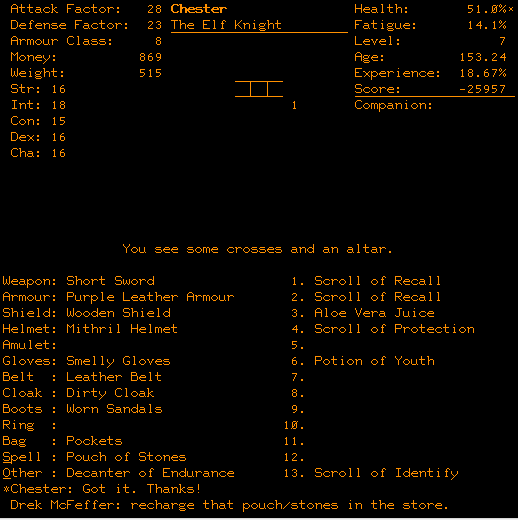
My inventory fills up as I continue with Camelot.
           
Since my first year of blogging, when I forced myself to win Wizardry while adhering to its implementation of permadeath, I've often remarked that I would never do that again. My adherence to "playing the way the developers intended" was so strict that during the remainder of the year, I quit Wizardry II, III, and IV rather than even consider backing up the save files. (I would later return to II and III and win both under more relaxed rules.) These days, I am likely to try to abide by both the developer's original intent and my own "conduct" (limited saves), but I feel that showing and documenting the endgame are more important than questions of integrity.

Thus, there's a certain exhilaration to the occasional PLATO game, where cheating isn't even an option. (At least, not in most forms, though see below for a slightly unusual version.) When my character dies, I frequently have a moment of disbelief, almost like people who experience sudden tragedies report having in real life. A couple years ago, I happened to speak to a woman whose husband had fallen asleep while driving home from work and had run head-on into a truck. "I remember thinking he was just here," she told me. "How could such a simple mistake be so irrevocable? How could there be no rewind button? No do-over?" That's how I feel when my elf fighter gets killed by a demon. I mean, maybe not exactly, but there are analogues.

The point is, life is precious in the real world and in Camelot, so it becomes all that more meaningful when you succeed. And while death may be a constant danger in the game, it's not at all arbitrary. When it happens to me, it's almost always because I've bitten off more than I can chew. The game is actually quite good about offering multiple ways out of a situation, about not requiring you to engage enemies that you don't want to engage. You have to be quick with your fingers, but it would be theoretically possible to explore an entire dungeon level, and collect a good percentage of its treasure, without engaging in a single combat round.

The problem is that once you decide to stand and fight, the game can be relentless. For instance, last night I wandered into a room and faced "6 imps." I had faced imps before. They're a demon type, but not very hard, and I was a relatively high level. Generally, when facing stacks of multiple enemies, you concentrate on killing one. Once you do, you escape the room, pray for healing, re-enter, and try to kill the next one. If you must, you can return to the town if your prayers run out.

What I didn't know was that the 6 creatures weren't actually imps; they were manes. That's a tougher demon. It turns out that this game goes one better than Oubliette, which often gave you the category of monster but not the specific monster. In Camelot, the character can mis-identify the specific monster. When I hit (F)ight, I watched myself do 60% damage to one creature and then watched as the demons took their turn and pounded my health from 100% to 40% in one round. There's no way to escape or to do anything in the middle of a combat round; that's the point of no return. At that point, I should have immediately fled, or prayed in combat, or done anything but attack a second time, because clearly the enemies were capable of doing more than 50% damage in a single round, and I was now below 50%. But some primitive part of my mind, trained on other RPGs, forgetting temporarily that actions are irrevocable, decided that I didn't want to waste the 60% damage I'd already achieved, and to at least try to kill one of the demons before I escaped. I hit (F)ight again, missed, and was swiftly torn apart.
      
Another death.
         
As I mentioned last time, there's a good chance of resurrection, and Chester was resurrected. He's been resurrected a few times now. But each one comes with a loss of score, the higher the level the higher the loss, and Chester now has a score of over -99,999. Fortunately, it caps there. Joshua Tabin (the author) insists that I'll recover those points at higher levels, but I'm not sure he's considering the possibility that I'll die a few more times at those higher levels, too.

I guess Joshua felt a little bad about the game's difficulty as I reported it in the first entry (though, as he points out, it's only difficult if you approach it as a typical RPG instead of as Camelot specifically). Joshua and his Level 17 ogre, Drek McFeffer, joined me for a while last night on the first two levels. He ran ahead of me in the dungeon, decimating some of the rooms and alerting me where I could find lucrative treasure caches. One room on each dungeon level is designated the "stud room" and features better treasure and harder monsters than anywhere else on the same level. He helped me clear Level 1's stud room a couple of times so I could bulk up my equipment. He also used his admin powers to insert a couple of useful items into the town's store, and all the while he kept a steady stream of hints and tips going with the game's chat feature. I still died twice, lest you think he made it too easy.
          
The author throws me some hints as I map the dungeon.
         
I can't speak for the mid-game or late-game, but finding useful equipment in the early game is a joy. You have numerous equipment slots, and almost anything you find during the first 10 hours is an upgrade. I was more than three hours into the game before I even had a weapon, so finding my first short sword and then a steel sword was like hitting the real-life lottery. When I found a mithril helmet in one of the stud rooms, I had to stop myself from calling my mother with the good news. Later, it was destroyed because of a cursed item, and the pain was palpable.

Camelot does some clever things with its inventory, too. There are useful items like Palantirs, which tell you where you can find quest enemies (those you have to kill to level up), and Scrolls of Recall to whisk you back to town. The Scroll of Identify does what it suggests, but it can also be used to identify traps before you open chests, and items before you pick them up. The latter use is particularly important because some items are cursed, and in this game, cursed items break the items of the same type that you already have before replacing them. It's a particular joy to find manuals, which increase your attributes permanently, but potions that increase them temporarily (they last a long time) are almost as good.

There are several items that let you briefly charm a monster companion. The Orb of Entrapment, for instance, seems to work on dragon types. Having one of those at your side really helps clear out a room.
           
A charmed firedrake follows me around.
        
I also like how character development is palpable. At some point, you get two attacks per round, which makes you feel like Hercules on the first level. (Although, as I learned more than once, you still can't get cocky.) Attack and defense factors increase as you level, and it's rewarding to go from missing 90% of the time to 70% of the time, to reversing the ratio and hitting more times than you miss.

Joshua clarified a few things from the comments on the first entry. He absolutely intended the game to be played by a single player. However, he also expected that the player would use two simultaneous logins. He built a feature where one user can "follow" another user on an automap, and I guess it was common at the time for one player to take over two terminals with two user names, playing on one, and using the automap on the other. A single player with two characters can also have them rescue and resurrect each other, at a higher chance of success than if you rely on the whims of the gods. Thus, I applied for and received a second Cyber1 account.
         
Playing with two terminal windows side-by-side.
         
I spent a number of hours mapping Level 2 and parts of Levels 3 and 4, but every time I thought I was finally badass enough to march around a level unopposed, I'd get my ass handed to me by some group of mages or demons who kill me in a single round.
         
Level 2 of the Camelot dungeon.
        
In the first entry, I noted that a number of rooms have "flavor text," and I noticed that various rooms on Level 2 repeated those on the first level. For instance, both have rooms coated in guano, filled with statues, with soft ground, with an empty wallet, and so forth. Both have a small room with beakers and burners that seems to be a lab. Both have a room where I feel a "force of nature." Joshua has hinted at deeper puzzles later in the game, and I wonder if they have something to do with these rooms.
         
If I need an alchemist's lab later, I'll know where to come.
        
Camelot is probably going to have to go on the back burner for a while. I enjoy the gameplay, but it's taken me 16 hours to build a Level 14 character and map two and a half levels. The characters who have actually won the game are Level 60. I'll dip into it now and then as I continue to progress with the rest of my list.

Time so far: 16 hours

Tuesday, October 29, 2019

Game 344: Bandor II (1992)

That's a lazy title graphic.
               
Bandor II
United States
Magic Lemon (developer and publisher)
Released as shareware in 1992 for DOS
Date Started: 26 October 2019
Date Finished: 28 October 2019
Total Hours: 14
Difficulty: Moderate-Hard (3.5/5)
Final Rating: 23
Ranking at time of posting: 132/349 (38%)
          
I was willing to give some credit to Bandor: The Search for the Storm Giant King (1992) for at least having the originality to try to clone the Gold Box instead of Ultima, Dungeon Master, Wizardry, or any other title that we've seen dozens of times. All that good will is gone with Bandor II, which differs so little from Bandor that it feels more like a remake than a sequel--albeit a remake in which very little is actually remade except trivial graphics and interface changes.
            
And let's not over-emphasize those graphics upgrades.
        
In the original Bandor, you controlled a party of four adventurers set loose in the titular city to take quests from the council and its chief wizard, Osi. Both games draw heavily from Pool of Radiance in the nature of the plot and quests; for instance, a mysterious warlord organizing monsters in the slums, and someone poisoning a nearby river. In the first game, the city's woes were revealed to be the machinations of the Storm Giant King, whose defeat ended the game well before I'd completed all the side quests. Here, the game begins with new ills facing the city, including word that the Storm Giant King has returned. Bandor II is subtitled "The Wrath of the Storm Giant King" on some external sites, but the subtitle is never given on a game screen or within the game files.
           
Bandor is having more problems.
         
I tried to import my characters from the first game but couldn't figure it out, so I created brand new ones. Classes are warrior, thief, mage, friar, rogue (warrior/thief), and jack-of-all-trades (warrior/thief/mage). Races are human, dwarf, elf, half-elf, and half-dwarf, with only the mongrels able to be jacks-of-all-trades. Attributes are strength, magic, and luck, given as percentages from 0 to 100. Everyone begins with axes and leather armor. Spellcasters have spellbooks that (annoyingly) must be swapped into the weapon slot when you actually want to cast a spell.
            
I was uninspired during character creation and chose an uninspiring name.
           
The game re-uses the three 40 x 40 maps from the first title: the city of Bandor, the forest, and the underworld (slums) to the city's east. The underworld has a teleporter to a fourth map, titled "Landthi's Lair," which makes no sense until you reach the final encounter. The city map is entirely wasted. The huge space has only a few shops and no special encounters.

This was a huge waste of time.
         
A large city council building in the center doles out quests. There are only 5 in the game:
            
  • Retrieve a bottle of Elixir of B'Tet from the Fortune Teller in the slums; bring it back to the wizard Osi. The Fortune Teller has you rescue her brother, the guildmaster, from a group of bandits before she hands over the elixir.
         
The Fortune Teller has a sub-quest.
         
  • Investigate unexplained deaths in the city slums near the old Temple of B'Nah. This turns out to be former acolytes of B'Nah attempting to resurrect him. One combat clears this quest.
           
Getting rewarded back at the city council chambers.
           
  • Find out who's poisoning the River Quoth. It turns out to be a dragon.
  • Investigate the return of the Storm Giant King and find out who is behind his return.
            
The council issues the main quest of the game.

         
Only the last quest is necessary to win the game, and depending on your exploration pattern, it's entirely possible that you'll stumble on that quest first.

Bandor featured three major problems, none of which is fixed in Bandor II:

1. No inventory improvements. From your starting axes and leather armor, you can use your gold to buy slightly better items like long swords and plate armor. Once you have those, there's nothing else. No upgrades are found during adventuring, or as quest rewards. This means there's no purpose to the economy except healing and resurrections.
              
There's hardly anything worth buying here.
          
2. A horrible mouse-only interface. I hated the mouse-driven interface of both games. Actions require too many clicks; there are no alternatives to clicking; and clicking even slightly away from the center of your target produces a question mark, a pause, and a noxious noise that made me want to punch a kitten. The worst part is that this game was supposed to feature a keyboard interface, and it technically does. But it's bugged and broken, failing to read your input about half the time. Worse, you have to choose one or the other during configuration. Good games have redundant commands active at the same time.
            
Graphics haven't improved. I don't know what this was supposed to be.
            
3. Too many combats with too few tactics. Bandor tries to emulate the Gold Box combat system but only offers a handful of spells (admittedly, its "Fireball" analog is about as much fun as "Fireball" without being quite so over-powered) and eliminates useful features like backstabbing, delaying, and guarding. Worse, it often puts the party in extremely narrow corridors where only one character can fight and spellcasters can't cast over their heads because they must have an uninterrupted line-of-sight to the enemy. Random combats are programmed to come along something like every 20 moves, and I found it less annoying to save the game, quit, and reload (which restarts the counter) than to fight all of them.
             
Fighting bandits in confined conditions.
         
To these inherited problems, Bandor II maddeningly introduces another:

4. No ability to level up until late in the game. If you visit the guild early in the game, you can't get in. A message on the door indicates that the guildmaster has gone into the slums to investigate the problems there. You have to rescue him from bandits before he'll return to the guild and train you. But the bandit encounter is so deep in the slums, you could easily do this quest last, or not at all.
          
This doesn't happen until it's so late you hardly need it.
      
The only thing to unarguably improve is the automap, which no longer forgets your progress and clearly annotates physical features like doors and uncrossable foliage.
            
A growing automap of the final area looks a bit like Ultima Underworld's.
           
Of the maps, the outdoor forest is the most annoying. It is essentially linear, with trees, bushes, and water blocking any attempt to create your own exploration pattern. In short order, you find a magic staff, talk to a druid who is only able to contact you through the staff, and then fight a dragon to destroy the threat to the city's water supply. Random battles against ogres and giant rats are more dangerous than the "boss" battle in the area.
            
This time, it's a three-headed dragon instead of a sorcerer named Yarash, but the idea is the same.
          
The slums serve up more giant rats and ogres, along with bandits, fire beasts, and "black servants." (Nothing like a message saying, "You hit the black servant" to test my liberal sensibilities.) Buildings within this area hold the encounters necessary to solve all quests except the Storm Giant himself.
             
Threatened by Benson.
           
The undead Storm Giant King is found through a portal. He attacks after a bit of exposition with two black servants, and again the combat is easier than some of the random ones found in the same area.
         
The Storm Giant King, just like Tyranthraxus, doesn't know when to stay dead.
           
After he's defeated, you can enter an inner sanctum and find the wizard Landthi, brother of Osi. He takes the credit for raising the Storm Giant King and then attacks with no minions, making the final battle one of the easiest.


The villain delivers his exposition.
The final battle against Landthi in a corner.
           
Once you defeat Landthi, Osi apparates in and says that Landthi still lives . . . somewhere. He thanks you for your service and ends the game.
           
Maybe we'd like to be heroes of some other city next time.
        
I gave the original Bandor 26 points on the GIMLET. Since its sequel uses a near-identical interface, mechanics, and plot, I'm inclined to give it the same thing--minus 2 points for "character creation and development" since you can't develop for most of the game. I guess I'd also subtract a point for "encounters," since this game had the same unmemorable foes as the first but without the handful of non-combat encounters that I noted in my review.

If I can say one good thing about Bandor II, it's that magic and physical combat are well-balanced. You can't win with just a melee party, but spells aren't quite the deus ex machina that they are in the Gold Box series. There are only a few of them, and while none of them ever stop being useful (e.g., "Sleep" doesn't stop working against higher-level foes), they also have logistical concerns that prevent the mage from wiping the floor with every enemy party. For instance, enemies have a chance of dodging spells, you have to be in a line-of-sight to cast them (no other party members blocking), and the spellcaster cannot be in melee range of an enemy.
          
Blasting the Storm Giant King with a "Fireball."
          
Still, unless Bandor III (1993) offers a significantly different experience, I won't be sad if it never surfaces. We'll see author Don Lemons' other work with Shadowkeep I: The Search (1993) and The Infernal Tome (1994).

We'll check in with Camelot next, after which I'll either take another stab at The Magic Candle III or move on to Challenge of the Five Realms

Sunday, October 27, 2019

Game 343: Camelot (1982)

Hardly anyone has won this game.
          
Camelot
United States
Independently developed in 1982 at the PLATO mainframe at the University of Illinois
Date Started: 20 April 2019
          
As far as we know, and until someone comes along with evidence of earlier creations, the first computer RPGs were developed by students at the University of Illinois at Urbana-Champaign using the PLATO educational system. The Dungeon (1975),  The Game of Dungeons (1975), and Orthanc (1975) were all developed swiftly after the publication of the first edition of Dungeons & Dragons (1974), in that order.
          
Camelot has a single character exploring via a tiny first-person interface. It has more equipment slots and logistics than the typical RPG of the era.
        
The developers of these early RPGs did us a favor by creating what are, unarguably, RPGs. They didn't muddy the waters like their counterparts on the commercial side, where you have to wade through a bunch of early titles that might technically be RPGs, but you don't really feel like the developers were familiar with tabletop role-playing. The University of Illinois students played and loved Dungeons & Dragons and were explicitly trying to replicate the experience on the computer. Their first games offer a full set of RPG mechanics: character creation, leveling, equipment acquisition, and combat based on the attendant statistics. Even the graphics are reasonably good. They lack a certain narrative sophistication, but that's a matter of quality, not definition.

The earliest games--the 1975 trio--all feature a single protagonist with fighter, cleric, and mage abilities entering a large and deadly dungeon pictured from the top down. As he defeats enemies (more often with spells than swords) and carries treasures out of the dungeon, he grows in power and experience, hoping to eventually appear at the top of the leaderboard. These games led directly to the Daniel Lawrence DND line and may have had some impact on the development of roguelikes.

In late 1975, Moria started a second tradition of PLATO games, this one characterized by first-person dungeon exploration, a town level (or menu town) with various services, and multiple characters per party. Each player only controls his own character, but multiple players can meet up, join together under a leader, and use various talk features to chat, plan attacks, and summon help. These games--Moria, Oubliette (1978), and Avatar (1979)--are essentially the world's first MMORPGs. Avatar is still actively and enthusiastically played today.

Joshua Tabin's Camelot (1982) is the last of the PLATO CRPGs, developed after the advent of the microcomputer RPG but without any influence from it. Instead, it unites the two previous PLATO lines, offering the first-person exploration, dungeon design, and advanced inventories of the Moria line but the single-character focus of the earlier Dungeon line. Multiple characters do explore the same dungeon, and can engage in some limited cooperation, but each character's ultimate development and victory are independent of the others.
         
Camelot's backstory mangles the Arthurian legend.
         
Players can control only one character at a time, chosen from human, elf, dwarf, hobbit, ogre, and pixie classes. Each class comes with fixed attributes in strength, intelligence, constitution, dexterity, charisma, and maximum age. The plot, which makes no sense in context, is that the character is a Knight of the Round Table in search of the Holy Grail. It exists somewhere in a 10-level dungeon beneath a menu town. According to the documentation, you first need to get Excalibur from the Lady of the Lake.

Dungeon levels are 16 x 16, organized into rooms. Every space between two doors is considered a room, even if long, linear, and twisting. The moment you enter a room, there's a chance of an encounter with monsters, treasure, or both. Some rooms have messages ("you notice an empty wallet on the ground"; "there is guano spread on the walls and floor") that help keep you oriented. All active players are sharing the same dungeon, and once cleared, rooms remain so until the next level reset, which happens every hour or when the entire level is cleared.
           
Character creation. The different races have fixed attributes. I'm not sure how you live long enough to even get off Level 1 as a human, ogre, or pixie.
         
Movement is by the waxd cluster, with SHIFT-W used to open doors. Other dungeon features include secret doors, traps, spinners, and teleporters--all features drawn from Moria and Oubliette and used with abundance in Wizardry and other grid-based dungeon crawlers.

It takes a long time to get any traction. A new character starts with his bare hands and a loincloth, and not enough money for much else. You have to get lucky with a few treasure rooms or combats before you can buy anything. Naturally, these early combats are pretty dangerous. You spend an awful lot of time running away and retreating back up the stairs to the inn, where you sometimes rest as long as a year to get back to full health. In more unfortunate cases, you die. The game's permadeath is slightly blunted by relatively favorable odds for getting found and resurrected, although this comes with a loss of score, any money you were carrying, and sometimes an attribute.
          
I live, but I've lost a point of charisma.
          
If the game excels in any particular area, it's in its encounter design. When you enter a room, you're told how many enemies you face, of what type (unless they surprise you, in which case you just get a category), whether they're guarding treasure, and what their disposition is. A peace symbol suggests friendship while a sword shows they're hostile.

Like a lot of games, you have numerous options for dealing with enemy parties, including three fight options (berserk, regular attack, and critical hit), parrying, reasoning with the enemies (which usually leads to them asking for money to go away), or attempting to steal their treasure out from under them. The good thing is that no matter what option you try, you get experience even if it only partly works. There are plenty of times that paying a few hundred gold pieces to get the monsters to leave voluntarily is the best course of action, especially if the party is going to be difficult. Otherwise, they'll remain in the room, blocking your progress, until the next reset.
          
Missing is the default outcome at Level 1. The demons guard a small treasure (the box to their left) and are hostile (the sword to their right).
          
Combat is quasi-real-time rather than turn based. Dexterity determines how often you and your foes get to hit an attack key, but if you stand still and do nothing, enemies will keep attacking you rather than waiting for you to take your turn. The good news is that you can also simply run through the area--or turn around and flee--during this process, maybe taking a hit or two, but usually getting out of the area alive. With all these options, it's often stubbornness that kills you.

Camelot has the most extensive equipment system of the PLATO games, with separate slots for weapon, armor, shield, helmet, gloves, belt, cloak, boots, ring, bag, spell, and "other." The bag slot accommodates an increasing variety of bags that hold gold; otherwise, it's very easy to get over-encumbered by coinage, with a consequent penalty to speed and accuracy in combat. You fill in the items slowly as you purchase them or, more commonly, find them in special treasure rooms. Scrolls and rings and such are the game's only approach to magic. Particularly prized are manuals, which increase attributes permanently, and Potions of Youth, which reverse the affects of aging.
             
My April character had amassed a lot of stuff, but a very low negative score.
        
I played quite a bit of the game in April, and corresponded with developer Joshua Tabin, but I didn't compile an entry for a rather stupid reason: I didn't want to play it officially if I wasn't going to win. But the game needs to be discussed, and winning seems so far off that it will likely be impossible, so I'll just have to take the hit. Back then, I had a character up to Level 7, but he was getting old, and he had a negative score in the tens of thousands from multiple deaths and resurrections. I decided to start over with a new elf character, who has the greatest longevity.
            
Leveling makes a huge difference. For the first couple of levels, the only mystery in combat is whether you're going to "miss" or "miss wildly." You have to hope to find rooms with treasure that boost your experience a bit artificially. In the rare fight, you might kill 1 monster in a stack of 6. Even with frequent (P)raying to your god (which you can do about twice an hour, restoring about 30% of your health each time), you run out of health fast and have to retreat to the stairs. Returning to the town level makes you rest automatically until your health is back to 100%, which may take literally years game-time.
         
By Level 7--which might take 10 hours real-time, you're probably powerful enough to clear the entirety of the first level. However, the game starts to introduce quests, which require you to kill a specific type of monster to make the next level. Sometimes, these monsters are only found one or two levels down, so you can't dally on the easy levels forever.
          
I'll need to kill a "foot fungus" before I can level up again.
           
Until you find other items that allow you to heal, you can (P)ray several times per outing to restore anywhere from 10% to 50% of your health. I've never had it work more than 5 times. After that, you have to return to the town if you want to heal. 
     
Level 1 has mostly easy monsters but they often attack in groups of up to 6. Sometimes you have to just concentrate on killing one--perhaps exhausting all your prayers in the process--then return to the town, heal, get a new set of prayers, and return to kill another one. Enemies include various types of clerics, mages (who can put you to sleep), orcs, hobgoblins, "tweens," gas spores and other types of fungus who can poison you, skeletons, and faerie dragons. Some rooms are designated "special treasure" rooms with each reset and typically have enemies found on lower levels.

There are two teleporters that take you to fixed locations on the same level. There is one spinner in the middle of a 3 x 3 room with a message indicating it's full of fog. There is one room that tells you it's hot every round. There are two stairways down.

Miscellaneous notes:
             
  • When you enter the dungeon after each new hour (real-time) turns, there's a chance--a good chance--that the dungeon will designate it "the witching hour!" and enemies will almost always get a surprise attack. In real life, only midnight is "the witching hour," not every other damned hour. I think the witching hours may actually get more frequent as you get closer to Halloween.
  • I'm having a weird graphic glitch where sometimes a weird graphic obscures the already-small game window. I'm not sure if this is deliberate or not. It seems to happen more often during a "witching hour."
  • There are more limited multiplayer options than in other PLATO titles, but they exist. Two players in the same room at the same time will attack the same enemy party and will then scramble for the treasure. You can have chats with other people in the dungeon. There hasn't generally been anyone around during my explorations, but occasionally I've left the session running only to come back and find that someone tried a "Hello" while I was gone.
  • There's no automap in normal play, but you can "Follow" any active player and see his position on a map. If you have two Cyber1 accounts (I don't), you can play with one account and follow your character with the other account, thus creating a de facto automap.
  • There's a way to tame some animals and have them as companions for a time.
  • Unlike most other PLATO games, treasure doesn't help much with experience. You have to defeat enemies. Treasure is important for buying equipment and leveling up, however.
                      
I've already mapped Level 1, so what I do is every time the hour rolls around, I start shading the rooms I've already cleared. When the hour is up, I clear my shading and start over. I figure it's time to move on to the next level when you can completely clear the previous one in an hour. I have a Level 4 character that is capable of clearing about 2/3 of Level 1 in an hour, but he's died a few times and thus has a very high negative score. He also has yet to find a single weapon, and during his last resurrection, his dexterity got knocked from 18 to 16. I'll still probably continue with him because it took me 4 hours just to get him to Level 4.
         
10% of the Camelot maze.
          
The game was designed to be hard to win, and I'm not sure I have the patience for the whole thing. If I lose my character again, I'll probably give up. Even if that happens, I have enough material from my conversations with Joshua Tabin to justify at least one more entry.

Time so far: 8 hours