Sunday, October 27, 2019

Game 343: Camelot (1982)

Hardly anyone has won this game.
          
Camelot
United States
Independently developed in 1982 at the PLATO mainframe at the University of Illinois
Date Started: 20 April 2019
          
As far as we know, and until someone comes along with evidence of earlier creations, the first computer RPGs were developed by students at the University of Illinois at Urbana-Champaign using the PLATO educational system. The Dungeon (1975),  The Game of Dungeons (1975), and Orthanc (1975) were all developed swiftly after the publication of the first edition of Dungeons & Dragons (1974), in that order.
          
Camelot has a single character exploring via a tiny first-person interface. It has more equipment slots and logistics than the typical RPG of the era.
        
The developers of these early RPGs did us a favor by creating what are, unarguably, RPGs. They didn't muddy the waters like their counterparts on the commercial side, where you have to wade through a bunch of early titles that might technically be RPGs, but you don't really feel like the developers were familiar with tabletop role-playing. The University of Illinois students played and loved Dungeons & Dragons and were explicitly trying to replicate the experience on the computer. Their first games offer a full set of RPG mechanics: character creation, leveling, equipment acquisition, and combat based on the attendant statistics. Even the graphics are reasonably good. They lack a certain narrative sophistication, but that's a matter of quality, not definition.

The earliest games--the 1975 trio--all feature a single protagonist with fighter, cleric, and mage abilities entering a large and deadly dungeon pictured from the top down. As he defeats enemies (more often with spells than swords) and carries treasures out of the dungeon, he grows in power and experience, hoping to eventually appear at the top of the leaderboard. These games led directly to the Daniel Lawrence DND line and may have had some impact on the development of roguelikes.

In late 1975, Moria started a second tradition of PLATO games, this one characterized by first-person dungeon exploration, a town level (or menu town) with various services, and multiple characters per party. Each player only controls his own character, but multiple players can meet up, join together under a leader, and use various talk features to chat, plan attacks, and summon help. These games--Moria, Oubliette (1978), and Avatar (1979)--are essentially the world's first MMORPGs. Avatar is still actively and enthusiastically played today.

Joshua Tabin's Camelot (1982) is the last of the PLATO CRPGs, developed after the advent of the microcomputer RPG but without any influence from it. Instead, it unites the two previous PLATO lines, offering the first-person exploration, dungeon design, and advanced inventories of the Moria line but the single-character focus of the earlier Dungeon line. Multiple characters do explore the same dungeon, and can engage in some limited cooperation, but each character's ultimate development and victory are independent of the others.
         
Camelot's backstory mangles the Arthurian legend.
         
Players can control only one character at a time, chosen from human, elf, dwarf, hobbit, ogre, and pixie classes. Each class comes with fixed attributes in strength, intelligence, constitution, dexterity, charisma, and maximum age. The plot, which makes no sense in context, is that the character is a Knight of the Round Table in search of the Holy Grail. It exists somewhere in a 10-level dungeon beneath a menu town. According to the documentation, you first need to get Excalibur from the Lady of the Lake.

Dungeon levels are 16 x 16, organized into rooms. Every space between two doors is considered a room, even if long, linear, and twisting. The moment you enter a room, there's a chance of an encounter with monsters, treasure, or both. Some rooms have messages ("you notice an empty wallet on the ground"; "there is guano spread on the walls and floor") that help keep you oriented. All active players are sharing the same dungeon, and once cleared, rooms remain so until the next level reset, which happens every hour or when the entire level is cleared.
           
Character creation. The different races have fixed attributes. I'm not sure how you live long enough to even get off Level 1 as a human, ogre, or pixie.
         
Movement is by the waxd cluster, with SHIFT-W used to open doors. Other dungeon features include secret doors, traps, spinners, and teleporters--all features drawn from Moria and Oubliette and used with abundance in Wizardry and other grid-based dungeon crawlers.

It takes a long time to get any traction. A new character starts with his bare hands and a loincloth, and not enough money for much else. You have to get lucky with a few treasure rooms or combats before you can buy anything. Naturally, these early combats are pretty dangerous. You spend an awful lot of time running away and retreating back up the stairs to the inn, where you sometimes rest as long as a year to get back to full health. In more unfortunate cases, you die. The game's permadeath is slightly blunted by relatively favorable odds for getting found and resurrected, although this comes with a loss of score, any money you were carrying, and sometimes an attribute.
          
I live, but I've lost a point of charisma.
          
If the game excels in any particular area, it's in its encounter design. When you enter a room, you're told how many enemies you face, of what type (unless they surprise you, in which case you just get a category), whether they're guarding treasure, and what their disposition is. A peace symbol suggests friendship while a sword shows they're hostile.

Like a lot of games, you have numerous options for dealing with enemy parties, including three fight options (berserk, regular attack, and critical hit), parrying, reasoning with the enemies (which usually leads to them asking for money to go away), or attempting to steal their treasure out from under them. The good thing is that no matter what option you try, you get experience even if it only partly works. There are plenty of times that paying a few hundred gold pieces to get the monsters to leave voluntarily is the best course of action, especially if the party is going to be difficult. Otherwise, they'll remain in the room, blocking your progress, until the next reset.
          
Missing is the default outcome at Level 1. The demons guard a small treasure (the box to their left) and are hostile (the sword to their right).
          
Combat is quasi-real-time rather than turn based. Dexterity determines how often you and your foes get to hit an attack key, but if you stand still and do nothing, enemies will keep attacking you rather than waiting for you to take your turn. The good news is that you can also simply run through the area--or turn around and flee--during this process, maybe taking a hit or two, but usually getting out of the area alive. With all these options, it's often stubbornness that kills you.

Camelot has the most extensive equipment system of the PLATO games, with separate slots for weapon, armor, shield, helmet, gloves, belt, cloak, boots, ring, bag, spell, and "other." The bag slot accommodates an increasing variety of bags that hold gold; otherwise, it's very easy to get over-encumbered by coinage, with a consequent penalty to speed and accuracy in combat. You fill in the items slowly as you purchase them or, more commonly, find them in special treasure rooms. Scrolls and rings and such are the game's only approach to magic. Particularly prized are manuals, which increase attributes permanently, and Potions of Youth, which reverse the affects of aging.
             
My April character had amassed a lot of stuff, but a very low negative score.
        
I played quite a bit of the game in April, and corresponded with developer Joshua Tabin, but I didn't compile an entry for a rather stupid reason: I didn't want to play it officially if I wasn't going to win. But the game needs to be discussed, and winning seems so far off that it will likely be impossible, so I'll just have to take the hit. Back then, I had a character up to Level 7, but he was getting old, and he had a negative score in the tens of thousands from multiple deaths and resurrections. I decided to start over with a new elf character, who has the greatest longevity.
            
Leveling makes a huge difference. For the first couple of levels, the only mystery in combat is whether you're going to "miss" or "miss wildly." You have to hope to find rooms with treasure that boost your experience a bit artificially. In the rare fight, you might kill 1 monster in a stack of 6. Even with frequent (P)raying to your god (which you can do about twice an hour, restoring about 30% of your health each time), you run out of health fast and have to retreat to the stairs. Returning to the town level makes you rest automatically until your health is back to 100%, which may take literally years game-time.
         
By Level 7--which might take 10 hours real-time, you're probably powerful enough to clear the entirety of the first level. However, the game starts to introduce quests, which require you to kill a specific type of monster to make the next level. Sometimes, these monsters are only found one or two levels down, so you can't dally on the easy levels forever.
          
I'll need to kill a "foot fungus" before I can level up again.
           
Until you find other items that allow you to heal, you can (P)ray several times per outing to restore anywhere from 10% to 50% of your health. I've never had it work more than 5 times. After that, you have to return to the town if you want to heal. 
     
Level 1 has mostly easy monsters but they often attack in groups of up to 6. Sometimes you have to just concentrate on killing one--perhaps exhausting all your prayers in the process--then return to the town, heal, get a new set of prayers, and return to kill another one. Enemies include various types of clerics, mages (who can put you to sleep), orcs, hobgoblins, "tweens," gas spores and other types of fungus who can poison you, skeletons, and faerie dragons. Some rooms are designated "special treasure" rooms with each reset and typically have enemies found on lower levels.

There are two teleporters that take you to fixed locations on the same level. There is one spinner in the middle of a 3 x 3 room with a message indicating it's full of fog. There is one room that tells you it's hot every round. There are two stairways down.

Miscellaneous notes:
             
  • When you enter the dungeon after each new hour (real-time) turns, there's a chance--a good chance--that the dungeon will designate it "the witching hour!" and enemies will almost always get a surprise attack. In real life, only midnight is "the witching hour," not every other damned hour. I think the witching hours may actually get more frequent as you get closer to Halloween.
  • I'm having a weird graphic glitch where sometimes a weird graphic obscures the already-small game window. I'm not sure if this is deliberate or not. It seems to happen more often during a "witching hour."
  • There are more limited multiplayer options than in other PLATO titles, but they exist. Two players in the same room at the same time will attack the same enemy party and will then scramble for the treasure. You can have chats with other people in the dungeon. There hasn't generally been anyone around during my explorations, but occasionally I've left the session running only to come back and find that someone tried a "Hello" while I was gone.
  • There's no automap in normal play, but you can "Follow" any active player and see his position on a map. If you have two Cyber1 accounts (I don't), you can play with one account and follow your character with the other account, thus creating a de facto automap.
  • There's a way to tame some animals and have them as companions for a time.
  • Unlike most other PLATO games, treasure doesn't help much with experience. You have to defeat enemies. Treasure is important for buying equipment and leveling up, however.
                      
I've already mapped Level 1, so what I do is every time the hour rolls around, I start shading the rooms I've already cleared. When the hour is up, I clear my shading and start over. I figure it's time to move on to the next level when you can completely clear the previous one in an hour. I have a Level 4 character that is capable of clearing about 2/3 of Level 1 in an hour, but he's died a few times and thus has a very high negative score. He also has yet to find a single weapon, and during his last resurrection, his dexterity got knocked from 18 to 16. I'll still probably continue with him because it took me 4 hours just to get him to Level 4.
         
10% of the Camelot maze.
          
The game was designed to be hard to win, and I'm not sure I have the patience for the whole thing. If I lose my character again, I'll probably give up. Even if that happens, I have enough material from my conversations with Joshua Tabin to justify at least one more entry.

Time so far: 8 hours

Thursday, October 24, 2019

Game 342: The Forgotten Island (1981)

I didn't figure out how to fix color issues with the emulator until after I originally posted this entry. Some of the images below retain the original but incorrect pure black-and-white look.
              
The Forgotten Island
United States
Liberty Software (developer); Crystalware (original publisher); Automated Simulations (later publisher)
Released in 1981 for Atari 800. Rereleased in 1982 as Escape from Vulcan's Isle
Date Started: 23 October 2019
Date Finished: 23 October 2019
Total Hours: 2
Difficulty: Very Easy (1/5)
Final Rating: 10
Ranking at time of posting: 11/343 (3%)


I figured I might as well bang out one more from Crystalware while I had the company on my mind. (The next game on my list was 1992's Arcana, which is an SNES-only game, so I'm not sure how it ever ended up on my "upcoming" roster.) The Forgotten Island was written by Marc Benioff, not John or Patty Bell, but it plays pretty much like Crystalware's other titles. Benioff, who was only 15 or 16 when he wrote this game, went on to found Salesforce and to purchase Time magazine. You can read his Wikipedia entry. I think it's safe to say that this is the first game that I've played whose author is now a billionaire.
           
The brave vessel is dashed to pieces. And all the helpless souls within her drowned. All save one.
              
There is no character creation process. Island starts with the unnamed character shipwrecked on a mysterious island from which he must escape. He begins with 5 gold pieces and 102 power. For every treasure chest he finds, he gains both gold and power. He gains additional 2 power for every day that he survives on the island. Days pass at a rate of about 1 per 4 seconds, so you can just stand still for a little while and amass a lot of power. This is just one of the many ways in which the game is "very easy."
        
No headhunters here--just helpful villagers.
            
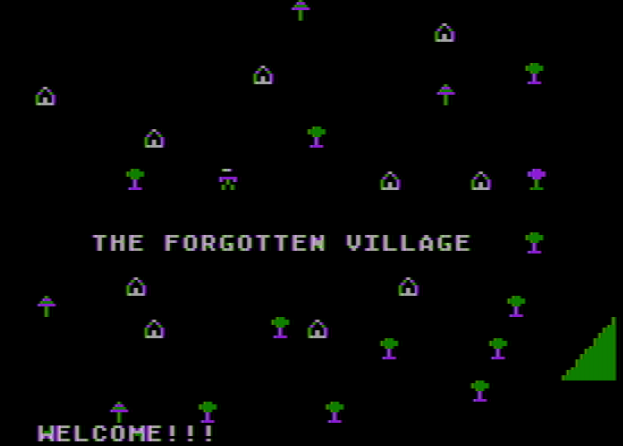
Island plays a lot like a less sophisticated version of Fantasyland 2041, which itself wasn't very sophisticated. From the original island, you pass through a series of areas small enough that you don't need to map anything. There are no puzzles. Commands are limited to movement, a couple of attack options, and checking your inventory. There's a "Forgotten Village" in the opening area where you can spend your gold for a few items: a metal axe (which I guess improves combat), stringy rope, an old lamp, a small straw raft, and a first aid kit. I'm not sure what the first aid kit does, but the other items are all necessary in various places; for instance, you need the lamp to see in a cave, and you need the raft to cross a river.
         
The few items for sale in the village. What do you suppose is up with those prices?
         
As you explore, the game warns you about nearby enemies. When they finally acquire you, they rush up and attack. Where Fantasyland 2041 had both visible enemies that would run up to the character and invisible ones that attacked at random, Island only has the former. They spawn from central points on each screen, making them relatively easy to avoid. Even if they weren't easy to avoid, they're easy enough to fight. When you engage in combat, you can attack or flee. (Fleeing puts you all the way back at the shipwreck.) Attacking prompts you to hit the joystick button, at which point random numbers flash at the bottom of the screen for the number of hit points that you lose versus the number that he loses. They flash too fast to time your next button press, which freezes the current values and deducts them accordingly. Begin next round. I assume your power weighs the numbers. Although the values were all between 0 and 20, the enemy almost always suffered more damage.


Attacked by a "Harris" in some woods.

Victories give you additional hit points, and your health fully regenerates after each battle. Soon you have 200 hit points and you're facing enemies with 20, and with the rolls weighted in your favor. Beyond the first couple of combats, you aren't in the slightest danger of death.
             
Fighting an enemy in a cave.
         
The first major task is to enter some caves and find the diary of Alcemnon, a previous shipwreck victim who was eventually killed by "Harrises," the enemies who roam the starting area. That must be some in-joke. Other than some generic mumbo-jumbo, Alcemnon has a clue to "try the other side!" He also mentions seeking Sarfon's Cloak.
           
Most of Alcemnon's diary.
          
Once you have the diary, you can enter the volcano and the Cavern of the Satyrs. Enemies change to satyrs but otherwise behave the same as the "Harrises" outside.

Like a lot of Crystalware games, Island suggests side-view graphics even in its top-down interface.
           
You have to find the Tomb of Pan to recover Pan's Flute and thus enter the next area: The Forgotten Gardens of the Shirrah Shirrith, a phrase for which this page will soon be the only Google result. Enemies here are "giant med flies," but again not remotely dangerous.
             
Anyone want to take a stab at the origin for this term?
        
Another cave dumps you into the Forgotten Tombs of Safron. The game can't decide whether it's "Sarfon" or "Safron," but it hardly matters either way. You can spend time exploring the tombs--enemies are generic "guards"--and find the magic cloak, but you don't need it.
           
An unnecessary part of the tomb.
         
The tombs exit back to the island, and it's at the exit that Alcemnon's clue becomes important. If you choose the obvious "front" side of the exit, the area of the island on which you appear is a dead end. But if you wander around to the back, you head for the endgame.

The last area of the game is a small maze called "Alcemnon's Home." To enter, you have to pass some inert demons who kill you instantly unless you're wearing Sarfon's Cloak--or unless, as I found out the first time, you simply walk between them diagonally.
           
These guardians mean instant death--unless you thread through them diagonally.
        
Deep in Alcemnon's Home, you find a flare gun. The moment you touch it, you get a message that you fired it. "Welcome back to San Francisco," a screen congratulates before telling you your final score.
           
But I left my heart on the Forgotten Island.
         
The entire thing took less than an hour. I was astonished at how fast it was over, and I can't imagine why any player would need take advantage of its save capability. House of Usher and Beneath the Pyramids were both at least somewhat replayable. The best I can give it on a GIMLET is 10, with 1s across the board except for NPCs (0) and quests (2).

Benioff wrote Quest for Power for Crystalware during the same year, plus The Crypt, The Nightmare, and The Bermuda Experience in 1982. He also ported several of John Bell's games. At some point, the Bells must have sold their entire catalog to Automated Simulations (soon to be renamed Epyx), because new versions of the Crystalware titles were issued by Automated Simulations as early as 1982. Almost all of them were renamed. The Crypt became Crypt of the Undead; The Nightmare became The Haunted Palace; Quest for Power became King Arthur's Heir; and The Forgotten Island became Escape from Vulcan's Isle. The republished version has Epyx's traditional production values; honestly, the manual, full of sound and fury and quotes from Dante and The Island of Doctor Moreau, is all a bit much for such a trite game. The game itself is completely identical except a different title screen and font.
       
Escape from Vulcan's Isle is the same game as The Forgotten Isle, just with a different publisher.
         
If Marc ever makes it here, I guess I shouldn't expect a life-changing Patreon subscription or "Man of the Year." But his creation seems so much like Crystalware's other titles--which are beginning to feel highly formulaic--that I wonder how he knew the Bells and ended up programming a game with such a similar look and feel. At least he didn't suggest some greater mystery beneath the surface.

Tuesday, October 22, 2019

Fantasyland 2041: Won! (with Summary and Rating)

Does that mean Guinevere is real?! Or have I just carried a robot out of the park?
       
Fantasyland 2041
United States
Crystalware (developer and original publisher); Epyx (later publisher)
Released in 1981 for Apple II and Atari 800
Date Started: 9 October 2019
Date Finished: 19 October 2019
Total Hours: 9
Difficulty: Hard (4/5)
Final Rating: 18
Ranking at time of posting: 68/333 (20%)
         
Summary:

Fantasyland 2041 is an epic adventure on non-epic hardware: a long, difficult game with primitive graphics and mechanics. Set in a Westworld-like future of holograms and animatronics, guests proceed through a series of adventure scenarios--Congoland, Arabian Adventure, King Arthur, Olympus, Captain Nemo, and Dante's Inferno--and back again. Along the way, they must find certain items to rescue Lancelot or Guinevere from hell. They must also manage food and inventory, fight hostile parties, and solve a few light inventory puzzles. The interface is top-down, which often conflicts mentally with what looks like first-person graphics. The game's scope and intent are admirable, but ultimately it's too annoying and boring for the graphics, sound, and mechanical complexity of the era.
       
******
       
The manual to Fantasyland 2041 takes pains to emphasize the length and difficulty of the adventure.
           
[Y[ou may conclude that it is impossible to ever finish or win this game. We had to make it pretty tough. The average adventurer will probably never see the Throne of Lucifer or make it past the gates to the Underworld. We hope that just the experience of a single adventure will be sufficiently entertaining to satisfy our most critical hobbyists.
          
I can sympathize. Players expected, as they do now, to get a certain amount of playing time out of a $40.00 purchase. Arcade games satisfied that time minimum by being repeatable, but for adventure games and RPGs, a lot of the mystery was gone after you won for the first time. Thus, the developer had to prolong that time. Eventually, they would do that with bigger worlds and more game detail, but those weren't options in the early years of the microcomputer. (Less because of technology and more because of a lack of innovative templates.) So instead, they prolonged the games by just making them hard. Permadeath was a common solution. Fantasyland goes a different direction by allowing you to save anywhere but almost always rolling the dice against you.

There's a seed of a good game in Fantasyland 2041, and part of me wishes John Bell had waited several years and then developed it under the influence of, say, the Ultima series. I would have liked to experience it with more complex commands, more thoughtful puzzles, interesting NPCs, and tactical combat. Instead, game design is as primitive as the world it inhabits, involving a lot of trial and error before the player learns enough to make a successful winning run.

As we covered in the first entry, exploring the land is a very linear process. The Hall of Heroes leads to Congoland, which leads to the Arabian Adventure, which leads to King Arthur. These first three lands are all quite similar.
           
  • Each one has individual enemies visible on-screen who chase you around the map and attack you. In Congoland, these are tigers and gorillas. In the Arabian Adventure, they're samurai. In King Arthur, they're Modred and the Black Knight.
          
I'm not sure I remember this part of Le Morte D'Arthur.
           
  • Each has packs of enemies who can attack randomly at any moment (while you're standing still or moving) but are not seen on-screen. Across the three lands, these progressed from headhunters and Zulu warriors to Turks and scorpions to knights and archers.
  • Each has physical features that are dangerous to bump into, running the risk of losing equipment or companions. These include swamps, logs, mountain crevices, fallen logs, and cliffs.
           
          
  • Each has random environmental effects (earthquakes, sandstorms) that have the same effect.
  • Each has treasure chests to find and loot, and villages where you can buy and sell goods and companions.
  • Each has a special spellcasting enemy--witch doctors, genies, and sorcerers--who are necessary to have in your party to "solve" the area.
  • Each culminates at a door to the next world, where you must use the magic of one of your spellcasters to progress.
           
Each land is made of blocks of roughly 8 x 8. It's tough to count exactly because the screens continually scroll. Each block can have a particular type of terrain. The manual organizes these blocks into named sections ("Jungles," "the Desert," "Baghdad," "Stonehenge") and gives you clues about what you need to accomplish there.

King Arthur's world changed the rules a bit by allowing parties of knights and archers to join you when you (G)reet them rather than attack. This sounds like a good idea, but the most difficult feature of the game is keeping all your companions fed. You can only carry a maximum of 255 of any item, including rations, and every companion eats a meal roughly two game minutes. If you somehow get 100 companions in your party, you have at most about five minutes before they start to starve to death. You can barely move between all the death notices and the need to constantly stop and drop equipment, so once characters start starving, it's basically a reload.
           
I don't remember why this was here.
         
Thus, resource issues discourage you from developing a large party, particularly since enemy parties just scale to your size anyway. However, the "individual" enemies on each map--Modred and the Black Knight on King Arthur's map--all have high strength and need a large party to successfully counter, particularly if you want to minimize the chance that they'll kill your spellcasters. Thus, you have to find the balance between logistical annoyance and combat effectiveness.

King Arthur's realm features a dragon's lair, with the dragon guarding the sword Excalibur. The dragon has 50,000 strength, which can only be countered by a very large party. To defeat the dragon, I hung out near his lair, let hundreds of companions join me, killed him, grabbed Excalibur, and then dropped the companions. Having Excalibur among my equipment made the rest of the game a lot easier.
         
Fighting a dragon to get Excalibur.
          
There's also a second artifact to find in King Arthur's territory: a Ring of Power. The manual makes a big deal about the importance of Rings of Power, but I only ever found two, and as far as I could tell, they just sat in my inventory. I never employed them. Also in King Arthur's realm: Holy Grails (plural!) show up in treasure chests and can be sold for a lot of money.

King Arthur's world culminates in Merlin's Labyrinth, another maze. Getting past Merlin involves using one of the magic items you've acquired from the witch doctor, sorcerer, or genie. Once he's gone, you can progress to Olympus.

I'll pause here to note that (U)sing items is one of the more annoying parts of the game. Every time you hit the command, you have to scroll through multiple inventory pages before you get to the place where you enter the item's number. Since the "B" key also scrolls through inventory, the developers should have had "U" just take you right to entering the number, in case you already remembered it. A lot of items, like scrolls, feel like they should be useable but are not.
           
Inventory eventually gets very unwieldy.
        
The Olympus level changes the rules. You begin at Olympus itself, a town where you can buy and sell goods. You must buy the ship Argos, which appears off the "coast" to the west. To get to the ship, you have to buy a longboat and (U)se it at the edge of the Olympus screen. Once you're on the Argos, you need a sail, an anchor, and oars to operate it. You have to (U)se the anchor to lift it, and after that you can either row with oars, which allows you to go any direction but consumes more food, or sail with the winds, which is a little harder to master.
          
Sailing away from Olympus.
         
The level is populated with numerous islands. I couldn't figure out how to land on the Isle of Delos to the west. A northwest island had the Cyclops, who carried 2,000 gold pieces. A northeast island had the sorceress Circe, who carried the second Ring of Power. Finally, an eastern island, Thera, had the portal to the next land. I should mention that we get the only complex sound on this level, with a cycling shhhhh suggesting waves.
           
The Argos waits offshore while the party picks up the Ring of Power from the slain Circe.
        
There was a lot of inventory shuffling because to enter Captain Nemo's world, you need a submarine, which you can purchase in Olympus, but it's enormously heavy, so you need people without equipment to bear the weight. Once you choose to enter the submarine, however, your companion and inventory maximums drop precipitously, and you have to jettison a lot of people and stuff.
          
Handling logistics for boarding the submarine.
          
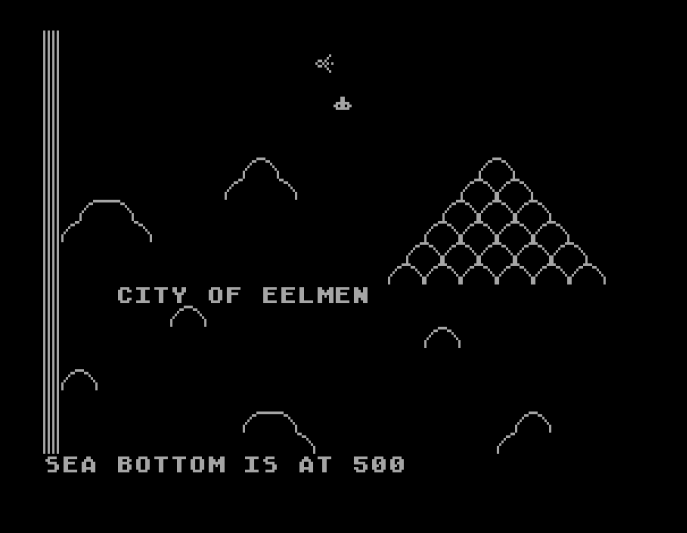
Captain Nemo's world is all underwater, and running the submarine into any object causes it to fall apart. I think you can fix it with "spare parts," but I had neglected to purchase any of these, so any time I accidentally rammed into a coral reef, I had to reload. There are treasure chests that you can send divers with diving suits out to retrieve, but only at certain depths. I found the whole level frustrating and thus wasn't unhappy when I found Atlantis in the northwest corner and immediately transitioned to the final level.
        
I never figured out anything to do in the City of Eelmen.
        
Dante's Inferno takes place among brimstone pits and rows of demons who just stand there until you run into them, at which point they kill your companions. The City of Dis in the northwest is the first place to buy and sell equipment and companions since Olympus. Demons and Nosferatu attack as you explore, although I found that around a dozen knights plus Excalibur made short work of them.
              
At least they make me feel "welcome."
           
Rivers of fire funnel you to the north, where you have to use a plank (sold in Dis) to cross an abyss. Finally, in the northwest corner, you find Lancelot or Guinevere being guarded by Lucifer. As long as you have the two Rings of Power and a Signet Ring from Camelot (the manual warns you to buy it), he or she will come along with you immediately.
         
All I did was walk up to him. This felt anti-climactic.
       
At that point--much to my furor--you have to reverse your steps and make your way all the way back to the beginning, traversing each of the lands in reverse order. That took longer than it should have because I had gotten rid of a lot of the items needed for the ship and submarine, thinking I wouldn't need them again.

Returning to the entrance gives you a brief message that "You made it back with Guinevere" and then a "Final Score" screen that summarizes your wealth, experience, and time. The screen encouraged early players to send their disks to Crystalware for a chance to win $1000, with the winner chosen from the highest scorer to solve the game before 1 December 1981.
          
201 days?! How do people take that much time off work in the future?
        
One outstanding mystery concerns, well, "The Great Mystery." This is what the manual has to say about it:
          
To win the prize, you must solve the Great Mystery and beat out your competitors in treasure and courage . . . The mystery is unlike any of the others. It is not an anagram nor is it found anywhere on the disk in basic or machine language . . . At the end of the game, if you make it, you will be prompted to send your disk in if you wish to enter the contest. Do not try to make a copy to send in; it must be the original. At our plant, we have a huge score board, with a list of all the fantasylanders and their achievements. The person to solve the mystery and score the highest will be awarded a trophy and receive $1,000 in cash.
            
So there's supposedly some Great Mystery that you have to solve to win the prize--but it's not the same thing as winning the game by finding Lancelot or Guinevere, which you presumably have to do, too. More important, the instructions only mention sending in the disk. How will the developers know that someone has solved the Great Mystery, too? Is it somehow recorded on the disk? Did they assume players would know enough to include a separate note? What did they mean when they say the mystery "is unlike any of the others"? Any of the other what?

A re-read of the manual produces few clues. There are poems that suggest using the rings or perhaps scrolls on the "666" of King Solomon's Temple, but nothing I try works. Messages just tell me that those items are "already in use." I've inspected the disks, and I can't find any text related to a bigger mystery, but then again the manual itself warned me that wouldn't work.
          
Here's a scene from Dante's Inferno. I have no idea what's going on, or who that guy in the center is. Touching any of the figures around him causes your companions to die. Maybe this had something to do with the Great Mystery?
           
Fantasyland 2041 isn't much of an RPG. It lacks any character development (I don't think the "experience" statistic does anything for you during the game) or personal inventory, and combat is as simple as a game of War. I give it an 18 on the GIMLET, with the best scores (3s) in encounters and inventory. I still don't know the purpose of half the stuff you can pick up. I don't believe I ever used a rope, a shovel, a spotlight, citrus fruit (I assume it was there to stave off scurvy, but no one ever ate it), quinine, a compass, a magic carpet, a box of sand, mushrooms, a lute, squid ink, a wooden stake, or half a dozen other items that didn't seem to be weapons, armor, or treasure.

We also leave the game with some out-of-game mysteries as well. Why did John Bell announce in the manual that this would be his last great fantasy? What happened to him and Patricia Bell after 1982, when the last Crystalware title was published? How did it morph into Crystalware Defense and Nanotechnology of the 2010s, and what did Bell do in the meantime?

I've been exposed to three Crystalware games at this point, and all of them are similar in their interfaces, mechanics, and suggestions that something deeper is happening beneath the game's surface. I have four more on my list and will probably be a bit less forgiving about their statuses as RPGs under my rules. Nonetheless, it was fun to see another example of a developer who, in the area of five-and-a-quarter-inch floppy disks, dared to dream big.

Saturday, October 19, 2019

Game 341: Shape Shifter (1992)

          
Shape Shifter
United States
Independently developed and released as shareware
Released in 1992 for DOS
Date Started: 17 October 2019
Date Finished: 18 October 2019
Total Hours: 4
Difficulty: Easy (2/5)
Final Rating: 17
Ranking at time of posting: 61/343 (18%)

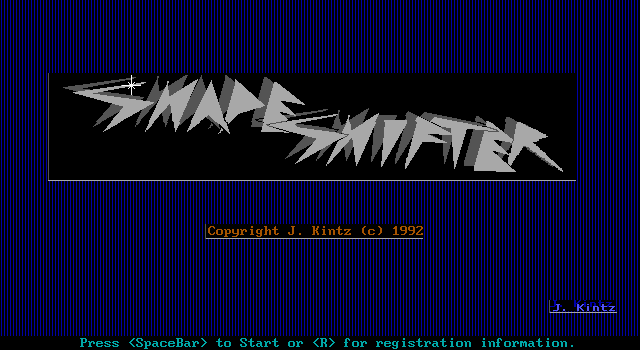
Some years ago, I modified my rules to allow myself to reject independent games "if they are clearly amateur efforts with no innovations or accolades attached to them." I have never invoked the rule. The problem with the rule is that it almost seems like there's at least one innovation to explore. It's only after several hours, when you've committed to the game (or else you'll have nothing else to publish), that you realize that you've been hoodwinked.

In the case of Shape Shifter, the element that sucked me in was right there in the title. You play a non-human character who can polymorph from a tiger to a snake to a mouse. The tiger, we learn, is strong and good at combat, but also slow and obvious, thus inviting more encounters. The snake avoids most combat, the mouse almost all of it. I figured the game would feature some interesting puzzles and encounters that relied on the ability to shape-shift.
            
The game opens with the player as a tiger.
           
The manual establishes the land as Vor Terra. Creatures of Chaos are invading the world via a rift in the space-time continuum. To face the threat, Lord Drelx Axtvqar created the Absomal Fxile, a council of the most intelligent (which, ironically, the manual repeatedly spells as "intellegent") creatures in the land. The Absomal Fxile sequestered itself in an impenetrable palace. "It is the goal of every living creature," the manual offers, "to one day join rule with the Absomal Fxile," whatever that means. To gain access to the palace, the character will need to significantly increase his knowledge and solve a variety of puzzles.
              
I explore another part of the world as a snake.
         
Character creation asks only for a name, after which the character begins in tiger form. Statistics are strength, knowledge, speed, and health. The numbers redistribute every time you change forms; for instance, the starting character has 55 strength and 25 speed as a tiger, 25 strength and 45 speed as a snake, and 20 strength and 55 speed as a mouse.
       
Checking my statistics on a city street.
           
As you explore the land, random encounters mess with your statistics. Angry gnats, chill winds, and snare traps sap your health. A "horrible darkness" decreases health and knowledge. The goddess Sona Luna might suddenly decide to increase your health and knowledge, or "friendly wicker people" might give you a boost to strength, speed, and knowledge. Two of the cities have temples to gods who alternately boost and decimate your statistics.
            
A random event costs some health.
           
There are also combat encounters, and here the developer shows something of Chuck Dougherty's (Questron) inventiveness with monster names--if Dougherty had endeavored to make them all unpronounceable. You face off against Illio Mucks, Nubliagg Frimuth Teroptts, MetzoBraums, Altzo Mafts, and Thraxiax Runners, among others. You and they do an amount of damage determined by your speed and strength. You get "credits" with every victory.
          
Combat is a rote exchange of blows with weird creatures.
         
The game takes place on 9 adventure screens arranged 3 x 3. The palace is in the far northwest. There are five other cities and towns to enter, each consisting of a single street of structures. Some of them are random buildings that you can search and talk to the residents. Others are more classic RPG facilities like taverns, healers, temples, and shops selling potions that temporarily increase strength and speed. There are no explicit weapons or armor in the game.

An all-keyboard interface works reasonably well, with arrows for movement and the occasional use of easy-to-remember commands like (E)nter, (I)nventory, and (U)se. The screen shows your available options in special circumstances.
                 
Getting a clue from a tavern patron.
             
So far, none of this sounds too bad, but the game simply doesn't add up to anything interesting or enjoyable. The world is extremely small, and you can explore the 9 screens and 5 cities and towns in significantly less than an hour. There are no puzzles in these locations. You have to acquire an inventory of artifact items, but you simply find them on your first search of the houses in which they're secreted. (And in a bit of amateur programming, you keep finding them every time you search the houses, even if they're already in your inventory.) There are also clues to find, but you get them by simply hitting T)alk in obvious locations.
             
A magical ring just laying about in an abandoned house.
             
Worse, there's really no reason to use the titular shape-shifting ability. No puzzle or encounter requires you to be a particular animal. (I think there's one tavern where they don't talk to snakes, but that's it.) You might want to swap out of tiger form to avoid combat, but combat is how you earn money, and as long as you replenish hit points by paying for healing, combat isn't all that dangerous.

Over the course of the game, you learn that a key artifact--the Crystal Heart--is in a tower in the southwest part of the map. To enter the tower, you need three keys. Two of them are found in deterministic locations in cities, but the third appears as part of a random encounter in the wilderness, meaning you have to wander around until you get it. By then, you've probably assembled most of the other items and clues you need to solve the encounters in the palace. 
         
Only one thing to do in the "tower."
        
You encounter one odd issue in that once you achieve a certain speed threshold--around 25--you successfully avoid all encounters. The problem is that a few key items and clues only appear with random encounters, so you can character-develop yourself out of victory unless you get lucky and pray to a god who takes umbrage and busts you back below the speed threshold.
                  
One of the keys needed for the tower only appears as a random encounter.
        
The hardest part of the game is finding the Fire Lizard's Bladder that you need to--uck--eat to immunize yourself to a poison mist that surrounds the palace. It only shows up in random encounters, possibly after a certain knowledge threshold, and I began to despair that I would ever find it. I finally got it after wandering and fighting for about an hour.

Part of the endgame sequence involves dealing with Earth Demons . . . 

. . . and crossing a "Rainbow Bridge."
              
The endgame takes place at the palace, where you have to use all your artifacts in sequence. You eat the bladder to escape the mists. You use the "silk wings" to get over the wall. You use the Ring of Flame to destroy some Earth Demons. You use an Amulet of Knowledge to safely cross a Rainbow Bridge. You appease a guardian by giving him the Crystal Heart. Finally, you speak five words of entrance at the door to the Absomal Fxile. All of these solutions are provided in very straightforward clues throughout the game.

It would be easy to make a typo on this final screen.
        
The final message tells you that you have achieved the honor of joining the Absomal Fxile, "the most prestigious council in the land." A final victory screen precedes the DOS prompt.
            
I can't decide if it sounds more like a weapon or a tumor.
            
With 1s and 2s across the board, Shape Shifter earns a 17 on the GIMLET. It's ultimately too trite and unchallenging, and it fails to live up to the promise of its premise. 

The game's author was Jeffrey P. Kintz of Waukegan, Illinois. (He goes by "J. Kintz" in all the documentation.) A 1999 biography indicates that Kintz was 19 when he wrote Shifter. He claims his primary inspirations as the Ultima series, Moebius (1985), and the adventure game Below the Root (1984), although it's hard to see the influence of any of them in his own work.

Shifter was his second game; his first was a horror-themed adventure game called Dismal Passages (1992) in which a protagonist tries to avenge his family's death by tracking down a wraith. Over the subsequent decade, he would churn out half a dozen games, including The Dark Convergence (1993) and its sequel (1994), Elkinloor (1995), a 1995 remake of Dismal Passages, Vor Terra (1996), Borderworld (1996), The Darkest Night (1997), Savage Future (1999), and Lost Infinity Part 1: Roquan's Farewell (2001). All of them except Vor Terra seem to be adventure games, although some of them are set in the same world as Shape Shifter. Enough feature non-human protagonists that it seems to have been something of a thing with Kintz, and in his bio he brags about the appearance of several of his games in a "Furry Video Game Database."
        
A shot from Dismal Passages, which appears to have no character creation.
           
He sometimes published under the label of Aries Software and sometimes Midlothian Software. Although there are signs that his games do get better, Kintz strikes me as one of those Ed-Woodish creators (see this entry for more on Wood and developers I associate with him) whose enthusiasm for making games far surpasses his skill. I tried to see what he's been up to in the last couple decades, but my search led me down some weird paths perhaps best left undiscussed in case I accidentally picked up the trail of the wrong Jeff Kintz.

Apparently, registering Shifter got players a free copy of a sequel called The Sun Demon in which the character faced the origin of the Creatures of Chaos. I was unable to find an extant copy.

If nothing else, an independent one-and-done is a good way to build some momentum after a long break. We'll continue with Fantasyland 2041 soon. For those of you wondering about The Magic Candle III, for some reason I was unable to muster any enthusiasm when I fired it up the other day. I figured I'd best table it for a while longer and play a few games that intrigue me more.