Showing posts with label mapping. Show all posts

Sunday, April 18, 2010

Phantasie: Plugging Along

I continue to only vaguely understand why the colors had to be so bad in the DOS version of this game. I'll try to educate myself, but if someone wants to summarize it in a comment, I'll owe you one.

I think Phantasie is the first CRPG to introduce the convention shown in the above screenshot: hiding the map and only revealing it as you explore. No, scratch that. Rogue did that first. Well, Phantasie is the first non-"Roguelike" to do it, and the first for outdoor areas.

I believe we're also seeing the first "side quests." I received a mission in a dungeon to rescue a priest from some lizardmen. This could be part of the main quest, so I don't know just yet if it's a first. Either way, it's fun to see the elements that now come naturally in CRPGs introduced game by game.


A neat feature of the game is that as you explore new areas, you find scrolls that help explain the area, provide hints to your quests, and flesh out the stories. For instance, the scroll below talks about the cave where I am to find the uncle of Lord Wood.


Alas, it did not end well for the unfortunate uncle:


The game is progressively getting more difficult (although it hasn't really become "hard" yet), with battles against numerous tough foes, including spellcasters and legions of undead.


I have already slain four Black Knights, and from what the scrolls suggest, there are only nine of them. I suspect they do not stay dead, however. They are quite difficult to kill, and 8bitjeff's comment in my first Phantasie posting about needing the Fireflash IV spell turned out to be rather prophetic. It's really the only thing that does any serious damage.


My biggest problem at this point is gold. It costs thousands and thousands to level up my ogre fighter, dwarf fighter, and hobbit thief, and I never seem to have enough. Several of my characters are two or three levels below where they could be if I just had sufficient funds. I hope dungeons coming up bring more riches.

It's also fun, in a vaguely annoying way, to see how these older games protected themselves against piracy. The Bard's Tale would make you answer questions from the game map when you leveled up. Now as I explore the Phantasie dungeons, the game periodically stops to ask me questions from the manual, like this one:


The game makers, of course, didn't anticipate flatbed scanners, OCR, and the Internet.

That's about all there is to cover right now. I'm definitely going to continue with this one until the end.

Monday, April 12, 2010

Game 15: Phantasie (1985)


Phantasie
United States
Independently developed; published by Strategic Simulations, Inc.
Released 1985 for Apple II and Commodore 64; 1986 for Atari ST, PC-88, PC-98, and FM-7; 1987 for Atari 800, Amiga, and Sharp X1; 1988 for DOS and MSX
Date Started: 13 April 2010
      

In a response to my first posting, a blogger going by the handle Gooberslot asked a good question: "Why only PC rpgs? You say you don't want to 'frig' around with emulators but dosbox is an emulator too. Plus, you're missing out on playing the best version in some cases. The PC sucked compared to some other computers until VGA came out and it still sucked in the sound department for a while after that."

Phantasie illustrates this quite well. Here, for instance, is a screenshot of the Amiga version of Phantasie:
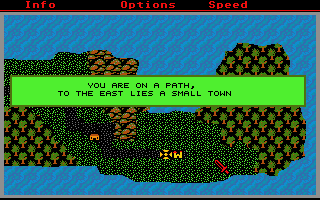


Here, in contrast, is the same screenshot from my DOS port:


Yuck, right? Here's a nice shot from the Atari ST version in battle:


..versus my DOS version:


I am green with envy. Get it...green with...right. Moving on.

So, at least in the graphics department, the DOS version blows. And a couple of weeks ago, when I posed the question, you were almost all for me trying the non-DOS versions. So yesterday evening, I made an attempt. I Googled "Apple II emulator," "C64 emulator," "Atari ST emulator," downloaded some, and gave it a go. I'll spare you the rest of the details--which involve a difficulty finding Phantasie downloads for some of those systems, an unfamiliarity with their conventions, crashes and freezes (perhaps owing to my running Windows 7), lack of clear DOSBox-like frontrunners in the emulator departments, and so on--and simply announce my recommittment, as bad as the graphics are, to staying with a DOS/PC-only gameplan.

That aside, I like Phantasie so far. The story is simple: the island continent of Gelnor has been conquered by a tyrannical wizard named Nikademus, who maintains fear with a cadre of near-invincible Black Knights. Your party is composed of newly-arrived adventurers seeking fame and fortune, and liberating the land from Nikademus seems like a sure way to both.

Phantasie is notable as the first RPG from Strategic Simulations, Inc. (SSI), which would soon gain the gratitude of CRPG fans everywhere by making the "gold box" Dungeons & Dragons games. That reminds me: how long is it until I get to Pool of Radiance? One, two, three, four....nineteen games. Damn.

The game is multi-character, allowing you to choose from fighter, monk, priest, ranger, thief, and wizard classes. It offers more races than any CRPG I can think of: in addition to humans, dwarves, elves, gnomes, and halflings, you can also play gnolls, goblins, kobolds, lizard men, minotaurs, ogres, orcs, pixies, sprites, and trolls. Wow. The monster classes all excel in at least one attribute (you have the standard strength, intelligence, dexterity, etc. in this game) but they pay for it in increased training costs. And the manual isn't kidding about this: it cost 24 gold to move my human ranger for level 2 to level 3; for my ogre fighter, it was 1,056 gold.

You move about the game world in a top-down perspective, with your entire party represented by a single icon, much like in Ultima III. The perspective changes a bit when you enter a dungeon. The dungeons look like paper maps in which you reveal passageways as you move. Special encounters are represented by little symbols and described in text at the bottom. It sounds primitive, but I actually rather like it.


Since you can save your dungeon progress when you leave, this makes Phantasie the first game I know to automap. The encounters have been fun and fresh so far: levers to pull, a sage with a ring, a door that locked me in a room until I found a secret exit, and a "pile of gold covered with a gooey substance" that turned out to be the honeycombs of a giant bee hive.

The combat system in Phantasie is unusual and, I think, rather fun. Statistically and tactically, I suppose it's little different than Wizardry or The Bard's Tale. Your six characters line up in a single line to face your foes, who can be in up to four ranks. Most of your characters can attack only the first rank, but your thief can dart into any rank and your spellcasters can target the entire field. Like Wizardry, you set an action for each character and execute them all at once. The unique thing is that the animation shows your characters leaping and thrusting when their turn comes, and their blows connect with a satisfying crunch.


The animation doesn't change the basic tactics, though. Each of your characters can attack, parry, or cast a spell. Attacks are split into thrust (more damage, only one attack), attack (moderate damage, two attacks), and slash (minimal damage, three attacks). You also have the macro options to avoid combat by greeting the monsters, threatening them, fleeing, or begging for their mercy (and giving over your gold).

In between adventures in dungeons and wilderness areas, you return to towns to rest, level up, and buy and sell equipment. When you enter a town, the game asks how you want to divide your accumulated experience points among your characters. I can't think of a single other game that does this, allowing you to channel everything into one character for quick development or spread it evenly among your group. The former options means that if a character dies, you can train a replacement in fairly short order. Man, do I wish Wizardry had that option.

The town of "Pelnor." Arthurian influence?

I created a party consisting of a human ranger (Aodin), an ogre fighter (Ghalar), a dwarf fighter (Yalgar), a halfing priest (Sanctavia), a gnome thief (Slissk), and an elf wizard (Arcanius). In my first couple hours of gameplay, I've explored one dungeon and collected a series of scrolls that tell me more about the land and Nikademus. This is actually a pretty cool way to slowly divulge more about the game world and the central quest.

The scroll goes on to say that nine wizards forged nine magical rings to combat Nikademus, but he perverted the power of the rings and used them to turn the wizards into Black Knights. This is starting to sound vaguely familiar...

Finally, I'll note that the game has been challenging so far. I've lost a few characters, and there's no temple in the towns (at least, not the first town), so I've had to create new ones. Gold looks like it's going to be a problem; I have a few characters ready to level up but not enough money to pay for it. You can only save in towns, but at least (unlike Wizardry and The Bard's Tale) you have the option to quit without saving if the battle goes badly.

In short, Phantasie has tactics as deep as Wizardry, stuff in dungeons as varied as Telengard, a lore as rich as Ultima III, and a difficultly level as pleasing as The Bard's Tale in its early stages. I hope the rest of the game lives up to its beginnings!

(If you're interested in a video of the gameplay, including the combat, here's one on YouTube, albiet for the Atari ST version. Hopefully I'll finish setting up my new laptop soon and I can make my own.)

Monday, March 8, 2010

Game 8: Exodus: Ultima III (1983)

      
Exodus: Ultima III
United States
ORIGIN Systems (developer and publisher)
Released in 1983 for Apple II, Atari 800, and Commodore 64; 1985 for DOS, Macintosh, PC-88, and PC-98; 1986 for FM-7, Amiga, and Atari ST; 1987 for NES; 1989 for Sharp X1
Date Started: 7 March 2010
        
My first impressions of Ultima III are that it redeems Ultima II. It feels like a real game instead of Richard Garriott screwing around. It (at least so far) keeps the game grounded in more standard fantasy conventions without involving light swords and rocketships. Combat is more tactical and interesting (if longer), equipment and items are more varied, the magic system is more sophisticated, dungeons have a reason to exist, and the overall gameplay, to me, is a lot more satisfying. This is the first game from Origin Systems, Richard Garriott's company; his first two games were published by established game producers.

Ultima III was released in 1983 for the Apple II, the Atari, and the Commodore 64. I'm playing a DOS port from two years later. In fairness, I should mention that I also downloaded and installed a graphics and sound upgrade package designed by some cool programmers over a decade ago. Compare the screen shot above to the original below, and you'll see why.


Ultima III begins an era of games in which it really pays to read the manually carefully first. The manual and its accoutrements are one of the things that Garriott and Origin really excelled at. Each game in the original series came with a hand-drawn cloth map (I read somewhere that it took Garriott a long time to find a publisher for Ultima II because he insisted that they produce the cloth map with every game) and an ornately-decorated, magniloquently-written game manual. Consider the opening paragraphs of the manual:

Welcome back, oh illustrious adventurers! Long has been thy sojourn in this strange realm, though 'tis a fitting respite for great heroes. Glorious are the names of those adventurers who slew the mighty Wizard Mondain and his evil consort Minax. Lord British's minstrels still sing thy praises for the epic battles waged in the overthrowing of those two crimson necromancers. The chronicles of Ultima I and Ultima II bear witness to thine effects on behalf of the good subjects of the realm of Sosaria.

"The time of thy rest is now o'er. Thou wouldst not be here if thou hadst not heard the distant braying of the war horns, or felt in thy blood the cry of kinsmen in dire peril. Thou art Called, and from such a Calling none of the People may turn aside. It is thy duty and thy destiny.

Aside from the fact that Ultima II has nothing to do with Sosaria, it's beautiful prose. Sometimes, they go a bit campy with their metaphors. Nothing beats: "With the fall of Mondain and Minax, peace had flowed like molten honey around all of Sosaria." Yes, there's nothing like the molten honey of peace.

The basic setup is that a new evil, called Exodus, the "child" (either metaphorically or actually) of Mondain and Minax has appeared on an island of lava in the middle of the ocean. None know whether Exodus is "man, monster, or daemon." The only way we know its name is that the word "EXODUS" was found written in blood on the deck of a ship from which all crew had vanished, "as if plucked by some evil force." Also, a "shattered man found wandering the groves" outside Lord British's castle had this to say: "from the depths of Hell, he comes for vengeance." I tell you, I just eat this stuff up. In a modern game, this would all be handled with a cut scene, but I almost find the manual more fun.

Nothing compares to the spell manuals, though. Ultima III follows Wizardry's (and, for that matter, Dungeons & Dragons's) example of dividing spells into priest spells and wizard spells (or holy magic and arcane magic, if you prefer). In-game, you cast a spell by specifying the character and the spell letter. There are 16 spells on each side, each with a letter from A to P. Cleric A is turn undead while wizard C is light. But, God, how the spell book describes them!

I didn't put this much effort into my wedding vows.

To cast a light spell--or "Lorum," as the book has it--you don't just type (c)ast and "c": you chant "obrey uricum obla sum" while casting into the air a small portion of lorum dust, collected from "a spider's bath, which has been warmed by strong sun for many hours." This is art, people. I almost feel bad that I created a little text file as a reference. There are a couple wizard spells so thickly described that I still have no idea what they actually do.

Ultima III is the first game in the series to allow multiple party members, and the classes and races have been expanded to include some that will not only never occur in any other Ultima game but as far as I can tell never occur in any game. For instance, one race is a "fuzzy"--literally little furry creatures--that I suppose could become the emps of Ultima VII but are never a player race again. In addition to fighters, thieves, wizards, and clerics, classes include paladins, barbarians, larks (basically a synonym for bard), illusionists, druids, alchemists, and rangers. Each has a different combination of combat and magic skills, so you have to choose carefully.


Gameplay is in some ways very similar to the previous Ultimas, with a top-down perspective and with actions tied to single keyboard letters. There is more depth to the game world, though, including an early type of "fog of war": you can't see around corners or through dense wooded areas or across mountains. There's also a mysterious (o)ther action command that allows you to do special things you have to discover along the way.

Combat is what makes this Ultima stand out from the others. During the main part of the game, your party of four is represented by a single icon, but when you enter combat, you become four distinct party members, each of which performs an action in turn, including fighting or casting. There are both ranged and melee weapons, plus a wide variety of offensive and defensive spells (although limited spell points), so battle is far more tactical than in many other games of the era. One annoying thing is that monsters can attack diagonally but you cannot. Different icons represent different character types so it's easy to figure out whose turn it is. I'm pretty sure this style of combat remains all the way through Ultima V.


As with previous Ultimas, dungeons are first-person, although a little more interesting in color and items. But the series continues its obsession with food, and keeping from starving is just as difficult as it was in Ultima II--more so, in some cases, because in the dungeons you keep running into gremlins which steal it.


Hit points are dependent upon leveling, not upon bribing the nearest sovereign. You increase in levels by visiting Lord British, who as usual provides no helpful information. I note that Iolo, Gwino, and--making an appearance for the first time--Chuckles are all found in Lord British's castle, and it doesn't look like I'm going to have to kill them this time.

You're not going to demand a tribute from me?

In the early stages of the game, I've been exploring and mapping Sosaria--which isn't all that large--visiting towns, and getting clues from the locals. As with Ultima II, each person gives you exactly one line of dialog and most of them offer stock responds (although not as dumb or annoying as in Ultima II). From those that have something original to say, I've learned that Exodus lies beyond the silver snake, and I'll need to find exotic arms to defeat him, as only they will protect me from great evil. Other clues--and I'm not sure how they relate yet--tell me to seek a place called Ambrosia, seek the Shrines of Truth, journey through a whirlpool (I have a feeling these are all related), seek the jester in the Castle of Fire, and to find "marks" and "cards." There are apparently four of the latter, and I need to use the command to stick them into panels somewhere.

I haven't gotten a ship yet, and I can see towns and dungeons off shore, so I need to find a frigate next.

One word on the mapping: the game isn't conducive to graph paper, so I imported the cloth map as a raster image into a geographic information system (GIS) program called MapInfo Professional. I then created a vector layer to draw on top of the map, so I can note the locations of towns and their names. Overkill? Perhaps. But fun.