Showing posts with label Xanadu. Show all posts

Thursday, April 14, 2016

Xanadu: Dragon Slayer II: Summary and Rating

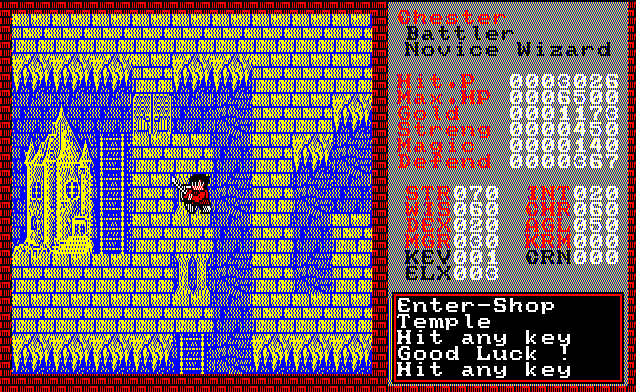
Here I am in front of a castle with a scorpion or something.
  
Xanadu: Dragon Slayer II
Japan
Nihon Falcom (developer and publisher)
Released 1985 for PC-88, PC-98, and Sharp X1; 1986 for FM-7; 1987 for MSX
Date Started: 27 March 2016
Date Ended: 11 April 2016
Total Hours: 9
Difficulty: Moderate-Hard (3.5/5)
Final Rating: 26
Ranking at Time of Posting: 94/215 (44%)
Ranking at Game #452: 230/452 (51%)
     
It's been a long time since I felt this pathetic about my attempt to play a game. The late summer of 2015 brought a spate of games in a row--Antares, Out of the Shadows, The Ormus Saga, and Dungeons of Avalon--that I didn't or couldn't finish, but I at least played them long enough to get a full sense of what they offered. The last time I bailed on a title without feeling like I had at least experienced the totality of the gameplay was back in 2011.

But I just can't bring myself to continue with Xanadu. My sessions with the game have been the living definition of "ennui." Its approach is miles different from what I like about the role-playing genre. I have no interest in watching a GCLM run around, climb ladders, and bump into enemies in a setting that lacks NPCs or a story. I tolerated it for short games like Hydlide and the first Dragon Slayer, but this one is just way too long and exhausting. And as we talked about last time, its closed economy and experience system leave me constantly anxious that I'm doing everything wrong. My game periods keep coasting to a stop with nothing having been achieved. I keep saying, "What have I really accomplished in the last half hour?," coming up short with the answer, and killing the session without saving. I keep getting stuck because I run out of keys and money to buy new keys. I'm sick of Level 2 but the doorways to Level 3 won't open and I don't know why. In 9 hours of play, I don't feel like I did much more than dither around.

The weird thing is, I fundamentally realize that Xanadu isn't that hard--there are paths to explore that I haven't explored and enemies that I haven't slain--but I just get filled with distaste when I think of playing any more. Don't ask me to explain it. I think we can all agree that, despite it being a role-playing game, Xanadu is vastly different in its approach than the types of games I rate highly. Having agreed that it's different, you'll just have to accept that I don't like this kind of game. I promise I won't judge you for liking it. It would be a boring world if we all had the same tastes.
    
I guess this would have been the final boss. Screenshot courtesy of Hardcore Gaming 101.
   
I feel particularly bad because even though Xanadu seems quite popular, there isn't much about it online. I couldn't find any endgame videos, for instance. From descriptions, I gather that the game ends when you find a "dragon slayer" sword and kill a dragon named Galsis. But all I can rate is what I experienced, which is:

  • 0 points for the game world. The land has a king is all I can tell you. Even the documentation doesn't seem to have offered anything.
  • 4 points for character creation and development. There's a reasonably complex RPG character sheet here, with a full set of attributes and separate experience for fighting and magic. How you spend your initial funds on attributes and how you fight enemies throughout the game helps you define your character as a fighter, wizard, or hybrid. This is all great. But let's not have any more of this individual-experience-per-weapon-and-armor-type thing again. Not unless daggers and short swords can somehow remain relevant the whole game. Also, the "karma" system is pretty nonsensical.
   
Some of my statistics.
    
  • 0 points for no NPC interaction.
  • 3 points for encounters and foes. The enemies have some strengths and weaknesses depending on type, and there are boss-level enemies that require special tactics.
  • 2 points for magic and combat. I will never like the "bump" combat system. Magic is a little more advanced here, requiring the player to select from a variety of spells. But too much boils down to action and manual dexterity.
     
These guys were really hard.
    
  • 4 points for equipment. I really like the variety of special magic items that you can find and use.
  • 6 points for economy. A major part of the game, and a major resource to manage, it never stops being relevant. I just wish it wasn't a closed system.
  • 1 point for the quest. I assume there is one, but the game gives you no information about it.
  • 3 points for graphics, sound, and interface. I didn't have any major complaints with any of them, but they're only good enough for the period. The interface did have a few snags and was clearly optimized for a joystick.
  • 3 points for gameplay. It feels both linear and nonlinear, as in many paths are open but you have to complete them in a particular order to have a chance. I guess it has some replayability with different approaches to class and character development.

That's a final score of 26, a number high enough to describe some games that I enjoyed. I didn't enjoy this one at all, but I can't put my finger on the "why" well enough to deliberately subtract any points.

I recognize that I'm in the minority on this one. It was hugely popular. According to Wikipedia, its 1985 sales total of 400,000 in Japan alone has yet to be broken (that seems low to me, but that's what Wikipedia says). The soundtrack was so popular that a Japanese band released a best-selling album based on it. The game influenced later series like Ys and Zelda and perhaps even Final Fantasy. It launched its own sub-series of the Dragon Slayer line, with Scenario II (an expansion pack) coming out in 1986, followed by Faxanadu (1987), The Legend of Xanadu (1994), Revival Xanadu (1995;   this one a remake rather than a sequel), The Legend of Xanadu II (1995), and Xanadu Next (2005).
       
A screenshot from the "Revival" remake doesn't look much different than the original.
   
I gave decent ratings to Zeliard and The Ancient Land of Ys, both clearly influenced by Xanadu, so it's possible for me to enjoy this style of game (at least somewhat) with some additional features. But I didn't enjoy this one. Sorry. I really do feel bad about ending this soon and writing such a truncated final posting. I won't make you wait the usual 3 days for the next entry; I want to forget this one as soon as possible.
    
******
    
After a very frustrating experience trying to start Shadow Keep, I kicked it down the list a little ways. I've lost patience with Mac emulation for now. It took me several hours to get the Basilisk II emulator working properly. I first tried to set up a newer version but got some common "black screen" error so I had to start over with an older version. That worked, but then I couldn't extract the .sit files that the game came in. I downloaded two different versions of StuffIt Expander for Windows, but both just crashed on loading (and messed up my .zip file associations at the same time).

Finally, some readers helped out with extracted versions of the game. I got it started only to find that Shadow Keep runs way too fast in Bailisk II and there's no way to slow down the emulator. Also, it kept crashing during the game. So now if I'm going to run the game, I have to start all over and try to set up a different emulator, like Mini vMac.

Setting up KEGS, the Apple IIGS emulator, was no picnic either, but I seem to have it running. I'll try Dark Designs III next.


Saturday, April 2, 2016

Xanadu: A Closed System

A frustrating jumping puzzle on Level 2. You have to hit just the right combination of keys to bounce up to the platform above. Without save states, I'd never have the patience.
   
Xanadu hasn't beaten me yet, but it already has me annoyed with the idea that it might beat me. I often get this feeling in "closed system" RPGs; Xanadu makes it worse by throwing in some additional logistics.

An RPG is a "closed system" when it has a fixed number of encounters (and treasure) that never respawn. They are relatively rare in the genre. Looking over my list, I can only identify a few for sure--Beyond Zork, the Stuart Smith series, Legends of Murder: Stonedale Castle, Dungeons of Avalon, Captive, Dusk of the Gods. There are many that I don't remember for sure, but almost always they belong to adventure/RPG hybrids in which character development and accumulation of wealth are a minor part of the game.

At best, closed systems ensure that no character, upon reaching any particular milestone (including the endgame) is better than any other character. Consider a game in which a character levels up at a consistent rate and there are no character choices to make when leveling. Such a game is really an illusory RPG, because while the character might technically improve, the fact that he improves at a consistent, predictable rate with no input from the player means that this variable is already "controlled for" by the game developer. It may as well not exist. Success will come down probably to manual reaction.

At worst, closed systems can ensure that a player's choices doom him to having a weak character at particular milestones. This often occurs when there's an inter-relationship between variables. Consider a game in which there are a fixed number of monsters. The character finds gold at the end of every battle and can use this gold to purchase healing potions to restore hit points. In such a case, gold and hit points are really just two sides of one variable. The less gold you have, the fewer hit points you can pay to restore over the course of the game. The fewer hit points that you lose, the more gold you have for other purposes. Grinding to gain more gold is not an option. The unskilled or unlucky player thus ends up with less wealth than the skilled or lucky player and thus has worse equipment throughout the game. Because he has worse equipment, he loses more hit points, must pay for more potions, and is doomed to this continual downward spiral until he gets crushed by the endgame boss. I don't like such games, but I can handle them. After all, I'm not a bad CRPG player.

Xanadu is this sort of game, but worse. First, it has the inter-relationship with gold that I describe above. Because there's a fixed number of enemies in the game, there's a fixed amount of gold. You have to be careful how you spend it. Fight poorly and you have to spend too much restoring hit points. Goof around too much and you have to spend it restoring food. It's almost impossible to know the optimal time to buy a weapon or shield, since you might find an upgrade at any moment in one of the dungeons and thus have wasted the gold you spent on it (although you can sell it back for about half). Unlock a door that you didn't really need to unlock, and you've just wasted a $300 key. The cost of items, healing, everything is dependent on your charisma score, and I suspect that new players who don't jack up the charisma are dooming themselves to chronic under-funding.
    
    
Perhaps worse is the way the game allocates experience based on particular weapons and armor. This would be a fun dynamic if various weapons were almost as good as each other or there were special versions of some of the "lower" weapons. In a typical Dungeons & Dragons game, for instance, a short sword isn't so much worse than a long sword that it wouldn't make sense to specialize in a short sword for role-playing reasons. You might eventually find a short sword of fire +3 or something, so your skill with the weapon remains relevant throughout the game. Here, on the other hand, each weapon upgrade is so manifestly better than the previous that it feels like all the experience you've accumulated on "lower" weapons has been wasted. But of course you can't move to a higher weapon until you've gained enough gold or skill using the lower weapons to find or purchase one. Then you immediately start to feel like you're wasting experience that could be applied to the next upgrade.

It's possible that I'm all angsty about this for no reason, that just playing steadily and sensibly will serve me fine, and that although the resources are fixed, there's still plenty to go around. It's possible, but I suspect not. I suspect that to take a successful character through Xanadu, you need to have enough prior experience to plot an optimal route through combats and equipment upgrades. I don't have enough time for that. So I'm just going to keep playing, doing the best I can, until I can't go any further, and if that means the game beats me, then it beats me.

Since the last post, I restarted with a new character. Professor Gaijin's helpful links to the game's documentation allowed me to see how I could allocate my skill points better. First, I knew I needed to beef up my charisma to conserve on gold. Dexterity only affects how quickly you open chests. Since opening chests too fast is actually a bad thing--chests block enemies from getting to you--I could set that to the minimum level necessary. I also decided to minimize my intelligence and rely on brawn rather than spells for this character.
   
This shop lies right at the entrance to the first level. The problem? If you have any money to spend at this point, you haven't spent it on attributes, which seems like a bad idea.
   
As I replayed the first level, I tried to leave at least some enemies on the map so I could later grind against them with new weapons and armor. I also declined to pick up the magic gloves (which increase your skill with the current weapon) and magic rods (which increase your skill with the current spell) until later, when I had better weapons and spells.

Miscellaneous notes:
  • Apropos of nothing, I just happened to notice that my name is only one letter away from "Cheater." Screw you, dad.
  • At Level 2, it costs $304 to do a full HP restoration of 4,000. That's $1 for 13 hit points. Simply waiting around for 10 seconds consumes 4 food units and restores 4 hit points. Since food costs $1 for 10 units, that's $1 for 10 hit points. Staying at the inn costs exactly $1 for 10 hit points. Thus, all healing options are about equal.
  • I assume most people know this, or have looked it up on Wikipedia, but "Xanadu" was the name of Kublai Khan's summer capital in Yuan Dynasty China from 1271-1294 (the site is now in Mongolia). It is mentioned in the famous Coleridge poem "Kubla Khan" (1816), was the name of Charles Foster Kane's estate in Citizen Kane, and was the name of an awful Olivia Newton John film of 1980. I can't see what any of these things have to do with the game.
  • Technically, you have three "lives" in the game, tied to three elixirs that the king gives you at the beginning. I don't know if you can find any more. I don't think you lose anything from dying and getting resurrected by an elixir, but I've just been reloading when I die.
   
I was no match for these ravens in the first room of a castle on Level 2.
    
  • The translation of the manual, which is full of fun tortured English ("Make your agent who adventure for you...Go to the castle first and see the king for greetings") still says absolutely nothing about the game world or backstory. 
  • In the last post, I showed a screen shot of a "boss-level" encounter with a kraken. I frankly don't know how I got there. When I restarted, the castle leading to that encounter was blocked by a fire elemental that I couldn't beat until I had the "Douse" spell. I never got it in the previous game, so I don't know how I bypassed him to get to the kraken.

Since the last post, I haven't accomplished much more than in the first one. I've explored a bit more of Level 2, which has an abundance of locked doors, causing me to invest much of my money in keys. Navigating it is much harder than Level 1, as it has a bunch of pillars that you can climb down but not up, plus some weird teleportation puzzle that I'll try to describe next time when I understand it better.
  
Trying to decide whether to waste a key opening this locked door.
   
If there is a next time. Honestly, I find this kind of RPG pretty boring and frustrating. I suppose to some players, watching their GCLM climb up ladders, fall down pits, and bump and grind against little monsters is the height of entertainment, but I can't play more than 15 minutes at a time without starting to crave a deeper story or more combat tactics. I can't help but contrast its basic approach with Gateway to the Savage Frontier, which not only offers an actual story, but also ensures that there's virtually no way to permanently screw up. If I decide my party composition is bad, or someone dies permanently, I can swap in a new character at any time and then engage in as many wilderness combats as I want to buff him up. I don't have to worry that I spent too much on healing to afford the Gauntlets of Dexterity, since respawning encounters mean I can make as much gold as I have the time and patience to make.

Xanadu, in contrast, makes me feel like I've done something wrong even when I win a combat. I routinely kill my sessions without saving just because I'm not sure what I've accomplished in the last 15 minutes except depleting food, depleting hit points, and killing enemies that I should have saved for the next weapon. This is more like a job than a game.

Sunday, March 27, 2016

Game 217: Xanadu: Dragon Slayer II (1985)

        
Xanadu: Dragon Slayer II
Japan
Nihon Falcom (developer and publisher)
Released 1985 for PC-88, PC-98, and Sharp X1; 1986 for FM-7; 1987 for MSX
Date Started: 27 March 2016
            
There wasn't much chance that I was going to really love a side-scrolling action RPG in which a weird-looking little guy defeats foes by bashing into them, but I have to admit that Xanadu is a little better than I expected. It significantly improves on Dragon Slayer (1984) and anticipates its own Part V, Sorcerian (1987; which I covered without realizing its Dragon Slayer lineage) as well as Zeliard (1987).

It doesn't feel much like its predecessor (which I covered last year), but I gather that the Dragon Slayer label denotes less a "series" than a "lineage." In the first game, the Goofy Cartoonish Little Man (GCLM) ran around a one-story dungeon, collecting treasures, fighting monsters, and building experience so he could defeat the dragon at the center of the map. I called it a "win!" after 5 hours and one dragon-slaying, although technically there were at least 8 "phases" that I should have played before getting to the true end of the game.
  
Exploring the vertical dungeon of Xanadu.
   
Xanadu (I'm playing the PC-88 version) keeps the action-oriented gameplay and the GCLM but puts you in a side-scrolling dungeon that wraps around on itself horizontally but not vertically. Various chutes and ladders take you to the monsters, shops, and dungeons to be found within. It's not quite a "platformer," as it lacks jumping puzzles; it's more of a vertical maze. I find it hard to find my way to desired locations and equally hard to map.

Several monster types haunt the hallways. On the first level, I encountered skeletons, beetles, goblins, giant bats, and fire elementals. You don't fight them in the side view (like you do in the later Sorcerian and Zeliard); instead, running into them takes you to a top-down combat screen with 6 or 8 of whatever monster icon you encountered. Exploring castles, caves, and towers within the side-scrolling map is also top-down.
  
Entering a room full of skeletons--and a ring.
   
Aside from the interface changes, what Xanadu mostly adds is a wider variety of equipment and statistics. Dragon Slayer had a few items--swords, crowns, crosses, and so forth--but you could only hold one item at a time. Xanadu expands with a bunch of different weapons, suits of armor, shields, and usable items like lamps and keys, and you don't have to go through the idiotic juggling-dropping routine that added a lot of extra time to Dragon Slayer. Some of these items are found in combat or dungeon rooms, but most are available from shops scattered throughout the caves.

You also have a full set of attributes--strength, intelligence, wisdom, dexterity, agility, charisma, and something abbreviated "MGR." There's a regular experience counter, which causes you to level up when visiting temples, as well as individual experience for each item type in the game, something I don't fully understand yet. Finally, there's a "karma" statistic, but it hasn't budged since I started the game and I'm not sure what causes it to do so.
  
The "statistics" screen shows my attributes and other numbers.
   
Let me back up to the beginning. I haven't been able to find a manual for the game, so I'm not sure of its backstory. The opening screens give you no indication of who you are or why you're in the dungeon. You start in an outdoor "castle" level, with the entrance to a king's palace right next to you. Entering the palace starts the character creation process. Before the king, you specify a name, and suddenly the game gives you 1,500 hit points, 3,500 gold, 100 units of food, and a basic suit of equipment: a dagger, cloth armor, gloves (in the "shield" slot), a "Needle" spell, and spectacles in the miscellaneous equipment slot.

"Character creation." Note that the various items are laid out in front of the king.
 
Near the palace are a number of doors marked with the character's attributes. Visiting each gives you the ability to pay 100 gold pieces for boosts of 5 or 10 in that attribute. This is a slightly more complicated way of simply assigning your attributes from a pool of points. I went with a strength- and dexterity-heavy allocation for my first character.

Buying wisdom.
    
Little NPCs or monsters--a princess, a knight, a dog, a gull, some kind of whirlybird--roam around the outdoor area, but there doesn't seem to be any way to interact with them.
  
Walking around the castle level.
  
At the far right of the castle level is the entrance to a small dungeon with no monsters, introducing you to the game's approach to chutes, ladders, and tunnels. There's some kind of copy protection thing going on here, because you have to know exactly what to do--walk to a precise point and then turn around and go the other direction--to progress in the game. Otherwise, you end up in a never-ending repeating loop. Fortunately, my version came with a text file explaining what to do. Find the right path, and you are amidst the monsters and shops of the first level.

Enemies float about fixed areas, and running into them takes you to the top-down combat screen. Combat seems as dull and unsophisticated as Dragon Slayer or Hydlide at first, but there are hints of greater complexity to come. You fight creatures here by bashing into them. Unlike some of the previous games, you can't avoid getting attacked yourself by bashing them from the side or rear, or by attacking them with your position a little off-set. But what does seem to make a huge difference is who attacks first. If you can be the one who initiates the attack, you seem to take less damage than if you let the creature attack you first.
  
Fighting "Ares." The bubble around my character indicates he's hitting me.
   
There are probably more tactics later on with spells. You start with the "Needle" spell; it shoots a little rod at enemies that does less damage than a regular attack. I didn't really start experimenting with it until late in this session.

Slain creatures drop treasure chests with gold, food, or special items. As I played, I learned how I could delay opening these chests and picking up the items to create a kind of "terrain" by which enemies couldn't reach me, or could only reach me from one angle.
   
Opening chests after killing a few snakes. Snakes drop food.
   
At first, I thought the enemies respawned endlessly, as a new icon would appear immediately at the end of each combat. It turns out, however, that they only respawn 2 or 3 times before you've effectively "cleared" that monster. Unless I'm missing something, this means that there is a fixed amount of experience and money in each level.

The first level had two towers and two castles to enter, each with a selection of top-down rooms full of monsters and treasures. With my first character, I couldn't fully explore these edifices because I ran out of keys before I was able to explore all the rooms. Maddeningly, locked doors have to be unlocked from both sides, and it's possible to spend your last key unlocking a door only to find yourself in a dead-end room on the other side, with suicide as the only way out.

I like the variety of special items that you can find in the game even though I don't understand them all. Spectacles give you the specific strength and defense statistics of the nearest enemy. Lamps are  necessary to light up interior areas. Red potions heal you. Mantles allow you to "pass wall" for a limited amount of time. Candles transform you to a skeleton for a limited time, which makes you immune to monsters (but you can't attack them either). There are a few others I haven't experimented with yet.
   
The experience screen shows my accumulated experience with the dagger and short sword (first two weapon slots), "Needle" spell (first scroll slot), cloth and leather armor (first two "armor" slots), and first and third shields (I skipped small shields).
    
A key dynamic in the game seems to be managing the way your experience develops, particularly since each weapon, suit of armor, and shield has its own associated experience level. I spent most of the first level killing enemies with a dagger before realizing that I was probably wasting a lot of potential skill development time with more advanced weapons. (I presume a skill of 100 with a long sword is better than a skill of 100 with a dagger.) I found daggers and short swords on Level 1, but more advanced weapons and armor have to be purchased, adding an economic consideration to the whole thing. Should I buy a suit of leather armor now and start developing experience with it, or should I save money for a suit of chain instead?
  
I'm not sure I ever would have been able to afford a long sword on the first level.
  
Shops in the dungeon include weapons, armor, shields, guilds (sell keys), magic scrolls, inns (restore hit points 10 at a time), healers (restore all hit points for a fixed fee), and temples where you level up. I'm not really sure how the leveling system works. After I accumulated about 2,000 experience points, I visited the temple and got elevated from a "novice fighter" to an "aspirant." But despite earning around 6,000 more experience points, I never got elevated again after that. Does it simply take more, or is there something else I need to do? The game also tracks fighter and wizard experience and levels separately, and I'm not sure if I should focus on one or create a more balanced character.
  
Leveling up in the temple.
     
Eventually, I found a cave to Level 2. At first, it wouldn't let me through the door, but later it did, and I'm not sure what caused it to open--an experience threshold? Some item?
   
Moving on.
   
In any event, something interesting happened before I found the transition: In one of the towers or castles, I encountered what seemed to be a "boss-level" creature: a "kraken" that I had to fight in side-view. I came here way too early and was killed almost immediately. I reloaded and explored more of the dungeon, but I was never able to find the kraken again. I don't remember how I got to him in the first place.
  
What seems like a "boss-level" combat proves impossible for me.
   
While I'm asking questions, here are a few other mysteries I wouldn't mind getting a solution to from someone who understands the game better:

  • What is with the "karma" statistic? It never seems to budge, and I can't think of any gameplay elements that would cause it to budge.
  • There's a "strength" statistic that seems to be independent of my strength attribute. What goes into this score?
  • There are some fire elementals that have attack and defense scores way above the norm, and I'm unable to beat them. One of them is blocking the entrance to a castle and won't move. What the hell?
  • I keep finding "rods" within dungeons, but after I pick them up, they don't show in my inventory list. What are they for?
  • Does the character ever return to the "outside" where he can buy attributes for gold, or does all that have to be accomplished at the beginning of the game?
  • There were several other portals that I was never able to enter, including one behind a series of locked doors. This, plus the fact I was able to get to Level 2 without defeating Level 1's "boss" suggests to me that the levels aren't necessarily linear but more interconnected. Is this the case?
    
What is down this tantalizing tunnel?
   
A more complex and interesting game, with more RPG elements than Dragon Slayer. With a lack of NPCs, meaningful role-playing encounters, a sensible backstory, and deep combat tactics, it's not destined for a high rating, but I'm happy to give it another couple of levels at least. I'll probably start over with a new character now that I understand the experience system better, make better maps, and see if I can find that kraken again.