|
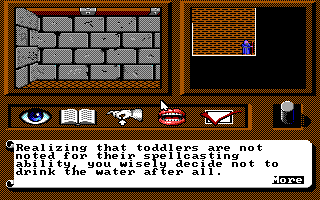
| The closest you get to a victory screen before getting dumped to the DOS prompt. |
Tangled Tales
United States
ORIGIN Systems (developer and publisher)
ORIGIN Systems (developer and publisher)
Gary Scott Smith, Alex Duong Nghiem
Released 1989 for DOS, Apple II, and Commodore 64
Released 1989 for DOS, Apple II, and Commodore 64
Date Started: 20 February 2013
Date Ended: 23 February 2013
Total Hours: 15
Difficulty: Moderate-Easy (2.5/5)
Final Rating: 38
Ranking at Time of Posting: 63/87 (72%)
Date Ended: 23 February 2013
Total Hours: 15
Difficulty: Moderate-Easy (2.5/5)
Final Rating: 38
Ranking at Time of Posting: 63/87 (72%)
Ranking at Game #455: 370/455 (81%)
Before it ended, Tangled Tales got a little harder and a lot sillier. I don't think the final valley could have been more ludicrous if the developers had actually been on drugs. To give a little snippet: dodging giant lizards capable of casting "Teleport," "wabbit hunters" with rifles, giant gorillas called "banana peelers" capable of casting "Paralyze," and polar bears capable of breathing fire, I find my way down a rabbit hole where I got a carrot from a female rabbit. Then I ice-skated across a glacier and used a "Time Disortion" spell to help an Eskimo catch some fish so he would agree to let me use his kayak. In the kayak, I met a talking penguin who needed a bow-tie, but fortunately I had purchased one at a tailor shop. At the penguin's advice, I built a snowman named Snookie north of the Eskimo's igloo and outfitted it with a corncob pipe, two button eyes, and a carrot nose. The snowman helped me win a snowball fight against some yetis so I could get past them into a cave and free a Time Lord named Azersun from an hourglass by blowing a silver flute. Azersun took me back in time where I evaded a man-eating plant to get a pot o' gold from a pyramid for a leprechaun so she would return a stolen diploma to a witch doctor so he would lift a lycanthropy curse from the valley.
 |
| This may be the most absurd screen shot ever taken in a CRPG. |
If all of this sounds harmless, keep in mind that it took me hours to figure it all out. More so than the first valley, the second two required NPCs to be recruited, items to be found, and puzzles to be solved in a relatively precise order. There were no individual puzzles: everything was joined in one giant machine. Since I didn't know the precise order of places to go and things to do, I ended up havin to backtrack a lot. I'd be curious to see Trickster's take on this one, because it felt a lot more like an adventure game than an RPG. This was exacerbated by combats that give you no experience and very little need for gold. I eventually learned to avoid most combats with the "Detect Monster" spell.
 |
| Or maybe this one. |
In a comment on my last posting, Gamma Leak alluded to a quote from Scorpia in the August 1989 issue of Computer Gaming World:
Solving many of the puzzles is more a matter of having the right people in the party than anything else, which reduces the main character to [a] spectator at many crucial points in the game. A little less reliance on all these NPCs would have been better.
 |
| Maxwell gets in some final jive before taking off. |
I didn't feel that way, yet, at the end of my last posting, but I definitely did by the end of the game. NPCs bailed me out of situation after situation, each one sashaying into the sunset once their destinies had been fulfilled. I would have appreciated alternate solutions to many of the puzzles that only NPCs could solve.
 |
| It's just way too hard to choose among them. |
I'll just summarize the plot quickly before heading on to the rating.
The answer to the drought in the second valley had to do with obtaining a magic carpet from an imp (I needed to wake up a djinn to fight him first) and use it to get to a giant's castle in the clouds. There, I rescued a woman named Veronica and returned her to her beloved Charles. (The two ran off to start a bakery and showed up in the third valley.) But more important, I had my elven minstrel Jenny read a book of poetry to the giant, causing him to cry so copiously that water poured down into the valley below. I suspect the salinity of giant's tears makes the water unsuitable for crop-growing, but whatever.
 |
| This sounds a bit familiar... |
For the third mission, Eldritch sent me to another valley to find a spell to strengthen the portals that connected the three valleys. That's where I had the nutty adventures recounted above. There were actually two maps of the valley, one in the past and one in the present, and I had to toggle between them with the help of the Time Lord. Once lycanthropy was cured, Charles, who had been infected, gave me a magic map that allowed me to get through the foyer of a wizards' college.

The final area tested my knowledge of all of the spells I'd acquired throughout the game. I had to use "Time Distortion" to get past the wizards' bouncers; prove that I had "Awaken," "Cure Paralysis," and "Energy Blast" (the latter by using it to char a steak); and answer some questions about the effects of "Recall," "Reflection," and "Gnihton."
 |
| The answer was a "thimble." I don't really want to explain why. |
After that, I was given access to a couple of tomes that filled in my knowledge of any spell I hadn't otherwise picked up, including "Strengthen Portal." I cast this last spell on the three valley portals, returned to Eldritch, and won the game.

Eldritch gave me a final ability increase, which was kind of silly since the game dumped me to the DOS prompt immediately after I spoke to him.
 |
| A bold plan for an apprentice who was playing pranks and just had his spellbook wiped a few days ago. |
By the end of the game, I had 19 spells, but I barely used the ones I acquired in the second half of the game. Part of the problem is that the character has so few spell points, and the "Continual" ones deplete so quickly, that if you want to make robust use of the spells, you have to rest constantly. Other spells just aren't very useful. "Recall," for instance, allows you to return to the location of a dropped object, but none of the maps are really big enough to make such a useful-sounding spell very necessary.
 |
| My final spell list. |
A quick GIMLET:
1. The game world is reasonably well described in the manual and wizard's journal, and though small, it certainly has some interesting features. The setting is less "fantasy" and more "fairy tale" (which I suppose goes with the title), featuring elves, dwarves, talking snowmen, cloud giants, leprechauns, werewolves, witch doctors, talking rabbits, nymphs, Eskimos, and Vietnamese martial arts experts, all within the space of three valleys. Yes, it was very original, but no, I didn't like it. Score: 5.
2. Character Creation and Development. Although you always play a wizard, character creation does allow for some customization of attributes. You could make a very brawny wizard (more effective in melee combat) or a very brainy one (with more spell power). "Development" occurs in between stages of the story, with three level-ups (but functionally only two, since the last happens moments before the game quits) and the acquisition of additional spells. I'm not a fan of plot-driven level-ups; I'd rather have gotten experience and levels from slaying monsters. Score: 3.
 |
| My final character sheet. |
3. NPCs. If they weren't so goofy, they'd be some of the best NPCs we've seen in CRPGs so far. You have a selection of dialogue topics for both party NPCs and other NPCs, and they contribute significantly to the atmosphere of the game. Some are absolutely necessary for solving quests and others provide helpful advice. They have unique characteristics and are extremely memorable. I just wish they hadn't been so silly. Score: 7.
 |
| I mean, come on. |
4. Encounters and Foes. Enemies in the game were varied and a bit nonsensical, especially toward the end. But their unique strengths, weaknesses, and spells drove the only real tactics in combat. A few of them were completely unbeatable and required intelligent use of spells to avoid, which is an interesting departure from the normal CRPG trope of having to kill the evil wizard. The other "encounters" came in the form of puzzles, but I didn't think they were good puzzles. As I mentioned above, they involved less intelligence and creativity and more luck of having been to one place, and gotten an item there, before going to the next place. Because all possible actions are listed under the "Action" button, you never have to think logically about how a certain item might effect a certain outcome, as you do when puzzles depend on typing commands or manipulating inventory. Score: 4.
 |
| One of the game's several unbeatable monsters. I had to cast "Monster Detection" and "Time Distortion" to skirt my way around him. |
5. Magic and Combat. The non-magic side of combat is hardly worth mentioning. You hit "attack" and the game tells you when your enemies are slain or when you take damage. You don't see attack rolls or damages, and you can't control the actions of NPC characters. Tactics come entirely from the use of spells, and there are some tactical decisions to make about when to use various continual or noncontinual spells. This aspect of the game would have been better with more spell points to work with; the 170 I had by the end of the game would support 6 or 7 noncontinual spells in between sleeping, and less if I was in a dungeon and needed to keep "Light" active. I also felt that many of the spells appeared too late in the game, long past the point where I really needed them. Score: 4.
 |
| The adventurers take on Elmer Fudd. |
6. Equipment. One of the lousier parts of the game. Aside from all the puzzle-based inventory, you find a small selection of weapons, armor, and shields during the course of the game, a lot of which the wizard can't equip. There are no statistics associated with them, so you have to guess on your own whether the "big axe" is a better weapon than the "+2 dagger." I went through almost a dozen re-loads trying to defeat a "Blue Knight" only to find that my reward was a sword and armor I had to give to an NPC. And the system of assigning weapons and armor to NPCs is rather silly, with them asking you for them upon rests. Score: 2.
 |
| My massive equipment list from the end of the game. Why can I use a "big axe" but not a sword? |
7. Economy. You get gold from slaying some monsters. There are a handful of quest items to buy, but otherwise you spend most of it healing and resurrecting NPCs. I never saved up the 900+ gold pieces to learn the secrets of the universe from Esmeralda, but I suppose that qualifies as a long-term financial goal that keeps money from becoming completely useless. Score: 4.
8. Quests. There are three "chapters" in the game, together forming a main quest. Although there appear to be side-quests, ultimately none of them are optional. There's only one outcome to each scenario and to the game as a whole, so no opportunities for role-playing. Score: 2.
 |
| Eldritch gives the game's final quest. |
9. Graphics, Sound, and Interface. My version has no sound, but the graphics are pretty and with enough detail to make interesting vistas and character portraits. The interface was reasonably good. Every clickable icon has an associated keyboard shortcut, making gameplay relatively smooth. Score: 4.
 |
| A decent-looking dragon. This was another unbeatable foe, by the way. Fortunately, I had a book of extremely boring stories. |
10. Gameplay. Regrettably linear. The valleys are too small to support open exploration, and although it appears you can hit the dungeons in each scenario in any order, you really need to proceed in a specific order to solve all of the puzzles. I didn't appreciate all the backtracking I needed to do, though it wasn't terrible because the distances were so small. I can't see any reason to replay it once you know the puzzle solutions. If combat had been more tactical, it would be interesting to see how characters of different starting attributes performed, but alas...
The pacing is okay. I didn't feel like the game dragged on too long. And it did a reasonably good job easing into the difficulty, with the first valley very easy and the next two progressively harder, though it never got very hard. Score: 3.
 |
| The game subtly clues me to the existence of a secret door. |
The final score of 38 puts it close to Drakkhen, another game whose innovations I admired but which had enough flaws in the gameplay to edge it into the "thumbs down" category. Tangled Tales has an interesting interface, a great approach to NPCs, and a rare blend of RPG and adventure game elements. I just wish they had been employed in a more serious game in which combat had more purpose and deeper tactics.
Scorpia also gave a mixed review. She seemed intrigued by the hybrid design, but ultimately found it negative: "Just imagine doing Zork (although the puzzles here are generally much easier) with unpleasant critters wandering all over the place." She noted the uselessness of combat, the fact that more NPCs means more monsters, the "pretty" graphics, and the inconsequential nature of death.

Tangled Tales is one of many ORIGIN games that feel like side-projects in between Ultimas. We've seen a few others on the blog so far--Autoduel, Moebius, 2400 A.D., and Times of Lore--and I haven't really liked any of them. I keep hearing good things about Knights of Legend from the same year, and I guess that game uses many of the same interface elements of Tangled Tales. Perhaps that's the "more serious game" that I was just hoping for. I'll be checking it out in just a few games. For now, it's on to Keef the Thief, a game about which I know extremely little except that its title doesn't fill me with promise.