Space Rogue
ORIGIN Systems (developer and publisher)
Paul Neurath (designer)Released 1989 for DOS, Apple II, Commodore 64,
Date Started: 06 July 2013
Date Ended: 10 July 2013
Total Hours: 12
Difficulty: Moderate-Hard (3.5/5)
Final Rating: 46
Ranking at Time of Posting: 82% (86/105)
Final Rating: 46
Ranking at Time of Posting: 82% (86/105)
I had fun at the beginning of Space Rogue, but after the princess told me that I needed to kill a certain number of ships to become a "space ace," both my enjoyment and progress plummeted quickly (necessitating my Crown of Arthain posting). I tried desperately to kill pirates and Manchi, but my ratio was about one successful battle for every nine times they killed me. After every victory, I checked my status and I couldn't seem to budge from "unknown."
But slowly I got the hang of it and learned the most effective tactics. I learned to fire my missiles only when very close to enemies, and with the "target lock" turned off (having it on allows their countermeasures to deflect the missile), and to use Newtonian flight mode to keep the enemy from being able to buzz all around my head. As I got better at defeating ships, my enjoyment grew considerably. I was able to buy upgrades with the bounties (awarded instantly after the ship is destroyed), my reputation improved, and there is something satisfying about blowing up a ship in space, even if the graphics aren't very good at depicting it.
From there, the rest of the main quest was fun, albeit with a little too much shuttling around through Malir Gates, certainly the least enjoyable experience of the game.
I also got annoyed with the frequency of combats in the late game, as pirates and Manchi took my reputation (ultimately "deadly") as not a warning but a challenge. I got attacked everywhere and constantly had to pull into ports for repairs to my shields and systems.
The video below shows some aspects of gameplay, including trade, combat (before I got good), and NPC dialogue.
From there, the rest of the main quest was fun, albeit with a little too much shuttling around through Malir Gates, certainly the least enjoyable experience of the game.
 |
| A scow flies around the opening of a Malir Gate. |
I also got annoyed with the frequency of combats in the late game, as pirates and Manchi took my reputation (ultimately "deadly") as not a warning but a challenge. I got attacked everywhere and constantly had to pull into ports for repairs to my shields and systems.
The video below shows some aspects of gameplay, including trade, combat (before I got good), and NPC dialogue.
I should have offered a posting between the first one and this one, but to make a long story short, these were the steps to the endgame:
1. Flew around and fought until I got a "fierce" rating. During this period, I continued to trade and solve mini-quests. I reunited two robot lovers and followed some clues to find a "neurostabilizer booster" on the ruins of an outpost where a monster attacked.
2. Returned to Duchess Avenstar and had a long conversation with her. She indicated that Admiral Koth had been plotting to usurp the emperor, and that the previous owner of my ship, Captain Targon, had been on a secret mission to try to find out his plan. She asked me to try to track down Targon and discover what became of him.

3. I found Targon quite by accident on a mining station. The game simply introduced him as a madman, and I tried the neurostabilizing booster on him, as I'd been told it would cure madness. Once he came to his senses, he revealed himself as Targon and asked if I knew his mission's codename, which I did, thanks to the duchess. He revealed that the Scarlet Brotherhood, a band of pirates led by a man named Gut, had been raiding deep into Manchi space to deliberately kindle war between the humans and the Manchi. Admiral Koth, who'd been paying Gut through his associate, Vilanie, figured that if the humans and Manchi devastated each other, he could de-throne the emperor in the chaos. Unfortunately, after his bit of exposition, the booster wore off and Targon regressed to madness.
4. When I returned to Duchess Avenstar, I found that someone had tried to assassinate her, so she'd left the Far Arm for the capital. I never saw her again.
5. Gut wouldn't speak with me unless I destroyed an imperial titan-class ship. This was a little disturbing--the idea that I'd blow up a ship with hundreds of people just to complete a bit of intelligence-gathering. Nonetheless, I found one and eventually destroyed it after about seven tries. Titans are very large and pack a lot of firepower.
6. Once I spoke with Gut, he confirmed everything that Targon had said. Further, he said that Vilanie, the psionic leader of the Black Hand cult, had paid him a lot of money to land on the Manchi homeworld and steal an egg. He didn't know why, but he suggested that I ask a Baakili trader, as they're known to go into Manchi territory.
7. It took me forever to find one (I guess they show up randomly in space station pubs), but when I spoke to him, he told me that the Manchi are basically evolved ants, and they still have a sort-of hive mind, including the worship of a queen. When the queen senses her death, she lays a single egg to hatch the new queen. It was this egg that Vilanie had paid Gut to steal.
8. Gut suggested that I steal it back from Vilanie, offering to attack her station and distract her guards while I did so. I got bogged down in this part for a long time. Vilanie was on a base in a secluded section of space, and she kept killing me with psionics before I could get anywhere near the egg.
Finally, I gave up and went wandering around the galaxy, re-talking to every NPC I could find. Eventually, this bore fruit. I found a man named Omas on a remote base. He said he'd lost his wife to the Black Hand cult and asked my help in finding her. I traveled back to Vilanie's base and found the woman, Nycene, but she said she didn't want anything to do with Omas anymore. I returned to Omas to give him the news, and he rewarded me with a "psionic shield" that would block their attacks. The annoying thing was that Omas's base was four Malir Gate jumps from Vilanie's, so I had to travel the path three times, for a total of 12 gate jumps. Since Malir Gates sap armor from the ship, I had to stop and repair in between each of the jumps. This episode alone took up about 20% of the total game time.
9. With the psionic shield, I was able to infiltrate Vilanie's base again, ignore her attacks, and find the egg.

10. With it, I now needed a way to jump to Manchi space--difficult since none of the Malir Gates went there. Gut directed me to a scientist who was working on a warp drive, and fortunately, when I got to him, I had the "transmission coil" that he needed to complete it (I'd picked it up from a station earlier, not knowing what it was for). He asked me for the coordinates, and thanks to the screen shots I'd taken during my conversation with the Baakili, I had them.
The end game was fairly fun and challenging, as I had to navigate to the Manchi homeworld while dodging (and, unfortunately, often destroying) Manchi ships. I made it with only a little armor to spare. There was a satisfying series of endgame screen shots, describing how they gratefully accepted the egg's return and ceased their war on humanity.

I then left the Far Arm for the empire's capital, where Emperor Hiathra rewarded me. In a possible setup for a sequel, he indicated that the traitorous Admiral Koth had disappeared.

Altogether, it was a reasonably original, interesting, and satisfying plot and endgame.
A quick GIMLET:
I'm going to add one bonus point for the HIVE mini-game. As a reward for delivering a letter, an NPC told me that if you get to Level 5 in the game, you start to win credits. I never got that good, but it was still an innovative addition and a nice alternate path for someone with more manual dexterity than me. From the walkthrough I consulted after winning, the rewards can be considerable.

That gives us a final score of 46, quite respectable. I think it's easily the best of the "in-between-Ultimas" offered by ORIGIN and I'm sure elements went into their Wing Commander series a few years later. For a reasonably good game, it doesn't seem to have made much of a splash at the time, although almost everyone who reviewed it gave it a good rating. In the December 1989 issue of Computer Gaming World, Omar DeWitt perhaps offered the reason:
This suggests that RPG fans found it too action-focused with annoying controls (the way that PC gamers today complain about interfaces clearly designed for consoles), and action game fans found that there were too many moments without action. In any event, DeWitt concludes that "Space Rogue is an interesting blend of arcade action, role-playing interaction, and economic strategy."
This is the second game on which long-time ORIGIN employee Paul Neurath was credited as the designer. (His first, Deep Space: Operation Copernicus was an action game I didn't play.) He would later go on to design the Ultima Underworld games and eventually form his own companies. His last credit is as creative director for a National Geographic game called Great Migrations in 2010.
It was a "minor" game, but a good one. Let's continue to push towards 1990 with Sword of Aragon.
1. Flew around and fought until I got a "fierce" rating. During this period, I continued to trade and solve mini-quests. I reunited two robot lovers and followed some clues to find a "neurostabilizer booster" on the ruins of an outpost where a monster attacked.
 |
| There's no way to attack while in third-person mode, so if the monster (on the left side of the garbage piles) touches me, I die. It took me a while to figure out the best path through the area. |
2. Returned to Duchess Avenstar and had a long conversation with her. She indicated that Admiral Koth had been plotting to usurp the emperor, and that the previous owner of my ship, Captain Targon, had been on a secret mission to try to find out his plan. She asked me to try to track down Targon and discover what became of him.

3. I found Targon quite by accident on a mining station. The game simply introduced him as a madman, and I tried the neurostabilizing booster on him, as I'd been told it would cure madness. Once he came to his senses, he revealed himself as Targon and asked if I knew his mission's codename, which I did, thanks to the duchess. He revealed that the Scarlet Brotherhood, a band of pirates led by a man named Gut, had been raiding deep into Manchi space to deliberately kindle war between the humans and the Manchi. Admiral Koth, who'd been paying Gut through his associate, Vilanie, figured that if the humans and Manchi devastated each other, he could de-throne the emperor in the chaos. Unfortunately, after his bit of exposition, the booster wore off and Targon regressed to madness.
4. When I returned to Duchess Avenstar, I found that someone had tried to assassinate her, so she'd left the Far Arm for the capital. I never saw her again.
5. Gut wouldn't speak with me unless I destroyed an imperial titan-class ship. This was a little disturbing--the idea that I'd blow up a ship with hundreds of people just to complete a bit of intelligence-gathering. Nonetheless, I found one and eventually destroyed it after about seven tries. Titans are very large and pack a lot of firepower.
 |
| Chasing and firing at an imperial titan. |
6. Once I spoke with Gut, he confirmed everything that Targon had said. Further, he said that Vilanie, the psionic leader of the Black Hand cult, had paid him a lot of money to land on the Manchi homeworld and steal an egg. He didn't know why, but he suggested that I ask a Baakili trader, as they're known to go into Manchi territory.
7. It took me forever to find one (I guess they show up randomly in space station pubs), but when I spoke to him, he told me that the Manchi are basically evolved ants, and they still have a sort-of hive mind, including the worship of a queen. When the queen senses her death, she lays a single egg to hatch the new queen. It was this egg that Vilanie had paid Gut to steal.
 |
| Oops. |
8. Gut suggested that I steal it back from Vilanie, offering to attack her station and distract her guards while I did so. I got bogged down in this part for a long time. Vilanie was on a base in a secluded section of space, and she kept killing me with psionics before I could get anywhere near the egg.
 |
| The death descriptions in the game are pretty good. |
Finally, I gave up and went wandering around the galaxy, re-talking to every NPC I could find. Eventually, this bore fruit. I found a man named Omas on a remote base. He said he'd lost his wife to the Black Hand cult and asked my help in finding her. I traveled back to Vilanie's base and found the woman, Nycene, but she said she didn't want anything to do with Omas anymore. I returned to Omas to give him the news, and he rewarded me with a "psionic shield" that would block their attacks. The annoying thing was that Omas's base was four Malir Gate jumps from Vilanie's, so I had to travel the path three times, for a total of 12 gate jumps. Since Malir Gates sap armor from the ship, I had to stop and repair in between each of the jumps. This episode alone took up about 20% of the total game time.
 |
| That was just cold. |
9. With the psionic shield, I was able to infiltrate Vilanie's base again, ignore her attacks, and find the egg.

10. With it, I now needed a way to jump to Manchi space--difficult since none of the Malir Gates went there. Gut directed me to a scientist who was working on a warp drive, and fortunately, when I got to him, I had the "transmission coil" that he needed to complete it (I'd picked it up from a station earlier, not knowing what it was for). He asked me for the coordinates, and thanks to the screen shots I'd taken during my conversation with the Baakili, I had them.
The end game was fairly fun and challenging, as I had to navigate to the Manchi homeworld while dodging (and, unfortunately, often destroying) Manchi ships. I made it with only a little armor to spare. There was a satisfying series of endgame screen shots, describing how they gratefully accepted the egg's return and ceased their war on humanity.

I then left the Far Arm for the empire's capital, where Emperor Hiathra rewarded me. In a possible setup for a sequel, he indicated that the traitorous Admiral Koth had disappeared.

Altogether, it was a reasonably original, interesting, and satisfying plot and endgame.
A quick GIMLET:
- 6 points for the game world. The political structure of the empire wasn't well-defined, but in general the game supplied a detailed back story, an evolving world, and a compelling entry for my own character. As I hit certain plot points, the world changed--in more ways than I realized during play. A walkthrough mentions how various characters offer new dialogue options once Avenstar disappears, for instance. The "world" is also reasonably large and nonlinear.
 |
| There are occasional notes in the ships about particular asteroids and planets that, although you can't do anything with them, add flavor to the game world. |
- 2 points for character creation and development. Like Starflight, the human PC is nothing. You can name him, but he has no other attributes save his reputation (something I've covered more under quests and gameplay) and equipment (for which I gave points in that category).
- 6 points for NPCs. The game is clearly an ORIGIN game in this respect. It's one of the earliest games that offers dialogue options and not just keywords when speaking with NPCs, although some of them have keywords, too. These options allow for some significant role-playing opportunities. Talking with NPCs is vital to progression in the game and understanding the game world. I like the way you can collect intel from bartenders but get drunk if you're not too careful. The only reason it doesn't get a higher score is that there just aren't many NPCs--about 30--and there aren't a lot of the dialogue options that I praise. Still, a significant step in the evolution of RPGs.
- 5 points for encounters and foes. The encounters are mostly all in the form of ships (save the monster I had to dodge on one station), and they do behave differently depending on whether they're imperial, traders, pirates, pirate hunters, or Manchi. All of these are well-described in the game manual, and dealing with them is a careful process of weighing their strengths compared to yours. It's neat how pirates will often flee but Manchi never do. More than once, a pirate hunter swooped in and killed a pirate I was trying to kill myself. These are nice touches.
- 4 points for magic and combat. No magic, of course. Space combat is reasonably tactical, with a lot of fast-thinking required as to the best times to fire missiles versus lasers, keep targeting turned on or turn it off, fight to the death or offer surrender (I think this only applies to merchant vessels), flee, or try to surrender yourself (something I never did). I hated the controls a bit, but blowing up enemy ships with missiles never did get old.
 |
| Putting a missile directly up the nose of a pirate. |
- 4 points for equipment. Most of the interesting equipment in the game was ship-based: armor, electronic countermeasures, shields, beam weapons, and missile weapons. But there were also special quest-awarded items that supplemented both personal and ship effectiveness, such as the psionic shield, the stealth box, and a damper that prevents the ship from taking damage in wormholes.
 |
| I never did find out what this was for. Funny seeing the term "blog" in 1989. |
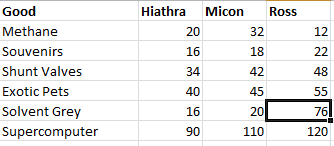
- 5 points for economy. The trading aspect of the game (influenced, I guess, by the 1984 game Elite) was interesting but not extremely well-implemented, and it became unnecessary once I could get paid for killing pirates and Manchi. I did reach a point where money didn't do much for me (save the occasional repairs and restocking of missiles), but part of that was my fault for over-doing the trading in the early section.
- 6 points for quests. I thought the main quest was interesting and original, but equally important were the handful of side-quests, which usually produced some item or hint reward. A few of these featured role-playing opportunities. I could have kept the MAID droid as a repair droid on my ship instead of returning her to her lover, for instance. Also notable is the option to approach the main quest from several angles. You could get the "combat experience" required by the duchess by hunting pirates (as I did), becoming a pirate yourself, or ignoring both factions and just fighting Manchi.
 |
| It's hard to imagine being evil enough to choose the second option. |
- 2 points for graphics, sound, and interface. Probably the worst part of the game. This is not an era where graphics have advanced enough for the player to truly enjoy 3D space exploration. Sound is bloopish and unnecessary. I thought the controls were awful. Yes, perhaps I should have tried harder to connect a controller instead of relying on the keypad. In any event, the keypad was unintuitive, unresponsive, and too difficult to navigate in pitched combat.
- 5 points for gameplay. Perhaps the best part is the non-linearity. I think you could do the steps of the main quest in almost any order, save a few examples such as getting the psionic shield before stealing the egg. Right at the beginning, you're encouraged to just explore the game's nine systems and all their stations, talk to NPCs, trade, fight, and start solving quests at your leisure. I'm always sucked in by such open-endedness. There is some replayability in terms of both the side quests and different paths on the main quest. I thought the interface made it frustrating at times, and the Malir Gates were just annoying, but the overall pacing was okay.
I'm going to add one bonus point for the HIVE mini-game. As a reward for delivering a letter, an NPC told me that if you get to Level 5 in the game, you start to win credits. I never got that good, but it was still an innovative addition and a nice alternate path for someone with more manual dexterity than me. From the walkthrough I consulted after winning, the rewards can be considerable.

That gives us a final score of 46, quite respectable. I think it's easily the best of the "in-between-Ultimas" offered by ORIGIN and I'm sure elements went into their Wing Commander series a few years later. For a reasonably good game, it doesn't seem to have made much of a splash at the time, although almost everyone who reviewed it gave it a good rating. In the December 1989 issue of Computer Gaming World, Omar DeWitt perhaps offered the reason:
This is not a game for the "junior joystick" class. If they survive the Manchi fighters, they must still negotiate the wormholes into another solar system. On the other hand, there is always the danger that real joystick jockeys may get impatient with trading and "social interaction" needed for success in Space Rogue.
This suggests that RPG fans found it too action-focused with annoying controls (the way that PC gamers today complain about interfaces clearly designed for consoles), and action game fans found that there were too many moments without action. In any event, DeWitt concludes that "Space Rogue is an interesting blend of arcade action, role-playing interaction, and economic strategy."
This is the second game on which long-time ORIGIN employee Paul Neurath was credited as the designer. (His first, Deep Space: Operation Copernicus was an action game I didn't play.) He would later go on to design the Ultima Underworld games and eventually form his own companies. His last credit is as creative director for a National Geographic game called Great Migrations in 2010.
It was a "minor" game, but a good one. Let's continue to push towards 1990 with Sword of Aragon.