Phantasie II
United States
Winston Douglas Wood (developer); Strategic Simulations, Inc. (publisher)
Released in 1986 for Commodore 64, Apple II, and Atari ST; 1987 for Atari 8-bit, FM-7, PC-88, PC-98, and MSX
Date Started: 21 January 2017
Date Ended: 11 February 2017
Date Ended: 11 February 2017
Total Hours: 25
Difficulty: Moderate (3/5)
Final Rating: 39
Ranking at Time of Posting: 193/238 (81%)
Ranking at Game #455: 377/455 (83%)
[Ed: When I originally wrote this posting, I thought I couldn't win because I couldn't find the final monster. Later, I did. An addendum at the end of the posting has the winning information.]
Well, I can't win Phantasie II. Something is askew with my game and I can't figure it out. (My best guess is that I started playing an existing game by accident instead of re-initializing the first disk.) As much as I like the game, I've decided it's not worth fretting about. I got most of the way to the end and enjoyed myself along the way. These last few days have delivered an object lesson about obsessively playing every CRPG to its conclusion, and it wouldn't be worth the time to re-scout every inch of the game for what I missed, or to start over with new characters.
The problem is the missing Beast #1, the "giant constrictor," theoretically the easiest of Pluto's eight minions. He's supposed to be wandering the overworld somewhere, but I've gone over every square in the overworld, the underworld, and the dungeons, and he's just nowhere to be found. I've otherwise cleaned out every dungeon, slain every other beast, collected every other amulet, and acquired the Orb, so that's "nearly won," at least.
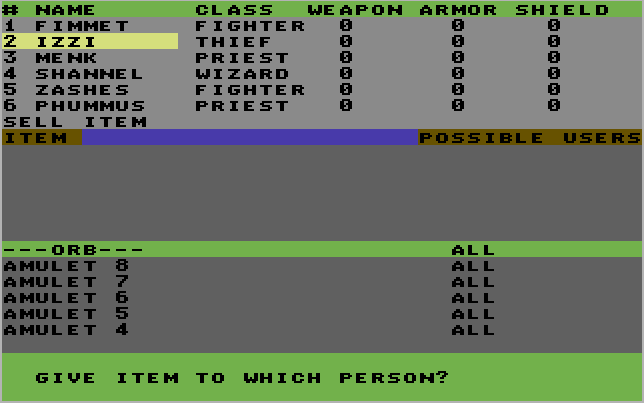 |
| I have everything I need to win except Amulet 1. |
Pluto's Smallest Castle was, despite its name, a fairly large castle with eight separate entrances. Seven of them led to an unwinnable battle with Pluto (oh, I'm sure he's killable with enough levels and luck, but I didn't have the patience to try). But a scroll alerted me to use the western entrance and look for a secret door, leading to the rest of the cavern network. There, amidst multiple battles with demons and devils, I defeated Pluto's Giant Wyvern.
 |
| In Pluto's castle. |
One odd encounter had my party following a troll throughout the dungeon until he finally gave us a scroll. We then had to beat our way back through half a dozen monster parties. But the scroll outlined a path through the lava to Pluto's Menagerie, so it was worth it.
 |
| Making my way across lava. |
Pluto's Menagerie was also swarming with demons, devils, giants, dragon kings, and high-level spellcasters. Even though I stocked up on magic potions before visiting, I had to retreat a couple of times, which was annoying because it involved hiking across two screens of lava to the nearest town. A long, winding corridor packed with encounters led to a teleporter with six numbers, each leading to a different section of the Menagerie.
One of them led to Beast #8, the most difficult of the lot, the Demon-Dragon. It took me about 10 tries to kill him without losing most of my party, and even then the best I could do was two members killed. (Fortunately, I have the "Resurrection" spell.) He had more than 350 hit points, got about 10 attacks per round, and did more than 50 points of damage with each hit or breath.
 |
| This demon-dragon isn't taking any of my $#@*. |
That was as far as I could go. I found the way to the Ice Dragon, but without all eight of the beast amulets, the game said I was too scared to approach.
In general, the late game featured a lot of battles with individual, high-level enemies like cloud giants, dragon kings, high demons, and high devils. They might have one or two allies, but there are very few large parties. "Fireflash 4" becomes the most important spell; a player would be extremely hard-pressed to win without it. By the late game, both of my clerics, my mage, and my thief were capable of casting it. I let it do a lot of the work, gulping potions when my spell points got low.
Judging by what walkthroughs tell me and what I can extract from the text on the disk, if I had been able to acquire all 8 amulets, I would have been able to approach the Ice Dragon in Pluto's Menagerie. Although the game gives an option to attack, the game apparently has the party think twice after hearing a threat from the dragon. If you choose to talk to the dragon, you have the option to try to feed him gold or "the weakest party member," but he's not interested in either. If you feed him the Orb, he crunches it down. Somehow, destroying the Orb destroys the evil possessing the dragon, and he gratefully flies away.
Filmon teleports the party out of the dungeon to his hut and confirms that destroying the Orb broke the curse on Ferronrah. He then tells of Nikademus's forces marching on a continent to the north, presumably Scandor of Phantasie III, and invites the party to continue their adventures in the sequel.
Filmon teleports the party out of the dungeon to his hut and confirms that destroying the Orb broke the curse on Ferronrah. He then tells of Nikademus's forces marching on a continent to the north, presumably Scandor of Phantasie III, and invites the party to continue their adventures in the sequel.
In a GIMLET, the game earns:
- 5 points for the game world. The backstory and lore aren't as expansive as other titles, but it's well-plotted, tightly-written, and generally free of plot holes or logical inconsistencies. The in-game scrolls, the manual's backstory, and the physical features you find in the landscape all work well together.
- 3 points for character creation and development. It's fantasy boilerplate. I generally forgot about the skills--they play a passive role in the game. The first and third titles had some needs for particular races and classes, which this one didn't, and I generally forgot I was role-playing gnomes, monsters, and halflings. Leveling slows down markedly in the second half of the game.
 |
| My character aged 9 years during the course of the game. |
- 4 points for NPC interaction. Named NPCs play a key role in the game and impart information about the lore of the land and the quest steps. There are no dialogue options, but there are some encounter options with these NPCs.
- 5 points for encounters and foes. In their strengths and weaknesses, special attacks and defenses, the enemies of Phantasie II are only average compared to other games of the era. The titles do a better job with the miscellaneous role-playing options, encounters, and small puzzles that you get while exploring the dungeons. They don't quite rise to the level of good role-playing--most options are either "good" or "stupidly evil"--but they're a start.
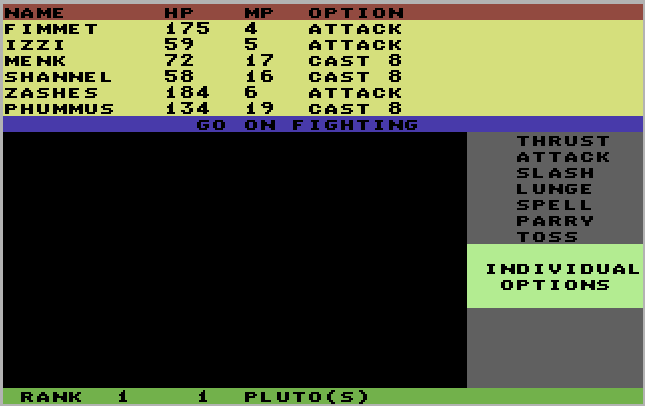
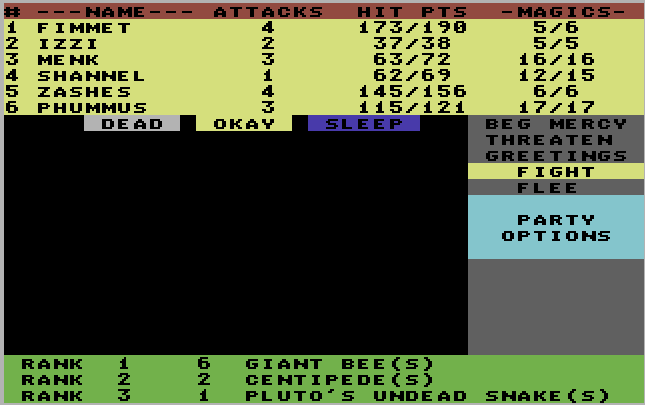
- 4 points for magic and combat, basically a Wizardry-derived base with animation, but the animation adds a layer of tension and fun. As with Wizardry, the developers did a good job tightly controlling magic use through limited spell points. A little too much rests on just a couple of spells, though, and physical attacks become undervalued in the late game.
 |
| Battling one of the bosses. |
- 4 points for equipment. You only have weapons, armor, shields, and potions--no accessories--but the distribution mechanic is fun, and I like the way that the items are randomized in the world, not found at fixed locations. The series suffers from a lack of special or "artifact" items.
- 2 points for the economy. Save for potions (which are cheap), the store is mostly wasted--you start with a decent set of equipment and find the rest. You're either saving every gold piece for training (early game) or running into the maximum value for the gold variable (late game).
- 4 points for an interesting main quest with some randomization (which sank me, unfortunately), multiple steps, and even some small "side quests" (killing Pluto, rescuing Filmon's friends).
- 3 points for graphics, sound, and interface. The first two are era-tolerable but nothing special. I didn't care for having to scroll around menus when there was a perfectly-good complete keyboard in front of me. I'm rating this category for the C64 version, so mentally increase it a couple of points if these elements are notably better on your preferred platform.
 |
| The Atari ST version was more colorful and elaborate. I wish I didn't hate the emulator so much. |
- 5 points for gameplay. Although there's a natural order to the dungeons, it's mostly non-linear, and you're encouraged to visit some of the dungeons multiple times. I wouldn't call it "replayable," but the pacing and difficulty are right on the money.
Wow. Without even looking at my reviews for Phantasie and Phantasie III, I managed to land on the exact same score of 39 that I gave to the other two. This raises the question of why Phantasie III didn't earn a higher rating given that it added several new elements. (I did rate it higher for combat, where most of the elements are found). Looking over my review, I think I failed to realize that the three titles were intended as a trilogy, building on the same story. Instead, I thought that the developers kept using Nikademus as the villain because they lacked imagination. I also apparently thought that the third game dragged a bit. Still, I won't worry about a few points. 39 is a pretty high score for any era (so far).
I'm debating whether to subtract points for whatever bug failed to bring me the encounter with Beast #1 so I could win the game. Normally, I would, but I can't find anyone else talking about the same problem, so I'm going to have to assume that I just messed something up.
In these early days of limited graphics, storage, and processing power, the best that a game could do was sketch the outline of a dungeon and prompt your imagination to fill in the rest. I don't have any issue with that--I enjoy it, in fact--but a lot of titles do a poor job of developing the skeleton of their worlds. They don't provide enough walls on which to imagine the paintings and curtains. Wireframe dungeons are fine, but they're best when they have a logical structure, a theme, and occasional atmospheric messages to tell you what's happening. (Of the 3D games, The Bard's Tale does a poor job with this; Wizardry does better; Might & Magic does it best.)
This is where the Phantasie games excel. The dungeons aren't a random configuration of rooms and corridors: the developers gave some thought as to the layout of castles and dungeons. A palace is going to need bedrooms, kitchens, servants' quarters, and a dungeon, for instance, and they designed it accordingly, giving each room a name and maybe even a paragraph of text as you entered. When you meet monsters, it's not some random hodgepodge of bats, priests, zombies, and goblins all traveling together. You fight kobolds and orcs in the kobold village, insects and vermin in caves, and demons and devils in the Netherworld. In other words, the series pays attention to setting the same way that a good tabletop RPG module might.
It makes sense, of course, that developer Winston Douglas Wood was a veteran of Dungeons and Dragons and RuneQuest campaigns. According to a 2013 interview at RPG Codex, he was a sophomore in college when he began working on Phantasie, and he was in graduate school by the time it was published. This was an era in which SSI, lacking a lot of RPG experience of its own, readily published titles submitted by independent developers such as Tom Reamy (Galactic Adventures) and Chuck Dougherty (Questron). Ultimately, none of these independently-developed titles (including Phantasie) had the staying power of SSI's internally-developed games (Wizard's Crown, Pool of Radiance), which built upon the company's wargaming expertise.
As the various ports above indicate, Phantasie became very popular in Japan, leading to the Japanese-exclusive Phantasie IV, which I unfairly brushed off at the end of my Phantasie III review. I assumed it had been developed by an unscrupulous Japanese company taking advantage of the name. In fact, Wood says in the interview that he designed Phantasie IV himself, although Japanese programmers at Starcraft wrote the code for the PC-88, PC-98, and MSX. There were vague plans to port it to western PCs, but its release corresponded with the decline of the classic Phantasie platforms like the C64 and the Apple II, and by that time Wood was deep into his "real" profession working for his father's pipe network analysis software company, of which he is now a co-owner.
Wood developed one other title for SSI--Star Command (1988)--and designed Starfire (1994) for StarCraft (another Japan-only title). At the time of the RPG Codex interview, he was working on and off on Phantasie V, but that was almost 4 years ago, and there doesn't seem to have been any news since then.
In the interview, Wood suggests an uncertainty about the game's legacy. While it's true that third-person games largely won the interface struggle (at least until the late 1990s), you can see a clear homage to Phantasie in some of the diskmag titles we looked at in the late 1980s and early 1990s. In both combat and exploration, John Carmack's Dark Designs trilogy (my reviews start here) could easily be mistaken as having been written by Wood. I suspect that the author of the two Legends of Murder titles was also a player. And of course we saw an adaptation of the character ranks and character leaping in Legend of Faerghail.
As I said when I started this series, I'm glad I had a chance to return to the Phantasie universe and look at it properly, not just in the rushed way that I covered I and III and everything else during the first two years of blogging. They are stand-outs among 1980s titles and still fun in any decade.
****
Update: based on some commenters' messages, I decided to run around on one of the wilderness maps and give myself one more try to find the first beast, the giant constrictor. I found him almost immediately. He was so easy I forgot to take a screenshot of the fight.
When he was dead, I had the last amulet. One by one, I had my characters examine them and gain their associated "beast runes."

With the eight beast runes, I returned to Pluto's Menagerie. I had to slog across dangerous lava, healing myself as I went, and fight about a billion combats against fixed monsters in the dungeon's hallways.
Eventually, after exhausting most of my spell points and potions, I found my way to the dragon's cave again.

This time, the game didn't tell me I was too scared to face the dragon. I walked up to it and fed him the Orb.

As noted above, the dragon flew away after destroying the Orb, saying that the curse was lifted. Filmon teleported me to his hut and confirmed the same, then led me outside for a victory party in which each of my characters was introduced and the crowd cheered.

The final screen has Filmon setting up the third game.

No change to the GIMLET, but a reasonably satisfying ending. I'm glad I don't need to carry it as a loss.
****
Martian Dreams may or may not be the next new game. I need a stretch of time at home when I don't need to close my computer or kill the emulator to make sure the saving/crashing problem doesn't recur. The next time I have 3 or 4 days off the road, I'll play it.
Realms of Darkness was coming up on the list, but upon examination, it appears to have been released in early 1987 rather than 1986.
It makes sense, of course, that developer Winston Douglas Wood was a veteran of Dungeons and Dragons and RuneQuest campaigns. According to a 2013 interview at RPG Codex, he was a sophomore in college when he began working on Phantasie, and he was in graduate school by the time it was published. This was an era in which SSI, lacking a lot of RPG experience of its own, readily published titles submitted by independent developers such as Tom Reamy (Galactic Adventures) and Chuck Dougherty (Questron). Ultimately, none of these independently-developed titles (including Phantasie) had the staying power of SSI's internally-developed games (Wizard's Crown, Pool of Radiance), which built upon the company's wargaming expertise.
As the various ports above indicate, Phantasie became very popular in Japan, leading to the Japanese-exclusive Phantasie IV, which I unfairly brushed off at the end of my Phantasie III review. I assumed it had been developed by an unscrupulous Japanese company taking advantage of the name. In fact, Wood says in the interview that he designed Phantasie IV himself, although Japanese programmers at Starcraft wrote the code for the PC-88, PC-98, and MSX. There were vague plans to port it to western PCs, but its release corresponded with the decline of the classic Phantasie platforms like the C64 and the Apple II, and by that time Wood was deep into his "real" profession working for his father's pipe network analysis software company, of which he is now a co-owner.
 |
| Phantasie IV clearly shows the series lineage, but it has little squiggles instead of actual text for game options. |
Wood developed one other title for SSI--Star Command (1988)--and designed Starfire (1994) for StarCraft (another Japan-only title). At the time of the RPG Codex interview, he was working on and off on Phantasie V, but that was almost 4 years ago, and there doesn't seem to have been any news since then.
In the interview, Wood suggests an uncertainty about the game's legacy. While it's true that third-person games largely won the interface struggle (at least until the late 1990s), you can see a clear homage to Phantasie in some of the diskmag titles we looked at in the late 1980s and early 1990s. In both combat and exploration, John Carmack's Dark Designs trilogy (my reviews start here) could easily be mistaken as having been written by Wood. I suspect that the author of the two Legends of Murder titles was also a player. And of course we saw an adaptation of the character ranks and character leaping in Legend of Faerghail.
As I said when I started this series, I'm glad I had a chance to return to the Phantasie universe and look at it properly, not just in the rushed way that I covered I and III and everything else during the first two years of blogging. They are stand-outs among 1980s titles and still fun in any decade.
****
Update: based on some commenters' messages, I decided to run around on one of the wilderness maps and give myself one more try to find the first beast, the giant constrictor. I found him almost immediately. He was so easy I forgot to take a screenshot of the fight.
When he was dead, I had the last amulet. One by one, I had my characters examine them and gain their associated "beast runes."

With the eight beast runes, I returned to Pluto's Menagerie. I had to slog across dangerous lava, healing myself as I went, and fight about a billion combats against fixed monsters in the dungeon's hallways.
 |
| Combat with a cloud giant and minions. |
Eventually, after exhausting most of my spell points and potions, I found my way to the dragon's cave again.

This time, the game didn't tell me I was too scared to face the dragon. I walked up to it and fed him the Orb.

As noted above, the dragon flew away after destroying the Orb, saying that the curse was lifted. Filmon teleported me to his hut and confirmed the same, then led me outside for a victory party in which each of my characters was introduced and the crowd cheered.
 |
| I assume it said "from Gelnor" if you used an imported party? |

The final screen has Filmon setting up the third game.

No change to the GIMLET, but a reasonably satisfying ending. I'm glad I don't need to carry it as a loss.
****
Martian Dreams may or may not be the next new game. I need a stretch of time at home when I don't need to close my computer or kill the emulator to make sure the saving/crashing problem doesn't recur. The next time I have 3 or 4 days off the road, I'll play it.
Realms of Darkness was coming up on the list, but upon examination, it appears to have been released in early 1987 rather than 1986.