In a week or so, U.S. CRPG addicts will celebrate Columbus Day (or maybe not; it's become a bit un-PC over the last couple of decades), which commemorates Christopher Columbus's discovery of the Americas on 12 October 1492. Armchair historians will spit out their Cocoa-Puffs in protest at the last sentence, bellowing semi-coherent phrases about the Norse, Leif Ericson, John Cabot, St. Brendan, and perhaps the Chinese. But whether earlier explorers reached the New World before Columbus, or whether Columbus even had the vaguest notion where he was, doesn't really matter. None of the earlier voyages "took." Though Columbus's voyages were flawed to the point of being comical if not for such horrific consequences to the indigenous populations, it was incontrovertibly his trips that led to the widespread knowledge of the Americas in Europe, launching the Age of Exploration. Hence, we give Columbus the credit for "discovering" America, at least from the European point of view.
By the same vein, we give PLATO the credit for the "first CRPGs," even though we don't have any evidence that this is the case. For all we know, hordes of eager young programmers were building
dungeons and simulating combat rolls on IBM 5100s within months of the
release of the original D&D booklets in 1974. Perhaps the
researchers over at PARC created multi-user dungeons on their Xerox
Altos before the first line of code of pedit5 or the elusive m199h was ever typed. But if these games existed, they were the equivalent of L'Anse aux Meadows: they didn't "take." No one remembers them, and they left no legacy.
PLATO, as a series of multi-user mainframes intended specifically to connect and educate young people, was in a much better position to develop the progenitors of the CRPG genre, and of course it did. The original Dungeon/pedit 5 led directly to The Game of Dungeons/dnd, which in turn led to a series of commercial top-down dungeon crawlers (developed off-PLATO) with random encounters. PLATO's MUDs (multi-user dungeons) are the direct ancestors of today's MMORPGs. But perhaps most important for our current purposes, the multi-character game called Oubliette inspired Wizardry, which in turn inspired Might & Magic, The Bard's Tale, Dungeon Master, and even Ultima III.
I was going to wait for my book to offer any more reviews of the PLATO games, but circumstances essentially demanded that I say something about PLATO this week because I'm here, at the University of Illinois at Urbana-Champaign, teaching a class on the same campus where it all began.
I've touched upon
Oubliette before, in a
December 2011 post about the PLATO series, and a brief
July 2010 post in which I played (but didn't score) the 1983 DOS version. On PLATO, the game was continually developed between 1977 and 1982 (and at least some edits have been made as late as the current year), so I don't know how much of what I'm about to describe is from the original 1977 version.
 |
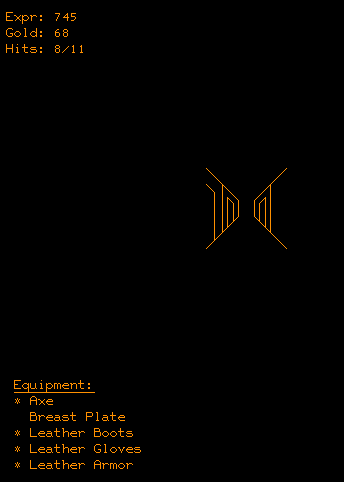
| An equipped character heads down the corridors. |
Unlike the 1983 version, the original
Oubliette is a multiplayer game--a shared environment, including a castle (Ligne Castle) and dungeon, in which multiple users can meet in a tavern and form parties for dungeon exploration. (A single character
can adventure by himself, but it's deadly.) The amount of detail in the game is astonishing for the era in which it was created
. It includes:
- 15 character races: human, elf, dwarf, half-dwarf, half-elf, hobbit, orc, Uruk-hai, ogre, pixie, goblin, hobgoblin, kobold, Ur-vile, and Eldar elf. A cute mix of Lord of the Rings, Dungeons & Dragons, and the Thomas Covenant series.
- 15 character classes: cleric, demondim, courtesan, hirebrand (fighter), mage, minstrel, ninja, paladin, peasant, ranger, raver, thief, sage, samurai, and valkyrie, the choice of which is dependent on minimum attribute rolls. Demondims and ravers also come from Covenant, though they aren't really classes.
 |
| The game's classes and prime requisites. |
- A fully explorable main castle of 841 squares, with various types of shops, taverns, hotels, and temples.
 |
| The castle, which I--for some reason--took the time to map. |
- The ability to retrieve and resurrect slain characters.
- Perhaps the first gambling mini-games in a CRPG, with choices for blackjack, craps, and a "roachrace."
- A great selection of equipment, with the ability to simultaneously wield weapons, armor, shields, helmets, gloves, boots, cloaks, rings, and other items, both magical and non-magical.
- An extremely detailed spell system. Each spell has an arcane name comprised of consistent syllables. There are seven levels of spells and spellcasters get additional slots as they gain experience. If this is sounding a lot like Wizardry, keep reading.
 |
| The spell list, from the in-game documentation. |
- Dozens of monsters, most unapologetically drawn from the D&D list, to which the game refers you for questions about both monsters and equipment.
- The ability to bring a "hireling" into the dungeon with you, purchasable at various amounts from all of the game's monster classes.
 |
| Buying a robber as a hireling. |
Add these elements to the game's cooperative multiplayer and chat abilities, and we've got a game that's well ahead of its time.
Character creation is a relatively simple process of selecting a race, rolling the standard D&D list of attributes, and choosing a class based on the roll.
 |
| Rolling a new character. |
After character creation, you find yourself on the safe castle level, where you can spend your meager starting gold pieces on some equipment (weapons, armor, torches), try to gamble them for more, or visit a tavern to join up with a party. After that, it's to the dungeons and its random encounters with both enemies and treasures. Movement is through the WASD keys, and most of the other keys have some sort of specific option, varying by capital and lower case, such as assigning (E)quipment and (I)gniting a torch.
Surviving a trip to the dungeon allows you to spend accumulated gold on more advanced equipment at the magic shop, potions, healing, and hirelings, some of which are extremely expensive. You can also join a guild specific to your character class--necessary if you want to level up.
 |
| Beginning adventurers start with 50-100 gold pieces It will take a while before I can buy anything here, but I like the idea that money always has value. |
If your character dies, he can be found, returned to the town, and resurrected by another adventurer (or dumped in the morgue)--or you can delete and start over.
 |
| I found these guys two steps from the entrance but lacked any money to raise them. |
The game essentially assumes that you'll adventure with a party. It's not impossible to win a few combats as a sole champion, but it is quite difficult. When you enter combat, you're presented with a screen listing your foes. When it's your turn, the word "Options" flashes, and you have a few seconds to fight, parry, cast a spell, hide, evade, use an item, or use special abilities such as the courtesan's seduction, the bard's charming, and the cleric's dispel. When the foes are defeated, you divide the experience and treasure.
 |
| Fighting a gang of thieves. |
Each party has a "leader" who controls the party's movements; other party members can basically just wait for fights and hit the combat keys. As such, it seems a little boring to go with a party, but still quite impressive for the era in which it was created. Since there were only a handful of adventurers on Cyber1 each time I logged in, I wasn't able to find any active people to join a party. I focused on building up my own character and using hirelings, but I wasn't able to get very far in the dungeon.
As far as I can tell, there's no way to "win"
Oubliette, though there are hints of a greater complexity to the gameplay that I haven't been able to experience. For instance, there's a jail where you can look for other players, though I don't know what they do to get there. There's a temple where you can donate a lot of money for an audience with the high priest. There's a building called the "Ghenghis Army Recruiters" where I only get a message saying that it's closed because of loss of federal funding (did this message just appear this week?).
Oubliette's primary creator was Jim Schwaiger, apparently inspired by a previous game called either
Moria or
Mines of Moria (having nothing to do with the later roguelike), which I've been unable to play. In 1983, through a company called Bear Systems, Schwaiger and programmer Victor Helsing tried to market a commercial version of the program for DOS and the Commodore 64.
 |
| I'm going to go with "rite of passage." |
Lacking the full power of the PLATO mainframe, the 1983 version strips some of its features. Ligne Castle is a menu rather than a fully-explorable environment, and some of the locations (like gambling) are gone. Races and classes specific to either Tolkien or
Thomas Covenant were stripped. Characters join guilds immediately on creation and either graduate with enhanced abilities (and age) or die.
Most important, the game is no longer multiplayer. Rather, a single player controls up to six party members at once. Dungeon exploration has both top-down and first-person options.
 |
| Crawling through the dungeon with a re-engineered interface and a five-character party. |
Beyond that, the basic gameplay is the same: descend into the dungeon, survive as long as you can, rotate slain party members for fresh ones. There's still no main quest or overarching goal.
Let's consider the extent to which
Oubliette influenced
Wizardry. In a history of the PLATO games, and particularly
dnd, available only on Cyber1,
dnd contributor Dirk Pellet has this to say:
Sometime around 1977, Robert J. Woodhead (who was non-affectionately known on PLATO as "Balsabrain") through means unknown to the dnd authors, obtained a copy of the source code to the current version of dnd (probably 6.0 or 7.0). He "created" "his" own game from it, in a file called "sorcery." It had essentially all the same features of dnd except the messages, monsters, and magic items had different names and pictures (although identical functions). Apparently the illicit copy hadn't included the charset. The elven boots were socks, among other alterations.
When the dnd authors were informed of the existence of Woodhead's copy, and took a look at it (including looking at the source code in a monitor mode with a concerned sysop), the copy was promptly deleted, and Balsabrain learned that if he wanted to plagiarize PLATO games, he would have to do it OFF of PLATO. He put that lesson to use by plagiarizing Oubliette when he "created" "his" game of Wizardry and began to market it.
I've referred to these claims in past postings, and I've declined to offer a serious opinion, but I'll try to now. First, it's obvious that
Oubliette did significantly influence
Wizardry. Points of similarity (excluding those obviously adapted from D&D) include:
- The overall structure of the game, with a castle and shops on top and a first-person wireframe dungeon below
- The specific types of shops and visitable locations on the castle level
- The system of rolling attributes first, then determining the character class
- The basic combat system
- Some identical spell names and root syllables, identical spell effects, and the basic spell "slot" system
- The traps associated with chests found in the dungeon, which are exactly the same in both games
- Some of the character classes (I don't think samurais and ninjas were common RPG classes at the time)
- Permadeath and the ability to retrieve slain characters in the dungeon
- Raising in temples having a chance to fail, based on the character's constitution
- The ability to rest in an inn to slowly restore hit points
- Secret doors found by simply walking through a wall as if it was a regular door
At the same time, Woodhead and Andrew Greenberg (who, according to numerous sources, was also on PLATO) introduced a ton of material not found in
Oubliette, not the least of which is an actual plot and quest, plus associated dialogue options, special encounters, and NPCs in the dungeons.
Oubliette has only random encounters in its dungeon levels;
Wizardry has numerous fixed encounters.
Wizardry also features some different spells and slightly varying combat options, a system of item identification, and different enemies with special attacks. Perhaps most important, a single player controls multiple party members in
Wizardry, which appears to be the first time this happened in any CRPG, unless the 1983 version of
Oubliette was based on a prior PLATO version now lost.
Nonetheless, it seems clear to me that the
Wizardry developers started with an
Oubliette paradigm and worked from there, and certain aspects, like the spell names and trap system, can legitimately be seen as "plagiarism." What is damning is that
Wizardry gives no credit to Schwaiger or
Oubliette--no acknowledgement, no mention in the manual, not even a sly wink with the name of a monster or NPC. It was probably this that most raised Pellet's hackles. In an era where the makers of
Questron decided to license the "look and feel" of
Ultima from Richard Garriott, Woodhead and Greenberg's failure to even tip a hat to the PLATO game is slightly unforgivable. (Of course, we can't discount the possibility that they
did make such an acknowledgement in a source now lost to us.) There's a poorly-sourced quote floating about that says that Robert Woodhead posted on Slashdot back in 2001, saying "
Wizardry was in many ways our attempt to see if we could write a single-player game as cool as the PLATO dungeon games and cram it into a tiny machine like the Apple II." If this quote is true, his failure to mention
Oubliette specifically seems like an extension of his original disservice.
 |
| The welcome screen from the iPhone version of Oubliette. |
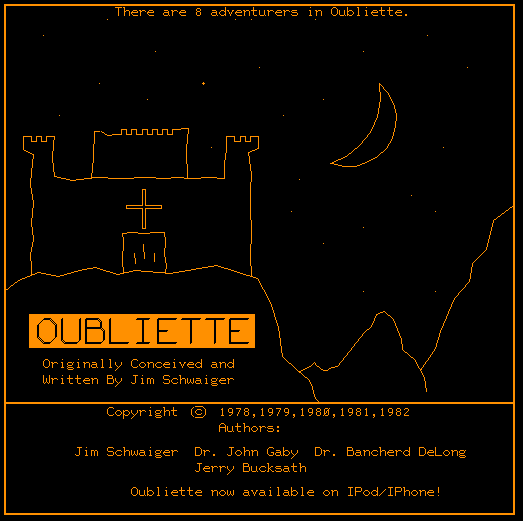
Oubliette lives on. Schwaiger (now a radiologist) and co-creator John Gaby (a PhD/software developer) created an iPhone and Android versions through Gaby's company, GabySoft, in 2010. I downloaded the free version the other day and have had a lot of fun with it so far, finding the controls much more intuitive than the iPhone version of
NetHack. (In general, the size of the iPhone screen supports first-person exploration much better than top-down.) It appears to be based on the 1983 version of the game, and in every way that I've discovered so far, it implements the same rules, just with much nicer graphics.
 |
| Fighting spiders in the dungeon. |
For GIMLET purposes, the PLATO, DOS, and iPhone versions of
Oubliette should probably be considered separate games, but I'm going to try to rate them all at once, noting a few variances:
- 1 base point for the game world in the PLATO version, which gives you only the name of the world and its castle. The DOS version would get 2 for having more of a story about Tokal being a harsh and cruel place, and a great wizard named Ligne establishing the one civilized outpost.
- 5 points for character creation and development. Experience and leveling is basic D&D-derived stuff, but the great selection of classes and races, and the ability to join a guild, put it above its competition in the era.
- I don't know exactly how to rate NPC Interaction in a MUD. Technically, those people are "PCs," though I suppose each PC is an NPC to each other. Since it doesn't advanced the "plot" to talk to them, let's call it a 3, which partly reflects the ability to bring hirelings aboard. There are no NPCs or hirelings in the non-PLATO versions, so it would be 0 for them.
 |
| I did find two characters in a tavern at one point, but both of their users were offline. |
- 3 points for encounters and foes. There are no RPG encounters, but the enemies are varied and have special attacks and defenses that I didn't get to fully explore.
 |
| A table of some of the game's monsters. Everything in this game is well-documented. |
- 4 points for magic and combat, perhaps 6 for the DOS version where you control six characters and can explore all the options. The nature of combat varies considerably depending on whether you're a fighter or mage. If you are a mage, the mage spell selection is sufficiently eclectic and powerful.
- 5 points for equipment. You've got weapons, helms, cloaks, boots, armor, torches, potions, and other items to buy or find. Very sophisticated for an early RPG. The game offers no information about them, however, simply referring the player to the D&D guides.
 |
| Purchasing items at the general store. |
- 4 points for economy. Gold is very valuable, but the economy isn't well-balanced. There's a huge gap between affording basic equipment and affording magic equipment or good hirelings.
- 0 points for quests. The lack of a main quest is the major failing of this game and one of the reasons I didn't bother to play beyond a couple of levels. There are doubtless some players who enjoy the open-ended nature of games like this and Telengard, but "just play it and enjoy it" is not attractive to me. I want a mission and a defined endpoint. [Later edit: Based on a commenter's report, it appears that the iOS version might have a main quest and several "boss-enemy" sub-quests on each level. I'm primarily rating the 1977 version here, so that doesn't change the overall GIMLET, but it's welcome intelligence.]
- 2 points for graphics, sound, and interface. The graphics are wireframe primitive, and there is no sound in any version except the iPhone one, where it would get an additional 2 points. I don't like the controls very much in any version.
- 4 points for gameplay. Though very difficult, the game benefits from nonlinearity, replayability, and the different experiences it offers to different characters or combinations of characters.
This gives a
final score of 31 for the PLATO and DOS versions (though different combinations) and 33 for the iPhone version [
later edit: the iOS version might go up to 36 if there are quests]. This is the highest of any PLATO game so far, and the highest of any game at all prior to 1981, when its child,
Wizardry, would trump it with slightly better encounters, NPCs, combat, and of course a main quest.
The rating might be higher or lower if I had experienced more of the game. Among other things, I barely touched upon spells. But with no main quest and such a steep difficulty curve, I just don't have any more time to devote to it. I'm satisfied that I've seen the elements that inspired
Wizardry, and glad I got to stand in front of a PLATO terminal in person. Now, it's back to Massachusetts and on to
Wizardry VI.
*****