|
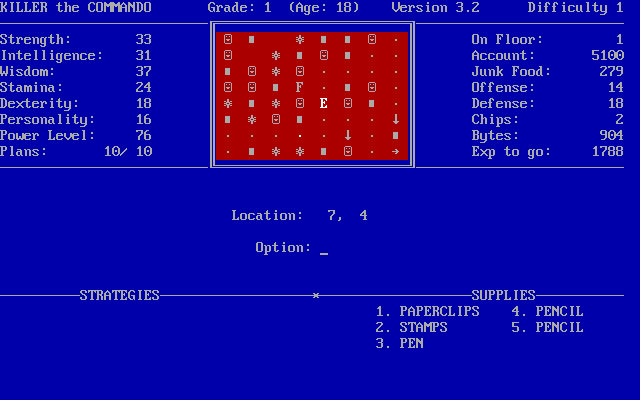
| This screen--and this screen only--is what awaits you at the end of hundreds of hours of gameplay |
Mission: Mainframe
United States
Independently developed and released as sharewareReleased in 1987 for DOS
Difficulty: Hard (4.0/5)
Final Rating: 25
Date Started: 31 December 2010
Date Ended: 2 January 2011
Total Hours: 10Date Ended: 2 January 2011
Difficulty: Hard (4.0/5)
Ranking at Game #404: 179/404 (44%)
So, Mission: Mainframe wasn't all that hard, it turns out. Anyone who struggles with it is, quite frankly, a roguelike noob. It just requires a little bit of persistence, a lot of skill, and maybe some...yeah, okay, I cheated. Cheated big-time.
I had pretty much decided after the last M:M posting that I wasn't going to play any more, but it bugged me a bit, and I figured I'd at least like to see what the game offered at higher levels. So I committed what I thought was a mild sort of cheat: I backed up my save game file so that permanent death wouldn't be permanent. With this done, I was free to take greater risks, starting with descending directly to Level 10 and picking up the security key that would allow me to access Levels 11-20. Then, after a couple hours of that, I went right down to Level 20 and got the security clearance that would get me to Levels 21-30. Thinking that I could just end things once and for all, I sneaked around Level 30 until I found the "Executive Meeting" consisting of a bunch of high-level office workers (executives, directors, attorneys, and the like), culminating in The Operator--the big boss. I could trick and evade the others, but there was no getting around The Operator, and he thoroughly thrashed me.
Still--not a big deal. I knew where the big boss was; I just needed to build up my character enough to defeat him. I ran around collecting gold and valuable office supplies (scissors were the best I found, offering 100 each to offense and defense), finding potions that raised my stats, spending money on "strategies" (which turned out to be mostly useless) and health club sessions to boost my stats further, getting experience and rising levels, and so on.
And this, my friends, is when I started to remember why we don't allow save game backups in roguelikes. Sure, you start out by saying, "I'll just use it when my character dies." But these being roguelikes, your character dies a lot, and suddenly that backup file seems a little too handy. Accidentally swap out a good weapon with a so-so weapon? Restore the backup! Attorney destroys one of your supplies (which they do, the bastards)? Restore the backup! Manger or supervisor knocks down some of your stats? Restore the backup! Don't like the attribute score increase that you got on your last visit to the gym? Restore the backup! Etc. etc. etc. And of course, the backups change the entire dynamic. Suddenly, shooting directly to Floor 30 isn't a risk--hell, that's where the best stuff is! There's no point in avoiding risk when you have a fail-safe! Backing up your save game file doesn't just save you from permanent death--it breaks the entire purpose of roguelike games.
And yet, not even this amount of cheating was enough. I did it for about maybe six hours of gameplay time (although, to be fair, I was multitasking), and I still couldn't improve my character enough to defeat The Operator. So I resulted to way worse cheating:
 |
| If you don't know what this is, I'm proud of you. |
That's right: I downloaded a hex editor and modified my save game file. But I even screwed that up, since I don't really understand hexidecimal code. I meant to change all my attributes to 999, but somehow I ended up changing three to 14,649 and three to 57. Since the 14,649s included my strength and dexterity, though, it didn't matter: The Operator couldn't hit me as I devastated him with scissors, coffee, and a rubber band.
 |
| I defeated the controller of an evil computer with a hex editor. That's called "fire with fire," my friends. |
Let's be clear: there is no way I would have ever won this game playing it "straight." Not in four months, like I did with Rogue; not in four years. Even cheating, I died constantly--from alcohol, darkness, traps, and enemies. I probably would have won, eventually, without the hex editor, but never without making backups. I would love to hear from a single person who has ever won this game without making backups of the save games. Tell me how you did it (you have to be convincing), and I'll send you $100 [Note: someone got it much quicker than I would have imagined; see comments].
But it doesn't really count as a "win"; hence, the asterisk in the title. And I won't list it as such in my ranking spreadsheet.
Speaking of rankings, here we go. Does it make sense to rank roguelikes on the GIMLET scale? Probably not. But I'll bet it reflects my actual enjoyment of the game.
1. Game World. Roguelikes are not known for their attention to the back story and game world. This one is no exception. It offers a paper-thin plot as an excuse to transform Wizard's Castle to an office building, but all of the adaptations--a gym instead of a training hall, a supply cabinet instead of a weapons shop, "strategies" instead of spells--seem goofy and forced. Score: 2.
2. Character Creation and Development. The character creation system has you pick from four classes--commando, detective, secret agent, and private eye--but these don't even do what they say they'll do (adjust your ability scores), let alone anything else. Development in terms of increasing attributes is quasi-satisfying since it happens so rarely. I have no idea what leveling does for you--it doesn't increase your hit points or anything. Score: 2.
3. NPC Interaction: There are no NPCs. Score: 0.
4. Encounters and Foes. Some of these are cute, I'll give it that. Instead of the standard menagerie of orcs, hobgoblins, trolls, and such, you fight secretaries, consultants, analysts, and vice presidents. Most of them do something unique--steal your money, destroy your food, destroy your equipment, damage your ability scores, teleport you, and so on--and you need to learn these things to determine which to fight and which to trick or flee. There's no way to "role play" any of this of course, but all levels respawn when you leave them, so there's no shortage of experience. Score: 4.
 |
| If my secretary could teleport people out of the office, I'd be a happy man. |
5. Magic and Combat. "Magic" consists of "strategies" that you have to buy--analyze, bluff, confuse, decoy, flatter, and hypnotize. They increase in price in that order, and "hypnotize" is so expensive I never got it. The strategies seem to work about as often as "trick," which you pay nothing for. Combat is very basic--just hit the "B" key--and since you can't flee or avoid encounters, there's really no strategy to it. Score: 2.
6. Equipment. Like the game world, the use of rulers, erasers, bookends, and such as offensive and defensive items is mildly amusing at first, but ultimately seems stupid and forced. Plus, the thought of killing secretaries with paperclips doesn't encourage you to suspend disbelief and immerse yourself in the game world. There is a shop, and it's easy to tell which pieces of equipment are best. Score: 3.
 |
| Did I mention that you kill people with stamps, file folders, and credit cards? |
7. Economy. You collect money throughout the game, and since you can use it to increase your attributes, there's never any reason to stop. That's about the best I can say for it. I wish the office supply cabinet got better things as I rose in levels; instead, it only ever offered the selection of starting equipment. Score: 4.
8. Quests. Only one main quest, and pretty lame at that, and no side quests. I know that almost all roguelikes just feature one thin main quest, but I like quests in CRPGs. If that means I rank all roguelikes slightly low, so be it. Score: 1.
9. Graphics, Sound, Inputs. The graphics aren't going to fool you into thinking that you're really in an office building, but they're good enough for a roguelike, which after all doesn't depend on graphics. There is some decent sound, sparingly used, and the controls are fairly easy to master. Score: 5.
10. Gameplay. I suppose this is the most subjective category. I like games that are challenging but not impossible; Mission: Mainframe strikes me as impossible. Unlike some roguelikes, it's really not replayable--the "classes" offer the same experience--there's no real opportunity for role playing (especially since the game world is so goofy). At least things move along pretty fast. Score: 2.
Final Score: 25. That puts it lower than everything except Ultima II and the original Rogue, and frankly I think I gave Rogue a raw deal (the GIMLET scale was new back then). It ranks higher than Rogue only because it has an economy and the encounters are a little more interesting. If you like traditional roguelikes, you'll likely disagree with this assessment, but I wouldn't be upset if this was the last one I played.
With those words, I ought to return to Le Maitre des Ames, but NetHack is next, and I'd like to be able to compare the latter to Mission: Mainframe while it's still fresh in my mind. I've just downloaded version 2.3e, and I think I'll check it out for a few minutes before I go to bed.