
 |
| I don't like the sound of that last bit. |
Elvira II: The Jaws of Cerberus
Horror Soft (developer); Accolade (publisher)
Released 1991 for DOS; 1992 for Amiga, Commodore 64, and Atari ST
Date Started: 20 June 2015
Date Ended: 04 July 2015
Total Hours: 21
Reload Count: 44 (mostly from trying alternate solutions to puzzles, not death)
Difficulty: Moderate-Hard (3.5/5)
Final Rating: 34
Final Rating: 34
Ranking as of Game #349: 238/349 (68%)
If nothing else, Elvira II helped me clarify why I'm a CRPG addict and not an adventure game addict. Although I value puzzles in RPGs--the occasional riddle, mystery, inventory puzzle, or navigation puzzle--I don't like games that are all puzzles. I don't always want to have a puzzle on the board, waiting to be solved. Rather, I want my puzzles to be punctuations after moderately-long periods of dungeon crawling and tactical combat. This probably explains why I'm not a huge fan of Dungeon Master-style games, where unsolved puzzles tend to rack up pretty fast.
As I wrapped up last time, I was preparing to navigate out of 6 levels of catacombs so I could grab some items of makeup and then navigate back through 6 levels of catacombs and fool the evil sorcerer into thinking I was his apprentice. As I had done with the mad scientist's assistant, I studied the picture that looked like a wizard's apprentice and dressed up in the appropriate garb, hat, and facial hair.
 |
| This was fun the first time. |
Fortunately, it occurred to me to take all the makeup items back with me, in case I'd made a mistake, because I did. I forgot the fake nose. If I hadn't brought everything, I would have had to trek up and back again, and that probably would have killed my interest in finishing the game. (Later, though, when it became clear that I missed some fish bones needed for a "buoyancy" spell, I did have to trek down four levels again.) As it was, they were pretty annoying. Frequent traps pop up in your path, so you can't get into a rhythm where you're constantly moving forward, because this happens:

Instead, you have to pause after every step to make sure there isn't a trap ahead, and if there is, you have to click on it and "avoid" it.

Anyway, fooling the wizard just made him go away, allowing me to proceed into the small chamber beyond, where I found Elvira!


Or, at least, I thought so. The visage of Elvira turned into an acid-spitting demon. Once I dealt with it, I recovered the Indian's war lance.
It turned out that each of the three major areas--the "stages"--culminated in an encounter with "Elvira," followed by the recovery of one of the Indian's magic items. The first two times you find Elvira, she turns out to be a fake and you have to battle the creature that's taken her visage. The third time, it's the real Elvira, and after that until the end of the game, she appears in your inventory(!).

The caverns of Stage 1 were as large as the catacombs, but only four levels. They were crawling with giant mosquitoes, ants, grubs, and other vermin, but I clearly was supposed to have visited this area first, because I was way overpowered for them. Most of them died in a single blow with combat set to "berserk" mode. Occasionally, they poisoned me, but red mushrooms in the area were capable of creating the "antidote" spell.
The encounters in the dungeon were punctuated by rooms full of crystals and mushrooms that I could use to make helpful combat and healing spells. I ended up using hardly any of them because I had already conquered the place where I would have needed them most--the catacombs in Stage 3.
At the apex of the level was a giant spider and spider web. The spider was unkillable, I think, but I was able to evade him by trapping him behind an elevator door. In his web, I found a version of Elvira that turned into a hideous wasp-woman and the Indian's magic tomahawk.
 |
| Okay, enough of that. |
Clearing the area meant finding a key to the elevator, and I had to look up a spoiler for that one. It wasn't obvious to me that a couple of pixels on an image of a dead man wrapped in a spider's web held a necessary item, or that I would need to use the "Telekinesis" spell to obtain it rather than simply cutting it out of the web. There are quite a lot of puzzles in the game that are like this.
 |
| Do you see anything obvious to try to take? |
During my explorations of Stage 1, I maxed in level (10) and experience (9999). Even though I took multiple passes through the catacombs, I still think it was a bit too easy to hit the cap well before the end of the game.
 |
| Fighting a giant worm. Note all the crystals and mushrooms in my inventory. |
With Stages 1 and 3 clear, I had to return to the haunted house at Stage 2 and figure out what I hadn't finished there. It turned out I had to bring Frankenstein's monster to life by casting "Summon Storm" on the house's roof and letting it strike a copper rod I inserted in a barely-visible slot. Again, I was relying on a walkthrough at this point.
The storm brought the monster to life, but what ensued was the most annoying puzzle of the game. Basically, you have to do two things with the monster: remove his headband, scalp, and brain, and get him away from the door that he's blocking when you first find him. This means that you have to animate him long enough to get him to walk a few steps from the door, but then stop him (by pulling out his brain wires) before he has a chance to kill you. The timing is hard to get right, and if you don't realize there's a door behind him in the first place, it's easy to put yourself in a "walking dead" scenario by taking his brain before he's moved away from the door.
 |
| Disassembling the monster. |
Behind the door was, in my case, the real Elvira, along with the Indian's magic bag.
 |
| I don't suppose I could just leave her here? |
I took all of the magic items to the Indian and he, one by one, in a series of identical animations, infused them with magic power.
 |
| You'd think a man of such ability could find a better job than janitor. |
I now had all the items I needed for the summoning and binding ritual to kill Cerberus, described at length in one of the library's books, but I needed a holy man to draw the pentagram, and that meant resurrecting the dead cleric. Fortunately, now that I was at Level 10, I could mix the "resurrect" spell. I'm sure the ingredients were among the library's many tomes, but I just tried various mixtures of likely-sounding items (brain, heart, spleen, holy book, holy water, etc.,) until I got it right.
 |
| Trying various items to mix the "Resurrect" spell. Note Elvira sitting there in my inventory (second from the left). Could I have used her to mix a spell? |
With the cleric revived (no word on how a clearly-Catholic priest felt about being resurrected via arcane arts), he took my chalice full of blood (I honestly can't remember where I got it) and went off to the parking lot to draw a pentagram. At this point, relying on the instructions in the book and a little help from the walkthrough, I completed the ritual necessary to kill Cerberus: light a series of 10 candles around the pentagram, use the magic bag to summon the beast, cast "Bind Demon" at him, throw the Indian's spear at his head, and hack his heart with the tomahawk. It took me a few tries to get it right because he kept killing me while I was trying to find necessary items in my inventory.
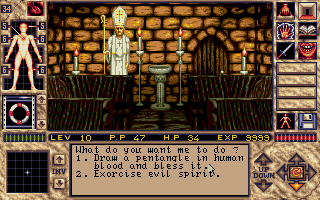 |
| You'd think he could just do #2, but he just says "I don't perform that mumbo jumbo sort of religion." |
The endgame animations were pretty good, and it's worth watching the video below of the entire sequence. Note the constant music. I played the game with sounds turned off on my computer; how long would you have been able to last with music like this playing incessantly?
Like the first game, this one ends with Elvira beckoning you to your ribald reward.
I hope that the folks at The Adventure Gamer get to this one eventually, because I'm curious what they'd say about it from an adventure game perspective. I thought that some of the puzzles were rather obscure and illogical, and that there was too much screwing around trying to make sure you had the right inventory items in each situation. Add to this a number of "walking dead" situations (avoided in my case by breaking my rules and looking at spoilers), and I'm not sure it performs well as an adventure game.
On the other side, the role-playing aspects were under-developed. You do get notably stronger with each level-up, but the dungeons are long and boring and the combats bereft of anything you might call "tactics," so for me the role-playing elements were somewhat unwelcome. They mostly just padded the time.
It might score higher in a GIMLET than the first one just because it has more elements, but I can't honestly say I enjoyed it more. Let's see.
That gives us a final rating of 34, a little higher than Elvira but not enough to cross into "recommended" territory. Elvira II is definitely a better RPG than Elvira, but being a "better RPG" doesn't count for much if you're still not a good RPG.
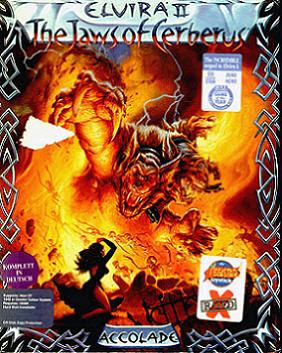
I've run out of ways to make fun of Dragon giving everything 5 out of 5 stars, but they did it again here. You'd think a magazine focused on role-playing would recognize that Elvira II had some definite weaknesses in this area, but instead they offered a review that could have doubled as an advertisement: "From the opening screens, you'll be on the edge of your seat trying to rescue the beloved Elvira. This is a 'must' purchase."
Scorpia offered a more sober look in the March 1992 Computer Gaming World. Her primary problems are the "walking dead" scenarios: she was unable to complete the game because she'd used a crucifix needed to ward off a vampire in a spell; even if she could have gotten past this, she also used the matches needed to light the candles on a "Fireball" spell (which I also did; thankfully, I had VK to warn me). She also mentions the Frankenstein one. The entire second half of her review, in fact, is taken up with complaints about this specific issue, and I can see why. I was also happy to see that she complained about the music. On the other hand, she goes on for a while about a lack of save slots, which baffles me a bit. The game allows 48 different save slots in an era where the default is usually one. I only used 6 slots, but I grant you I tend to be overly conservative about this.
I'll tell you this: I wish there were more horror-themed RPGs. To that end, I'm going to be happy to give the Horror Soft/Accolade team another chance with Waxworks, coming up in 1992. Judging by the screen shots, it uses the same engine as Elvira II, but perhaps it improves elements of the gameplay. Either way, the setting looks pretty cool.
That will, alas, be Horror Soft's last game. The company renamed itself Adventure Soft in 1992 and produced the Simon the Sorcerer series but never tried again with an RPG. Of the three primary developers on Elvira II--Alan Bridgman, Michael Woodroffe, and Simon Woodroffe--only Simon Woodroffe seems to be active today, with some 2010s credits on action games produced by Sega. Michael Woodroffe last shows up as managing director of Call of Cthulhu: Dark Corners of the Earth (2005), and Alan Bridgman last contributed to Simon the Sorcerer 3D (2002).
My acquaintance with the Mistress of the Dark was brief, but I can't say that breaks me up. It's time to finally get serious about Antares.
****
Further reading: My series of posts on Elvira: Mistress of The Dark from early 2014. YouTube user Lemm has a 3 hour and 20 minute LP that takes the game from beginning to end, and as a bonus you can check out Javier Juan Castro Sanchez's compilation of all of the game's death scenes.
 |
| I'm not sure I like the look of that dagger. |
I hope that the folks at The Adventure Gamer get to this one eventually, because I'm curious what they'd say about it from an adventure game perspective. I thought that some of the puzzles were rather obscure and illogical, and that there was too much screwing around trying to make sure you had the right inventory items in each situation. Add to this a number of "walking dead" situations (avoided in my case by breaking my rules and looking at spoilers), and I'm not sure it performs well as an adventure game.
On the other side, the role-playing aspects were under-developed. You do get notably stronger with each level-up, but the dungeons are long and boring and the combats bereft of anything you might call "tactics," so for me the role-playing elements were somewhat unwelcome. They mostly just padded the time.
It might score higher in a GIMLET than the first one just because it has more elements, but I can't honestly say I enjoyed it more. Let's see.
- 6 points for the game world. This is one category that's notably better than its predecessor. It makes good use of horror movie tropes and characters by having the sets literally come to life. Elvira felt more like a standard fantasy game in Elvira's clothes; this one felt closer to a horror RPG.
- 3 points for character creation and development. Definitely better than the first. You get noticeably stronger as the game progresses and you gain experience and level up. I like that you get experience for a variety of actions and puzzle-solving, not just combat. But there are no meaningful character choices throughout the game; even the initial selection of "profession" is staggeringly unimportant.
- 5 points for NPC interaction. Between Elvira, the Indian, Frankenstein, and the sorcerer, there are a handful of NPCs with dialogue options, some of them even involving a small amount of role-playing (e.g., whether to insult the Indian by asking for "fire water").
 |
| Elvira's interpolations were usually unwelcome. |
- 5 points for encounters and foes. A variety of monsters undone by a lack of true strengths and weaknesses, plus puzzles that tended on the too-tough side. Balancing this were some occasional puzzles different than anything I've seen in a CRPG or adventure game. I like the use of spells as puzzle-solving tools.
- 4 points for magic and combat. The combat system is arguably worse than the first game, but either way it's just a click-fest. I did like aspects of the magic system, such as being able to create "Fireballs" from a combustible material. This would be a fun dynamic in an open-world game where items replenish. Here, because there were so many "walking dead" scenarios, I was reluctant to fully exploit the magic system. I could have gone the entire game without running out of "Herbal Healing," for instance, but there was only a single item available to cast "Telekinesis." Good thing I didn't waste it.
 |
| Killing a giant mosquito, like everything else, is just rapid clicking. |
- 3 points for equipment--a handful of weapons and armor. The game gives you no clues as to the damage or protective value of the items you wield and wear.
- 0 points for no economy.
- 2 points for the main quest, which offers only one outcome and no player choices.
 |
| Tossing a spear at Cerberus to win the game. |
- 3 points for graphics, sound, and interface. The graphics are lovely, but the relentless music is unbearable and makes it impossible to enjoy the other sound effects. And I can't excuse the all-mouse interface. If a game is going to feature long series of mazes, I want to be able to move through them with the arrow keys.
 |
| A well-rendered giant spider chomps me to pieces. |
- 3 points for gameplay. I like the non-linearity during the central acts, but I'd say it's just a little too hard and quite a bit too long.
That gives us a final rating of 34, a little higher than Elvira but not enough to cross into "recommended" territory. Elvira II is definitely a better RPG than Elvira, but being a "better RPG" doesn't count for much if you're still not a good RPG.

I've run out of ways to make fun of Dragon giving everything 5 out of 5 stars, but they did it again here. You'd think a magazine focused on role-playing would recognize that Elvira II had some definite weaknesses in this area, but instead they offered a review that could have doubled as an advertisement: "From the opening screens, you'll be on the edge of your seat trying to rescue the beloved Elvira. This is a 'must' purchase."
Scorpia offered a more sober look in the March 1992 Computer Gaming World. Her primary problems are the "walking dead" scenarios: she was unable to complete the game because she'd used a crucifix needed to ward off a vampire in a spell; even if she could have gotten past this, she also used the matches needed to light the candles on a "Fireball" spell (which I also did; thankfully, I had VK to warn me). She also mentions the Frankenstein one. The entire second half of her review, in fact, is taken up with complaints about this specific issue, and I can see why. I was also happy to see that she complained about the music. On the other hand, she goes on for a while about a lack of save slots, which baffles me a bit. The game allows 48 different save slots in an era where the default is usually one. I only used 6 slots, but I grant you I tend to be overly conservative about this.
I'll tell you this: I wish there were more horror-themed RPGs. To that end, I'm going to be happy to give the Horror Soft/Accolade team another chance with Waxworks, coming up in 1992. Judging by the screen shots, it uses the same engine as Elvira II, but perhaps it improves elements of the gameplay. Either way, the setting looks pretty cool.
That will, alas, be Horror Soft's last game. The company renamed itself Adventure Soft in 1992 and produced the Simon the Sorcerer series but never tried again with an RPG. Of the three primary developers on Elvira II--Alan Bridgman, Michael Woodroffe, and Simon Woodroffe--only Simon Woodroffe seems to be active today, with some 2010s credits on action games produced by Sega. Michael Woodroffe last shows up as managing director of Call of Cthulhu: Dark Corners of the Earth (2005), and Alan Bridgman last contributed to Simon the Sorcerer 3D (2002).
My acquaintance with the Mistress of the Dark was brief, but I can't say that breaks me up. It's time to finally get serious about Antares.
****
Further reading: My series of posts on Elvira: Mistress of The Dark from early 2014. YouTube user Lemm has a 3 hour and 20 minute LP that takes the game from beginning to end, and as a bonus you can check out Javier Juan Castro Sanchez's compilation of all of the game's death scenes.


