|
| The winning screen, such as it is. |
The Black Onyx
Japan
Bullet-Proof Software (developer and publisher)
Released 1984 for PC-88 and Sharp X1; 1985 for MSX, FM-7; 1986 for PC-6001; 1987 for SG-1000Date Started: 12 February 2015
Date Ended: 14 February 2015
Total Hours: 9
Reload Count: 31
Difficulty: Moderate (3/5)Final Rating: 21
Ranking at Time of Posting: 43/177 (24%)
Ranking at Game #431: 143/431 (33%)
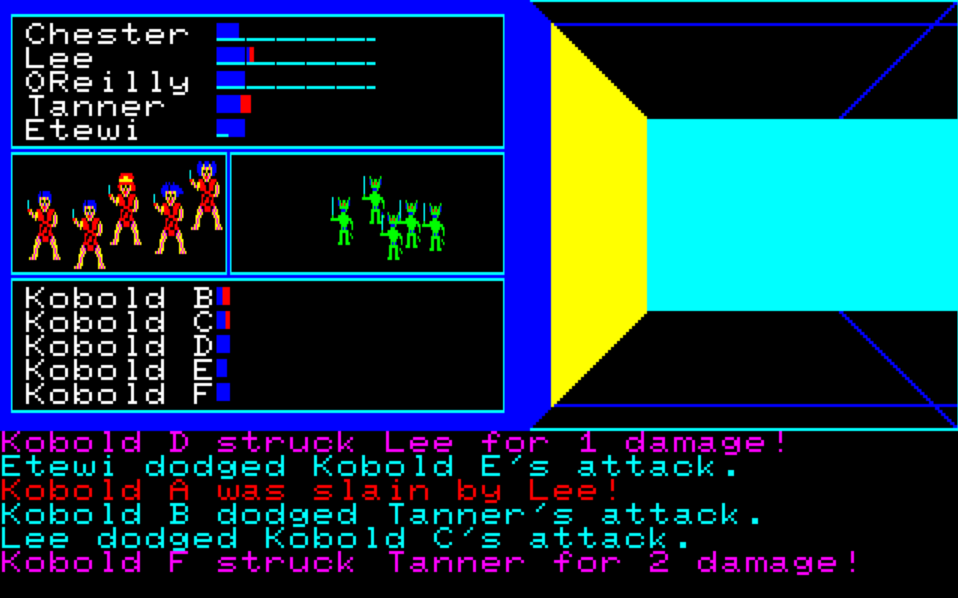
If I was a Japanese computer enthusiast in 1984, checking out a role-playing game for the first time, The Black Onyx would leave me wanting more. The game's featureless dungeons, blunt approach to combat, and one-line NPCs aren't quite enough to satisfy the RPG craving that both sides of the Pacific seem to experience.
However, The Black Onyx would indisputably leave me wanting more, in that it gives players a taste of the veritable feast of RPGs that would soon be available. It is a generally unimpressive game that nonetheless fulfills its core purpose: to introduce the Japanese market to the kinds of games being developed in the west during the period. I haven't had a chance to play its contemporaries from the year--Hydlide and Dragon Slayer, predominantly--so I don't know how The Black Onyx stacks up against them, but taken by itself I can see how it became immensely popular for a brief period of time, until more advanced games came along.
 |
| Level 4 had several sections with lots of teleporters and one-way walls. I think it's cool that the developer didn't feel compelled to cram everything into a 15 x 15 space or something. |
The dungeon ended up consisting of six levels, all wonderfully asymmetrical. Levels 3-5 introduced a fair number of navigation obstacles like secret doors, one-way doors, one-way walls, and teleporters, all necessary to maintain some interest in a dungeon that has no special encounters or other puzzles.
Character development--probably the strongest part of the game--remained rapid and oddly satisfying until the game's final hours, when there was nothing else to buy and it took forever for the meter to get from Level 6 to Level 7. Until then, every dungeon level brought a corresponding increase in character level and a corresponding amount of money necessary to buy the next equipment upgrade.
Character development--probably the strongest part of the game--remained rapid and oddly satisfying until the game's final hours, when there was nothing else to buy and it took forever for the meter to get from Level 6 to Level 7. Until then, every dungeon level brought a corresponding increase in character level and a corresponding amount of money necessary to buy the next equipment upgrade.
 |
| Eventually, I was able to buy the most expensive item in the game. |
Some odd rules emerged as I explored. Some combats would result in money and some wouldn't, and I ultimately realized that only the fixed encounters led to cash rewards (and even then only if the enemies were humanoid); random encounters give you experience only. This turns out to be a non-issue, however, as you ultimately have more cash than you can possibly spend. Each character maxes at 15,000 gold pieces each (and there's even a bank to store excess!), but once you have the top weapons, armor, helms, and shields, the only place to spend money is on doses of medicine at the low price of 55 gold pieces each; each character can carry up to 5 at any one time.
I never did understand what was
going on with the helmets. The game kept taking them off automatically,
and I had to manually put them back on. Thankfully, there was a command
for that purpose. I have no idea why there was no comparable command to
equip or remove other items or why helmets were singled out this way.
Monsters escalated in difficulty but not interest. On higher levels, kobolds and skeletons gave way to cobras, slimes, vampires, spiders, ghouls, "blaabs," demons, and trolls. Some of these monsters were able to kill characters more or less instantly, so I found myself reloading a lot, particularly since I found that "run" almost never works. Players of the era were probably expected to grind a lot more before hitting the lower levels. I finished the game on Level 7, but I'll bet that "in the day," levels of 10-12 were probably more common.
 |
| This was a "run" situation for me at any level. |
On higher levels, monsters occasionally dropped magic versions of the items you could buy in the stores, and I was never really sure how to evaluate them. In the store, for instance, the progression goes knife > club > mace > short sword > axe > spear > broadsword > claymore > battle axe. (I stopped at broadswords because I wanted the characters to be able to carry shields.) So where does a "magic spear" fall in this hierarchy? I ultimately adopted the expedient of locating it halfway between the regular item and the next item, which the damage rolls seemed to bear out.
 |
| Yay? |
The "well" in the city turned out to be a shortcut to Level 5 of the dungeon, so once my characters were powerful enough to defeat the Kraken at the bottom, they could go from the town to the bottom without having to trudge down 5 full levels.
Level 6 of the dungeon was separated into six color-coded sections. After I mapped them and still couldn't figure out what to do, I consulted the Internet, which indicated that the player needed to progress through the six sections in a particular order to unlock the way to the black tower. The color order was different on each type of computer, and I couldn't find anything that told me the right order for the PC-88. I wrote to LordKarnov42, the translator, and he suggested that it had to do with the colors that flash inside the "O" in "Onyx" on the main screen. I had to call in Irene to tell me what the colors were ("this looks like a really stupid game"), but sure enough, they provided the correct order to progress through the maze. What an obscure solution to a puzzle!
 |
| Fortunately, the game told me the color of each area as I transitioned into it, so Irene didn't have to hang around the computer for too long. |
Oddly, when you start the game, it gives you the ability to specify monochrome graphics. I'm not sure how the puzzle works if that's what you had.
Anyway, solving the maze allowed entry into this level's version of the 2 x 2 "dark squares" that had been on every level preceding it. It became clear that these squares represent the black tower thrust into the middle of the city, as seen on the main screen.
 |
| It's even in the position that the four black squares occur on the town map. That's pretty cool. Note that in this screen capture, the color in the middle of the "O" is green or red. It cycles through all six colors on the actual main screen. |
The tower had 6 levels going up, all with more navigation puzzles, but in all cases the stairways up were really close to each other, so if I got lost, I just reloaded and tried a different direction.
 |
| Working my way up the tower. |
At the top, I passed through an outdoor area and then into an area where, I don't know, I seemed to be among the stars or something.
 |
| The weird final area. |
Eventually, I bumbled into a square that told me, "I found the Onyx!!! The keyword is YGGDRASIL. Please remember!"
And then we were back on the main screen.
"Yggdrasil" is a holy tree in Norse mythology. Apparently, the first 100 players to complete the game could send that word to Bullet-Proof Software and receive a real black onyx gem.
(As a side note, The Black Onyx vies only with Dungeon as the worst game in the world to try to Google. No matter what other terms you put with it, you're overwhelmed with jewelry pages. Even "Black Onyx" and "Yggdrasil" returns a ton of pages selling representations of Yggdrasil made out of black onyx.)
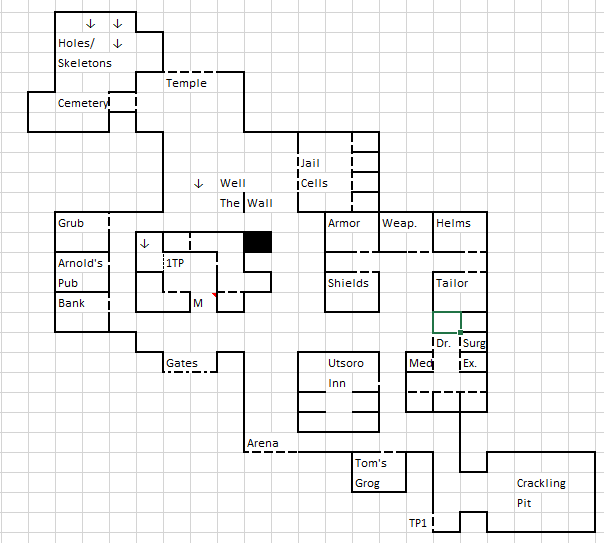
Three inaccessible areas in the main town--a temple, the front gates, and the arena--remain a mystery. I guess they were used in some expansions to the game, but I can't find a lot of reliable information whether the expansions were ever released or, if so, how they interacted with the original game.
 |
| I never was able to enter the Arena. |
Here's my GIMLET:
- 1 point for the game world. Granted, I didn't have a manual, but the back story seems underwhelming and is not represented in any way during gameplay or in the game's conclusion.
- 3 points for character creation and development. This is the first game I've played to give far more consideration to the character's appearance during creation than any other aspect. (Since you can't set a class, sex, race, or any attributes, appearance is really all you have.) Nonetheless, leveling is relatively rapid and rewarding.
- 2 points for NPC interaction. There are NPCs you can talk to, but all they ever have to say is "good luck finding the Onyx!" The game gets an extra point, though, for allowing the player to recruit and rob NPCs.
 |
| The extent of most NPC interaction. |
- 2 points for a fair number of standard fantasy foes, distinguishable primarily by their hit points and how hard they can hit. There are certainly plenty of grinding opportunities.
 |
| Late-game creatures were very hard and occasioned a fair number of reloads. |
- 1 point for magic and combat. There's no magic and only one combat action.
 |
| Monster parties occasionally substituted quantity for quality. |
- 2 points for equipment. Very basic, but a reasonably good mechanism of character development.
- 3 points for the economy, which remains strong until the game's final quarter. Players who jettison dead characters instead of reloading would get even more use out of the economy as they constantly replace dead characters' gear.
- 1 point for a main quest that doesn't really make any sense and doesn't have any effects in-game.
- 3 points for graphics, sound, and interface. They're all somewhat primitive, but the game gets some credit for paper-doll portraits (the first I know to offer portraits that change based on equipped gear), and the keyboard interface works fine.
- 3 points for gameplay, awarded for the even level of difficulty, good pacing, and short duration.
Added together, we get a final score of only 21 for this early JRPG, but while it's hard to recommend the game for modern readers, in 1984, it did its job. It was the best-selling game in Japan in 1984, and second-best in 1985 despite an incredibly high sale price, equivalent to $72 USD in 1984, or over $160 today. The sheer number of ports indicates how well the game was loved throughout the 1980s.

Its legacy is hard to nail down. Some histories credit The Black Onyx for inspiring other landmark Japanese games, like Dragon Quest and Final Fantasy. On the other hand, a critical look at the history in a 2011 post by Sam Derboo on Hardcore Gaming 101 suggests that these later JRPGs were primarily inspired by the game that inspired The Black Onyx: Wizardry. In any event, I don't think there can be any question that The Black Onyx served to excite Japanese interest in RPGs in a way that otherwise might have taken a lot longer.
At some point before 1986, Bullet-Proof developed The Black Onyx II: Search for the Fire Crystal, published by ASCII. Some sites say that the original game had an expansion called The Fire Crystal, and I'm not sure whether these are two separate games or whether it was originally offered as an expansion and then developed into an entire game. (There are also tales of expansions titled The Moonstone and Arena, though I'm not sure if they were ever published or just planned.) Either way, Fire Crystal seems to have introduced classes and a magic system while keeping the same overall engine. In 1988, the original game was remade for the NES as Super Black Onyx.
As for the Dutch-born, American-raised Henk Rogers, he went on to achieve greater fame for brokering the deal that allowed Nintendo to purchase the exclusive rights to Tetris from developer Alexey Pajitnov; the game went on to help establish Nintendo's Game Boy as the predominant handheld device of the late 1980s and early 1990s. When the rights reverted to Pajitnov in 1996, he and Rogers (who moved back to Hawaii at some point) formed The Tetris Company, which continues to license Tetris to this day.
Somewhere in there, Bullet-Proof Software became a division of Nintendo and continued to develop games under its own name throughout the 1990s. Only one of the company's other games--Dimensional Fighter Epsilon3 (1985)--is classified as an RPG by MobyGames. I can't find any evidence that Rogers ever worked on another RPG, either.
Thus we fill in one small hole in the development of early JRPGs. For those of you who want to see me play more of them, I may go back and start picking up the most important Japanese console RPGs once I finish catching up on non-DOS 1980s games that I missed on my first pass. Until then, I'll be happy to play any more fan translations that you tell me about.
For now, it's back to either Moria or Quest for the Unicorn depending on how I feel.
For now, it's back to either Moria or Quest for the Unicorn depending on how I feel.