Showing posts sorted by relevance for query Captive. Sort by date Show all posts

Thursday, September 11, 2014

Captive: Final Rating


Captive
United Kingdom
Antony Crowther (designer), Mindscape (publisher)
Released 1990 for Amiga and Atari ST; 1992 for DOS
Date Started: 10 August 2014
Date Ended: 8 September 2014
Total Hours: 42
Difficulty: Hard (4/5)
Final Rating: 36
Ranking at Time of Posting: 109/158 (69%)
Ranking at Game # 431: 322/431 (75%)

Even bad games often have an enjoyable "hook." With Captive, for me, it was the satisfying combination of a burst of blood and an audible clack that accompanies each enemy's death. You get no indication of hit points or damage levels until an enemy dies, so it's almost always something of a surprise when it happens, especially when you've just spent a few minutes engaging the foe in the deadly side-step-turn dance in which one mistyped key can be fatal.

It's no secret that I didn't care for Captive--didn't hate it, just didn't care for it--but there are several ways in which I admire the game, starting with the one above. In few games is seeing an enemy die so satisfying. Another is in the programming that must have gone into the procedural dungeon creation. While this results in dungeon layouts that are overly linear and a bit bland, it's still pretty cool. The complex rules that must have gone into the procedure--no shops too soon, release buttons must always follow closing walls, enemies with clipboards must always precede computers or puzzle doors--execute flawlessly.

The procedural generation also results in a few oddities, however. First, there is no "final battle" in each base--no "big bad" or unique enemy. Given how difficult I found the combats, this was somewhat merciful but also somewhat bland from a story perspective. As we've discussed in the comments, it also means that the puzzles can only be of the most rote sort, such as password-protected computers preceded with clipboards that tell you the password. When generating random dungeons, it's harder (impossible?) to create crafted puzzles that require complex maneuvering, testing, or logical inference, such as Dungeon Master's pressure-plate puzzles or Might & Magic's wall messages.

The puzzles get slightly more complicated as the game goes on, but they always involve a clipboard that tells you the exact answer.
  
Captive is rightly famous for being the game that never ends. When you finish each mission, you're given the option to continue to the next one, and the whole process starts over. Technically, this process does have an "end," but even the low mission limit on the PC version (256) would take thousands of hours to complete--I estimate about three times as long as every other game I've played as part of this blog--and I would be filled with despair if anyone told me they'd done that. Since your droids continue to get better while the enemy doesn't (you encounter every enemy type in the first mission), it must eventually get boring.

I've been criticized for playing Captive "wrong," by not upgrading weapons fast enough. I maintain that taking this approach is hampered by a) always needing to keep enough cash to repair droids; b) the fact that only like one shop in each base sells weapons; and c) the game documentation not making it clear that the next class of weapons is always a good thing (although this can admittedly be determined with the "AG Scan" device). Contrast this with, say, Fallout: New Vegas, where a player using a handgun at a high skill is going to be more effective than a player using a machine gun at a low skill. 

But I also allow that my own RPG tendencies did hamper my progress. For instance, I have an aversion to purchasing equipment in a game that offers it for free. It's much more satisfying to loot a helm +2 from a dead orc captain than to purchase it in a shop. Since Captive offers copious found melee weapons, super balls, and handguns until all but the final levels, I tended to equip those rather than purchase expensive-but-better weapons in the stores. I also have a weird tendency to try to diversify the types of weapons I equip, perhaps ingrained by RPGs where enemies have weaknesses to different weapon types (which is not the case in Captive). Fallout: New Vegas offers the ability to break down ammo and use the resulting powder and lead to reload empty cartridges, meaning that if you want to go through the entire game with just a .45 pistol, you can still make use of the other handgun ammo that you find. Despite this, I insist on toting around a weapon that makes use of every type of ammo in the game, switching between them as I run out, ensuring that eventually I'll be taking on a swarm of deathclaws with a BB gun--a situation not so different than showing up in the final levels of Captive with magnums. Even after I understood how Captive worked, I insisted on replacing my superior laser pistols with "zlot" shotguns that I'd found, just to diversify my weapon selection.

Note that in this late game shot, I've replaced two of my lasers with inferior "zlot" shotguns just because, I don't know, they were free.
  
Nonetheless, even doing everything "right," I'd have to ding the game a bit for difficulty. Enemies encountered on the final levels are capable of blasting the droids to scrap, in just a couple of shots, even with upgraded parts and all shields blazing. Repairing droids is so expensive that you're essentially forced to play like a jackass--reloading every time you take significant damage, not just when you die--so you don't go broke and lack the ability to purchase the weapons and ammo that are so important. Yes, pushing through the final base with no weapons until I finally found a shop was satisfying, but it was one moment of satisfaction after endless hours of frustration.

Ultimately, my ambivalent feelings about Captive boil down to it not having enough of the elements that I truly enjoy about RPGs, something that I think will be reflected in the GIMLET:

1. Game World. A missed opportunity. Captive is nominally a sci-fi game that takes place in space, but it really feels more like a standard high fantasy game with sci-fi textures (the same way that Don't Go Alone felt like a standard fantasy game with horror textures). The framing story is essentially unnecessary and its conclusion confusing and uninteresting. In this, I must admit, it captures the spirit of other Dungeon Master clones perfectly. Score: 3. 

The space parts of the game were just time-fillers. They didn't in any way seem to be about traveling through space.

2. Character Creation and Development. "Creation" is limited to assigning names to the droids, which oddly determines their starting attributes. "Development" throughout the game is unsophisticated but still somewhat satisfying, as you spend experience points on skills and get random attribute increases every time you do so. Skill levels not only increase proficiency but unlock new weapons and armor.  It was nice to let a couple hours go by and suddenly realize I had 8,000 experience points to spend. On the downside, there are absolutely no role-playing opportunities, and development stalls in the last couple of bases, when you get paltry rewards for slaying difficult creatures and each new skill purchase costs thousands of points. Score: 4.

One character towards the game's end. I never got to use a "spaygun," and I'm not sure I even want to know what it does.

3. NPC Interaction. There are, alas, no NPCs. Turning the shopkeepers into NPCs would have significantly improved the game, as I'll discuss below. Score: 0.

4. Encounters and Foes. Captive has a variety of foes original to the game, though some clearly based on pop-culture references like Go-bots, Robocop, and Critters. Moreover, they are well-distinguished in power and attributes, such as whether they can shoot missile weapons, what types of damage they do (fire vs. physical), the speed they move, their relative hit points, and whether they can fly. These various characteristics determine the strategies you need to employ to defeat them, which is as it should be. There are no other satisfying "encounters" in the game, with all of its "puzzles" somewhat sophomoric and no role-playing choices. Some level of respawning would also have been welcome, to compensate for poor skill and money selections. Score: 4.

Didn't quite close that door fast enough.
  
5. Magic and Combat. I have to give Captive a lot of credit for being among a small number of games in which the player really makes use of the physical environment in combat. Between leading enemies in a "fighting retreat" along long corridors, smashing them with doors, laying mines, tricking them into shooting each other, freezing them in place by flooding rooms, and a variety of other tactics I outlined a few days ago, there are a lot of ways for the under-equipped player to (very slowly) whittle down the enemies. I maintain that for most of the game, you essentially must do these things to avoid taking too much damage.

The rest of combat was a little less interesting to me. The game offers Dungeon Master's basic mechanics but without the special attacks and magic system that allowed you to fine-tune attacks and defenses. And in general, I don't like real-time combat unless it's a bit more forgiving. I'm old and clumsy. Score: 5.

6. Equipment. In my opinion, the game's best category. Between weapons, armor (droid parts), devices and optics with special uses, cameras, and mines, you have a lot of options for outfitting characters. This game is (I think) tied with The Keys to Maramon to offer the first mines in RPG history, and I don't recall any previous game offering something as sophisticated as cameras that let you spy on what's happening in other parts of the dungeon--and to detonate them when an enemy approaches. I also liked that you could find limited-use versions of most weapons ("zlots") throughout the game. Considerations of weight (more weight saps more power) and item damage also added to the game's strategy.

Captive leaves it entirely up to the player to figure out what each of the items does and how it works. For instance, you have to purchase and test each "dev-scape" and "optic" to figure out its use, and even then it can be somewhat obscure (does the "Power Sapper" do anything but drain power?). To understand damage levels of each weapon, you have to run the "AG Scan" optic. I don't know any way to determine what ammo each weapon uses without just buying it and trying to reload. While in other games, I might appreciate the extra challenge afforded by all this experimentation, I generally felt Captive was challenging enough. Score: 6.

A late-game inventory illustrates some of the game's diverse equipment, including a dagger, a rifle, a shield, a die (to figure out door combinations), several clipboards with passwords, a battery, gold, three cameras, and several types of melee weapons and handguns.

7. Economy. Well, unlike many games, gold in Captive--as nonsensical as it is--remains valuable all the way to the end of the game, what with the constant need for upgrades, repairs, and ammo-refills. Because I was always on the verge of being broke, I didn't even fully experience all of the devices, weapons, and parts the game had to offer--perhaps the most compelling reason to continue on to Mission #2. Other than that, the economy isn't very sophisticated, and I didn't care for the fact that it was a closed system (since there are no random encounters), nor that you couldn't sell back unneeded ammo or zlots. Score: 5.

8. Quests. The game has a main quest, but it's so bereft of any real story or information that it's hard to regard it as much of anything. Even the final "choice"--whether to end the game with Trill's liberation or let him be re-captured and go on another mission--doesn't really make any sense thematically. No side-quests, no role-playing, not even the satisfaction of a real ending. Score: 2.

9. Graphics, Sound, and Inputs. I found the graphics reasonably good for the era--certainly above the "not distractingly bad" threshold I set for full score. Sound is about as good as you might expect for the era, and I definitely found gameplay enhanced with the sound turned on. I liked that the game had redundant mouse/keyboard controls for most things; didn't like that it didn't have keyboard controls for combat actions. Score: 5.

10. Gameplay. I would characterize it as very linear, overly hard, not very replayable, and too long even for the first mission. The ability to keep playing as long as you want is, I suppose, a "good" thing if you like the game, but for me every base offers the same bland experience punctuated with the occasional thrill of dispatching a particularly difficult foe. This is not enough to sustain the 10 bases that the first mission requires, let alone unlimited additional missions. Score: 2.

The final score of 36 puts it just above my "recommended" threshold. I think Captive could have elevated itself to something I truly enjoyed with just a little additional effort, such as a few dialogue options with the shopkeepers offering tips on equipment and foes, a few fixed encounters interspersed with the procedural dungeon creation (would it have been so hard to plug them in for the first mission, at least?), maybe a text screen at the end of each mission, or with each computer hack, that revealed a bit more about Trill and his crimes. Heck, if this story had been any good, I might have been tempted to go on to the second mission just to continue fleshing it out.

Players that don't care much about plots, NPCs, and role-playing choices would probably scale the score up to an equivalent of a 50. I understand if you're one of those players, and I admit the game's mechanics are good for what it does, but even you have to admit that a game purely about mechanics is not what people generally think about when you say "RPG."

MobyGames's review round-up shows that contemporary reviews were all over the place, ranging from 44/100 to 94/100, but each notes its Dungeon Master heritage and suggest that the game appeals most to fans of Dungeon Master-style games, with which I agree if what you like most about Dungeon Master is the real-time combat mechanics.

I always try, often unsuccessfully, to separate my personal enjoyment of a game from my admiration of the development. I didn't like Keef the Thief much, but I thought it was an impressive effort for a couple of teenaged developers. In this case, I think 25-year-old author Antony Crowther deserves a lot of credit for designing the game by himself (apparently after his brother, a Dungeon Master fan, suggested it) in an era in which most single-developer games feel like throwbacks to the early 1980s.

Crowther had been building up experience prior to Captive, as a developer of minor arcade-style games like Bat Attack (1983) and Zig-Zag (1987) and a programmer on several Starlight Software titles like Deathscape (1987) and Dogfight 2187 (1987). Since Captive, he's continued to be active in the gaming field, working most recently for Electronic Arts on the Harry Potter series. His LinkedIn profile currently shows him as a "Technical Consultant" at Sumo Digital, a UK-based game company that seems to specialize in board, sports, and fitness games.

In 1993, while still working for Mindscape, Crowther wrote Liberation: Captive II with a much bigger team. Judging by the screenshots, its a very different game, preserving some of the first game's elements (like a party of four droids and associated equipment) but set in a much less linear world and featuring an actual story. I look forward to giving it a try. We'll encounter Crowther again before then, however, with Knightmare (1991), based on a British children's show, which appears to be yet another Dungeon Master clone but with a simpler interface than Captive.

For now I return to Secret of the Silver Blades, a game so different from Captive that we must marvel that they're considered part of the same genre.


Monday, November 7, 2016

Game 234: Knightmare (1991)

       
Knightmare
United Kingdom
Mindscape (developer and publisher)
Released in 1991 for Amiga and Atari ST
Date Started: 6 November 2016
    
We've seen it happen before and we'll see it again: A TV or film franchise is popular. Someone thinks it would make a good computer game. But time is of the essence--you have to catch fads while they're hot--so there probably isn't a lot of time to build an appropriate game engine from the ground up. A developer is contracted with a strict deadline. "Hey, why don't we re-use the Whatever engine that was so successful in Our Last Game?" they say. Boom. Three months later, you're playing Friends: The Official Game, which inexplicably has the six title characters repelling a demonic invasion of New York in the DOOM engine. ("Could you be any more dead?!" Chandler says every time he takes down a boss. It's funny the first time.)

Thus, when I first heard that Knightmare was both a) based on a British television show and b) was developed by Antony Crowther using his Captive engine, I was sure we had another such situation on our hands. I knew nothing about the plot of the TV show: I just couldn't imagine how it could possibly be served in the kind of plot-limited, Dungeon Master-inspired first-person gameplay featured in Captive.

Little did I realize that this is a rare case of the match-up making perfect sense. The original show takes place in a first-person view (for one player) and a quasi-first-person view for the rest. The Dungeon Master-inspired Captive engine, which already allows for a variety of navigation puzzles, probably works better than anything else available in 1991 to offer a combination of role-playing and puzzle-solving.

Having watched a few episodes of Knightmare (1987-1994) now, I first can't believe I'd never heard of the show before. It's a delightfully bizarre cross between a reality/contest show, a virtual reality experience, and live-action role playing. You have to watch it to do it justice, but the basic theme is that a team of 4 kids navigates a part-constructed, part-virtual reality dungeon, solves puzzles, slays monsters, casts spells, and whatnot, hoping to find a treasure. A host, named "Treguard of Dunshelm," sets up and moderates each episode, and other recurring "NPCs" occasionally appear to offer hints or challenge the players. Only one member of the team actually "navigates" the dungeon, wearing a "helmet" that restricts his or her view. The rest observe his or her progress and offer advice and encouragement. The quests are extremely hard, and in the eight-year history of the show, only eight teams won the game. 
   
A player tries to navigate around a cobra while his team members give him instructions on where to walk.
      
(As an aside, the kids on the show crack me up. I watched three episodes from different seasons, and I don't think a single one of them smiled or laughed the entire time. They were all deadly serious and somber, even when just stating their names and the towns they came from.)

The game manual similarly presents the party as composed of four English youths who have been camping and hiking all summer, hoping to find the way to Treguard's realm. Eventually, they come upon a portal that takes them to Dunshelm, where they are given a quest to retrieve four items--shield, sword, cup, and crown--from the castle's dungeons. Much as in Chaos Strikes Back, each item lies along a particular path with puzzles appropriate to one of the game's classes. Once the party has assembled all the items, they will use them to challenge Lord Fear and "banish him from this earth forever."
    
The introductory screens invite the player to a castle.
    
In creating a party of four characters, you choose one of 8 "breeds"--man, woman, goblin, ogre, ghoul, elf, troll, and insectole--and one of 6 classes--adventurer, gladiator, samurai, wizard, priest, and genie. Of the advantages and disadvantages of these breeds and classes, the manual tells you precisely nothing, nor does it attempt to reconcile such races with the backstory. You assign a name and title to each character, then select sex, breed, class, and dominant hand.
   
Character creation.
    
I went with a male adventurer, female samurai, an elf wizard, and an insectole priest. The game began!

I played Captive over two years ago (starting here) and left the impression that I didn't like it. It was the sort of game that's confusing on your first trip, and it wasn't until after I'd finished playing that I realized I liked it better than I thought and actually found myself missing it a bit, so I didn't approach this one with any kind of dread. The interface has been simplified--there are no "monitors" across the top of the screen, among other things--and this coupled with the medieval setting actually feels a bit more like Dungeon Master than the original Captive. The engine has been modified to allow more puzzles, and my understanding is the levels are all created by hand instead of procedurally-generated as in Captive. Even in the first area, it was clear that Knightmare allows more things in the environment than Captive.
   
Yes, I know some of you think it makes perfect sense that you take damage from walking into a bush. We'll never agree on this issue.
     
Unfortunately, just as in Captive, the party takes damage from walking into things, and there are more things in Knightmare's environment (like small bushes) that it looks like you ought to be able to move through. These bushes, I soon found, are used to create mazes in the outdoor areas.

Combat is much the same: each character has two hands and can hold a variety of weapons and magic wands or staves in those hands. Right-clicking activates the attack or item use. When you first find an item, the first time you right-click, the game asks what action you want to execute. It asks this even if there's only one possible action. You want to do this right away and not have the pop-up menu show up in combat. Annoyingly, every time you toss a throwing weapon, the action re-sets, so you have to specify it again every time you pick up and re-equip the weapons. As if picking up all your throwing weapons post-combat wasn't annoying enough.
    
The party fights some kind of troll thing with its fists after exhausting its balls.
    
The characters start the game with no equipment. The opening area was small and offered only a couple of faces in magic mirrors (or something), one of which said "Welcome to your knightmare" and the other said "return the crown here." Through a nearby portal, I found a cubbyhole with three balls that work like the superballs of Captive. Later, strewn across the ground, I found various items of "armor"--shirts, shorts, and sandals. This makes me wonder what my characters were wearing, if anything, when they went exploring in the first place.
     
My character assembles a basic outfit.
    
The opening area consisted of three small rectangles, 6-10 squares wide and 6-7 squares tall. They were connected by a track with a cart that moves automatically. I couldn't walk on the track itself and I took damage when I tried (was I hitting the third rail?). Exploring these areas meant jumping off the cart at strategic times in it's rapid back-and-forth movement.

There was one enemy in the area, some kind of troll thing. Just as in Captive, it's satisfying when enemies finally die in a puff of blood.

"Take this shortcut to the forest" a floating head said next to a portal. This led me to a much larger map, about 25 x 25. "Your quest starts here," a nearby head announced. At first, I was hemmed in by hedges, but a switch on a wall opened one of the hedge squares. A "twig" found near the entrance served as a crude weapon.
    
The forest. You start in the bottom-center.
    
The larger area was crawling with little gnomish creatures, flying tree heads, and little rabbits, the latter of which seemed non-hostile. As I explored, I found a couple of penknives to serve as better weapons.

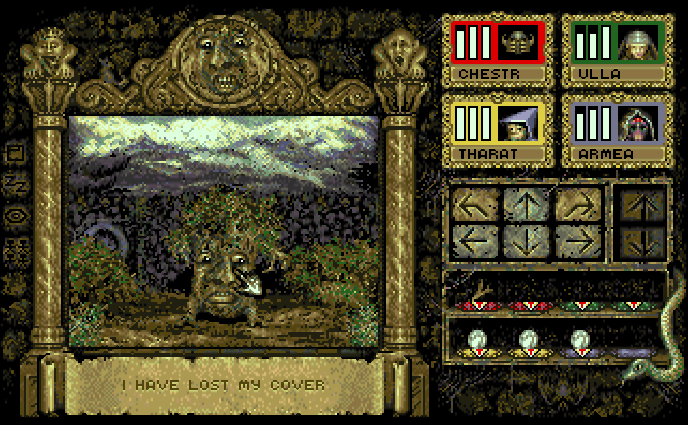
Four exits from this area were blocked by living trees. After they thoroughly whomped me in combat (that I started), I realized that they're not even hostile. If you click on them, they talk. Lesson learned--don't just attack every creature on the screen. Each tree wanted something. "Have you seen my cup?" one asked. Another wanted his weapon, a third his "cover." None of these corresponded with items that I'd found.
    
      
The fourth said he was missing his "child." I tossed the twig at him and the tree disappeared, leaving a magic wand in his place. His disappearance unblocked a path to a portal. A nearby head announced that this was "Quest One, the Shield of Justice." I assume that on this quest path I'll find an object to give to the tree blocking Quest Two.
    
     
In the northeast corner of the map, I found an iron key. I nearly missed it; my colorblindness hurts me a bit in games with small items on top of such detailed features. Anyway, the key opens a door in the northwest corner, behind which three ogre-like creatures are lurking. They killed my party in a hot minute. I reloaded and tried combat-waltzing them, but one mistake led to the death of a character in one blow. I guess I'll save them for later.
   
I suppose this gate was probably closed for a reason.
     
When party members die, incidentally, their--yuck--hearts are left behind. I don't yet know if there's any way to raise them.
    
A gnome manages to kill two characters while I thought "pause" was active.
     
The manual for Knightmare is unforgivably sparse. In addition to not covering anything about races and classes, healing and resurrection, it doesn't indicate if there's any downside to resting or standing around (both of which, unlike in Captive, heal damage). It's very thin on how the magic and character development system work. Rather than offer skills and experience points as in Captive, the game seems to copy Dungeon Master by assigning skill levels to the various character classes and by leveling you up based on how you use those skills. Various weapons, wands, and staves are aspected to particular character classes.
   
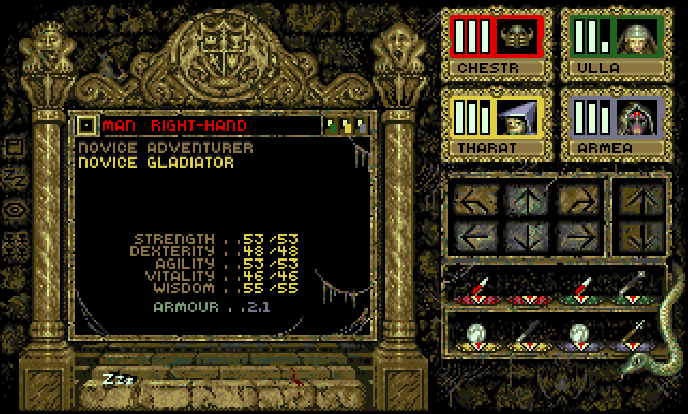
My lead character has an adventurer and a gladiator level.
    
Finally, I'll note that after playing Fate, with its rich background sounds, Knightmare is a bit eerie in its silence. A jaunty tune based on the TV show theme plays when you first start the game, and there are sounds to accompany combat and accidentally walking into walls, but otherwise nothing. There won't be many more games that are so quiet during exploration.
    
The Quest One portal takes me into a more standard dungeon-looking terrain, and I suspect the puzzles there are going to get harder, so I'll leave off for now. It's not bad so far, but I wish I wasn't playing and mapping two large, first-person Amiga games at the same time.

Time so far: 3 hours

Tuesday, August 3, 2021

BRIEF: Liberation: Captive II (1993)

        
Liberation: Captive II
United Kingdom
Byte Engineers (developer); Mindscape (publisher)
Released in 1993 for Amiga CD32, 1994 for Amiga
        
There was a period of my childhood, probably around ages 8 or 10, when I was obsessed with "treasure hunts"--the kind where you find a clue that leads to another clue, and so on, ultimately to some kind of treasure. I think I was inspired by Gertrude Chandler Warner's The Yellow House Mystery, one of the Boxcar Children books. I liked both creating and playing treasure hunts. My mother made really good ones, full of anagrams and acrostics and other types of wordplay. In contrast, I once tried to get a babysitter to make one, but either she didn't get the concept or didn't care. Her clues would say, "Go look in the kitchen." In the kitchen, I'd find a clue that said, "Go look in the upstairs bathroom."
    
These two approaches illustrate the problem with procedural generation in Captive. I had an interesting experience with the original game. I admired it more than I liked it. Antony Crowther built his reputation on rapid and efficient code, and he used those skills in Captive to produce a game with Dungeon Master-style mechanics, but with levels that could be infinitely generated. (That's not quite true because of some bugs, but most versions will generate more levels than any player would possibly have time to play.) The levels aren't randomly generated--they're the same for every player--but they are procedurally generated, spinning out large levels from a fixed sequence of seeds. The size of the levels isn't quite as impressive as the number of items and interactions he included within them; the code had to include considerations of stores, enemies, weapons, power sockets, up and down ladders, moving walls (but not anywhere that would trap the player), traps, and a variety of approaches to doors--always ensuring that the passcode or key could be found before the doors they opened.
      
Liberation's city is huge, bizarre-looking, and procedurally-generated.
     
In the sequel, he takes it even further, using the seeds to create not only an enormous city but also the NPCs and enemies that populate it, the names of its streets and businesses, the name of the sub-titular captive you're trying to rescue, and the trail of clues that leads you to his location. It's an impressive effort in terms of coding, but for me it results in unsatisfying gameplay. With procedural generation, there's no room for unique NPC personalities, particularly complex or creative puzzles or clues, or areas that feel like real places. It's rather like playing Skyrim or Fallout 4 and doing only the "radiant" quests, only worse because in those games at least the locations are hand-designed. Some of the advertisements for Captive II suggest that it would take a lifetime to complete the thousands of missions that the game offers, but I don't know why you'd want to. I'd much rather have a hand-designed game with only a single mission.
       
Before I get to the game, I would note that I'm playing a new machine. The Amiga CD32 wasn't just another Amiga model, as I originally assumed, but a short-lived console that never had an American release. Its "life" was less than a year, from September 1993 to Commodore's bankruptcy the following April, but it supported nearly 150 games, including seven RPGs: Liberation, Whale's Voyage (1993), DragonStone (1994), HeroQuest II (1994), Heimdall 2 (1994), Magic Island: The Secret of Stones (1995), and The Speris Legacy (1995). I believe all of these games also had regular Amiga releases, but the CD32 version often has features that the computer version doesn't, like cinematics and voiced dialogue. Thus, although it gave me all kinds of grief, I took the time to figure out how to emulate the console in WinUAE, only later realizing that I was essentially breaking my blog's rules (or at least normal SOP) by favoring the console version in the first place.
     
Trill seems to belong to some military service.
    
Captive's framing story was often confusing. The opening told of an innocent man named Trill being convicted in 2542 of "all counts" of an unspecified crime. Hoping for "community service," he instead received 250 years in suspended animation. Only a couple years before the date of his release, an attack on the prison space station woke him up. A laptop computer in his cell somehow allowed him to connect to a group of four droids on a distant ship, and over the course of 10 levels, the droids slowly pieced together Trill's location. The scenario ended when the droids invaded Trill's station and found him, but at the press of a button, the player could have some security bots whisk Trill away to another station and start the cycle over again.
   
You may recall that the game ended with a bit of a mystery. If the player chooses to end the game after freeing Trill, the game says that they have just liberated "the Creator of Evil." I don't know what that was supposed to mean, but Liberation opens as if the words had never been spoken. Instead, the droids are seen carrying the exhausted Trill to freedom. "At long last, Trill is a free man," a narrator intones, as the cinematic shows fireworks exploding in celebration and Trill receiving some kind of medal. I guess he got a sinecure, as the next screen shows him making paper airplanes while watching monitors in some facility. On the news, an anchor reports on unrest at the Alpha Detention Centre, where protestors are rallying against the imprisonment of a Mark Antony Jadva. Jadva has been convicted for the murder of a Councillor Dran. Trill searches his company's database and finds that Dran was actually killed by a malfunctioning Securi-Droid manufactured by BioCorp, and the company covered it up and pinned it on Jadva. Trill also finds 264 similar cases of innocent people rotting in jail to cover for BioCorp's mistakes. I'm not sure why Trill's company computer has confidential files on another company's misconduct. It's possible that Trill works for BioCorp--I'm a little unclear on that--but either way, such damning information seems awfully easy for him to retrieve.
      
You'd think it would be easier to say that Councillor Dran had attacked the police droid.
      
(The video is amusing in the way it depicts computers a millennium into the future. They look like 1980s PCs except that the keyboard and other interface devices sort-of materialize on the desk in front of the user, as if they were holograms. Trill summons them and switches between them by banging on the desk with his fist.)
   
Trill does a video call with a friend named Doltana and asks him to check out the case. Securi-Droids for BioCorp are monitoring the call. Doltana confirms that the droids are malfunctioning because of "magnetic storms." Trill wakes up his own four droid companions and apparently sends them on a quest to rescue the imprisoned innocents, with the ultimate goal of convincing the Empire to shut down BioCorp.
      
Various parts of the game conflict significantly on the subject of the current year.
      
The manual offers a couple of memos that support the story, including a report by an Office Gene Runciter who says that Councillor Dran was being investigated for "possible funding violations related to the Fraud Act of 2893." The security droid murdered him while he was in an interrogation room. Also killed was a police officer named Luba Luft. Securi-Corp removed the bodies and placed them in new locations, framing Mark Leonard Jadva and some local gang members for the two murders. Officer Runciter seems bent on pursuing the cover-up, but the memos indicate that he was "taken care of."
        
There are two settings before you begin. The first is "easy" or "hard," indicating the complexity of the route leading to the captive on each level. The other is "strategy" or "action," and it determines whether you want a puzzle/action combination or all action. I set the game to "hard" and "strategy."
   
The first mission begins.
     
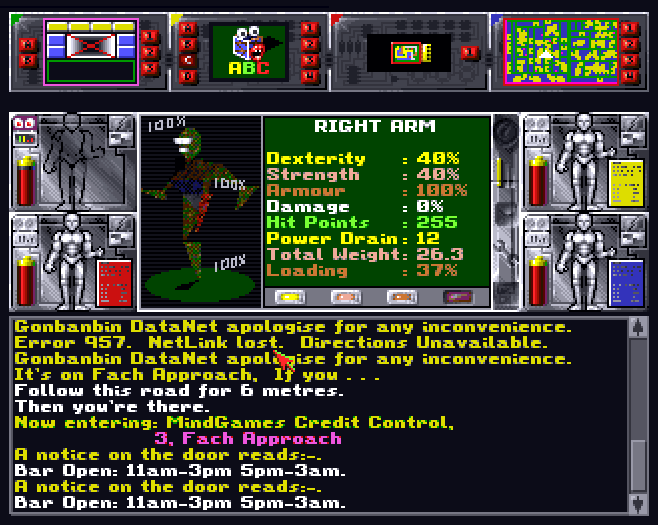
The game begins in "Mission 1" with the four droids dropped in front of the City Records Office. There's no character creation, unlike Captive. The droids are named Brian, Charlie, Dave, and Axel. The interface, which is supposed to represent Trill looking at the screen of his "briefcase computer," is easily the most complicated we've seen in an RPG. I was still discovering buttons hours into the game. Small panels might have 10 or 12 options. It takes a long time to get used to it.
   
I think the interface would have been a nightmare for a contemporary CD32 player. To play solely with the controller means pressing a button to indicate that you want to use an interface option, then moving around the screen until the right button is highlighted (among a couple dozen possibilities), and then hitting another button. It's far easier with a mouse, which was apparently an option with the CD32, although I'm not sure how that doesn't ruin the purpose of a console in the first place. There's obviously no native keyboard support, but the WinUAE defaults for the CD32 map so nicely that I suspect controlling the game is far easier for me on a keyboard, emulating the controller, than for someone with an actual controller. For instance, the colored button group on the controller is automatically emulated with the corner buttons (7913) on the numberpad. Moving is done with the other numberpad buttons (8462). So with a single hand, I can both move and fight. I wish this were possible in all games of the Dungeon Master line.
       
An alternate interface arrangement.
     
There are a few cool interface elements. You can look up, down, right, and left at 45-degree angles. Droids can be split from the group into multiple smaller parties. The upper-left panel lets you change the configuration of the main screen into several different templates, which is necessary once the droids get various enhancements that have their own panels. There's not only an automap but also a method for loading destinations into your map and automatically traveling there by taxi.
   
I find the graphics a bit odd, almost disconcerting. They're designed abstractly, with a lot of sharp angles. They look like vector graphics, although that just might be the aesthetic. The buildings have a variety of wall textures along with bits of furniture that at first confused me because they weren't interactive. It's interesting to me how two recent games--Liberation and Perihelion--have both managed to evoke a cyberpunk aesthetic with two starkly different graphical approaches, Liberation more abstract and Perihelion more impressionistic.  
   
An NPC demands a bribe for a hint.
    
NPC dialogue is all-voiced on the CD32 version, which is easier than it sounds because there are only a few voices (at least, so far) and their assignment is randomized. The NPCs themselves look abstract and androgynistic. I can't even tell if they're supposed to represent people or robots. When you speak to them, you either get a female voice with a New York accent, male voice with a southern U.S. accent, and a male voice with a working-class English accent. In the cinematic, Trill speaks with a neutral American accent, the newscaster with BBC English, and Doltana with a heavy Scots. It's nice to know the future is so multi-cultural.
   
The Records Office had three small levels with a number of locked doors, keycards always found outside the doors that they opened. But there wasn't necessarily anything interesting on the other side. Sometimes there were objects and credits (the game's money comes on individual credit cards) but usually just uninteractive pieces of furniture. A couple of rooms had computers on which I could look up any city street and a variety of business locations.
   
There were also a couple of inexplicably hostile droids (or perhaps people) that I had to shoot. Combat is much like the first game except the droids come armed with pistols and one magazine, so there's no melee phase. The cool-down period after each action is all relatively short--short enough that one character can shoot repeatedly almost as fast as four characters can shoot together. Enemies sink into the floor and disappear when they die, sometimes leaving stuff behind. 
    
Shooting an inexplicably-hostile droid or person or something.
      
The droids take damage to individual body parts, which may be removed for healing or swapped with upgrades. Every action the droids take causes a small power drain. You have to recharge by finding an electrical outlet, which I did by kicking in random doors. This is the sort of game where you can burst into random houses, kill their occupants, and loot their stuff with no penalty, which is an odd feature given the supposedly altruistic nature of the quest.
   
As for finding the subtitular captive, I got a couple of generic hints. I was confused for a bit because I thought I was going to have to find my way to the Alpha Detention Center to rescue Jadva, but I soon realized that the cinematic can only be trusted for its general theme, not its specific facts. The captive in Mission 1 turns out to be named Toyogon, and his location is just a random building. Eventually, one droid told me that a woman in a bar might know something. Later, in a bar, I got a few more potential clues, but the place was so packed with people I had to kill some of them just to get back outside.
      
The first hint I got that the captive's name wasn't the same as in the backstory.
        
The city outside is enormous, nine sectors that are each (I think) 64 x 64. They sectors are organized into named streets with a few buildings, including shops, bars, city offices, police stations, and a lot of private houses. There are oddly two "layers" to the streets--an upper level and a lower level--and the entrances to buildings can be on either. There are occasional ladders connecting them, but I haven't figured out how to go down a ladder without taking damage. The streets that you walk on are the same ones that cars drive on, and if you're not careful, the party can get hit by a car and knocked off the upper layer.
   
Somewhere in the middle of exploration, I realized something that I had not seen in the manual or any of the interfaces: any indication of character development or leveling. Captive had a system in which you could spend experience on upgrades to your skills and attributes, but the sequel doesn't have anything like that. There are four attributes--strength, agility, dexterity, and intelligence--but they attach to the droid's individual parts rather than his overall "character." They increase by finding or buying better parts.
     
The droid's parts have attributes, but the droid does not.
       
This revelation vastly changed how I saw the game. As I've often said, without character development, I'm no longer an hourly employee; I'm a volunteer. This feeling is strengthened by the procedural generation, which, though impressive in concept, makes everything feel detached and soulless. I decided to look up how long the first mission takes. From online discussions and videos, it sounds like it's a minimum of around 6-8 hours, but I also discovered that there are apparently several versions of the game, some with a variety of bugs, and the one I had been playing for a few hours has a bug that makes the first mission unwinnable. Already feeling blah about the game and its lack of RPG status, and facing the prospect of starting over if I was going to cover it, I decided to convert this to a BRIEF and reject it.
   
I did watch some video to see how the first mission ends. After following a trail of clues of somewhat arbitrary length, the player eventually encounters an NPC in a police station with a data crystal that tells of the captive's specific location. Once you find him, he gives you evidence to give to the emperor.
        
Finding the captive. I hope the droids untied him after taking his evidence.
     
The final cinematic shows the droids and Trill docking with the imperial space station and demanding an audience with the emperor. After a few tense moments in which it looks like the station's droids are going to turn on Trill, the emperor appears and thanks Trill for bringing the evidence to his attention. The cinematic ends and the droids find themselves in "Mission 2." The city is reconfigured, so I'm not sure if it's supposed to be a different one entirely, maybe on a different planet. The droids have the equipment they found in the first mission. As a commenter recently pointed out, that includes the data crystal, so unless you drop it and play things straight, you can use it to go immediately to the second mission's captive.
     
That thing around his neck looks like it weighs 20 pounds.
       
I hope no one is too disappointed, but if I'm going to move through the 1990s, I need to be relentless about my definitions. I see Liberation: Captive II as a procedurally-generated action-adventure game rather than an RPG. We're certainly seeing some evolution in game cinematics, though.

Saturday, August 16, 2014

Captive: Penned Up


All the bases have these dinosaurs wandering around outside. I guess you can grind against them.

As we discussed last time, Captive is about a convicted criminal who remote-controls a hit squad of four androids as they invade a series of bases and blow them up, killing everyone inside, all with the ultimate goal of freeing the convict from prison. 

As I closed my first post, I had finished exploring the first base and had found a probe that would lead me to the second one. As instructed, I tossed some explosives into the base generators. But I was stymied trying to get out of the base. It turns out there's a weird mechanic for exiting the base via the front door. You have to click on the door, which takes you to a little 2 x 1 room with the same door but facing away from it. To normal perception, it looks like you've gone through the door and are now facing a blank wall. But it turns out you have to turn around and enter the same combination in the second (same?) door that you used to get into the base in the first place. Then you can leave, run to your ship, and blast off before the base blows up.


I remain slightly mystified as to why it's necessary to blow up the entire base--killing all those shopkeepers, among (presumably) others--after you already have the information you need for the next one. In what way are my androids not terrorists?

Once in space, you put the probe onto your space map. It heads out and finds the next base in your mission.


When I landed on the second planet, I realized I was in trouble. For some reason, I had assumed that droids heal in between dungeons, but this isn't the case. Two of my droids had very low health, and I didn't know how long it would be before I found a shop to purchase repairs. I kept dying at the hands of the level's denizens (and at my own hands, as it turns out; see below), and for some reason my lead droid got into a situation where he was taking damage every round. I don't know what caused that.

As far as I know, the only way to heal droids is to purchase repairs at shops.

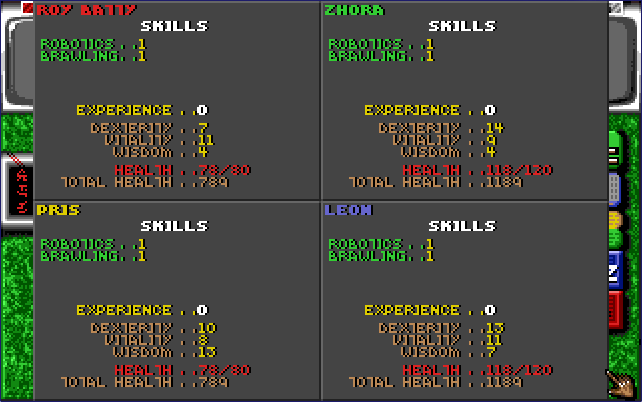
Thus, I decided to start over and use the experience to go for better statistics. I had some pretty lousy starting attributes for my first party. In some odd, behind-the-scenes, non-obvious manner, the characters' names determine their starting statistics. The algorithm is impenetrable to the casual player; a one-letter difference in names produces wildly different values, and there doesn't seem to be any way to game the system except to try a bunch of different combinations. Some examples (numbers are, in order, dexterity, vitality, and wisdom)

CHESTER:   5 - 10 - 13
HESTER:     5 - 3 - 15
CHESTED:  13 - 15 - 12
CHESSER:   14 - 3 - 5

No famous foursomes produced terribly great combinations of attributes:


Not even androids:


So I rolled up 20 names on my random name generator, tried them all, recorded the scores, and chose the four best for my new party. I prioritized wisdom, which lowers the experience cost necessary for new skill levels.

I got 15/15 wisdom with three characters, so I did pretty good.

With my new party, I replayed the first dungeon and found it much easier (partly because I better understood what I was doing). I found that I could avoid melee combat entirely and just use the electricity-throwing trick.

The second dungeon was also much easier, but it was in the midst of exploring it that I realized why my droids were taking so much damage: only the two droids in the front rank can attack with a punch. If you punch with droids in the back rank, they punch their colleagues in the front rank. I was taking massive damage in each battle and I didn't know why. Not having 50% of my party attacking their fellow party members made the level a lot easier.

I thought this was a ridiculously tough enemy until I realized that my lead character was killed by the guy behind him, not the enemy.

The second base had one of those four-button code doors at the beginning and another a few rooms into the dungeon. There was no script offering me the combination here, but there are only 4 x 3 x 2 x 1 = 24 combinations of four buttons, so I just tried them systematically until I found the one that worked.

This is a map I've made of the second dungeon:


Seem a little small? Well, I haven't found the generators or probe yet, so I'm clearly missing something, but I can't figure out what. I've faced every wall, tried to walk through it, tried to push it, checked for buttons and levers, and can't find anything at all.

So once again, I have to end a Captive posting pleading for help. What could I be missing? I also can't leave the dungeon and return; apparently, you need to blow up the generators in each dungeon before the entry door will open again.

A few other things I discovered while playing:

  • "Swords" became available as a third skill the moment I reached Level 9 on the previous two ("Brawling" and "Robotics").
  • Every time you increase a skill, a random attribute goes up by one.

My character is significantly more powerful than when created.

  • Experience rewards were lower on the second base.
  • Crushing enemies with the door is effective, but it has the side-effect of destroying the enemies' gold.
  • The game occurs in real-time, and (just like in Dungeon Master), enemies can attack while you're on the inventory screen or buying something in a shop.
  • You take damage from running into walls, something I keep doing because I forget that the 4 and 6 keys strafe instead of turn.

Other than not being able to find the way through the second dungeon, I'm particularly annoyed that my body parts seem to take damage even when I don't do anything. I'll simply walk down a corridor, and suddenly I notice that one of my limbs is flashing "0%," and I've got to pay some shopkeeper for repairs. I don't mind being challenged by games, but I hate being confused by them. I don't like it when things happen for reasons I don't understand. Give me a game that kills me over and over, like Dark Souls, over a game that kills me rarely but leaves me saying, "Wait. Why did I just die?"

Captive seems determined to confound me all over the place. The manual, indeed, is so sparse that I suspect figuring out every aspect of the interface is deliberately intended as one of the goals. Just one more example of how Captive really isn't my sort of game.

Thursday, August 28, 2014

Captive: A Long Stretch

"Ladder-scumming" fails with the quick-reacting mad scientist. Time to reload.

Captive has perhaps the highest reload count of any game I've ever played, making a hash out of my normal rules. In a less difficult game, every time one of my droids was reduced to scrap, I'd haul his pieces to the nearest shop and have him repaired. But when a game makes you do that roughly every 5 minutes, it becomes unfeasible, and death is now an occasion for reloading. Even getting whacked for more hit points than I'd like--especially if I've just finished getting repaired--is an occasion for reloading.

Captive is far more difficult than Dungeon Master, primarily because of the lack of any ability to rest and heal. In Dungeon Master, if you could get away from an active combat, you could wait for hit points and spell points to regenerate and keep making healing potions. Captive offers no such breaks. "Getting away from active combat" usually means hustling your crippled party to the dead end of a corridor where you can sit and rest as long as you like, but your bent and broken limbs won't get any better. The only time you're "safe" in Captive is when a) a store is nearby, b) a power outlet is nearby, c) you have a clear route to both, d) there are no wandering monsters in the area, and e) you have enough money to pay for repairs.

Knowing this, the game screws with these variables every chance it gets, primarily by forcing you to walk on pressure plates that seal the walls behind you. Until you find the switch that lets you back, you're in limbo, not knowing how much damage you can afford to take from each encounter. If you're unlucky enough to save when you're at 50% health and it turns out there's 10 more packs of difficult enemies between you and the switch--and none of the tricks you'd normally use to survive them--you're basically walking dead.

My characters are in really bad shape. The first two are almost dead and have all their arms disabled; the back two have plenty of health but each has one arm disabled. I really hope there's a shop behind this door somewhere.

The beginning of each base is also quite difficult, before you've found any stores or power outlets, because there's no way to get back out. Even if there was, there wouldn't be anywhere to go. Both Bases #5 (Salstee) and Base #6 (Seavy) required me to explore for over an hour before I found my first shop, right about the time I was sure I was going to have to reload a saved game from outside the base and try again.

But of all the variables, it's the money that I worry about the most. The game has a closed economy, since enemies don't respawn. I'm so paranoid about running out of money for repairs that I haven't been purchasing potentially-useful upgrades and tools. I keep envisioning a scenario in which I load up on batteries, weapons, ammo, and better droid parts, and then I hit the famous "dungeon with no money" that everyone knows about except someone playing blind.

Better droid parts are available, but I've been reluctant to spend the money.

Dungeon Master offered stair-scumming, the side-step dance, and the merciless closing doors as options for beleaguered players, but in Captive, these tricks are essentially necessary. Standing face-to-face with an enemy and trading blows simply results in a quick death, unless I'm missing some tactic somewhere.

Believe it or not, you can punch these to death, and like all other enemies, they explode into blood when killed.

Base #5 offered up a couple of new enemies, including (nonsensically) tanks, plus demons with flaming blue swords. (Again, with no names assigned to the enemies, I have to make them up.) Base #6 had smiling computer monitors somehow capable of spitting fireballs.

And they look so friendly, too.

Oh, and these trolls. I forgot where they first appeared.

But none of the previously-encountered foes held a candle to the bastards I encountered in Base #6: deadly "hovercraft" capable of blasting my characters out of existence with one shot. Not only that, they hover so high that you have to be inverted on the ceiling to hit them. They attack in pairs of two, and I must have encountered 10 pairs throughout the base. I found only one way to effectively deal with them: ladder-scumming. If I could lead them back to a ladder, I could pop down, save, invert myself, pop up, get off one or two shots, then pop back down before they could retaliate. It didn't always work; these guys react fast. I saved after every 2 or 3 successful shots, and had to reload that save frequently when they reacted too fast. This is not my idea of a fun game.

These guys kill me so fast that it took several tries to even capture a screenshot in time.

Oh, and to make matters even more fun, when the hovercrafts die, they leave landmines behind! I haven't found any way to effectively disarm them yet. I can't seem to throw things at them from a distance (rarely do I have an unobstructed hallway anyway), and fiddling them from one square away causes significant damage (though not as much as walking on them). I can avoid them by walking across the ceiling, and a couple of times, I've led other enemies to them, which is always satisfying. The shops sell mines I can buy for my own use, but they're expensive and I've been hesitating to splurge.

The hovercrafts left me a present.

Enemies can be divided basically in two ways: movement speed, and whether they have missile weapons. If an enemy is slow, I can usually lead him to a room where I can do the two-step and hit him from the sides and rear while he struggles to turn. If the enemy has no missile weapons, I can use a shooting retreat or take potshots at him from the other side of a fire or water barrier (most enemies don't cross water; so far only hovercraft have crossed fire). But enemies that are fast and have missile weapons are nightmares.

Shooting a pack of Go-bots across a field of fire.

The size of the bases is also getting worse. I haven't had to map yet, but they still last bloody forever. I was in Base #6 for about 8 total hours--longer than some entire games. Every time I thought I'd explored everything, I'd find some new movable wall, ladder, or switch to open a door, leading to some vast new area. Technically, you can get out of a base as soon as you find at least one probe and the generator room, but the only way to make sure you get all the gold and experience is to to fight all the monsters. I'll be happy to end the last base prematurely; until then, I need every advantage I can get.

Late in Base #6, I did finally spend about half my gold on a battery, because I was sick of having to find my way back to the infrequent power outlets to recharge. The one I bought stores enough power to fully recharge a droid four times, which should be enough to tide me over when outlets are scarce.

I cannot figure out what these are for.

In terms of navigation obstacles, Base #5 introduced a "spinner" square, but it was pretty pathetic, simply rotating me once clockwise. I think there was only one. Both Base #5 and #6 had areas with fire barriers. They also had hydrants, and at first I was sure that the purpose of the hydrants was to put out the fires. Only that didn't work; the hydrants would just flood the areas but stop at the fire barriers. So I'm left not knowing what the hydrants are for. I couldn't figure out any reason why I'd want to flood the dungeon. It just makes navigation a lot harder, since droids take damage when they walk in water, and the only way to navigate the areas safely is to walk on the ceiling (again, at a huge power drain). The bases had enough water areas on their own without my contributing to the problem.

Using a computer while upside-down to avoid the flooded floor.

Base #6 had one small "dark" area that I needed the visor to get through.

Making my way through the dark.

As I mentioned, I've been slow to upgrade weapons even when I could seriously use them. My lead characters are still using melee weapons and my two rear characters are still using magnum pistols even though I found a shop selling laser pistols some time ago. The skills went through "Rifles" and "Automatics" before offering me "Lasers," but I'm not sure I ever saw any rifles or automatics for sale. I'm not sure they'd be better for me anyway, as my characters have a skill level of 24 in handguns but are only up to 3-5 with lasers so far. If I'm not mistaken, this would maybe let me use the worst laser weapon. Is the worst laser better than the best handgun?

Speaking of skills, an anonymous commenter told me that "24 is always the highest skill requirement for the best version of a given weapon," but nonetheless, "more skill still helps." That may be true, but the experience points needed to raise any skill from 24 to 25 seems to be 35,399, whereas the highest experience cost I've encountered to raise a skill below that is only around 2,200. So I probably won't be saving up for that 25th point any time soon.

 
In my first post, I said that the bases were "randomly-generated." After doing some more reading on the subject, I realize this was probably misleading. Procedurally-generated is probably a better term. Every numbered base will look exactly the same for every player. But Anthony Crowther didn't map them all out; that would have been functionally impossible, since there are theoretically thousands of bases. (Apparently, the maximum number is 65,535, but some bug keeps you from going past something like 25,476. I've also read that the PC version has a bug that limits the bases to 2,816. No matter what, you'd have to be simply insane to hit those limits.) Instead, Crowther designed a map generation routine that uses the base number as a seed and generates the rest of the layout based on it.

I don't deny that it's an extremely impressive bit of programming, but it has the effect of limiting the types of puzzles that the game can provide to the player. Dungeon Master fans often talk about the game's navigation puzzles as a highlight of the game, but complex navigation puzzles can really only work in a hand-crafted dungeon. A procedurally-generated dungeon will allow for a wall that closes behind you, and a switch that later opens the wall, but not much else. Certainly nothing like the puzzles in Chaos Strikes Back where you had to herd skeletons onto four pressure plates, or the one in Dungeon Master where you had to use riddles on a scroll to identify four pieces of equipment to put into four alcoves. Thus, I would think that this aspect of the game would be disappointing even for fans of the sub-genre.

I prepare to extinguish a wall of fire with a switch. By design, any fire wall is going to have a nearby switch to disarm it.


Miscellaneous notes:

  • It took me a while to figure out how to use the dice. If you hold them in your hand while facing a combo door and right-click, the die shows you the location of the next button in the sequence. I keep finding more dice, and as far as I can tell, you only need one of them. The shopkeepers aren't interested in the excess. They don't work on the bases' front doors, where you really need them.

The die saves me from having to try up to 24 different combinations.

  • It turns out that if you accidentally leave your gold in the hands of shopkeepers, it's not only always there when you return, it will also be in the hands of any other shopkeepers you visit in the same base. I'm not sure if it will also appear with shopkeepers in the next base, but I'm going to leave a small amount when I escape Base #7 so I can test it. 
  • The "root finder" finds the front door of the base--very handy when you're trying to escape the base after planting the charges. Then, once outside the base, it guides you to your ship.

The device indicates the way to the exit is through this door.

According to my commenters, I still have four bases to go in the first mission; my vague understanding is that you can consider the game "won" after the first mission, since you can keep generating new ones indefinitely. At this rate, we're looking at another 30-40 hours in a game that I've sunk almost 30 into already. This is why it burns me that these Dungeon Master clones never have any kind of plot progression. All I'm asking for is a single screen at the end of each base that reveals more about why I was imprisoned, and who was behind it--a slow return of Trill's memories as the droids fight to reach him. Or maybe a dialogue option or two with the shopkeepers: something that alerts me to dangers in the next section. Anything. But none of the ones I've played--Dungeon Master, Chaos Strikes Back, Bloodwych, and Captive--can even offer the tiniest bit of story to the player. They expect players to just delight in their mechanics and let their imaginations do the rest.
  
This works for many players but not for me. I'm going to keep Captive on my "active" list, but I'm not going to give it more than a couple hours a week. If it takes the rest of 1990 to win, that's what will have to happen. That said, the difficulty I've been experiencing probably has a lot to do with my reluctance to spend money and try out all the weapons and tools, so I'll try to do better with that before the end.

Moving on to yet another base.