|
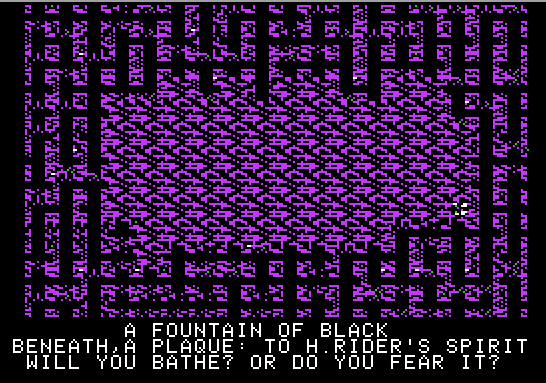
| You existed before the rain? Does that mean you existed before the earth had a hydrosphere? What did you drink back then? |
Lord of the Rings has me asking a question that I rarely ask when playing an RPG: How do I know I'm encountering all the important stuff?
CRPGs have a variety of ways to ensure that players don't simply bypass key NPCs, encounters, and items:
CRPGs have a variety of ways to ensure that players don't simply bypass key NPCs, encounters, and items:
1. Limited number of tiles. The default for the first decade of RPGs was to construct a world with a limited number of explorable tiles. If the player wants to make sure he hits everything, he just makes sure to step on each tile. This dynamic is found mostly in first-person games like Might & Magic and Pool of Radiance, but we occasionally see it in a top-down game like Tunnels & Trolls: Crusaders of Khazan.
2. Environmental signaling. So you have a continuously-moving world or even a tile world so large that you probably can't hit every tile (such as most top-down tile-based RPGs from the 1980s). How do you ensure that the player hits every encounter? You make the people and icons with which he can interact extremely visible, standing out against the overall bland background. Examples include the very obvious towns and keeps of Ultima IV and Ultima V and the way that key NPCs stand out from drab commoners in Baldur's Gate.
 |
| This game in no way signaled me that this tree was important. I just happened to be lucky enough to walk up to it. How many important trees have I missed? |
3. Facilitate exploration. For large, continuously-moving worlds where some of the encounter locations might be non-obvious, the game can assist you in a variety of ways that facilitate exploration, including automaps that slowly reveal, obvious paths and routes of travel, and breaking the game world into small, discrete maps that are easy to explore in their entirety. This is the most common strategy in adventure games and hybrids, like Elvira and Hero's Quest; we also see it in a lot of modern games, like Dragon Age.
4. Quests. Quest-oriented games make things easier by letting you know there is a specific person to talk with, or a specific thing to find, within a map--ensuring that you won't stop searching until you locate it. Some games even provide obvious quest markers.
5. Making the consequences of missing something unimportant. I suppose some players embark on a game like Skyrim insisting that they will talk to every NPC, find every item, and solve every quest, but they must get exhausted fairly quickly. In a huge and open world like Tamriel, the developers simply have to make most items, people, and encounters ancillary to the main quest--fun if you stumble upon them, but not tragic if you don't.
Various games mix and match these strategies. Baldur's Gate and its sequel both have relatively small maps with automaps (#3) and highlight chests and barrels you can actually open when you hit the ALT key (#2). NetHack has both a limited number of tiles (#1) but also lets you see from a distance what you're likely to find on those tiles (#2). Oblivion's dungeons (as opposed to the overworld) are small enough to systematically explore (#3); it has markers for the quest locations (#4); and it makes it clear which items are indispensable relics and which you can save inventory weight by not picking up (#5).
Lord of the Rings has been giving me a lot of angst, and I realize it's largely because it has none of these features. The maps are continuously-moving and huge, so they're tough to explore systematically. There are no quest logs or lists that let you know what you still have
to do in an area. There's no automap. It's impossible for me to separate
key quest items from spurious junk. I suppose the only saving grace is
#5--perhaps a lot of the encounters I'm missing are entirely optional,
and have no bearing on my ability to win the game. But I simply don't
have that kind of faith yet.
 |
| Luckily, I happened to walk into the right area to find this item. If I'd skirted the north part of the cave, I would have missed it. |
Many key encounters are triggered by happenstance when you wander into a particular section of the map, and even then only under certain conditions. For instance, in the last post, I noted about finding the elves and the ELBERETH word, "the area where I encounter them seems
to have a certain probability of producing a Nazgul . . . and a certain probability of triggering the elf
encounter." A reader alerted me that, in fact, the elf encounter always happens if you're walking west when you enter the area of trigger pixels, and the Nazgul encounter always happens if you're walking east. This is on top of having to stumble into the right set of pixels in the first place. I now know what an anonymous commenter meant when he said that this game "can be very unforgiving to players without a walkthrough."
There are other sources of angst. There seems to be no reliable way to heal all my characters (save making the long walk back to Hobbiton to purchase rations). Throughout this last expedition, every combat bled a few more hit points from one or more party members, until I was at the point I was constantly reloading because every hit was killing me. At some point, however, my hit points did all spontaneously regenerate for no reason I could tell. I didn't even notice when it happened. I don't like this kind of inconsistency and unpredictability. I like games where I know I can periodically return to town, sell my excess equipment, buy new equipment, train, and heal.
When I wrote last time, I was stuck in the Shire because I'd missed a key gate to the Old Forest and the only other exit was blocked by a Nazgul I couldn't defeat. When readers alerted me to the gate, I visited it, found out I needed a key, returned to Brandy Hall, found it, and ultimately let myself out.
 |
| I wish more parts of the game were this overt in their hints. |
Leaving the Shire produced a multi-screen cartoon sequence recounting the fate of Fatty Bolger, who had stayed behind, posing as Frodo to throw off the Nazgul. (I guess he's in the book but not the films.) Meanwhile, my party arrived in the maze of the Deep Forest.

The game oversold the perils of the forest a bit. I didn't even have to follow the long set of directions I'd received from a book in Brandy Hall. I just had to go east for a few minutes and help a songbird tied to a tree. As a reward, he opened a secret door out of the forest. But this was yet another encounter that I had to be lucky enough to trigger by walking close to the relevant tree. I could have easily missed it entirely.
 |
| The "previously unseen" hole is apparently large enough for three hobbits, a dwarf, and a pony. |
The rest of the map consisted of four major encounter areas:
1. A long road leading across the north of the map from the Shire to the next map (Bree, I assume). This is where I would have emerged if I'd defeated that Nazgul instead of taking the forest gate. The road was full of encounters with wolves and bandits that sapped my hit points. (I had the option to give my gold to the bandits, but who does that?)
 |
| What if I do want trouble? |
2. "Sharkey's Shipping," a couple of buildings whose owners are apparently in league with Saruman. There was a store on top and a couple of dungeon levels beneath the main building where I fought a bunch of guards and orcs, freed a hobbit prisoner named Nob Appledore, destroyed an evil book, and recovered an artifact called the "Golden Wheel" that the orcs had been desperate to dig up. It apparently has something to do with finding "Durin's Axe" in Moria.
 |
| The "White Hand" appears again as an item you can buy in a store. Saruman's allies aren't doing a very good job concealing their presence. |
On this map, Athelwyn revealed herself to be a witch in league with Grimbosh, the manager of the place. When I entered his room, she left my party and switched sides. Fortunately, she didn't use magic in the ensuing combat, and I killed her. I'm curious what would have happened if I hadn't wandered into this particular room. Would she have stayed with me until the end?
 |
| If you surrender the Ring, the game immediately ends. |
After I left the main "Sharkey's Shipping" building, I found a journal in another building that gave me a password that would have prevented some of the battles with humans and orcs. The danger of doing things out of the game's chosen order.
3. The Barrow Downs, which I remember from the book. I had a bunch of encounters with barrow wights that occasioned many, many reloads before I defeated them. I recovered a variety of treasures from the barrows, but I'm not convinced I hit every encounter or did everything the most optimal way. Among other things, there's this barrow I can figure out no way to enter:

At one point while I was exploring, the entire area became shrouded in gray and my party members disappeared one by one. Eventually, I was taken, too, and I awoke in a barrow with a wight about to sacrifice me. The only way I could figure out to escape (after multiple deaths) was to use the HELPHELP word of power, which summoned Tom Bombadil, who freed me and helped me against the wights before disappearing at the exit. He didn't cleave in their heads with an axe or anything; he drove them away with some goofy song.
 |
| Using a word of power. |
4. The residence and environs of Tom Bombadil, perhaps (let the flame wars commence) the most idiotic character in Lord of the Rings. My advice for writers is that if you're going to invent a near-omnipotent character who's supposed to be older than any other living thing, don't name him "Tom." It breaks the suspension of disbelief a bit.
In the game, Tom asks me for the Ring. If I give it to him, he does a little trick and makes it disappear, then gives it back to me. The game plays some triumphant music at that point, but I don't know what I accomplished. Did he steal it and give me a replacement? That would be a neat twist.
 |
| If he's so damned powerful, why doesn't he take it to Mordor? |
I never got to fully explore dialogue options with Tom, as the moment I left his room, he disappeared and never returned. Despite his great age and power, he seems unaware that his wife, Goldberry, is deathly ill upstairs in the bedroom. She asked me to find some lilies to cure her.
Unfortunately, the nearby pond where she normally gets lilies is frozen over, and the only place to recover them is from the spirit of Withywinde in a cave. Withywinde asks for some kind of token from the person who sent me to her, and this is where I'm stuck. When I first encountered Goldberry, the paragraph read:
Tom's wife, the beautiful Goldberry, is here. She is lying in bed, ill. Beside her, a blackened willow leaf floats in a bowl of stinking water. "My lilies..." she whispers. "My special pool lies south of this house. Please...bring me lilies. Take this token and whatever you may need from this house." She offers you her token, a golden leaf pasted against oak bark.
Sounds great, but this token never appeared in my inventory, and it's not in the room when I use the "get" command. Without it, I don't think I can get her lilies. I have no idea if this is a vital quest to progress, but it's emblematic of the frustration I have with the game. I'm currently dithering around, trying to figure out whether to restart, move on, or keep trying to find an alternate solution.
 |
| There's also this wall of ice I can't get past. Torches don't melt it. |
A few miscellaneous notes:
- Yes, Frodo can wear the Ring and does turn invisible. Fortunately, the game doesn't pester me with a flaming eye shouting "I . . . see . . . you" everywhere I go. But using the ring costs me 1 willpower point every time I put it on, and enemies still happily attack my other party members, so the utility of the item seems limited.
- My pony can attack enemies in combat. I don't know whether he's biting them or using his hooves.

- Perhaps even more nonsensically, the pony accompanies me into every building, room, and dungeon. When my characters use "sneak," he somehow sneaks.
- Similar to encounters not triggering unless you hit a particular area of pixels, you can't collect items from a room until you get the message that "you have found something that you can use," and you can't interact with locked chests until you get the message that you've found them.
 |
| I could see it from a screen away! |
- In combat, if characters fall below 6 life points, they go "unconscious" and lose a point every round until they hit 0, when they die. But if the party finishes the combat before that happens, the characters will regenerate to a minimum of 6 points and automatically wake up.
- The manual indicates that there is no mechanism to resurrect dead characters. I guess no particular character, not even Frodo, must survive, but it seems wrong to let canonical characters stay dead. I've been reloading.
 |
| In good conscience, how could I continue without Sam? |
- In one of the barrows, I finally found some decent weapons: "barrow daggers." Most of my party members are equipped with these; Druin has his axe; Pippin has a bow; and Sam now has a "spider sword" I found in a cave. I have an extra sword awaiting another character getting the sword skill. I still have no decent armor.
- Even as a non-fan of the books, I object a bit to the idea of the little hobbit band doing so much fighting and killing before they even get to Rivendell. Sam is supposed to slowly and reluctantly evolve from a gardener to a warrior, and I have him killing humans within the first few hours of the game.
 |
| He even looks depressed about it. |
- Mystifying items in my inventory: various gems (can I sell them later?), a "springstone" that I dug up on one of the barrows, a "leaf belt" that I can't equip; a red acorn; a signet ring that I found way back in the Shire.
- I hope there are stores in Bree because I have a ton of cash.
- Torches never seem to run out.
- I like that some puzzles have non-obvious solutions that you have to suss out based on your inventory or skills. Destroying this evil book, for instance, was a matter of selecting "use" on a torch. I suspect there were other solutions, too.

- I still can't tell you much about magic. I only had a spellcaster (Athelwyn) for a brief time, and I only had her cast a couple of spells (which deplete life points) before she betrayed me and died.
The game has some good elements, but I'm already getting frustrated with it, so I might divert to something else for one post while I wait for any hints about Goldberry and/or decide what to do next.