Showing posts with label Tunnels and Trolls. Show all posts

Monday, April 6, 2015

Tunnels & Trolls: Won!* (with Final Rating)

I'm sending that postcard. New World had better send me a freaking certificate for this one.

Tunnels & Trolls: Crusaders of Khazan
United States
New World Computing (developer and publisher)
Released 1990 for DOS
Date Started: 22 March 2014
Date Ended: 5 April 2015
Total Hours: 41
Difficulty: Moderate-Hard (3.5/5)
Final Rating: 46
Ranking at Time of Posting: 154/181 (85%)
Ranking at Game #431: 386/431 (90%)

I was in the midst of starting over when a thought occurred to me: what if instead of basing the enemy difficulty on the maximum character level, the game used something like the average character level, and what if it reads a dead character as Level 0 instead of excluding him from the calculation entirely? I reloaded with my original party, deliberately got Stahr killed in some random combat, and progressed forward. Sure enough, where I'd faced 12 dragons or 12 cave bears before, I now faced 7 hobgoblins. The resulting corridor was still hard, but not nearly as hard as before, and I was able to limp through it to the endgame.

At the end of the corridor, I was teleported to Khazan's tomb, where I had the option to place the Demon's Eye in either of his statue's eyes or on his forehead. The "forehead" solution seemed a little odd, but putting it in either the right or left eye would have violated symmetry, so I chose the forehead and was congratulated by Khazan.

Why, thank you.

In the next room, I found another statue of Khazan. His staff, which I had previously recovered from the depths of a sea goddess's temple, began shouting to be returned to him. I put it in his hands. Then I had to run around a series of six squares and recite passwords I'd gotten from a ghost ship.


Khazan woke up, said he'd get started on "enforcing the treaty between the Death Empress and myself" and named me "Crusaders of Khazan!"

I rather thought we were already.

Kind of a pathetic ending. Empress Lerotra'hh and Khara Kang are still going to be around; they'll just have Khazan checking and balancing them. Anyway, Khazan zapped me back to Gull with enough experience points to rise three levels, and the game let me keep playing if I wanted to.

Oh, no. I learned my lesson on leveling up.

In total, a slightly unsatisfying conclusion to an unsatisfying game. There are some strengths to Crusaders of Khazan, which will come out in the GIMLET, but the fusion of literal gamebook text with a CRPG frame is something I hope we don't see again.

Let's see how it rates:

1. Game World. Tunnels & Trolls is somewhat famous for offering little in terms of a game world and back story, saying only that it takes place in "a world somewhat but not exactly similar to Tolkien's Middle Earth." The computer game had to assemble a world from a large variety of gamebooks, and none of it holds together very well, with numerous inconsistencies in themes and lore. Although some encounters reference previous decisions, most of what you find in the world is stand-alone text encounters. While the backstory offers a relatively clear mission, a lot of the game world seems to have nothing to do with it with references to Khazan and Lerotra'hh uncomfortably shoehorned into the text that the developers were adapting from gamebooks. Oh, it's still better than a lot of games of the era, but certainly not up to New World's usual standards. Score: 5.

2. Character Creation and Development. The races and classes don't offer much more than a typical D&D derivative, and I really don't like Tunnels & Trolls's approach to character attributes, by which what's "high" or "low" depends a lot on the attribute itself (e.g., 20 is a very high speed but a somewhat miserable luck score), and by which damage comes directly out of "Constitution" and spell points come directly out of "Strength." I also don't like that the attributes seemed to go up and down randomly in the game, even when they weren't cursed. Finally, the fact that the game punishes characters for leveling is simply unsupportable. Nothing is good about T&T's system. Even the character portraits are ugly. One redeeming feature: some dialogues, quests, and items are tied to race and sex, so different parties face slightly different games. Score: 4.

Only in this game is this an occasion for cursing.
            
3. NPC Interaction. "NPCs" don't really exist as interactive things in the game. They show up as part of encounters, but in such cases you just visit them once and then never hear from them again. There are no particularly notable personalities in the game, and most encounter dialogue is goofy. It's interesting that you can recruit some NPCs to join you in guilds, I guess to replace dead characters, but I'd rather just reload and keep developing the characters I made. Score: 4.

One of the few places in the game where you can ask questions directly of an NPC; in this case, an imprisoned demon.

4. Encounters and Foes. When I first started playing the game, I thought this category would rank very high. Oh, I suppose it still will. After all, this is one of only a few games of the era to offer such a variety of encounters in which the characters have real options for solving them. The problems are, as I've covered extensively, first that the encounters are too literally drawn from gamebooks, and second that the options aren't really role-playing options, or even logical choices to solve puzzles. In almost all cases, there's no way to predict which choice will lead to a positive outcome to an encounter.

And--it's hard to believe I'm saying this--there are just too many of them. You're trying to just get a damned dungeon mapped, and every two squares you have to read a wall of text, make some arbitrary choice, and half the time get yanked from wherever you are and deposited unceremoniously somewhere else. Finally, since the main plot depends so much on successful outcomes to a handful of encounters, you basically have to "encounter scum" to win the game.

As for foes, they're neither horrible nor great. Like any RPG, they have various strengths and weaknesses, and a few combats thus require special tactics. Score: 6.
 
Option 5 is evil and if you choose Option 6 you're just a cad, but none of the rest can be discerned by logic or role-playing.

5. Magic and Combat. I generally like the approach taken by Crusaders of Khazan to combat: a separate screen on which the party can plot tactics and (occasionally) use elements of the environment to their favor. Auto-combat is a welcome option even if I hardly ever used it. In execution, combat has a couple of problems--primarily that enemies seem either incapable of hitting you at all or, on the rare occasion that they do connect, killing you in one hit. Late game combats, especially, become a game of "quick draw" by which the side that goes first absolutely obliterates the other side.

The magic system is nothing special: a variety of spells with silly names (so you constantly have to refer to the manual to remember what they do) organized by level. A few of them are quite necessary to survive in the game and offer some important combat tactics. As we'll see in "Economy," I didn't have a chance to explore all the spells. Score: 5.


6. Equipment. A mixed bag. You find a lot of items over the course of your adventures, and it's often hard to tell what's a plot item and what's just a general piece of gear. The identification system, by which you pay a mage to tell you all about the item, is pretty good. The weird thing, at least by conventions of most RPGs, is the lack of enchanted weapons and armor. About 50% of the gear that my characters wore and wielded at the end of the game were the same things I bought in the shops of the first town. Score: 4.

One of the few magical weapons I found in the game.
            
7. Economy. This is a strong aspect of the game that I didn't cover in detail during the postings. You get money from combats and quest rewards, but most of it comes from finding gems and jewelry that you then sell to special shops. You can never have enough money. Between food, ammunition, ships, healing, and replacement equipment, you bleed money as fast as you earn it. A couple of the towns have beggars, and by god you'd better pay them, or you might see half your gold evaporate from thievery.

The most expensive commodity in the game is spells. Some of the higher-level ones cost tens of thousands of gold pieces, and I never even came close to being able to purchase all of them. In some ways, that's too bad, but in general I like an economy where you never run out of reasons to make money, just like in real life. Score: 7.
           
8. Quests. The main quest was a little nonsensical at times, but the game does, at least, have one. More important, New World is one of the few developers of the era that truly understands the concept of "side quests" and their importance to RPGs. We've seen a few in the "Gold Box" titles and an occasional focus on them in Interplay's games, but they're far from the norm, and more than 75% of the games I've played so far have rated 5 or less in this category for that reason. That said, none of Crusaders of Khazan's side quests are particularly compelling--most are inseparable from "Encounters"--so there's still work to be done. Moreover, Khazan doesn't offer many opportunities for role-playing in its quests, nor any alternate outcomes in the main quest. Score: 6.

I'm glad I didn't choose "put it out of its misery," but I frankly don't know what the horse god's blessing actually did for me.

9. Graphics, Sound, and Interface. The graphics in this game are godawful. I've criticized Khazan for putting too much text on the screen, but in some ways, I think they should have gone to all text. You can't tell what half the stuff on-screen is supposed to be, and even the cut-scene graphics are tiny and poorly-composed. Neither is the sound anything to sing about. The interface, on the other hand, is okay. Not great, but okay. The redundant keyboard and mouse controls work pretty well, and there's generally some on-screen hint as to your options. Score: 2.

10. Gameplay. Khazan deserves credit for highly non-linear gameplay (such that you can blunder into the endgame tasks in the wrong order!). Its non-linearity, the varying difficulty associated with different classes and races, and the different encounter options make the game fairly replayable. It's a little long, but not horribly so. Where it really falls apart is in the "difficulty" item. Combats are punishingly hard through most of the game, and they get progressively worse as you level up. Score: 6.

The total is 49, but I'm subtracting 3 points for all the bugs and dead-ends, resulting in a final rating of 46.

           
Normally, I regard the space between 35 and 50 as "I recommend you check it out, but it's not really what I'd call 'good,'" so basically that works. Nonetheless, I don't think a consideration of the individual categories really gives the proper sense of playing Crusaders of Khazan. Generally speaking, if a game is going to top 40 in my score, it's good enough that I don't want to stop playing. With Khazan...just imagine that you're trying to clear a map. A map of ugly colors that make it hard to tell what the terrain is actually supposed to be. You step on some random square and a text encounter appears saying you've been captured by an orc patrol. This happens no matter how powerful your characters because it's scripted like a gamebook. You're whisked to some dungeon where your party is forced to work the sulfur mines. Eventually, you escape, but every third step, without any warning of means of prevention, you step into a pocket of gas and two of your characters die. You have to keep reloading.

Eventually, you come to a chamber where a bunch of orcs are having dinner. One of them invites your party to join them. Since you were just their slaves and are trying to escape, you think this is a bad idea and decline. A text box tells you that the orcs, offended at your refusal, recapture you (again, there's no chance for your party, no matter how powerful, to shrug off this event) and you're back in the mines. You reload and counterintuitively join them for dinner. One of them asks you if you want the bread or the fish. You eat the bread and a character dies. You reload and choose the fish and it says that you "choke and gag" on a fishbone but everything otherwise seems okay. Later, you realize that your "Constitution" score is 3 points below normal and it never seems to heal all the way to the maximum.

Moving past the room, you find yourself in the chambers of the king of the mines, Lord Bozo. You cringe at the stupid name. His guards attack you and you kill them in a single round without taking any damage. Then Lord Bozo attacks. His speed is higher than yours, so he gets to go first, and he clobbers your mage to death before you can act. In the next round, he kills your rogue. Annoyed, you reload. You try to prepare for the next combat by quaffing some potions that purport to increase your attributes, but they don't actually go up. Lord Bozo kills you again.

You spend the next four hours grinding your characters in the mines so that you'll get strong enough to defeat Lord Bozo. You take him on again, and this time he has twice the hit points as before, and he kills all four of your characters in the first round. You stare at the "game over" screen and wonder what you're doing with your life.

That's what it's like to play Crusaders of Khazan.

Do you change the position of a lever? Yes! Nothing happens! Do open a curtain! Yes! You're automatically turned to stone!

I'm gratified to find my experience echoed in reviews. Oh, Dragon loved it, of course. Five out of five stars. Someone at that magazine, 'round about 1983, said, "Holy @$&%, guys! Look at this! A role-playing game on a computer!!" and got stuck on that note all the way into the mid-1990s.

But the February 1991 issue of Computer Gaming World had dual reviews from both Scorpia and G. Marc Clupper. (They said basically the same things, so I'm not sure why the magazine decided to go with a "two views" format.) They both note the weirdness caused by the out-sourcing of the programming to Japanese developers, and they both make the point that it didn't live up to New World's usual standards. Clupper's "it could have been so much more" echoes Scorpia's "Tunnels & Trolls could have been a good game."

Scorpia gives this rundown of the history:

[Tunnels & Trolls]...became popular in Japan and, as a result, the Japanese requested a computer version. Liz Danforth, who had prior CRPG design experience...and had worked with Ken [St. Andre] on the revisions of the original T&T system, did the initial design for the computer game.

The material was then sent overseas. The Japanese translated the text, and did all of the programming. After its release in Japan, the game made its way back to New World Computing, where it was re-translated into English, and released in the U.S. During all this, there was no communication at all between the designers and the programmers.

Scorpia's review reminded me--because I stretched out playing so long, I hadn't been thinking about it--of how many "clues" appear in the game that ultimately lead nowhere or turn out not to be true, such as one involving the need for the "Teacher" spell to defeat Khara Kang, or another that suggests you must have a female dwarf in the party. She also confirms my perception that:

Much of the design was taken from individual T&T scenario books and woven into one complete adventure. Ergo, the plotline and events are not as tightly constructed as they could have been, and the bugs make it much worse.

Scorpia concludes that she "can't, alas, recommend this to anyone" except hardcore T&T fans. I don't go quite that far. It's an interesting take on a CRPG with elements that we haven't seen before. I'd recommend it to both hardcore T&T fans and students of CRPG history. If you're not one of those, load up a Gold Box title.

None of this ended up having anything to do with anything.
          
I should note that New World published a pretty long cluebook for this one. The Museum of Computer Adventure Game History has it for download [59MB]. (I can't get over how great that site is; they even take the time to OCR the text so you can search it.) I consulted it for a couple of the late-game maps and I found it remarkably inept--almost as if it was designed by someone who didn't have the game in front of him. The book annotates only about half of the encounters on any given map, and there are no actual numbers on the maps to correspond with the text description of the encounters. In places, it tells you what item or artifact you need to solve an encounter, but nowhere else in the book does it tell you where to find that item. It's like when it came to Tunnels & Trolls, the company couldn't do a damned thing right.

We're not going to hold it against New World, though. Everyone's entitled to an occasional screw-up. They published King's Bounty the same year, and in 1991, we're going to get Might & Magic III. I'd rather get two great games and one flawed one than three mediocre ones.

With apologies for readers eagerly awaiting Worlds of Ultima: The Savage Empire, I've re-elevated Wraith to the next game, since I've already played it. I won't have much time in the next week, and I want to have a block of uninterrupted time for The Savage Empire. I also kicked Flight from the Dark down a couple notches because I'm waiting for the book version to be delivered. Up next, then: a couple of early John Carmack games.

Saturday, April 4, 2015

Tunnels & the Ultimate Trolls

Good. Let them have it. The Dragon Continent sucks.

God, I've never been so mad at a game. I've played plenty of RPGs that sucked, but rarely have I played a game with so much potential that so completely squandered it. It has a solid character development system, a very open game world, and a decent combat system, but none of them can overcome the game's flaws.

A quick rundown of the game's major problems:

1. Its adaptation from a series of gamebooks means that the game as a whole lacks thematic unity. There are dozens upon dozens of independent encounters that feel disconnected and random, with no connection to the main quest except (occasionally), a throw-away line about Khazan, Khara Kang, or  Lerotra'hh.

Some interpolation about the main quest from an otherwise unrelated encounter, probably drawn from a gamebook.
         
2. The game is too in-love with verbose text-based encounters that eschew the main game interface for a more literal gamebook experience.

3. While these encounters have options, they lack role-playing options, or even any sense to their puzzles. They whisk you this way and that, with no consideration of tactics, roleplaying, or even fairness.

An example: Near a volcano, you're given the chance to explore a tunnel. This is another "text map," where instead of actually entering a tunnel, you get a narration of events on-screen. In a large cavern, you find a number of slaves being whipped by fire demons. One is killed and tossed into a furnace. Suddenly, a bunch of demons rear up behind you and block the way back. Your options are:

a) Fight your way back
b) Plunge deeper into the cavern
c) Surrender

If you fight your way back, you get into a combat with a shadow demon and 16 minor demons. I don't know what you need for "Speed" to act first, but the lead demon used "Blasting Power" on me for 263 points of damage (far more than my 60 hp) and killed my lead character. In subsequent rounds, I lost another character before everyone was able to kill the demons. There's no way to avoid losing at least one person with this option.

Okay, so try again. "Plunge deeper." You get into a combat with 6 minor demons. They're not tough. I defeat them handily. No one dies. But after my victory screen, the text says I'm overwhelmed by demons and taken prisoner. The demons "decide to make an example of me" and throw Stahr into the furnace, killing him. Then I'm enslaved.

Reload. Only by surrendering--the most counterintuitive solution--do I get a postive outcome. I try to escape during an earthquake and only have to fight a handful of demons to get out.

Many of the encounters are "Morton's forks," leading to the same outcome no matter what you do. On the top of a hill, you see a circle of ancient stones. You're given the option to climb or leave. If you try to leave, you get pursued by a hellhound, at which point you have the option to fight or run. If you fight, you face battle with two hellhounds. If you run, you face battle with a hellhound. If you climb the hill, you find an altar to a demon. You're given the option to cast it down, investigate a wooden cask, or run. If you run, you get pursued and attacked by a hellhound. If you cast down the altar, you get attacked by a hellhound. If you investigate the cask, you get attacked by a hellhound. Basically, from the moment you step into the square--which offers no warning about what's to come--you get attacked by a hellhound no matter what you do.

The moment you step on this square, you're screwed.
          
Compare this to how a real RPG handles such things, allowing the player to employ his skills and the game mechanics to sneak, assess things from a distance, cast buffing spells before combat, and flee if necessary. Here, every player faces the same options no matter how strong, skilled, or prepared he tries to make his characters.

Really? That's as much information as you're going to give me to make this decision?
           
4. There are a handful of miscellaneous problems with items and spells. The "Froststaff" is supposed to teach rogues the "Freeze Me" spell (yes, I looked up a spoiler), but it doesn't do anything. You can't "use" or "equip" it. Most of the potions don't work as advertised, and neither do a lot of the spells. The "Remove Curse" spell absolutely never works. There are a lot of miscellaneous drains in attributes that the game doesn't bother to explain and can't seem to ever be healed.

5. To win the game, you have to collect a series of specific items and passwords, which means solving various encounters in precise ways. If you don't "encounter scum" to make sure you get the optimal outcome, you can easily put yourself in a "walking dead" scenario very early in the game. For instance, I don't think there's a way to defeat Khara Kang without a "Death Wand" that you get from an encounter with some mer-people. But the mer-people claim the wand as their own, and you either have to successfully bargain with them (involving an attribute roll) or kill all of them (violating role-playing) to keep it, and nothing at that point in the game alerts you that it's a necessary artifact.

These gremlins pester you every time you leave Khazan. But you have to (counterintuitively) be friendly with them and offer them money to get a password necessary to win the game.
             
In another place, a demon gives you a quest to recover his jeweled eye from a dragon. If you solve the quest, you can't win the game, because you also need the eye to awaken Khazan. You'd better not use the Bag of Winds to escape from storms on the ocean, because you need it in the final area. There are a dozen things like this.

6. But none of the above problems compare to the most egregious: merciless adjusting of enemy difficulty based on the player's level and attributes. We've seen this happen subtly in other games in my chronology, and quite often in modern games, but never in the kind of game-breaking way that Tunnels & Trolls does it, where the escalation in monster difficulty ensures that the game gets significantly harder for every level or attribute you increase. It's so absurd, in fact, that the simple act of quaffing "Warrior Juice" before combat, which increases your character's strength, simply serves to exponentially increase the difficulty of the enemies in the following combat.

I didn't realize this last point until more than halfway through the game. I noted that the encounters were getting more difficult, but I thought it was because of map progression, not my own character progression. Sick of always getting my butt handed to me in combat, I settled in for a long grinding session in a map that offered near-infinite battles with dire wolves who seemed incapable of hitting me. I spent several hours in the area--mostly letting the game fight on "automatic" while I did other things--and rose about 6 levels. Little did I know how much I was dooming myself.

My meteoric rise in power meant that practically every fixed combat was a hellish ordeal, with most monsters capable of killing characters in one hit. If I got ambushed in the first round, forget it--my whole party died.

This turned out to be a really bad idea.
        
Since I last blogged, I've explored most of the rest of the maps, reloading about a million times. I found Khara Kang in his fortress and, after about 12 tries, killed him with the Death Wand.

My characters are invisible here. It's a handy spell.

Well, I killed him in combat, anyway. The script said that as he died, he called out to Lerotra'hh, who opened some kind of portal to allow him to escape.

Later, I found Lerotra'hh in a dungeon called "The Digs." Well, technically, I went there first, but when I saw that an encounter with the Empress was pending, I left, because I had been warned by a commenter that killing her before killing Khara Kang breaks the game.

To be fair, there's a subtle in-game hint about this, too.

Her chambers had a series of puzzles that would be too boring to relate, including a battle with someone name "Fisk" who you needed a pair of Winged Sandals to defeat. Otherwise, you have to sit there and "block" for 30 consecutive rounds before he just collapses. A walkthrough helped me with that latter part, but not where I was supposed to have gotten the Winged Sandals.

When I reached Lerotra'hh, I was able to kill her quite quickly with the same Death Wand I used on Khara Kang.


But again, she wasn't really "dead." She cried out to Khara Kang, who scooped her up in that same kind of portal. They threatened revenge if I didn't wake up Khazan.

Not much of a "defeat," if you ask me.
           
The endgame is supposed to take place on the Uncertain Isle, where the old emperor, Khazan, slumbers. I made it to the isle.


I made it through a maze of teleporters.

The game starts to try my patience.
         
Using some special boots I'd found previously, I made it across a sea of lava (because walking on lava is only dangerous to the soles of your feet). I made it past an encounter where I had to give up an artifact called a "Heart of Fire."

           
I made it past a herd of buffalo, where I had to know the name of one of them from solving a previous encounter a precise way, and through a garden encounter where I had to have a Bag of Winds and have previously gotten a password from another encounter (I didn't have it; I was using a walkthrough to help by this point).

Even the walkthrough didn't tell me where to get this; it just told me to say it.
           
At last, I reached a final set of corridors, the end of which leads to Khazan's tomb.

And there my game ends. I can't get through the corridors. They're full of encounters with groups of monsters who always surprise me (no matter what I do) and always get the first attack. Their sheer number and power results in an instant slaughter. If I could survive the first round, there are some spells that could help (unfortunately, you can't cast them before combat), but there's no way to even come close surviving the first round, as the GIF below demonstrates.

              
I've reloaded numerous times. Sometimes the specific enemies change, but there are always too many of them, and they always wipe me out in the first round. I've seen videos online of people surviving the same area. They have half my characters' levels, strength, and stamina, and they therefore face much weaker enemies. Basically, I screwed myself by leveling up.

Replacing my characters with weaker NPCs was a decent idea, but ultimately futile.
           
I reloaded a save from before I entered Khazan's tomb and tried to swap out a couple of my characters for lower-level NPCs. Unfortunately, NPCs cooling their heels in the various guilds manage to level up along with the active characters. Their stats weren't nearly as good, and this helped a little with some of the encounters, but I still can't do anything about that last hallway.

Dragons bathe my party in fire before I can even react.
           
There's no way to create new characters in the middle of the game, so if I want to get a winning screen for this one, I'm going to have to start completely over, minimize leveling, and hit only the necessary encounters. Since I didn't take extensive notes, this will basically involve just following a walkthrough.

Even if I do that, it's going to take a little time. So let's move on to Worlds of Ultima: Savage Empire.

*****

A couple of modifications to our master game list: I checked out Ellak's Tomb for the C64. It was a little tape magazine game with a first-person interface. Although you can make four characters--warrior, thief, wizard, or priest--there's no inventory for the characters and no sense of character development. I'd call it a "half-RPG." It's not worth anyone's time and I dumped it.

Meanwhile, Operation: Overkill II looked really interesting, but it was a BBS game, and I'm not sure if it's playable offline. I downloaded it, but it kept telling me that it couldn't find certain files, even though those files were in the directories. I applied for an account in a bulletin board service that offers the game, but in general, online-only or multiplayer games don't appear on my list for a reason, and I'm inclined not to pursue it if it keeps throwing obstacles at me.

This means that the first 1991 has appeared in the playlist! For most of the year, like I did with 1990, I'll be selecting games at random. But I want to start the year strong, with a title I know I'll like. so I decided to put Eye of the Beholder there. (Death Knights of Krynn or Might & Magic III seemed too obvious.) We'll have an intermediate end-of-1990 post before then, of course.

Saturday, March 21, 2015

Tunnels & Trolls: A Full Map


Slowly working my way across the map.

After about 12 hours of play, I've finally caught up (roughly) to where I was when I was playing Tunnels & Trolls last spring. I thought I'd use this post to walk through the process of exploring one of the maps, annotating each of the encounters and the various gameplay considerations they evoke.

My party consists of two Dwarf fighters (Stahr and Stamper), a Hobb rogue (Josefa), and an Elf wizard (Abra). They're all Level 8 or 9. I have the rogue and wizard armed with bows; they mostly snipe from the rear (although arrows run out fast), with occasional spell support. The fighters charge into battle and bear the brunt of the attacks.

Stahr's equipment at the end of this session. I haven't found a single magic weapon or piece of armor.

As we discussed in the opening posts, there are no "derived" attributes in the game; enemy attacks do direct damage to constitution, and spellcasting depletes directly from strength. Strength is restored over time; constitution is restored every time you rest or eat food. Either way, it's pretty easy to get fully restored at the end of each battle. Given the importance of these two attributes, you want to level them up in greater proportion than the others. I've adopted the following strategy on leveling up: with every even level-up, I invest in strength and constitution (there's an option to raise both); with every odd level-up, I invest in the character's lowest useful attribute (e.g., dexterity, luck, and speed for the fighters; those plus intelligence for the spellcasters).

My first character loses a point of constitution regularly for no reason. This has been happening since I picked up an "illstone" in an encounter with an orc chief. I understood why it happened while I was holding the stone, but I sold it ages ago and the game didn't seem to recognize that it was gone from my inventory. My condition is listed as "good" and no spell stops the process.

The game starts in the city of Gull, in the far southwest of the game world, in map F1. Since Crusaders of Khazan is fundamentally a "lawmowing" game, in which you want to methodically uncover every square (16 x 16) on every map (5 x 4), I systematically worked east, exploring F1, F2, F3, and F4 before returning to Gull, refueling torches and arrows, and starting with row E. When I finished map E4, I went immediately north to D4 and started heading back west. That's where I pick up the narrative below.

I guess I'll be coming back to this one later.

I haven't completed all encounters: I had to annotate some for return when my party is stronger. These include:

  • A plesiosaur who lurks in the depths of one of the ocean squares in E2.
  • A mountain spire in F2 where I get attacked by a succession of powerful enemies on the way to the top.
  • A troll lurking under a bridge in E4. I have to fight him one-on-one with a single character, but he always kills me in the first round.
  • In the middle of a E4 swamp, a cave occupied by a hydra.

On the main quest to defeat the evil Empress Lerotra'hh and her monstrous forces, I have made only a little progress. In Blackwater Swamp, I found some dwarves holed up in a mountain fortress, begging for news about the war. (They automatically trusted me since I had some dwarves in the party.) They asked me to take word to their leader, a human warrior named Barengar, nearby in Grip Iron Pass.

I found the pass and helped Barengar and his forces against a slew of orcs. They rewarded me with a magic helm and asked me to take word of "Valdemarton's fall" to "the escarpment pass at Overkill," somewhere to the west. I assume I'll find it somewhere in these subsequent journeys. This dialogue is a good example of the clumsy way that the game introduces names and places, though. I assume a lot of it was adapted from gamebooks. Neither Valedmarton nor Overkill are mentioned in the backstory for the game.

A rare window on the main quest.

As we begin, I've arrived in Map D4, titled the "Red Orc Range," from the south. To keep things interesting, I adopt different lawnmowing patterns when exploring the maps. Sometimes, I uncover the map in north-south strips, sometimes east-west, and sometimes I make a ring around the edge and work inward. That's what I do here.

The game lets you choose a movement type as you go across the map. "Walk" is the default. "Run" lets you move faster, but at the cost of strength points. "Slow" helps you avoid traps but takes more time. These latter two are, I think, somewhat useless in wilderness areas. "Horse" lets you move through wilderness faster, saving on food. "Climb Up" is necessary if you want to move across mounts; this is a slow process that takes 12 hours per step. The best strategy when outdoors is to keep it on "Horses" most of the time, but almost everything causes it to revert to "Walk," so generally I just forget about it.

Setting movement options.

The first thing I encounter, in the bottom row of squares, is the walled village of Valdemarton, charred and burned from the orc attacks. I choose to enter. A beady-eyed man answers my knocks on the gate and demands 1 gold piece per person and horse to enter. I say "no," but that leaves me with no options for entering the city, so I re-enter the square to activate the encounter again and say "yes."

For all the talk of its "fall," Valdemarton seems to be doing okay. The general store is open, which is good because I'm low on food. The Adventurer's Guild and Rogue's Guild are closed. In a ramshackle tavern, I'm forced to check my weapons at the door by a "shadow demon" bouncer. This turns out to be a bad thing. It soon becomes clear that by entering the tavern, I've entered some kind of "barroom brawling" competition, and everyone thinks my party is the "pros from Tallymark." I soon find myself in combat with 8 "human scums."

Restocking on food at the general store.

I win the combat without too much damage, but soon an overturned oil lamp starts a fire. I grab my gear and flee just ahead of the destruction.

Elsewhere in Valdemarton, the Baron's Inn offers a legendarily comfortable bed. My party consumes a round of ales and stew (this does nothing for me that I can tell) and pays 50 gold for the room. I get a night's sleep but nothing special happens.

The "unnaturally refreshing" sleep doesn't seem to have done anything for my attributes.

As I go to leave the inn, a guard wearing Baron Valdemar's colors stumbles into me and demands that I apologize. I refuse, and a brawl with 6 guards breaks out. They don't look tough, so I let the computer fight it, which turns out to be a mistake because Stahr is killed. I reload (my only other option is to wait for a special resurrection gem or replace him with an NPC) and this time, I don't even go into the inn.

Occasionally, you get these bits of furniture and other obstacles in combat, but they're very inconsistent.

The Wizard's Guild teaches spell levels 2-8. Abra, my wizard, has only up through Level 4 so far, so I spend some time studying the manual to see which ones I want. I ultimately pick up "Wall of Thorns" and "Second Sight." I make a note to return later with more money.
 
I wander into the throne room of the Baron of Valdemar. He has a lovely red-haired woman chained at his side, and he nonchalantly orders his guards to kill me. The ensuing battle involves 23 guards. They're tough but inaccurate, and I kill them all with only a little damage taken to Josefa. 

Decent experience for this one.

The Baron then draws his sword and attacks. He kills all of my characters and I have to reload. I try various strategies in subsequent combats, but nothing I do works and my characters can't even hit him. I mark Valdemar for a later return and head back out to the wilderness to resume my lawnmowing.

In the northwest corner of the map, I'm surroudned by a group of "Red Circle outriders." (Again, nothing about this in the backstory.) They demand a password. I don't have it. They give me a chance to surrender, but I decline. The subsequent battle is easy: all 7 warriors go down without doing any damage to me.

I wonder where I was supposed to get this password.

Elsewhere in the range, I find a "tomb carved from dark granite" with a carving of a clenched fist over the entrance. I choose to enter. This isn't a real dungeon but rather a text-only dungeon. It tells me that I come to a room with two silver-gray gauntlets suspended between a pedestal and a large floating stone block. It allows me to put one hand within a gauntlet, place both within the gauntlets, or leave.
 
Note how this encounter is taking place as text in the window instead of on the game map.

I suspect that when I put my hands in the gauntlets, the large block will come crashing down on them, so I use my most dextrous character, Josefa. Sure enough, that happens. She pulls her hands away in time. While I don't get to keep the gauntlets, Josefa's dexterity increases by 6 (not her maximum, just her current).

On the top of a mountain, I find a tomb with a sword above the entrance. Inside, a find a crystalline sword spinning in the air. I choose to have Stahr take it. An image of a warrior appears and swings his own crystalline sword at me. I parry the blow and the warrior's blade shatters. Stahr's current strength goes up by 6.

I pass the ruins of Castle Frostgate. There appears to be nothing to do here.


Soon, I come to a tomb with a carving of a helm above the door. I enter and find a helm inside. If the gauntlets required, and led to, dexterity, and the sword required, and led to, strength, I figure the helm has something to do with intelligence. I have my smartest character, Abra, put it on. Sure enough, her intelligence increases by 6. I wonder how long these bonuses will last.

Abra with her temporary intelligence bonus.

Following a wisp of smoke in the sky, I come upon a farmhouse. I hear a scream from a nearby barn. Running into the barn, I find a woman and man threatened by hundreds of "Dhesiri" boiling out of the ground. (I have no idea what these are. By icon, they look kind of like lizard-men. They are unmentioned in the manual. A Google search turns up only spoiler pages for this game.) I engage them to give the couple time to flee.


The ensuing battle with 29 "Dhesiri drones" is easy. I win without taking any damage. But the experience point rewards are high enough that Abra gains a level; since it's an odd level-up, I put an extra point in speed.

Speed offers increases much more slowly than the other attributes.

The farmer and his wife escape the barn and torch it behind them, killing the remaining Dhesiri. The farmer has me to dinner and explains that his farm is on the ancient site of a battle between Silvermain the Elflord and Muramaxx the Arch-Demon. He gives me an artifact, the Horn of Lakri Muss, for helping him.

The rest of the map is uneventful, save for a couple more Red Circle attacks and some encounters with Dhesiri who are immediately frightened off. There are a handful of squares I can't visit because they're on the side of verticle bluffs. This occurs other places in the game and I hate it.

The final map with some maddeningly-unmowable squares.

The next map to the west, "Khazan Pass," ruins my lawnmowing system. Random encounters with "Death's Host Patrols" keep leaving me slaughtered. Clearly, I need to do grinding elsewhere before I can continue.

Two conclusions from this experience:

1. The storytelling in Tunnels & Trolls is extremely clumsy. Characters and places are introduced haphazardly, and there's no way to tell what's going to be important and what is just a throw-away vestige to the gamebooks. The game effectively requires you to have played the solo adventures to understand the lore behind the areas you're exploring.

This combat would be much more meaningful if the game had bothered to tell me what "Dhesiri" are. Also, my colorblindness means I can barely see the characters and enemies against the backdrop.

2. The combat system is oddly binary. Battles are either moronically simple (e.g., the baron's guards) or functionally impossible (e.g., the baron himself). 

When I finish the "D" row, I'll have finished half the game. I expect the other maps to offer the same mixture of weird allusions and random encounters, so I probably won't blog about this game again until I have more to say about the main plot.

Tuesday, March 10, 2015

Tunnels & Trolls: Back to the Books


If in 1990, I held the rights to a tabletop RPG that I wanted to turn into a computer RPG, I would have gone to SSI first. But if SSI already had the contract to produce CRPGs for my top competitor (which of course it did), there's no question I would have gone to New World Computing next. Origin was bungling almost anything that wasn't an Ultima; Interplay was hit-or-miss, mostly still stuck in Bard's Tale mode; EA was capable of publishing good games, but anything they developed in-house was laughable; Sir-Tech had just hired the goofiest project director in RPG history; and almost anyone else, even if they had a good RPG, was a one-hit wonder. New World had a relatively small catalog, but every one was a home run. Most important, in the first two Might & Magic games (which remain in my top 10 despite having been played more than 120 games ago), the developer showed an appreciation for side quests and role-playing encounters that are key to Tunnels & Trolls but absent from every other CRPG to date.

Unfortunately, New World subcontracted the programming to Japanese developers, and the result was a game with New World's production values, like Mike Winterbauer's beautiful cover art and game map (link is to his site with examples of his work) and Neal Hallford's excellent game manual, but with a slightly unsatisfying approach to gameplay. It's not bad, I hasten to add, just a little odd. Chief among its quirks is a tendency to resort to large passages of text and gamebook-style encounter options instead of using the game's actual interface. This approach often makes it feel like the rest of the interface is just window dressing for a traditional gamebook in which you press option #3 instead of going to paragraph 33.

In a way, the approach makes sense, as Tunnels & Trolls was perhaps better known for its gamebooks--which it calls "solo adventures"--than it was for actual tabletop RPG gameplay. There were around 25 solo adventures published between 1976 (Buffalo Castle) and 1991 (Dark Temple), plus some additional limited editions and "pocket solo adventures." A number of them form the basis for the plot and encounters of Crusaders of Khazan. In preparation for this re-boot of my Tunnels & Trolls experience, I purchased two of the solo adventures on which the game is based, The City of Terrors (1979) and Sewers of Oblivion (1980), both by prolific RPG-designer and fantasy writer Michael Stackpole. Both are set in the city of Gull, the opening city of the CRPG.

The gamebook on which the opening of the computer game is based.

Before we begin, we need a little memory-refreshing. Almost a year ago, I was about 2/3 of the way through Crusaders of Khazan when I suddenly had to take a work-related hiatus from blogging. When I finally got back, I said:

It's been so long since I played Tunnels & Trolls: Crusaders of Khazan that I no longer remember what I'm doing. I'm thinking it makes sense to start the game over with a new party; I'm also motivated to do this because my characters seem to have suffered an irreversible loss of attributes. But I don't want to do that right away, so I'm temporarily removing the game from the active list and moving on to Lord of the Rings, Vol. I to the next position. I'll come back to Khazan later in the year.

That was a mistake. I should have just sucked it up, figured it out, and finished the game. I'm sure it would have come back to me if I'd just started playing. Now, however, it really has been too long to remember what I was doing, and I need to read all the documentation again and start a new party.

To recap (links to my first five posts on the game are at the bottom), Khazan takes place on the Dragon Continent, most of which is under the control of an evil empire ruled by a half-elf/half-orc named Lerotra'hh and her deputy, Khara Kang. Four hundred years prior, they overthrew the benevolent Emperor Khazan and invited evil monsters to reside with the sentient races. Though an uneasy balance was maintained for centuries, the monsters have lately been getting the upper hand, and a party of adventurers is needed to ultimately oust Lerotra'hh.


The game comprises 24 maps of 16 x 16 squares each, replete with towns, dungeons, caves, and a huge variety of special encounters. It starts in Gull, an island city free of Lerotra'hh's empire. The player creates between 1 and 4 characters of four races (human, elf, dwarf, or hobb), three classes (warrior, rogue, and wizard), and random rolls for strength, IQ, luck, constitution, dexterity, charisma, speed, combat bonuses, age, and gold. With each level up, you can increase one or two attributes. There are no "derived" attributes in the game--wounds do direct damage to constitution; spells deplete directly from strength--meaning that some attributes get out of whack with the others fairly quickly.

Creating a new character.

Combat occurs on a special tactical screen on which you can control every movement or let the computer fight for you. At least in the early game, strong melee skills are vital since spells are expensive (wizards and rogues generally purchase them, though you get some as quest rewards) and you only have enough strength to cast a few of them in any given combat.

I'll blog about the computer game over the next couple of weeks, but for now, let's talk a bit about the solo adventures, which also take place in Gull. Each has between 200 and 250 short entries along with some introductory text and explanations of the character creation and combat systems. For character creation, the books instruct you to find three six-sided dice, a pencil, and a piece of paper and begin by rolling for the six attributes. You then choose a race and class and make various adjustments accordingly. The City of Terrors has tables for weapons and armor, with appropriate prices, and it's assumed that you can return to your inn and buy new stuff in between paragraphs unless otherwise stated. Sewers of Oblivion starts without these tables and largely assumes you already have a character from The City of Terrors or Deathtrap Equalizer.

The cover provides a great example of the "Absurdly Spacious Sewer" trope.

My prior experience with gamebooks is relatively limited, consisting only of Joe Dever's Lone Wolf and World of Lone Wolf series plus at least one book in Steve Jackson's Sorcery! series. I soon remembered two things. First, dealing with combat and inventory logistics is a huge pain in the neck. I'm glad we have CRPGs to do it for us. Even after I spent some time modeling everything in Excel, I kept getting confused with all the mathematics. Second, resisting "save-scumming" is even harder in a gamebook than a CRPG. I mean, what are you really supposed to do when you die? Force yourself to read all the text again, even though you know what happens? Meticulously re-fight battles that you already know you can win? I gamely tried, but after a few character deaths, I started just assuming that I won each combat so I could uncover more of the plot.

The Lone Wolf books helped you out with a character sheet, a random number table, and relatively simple combat mechanics. You really just needed a pencil to play. None of that for these solo adventures. You're expected to have your own paper, pencil, three six-sided dice, and a stack of index cards from which to shuffle and draw "wandering people" every time you come to an intersection. You're also largely expected to have a copy of the T&T game rules.

The City of Terrors starts with no backstory: you just wander into Gull and start adventuring. Sewers of Oblivion, on the other hand, has a short backstory that explains some of the names and events in Crusaders of Khazan. The Rangers--obliquely referenced but once in the CRPG--are a band of pirates threatening the city, and Biorom is a local wizard who has filled the sewers with traps to keep the Rangers from infiltrating the city that way. As the book begins, the player is ambushed by ruffians and tossed into the sewers.

Thanks to the books, I understand what this means.

I started to recount my adventures from the books, but the post was getting too long and somewhat boring. Suffice to say that many of the encounters in both The City of Terrors and Sewers of Oblivion have direct analogs to encounters in Crusaders of Khazan. Below are some paragraphs from the books with comparable screen shots.

       
115. This is the city square. Here is your hotel, along with a carriage ready to take you to your ship at 143, if you wish to leave now.
If you want to explore, you may go east on the Dark Way to 152. You may also go into the wilderness by going south to 189. To the north the Rogue Route will take you to the Black Dragon Tavern, 109. For those of you who are of a religious bent, you find your interests to the west on the Ranger Road, 113.

The paths in the game roughly follow the directions in the book. South does ultimately lead to the wilderness (passing through the docks) and the north route does eventually lead to the Black Dragon Tavern. The Temple of the Blue Beetle God is indeed to the west. There is no east in the game, however; the Dark Way is off one of the northern branches.

31. You should know that Gull is not a place to trust strangers. This is Barth Bladehand. He is a two-time loser thief who had both hands cut off. He has had them replaced with razor-sharp knives that look like hands. As he draws close to you, he extends a hand as if he wants to shake hands with you. You extend your hand, and he steps inside your guard and stabs you in the stomach. Take three dice worth of damage. 

Barth doesn't have a party in the book. He does in the CRPG.

59. In front of you is a cave. You hear a sound by the entrance and see a man, bloodied and obviously dying. You rush to aid him, but he is sinking fast. All he says is "Beware the Stalker!" and then he dies. If you wish to enter the cave, go to 195. If you don't want to go, go to 25.

The game offers a little more text.

130. In the brush, you find 300 warriors massed for an attack. You join them and, with a yell, they assault the house. Make two saving rolls at one level above your own on your LK [luck] to see if the orcish archers miss you. If you miss one of the two rolls, take 5 hits in arrow damage. If you miss both rolls, take 12 hits. Once you get inside the house, you will find that your men are outnumbered 3 to 1. You must fight three orcs, each with a MR of 40. Then when you are done with them, you must roll two dice--if you roll anything but doubles, you must battle two more. If you survive all that, go to 201.

The combat mechanics are naturally different. There are no archers in the computer game.

118. The Sheik laughs and says that his brother, the man you face, plays tricks. He tells you that if you look in your money belt, you will find a ring. You check and one is there. You are satisfied, but you continue to glare at the Sheik's brother. The Sheik has grown tired of his brother's tricks. He demands that you fight to the death for the ring. Go now to 90.

The game, unlike the book, allows you to try to get out of the combat.

Intro. "Hi, I'm Ignxx," the demon says. "This is your boat; I am your guide. I've been charged with the duty of wet-nursing every dude who falls in here until they get out. Don't use any magic; you can get turned into a fish by doing that stuff. And please don't die, I've got to get a certain number of you out of here before Biorom will forget about the gold-plated dumbwaiter."

Mercifully, the game replaces "dude" with "fools."

4D. The lock clicks open, surprising both you and the woman. "Great! Five hundred rats are dead!" she cries with joy. "Now I can leave!" She pushes the door open and you help her from the cage. She walks over to the south wall and touches a brick. A hidden door slides back and reveals a small room. She enters, dons some sorcerer's robes, picks up a staff and some other provisions. Set in the wall of the small room is a mirror. She waves a hand before it and an image of Biorom appears in it. She speaks to the mirror and you hear a mumbled reply. 

Quite a large difference between the book and the game here. The subsequent paragraphs in the book make it clear that the woman and Biorom are trying to trap you in the same cage to take the woman's place. A "successful" encounter has you locking the woman back in. In the game, Biorom gives you some advice about defeating Lerotra'hh and the woman, Jasmine, becomes a joinable NPC.

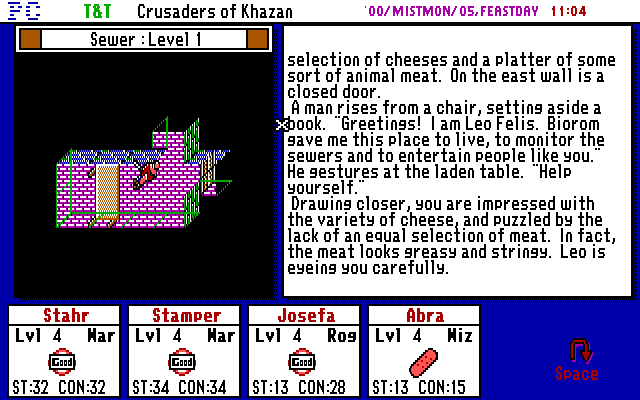
19A. At the far end of the table, a man rises from a chair. He sets a book down and greets you. "I am Leo Felis. I live here, placed by Biorom to monitor the sewers and to entertain people like yourself. Please help yourself," he says.

You draw closer and are impressed with the selection of cheese, and slightly puzzled by the lack of an equally wide selection of meat. Careful inspection of the meat shows it to be greasy and stringy. If you decide to attack this man, go to 40B. If you would like to eat some cheese, go to 24A. If you want to sample the animal flesh, go to 34E. 

Only slight changes in this text.

In general, only about one-quarter of the encounters in the gamebooks made it into the game, but virtually every encounter in the game, as well as almost all the text, was originally found in the gamebooks. The books offer a lot more encounters that increase experience and attributes directly, while the game relies more on traditional RPG mechanics to do this.

I suspect if I went and purchased a bunch of the other pre-1990 solo adventures, we'd find that nearly the entire game originally appeared in gamebooks, perhaps with the exception of the main quest (which really doesn't show up in the CRPG until very late in the game). I don't mind the borrowing of encounters and text so much as I mind the use of gamebook-style choices in the encounters. I'm perfectly capable of opening  my inventory and lighting a torch, or using the regular game interface to cast "Freeze Please," and I don't want to see those show up as options in a wall of text. It defeats the purpose of playing a game rather than reading a book.

I'm going to spend some hours catching up on Crusaders of Khazan, and I won't bother blogging about old territory, so the posts will pick up when I'm close to where I left off last time. In the meantime, we aren't quite done with gamebooks. I've also purchased Steve Jackson's Citadel of Chaos (1983) in preparation for the 1984 computer version, which is more of a direct adaptation. The book is somewhat larger than either of the two T&T adventures, clocking in at 400 entries. We'll see a post about that before the end of Khazan.

****

Posts on Tunnels & Trolls: Crusaders of Khazan: One | Two | Three | Four | Five | Six