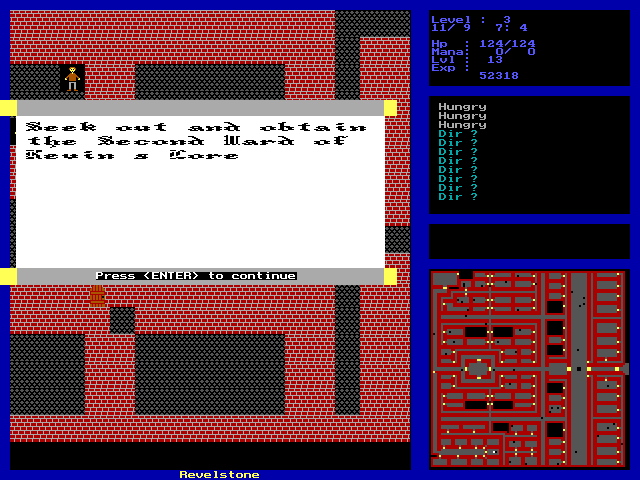
Perhaps now that you have some free time, you can come up with a better name for your country than "The Land."
NetHack was probably the most satisfying game to win in terms of challenge, but The Land was most satisfying in terms of process. I won honestly, and as the only player who gets to play his own custom version of the game...
....while in correspondence with an extremely friendly developer, and in a way that helps improve the game for future players. I'm now glad that The Land is my real 100th game (inserting a game called The Quest to Solve Chester's Problem with Counting between 11 and 13 was easier than renumbering everything by the time I realized I'd skipped a number).
In correspondence with Mike Riley, I learned that:
1. I hadn't done anything wrong in my final battle with Lord Foul. Thomas Covenant was supposed to be using "Wild Magic" in the battle to keep himself alive, and something in the game's code was preventing him. When Mike made a few tweaks to the .exe (in less than 24 hours!), I won quite easily.
2. This is the only battle that Thomas Covenant will fight in.
3. This isn't the only way to defeat Lord Foul, but the alternative--using the Talisman of Earthpower--is much harder and requires a Loresraat (which I did happen to be).
4. Most of the other options I could have wished for with the Seventh Ward would have backfired on me in some way. There is a warning from Amok in the books that is a clue about this.
5. If I hadn't wished to "Destroy Lord Foul," I could have returned to the surface for two more quests from Lord Morham, one of which would have led me to Foul's lair ultimately.
6. The un-killable monsters roaming the hallways of Foul's Creche are called "Ravers." There are some lore bits about them, but I didn't put two and two together. I was meant to do what I did: evade them by putting obstacles in their paths. Apparently, I could have been using "Create Forbidding" for that, but what I actually did was use the Krill of Loric Vilesilencer to summon iterations of Lord Amok in their paths.
7. Regarding my problem finding dungeon entrances: the "(S)earch" command would have worked. I mostly forgot about that command. It also helps you find random items in the wilderness, like torches and herbs.
8. The game originally had a lot more documentation, released when the player paid the shareware fee. But Mike lost the files some time ago.
9. The version I've been playing is actually from 2009. The RogueBasin article that Mike wrote is a little out of date.
The actual process of winning with the new version just took a couple of minutes. Covenant took on Lord Foul while I and the other party members dealt with his minions.
I'm not just standing off to the side and watching. I'm casting spells!
Unfortunately, my other party members died in the process (farewell, noble pegasus!). When I left the combat screen, I found myself returned to Revelstone with the message that Covenant had disappeared.
I spoke to Lord Morham, who congratulated me on destroying Lord Foul. The game let me continue playing at this point.
So my winning streak remains unbroken, and Mike is working on a patch for the next edition. (He removed gambling from the one he gave me, but I encouraged him to put it back in, just with worse odds and a betting cap.) All together, a good day.
And yet that leper-rapist Covenant gets all the credit. I think Gideon should be in the next book.
A little adjustment of the final rating is in order, and not just because I'm feeling kindly toward the developer. First, now that I know the game allows multiple paths to the end, that's worth a point in "Gameplay." Second, knowing there's a developer so willing to talk about the game and fix its problems leads me to return one of the points I subtracted for bugginess and poor documentation. That leaves it at 32. I guess I should explicitly say, though, that this rating applies to the next release.
If you missed the edited bit at the end of my last posting, I decided to postpone Rance. I'm doing my playing this week on a hotel terrace, and the last thing I need is my fellow guests and staff wandering by while a naked 1980s anime character is on my screen. Mines of Titan coming up next.
****
Further reading: Check out my series of posts on Quest for the Unicorn, Mike Riley's second RPG, in the winter of 2015.
As far as I got. That's Lord Foul in the vanguard of the enemies.
The Land
Riley Computer Services
Mike Riley
Released in multiple versions between 1985 and 2009
Date Started: 16 June 2013 Date Ended: 25 June 2013
Total Hours: 14 Difficulty: Hard (4/5) Final Rating: 32 Ranking at Time of Posting: 52/99 (53%)
I'm giving up on The Land until some more information comes along. It's annoying because I'm on the threshold of victory.
When I last blogged, I was hunting around for the Sixth Ward of Kevin's Lore. I finally found it, returned to Lord Morham, and got a quest to find the "Krill of Loric Vilesilencer." (Is this a character in the books? Does he silence people in vile way, or does he silence vile people?) I was looking forward to tracking down a collection of small crustaceans, but the Krill turned out to be a weapon of some sort.
While searching for lore on the Krill (the library didn't have any), I ran into Thomas Covenant in Revelwood, and this time he agreed to join me. "NOW we'll kick some ass," I thought, before I found that Tom's default response to any combat is to run away screaming the moment we enter. (His default action was set to "evade" and the game wouldn't let me change it.) Nonetheless, I kept him with me because I'd received clues that I need either the Talisman of Earthpower or Wild Magic to defeat Lord Foul, and other lore told me that Covenant, the "bearer of white gold," was the only one who could use Wild Magic.
"T-Cov" joins the group. That 5000 mana never did us much good.
The Krill turned out to be in a hidden dungeon exactly one step from Revelstone, and obtaining it wasn't too hard. I returned with it to Morham and got the quest to get the Seventh Ward. To find it, I had to summon someone named Amok using the Krill. It took me a while messing around with various words to figure out the right combination to do this. Once I finally had him there, he told me where it was and bade me summon him again once I reached its barrier. The weird thing is that after I summoned him, every NPC in the dungeons was flagged as Amok.
We're there! Can't you see it just to the south?
The moment I laid hands on the Seventh Ward, it gave me a selection of a series of wishes, including power, wealth, knowledge, and other items. The last two options were "Give me the Talisman of Earthpower" and "Destroy Lord Foul." I figured since destroying Lord Foul was my ultimate mission, I chose that. Well, the Ward didn't actually destroy him; it just warped me to his dungeon and left the job to me.
I do wonder what would have happened if I'd chosen some of the other options. Note that the last option definitely says "Destroy Lord Foul," not "Take me to destroy Lord Foul."
It was in the final dungeon--"Foul's Creche"--that the game utterly slaughtered me. The previous dungeons had served up groups of enemies that were very dangerous and difficult, but this one gave me enemies that were absolutely unkillable. I mean that literally. On every level, there seemed to be at least once group of invulnerable foes that refused to die no matter what tactics I used. I tried the Horn of Blasting for 100 consecutive uses on some of them (no enemy had ever survived more than 8 or 9 before) to no avail. I finally had to put up barricades in their paths and run to other corners of the dungeon. [Later edit: In an e-mail correspondence with Mike Riley, he confirms the invulnerable enemies, notes that they're called "Ravers," and says that I was supposed to get past them by putting up barricades. So in that sense, I guess they were an interesting addition to the game tactics.]
Foul's lair. I cannot get through the barrier to the artifact nor defeat Foul in combat.
Thus fleeing, I did finally encounter Lord Foul on the tenth level of his lair, near some artifact surrounded by a barrier that none of the commands I'd received through lore was able to dispel. Foul himself seems as impossible as some of his allies. He's capable of killing me with a single blast of his magic, no matter what type of protection I equip or cast. When I engage him in combat, Thomas Covenant doesn't flee as usual, but neither does he seem to be using any "Wild Magic." He just runs up and attacks Foul and inevitably gets killed. After Foul and his minions pick off my party one-by-one, I typically fall in a single hit. I've tried to defeat him more than 30 times with different tactics. I can't say "I never even came close" because the game doesn't show me how many hit points my foe has left, but it never feels like I came close.
Gideon hangs back while his party, led by t-shirt-clad Thomas Covenant, prepares to ineffectually deal with Lord Foul.
Before you actually engage him in combat, Foul stands in a fixed position and shoots magic, so I suppose it's possible that the goal is not to actually kill him but to get his artifact, but none of my keywords seem to break the barrier. I tried to leave the dungeon and return to towns to get more lore, but it seems there's no way to get off his peninsula once you're on it.
Gideon begins to regret that wish.
Unless someone proves otherwise (and I've been chastened when making this challenge before), I'm going to conclude that something in the game is broken and winning is not really possible. This is borne out by the fact that no one online seems to have won it. Even "Baltirow," the writer of the otherwise-thorough FAQ/walkthrough that accompanies the game (a document I didn't consult until I was thoroughly stuck) admits that he never completed the last three dungeons. This is obvious because there's some patently wrong information about them (though this may have been due to a version change). I created the only YouTube video I can find, and if anyone's done an LP or claimed to have won the game on a message board, it's not coming up in any of the keyword terms I use. (The game's generic title doesn't help.)
Compounding
the problem is a series of bugs that seem to have affected the final
dungeon. When I first arrived, I couldn't see anything and I had to go
up and down a few times to get the map to appear. My "Oath" setting suddenly announces that I'm "evil" with no obvious evil actions preceding it. While trying to find a
way to defeat Lord Foul at one point, the screen glitched and the game
suddenly said I was dead. Trying to adjust my party members' default
actions often produces a crash. I'm fed up with the bugginess of the
game as much as the difficulty.
Our hero is approached by a dungeon-destroying fuzz-monster.
But for a minor shareware game, The Land has prompted a lot of great discussion on the Covenant books, the nature of fantasy, what makes an engaging protagonist, and cheating. The developer had some interesting ideas that didn't come together well. I'm not sorry I played it, though it really wasn't meant to last this long.
3 points for the game world. It's a tough call because the world of the Covenant books is obviously quite large and rich, but The Land doesn't really make any attempt to ease non-Donaldson readers into the lore of the world. The player's place in the world never really becomes clear throughout the game.
4 points for character creation and development. The large selection of classes, with clear strengths and weaknesses, is one of the game's major assets. The skill system, offering a diverse array of specialties, is a good idea, though advancement should have been prompted by player choice and not random rolls. Leveling is satisfying in the hit point, spell point, skill, and attribute bonuses you receive (and you also get special items at fixed levels), and the "oath/service" system is intriguing if a little flawed.
Gaining spells upon leveling up.
5 points for NPC interaction. Talking with NPCs is absolutely necessary in the game, which is unique in the way that you collect and record "lore." You can also get certain NPCs to join you and perform some limited management of their tactics in combat. My problem is that the gameplay with NPCs is a little too blunt and literal. Good NPC interaction involves asking the right questions (and often providing the right answers) to tease out the related lore; this game just has NPCs say "The Sixth Word of Power is KHABAAL" with no depth to the interactions.
Good in concept, boring in delivery.
3 points for encounters and foes. The enemies in the game are drawn from the Donaldson universe and really aren't very memorable beyond their icons. They aren't well described and don't vary enough in tactics to be interesting. The only puzzles in the game involve finding the right words of power to use to dispel the barriers (which I now see are called "forbiddings"), and there are no scripted encounters or role-playing opportunities. The game provides as many grinding opportunities as you want.
4 points for magic and combat. There are a number of tactical options in combat, and there are a decent selection of interesting spells for combat, protection, and navigation. A few spells seem to do nothing, but otherwise magic is useful and well-balanced. The overwhelming press of enemies means that most players won't fully explore the detailed tactics possible in the game.
4 points for equipment. There are a lot of items in the games, and a lot of slots to equip them. The identification system is sensible and not too annoying, and the plus ratings, plus the consequent effects on combat and defense scores, allow you to easily rate equipment. It's annoying how rarely the word of power/artifact combinations seem to work, but perhaps this is more a matter of poor documentation (even the walkthrough writer admitted he had "no idea" how to actually use most artifacts).
Gideon's final inventory.
4 points for the economy. It would actually be quite good if not for the gambling system that breaks it. Gold is always useful for items and food, and the ability to purchase lore at the library was a nice addition. It's just too bad it's so easy to raise millions.
2 points for the quests. The game seems to have a main quest, but with no player options until perhaps what to do with the Seventh Ward. The quests are rote, unvarying, and ultimately boring, and it's never really clear what your overall mission is.
These got annoying and repetitive.
3 points for graphics, sound, and inputs. The graphics are okay, but the unvarying tilesets in the dungeons gets boring fast. The only sound is an occasional bloop. While the keyboard commands make sense and are easy to master, too many of the interface screens are buggy, causing the game to crash or for the player to lose inventory while trying to move it around. The process for speaking certain words or using certain artifacts was never very clear.
1 point for gameplay. It rates very badly in all of my gameplay categories. It's linear, non-replayable, and too long. It goes from too easy to too hard extremely quickly, and as I said, I found the final dungeon essentially impossible. [Edit: I restored a point after getting the patched version from Mike Riley. The final dungeon is not impossible, and there are a couple of paths to the endgame, making it slightly replayable.]
You take a risk with shareware games from a single developer, and in this case the risk doesn't pay off in a way that the initial sum of scores doesn't make clear. The bugs, lack of documentation, overabundance of combats, and difficulty conspire to create a game that I cannot really recommend--a game that essentially feels unfinished--and for these reasons I feel compelled to subtract 3 points from the initial sum [edit: reduced to 2 in light of Mike's willingness to talk about the game and fix problems] to arrive at a final scoreof 30 [Edit: 32 with the modifications].
But as things go, this really isn't a bad score. It ties with or beats a lot of commercial games from the era. I liked it far better than Ultima II or Questron II, which featured similar interfaces. The relatively high score speaks to the sophistication and innovation of the game, and I honestly think The Land could be a good game with a few tweaks, such as limiting the dungeons to five levels, cutting the number of foes by about 2/3 (and compensating with more experience from the remaining ones), creating less expansive towns, building in more history in the documentation or in-game lore, fixing the gambling system, improving enemy and party pathfinding, and ratcheting down the difficultly level of the final dungeon.
Of the developer, Mike Riley, I can find virtually nothing. [Edit: Until, that is, he posted a comment below.] Like the name of his game, his own name is a bit too generic to be easily-searchable. He may own a bookstore in Phoenix. (MobyGames credits him on two other titles--Frogger Advance: The Great Quest (2002), and Fat Princess (2009)--but I suspect this is an example of more than one person of the same name being conflated in the database.) Someone must have been playing The Land for Mr. Riley to continue updating it for 20 years, but I can't find a shred of online evidence with the exception of the aforementioned Baltirow, the game's biggest fan, who never seems to actually have won it.
I might keep trying to kill Lord Foul on occasion as I move on--I hate breaking my winning streak--and I'd sill love to hear from anyone with any tips.
Although many of you tried to convince me otherwise, I'm going to move on to Rance for at least one posting. No one successfully defended Fire King as an RPG, so it's gone. [Later Edit: I'm still going to play Rance, but I decided to move it below Mines of Titan because I'm doing a lot of my playing this week on a hotel terrace, and I didn't want other people seeing me play a porn game.]
I didn't want to post again on The Land until I've won, but about nine hours invested in that effort this week has not produced that outcome, and the game has gotten annoying enough that I'm not sure I'm going to continue.
When I closed last time, I was trying to find the Third Ward of Kevin's Lore, and now I'm trying to find the Sixth. But there was more than just Four and Five in between; after the Third Ward, I had to find Berek Halfhand's Staff, Kevin's Sphere, and the Adant of Damelain before I continued with the Fourth Ward, meaning I've solved six quests since I last posted. They have been exceedingly repetitive and mostly uninteresting, following the same formula:
1. Get the quest from Lord Morham.
2A. Wander around and talk to people until someone gives you the lore that tells where the item is. Keep talking until you get a different lore that tells you the Word of Power necessary to break through the barrier around the item. Or:
2B. Go to the library in Revelstone and pay $1,500 for a "lore search." This is a neat invention that I hadn't really understood until recently. After paying the fee, you enter a keyword and you get whatever lore is associated with the term that you normally would have gotten from talking to people. This allows rich players to avoid bumbling around until they get lucky with the right person, and I've essentially used it exclusively since I found it. The game glitches and just shows you a blank screen when you do the search, but the lore shows up in the "lore log" that you can access with SHIFT-L.
Searching for lore on my latest quest in the library. I like this idea, though the broken economy (thanks to the broken gambling system) also breaks this.
3. Travel overland to the dungeon entrance.
4. Battle hordes of monsters as you search for staircases and slowly descend through the levels. The "Clairvoyance" spell, which I got at Level 11, helps by revealing unexplored areas, so it's a little easier to find the staircases down.
5. On the last level--always Level 10 until this last quest--find the barrier surrounding the quest object. Use the Word of Power to break through and grab it.
Finding the Adant of Damelain. I don't think "adant" is a word.
6. Zip your way to the surface and get out of there. This got easier when I discovered a Word of Power (ABAKAAL) that allows you to jump up a level, and it got a lot easier when I discovered a Word of Power (MINTAAL) that automatically whisks you to the exit. Thus, most of the effort in the dungeon is just getting down.
This was a nice quest reward.
7. Return to Morham for the next quest.
As repetitive as all this is, I had gotten used to it, so the game's changes to the current dungeon, where I'm trying to find the Sixth Ward, are unwelcome. It has 15 levels instead of 10, and the barrier and item aren't on the last level. I'm slowly trying to work my way up and search every level, a process greatly complicated by enemies supremely talented at killing me.
The big change since last time is that the game got hard. For the first four quests, I was unnaturally beefed up in equipment and skills thanks to my gambling winnings. I simply charged through the dungeons and slaughtered the pitiful denizens wherever they appeared. This period of gameplay reminded me unfavorably of Ultima II, with its legions of enemies lining up to be slaughtered. Then I started to notice they were getting harder, and doing significant hit point damage as I barreled through them with abandon. So I slowed down a bit, watched my hit points, and healed myself when necessary.
Before long, though, they got so tough that I started dying every once in a while. I compensated for this by starting to use a bow and sniping them from afar. But soon their own magic missile attacks began to outclass my own, and more important, they started attacking in groups. Instead of fighting them individually in the main dungeon window, I entered the special combat map used in outdoor areas to take on more than one enemy at once.
At first, they attacked in pairs. Then triplets. The numbers kept growing, and now I routinely face six or seven of them.
During this period, I managed to get a "party" of my own. I figured out what I'd been doing wrong, at least in the game's own logic. When you encounter an NPC in a town or dungeon, he'll either talk to you and give you lore or join you. He won't do both. My mistake had been to talk to them first. What I needed to do instead was run right up and hit the (J)oin command.
The NPCs are of varying quality. The mount--a pegasus--is most important, as it greatly limits the time taken in overland travel. Some of the others have died almost instantly. A few have lasted a while and do pretty good damage to enemies with spells and melee attacks while I sit in the back and shoot at them. I feel bad about using the NPCs as cannon fodder this way, but I die, the game's over. Can they say the same?
Group-on-group combat.
There really isn't much you can do with NPCs. They make their own combat choices, although you can give them a broad command as to whether to generally attack or generally evade (I chose "evade" for my pegasus). They gain their own experience from the kills that they make (often stealing it from me!) but I noticed their hit points and levels don't actually increase from this process.
The party command screen.
In this last dungeon, the enemies have been too tough for me even with a barrier of NPCs. Some of them are capable of wiping me out with a few missile shots. Thus, combat has become much more tactical. I have a few resources at my disposal:
Terrain. The pathfinding for enemies in this game is pretty much this: if there's no direct path between the enemy and the victim, the enemy jams himself behind a barrier until there is. (The same bad pathfinding applies to party members, too, who tend to bunch up behind each other in combat.) This makes it possible to rest, heal, and use the horn strategy below. Also, enemies won't step on traps or cross certain dropped objects. They can shoot magic at you from behind these objects (and at this point, almost every enemy is capable of doing that) but not if they can't see you. So one strategy is to get them trapped, go off-screen, and fire arrows or spells down the hallway until the enemy dies.
Spells. I started accumulating one per level (and occasionally a bonus one based on a scroll) when I switched to the "Loresraat" class. I have a few dozen now. Of them, I use "Cure Serious Wounds," "Identify," "Clairvoyance," and "Fireball" most often. "Lesser Summoning" replaces an NPC temporarily if one dies. "Continual Light" is an odd one; when I cast it the first time, it created a light like a torch, only it's never burned out in six hours of gameplay.
My current spell list.
Items and Words of Power. Through lore, I've discovered the Words of Power that work with certain items (liberally dropped by enemies) to convey healing, protection, and offensive spells. For instance, MELENDRI used with a Sphere of Protection increases my armor class. I'm still confused by a lot of these, though; many don't work as advertised. For instance, a Lore Staff is supposed to heal me when used with MELEN, but it doesn't.
Horns of Blasting. These are a strange addition to the game that have been the only things keeping me alive. When you blow the horn of blasting--each of which has hundreds of charges--it damages anyone within a four-square radius. My survival strategy is to try to lead enemies to areas where some barrier blocks them from getting at (or shooting at) me and use the horn to destroy them.
From here, I'm able to hit multiple groups of enemies with the Horn of Blasting. I know they're dead when the status window shows that I've collected their experience points A glitch in the game keeps their icons on-screen even when I've eliminated the parties.
The horn strategy might not work for the rest of the game, though, as I'm running out of them. Enemies in this game tend to drop treasure specific to their level (or the level of the dungeon). In the first few dungeons, healing potions and food were dropped in abundance, but at this time (when I could really use lots of the former) I hardly ever see them. Horns of Blasting existed for about two dungeons when I was Level 17-18, and I haven't seen them since.
As you know, I do generally like tactical combat, and there is a vague NetHack-like feel to my current game state, when every time I see an enemy I have to figure out which combination of terrain, spells, and items work best. Unfortunately, this process isn't nearly as enjoyable as NetHack for two reasons:
1. There are one billion enemies per dungeon. Seriously, I think that might not even be hyperbole. They're relentless. You kill half a dozen packs of 'em, walk four steps, and face half a dozen more. Even the most joyful NetHack player who loves outwitting vampire lords would lose patience if he had to face 600 per level.
2. The enemies themselves aren't interesting enough. They come in two basic varieties--those who use melee attacks and those who use magic attacks--and nothing else differentiates them but icon and difficulty level. There are some theoretically capable of casting "Sleep" and "Fear," but I've never noticed any effect from these spells on my characters. In general, there are no enemy-based special tactics or strategies.
One other weird thing that's happened is NPCs have started showing up in packs with enemies. It was already odd enough to find NPCs in the middle of dungeon levels, but now it's worse because although they might be friendly, their companions certainly aren't, and once combat starts, my other party members don't make any distinction between them. NPCs also keep getting caught in my Horn of Blasting radius. I'm not 100% sure, but I think every time I kill an NPC, it damages my "Oath" and makes my "service" due faster.
Leveling has slowed considerably, with millions of experience points now required between each level. I get about one per dungeon. Leveling randomly increases skills and attributes. For me, strength is the most important. I'm carrying around so many quest items that I barely have room for any equipment, and each increase in strength gives me more carrying capacity.
I feel like I'm close to the end, so I don't want to give up now, but between slowly exploring and reloading when I die, it's taking more than half an hour to clear each dungeon level, and if I have to explore all of them to find the quest item, that could easily come to more than seven hours per dungeon. If I can find the Sixth Ward soon, I might have a go at the Seventh Ward (this is all putting New Orleans on my mind) and see if it ends the game.
I recorded some video below that demonstrates the various gameplay elements and combat mechanisms I talked about:
It starts in Revelstone, with a couple of examples of talking to NPCs and shops. At 00:41, you see overland travel and an example of multi-enemy overland combat. At 01:03, the game re-sizes the screen (it uses a shorter vertical screen for inventory) and you see some of this posting, in draft, behind it.
At 01:11, I enter Mount Thunder, an early dungeon, and use "Clairvoyance" to expand the map. The combats that follow are indicative of early dungeons in which you just have to charge at enemies and beat them to death. At 02:07, I kill an enemy with a "Fireball" spell and a few others with arrows. At 02:33, I use the Word of Power to exit the dungeon.
When I enter the Westron Mountains next, things change. At 02:58, you see me maneuvering enemies into barriers so I can repeatedly use my Horn of Blasting and wipe them out. A few such combats follow. At 03:49, you see me maneuver enemies against a trap so I can fire at them repeatedly off-screen without them continuing to advance. Even though these icons are showing just one enemy, there are actually multiple enemies behind them, and if I approach them and engage them in melee combat, I enter party-style combat as in 04:55. At first, my character uses arrows but at 05:16, he charges into melee range and uses his sword. He can't survive many combats in such circumstances, and at the end of the video, he dies.
Before we go, we have to deal with my next game, Fire King. I really need to trim some games off the list, and Fire King seems like a good candidate. I read the manual and played it for a little while, and as far as I can tell, it doesn't deserve its "RPG" label. It has no character development, only the most basic action-game-style inventory, and combat is solely based on the speed of the player's maneuvering and clicking. If someone would like to defend it as an RPG, you have a few days.
Looking up a map of The Land is probably a spoiler, but I figured most fans of the series would already have this at their disposal.
The Land is proving to be a long game, perhaps needlessly long, without much becoming clearer on the main quest. It seems to be shaping up into a series of quests to find the seven "wards of lore" left by Lord Kevin. I tried to look up some of this stuff online, and it sounds like Kevin was Lord of Revelstone who created some kind of horrific magic ritual to destroy Lord Foul and sealed away his knowledge in seven "wards" so it wouldn't be destroyed by the ritual, too. I guess the ritual didn't work, and Kevin ended up dying instead.
I don't know exactly how the plot of the game is following the plot of the books. There's some indication that I'll eventually hook up with Thomas Covenant. I got some lore about him, and there's an icon representing him in the tileset.
What about me?! I'm the one doing all the work!
The first quest, taking me to the dungeons beneath the giant city of Coercri, gave me a peek at the game's approach to dungeons. They're huge (all maps seem to take up all available map space), multi-leveled, and randomly-generated. The game regenerates levels as you go up and down, so every time you want to ascend or descend, you have to go through a process of finding the stairs again. The random generation creates oddities such as doors that go nowhere or doors right next to openings.
Each time you visit or re-visit a level, the game tells you how many experience points are to be found there, which is kind of silly because the number isn't really fixed. If you go up and down again, you'll get a new map with a new experience point total. This does mean, however, that once you "clear" a level, you don't have to worry about enemies regenerating (that is, until you leave and return).
There are multiple creatures to be found in the dungeons, and as you slay them, they drop food, weapons, armor, potions, torches, staffs, scrolls, and gold. You also find these things laying around. The scrolls give you the same types of lore that you might get from
people in towns, although there are occasional scrolls that give you an extra spell and Scrolls of Identification. Much like NetHack, potions are color-coded and items are given generic descriptions, but once you identify them once, the identification holds for every subsequent item that you find of that color or class. You need torches to get around and the occasional meal to keep healthy, but these are both so plentiful that you don't need to worry about bringing a stock with you.
Gideon fights a little creature while the detritus of previous battles--a staff, a sword, and a bit of food--lie around him.
Unlike the wilderness areas, combat is all on the main screen. I removed much of the fun and challenge of the game with my casino haul. Because I bought so much gear, I wasn't remotely interested in 90% of what enemies dropped (food and the occasional potions were the exception), and I've only found one enemy who was remotely dangerous to me (see below). Part of me wants to start over and experience the game "straight," but that's kind of like a guy who insists on continuing to work a menial job after winning the lottery.
NPCs show up randomly in dungeons, too, imparting the same sort of lore that they do in towns. In the second dungeon I explored, they included centaurs, but they said the same things that humans did.
Gideon trades "hellos" with an NPC. Note the nonsensical doors all over the place.
Because of the random regeneration every time you leave a dungeon level, there's no point trying to explore everything. In the first dungeon, I reasoned that the quest item would be on the last level, so I just kept moving downward every time I found a set of stairs. Eventually, I mapped the tenth level exhaustively and had found no stairs, so I knew that was the last one.
The tenth level of Coercri was also the only level to feature something other than generic corridors. At first, I thought it was some kind of water, but later I reasoned that it was a barrier. I didn't know what to do with it, but I fired up my lore and started trying all of the "words of power" that I had learned. One of them, MELEN, opened a passageway through the barrier and to the first ward.
After that, I slowly made my way up the 10 levels, having to find the staircases all over again, and returned to Revelstone. There, the lord who had given me the original quest (Lord Mohram) told me to find the second ward.
I think I'm sensing a pattern.
A bit of lore said that the second ward was under Mount Thunder, but I had no idea where that was. I spent a while wandering around The Land trying to find it, and I quickly discovered that time passes very quickly while wandering around the wilderness. My character aged from 20 to 22, I burned a ton of food, and I had to return to Revelstone to perform my "service," which is nothing more than entering the city, hitting "O," and watching as eight months burn away. I really don't understand the purpose of this feature.
Wilderness combats also started presenting me with multiple foes at once.
During my wanderings, I explored the forest city of Revelwood, where I ran into an NPC named Corimini, who asked if I wanted to join the "Loresraat." I said sure, why not, and found myself having changed classes (I had forgotten that Loresraat was a class). It re-started me at 0 experience points, but I kept all my skills and hit points from leveling up as a Warward. One advantage of the change was that I got access to spells; every level-up let me select a new one.
"Know" in the biblical sense?
This is great in theory, but so far I haven't needed to use any of them; my regular attacks and armor defend me fine. Even poison, which some creatures are capable of inflicting, lasts only a few turns.
The icons in the left-center show that my character has cast "Protection," he has quaffed a potion of fire resistance, and he has a torch lit.
In addition to spells, there are supposedly items (Gems of Brightness, Crystal Balls, Staffs of Curing) that work in response to various words of power. I've not been able to get any of them to work, though. If I wield the item and speak a word, nothing happens. If I "use" the item, nothing happens.
Still lacking the location of Mount Thunder, I caved and looked at a map of The Land online that would have been published in one of the Thomas Covenant books. I followed the features to the indicated location, but there was no obvious entrance to a mountain. I tried standing on random squares in the middle of the mountain and hitting the "down" key, and one of them took me into the dungeon. Horrible game design there.
The entrance to the mountain is a couple squares to my southeast. Is it just my colorblindness screwing me again, or am I right that there's nothing there?
As in the previous dungeon, I headed down as quickly as possible, but my explorations of the bottom level didn't turn up the ward--just an NPC named "Drool Rockworm" who I couldn't hit and was capable of killing me in about three hits. None of the other foes in the game have been even remotely dangerous, so this was a bit of a change.
For a little guy, he sure packs a punch.
I ran away from him, started exploring upward, and found the ward on Level 9. I had been previously alerted by an NPC or scroll that "the power of the wards is unlocked by the previous wards," so I tried the word that I had received at the first ward--MELANKURION--and got passage through the barrier to the second. Here, I was relieved to receive a word of power (ABAKAAL) that automatically transports me upward in dungeons. Exploring downward is still a pain in the neck, but at least returning to the surface is a lot faster.
Thank god for the "lore" window because I wouldn't be able to read what that word is otherwise.
Returning to Lord Morham, I received a quest to find--you guessed it--the third ward. (Is the game over when I've found all seven, or is this just a prologue?) A bit of lore suggested that was in a place called Doriendor Corishev, somewhre in the south. Getting there was a bit of a nightmare. Navigating through mountains isn't easy in this game: when standing among mountains, you often can't go certain directions, but there's no graphical indication where the "barriers" are. You have to blindly feel your way through them.
Navigating a path through the mountains.
Once I reached the area where the dungeon should have been, I found that it was just like Mount Thunder: no visible entrance. I had to wander around testing a bunch of random squares of mountain and grass before I finally found it, about a half hour later. I later discovered that the small-scale map (in the lower right) has a little black square where dungeon entrances are, so as long as you have the general area, it's not as hard to find as I've been making it out to be. As I close, I'm working my way down through the levels.
I'd like to get far enough to where I get additional party members. The "party" screen suggests I can have up to five of them, but everyone I ask to join me says "no."
Gideon sits at the head of an empty party.
Again, I'd love to hear from anyone else who has played this game, and any context to this plot from anyone who has read the books. I feel compelled to stick with it for at least a little while longer. It was clearly a labor of love for developer Mike Riley, and there isn't much about the game online except an article at RogueBasin. I'd like to be among the first to show the winning screenshot or post a little gameplay to YouTube. (I might be missing stuff that's out there, but it's hard finding articles for a game with as generic a title as The Land. Nothing came up when I tried to Google the types of terms that would show up in a walkthrough.) I'm just sorry I don't understand more about the context of the game.
Multiple versions released between 1985 and 2009 Date Started: 16 June 2013
"One word more," Foul said, "a final caution. Do not forget whom to fear at the last. I have had to be content with killing and torment. But now my plans are laid, and I have begun. I shall not rest until I have eradicated hope from the Earth. Think on that, and be dismayed!"
--Lord Foul's Bane, Book 1 of The Chronicles of Thomas Covenant, the Unbeliever, Page 20.
My reaction.
I suppose I should give Stephen Donaldson's The Chronicles of Thomas Covenant another try. A lot of people I respect seem to like the books, they apparently deal with complex themes in a fantasy backdrop, and the idea of a protagonist with leprosy is fascinating. But wow, the writing in the first book was awful. That quote above came at the end of about three pages of awkward exposition that you have to read to believe. I half expect that at the end, when Covenant wins, Lord Foul says, "You beat me?! I am destroyed."
The Land is set in the world of the books, called by its inhabitants...wait for it..."The Land." The geography, city names, monster names, and character classes are all drawn from Donaldson, giving non-readers a slight disadvantage. The game gives you no clues as to the story and quest, although the manual says that the latter will become clear during gameplay. As I cover this game, I won't mind at all if those of you who have read the books chime in with a little context.
"Lord Osondrea" is a character in the books, but damned if I know what role she plays.
You begin by naming your character, distributing 20 points among the six standard D&D statistics (all of which start at 10), and choosing from among seven race/class choices that are unique to the game. There are starker strengths and weaknesses among the classes than in, say, NetHack, with certain classes unable to use certain magic or spells. "Ramen," for instance, fight unarmed and unarmored and can never ride horses. "Warwards" can use any armor and weapons except for artifacts. "Loresraats" can use anything, magic or spells, but advance very slowly in experience.
My first character.
The game is often classified among roguelikes, but the tag is slightly debatable. It has a vague roguelike feel to it, especially in the selection of keyboard commands and the inventory. I don't know if early The Land influenced Omega or if Omega influenced later versions of The Land or if they have a common ancestor, but they seem very similar. (Certainly, they didn't independently come up with the idea of an "Up in Air" slot in the inventory.) It also has a certain randomization to some maps, and you only uncover areas as you move through them. On the other hand, it has a nice graphic tileset and some bloopish sounds, and there's no permadeath. Like Omega, it has an overworld and multiple towns and dungeons. You can apparently get other party members to join you, though I haven't gotten that far yet. In general, the game feels more like Ultima I or Ultima II than a traditional "roguelike."
Roguelikes and other freeware games are often difficult to peg to a
specific date because they undergo continuous development throughout
their lifetimes. I "solved" that problem with NetHack by breaking
it into six "editions" and planning to play each one in its appropriate
year. But I'm not going to do that for every roguelike. In the case of The Land,
version 1.0 was released in 1985 and version 5.0 was released in 1996.
I'm playing it among 1989 games because MobyGames said it was released
in 1989; I'm guessing they got this from the version 2.3 release date,
which was the first release to the public at large. The release notes suggest that not much changed between 1989 and 1996 except for bug fixes and a conversion to VGA, so I don't feel like I'm playing it significantly out of order.
Exploring "The Land."
Combats come upon you unannounced--enemies don't have icons that approach you while you explore. You're taken to a separate combat screen at that point (again like Omega, at least in its outdoor areas), where you can cast spells, attack with ranged or melee weapons, or flee.
Fighting a "cavewight type."
The game has a few other staples of roguelikes, including a hunger system and an encumbrance system. Its inventory system is a little confusing; removing items from packs puts them in the "up in air" slot, at which point you have to either put them back in the pack, use them, or assign them to an appropriate place on the body. I've found that if you hit the wrong key during this process, you can lose the item for good.
Shopping in town.
I don't know if all towns are like this, but the first town I explored, Revelstone, was huge and featureless, with multiple shops, NPCs selling equipment, and NPCs who would offer a bit of lore. Aside from buying things, the primary purpose of towns seems to be the accumulation of "lore" about the locations of various items and towns and the uses of various objects.
With a name like "Lord Foul," could he be anything else?
Revelstone also had a college with various "courses" you can take to increase skills, which is a nice use of the economy, although the economy is broken (see below).
Increasing skills in college.
The Land has a reasonably interesting skill system, with 16 separate skills for different types of weapons (edged weapons, pole weapons), travel and wilderness skills (scouting, hunting, riding, boats), and magic and lore. You start with 0 in all of these categories, but you can increase them by paying for training. As you level up, your skills increase randomly (an aspect of the game I don't like).
There are some other neat innovations in the game. Like any roguelike, it has good in-game documentation of icons and commands:
The main screen makes good use of its real estate. There's an odd "oath" system by which every class has to render a certain amount of "service" per year to his or her profession, done by returning to the home town. Characters age and, I guess, can die. The game keeps track of each piece of lore that you learn and displays them with SHIFT-L.
I'm not sure how the items in white (at the bottom) differ from the ones at the top.
Balancing these innovations are some "features" common to 1980s freeware games with only one developer. The manual is extremely scant (perhaps by design). You can't fully explore cities because you can't actually enter shops (they activate when you "open" the door), and because they activate automatically, you can't explore rooms across the way from them.
One of these doors has a shop. What's behind the other one, I don't know, because every time I try to (o)pen it, I end up back in the shop.
Hitting an unexpected key frequently produces an error and kicks you to the DOS prompt. This would have been rage-inducing in NetHack, but I suppose it's not so bad in a game that allows you to save anywhere. The font used in dialogue is absolutely unreadable, mitigated a bit by the game keeping track of what's said.
A lore staff is used with WHAT?!
Soon after entering Revelstone, I found an astonishing game-breaking mechanic: the gambling system at taverns and inns. There are two games: "dragon dice" and "die square." "Dragon dice" is a bad investment. You roll three dice, and some of the possible combinations pay out at different ratios. I calculated the rate of return at about 0.81 to 1.
It's not as bad as it looks, as the game organizes the rolls in order, so 6-6-3 pays out whether you roll that, 6-3-6, or 3-6-6.
"Die square," on the other hand, would bankrupt any casino that tried it. You have a nine-square grid, and each square can roll one of two symbols. If the pattern of any one type of symbol makes an "X" or "+", it pays out 25 to 1; if it makes a square (only the one in the middle a different symbol), it pays out 50 to 1, and if all 9 squares end up the same symbol, it pays 100 to 1.
The economy-breaking gambling game.
We don't really have to work out all the probabilities to see why this system breaks the game. Pretend that the game only pays out on an X. The odds of getting an X for one symbol, which involves 5 squares, is 0.5^5, or 0.03. But it pays out if you get either symbol in an X, so multiply that by 2, and we get 0.06. That means you'll win on an X 6% of the time. If the game paid 100/6 or 16.67-to-1, you'd break even over the course of time. But it doesn't pay 16.67-to-1; it pays 25-to-1. The rate of return on this symbol alone is over 1.5 monetary units for every 1 spent.
The probability of a + is the same. Add to this the more remote probabilities of a square or full grid, and you're getting a ridiculous payout. The proof is in my pocket. Within five minutes, I went from 590 gold pieces to over 300,000.
This win gave me 250,000 monetary units from my 10,000 wager.
Questron II was bad, but not this bad. I think there might have been spending caps with that one. In this case, I was able to take my new found wealth and purchase some badass equipment and training.
My post-winnings inventory.
The obvious solution, if you want to play the game straight and struggle for your money, is "don't gamble." But I'm a big believer in the notion that it isn't cheating if the game gives you the ability to do it without resorting to obvious bug-exploiting. If the game seems a little too easy after this, I'll know why.
A lord in Revelstone seemed to give me the first quest: "go get the first ward of Kevin's Lore" in Coercri. Other characters told me that Coercri is on the east coast of Seareach, Seareach is northeast of Sarangrave Flats, Sarangrave Flats run along the east of Landsdrop, and Landsdrop separates the upper and lower lands. I suspect if I wander around a bit, I'll find one of these other features and thus get a bead on where to go.
I think that says "Ward," anyway.
I feel a little crippled without having read the books (the only wiki online is woefully incomplete), but I'll see what I discover in my initial six hours.