|
| Star Command has no more use for a group of seasoned, decorated veterans. |
Star Command
Strategic Simulations, Inc. (1988)
Winston Douglas Wood, Eric Liebenauer
Date Started: 10 July 2011
Date Ended: 25 May 2012
Total Hours: 12
Difficulty: Moderate-Difficult (3.5/5)
Final Rating: 43
Ranking at Time of Posting: 48/61 (79%)
Ranking at Game #454: 399/454 (88%)
I felt that Star Command was a fairly good game, especially in the opening stages. Although the plot veered into nonsense towards the end, it held together better than Sentinel Worlds. The game offered lousier graphics than Worlds but a more challenging, tactical gameplay. It led me on a roller-coaster ride of difficulty, alternating easy milk-run missions with multi-stage ordeals involving dungeon exploration (with adventure game-style puzzles) and massive ship combats.
It appears largely overlooked in the history of CRPGs. After I completed the game, I could only find one walkthrough. Barton doesn't cover it in Dungeons & Desktops. The Wikipedia entry is barely a stub. On the latter, the entry indicates that it was based on a board game by Avalon Hill, but I don't know about that; I can't find anything in the copyright or credits in the game manual, and the one contemporary review I was able to find (Computer Gaming World seems to have ignored it) doesn't mention anything about it. If anyone has information about that board game, I'd be interested in hearing what it's like.
 |
| Nothing about Avalon Hill, though I am vaguely interested in which portions are copyrighted by Microsoft. |
On to the GIMLET:
1. Game World. The game takes place in a densely-populated sector of the galaxy, in which humanity huddles in a "triangle" anchored by three starports. The world is fairly open but not terribly memorable as science fiction RPGs go. The races you encounter (insects, lizards, robots) are somewhat derivative of Starflight, and the political situation calls to mind both Sentinel Worlds and Star Trek. The game responded minimally to my actions. For instance, although pirate ships disappeared once I defeated Blackbeard (and frankly, this might have just been because I stopped visiting their sector), the insects didn't stop attacking after I destroyed their queen. The overall setup was easy to understand, if fairly cliched by this point in the genre. Score: 4.
 |
| The galaxy is large and full of planets. If only there had been more on them. |
2. Character Creation and Development. The game begins with an original character creation process. After defining your character's class (pilot, soldier, marine, or esper), you send him through the academy for eight years, choosing what skills you want to develop during this time. Certain skills are restricted to certain classes, and you have to choose your areas of focus carefully. You can train in skills or send your characters to "officer school" to increase ranks (and therefore pay) or "survival school" to increase attributes. There's a lot of choice in this process--and fairly original choice at that--which drew me into the game immediately.
The composition of the party is also an important choice. Only pilots and espers can increase in astro-gunnery, but the pilot and copilot don't man gun positions. That means that if you want to have a pilot firing a gun, you have to take on more than two pilots--which might help you in space combat but will hurt you significantly in ground combat. Soldiers, espers, and marines all have their strengths and weaknesses, and I'm not sure I had a very good balance in my party.
 |
| Training my first marine. Note that I've invested heavily in scouting and heavy arms, excluding everything else. |
Increasing levels is similarly rewarding. I didn't like that there was no experience, and you could only train after completing missions (or paying lots of money--see below), but I liked the process of training, in which you can choose an attribute and then a skill to increase. I learned that it was better to focus on a couple of skills rather than spread your points out (e.g., heavy weapons and recon for a marine, not heavy weapons, light weapons, recon, and hand weapons), and only towards the end did my characters begin to max out their categories. Overall, character development was one of the best parts of the game, although the types of characters you choose don't affect the encounters. Score: 6.
3. NPC Interaction. There were very few NPCs in the game: a hermit, a couple of guys in a bar, a captured lizard, and a few computers. The game's system for talking with them, by entering keywords, recalls Ultima IV and other Origin games, and was kind of fun. I just wish the NPCs had more to say, and that the most important--the space hermit--wasn't so manifestly goofy. It would have been a little better if there were more NPCs to engage and learn about the various races; in a science fiction CRPG, only Starflight has done that well so far. Score: 4.
4. Encounters and Foes. The special encounters in the game brought out the worst tropes of adventure games, requiring illogical combinations of commands to produce unlikely outcomes. Fortunately, the game has limited inputs, so barring a couple cases where I blew something up and needed to reload, I got through them by just trying every command until something worked. Not many CRPGs of the era try to blend in some adventure game elements, so I appreciate the innovation, but it just didn't work well in execution.
 |
| I am unable to convince three insect freighters that I am their god. |
Perhaps even more frustrating was the shallowness of the encounters with various enemies in the game. Upon encountering ships or land-based forces, you almost always find yourself locked in combat; strategies like plead, demand, and bribe worked so rarely that they might as well have not been there. I don't think I ever got "impersonate a deity" to work, nor did I ever talk myself out of combat with a superior foe. Late in the game, when enemy ships outmaneuver and outnumber yours, each encounter produced only one viable option: fleeing. Even more nonsensical was the way that civilian freighters and luxury ships kept engaging me in combat, to their own inevitable destruction.
The foes themselves were unoriginal and tended to attack the same way in combat regardless of type. I do have to give my usual point for respawning and allowing grinding, though I don't appreciate how all the foes in the game increased with my level. Score: 3.
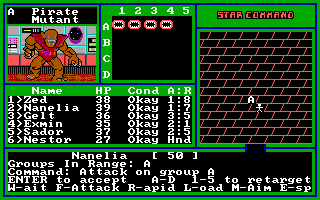
5. Magic and Combat. The tactical nature of both ship and ground combat were flawed, but still appreciated after the rote combat of Sentinel Worlds and so many other games of the era. There were considerations of weight, movement, weapon type, damage, terrain, type of attack (including the "aiming" rounds), ammunition, reloading, and several other factors that I'm probably forgetting. I never really mastered it all. Ship combat became far too difficult towards the end, and it was tough to even grind at that point, because every encounter tended to produce five deadly enemy ships.
On the other hand, I found the "magic" system to be fairly stupid. I never thought I got anything out of my esper, whose best magic attack only affected one enemy per round, that made him invaluable. If I had to play again, I'd forget about his psychic abilities and invest all his skills in astro-gunnery, or perhaps even replace him with a pilot for that purpose. Score: 5.
 |
| "Psychic scream" is about to fail again. |
6. Equipment. There is a very wide variety of weapons, armor, accessories, and special items to buy, and a lot of statistics to balance as you make your choices. I didn't mind so much that combat tended to break these items, but I did mind that every combat tended to break them. I also think it would have been more fun if, as in most CRPGs, you could pick up your enemies' weapons and armor after combat (for resale, if not replacement). Overall, though, this was one of the better parts of the game. Score: 5.
7. Economy. At first, I thought I loved it. There was always something new to buy: ship upgrades, weapons, armor, accessories, and ammunition. And if I was comfortable with all that, I could buy a clone to protect against death or even pay $200,000 for training sessions in between missions!
 |
| If things get bad enough, the game has the option to "declare bankruptcy." You lose your ship and all personal and ship's equipment, but you get $90,000 to start over (after a lecture from high command). |
But in practice, I found the economy deeply flawed. There are only a few ways to make good cash: completing missions and getting paid, and finding espionage items (of which there are a limited number). Defeating enemy ships is often not a viable option, as repairs to and rearmament of my ship usually meant that I was making negative progress. The game had a trading system (I didn't really cover it) by which some planets would sell special items and others would buy them, but the profit margins were so small you'd have to make thousands of the transactions to make a difference. Paying for training remained tantalizingly out of range for the entire game; by the end, I couldn't even afford a decent ship. Someone with more grinding patience or better combat tactics may be able to do more with it. Score: 5.
8. Quests. There were 17 total missions, with enough varied content to make them interesting: destroy a ship, explore a base, rescue a princess, deliver supplies, and so on. They came rapidly enough and, as I previously discussed, the rewards were tangible. Regrettably, there are no side quests (including a few might have helped with the economy) nor any decisions to make during the main quests. However, a few of the main quest stages are randomly generated, allowing for some minimal replay value. Score: 4.
9. Graphics, Sound, and Interface. In the GIMLET, graphics don't have to be terribly good, just not "distractingly bad," but I have to say the graphics in this game were almost distractingly bad. Audio was okay, with different sounds for different weapon types and such, but often annoying--such as when scoring repeated hits against an enemy. The controls were great--very intuitive and responsive--although I wish ships and parties had the ability to move diagonally. Score: 3.
10. Gameplay. I guess what I like most about the game was its relative speed. I'm not saying that I always want to race from quest to quest in a CRPG, but when there's not much in between--not many flowers to stop and smell, as it were--I'd rather just get a pair of coordinates and zip on over to them. Not only was each mission pacing fairly good, but the overall game pacing pleased me, too. It didn't overstay its welcome.
At first, I was entranced with the open game world--the whole galaxy to explore at the outset (if you have enough fuel), but that was when I thought I might find interesting encounters on the planets. An open game world doesn't mean much if there's nothing to find within it, and ultimately I don't think the game, in its non-linearity, really outperformed Sentinel Worlds, which only had three planets.
Perhaps the most frustrating element of the gameplay was its extremely variable difficulty. The first few missions were cakewalks. Then it got harder, but nothing that a little grinding wouldn't help. Then all of a sudden, towards the two-thirds mark, the ship battles became functionally impossible. But during this time, when I was hyperspacing away from every ship that engaged me, the missions themselves were fairly easy, and the last battle (as you can see from the last post's video) was disappointingly easy. Score: 4.
That gives us a final score of 44, which outperforms every game I've played since Wasteland. That feels right. It was an interesting game with innovative ideas and good moments, and it motivated me to play to the end, even if the overall package is a bit flawed. It didn't really stand out in any one category, but neither did it completely fail in any one category.
This was apparently the last game from Winston Douglas Wood and Eric Liebenauer, the team that designed the Phantasie series for SSI. As with other SSI offerings, the company's war game roots show in the game's devotion to tactical combat, which was uneven but innovative. I look forward to playing a lot more SSI in the coming months, as we enter the golden age of the "Gold Box" games.
Now, if I can just finish up Wizardry V, we'll be out of 1988 forever!