Quest for the Unicorn
United States
Independently developed and distributed as shareware
Released 1990 for DOS and at some point between 1990 and 2010 for Linux and Unix; DOS version last updated in mid-1990s. "Hardcore" version released for Windows and Linux/Unix in 2010, last updated 2014Date Started: 26 February 2015
Date Ended: 1 March 2015
Total Hours: 18
Difficulty: Moderate (3/5)Final Rating: 35
Ranking at Time of Posting: 117/174 (67%)
Ranking at Game #458: 335/458 (73%)
Quest for the Unicorn's mechanics satisfy the basic RPG craving of explore, earn experience, find better equipment, get stronger. As with many roguelikes, the content of the game isn't quite up to the mechanics. The one-line bits of lore make the wandering people more like fortune cookies than NPCs; the many dungeons, almost all using the same tiles, lack any personality; and even the enemies don't differ much except by strength and icon. My own playing was hampered by a lack of documentation. I had some fun for a while, but eventually I rushed the ending just to get further through 1990.
After the last post, I spent a lot of time exploring random dungeons, loading up on as much loot as I could carry before making trips back to town to sell, identify, and spend. As you enter each dungeon level, the game tells you the sum of the experience points of all the enemies there. I soon discovered that the harder dungeons might require a lot of reloading, but the experience point rewards were worth it: I sometimes went up an entire level from a single combat.
Equipment rewards were also better in the tougher dungeons. It takes far less than one dungeon level to fill up the backpack, so I would eventually resort to carrying items in the most unlikely of places before lumbering back to town to identify the unknown stuff and sell the stuff I didn't need. As Mike Riley pointed out in a comment, identification applies to the entire class of item, so you only need to identify a Ring of Fire Resistance or a Staff of Striking once.
The lack of documentation for the game hampered me when it came to equipment. I was never sure which items just need to be equipped and which actually had to be (U)sed to have an effect (e.g., Scarab of Protection, Luckstone). For those that needed to be equipped, I didn't always know where they needed to be equipped (e.g., does a Cloak of Displacement go in the "Robe" slot, and are gems held or worn?). A lot of items seemed to produce no effect no matter what I did (e.g., Horn of Valhalla, Necklace of Adaptation, Gem of Brightness, Sphere of Annihilation, Pearl of Power), probably because I was holding or using it wrong. One artifact item, a Phaser, was an awesome weapon when I shot enemies on the main screen, but it didn't work at all when I transitioned to the combat screen, and I'm not sure if this was a bug or some side-effect of the weapon itself. At worst, these were valuable sale items that got me things I did know how to use. Boots of Speed, a Ring of Regeneration, Scrolls of Magic Mapping, Potions of Extra Healing, and a Ring of True Sight--the latter reveals traps and secret doors automatically--were all vital to exploration.
 |
| My backpack is full, so I'm carrying a horn on my shoulder and a scarab on my belt. The game lets you put any item in any slot--it just doesn't always work there. |
The lack of documentation for the game hampered me when it came to equipment. I was never sure which items just need to be equipped and which actually had to be (U)sed to have an effect (e.g., Scarab of Protection, Luckstone). For those that needed to be equipped, I didn't always know where they needed to be equipped (e.g., does a Cloak of Displacement go in the "Robe" slot, and are gems held or worn?). A lot of items seemed to produce no effect no matter what I did (e.g., Horn of Valhalla, Necklace of Adaptation, Gem of Brightness, Sphere of Annihilation, Pearl of Power), probably because I was holding or using it wrong. One artifact item, a Phaser, was an awesome weapon when I shot enemies on the main screen, but it didn't work at all when I transitioned to the combat screen, and I'm not sure if this was a bug or some side-effect of the weapon itself. At worst, these were valuable sale items that got me things I did know how to use. Boots of Speed, a Ring of Regeneration, Scrolls of Magic Mapping, Potions of Extra Healing, and a Ring of True Sight--the latter reveals traps and secret doors automatically--were all vital to exploration.
Leveling is relatively rapid through about 16, after which it slows down even in the hardest dungeons, requiring millions of experience points to advance. As my paladin increased levels, he started getting spells at around Level 9. I found the spell system, at least for the paladin, reasonably well-balanced: spells like "Cure Serious Wounds" and "Continual Light" helped ease the pain of exploration rather than rendering it too simple. It would be interesting to play the game as a mage to see the difference that spellcasting makes.
 |
| Gaining a new spell upon leveling up. |
There are a couple of ways you can change classes throughout the game. The first is involuntary, through a change in alignments, which happens when you kill NPCs. This is easier than you might think, as they wander unmolested around dungeons and often get caught in the crossfire. I'm not sure how it works for all classes, but my paladin progressed from lawful good to chaotic good to chaotic neutral to neutral to lawful evil to The Essence of Evil. Upon reaching the last alignment, his class shifted to "Assassin" (not otherwise selectable in character creation) and his level reverted to 1. I reloaded an earlier game and made sure to occasionally pay for "Restore Alignment" at the healer's.
The second method is by joining the "Cavalier's Guild," which becomes available after you reach around Level 10 in your previous class. I kind of wish I hadn't done it, as I stopped gaining spells, and the only benefit I could really determine is that at the beginning of each year, I could go collect a salary of $1,000 x my character level. There might have been other, behind-the-scenes benefits that I couldn't determine.
 |
| I could get this in about 10 minutes of dungeon exploration. |
Eventually, I found a pegasus NPC in some dungeon who was willing to join me, thus saving myself $125,000 at the transportation shop. With the ability to fly, I was able to explore the totality of the kingdom and find the dungeons mentioned in the lore. The game world consists of nine 100 x 100 maps, for 90,000 total overland tiles in the game.
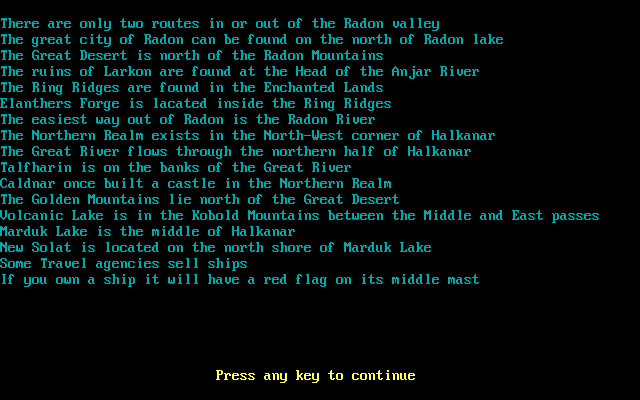
As we discussed last time, a big part of the game involves collecting bits of lore from the NPCs that dot the various cities throughout the game. Each lore line is like a piece of a puzzle, and you need to assemble them all to determine not only what items you need, but where they are, and how to follow the game's geography to find the right dungeons. For instance, this sequence leads from the main quest back to a specific place:
After Eshter captured the unicorns, she fled through the Gateway
Rumors say a Gateway exists from our plane to the Realm of Eshter
The Amulet of Yathun is needed to enter the Gateway
The Amulet of Yathun was last seen in Larkon
Larkon was once a major city
Larkon was destroyed during the Caldnar Droughts
The ruins of Larkon are found at the head of the Anjar River
The Anjar River is located north of the Enchanted Lands
Thus, finding the right dungeon was a matter of first finding the Enchanted Lands, then finding the river north of it, then following the river to its head, where there was a prominent dungeon entrance.

Every dungeon--there are about 60 of them--features some kind of major reward on the bottom level, always surrounded by some kind of electric field that saps half your hit points with every step. In some dungeons, the reward is a quest item; in others, it's a major artifact weapon; and in still others, it's a word of power that acts like a spell but without requiring spell points.
 |
| This word of power was a reward for reaching the lowest dungeon level. |
The player can make these items relatively easy to find by setting the maximum dungeon levels to 1. Buy a few Scrolls of Magic Mapping, and you can be in and out, reward triumphantly in hand, in just a few minutes.
 |
| Approaching the Aurafax, one of the major quest artifacts needed to win the game. Note that I've used a Scroll of Magic Mapping to reveal the level. |
I made the stupid decision to head right for the endgame after finding the three artifacts needed to enter the Gateway. Mike Riley had warned me that I should probably find some other weapon and armor artifacts, as well as build up my character levels more, but I was impatient to get out of 1990, so I decided to rely on Potions of Extra Healing and "Power Word: Reload." This turned out to be a bad decision.
The endgame begins when you find the entrance to the Gateway on an island off the Valley of the Unicorns. You need a flying creature to reach it. I assume the Gateway doesn't appear if you don't have the Talisman in possession, and the Aurafax must do something to allow you to enter it, but both happened automatically and didn't require me to do anything with the artifacts.
 |
| Entering the gateway--well before it was advisable to do so. |
Once you enter the Gateway, you need to equip the Amulet of Yathun to see anything, as bumbling around in the dark is swiftly fatal. The first level of the Gateway has walls of water, the second has walls of fire, and the third has walls of electricity, all of which halve your hit points the moment you walk into them. (These are the only dungeon levels I saw that varied the wall textures.) Not walking into walls turned out to be more difficult than you might imagine.
 |
| A level with walls composed entirely of electrical fields. Since I know I won't be leaving here, a bunch of unwanted items are strewn in my wake. Fortunately, my Ring of True Sight is finding all those traps. To my northeast, a wandering NPC awaits. I hope he joins me, because my party is pretty low. |
The difficulty posed by the walls was nothing compared to the difficulty imposed by the monsters, with creatures like demogorgons, demons, and dragons wandering everywhere and shooting at me even through barriers. Some of them were able to kill me in a single shot. Even though I loaded up on Potions of Extra Healing before entering the Gateway, I was toasted in most battles, especially after my party of NPCs died one by one (I was able to collect some more in the final dungeons, but not at a rate faster than I was losing them). I reloaded constantly, held down SPACE to regenerate after every battle, and eventually got to the point where I was saving with every step. This is nothing against the game and everything against my own stubbornness pressing forward without taking the time to collect the right items or levels.
 |
| Attacked by a demon immediately upon arrival in the Realm of Eshter. |
Three levels of the Gateway ended in a one-level Realm of Eshter, which in turn led to a one-level Castle Eshter. There, in the usual manner of the rewards in other dungeons, Eshter sat surrounded by energy fields. I pushed through, quaffed a Potion of Extra Healing, and entered what I was sure would be one of a thousand attempts at the final battle.
 |
| Approaching Eshter in the last dungeon. |
To my surprise, Eshter was a lightweight. She never hit me and died in a couple of shots from my Crossbow of Accuracy, at which point I got the winning message at the top of this post. The unicorns were freed and drove the evil from the Realm of Eshter, but decided to stay there so no one else could mess with them. They gave me $50,000 and passage back through the gateway, neither of which really mattered since the game wouldn't let me continue playing after the message.
 |
| Firing an arrow at Eshter in the final combat. I'm down to a single party member (a centaur). |
In a GIMLET, I give the game:
- 2 points for the game world. There are tantalizing allusions to history among the game's lore and names of lands and dungeons, and it would have been so much better with the documentation and full back story. Alas, I must rate what I played.
 |
| I question whether a dragon wouldn't have also worked. |
- 5 points for character creation and development, one of the best parts of the game. Although cut from the standard Dungeons & Dragons mold, Quest for the Unicorn does everything competently and even has a few surprises with the class changes. I only wish the player could choose the leveling of skills rather than have them happen randomly.
 |
| A mid-game character. Since I've been favoring the bow, all of those points in "Edged Weapons" and "Pole Weapons" are being wasted. |
- 5 points for NPC interaction, a key part of the game. It's just too bad that there aren't named NPCs with any personality, or any dialogue options with them. The ability to get NPCs to join the party is a nice touch, allowing you to build parties that complement your own character's strengths.
- 2 points for encounters and foes. The enemies in the game aren't really well-defined except by a) whether they can use ranged attacks; and b) how hard they hit. Yes, there are a couple that cause sleep or poison, but neither is a major concern after you gain a few levels, and I never found myself adjusting strategy in the game the way I would for, say, NetHack. (The inability to see any but the toughest monster in approaching parties contributes to this.) Except in the assembly of lore, there really aren't any puzzles in the game (unlike The Land).
- 3 points for magic and combat. As with The Land, there are more tactical options than you might notice at first glance, particularly in the composition of the party, the use of items, and the various spells--but the overwhelming number of combats encourages you to settle into mindless attacking (and reloading when you lose) rather than carefully plotting each battle.
 |
| My party versus a demogorgon and some allies towards the end of the game. |
- 5 points for a decent equipment system, with a lot of items and item slots, a sensible item identification system, and some useful artifact items. It might be higher without so many seemingly useless items. Again, I have to rate what I played.
 |
| A late-game inventory shot. |
- 8 points for the economy. I almost never give a rating this high, but this shareware title achieves something that almost no other game does: an economy that remains relevant from beginning to end. There are loads of things to buy--equipment, transportation, manuals that increase attributes, training at the university, lore, item identification, alignment restorations, potions, scrolls--and almost all of it is priced exactly right. There's never a moment when you feel that you have too much money, nor ever any moment when it's impossible to find a close dungeon and earn some more.
 |
| Improving my character by taking some college courses. |
- 2 points for a main quest. Mike Riley has said that the game is mostly about mechanics (equipment, leveling, economy) and the main quest is somewhat incidental. This unfortunately shows during the gameplay.
 |
| Approaching the Talisman, a step on the main quest. Something looks familiar about it... |
- 2 points for graphics, sound, and interface. Although the icons aren't bad, the unvarying tiles and textures get old quickly, and the only sounds are piercing boops during combat. (There's an option for some background music, but I couldn't get it to work. I probably wouldn't have liked it anyway.) The keyboard interface works okay, minus some bugs that I discuss below, but I didn't like the long screen refresh times (even with DOSBox cranked up).
 |
| The enemy icons are pretty good. If only every dungeon combat didn't take place on a blank floor. |
- 4 points for gameplay. It's non-linear until the end and somewhat replayable with different classes. The difficulty is highly customizable, and my own experience aside, it offers a decent challenge level to a player willing to put in the extra hours to achieve items and levels.
 |
| The configuration file lets you set several options to adjust the game's difficulty. |
Alas, I'm going to have to subtract points from this version for bugs. Mike Riley has already identified or fixed most of these in subsequent versions, but I'm playing a DOS version similar to what a 1990 player would have experienced, and there are bugs galore. Some are trivial, such as misspellings; others are nearly game-breaking, such as the player not re-appearing at the same coordinates where he saves in the outdoor map. (Before I had a flying mount, I ended up getting stuck in mountains this way.) Enabling the "bones" option is supposed to make levels permanent, but it doesn't work and you often lose level maps even while in the same dungeon. I found that even the outdoor maps would often "forget" my exploration progress under some circumstances. Dropping an item on the stairs erases the stairs. You can break the inventory system simply by hitting "x" (exchange) when there's no item in the "up in the air" slot, and it's extremely easy to lose valuable items in this slot. Searching for lore in town crashes the game. I ran into one bug that prevented me from buying any more food, and I had to reload a much earlier save. There are a dozen more. It was these frustrations, more than anything, that made me want to end the game quickly, and I subtract 3 points from the final rating.
But even with the subtracting, the final rating is pretty good, at 35, right on my "recommended" threshold, something that hardly any shareware game of the era achieves. It's particularly notable that I find Quest for the Unicorn at least as enjoyable as most of the commercial RPGs I've played since finishing Quest for Glory II last August. If the game world had been less bland, and the dungeons, towns, and NPCs less interchangeable, Unicorn would be a strong contender for a "top five" game of 1990.
Author Mike Riley has been a good friend throughout this process, just as he was with The Land, commenting frequently, warning me about doing things that I did anyway, and sending me several helpful e-mails (including a response to my request to dig up the DOS version in the first place). In a recent comment, he announced intentions to compile a 25th anniversary edition of Quest for the Unicorn and to re-do the game's official page. I hope these postings raise the interest in the game a bit, and I hope Mike comes back to comment when it's available.
If you visit that page now, you'll find download links to a couple of different versions, all published well after the version I played, with fairly different mechanics. The only version Mike has updated in the last few years has been the "HC" (hardcore) version, which implements permadeath and an ASCII interface. I played the Windows version for a little while, and I would consider it different enough to be a different game on my list.
 |
| A town shot from the "HC" version for WIndows. I've just talked to an NPC. |
I'm glad I played Quest for the Unicorn, but we should perhaps use this occasion to talk about a rules change when it comes to independent games, particularly since we're about to see an explosion of them in the 1990s. This is on my mind because I recently downloaded Dungeon, another independent title from 1990, that's not so much as a game as a programming exercise. I'm not saying its bad--it plays like an all-text Wizardry--but it doesn't really offer anything new, and I wouldn't have even known about it if a reader hadn't found it on an obscure DOS archive site and e-mailed me. I rejected it on a technicality--it doesn't have an "inventory" except for potions--but it won't always be that easy.
Naturally, I don't want to reject all games that never received a commercial release. That would remove most roguelikes, Quest for the Unicorn, and a host of 2000s games that better exemplify the type of single-player RPG I like. On the other hand, I don't want to commit to every entry in the Seven-Day Roguelike Challenge, either. Can you think of any good way to end the sentence, "If a game never received a commercial release, it doesn't appear on my playlist unless..." other than "I feel like it?"
While we're talking about that, it's time for a return to Tunnels & Trolls: Crusaders of Khazan!