Showing posts with label Phantasie. Show all posts

Monday, April 19, 2010

Phantasie: Final Rating

Back in town, the adventurers review their progress.

 
Phantasie
United States
Independently developed; published by Strategic Simulations, Inc.
Released in 1985 for Apple II, Atari 800, and Commodore 64; 1986 for Atari ST, PC-88, PC-98, and FM-7; 1987 for Amiga and Sharp X1; 1988 for DOS and MSX
Date Started: 13 April 2010
Date Finished: 19 April 2010
Total Hours: 12
Difficulty: Moderate (3.0/5)
Final Rating: 39
Ranking as of Game 359: 298/359 (83%)
              
This is the second time I'm applying the rating system I outlined a few weeks ago. Phantasie may be my favorite or second-favorite CRPG so far, so I'll know the system works if it produces a reasonably high rating.

1. Game World. Although mostly a standard high-fantasy world, Phantasie does a good job fleshing itself out with back story and characters. It doesn't approach the depth and detail of modern games, but it's good for its time, rivaled only by the Ultima series. Although its towns are completely interchangeable, its multiple dungeons each have their own unique character. Your quest is clear from the start, and although Nikademus himself doesn't make an appearance until the end, your progress through the game shows the effects of his tyrannical rule, and the Black Knights are a constant reminder of the main quest. The only thing I can fault the game on is my preference that your actions affect the game world. In this game, they don't, really. The dungeons continually re-set, meaning you find the same NPCs in the same perils every time you enter. In the end, you can kill Nikademus again and again. Final score: 6.

2. Character creation and development. The classes and characteristics are RPG standard, but the wide variety of races is interesting. Unfortunately, the choice of classes and races has no real bearing on the game except for a single dungeon you must have a minotaur to enter. Character advancement is fairly basic, giving you extra hit points and spells. Uniquely, all characters--including fighters and thieves--can cast spells, although not many. Final score: 4.

I can't think of any other game that allows you to play a troll main character. No...wait. Might and Magic VIII. Bollocks.
           
3. NPC Interaction. There are NPCs in the game, but your interaction with them boils down to you stumbling into them and them telling you things. Through the innovative use of scrolls, however, the game does allow you to learn interesting things about the world via your character interactions, and talking to them is necessary to advance the game. There are no role-playing options during dialog, however. Final score: 4.

4. Encounters & Foes. There are many monsters in the game, but they aren't very well distinguished among each other. They basically break down into two varieties: those that hit and those that cast. Aside from deciding whether to greet or fight (neither of which has long-term implications), there's no way to role-play during your encounters. On the positive side, there are both random and fixed encounters, and dungeons respawn, allowing you to replay battles and encounters, and re-find treasures. (Just so it doesn't seem like I'm inconsistent with #1, this is a good thing when it comes to fighting, but a bad thing when it comes to quests and NPCs.) Final score: 5.

5. Magic and Combat. At first, I thought Phantasie was equal with Wizardry in tactics with just a different battle screen. But it's not. First, since all your characters can attack (as opposed to just the first three in Wizardry or The Bard's Tale), you don't need to carefully plan the actions of half your party. Except towards the end, the battles are comparably easy, so there's no reason to meticulously ration your spells. Even at the end, they aren't very hard. My biggest objection is to the imbalance between combat and magic. You must have a wizard in this game, both to travel to the city of the Gods and to slay Nikademus. Fighters, no matter how high level, are completely useless--not relatively, but completely--against some of the higher-level creatures. Final score: 4.

6. Equipment. The variety of equipment in Phantasie is admirable. In addition to different types--swords, staffs, daggers, ring mail, chain mail, shields, and so on--there are different levels of augmentation, from regular through +10. Use of weapons and armor is not limited by character class but rather by strength and dexterity statistics. Items you find on your journey cannot be used right away; you have to get back to town and distribute them among your characters. During this process, it's very clear which weapons do the most damage and which armor and shields offer the best protection. Unfortunately, there are no terribly unique weapons and armor, and the game doesn't offer any descriptions of them. Final score: 5.
              
Distributing equipment among your characters.
           
7. Economy. Sucks a bit. After the initial equipment purchase, there's nothing else to buy. All gold goes to training, and for most of the game you don't have enough gold to fully train your characters to the levels they've achieved. Suddenly, towards the end, you end up with more gold than you know what to do with. Final score: 2.

8. Quests. Phantasie offers a compelling main quest, but there's only one outcome. Despite what I thought at the beginning, there are no real "side quests," although there is at least one side-dungeon. The quests do not really offer role-playing opportunities. Final score: 3.

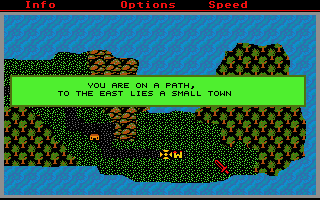
9. Graphics, Sound, Inputs. The four-color graphics are pretty bad on the PC version, and sound had not developed enough by this time to be un-painful. Final score: 2.

10. Gameplay. Theoretically, the game is alinear, allowing you to march off in any direction from the beginning. In practice, this would swiftly get you slain by any number of creatures even if you could survive the swimming (a skill you don't fully develop until a higher level). Similarly, with only a couple exceptions, you can progress through the dungeons in any order you wish, but you can only fully complete them in a specific order. The game offers the same experience for each play; there is no replayability. Even though you can only save in towns, the overall difficulty felt a little too easy at times. But it is evenly paced from beginning to end, and it's over before it gets boring. Final score: 4.

Final Total: 39. This means I liked it slightly more than Wizardry and The Bard's Tale but not as much as Ultima III. I guess that works. Next up....yes! Ultima IV.

Phantasie: Won!

Well, damn. I guess I'll have to play Phantasie II then.

The ending of Phantasie came at me all of a sudden. I had intended to get in at least one more posting before I won. This is par-for-the-course in some of these older games, though, which don't telegraph their final chapters the way that modern games do.

Many of the assumptions that I made about the game in the last posting turned out to be false. First, there are no side quests--what I thought were side quests were just steps along the path to the main quest (although there is at least one dungeon that seems to serve no purpose but to provide an interesting diversion). Second, there aren't a fixed number of Black Knights. Although the game repeatedly tells you there are nine, they must regenerate, because I must have killed 30-40 of them.


In your progress through the Phantasie dungeons, you meet the heroes of the pre-Nikademus era: the dwarven fighter Kilmor, the sage Filmon, and Lord Wood. Each gives you clues, items, and passwords to help you along the path through the dungeons and, consequently, the main quest. Your progress culminates with a visit to the city of the gods, where you meet Zeus himself, and then finally to the castle of Nikademus. [Later edit: 5 years after I posted this, an anonymous reader pointed out that you don't actually fight Nikademus in this game; you fight the Black Lord, leader of the Black Knights. Every time I say "Nikademus" from here on, I mean the Black Lord. I was under this misapprehension for a long time!]

The reason I was surprised by the ending was that the game led me to believe I had to collect nine rings along the way. But when the game finished, I only had six of them. Phantasie makes the origin of the "nine rings" concept quite clear and pays homage via the name of one of the game's villains.

Shouldn't it be J. R. R. Trolkin?

The odd-dungeon-out is the interesting dungeon of the Bleebs, where you encounter a multi-colored race that offers you a series of riddles having to do with which color tells the truth and which lies. I like it when games throw logic puzzles at you like this. The Bard's Tale, in retrospect, offered some fun riddles that I forgot to mention in my postings.

This turned out to be a lie.

Some of the encounters give you at least some ability to role-play, although we're nowhere near modern games in dialog and freedom of decisions. You can choose whether to rob a jewelry store, whether to pray to or deface statues, and whether to rescue a young maiden or an old man from lava. (To be fair, though, if you rescue the young maiden you can't continue in the main quest.)

Nikademus himself is pretty tough, repeatedly casting spells that do dozens of points of damage to all of your characters. Fighters barely damage him. The only way to defeat him--like the only way to defeat a lot of other big bosses in the game--is to repeatedly cast Fireflash IV.

The cloak makes the outfit.

The game lets you keep playing after the final battle--in fact, even after the final battle, Black Knights continue to roam the land and you can go back and defeat Nikademus again. In fact, you have to go back if you want to finish the dungeon and get the final scroll.


I guess Nikademus is multi-dimensional.

I made a video of the end game--no sound this time. Final accounting to follow in another post.


Sunday, April 18, 2010

Phantasie: Plugging Along

I continue to only vaguely understand why the colors had to be so bad in the DOS version of this game. I'll try to educate myself, but if someone wants to summarize it in a comment, I'll owe you one.

I think Phantasie is the first CRPG to introduce the convention shown in the above screenshot: hiding the map and only revealing it as you explore. No, scratch that. Rogue did that first. Well, Phantasie is the first non-"Roguelike" to do it, and the first for outdoor areas.

I believe we're also seeing the first "side quests." I received a mission in a dungeon to rescue a priest from some lizardmen. This could be part of the main quest, so I don't know just yet if it's a first. Either way, it's fun to see the elements that now come naturally in CRPGs introduced game by game.


A neat feature of the game is that as you explore new areas, you find scrolls that help explain the area, provide hints to your quests, and flesh out the stories. For instance, the scroll below talks about the cave where I am to find the uncle of Lord Wood.


Alas, it did not end well for the unfortunate uncle:


The game is progressively getting more difficult (although it hasn't really become "hard" yet), with battles against numerous tough foes, including spellcasters and legions of undead.


I have already slain four Black Knights, and from what the scrolls suggest, there are only nine of them. I suspect they do not stay dead, however. They are quite difficult to kill, and 8bitjeff's comment in my first Phantasie posting about needing the Fireflash IV spell turned out to be rather prophetic. It's really the only thing that does any serious damage.


My biggest problem at this point is gold. It costs thousands and thousands to level up my ogre fighter, dwarf fighter, and hobbit thief, and I never seem to have enough. Several of my characters are two or three levels below where they could be if I just had sufficient funds. I hope dungeons coming up bring more riches.

It's also fun, in a vaguely annoying way, to see how these older games protected themselves against piracy. The Bard's Tale would make you answer questions from the game map when you leveled up. Now as I explore the Phantasie dungeons, the game periodically stops to ask me questions from the manual, like this one:


The game makers, of course, didn't anticipate flatbed scanners, OCR, and the Internet.

That's about all there is to cover right now. I'm definitely going to continue with this one until the end.

Monday, April 12, 2010

Game 15: Phantasie (1985)


Phantasie
United States
Independently developed; published by Strategic Simulations, Inc.
Released 1985 for Apple II and Commodore 64; 1986 for Atari ST, PC-88, PC-98, and FM-7; 1987 for Atari 800, Amiga, and Sharp X1; 1988 for DOS and MSX
Date Started: 13 April 2010
      

In a response to my first posting, a blogger going by the handle Gooberslot asked a good question: "Why only PC rpgs? You say you don't want to 'frig' around with emulators but dosbox is an emulator too. Plus, you're missing out on playing the best version in some cases. The PC sucked compared to some other computers until VGA came out and it still sucked in the sound department for a while after that."

Phantasie illustrates this quite well. Here, for instance, is a screenshot of the Amiga version of Phantasie:


Here, in contrast, is the same screenshot from my DOS port:


Yuck, right? Here's a nice shot from the Atari ST version in battle:


..versus my DOS version:


I am green with envy. Get it...green with...right. Moving on.

So, at least in the graphics department, the DOS version blows. And a couple of weeks ago, when I posed the question, you were almost all for me trying the non-DOS versions. So yesterday evening, I made an attempt. I Googled "Apple II emulator," "C64 emulator," "Atari ST emulator," downloaded some, and gave it a go. I'll spare you the rest of the details--which involve a difficulty finding Phantasie downloads for some of those systems, an unfamiliarity with their conventions, crashes and freezes (perhaps owing to my running Windows 7), lack of clear DOSBox-like frontrunners in the emulator departments, and so on--and simply announce my recommittment, as bad as the graphics are, to staying with a DOS/PC-only gameplan.

That aside, I like Phantasie so far. The story is simple: the island continent of Gelnor has been conquered by a tyrannical wizard named Nikademus, who maintains fear with a cadre of near-invincible Black Knights. Your party is composed of newly-arrived adventurers seeking fame and fortune, and liberating the land from Nikademus seems like a sure way to both.

Phantasie is notable as the first RPG from Strategic Simulations, Inc. (SSI), which would soon gain the gratitude of CRPG fans everywhere by making the "gold box" Dungeons & Dragons games. That reminds me: how long is it until I get to Pool of Radiance? One, two, three, four....nineteen games. Damn.

The game is multi-character, allowing you to choose from fighter, monk, priest, ranger, thief, and wizard classes. It offers more races than any CRPG I can think of: in addition to humans, dwarves, elves, gnomes, and halflings, you can also play gnolls, goblins, kobolds, lizard men, minotaurs, ogres, orcs, pixies, sprites, and trolls. Wow. The monster classes all excel in at least one attribute (you have the standard strength, intelligence, dexterity, etc. in this game) but they pay for it in increased training costs. And the manual isn't kidding about this: it cost 24 gold to move my human ranger for level 2 to level 3; for my ogre fighter, it was 1,056 gold.

You move about the game world in a top-down perspective, with your entire party represented by a single icon, much like in Ultima III. The perspective changes a bit when you enter a dungeon. The dungeons look like paper maps in which you reveal passageways as you move. Special encounters are represented by little symbols and described in text at the bottom. It sounds primitive, but I actually rather like it.


Since you can save your dungeon progress when you leave, this makes Phantasie the first game I know to automap. The encounters have been fun and fresh so far: levers to pull, a sage with a ring, a door that locked me in a room until I found a secret exit, and a "pile of gold covered with a gooey substance" that turned out to be the honeycombs of a giant bee hive.

The combat system in Phantasie is unusual and, I think, rather fun. Statistically and tactically, I suppose it's little different than Wizardry or The Bard's Tale. Your six characters line up in a single line to face your foes, who can be in up to four ranks. Most of your characters can attack only the first rank, but your thief can dart into any rank and your spellcasters can target the entire field. Like Wizardry, you set an action for each character and execute them all at once. The unique thing is that the animation shows your characters leaping and thrusting when their turn comes, and their blows connect with a satisfying crunch.


The animation doesn't change the basic tactics, though. Each of your characters can attack, parry, or cast a spell. Attacks are split into thrust (more damage, only one attack), attack (moderate damage, two attacks), and slash (minimal damage, three attacks). You also have the macro options to avoid combat by greeting the monsters, threatening them, fleeing, or begging for their mercy (and giving over your gold).

In between adventures in dungeons and wilderness areas, you return to towns to rest, level up, and buy and sell equipment. When you enter a town, the game asks how you want to divide your accumulated experience points among your characters. I can't think of a single other game that does this, allowing you to channel everything into one character for quick development or spread it evenly among your group. The former options means that if a character dies, you can train a replacement in fairly short order. Man, do I wish Wizardry had that option.

The town of "Pelnor." Arthurian influence?

I created a party consisting of a human ranger (Aodin), an ogre fighter (Ghalar), a dwarf fighter (Yalgar), a halfing priest (Sanctavia), a gnome thief (Slissk), and an elf wizard (Arcanius). In my first couple hours of gameplay, I've explored one dungeon and collected a series of scrolls that tell me more about the land and Nikademus. This is actually a pretty cool way to slowly divulge more about the game world and the central quest.

The scroll goes on to say that nine wizards forged nine magical rings to combat Nikademus, but he perverted the power of the rings and used them to turn the wizards into Black Knights. This is starting to sound vaguely familiar...

Finally, I'll note that the game has been challenging so far. I've lost a few characters, and there's no temple in the towns (at least, not the first town), so I've had to create new ones. Gold looks like it's going to be a problem; I have a few characters ready to level up but not enough money to pay for it. You can only save in towns, but at least (unlike Wizardry and The Bard's Tale) you have the option to quit without saving if the battle goes badly.

In short, Phantasie has tactics as deep as Wizardry, stuff in dungeons as varied as Telengard, a lore as rich as Ultima III, and a difficultly level as pleasing as The Bard's Tale in its early stages. I hope the rest of the game lives up to its beginnings!

(If you're interested in a video of the gameplay, including the combat, here's one on YouTube, albiet for the Atari ST version. Hopefully I'll finish setting up my new laptop soon and I can make my own.)