
Omnitrend Software (developer and publisher)
Released 1988 for Amiga, Atari ST, and DOS
Date Started: 22 May 2011
To me, certain computer game genres age better than others. I think CRPGs age very well, which is really the entire point of my blog. The stories, gameplay, and challenges found in titles like
Ultima IV and
Might & Magic rival or exceed most current releases. Adventure games, too, can provide delight well past their shelf lives because of the richness of their plots and the challenge of their puzzles. Anyone who eschews
Zork or
King's Quest just because they're "old" is as characterless as someone who refuses to watch
Casablanca or listen to Benny Goodman for the same reasons.
But it's also true that other genres struggle to find relevance with age. First-person shooters are a good example.
Doom was groundbreaking for its time, but it's hard for me to imagine finding a lot of fun in it now, with other shooters on the market that offer the same basic experience but with better graphics, sound, and controls, and the ability to look up and down.
[Later edit based on comments: Oh, for #$*%s sake, people. Fine. Doom
is the greatest game ever made. All hail the glory of Doom
.] I imagine simulation games suffer some of the same problems, when each new release offers even more realistic simulation. I don't play many simulation games, so I could be wrong, but would anyone really enjoy the first version of
Microsoft Flight Simulator today, knowing that a more recent version would offer a more realistic experience, more aircraft, more locations, hardware acceleration, and so on?
Even within the basic genres, certain sub-genres age better than others. When I was playing
Sorcerian, I noted that action RPGs tend to age worse than regular RPGs, simply because action RPGs are more "about" graphics and animation.
Strategy games fall somewhere in the middle. Strategy games are fundamentally about
variables, and if you really like strategy games, you enjoy weighing the probabilities associated with power, movement, and resources--just like a real war theater. The best strategy games are those that give the most useful and interesting variables, and this isn't necessarily dependent on age. I remember playing a Civil War strategy game when I was a kid that would have given Einstein a migraine. It took me months to figure out what I was doing, but once I had a handle on it, the game was a joy. Graphics are secondary in strategy games; some great ones (
Reach for the Stars,
Roadwar) barely have any graphics. I thought
Warlords took a significant step backwards between
III and
IV because the latter jettisoned many of the strategic variables in favor of better graphics and animation. Did any
Warlords fan really want that?
This brings me to
Paladin, which is a strategy game without a lot of variables, which means that it didn't age very well. The game is a quasi-CRPG, and I admit that it satisfies all three of the core criteria that I establish in Rule #1. But I find it so little fun that I'm almost moved to spend the rest of my six-hour minimum staring at the opening screen rather than actually playing it.
Paladin has the least intuitive controls, of any game I've played so far. The game follows the opening screen above with a partially-rendered screen that makes it look like the game has frozen. No amount of clicking or typing seems to help. Only by a careful reading of the manual do you determine that the function keys are the way to control the game, and only by a more careful reading do you realize that the process of creating a new paladin involves opening up a
different program and using more arcane function commands.
You control a party of characters moving through one of several scenarios or "quests," each with a different set of objectives. Only your paladin, the leader, can move from quest to quest, and as he does, his statistics improve. Each quest is made up of turns alternating between your characters and enemies, much like in
Warlords,
Heroes of Might & Magic, or any number of similar strategy games.
10 quests come with the basic game, but the publisher, Omnitrend, released
Paladin Quest Disk: The Scrolls of Talmouth later the same year. The game also came with a construction set, and the version of the game that I downloaded contains several files that I can only imagine were constructed by fans.
The first quest I tried was called "House" and the game put my paladin (Drust) in charge of a swordsman and two mages. The quest instructions told me the back story:
A holy quest for real estate!
The "victory conditions" tell me that I have to find the scrolls and get off the combat map within an hour (all quests are timed).
During your turn, each character can move, attack an enemy, pick up an object, use an object, unlock a door, or cast a spell. Total actions and movement are limited by "movement points." In many ways, playing the game is like being perpetually on the combat screen in
Demon's Winter or the
D&D "Gold Box" games (which, incidentally,
Paladin is keeping me from), except that I think you have fewer options in
Paladin. You certainly have fewer spells: rangers can cast confuse, speed, invisibility, and detect door, and mages can cast those plus fireball and mind stun.
 Targeting an enemy in a basement.
The biggest problem with the game is that without the ability to move diagonally, it takes
forever to get around the game map, especially when you're walking through corridors and your characters can't get past each other. I also lost patience when the game decided that the SHIFT key was being held down permanently, and every time I tried to move to the next character (N key), it insisted on ending the turn (SHIFT-N).
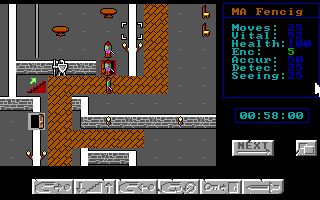 Three characters trying to pile through a doorway.
I made three assails against the house, and did find one of the scrolls one time, but you lose the game if your paladin dies, and that kept happening to me.

Sigh. I suppose I can't leave this game until I win at least
one of the quests, but I promise you, this game is tedious and boring. Don't look for a lot of postings here.


 At this point, the game gave me a simple message that "you have completed the quest" and told me that my paladin's accuracy had improved:
 The quest is then over, and the game saves my improved paladin file for use in another scenario. This is the only thing that really qualifies Paladin as a quasi-CRPG.
Knowing this entry wouldn't be long enough at this point, I started another scenario, called "Trojan Hoax," and was put in charge of two swordsmen, two mages, a ranger, and a thief.
The quest is then over, and the game saves my improved paladin file for use in another scenario. This is the only thing that really qualifies Paladin as a quasi-CRPG.
Knowing this entry wouldn't be long enough at this point, I started another scenario, called "Trojan Hoax," and was put in charge of two swordsmen, two mages, a ranger, and a thief.

 I stormed the castle (not a good tactic) and found a the entryway full of guards who slaughtered half my party in about two rounds.

 The dragons fell surprisingly easily given that they were dragons. Making my way around the tower the long way, I finally made it to the tower's upper levels, where I found the princess surrounded by monster guards:
 I managed to kill them, losing all but my paladin himself in the process, but then I ran afoul of the game's extremely short time limit for this quest.
 The second time around, with some foreknowledge of the layout, I was able to rescue my beloved and once again given the game's wonderfully rewarding quest completion message:
 I got another message that my accuracy increased.
I admit that I found the game slightly more enjoyable today than when I first posted about it, but not enough to complete a bunch more missions. The game would be more interesting if the quests were unified under some kind of general theme. Fractured as they are, playable in just about any order, some of them not particularly chivalrous...
I got another message that my accuracy increased.
I admit that I found the game slightly more enjoyable today than when I first posted about it, but not enough to complete a bunch more missions. The game would be more interesting if the quests were unified under some kind of general theme. Fractured as they are, playable in just about any order, some of them not particularly chivalrous...
 Ah, a noble quest for wealth and power.


