|
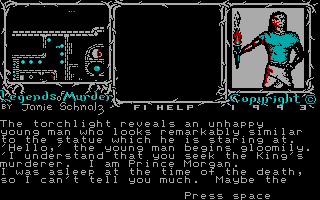
| Despite the copyright date, the game doesn't seem to have been published until Big Blue Disk #55 in May 1991. |
Legends of Murder, Vol. 2: Grey Haven
United States
Softdisk (developer and publisher)
Released 1991 for DOS.
Date Started: 1 September 2016
Date Ended: 4 September 2016
Date Ended: 4 September 2016
Total Hours: 4
Difficulty: Moderate (3/5)
Final Rating: 31
Ranking at Time of Posting: 136/224 (61%)
Raking at Game #453: 296/453 (65%)
Grey Haven is second of a pair of short, satisfying diskmag titles by James Schmalz. I reviewed the first about three years ago. Both games cast you in the role of an unnamed inspector, newly arrived in some generic high-fantasy location to investigate a murder. During the process of the investigation, you fight monsters, collect inventory, and level up much as in a traditional RPG. The brief series doesn't have enough mechanics to sustain games of any significant length, but they're both reasonably fun and rewarding for the time they require.
I didn't really see any interface changes between the two titles. The games are tile-based, but with tiles so small that movement has the illusion of being continual. You navigate with a tiny cursor in a tiny screen in the upper-left. The bottom half of the screen is reserved for messages; other window panes show inventory and NPC or monster portraits. Commands are limited to movement, inventory management, and an all-important (S)earch command. The game switches frequently from small-scale maps to large-scale maps (for instance, as you enter a house), something that I don't think was present in Stonedale Castle.
There is no character creation. Every inspector starts (strangely, given that he's supposed to be experienced) at Level 1 with 0 experience, 9 hit points, "poor" strength, "sluggish" agility, "unsteady" dexterity, "average" intellect, a whip, and a robe. As you explore the game and open various wardrobes and chests, you receive inventory upgrades, scrolls that increase your experience, and potions that permanently increase your attributes. Experience is also awarded for combat, of course. As you gain levels, you gain the ability to learn spells--one per level--which deplete a "concentration" statistic. Leveling is quite rapid: I went from 1 to 7 in the first 25 minutes, and ended my four-hour tour of the game at Level 12.
 |
| A mid-game character sheet. |
 |
| Developing experience by reading a scroll. |
Managing inventory is a key difficulty of the game. You only have 9 inventory slots, and items that you drop cannot be recovered. Sometimes, therefore, it's better to leave items in chests--annotating their locations for a later return--rather than bulking your inventory and risk having to drop something valuable.
 |
| Well, shoot. I guess I won't be taking any of them. |
Combat consists only of the (A)ttack, (R)un, (U)se item, and (C)ast spell commands. Combat rolls and the specific contribution of level, attributes, and weapon type are opaque, but I find that luck seems to matter a lot more here than in the typical RPG. I might die in two rounds in one combat, reload, and win the same fight without taking more than a few hit points' damage. Combats are relatively infrequent anyway, and fixed in logical places. For instance, a troll at an inn gets upset with your questioning and attacks you, or a skeleton conjured to protect a wizard's home attacks when you enter to burgle it.
 |
| Various options when fighting a stone giant. |
The victim in Stonedale Castle was the king himself, but the murder to be solved in Grey Haven is that of a wizard's apprentice named Eryl Drafe. Drafe is, or was, one of seven students at a college run by a wizard named Baswik, who has hired the inspector for this job. Drafe was stabbed in the back in his house.
Grey Haven is a small village of only a few screen widths, separated in the middle by a bridge. A hill giant guards the bridge and prevents passage to the east by low-level characters. The new character is instructed to find Baswik in the Golden Griffin Inn to the west. Once you find him, he relates that although the common believe is that Drafe was killed by a thief, only apprentices wearing their amulets can enter students' houses. Therefore, the killer must have been another student. Baswik gives the character an apprentice's amulet and has him go undercover as a new apprentice, with the first goal to search the students' houses.
 |
| Getting some background from my employer. |
The game does a good job with atmospheric messages as you enter various buildings or even rooms of those buildings. If the room happens to contain an NPC, his dialogue will be triggered automatically as you step into the room--and it only plays once, so you need to record it the first time. A few of many examples:


The (S)earch function serves as an all-purpose key to open doors, open chests, find secret doors, and look for clues. It's hard not to feel like you're missing things at times. A one-square-inch area has about 250 tiles. Now, you almost never find anything if adjacent tiles are all blank, and some discoveries are mapped to multiple adjacent tiles, so it's not like you have to hit (S)earch literally every step. But still, the difference of a couple of pixels can mean finding a chest or not.
 |
| Searching next to a piece of furniture often produces a message like this. |
Another problem is that messages can pop up when you're in the middle of moving, all of them with a "press any key to continue" command at the bottom. If you don't notice them fast enough and continue holding down the movement key, you miss the message for good and have to reload from your last save if you want to see it again.
The rest of this post gets heavy into the plot and mystery, so you should perhaps stop reading now if you think you might want to play the game for yourself. The search of the student housing reveals a number of clues. A student named Rauld is poking around Drafe's empty house, claiming to be investigating the murder. No one could have entered through the house's only window, as there are bars on it. Dried mud is found all over the scene. Near the houses, on the shore of a lake, an abandoned rowboat also has flakes of dried mud.
 |
| Checking out the murder scene. |
In one room of Drafe's house, he has a telescope pointed at the nearby island of Mencos. A note in another house indicates that a lot of people have gone missing on Mencos lately, and they were hoping Baswik and his apprentices could help, but Baswik refused.
 |
| This turned out to be an important clue. |
Another student named Renwick is found in his house. He says that on the night of the murder, he, Alisha, Jhora, and Thevin were meeting in their usual study group. The last student, Grayn, was missing from the group, and when the students later found him, he was caked in mud and never gave a straight answer as to why. Renwick also instructs the player how to use the apprentice's amulet to get into the school of magic.
Several combats occur during this period, mostly with guardians the apprentices have conjured to guard their houses, but also with a couple of thieves snooping around. Chests in the apprentices' houses hold numerous potions and scrolls for character development, healing potions, and dust that restores magic concentration. One house has a bookcase where repeated searching finds spells, although you can only learn one per level. In order, learned spells are "Heal," "Shield," "Fireball," "Cure Poison," "Slow Monster," "Missile," "Kill," and "Restore Health." (You can also learn the same spells in the college library.) "Kill" isn't as useful as it sounds, as you have to have a named NPC to apply it to. It really only comes into play at the end.
 |
| Some spell options when fighting a zombie. |
The player then explores the large wizard's college and encounters a few more NPCs. Alisha notes that the townsfolk seem afraid of the wizard's college students, and a lot of them have moved away recently. Jhora says that Rauld and Grayn were both unaccountable on the night of the murder, but he can't think what motive either of them could possibly have. The "study group" students were in the study room all night, and no one left by the main entrance until Thevin went to get Eryl and found his body. The only other way out of the study room, other than the main entrance, is a bathroom with bars on the window. The game notes that the bars are "spaced almost six inches apart," which seems like a weirdly specific detail unless it means to call attention to this fact, so already I was preparing myself to discover some mechanism by which Renwick, Alisha, Jhora, or Thevin might have slipped out of the study room through the bars. There is another clue that someone is able to change himself or herself into something small: a secret passage from the college leads to a room in a cave. The opening to the room is too small to fit through, and yet there are footsteps on the other side walking away from the opening.
 |
| Jhora's account of what happened. |
Focusing on Grayn this early in the investigation seemed too obvious. Later, you meet Grayn, and he indicates he was out in the rowboat that night to catch a rare species of frog. He also indicates that Eryl had some device that enhanced his magic powers, but it wasn't found in his room.
The college contains a room with a dragon skeleton, which attacks you when you try to remove a piece of paper from its mouth. Killing it (it took me several reloads) rewards you with a piece of paper that says, "Mid of empty row." This is an instruction to search a section of bookcase in the college library that has no books, where you find combination 182. This, in turn, is the code to a chest in another room, where you find some silver coins.
There is a shop in the game, and you can trade the silver coins for magic weapons and armor, but that put me in a "walking dead" situation without realizing it. I had to consult the hint file to see that I needed to give the coins to the bartender (an NPC I'd entirely forgotten about). Doing so led him to give me a mug of ale and some information that he saw two wizards digging up an old grave two nights ago. Visiting the bartender multiple times gets you drunk.
 |
| What do you mean, "you wizards?" |
I wasn't sure what to do next, so I killed the hill giant guarding the bridge and explored the east end of town. (S)earching at various houses caused me to knock on their doors, where the frightened residents yelled at me to go away, claiming that "We've lost four already and we don't want to take chances on losing another, even in daylight." There was a gate to a cemetery from the village, but spectral hands kept pushing me back every time I tried to enter.
I re-visited NPCs before one of them gave me the clue I needed to enter the cemetery: use my medallion at a magic mirror in the college. This led me to a room where I found a charm to ward off ghosts, allowing me to enter the graveyard.
 |
| Memorial Day must suck in this village. |
The caretaker rushed out of his house to greet me and told me that Eryl and Baswik recently had a fight after Eryl claimed his wizard's robes before Baswik thought he was ready. The fight intensified when Eryl wanted to help investigate the disappearances on Mencos, but he, Jhora, and Alisha were out-voted. The caretaker also said that Rauld was a wanted thief before he came to study in Grey Haven. I grabbed a shovel from a box near his house.
 |
| This guy had a lot of information for a cemetery caretaker. |
The bartender had said that the students were digging up the oldest grave in the cemetery, which turns out to belong to Mardus Elken (the game won't let you dig at the others). After a fight with a bone golem, you get a map of the area showing an "X" at one point. It took me a long time to properly interpret the map, as it's a very loose abstraction of Grey Haven, but ultimately I searched in the right location and found an entrance to a cave--the same cave accessible from the secret area in the school, but larger.
 |
| This map really doesn't look very much like the village. |
In the caves, I found a chest with two more sets of coins. One passage got me script-slain by "dark forms" after hearing "flapping." Clearly, I needed something to pass this area.
 |
| This is the only scripted death in the game. |
Returning to the weapons shop with my new coins, I tried the "special request" option, where you type what you want. I tried things like "ward," "spell," "amulet," and "protection" before hitting the jackpot with "cross." The smith gave me both a cross and stake, which conformed reasonably well with my suspicions that vampires are involved somehow. I bought a magical broad sword with my other set of coins.
I returned to the caves, and my cross kept away the vampires--which I hypothesized were the missing villagers. I soon died at the hands of a level-draining demon, but I avoided him on a reload and proceeded forward to the endgame. A vampire attacked as I was investigating his coffin. The game noted that he was one of the apprentices, but his hood kept me from seeing who he was.

In several tries, I was unable to defeat him in regular combat, so I tried the "Kill" spell. The game asked me for his "true name." This was equivalent to the moment in Stondale Castle where I had to give the name of the murderer to the elf advisor. In that game, even though I got it right, I could never figure out exactly what chain of logic I was supposed to use to come to that conclusion (commenters helped flesh it out).
 |
| The game waits patiently for me to identify the killer. |
I did my best here. The game was clear that the killer is a man, so that rules out Alisha. I felt it was clear that the killer was one of the 4 people studying in the study room that night, and that he used his vampire abilities (changing to mist or a bat or whatever) to escape via the washroom and enter Eryl's house through a comparable set of iron bars. He probably wanted to kill Eryl for wanting to investigate the vampire attacks on Mencos. Anyway, since he entered this way, the mud on Grayn's clothing was clearly a red herring, and he had an explanation for it anyway.
That meant my suspects were Renwick, Jhora, and Thevin. Thevin's the one that found the body, and choosing him would mean that I mistrusted his account. Moreover, since he walked to Eryl's house to find the body, there would be no need to postulate anything with the iron bars that the game seemed so intent to call my attention to. That left Jhora and Renwick. Since Jhora had voted with Eryl to investigate the missing villagers, that must mean my suspect is RENWICK!

Okay, that didn't work. Fine, let's try JHORA:

That did it. It only weakened him, though. I still had to finish him off in regular combat, which required me to use a healing salve after a few rounds.

After combat, the game noted that I finished off the vampire with the stake, then returned to Baswik to tell him the news. Baswick gave me some congratulatory words and money, and I departed for home.
 |
| The winning screen. |
Grey Haven comes with a hint file that, unlike the first game, explains exactly "what really happened." I guess the logic I was supposed to use was that since Eryl was stabbed in the back, he must have trusted the person who stabbed him because he was willing to turn his back on him. Eryl wouldn't have trusted the students who voted NOT to investigate the disappearances, so that means that he only trusted the students who voted with him: Jhora and Alisha. Since the master vampire was clearly a man, it was Jhora by process of elimination. I could have also noted that Jhora's house was the darkest of the lot, and Jhora makes a point of saying he studies all day (and thus does not go outside). I got most of the way there on my own, so I feel better than I did at the end of Stonedale Castle, where I was basically just guessing.
There were a few side encounters that I didn't mention, including a ruined castle that delivers a combat with a dragon and a mysterious room in the college, accessible only with Rings of Teleportation, where you can grind your experience in combats with zombies.
 |
| Exploring a ruined castle. |
In total, not an unsatisfying romp, even if it turns out I'm not equipped to be a homicide investigator. Without looking at my GIMLET for Stonedale Castle, I gave this one:
- 3 points for a small but well fleshed-out game world. Nothing special, but the village seems enough like a real place.
- 3 points for character development. None for creation, but progress is swift and satisfying through both combat and inventory upgrades.
- 3 points for NPCs. There aren't many options when interacting with them, but they do flesh out the story and provide important clues.
 |
| An information dump from an NPC. |
- 3 points for encounters and foes. The monsters are standard high-fantasy, but I'm giving a relatively high score because of all the things you find through intelligent uses of (S)earch, including many of the clues necessary to solve the mystery.
- 3 points for magic and combat. There aren't a lot of options, but there are a few tactics associated with when to use spells and other key items.
 |
| Even in a game this short we have to have these level-draining bastards. |
- 3 points for a variety of equipment, including a few levels of weapons and armor, potions, usable magic items, and plot items.
 |
| Good thing I didn't drop all the whips! |
- 1 point for the economy. I'm being generous even with that, because the three stacks of coins that you find are more like inventory items that a traditional RPG economy, and you need to spend two of those stacks on specific things. You only have options--two types of weapons or dragon scale armor--with the third.
- 4 points for the quest. It only gets 2 for having one, but it does a good job integrating that main quest throughout the game, giving you a few options for how to approach it, and offering a couple of optional side-encounters.
- 3 points for graphics, sound, and interface. The graphics are only serviceable and there's no sound, but the inputs are easy enough to master, excepting the issues I noted above.
- 5 points for gameplay. Fairly linear and not really replayable, but quick and satisfying. Just the right length for its content, and a nice average difficulty level.
That gives us a final score of 31, reasonably higher than the 24 I gave to Stonedale Castle. The sequel was more challenging, I thought, which significantly improved the "gameplay" score.
Overall, I like the approach of this series. There aren't many RPGs in which you solve murder mysteries, and even fewer in which you have to apply your own logic to the clues you've collected. I'd love to see a commercial RPG with a similar plot but better graphics and longer gameplay.
Developer James Schmalz went on to a long (and continuing) career in game development. In 1993, he founded Digital Extremes and had successes with Silverball (1993), Epic Pinball (1993), Silverball 2 (1994), and Extreme Pinball (1995) before making waves with Unreal (1998) and the storied engine of the same name. He has credits on various games in the Unreal series, the Bioshock series, and the game tie-in to Star Trek Into Darkness along with many others. Unfortunately, none of his titles after Legends of Murder have been single player RPGs, so we won't be meeting him again.
Now that I've achieved some momentum with a couple of quick ones, I suppose it's time to check back in with Fate: Gates of Dawn.
****
I took a look at Dungeon of Ymir (1986) for the ZX81, which means I had to download a new emulator (EightyOne). I simply couldn't get the program to work. Every time I tried to run it, I would get a nonsense screen. I know other people have done it, as I've seen screenshots online, but no setting I change with this emulator (with which I'm admittedly unfamiliar) seems to do anything productive. If anyone has ever successfully emulated ZX81 games, I welcome your advice. Otherwise, the game seems pretty derivative anyway and I don't mind skipping it.
****
I took a look at Dungeon of Ymir (1986) for the ZX81, which means I had to download a new emulator (EightyOne). I simply couldn't get the program to work. Every time I tried to run it, I would get a nonsense screen. I know other people have done it, as I've seen screenshots online, but no setting I change with this emulator (with which I'm admittedly unfamiliar) seems to do anything productive. If anyone has ever successfully emulated ZX81 games, I welcome your advice. Otherwise, the game seems pretty derivative anyway and I don't mind skipping it.