

Legends
United States
Asgard Software (developer and publisher)
Released in 1987 for TI-99
Date Started: 19 October 2017
Date Ended: 4 November 2017
Date Ended: 4 November 2017
Total Hours: 18
Difficulty: Moderate (3/5); this is partly user-definable
Final Rating: 29
Ranking at Time of Posting: 139/267 (52%)
I was too hard on Legends in my first entry, particularly since it offers perhaps the only traditional CRPG experience on the TI-99. (Tunnels of Doom is arguably a better game, but it's also a bit of an outlier among RPGs.) It copies a lot from Phantasie, but in some ways ripping off Phantasie is, paradoxically, original; most clones at the time were clones of Ultima or Wizardry. Finally, Legends gets better as it goes along and you get past the initial grinding phase.
The game's primary sin is a lack of balance. Take the issue of character development. To survive extended trips to the dungeons, your characters essentially have to attain the highest levels (15), or near so, before they set out. This means that the experience you earn in dungeons is mostly wasted, and you spend the bulk of the game with your experience maxed. You waste so much experience, in fact, that I wonder if the developers didn't intend for characters to die frequently, and for the party to continually have to train replacements.
 |
| These buttons turn the lights on and off. |
The difficulty setting is another odd addition. Early in the game, when you're trying to grind, it makes sense to sometimes set it to 3 or 4. You're taking a gamble, but you're rewarded with more experience, more gold, and faster development. But once you decide to clear a dungeon, you're just punishing yourself if you set the slider at anything other than 1. They're difficult enough at that.
After the last session, when I was trying to grind enough to survive extended trips in the wilderness, I discovered a somewhat lame shortcut. Recall that if you simply stand still in the wilderness, you get attacked by a random enemy within a couple of seconds. Since the "1" key chooses the "fight" option, chooses the "attack" option for individual characters, and serves to acknowledge all messages that pop up in between, you pretty much just need to hold down "1" and it will cycle you through random combats indefinitely. You have to keep a periodic eye on it to make sure that you don't die, but otherwise you can easily go from Level 3 to 15 in just a couple of episodes of Stranger Things.
Throughout the game, my primary issue was one of money, not experience. I earned enough experience for Level 15 while I was still trying to pay for training for Level 9.
 |
| Training starts to get prohibitive. |
Finding the dungeons is a small pain. The game world is unnecessarily large at 15 screens, and you face an insane number of random encounters while moving around. These can be mitigated with "Stealth" potions, which last for a random amount of time, but I was always too poor to invest heavily in potions.
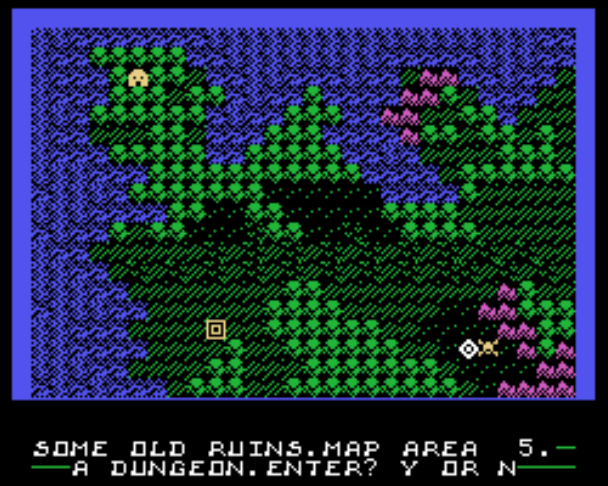 |
| This map section has a dungeon, a teleporter, and an inn. |
Scattered among those 15 screens are half a dozen inns, where you can rest to restore hit points and spell points, and half a dozen dungeons. There are 5 teleporters, which return you to Wizard's Rock if you enter the right code, found in one of the dungeons. These are mostly a waste of time, because if you save the game while in the wilderness and re-start it, you find yourself back in Wizard's Rock anyway.
There are two special encounters in the game world, both providing some textual background. One discusses the nearby Knights' Outpost, which I'll describe in a bit; the other discusses the view you have of Ashtar Creel's mansion on a southwestern island.

The game's approach to dungeons is odd in several ways. There are six of them, each made up of four screens except Creel's mansion, which has three. Like Phantasie, Legends asks you if you want to save your progress as you transition from screen to screen; unlike Phantasie, it remembers all of the dungeon screens, not just the last one you visited.
 |
| Entering a dungeon near an inn. |
Dungeons come in two types, and there are three of each. The first type has no monsters at all, just traps and treasures. The treasures include weapon and armor upgrades. These dungeons are faster to navigate than the second type, but in some ways they're more difficult. The ranger's "disarm traps" ability maxes at around 85%, so he flubs 1 in 5 or 6 traps and causes damage to himself or the party. You also find a lot of chests that have a tendency to explode when you try to open them. Since you can only cast spells in combat, and there are no combats in these dungeons, the only way to heal is to leave or to carry an inventory of healing potions.
 |
| This happens far too often. |
These dungeons are primarily valuable for the weapon and armor upgrades they provide. When you run across a piece of equipment, the game asks if you want to keep it, and if so, who gets it. It automatically overrides anything you're already carrying, so you have to keep track of what the characters already have, lest you equip them with something worse than what they were carrying. Weapons start with dirks and axes and slowly improve until you end the game with magic weapons like a "god longsword," "demon maces," and "wizard's teeth," the highest of these doing around 20 damage points at maximum. The best protection comes in the form of "legends armor" for three characters and enchanted robes for the wizard. The fighter, ranger, and cleric can wield silver, gold, and elven shields; the mage gets a "wizard's cloak" to compensate for his lack of a shield.
 |
| One of the best weapons in the game. |
The second type of dungeon has monsters--all fixed, none random. You can find potions and gold in these dungeons, but no item upgrades. You can last in them as long as your hit points and spell points hold out.
Both dungeons have the occasional message or special encounter, signaled (as in Phantasie) by a little dot on the map. There aren't as many role-playing options in these encounters as Phantasie offers, but there are a few. As you explore, the game changes descriptions of your current area: "An old dusty hallway," "a dark hidden room," "an old road with potholes," "inside a small temple." Some of the descriptors are a little odd, suggesting people or options that don't actually appear, like "Glom's Price-Rite Pawn Shoppe" and "Mad Ernie's Inn."
 |
| A rare role-playing choice. |
As I mentioned above, I explored mostly with the difficulty set to 1. Although it probably hurt me with gold, it ensured I didn't have to return to the same dungeon multiple times. The monsters were still pretty hard. Their most annoying weapon was the "Slow" spell, which reduces the number of attacks for each character from 5 (at max levels) to 1. You can "Dispel" it, but that's a cleric spell and the cleric always goes last. Often the enemies would just cast it again in the next round.
 |
| They're not evil; they're just late. |
Because I had to save most of my cleric's spell points for "Dispel," I didn't get much use out of any other cleric spells. I mostly used the ranger for healing. The wizard's "Firestorm" comes in handy, but the wizard always goes third in combat, and very often, the first two characters would have weakened an enemy but not killed him by the time the wizard's turn came up. At that point, "Firestorm" was a waste of resources (since you can only target one enemy at a time). Fortunately, the wizard is a decent melee fighter with the right equipment.
 |
| At least it's honest. |
There is one persistent annoyance with dungeon encounters, and thankfully Adamantyr helped me understand what was happening. If you're ambushed in a dungeon, giving the enemy the first round of attacks, the game somehow leaves the "ambush" flag permanently set. Every encounter after that one becomes an ambush. Drinking a "Stealth" potion, which otherwise doesn't work in dungeons, resets the flag.
Most of the dungeon screens are mapped as you enter, but this is deceiving. Any bit of wall may open up into a secret area if you try to step into it, or turn out to have a treasure or encounter hiding under it. You basically have to test every single wall square, from every direction, to make sure you don't miss anything. This is particularly true because the passages to other sections of the dungeon are all invisible secret doors lining the outer hallways, and many occur in non-obvious places.
 |
| My initial arrival in a dungeon map. |
 |
| The final map of the same area, after revealing all the secret walls. |
I explored the dungeons in roughly a counter-clockwise pattern; in the end, I wished I had done the opposite. The first was cued as "old ruins," and it was a trap/item dungeon. In one encounter, a skeleton had scratched numbers in the wall that correspond to the world's teleporters. Another special encounter in "Sadie's Diner" led to a clue to "seek out the white dwarf who was last seen in the west." I got some decent weapon and armor upgrades here.

Then second dungeon, an encounter dungeon, was called "Dumpmoat West," and early in the dungeon, a special encounter indicated that they used to be luxury apartment complexes. There were no special encounters or items in it; it was useful primarily for its caches of gold.
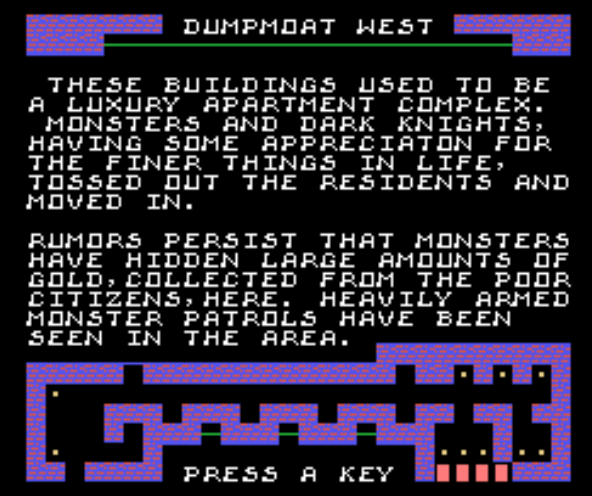 |
| "Dumpmoat" just screams "luxury." |
The third dungeon was the ruins of an old temple, again a trap/item area. A special encounter with a blind monk got me the code to a vault door when I gave him some money. A beautiful woman locked in a cell turned out to be a trap; it exploded when I opened it to release her. Inside the vault was a "temple key" that allowed me access to the temple back at Wizard's Rock, which provides healing and (at last) resurrection for dead characters.
 |
| My reload count fell quickly after this. |
Fourth, I explored the old Knight Outpost. Early on, you encounter a sleeping old warrior, who you can wake or murder. If you wake him, he gives you the password to the armory: INVICTA. The dungeon has an incredible number of weapons and pieces of armor as well as some addition text that fills in the game's lore. Finally, freeing the white dwarf gives you the magical password (ORM SOT) to close the gate in Creel's mansion. For the item upgrades alone, it would have been so much easier to explore this dungeon first.

The penultimate dungeon was an old graveyard. Its purpose was to deliver the Azure Amulet necessary to close the portal in Creel's mansion. Ultimately, this and Creel's mansion are the only absolutely necessary dungeons in the game, although you would need prior knowledge of the password from the Knight Outpost.
 |
| A major quest solved. Note the developers' initials in the dungeon walls. |
The dungeon is swarming with undead, including spirits and vampires, and some of them have the ability to cast a spell called "Level Loss." They do this so frequently that I had to enter and leave the dungeon twice, and both times they had gotten my characters down to Level 2 or 3 from Level 15. There is no "restore" option in the game.
Normally, this would infuriate me, but it turns out that level loss isn't a big deal in Legends. It's even beneficial. When you lose levels, you don't lose the maximum hit points and spell points that you earned from leveling up. You don't lose access to your higher-level spells, either. The only thing you really lose is the extra attacks, and this is just a difference between 3 and 5. Meanwhile, when you get back to the city, you can use your accumulated experience to re-level up, earning even more maximum hit points and spell points. "Level Loss" is, frankly, the only means of character development late in the game.
There were a few mysteries in the game:
- One pub clue says that "one of the numbers is 21+50. Another is 50+33." I don't know what these refer to. None of the teleporter codes are 71 or 83.
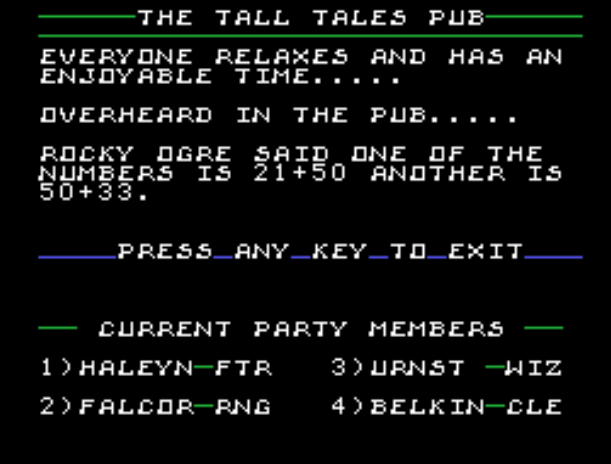 |
| I never figured out what this tavern tale was referring to. |
- About 6 dungeon encounters left me with gold keys. These never appeared to unlock anything.
- In a vault in the temple ruins, a skeleton had written something about an ogre. I don't think I ever met an ogre, and it didn't turn out to be a clue to anything.
- The Dark Knights are set up as a major obstacle, but they rarely appear in the game except in the final dungeon, where they are easily defeated.
 |
| The party takes on the Batman twins. |
The final dungeon is Creel's mansion, on an island to the southwest. For most of the game, I assumed that a teleporter would take me there, but once I exhausted the codes, I realized that wouldn't work. I was on the cusp of asking Adamantyr for a hint when I realized that he'd already provided it by noting in his own review of the game that "some of the water [squares are] actually shoals, which you CAN walk on." This jibes with the in-game description that a "sand bar" connects the mainland to the island. Bottom line: by finding the right set of water squares, you can just walk there.
 |
| Entering Creel's mansion. |
Creel's dungeon is a three-screen affair. On the second screen, you find a book of spells. On the third, you find the portal to the netherworld. With the spell book, the Azure Amulet, and the white dwarf's password, you can close it.
 |
| Reaching the endgame. |
This causes Creel to appear. He's a powerful character with 900 hit points and the ability to cast spells, but he attacks alone. As long as you've saved enough spell points for "Firestorm," the highest levels of which do more than 100 points of damage, you can kill him in a few rounds. Defeating him brings up the winning message at the top of this entry.
 |
| Ashtar's son, Carl, watched in horror as the party avenged the wrong Ashtar had done to the kingdom. A blast of errant magic sent Carl spinning through the portal. Coming to his senses on a strange new world, he discovered he had new and unusual abilities . . . |
I had a technical glitch during my gameplay, not worth recounting in detail, but I was saved by Adamantyr. I owe him several times over for the ability to successfully finish this game, and I thank him accordingly.
In a GIMLET, Legends earns:
- 3 points for the game world, including a derivative but clear backstory.
 |
| A few text-based encounters help fill out the backstory. |
- 2 points for character creation and development. Having to have exactly four characters of those specific classes is a bit too limiting; character development throughout the game is stunted; and the level cap is too low.
- 1 point for NPC interaction. This is generous. There are only a couple of NPCs in dungeons, and these are more "encounters" than NPCs.
- 4 points for encounters and foes. The Phantasie-style encounters were the best part of the game; I wish there had been more. Other than that, the bestiary is original and satisfying enough. I didn't explore the pre-combat options very much, even late in the game, but they do occasionally work, and they still reward you with experience and gold when successful.
 |
| Green dragons were common enemies in Creel's mansion. |
- 3 points for magic and combat. Combat offers relatively few options and the spell list is pretty short.
- 3 points for equipment. A small selection of weapon and armor upgrades is the best part of the game. Potions are equally important, though I didn't spend much time talking about them.
 |
| My mid-game potion inventory. |
- 4 points for the economy. Needed for training and potions, it never stops being relevant. It just lacks complexity and is perhaps a little too restrictive.
- 3 points for a main quest with no options and no side-quests, but one of those points goes to a couple of side-dungeons.
- 3 points for graphics, sound, and interface, all only "adequate."
- 3 points for gameplay. I applaud the relatively nonlinear approach to the dungeons, but overall the game is a bit too large, too long, and too grindy.
This gives us a final score of 29, which is higher than I thought I'd rank the game when I first started. TI-99 owners will probably object to rating Legends 7 points higher than Tunnels of Doom (1982), the platform's only truly original RPG. While I agree that Tunnels is a more iconic game, and more impressive for its year and platform, Legends offers a better experience as an RPG specifically.
I had an e-mail exchange with author Donn Granros this week. He said he met Ed Johnson in a class on TI assembly language. The two shared a love of the machine, with Donn specializing in graphics and game design and Ed more interested in the underlying engine. They considered a 3D game but found that the TI-99 didn't do well with 3D corridors, so Donn adapted what he had learned from Phantasie and tabletop gaming.
The Legends titles got good reviews and a set of dedicated fans, but the TI-99 was a minor platform even when new, and a cult platform by the time Donn and Ed were designing their games. They made "peanuts" by Donn's recollection. However, they both learned enough about programming to transition to IT roles in their respective industries. Donn, already in his mid-40s when Legends was written, spent his career at a tool distributor, retiring in 2013 to focus on painting. Ed became the systems administrator for Davanni's, a Minnesota pizza chain, and according to LinkedIn is still there.
Donn is still a fan of the TI-99 and laments what could have been if the company had better supported its computer and hadn't restricted third-party development. I'll only encounter it one more time, for Legends II (1989)--at least until I reach the games that Adamantyr is making for it in the modern era.
Next on the 1987 list, I look forward to finishing a game that has remained unfinished on my list for almost 7 years: Le Maître des Âmes.
*****
Ages ago, at the bottom of one of my Fate: Gates of Dawn entries, I wrote:
Somehow, this experience disappeared from my spreadsheet and mind, and Maze Quest ended up appearing on my "upcoming" list yet again. I have removed it again for the same reason, hopefully permanently this time.
*****
Ages ago, at the bottom of one of my Fate: Gates of Dawn entries, I wrote:
Maze Quest was supposed to be the next game after that, but I think I have to render it "NP." The game is really just a shareware tease for a full game called City Quest, but the full one doesn't seem to exist any more. Maze Quest's characters can only achieve Level 2. Moreover, when I tried to play it, it didn't emulate well. It froze frequently and wouldn't respond to my navigation commands, instead spinning my party around randomly. It otherwise seems like a competent dungeon-crawler, so if anyone comes across City Quest, I'd be happy to give it a try.
Somehow, this experience disappeared from my spreadsheet and mind, and Maze Quest ended up appearing on my "upcoming" list yet again. I have removed it again for the same reason, hopefully permanently this time.


