I've mostly just been drawing names for the next games on my list at random, so I didn't plan it that I'd play three German-published games in a row--let alone two of them from the same publisher, CP Verlag, which seemed to specialize in releasing quick, forgettable games through its various magazines. This one, developed by Zeret Software (which only seemed to exist for Dungeons of Avalon and its sequel), was originally published in Amiga Fun in 1991, then Amiga Mania in 1992. I've tried without success to find where Zeret was actually headquartered. The lead developer has a Turkish name, but his associates sound German. I think Amiga Mania was a Hungarian publication, which is comfortably in the middle of all of this.
 |
| Oddly, the game takes place not in Avalon but in "H'Khan." The lead developer's name is Hakan. |
It took me a while to find an English version of the game, and even then I don't know if it's an official translation. The quality isn't bad, but not everything is translated. Facing east, for instance, shows me an "O" on the compass, and a couple of the other terms and abbreviations are still in German. So is the manual, which I've uploaded
here if anyone wants to give me a hand (not the whole thing, but maybe the backstory and what the advantages to "monks" are). The back story seems to be the usual rot about a wizard taking over a peaceful kingdom.
 |
| A bit of the backstory. |
Dungeons of Avalon looks like Dungeon Master but plays more like Wizardry. You create a party of six characters in the adventurer's guild of a standard menu town and then descend into a dungeon of indeterminate levels, fighting creatures, opening treasure chests, and so on. Its encounter and combat system is straight out of Wizardry (perhaps via The Bard's Tale, which every German developer seemed to be familiar with), but it has the approach to dungeon design of Dungeon Master, including substantive walls, doors that roll up into the ceiling, opened by buttons, and a light smattering of navigation puzzles.

For your party of six characters, you choose between human, elf, half-elf, dwarf, troll, gnome, "lizzard," and sternbär races. (The latter translates as "star bear"; I have no idea what it's supposed to mean. A wookie?) [Edit: I guess it was "Stembar," an inside joke based on one of the programmers. See the comments.] Classes are fighter, thief, knight, hunter, monk, magician, healer, and wizard (these show a Bard's Tale influence, but perhaps by way of Legend of Faerghail). Attributes, which you can re-roll as many times as you like, are intelligence, dexterity, wisdom, luck, strength, and something abbreviated "KO"--probably constitution. There are no alignments, and every character is male. Portrait depends only on class and is not influenced by race.
 |
| Creating a party of characters. Gnarr is supposed to be a troll. |
Each character is created with a handful of gold pieces, from which you outfit him with basic equipment at the "armour" shop (despite its name, it sells weapons and magic items, too). Identification of found equipment is done in the shop, as in Wizardry. A temple for healing and resurrections, and a training guild for leveling up, are also found in the menu city.
 |
| Buying items for the new party. |
Once outfitted, you head into the dungeon, where the textures are reminiscent of Dungeon Master but the rest of the gameplay is more akin to Wizardry. Enemies don't appear in the hallways; instead, markings on the floor alert you to both encounters and treasure. Encounters are signaled by a barely-perceptible blue line; treasures by a star inside a circle. (I had assumed the latter was a Dungeon Master-style pressure plate at first.)
 |
| A button on the wall, but there's an encounter in between. Can you see that little bluish marking? |
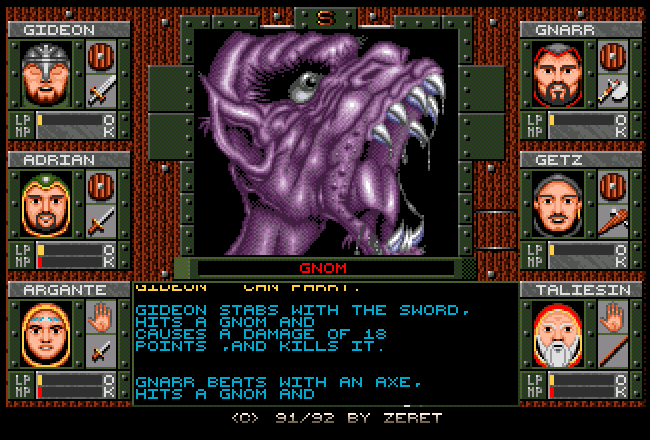
Combat is the turn-based, line-up-all-your-attacks-then-execute system that we've seen a million times (and are currently experiencing in Antares). Enemies can attack in multiple groups of multiple enemies at various distances. Characters can attack, use items, or cast spells.
The one major combat difference between Dungeons of Avalon and Antares is the existence of a "fast combat" feature here, where instead of seeing the blow-by-blow account, you just get a quick summary of post-combat statistics. I saw this for the first time in Legend of Faerghail, another Bard's Tale-inspired German game, and I wonder if this developer was a fan.
 |
| Watching the messages scroll by in normal combat. |
 |
| Versus just getting summary stats at the round's end. |
At this point, you've probably noted for yourself another of Dungeons of Avalon's strengths: its bizarre visuals. Everything from the weapons shop to the monster portraits are done in a highly original, grotesque style that reminds me of something I've seen before but can't quite place. Another element that may not be new, but that I can't remember from other games, is the animation of the character portraits. Each of them winks, blinks, waggles his eyebrows, and opens and closes his mouth more or less continually.
 |
| A freaky temple found in the middle of the dungeon. |
Sound is also reasonably well done. The town section has a relentless techno track that I'd rather turn off, but once you enter the dungeon, you encounter an evocative soundtrack of howling winds, creaking doors, rattles, and other weird noises. Unfortunately, you soon realize that the track is only about 50 seconds long, and the same sounds just keep looping repeatedly no matter where you are or what you're doing. There are some "ows" to accompany combat and some nice tones that go with spellcasting.
 |
| The first level of the game. |
I created a party consisting of a human knight, a troll hunter, a dwarf monk, a gnome thief, an elf healer, and a half-elf magician, then spent about 90 minutes mapping the first level of the dungeon. I soon learned that secret doors are clued by little grates in the lower-left corner; clicking on them opens the door.
 |
| Note the grate in the lower left. |
The "rest party" option, which restores both hit points and magic points, only works if you're standing on a floor tile that's marked by the letter "C"; there was only one of these on the first level. Since there are no torches in the game to run out, no character ages, no wandering enemies, and no food meter, there seems to be no penalty to resting as often and as long as you want.
Chests can hold gold or items and can be trapped. I assume thieves are supposed to be better than others at dodging the traps, but I had about as much luck with that as in Wizardry.
The Level 1 thief was pretty miserable at doors, too, but once I got him to Level 2, the "pick lock" option worked more often.
 |
| If I had a wet rag in your position, would I have to heal it as much as I heal you? |
When I first arrived at the level, a message told me to "Search for the 'Rune'!" I wasn't sure what that meant, but a little later, I ran into a face that demanded to know what I was searching for. Lacking anything else, I tried "RUNE" and was allowed to pass.
Beyond the face was a button that caused a lot of walls previously closed to open up. I soon encountered a dragon calling himself Elistaire, trapped by the "dark lord's" magic, and requesting a ruby dagger to free himself.
Later, I found the ruby dagger in a treasure chest and brought it back to him. He rewarded me with two chests containing 5,000 gold pieces each, way more money that I can even begin to imagine what to do with right now. The shop in town has only the paltriest selection of goods, and I've already bought everything useful there.
 |
| My reward. Taliesin's expression is appropriate. |
My characters went from Level 1 to Level 3 during the first dungeon level; each level-up in town is accompanied by an increase in attributes.
 |
| The most terrifying training guild imaginable. |
Some other quick notes:
- You take damage walking into walls, just like Dungeon Master.
- There are four squares surrounding the main dungeon window that seem to indicate active spells. One lights up when you cast the "magic eye" spell; I otherwise don't know what the spell does.
- You can save and reload anywhere.
- After experimenting a bit with reloading, it seems that the contents of treasure chests are fixed and predetermined, but the size of enemy parties is not. If you meet 4 worms in one encounter, you might only face 1 or 2 when you reload.
- Enemies don't seem to respawn; once you've cleared the fixed encounters on a level, the only way to fight more enemies is to move down.
- Door jambs fully occupy a square, like in Dungeon Master and Eye of the Beholder.
- The game is almost entirely mouse-driven, although you can use the arrow keys to move, and you occasionally have to type words.
A large part of the southeast of Level 1 had nothing in it. I don't know if I missed some other secret door dynamic, or if maybe there will be another set of stairs back up from Level 2.
 |
| On to the next level! |
The game is fast-paced and marginally fun, and I do like what they've done with the visuals, but in general there's a "been there, done that" feel that you often get with diskmag games. In the context of
The Ormus Saga, I talked about developers sometimes lacking self-awareness and turning out games of epic length with much less-than-epic content. If the developer of
Dungeons of Avalon possesses that self-awareness, the game should wrap up by my six-hour minimum. We'll see.
Time so far: 2 hours
Reload count: 1