
 |
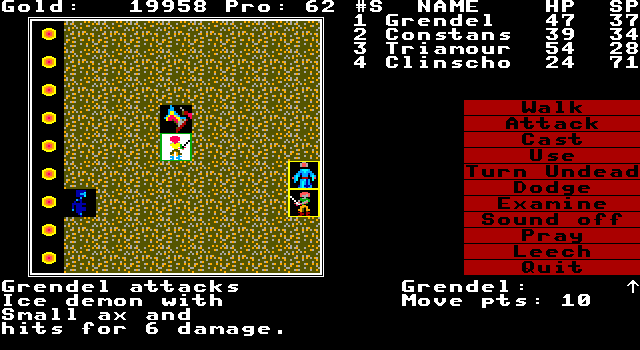
| The font I could have been looking at for the last 13 hours. Thanks for trying, Stu. |
Demon's Winter
United StatesStrategic Simulations, Inc. (developer and publisher)
Released 1988 for Apple II; 1989 for Commodore 64, Amiga, Atari ST, and DOS.
Date Started: 23 February 2011
Date Ended: 14 March 2011
Total Hours: 13
Difficulty: Moderate (3/5)
Final Rating: 45
Ranking at Time of Posting: 41/48 (85%)
Ranking at Game #453: 405/453 (89%)
Demon's Winter is an unusual game that originally left me numb but grew on me over time. Despite the length of time it took me to finish it, it's actually a fairly short game--I probably would have covered it in two or three postings if it had been a normal month.
It is hands-down better than Shard of Spring, and it told a more compelling story with better plot twists. But it suffered the same problems with excessive linearity, and I thought there were a few character development flaws that rendered moot some of its originality in character choices.
The ending is surprisingly grim. Yes, you've managed to re-imprison Malifon, and this works out well for your party, since they all get to be kings or immortal, but Ymros has lost all its gods and towns and is now covered in permafrost. That's what passes for "winning" the game!
Let's see how it rates.
1. Game World. The world of Ymros itself is nothing special: a standard high fantasy realm populated with interchangeable towns and temples. The back story of an imprisoned demon seeking to wreak havoc on the land is also nothing new. A few times I made joking references to The Wheel of Time series; this isn't because I thought the game was copying the plot (the game predates the first book) but because the trope is so familiar. Nonetheless, it's done well, and the game is one of the only ones from this era (or indeed any era) to measurably change the game world as the plot moves forward. I made fun of how the developers gave away the plot twist in the title, but to be honest, it did come as a surprise: by the time it happened, I guess I figured it was a metaphor or something. Zink said it pretty well in a comment yesterday: "This game...actually manages to create a feeling that $&#@ is quite definitely going down."
On the negative side, the developers seem to have spent a lot of effort on a religious system that has no bearing on gameplay, peppering the land with temples that essentially just sit there. It was a good idea that could have been developed better. Final score: 5.
2. Character creation and development. The game gets points for the inclusion of some interesting classes (scholar, sorcerer, visionary) with unique abilities, but then loses them again by making the abilities somewhat useless. There aren't enough traps in the game to justify the thief; I barely had enough call for magic at all, let alone the sorcerer's custom spells; and the ability to see around corners doesn't help much when enemies are unavoidable no matter what you do. Still, I found the game easy enough that I wish I had picked one of the custom classes just to see what it was like.
The skill system is also original--there's really nothing else like it in the era--but also somewhat poorly executed. Because the cost for acquiring skills outside your "class" is so high, you're effectively limited to a small selection until late in the game, when level increases have hopefully increased your intelligence. It was also needlessly difficult to acquire some of the skills. If you didn't start with Spirit Runes (which are the only really necessary spell class in the game), you have to trek all the way to the north pole to find the college. I just realized that I never found the school that teaches turn undead [Edit: turns out it wasn't a school but rather part of the priesthood skill.]

Leveling is satisfying because it happens infrequently and you get attribute upgrades when it does occur. I can't forgive the game for removing the ability to level up without any warning (or even with warning; the moment experience points cease to be relevant, battles stop being fun), although this is somewhat mitigated by the relative ease of the final dungeon. [Edit: I was wrong about this, too; I just didn't find the one town that survived.]
Finally, I liked that there were some class-specific encounters in one dungeon and class-specific end-game bios. Final score: 5.
3. NPC Interaction. There are a couple NPCs, including the Ancient One and Eregore the high priest. Talking to them is necessary to understand the plot of the game and advance the main quest. In the second conversation, we get actual "dialog options." Not the first in any CRPG, but still unusual in this era. But overall, NPCs are few and the interaction is mostly one-way. Final score: 4.
4. Encounters and foes. Maybe it's just me, but only a day after playing the game, I honestly couldn't name more than four of the game's many monsters. I never saw them as more than icons to be pummeled. I know that they had different attacks, strengths, resistances, and so on, but they just never stuck, partly because the game manual describes only a few of them, and very cursorily. There was only one encounter in which "role-playing" mattered, with Eregore, but that's one more than most games of the time. I really hated the lock-step regularity of combats (especially at sea), but it did help when level-grinding. The balance between regular and fixed encounters was good. Final score: 5.
5. Magic and combat. Physical combat is well done, and I didn't grow as bored with it as I did in Shard, although the game's insistence at starting your party on the other side of the room, facing away from the enemy, was continually annoying. You could really see the effects of high strength and speed scores in damage, initiatives, and extra attacks. There were tactics associated with positioning and whether to charge the enemy or wait for him to come to you.
Ship combat was stupid. There were virtually no tactics, and the experience rewards were overbalanced.
SSI invested a lot of time in the magic system--time that, as far as I'm concerned, was wasted. "Heal" and "Resurrect" are the only completely necessary spells. In the entire game, I only cast three or four others out of around 30 possibilities. Part of the problem is some of the area-effect spells. Some of them, like "fire storm," could theoretically be useful, but the game won't let you cast them until the second round of combat. By then, your characters are usually hopelessly intermingled with the enemy, and you risk fireballing your own people. Like Shard of Spring, I like that you can choose how many spell points to invest in each casting, though. There were possession and summoning spells I didn't even attempt.
Ultimately, all of the problems cited here boil down to the game being too easy. There's no reason to meticulously plot the battlefield if charging and pummeling almost always wins the day. Except for one time in which I entered a large dungeon too early, without enough food, and without having invested in quality weapons, I never felt in danger. Final score: 4.
6. Equipment. Another tough one. The difficulty in identifying weapons and armor was annoying, but then again it was I that chose not to have a scholar. I didn't even mention the game's vials and salves and miscellaneous magic items because I never felt any need to explore or use them. The process of identifying items and then later remembering what they were seemed overly complicated, and none of the items are ever well-described. The redeeming factor (although this applies better to "economy") was being able to enchant weapons and armor. Final score: 4.
7. Economy. Finding that I could spend all my money upgrading weapons and armor was a source of joy. Before that, I was using my money to pay for healing because I didn't know what else to do with it. I only wish I had discovered that dungeon earlier in the game. Its existence means that there's always a reason to get cash. Beyond that, I didn't love the process of buying and selling items. It took me hours of gameplay before I realized that merchants had multiple items; they just showed one at a time and you had to hit "c" to page through them. I never felt that "haggling" accomplished anything, and merchants bought my used stuff for a pittance. Final score: 7.
8. Quests. The game has a very clear main quest, and the fact that it's only slowly revealed is part of the fun. (Only complaint: why did Malifon reveal himself and draw the attention of a group of adventurers by having one of his minions attack some dinky little backwater?) There are a couple of different endings, but the decision is at the very last minute, and you can get the alternate ending through an instant replay. There are no side quests in the game. I like that one of the endings had character-specific epilogues, though not quite enough to see how the endings would change with different classes. Final score: 5.
9. Graphics, Sound, and Inputs. The graphics are tolerable but not memorable, except in a few special encounter scenes. The game notably declines to offer any nice end-game graphics, instead wrapping up with some lame flashes of light and an all-text finale. There are hardly any sounds in the game, and they're painful. The keyboard commands are intuitive and are offered in the on-screen dialogs, but the inability to move diagonally is a serious drag. I thought there were too many sub-menus; casting a healing spell requires the following sequence: (C)amp, (C)ast, (#)character, (4) for spirit runes, (F) for name of spell, type number of spell points, hit enter, choose character to cast on. The game also had unnecessary pauses in certain places, giving you 15 seconds to read three words of text. Final score: 2.
10. Gameplay. My biggest complaint is that the game is very linear while providing the illusion of being non-linear. It has a rather large game world to explore, but you really have to do the dungeons in a specific order or you can't finish them. On the plus side, I give points for the inventory puzzles which, while not complicated, are unusual in CRPGs. I did find the game a little too easy overall, but it was also paced well, with no sections that really dragged.
This might be the first game that I would really call "replayable"--not so much that I'm compelled to do it right away, but a party consisting of the characters I didn't choose--cleric, thief, visionary, scholar, and sorcerer--would have a very different game. It would be much more tactically challenging, you'd get different epilogues, and with a cleric the religion system might take a bigger role (e.g., you frequently "convert" to different gods to get different advantages). Any of you who say that you want to play it, try that and tell me how it goes. I recommend focusing on intelligence and speed during character creation: you'll need a lot of non-class-specific skills, and speed is vital for initiative and number of attacks.
Anyway, final score of 5 on gameplay for a final rating of 45. This is reasonably high; my median right now is 34.5. The game is strong on story but weak in logistics. I do recommend it, and if I didn't seem to enjoy it more while I was playing, it's probably because unrelated life stuff was creeping into the tone of my postings.
Next up: Dracula in London turned out to be not even remotely a CRPG, and I'm having issues with Eamon, which is actually a 1980 game that only received a DOS conversion in 1988, and a buggy one at that, so it's off the list until I can get it to run. Looks like Evets: The Ultimate Adventure.
The ending is surprisingly grim. Yes, you've managed to re-imprison Malifon, and this works out well for your party, since they all get to be kings or immortal, but Ymros has lost all its gods and towns and is now covered in permafrost. That's what passes for "winning" the game!
Let's see how it rates.
1. Game World. The world of Ymros itself is nothing special: a standard high fantasy realm populated with interchangeable towns and temples. The back story of an imprisoned demon seeking to wreak havoc on the land is also nothing new. A few times I made joking references to The Wheel of Time series; this isn't because I thought the game was copying the plot (the game predates the first book) but because the trope is so familiar. Nonetheless, it's done well, and the game is one of the only ones from this era (or indeed any era) to measurably change the game world as the plot moves forward. I made fun of how the developers gave away the plot twist in the title, but to be honest, it did come as a surprise: by the time it happened, I guess I figured it was a metaphor or something. Zink said it pretty well in a comment yesterday: "This game...actually manages to create a feeling that $&#@ is quite definitely going down."
On the negative side, the developers seem to have spent a lot of effort on a religious system that has no bearing on gameplay, peppering the land with temples that essentially just sit there. It was a good idea that could have been developed better. Final score: 5.
 |
| There are more than a dozen of these temples for virtually no reason. Then they all get destroyed. |
2. Character creation and development. The game gets points for the inclusion of some interesting classes (scholar, sorcerer, visionary) with unique abilities, but then loses them again by making the abilities somewhat useless. There aren't enough traps in the game to justify the thief; I barely had enough call for magic at all, let alone the sorcerer's custom spells; and the ability to see around corners doesn't help much when enemies are unavoidable no matter what you do. Still, I found the game easy enough that I wish I had picked one of the custom classes just to see what it was like.
The skill system is also original--there's really nothing else like it in the era--but also somewhat poorly executed. Because the cost for acquiring skills outside your "class" is so high, you're effectively limited to a small selection until late in the game, when level increases have hopefully increased your intelligence. It was also needlessly difficult to acquire some of the skills. If you didn't start with Spirit Runes (which are the only really necessary spell class in the game), you have to trek all the way to the north pole to find the college. I just realized that I never found the school that teaches turn undead [Edit: turns out it wasn't a school but rather part of the priesthood skill.]
Leveling is satisfying because it happens infrequently and you get attribute upgrades when it does occur. I can't forgive the game for removing the ability to level up without any warning (or even with warning; the moment experience points cease to be relevant, battles stop being fun), although this is somewhat mitigated by the relative ease of the final dungeon. [Edit: I was wrong about this, too; I just didn't find the one town that survived.]
Finally, I liked that there were some class-specific encounters in one dungeon and class-specific end-game bios. Final score: 5.
3. NPC Interaction. There are a couple NPCs, including the Ancient One and Eregore the high priest. Talking to them is necessary to understand the plot of the game and advance the main quest. In the second conversation, we get actual "dialog options." Not the first in any CRPG, but still unusual in this era. But overall, NPCs are few and the interaction is mostly one-way. Final score: 4.
4. Encounters and foes. Maybe it's just me, but only a day after playing the game, I honestly couldn't name more than four of the game's many monsters. I never saw them as more than icons to be pummeled. I know that they had different attacks, strengths, resistances, and so on, but they just never stuck, partly because the game manual describes only a few of them, and very cursorily. There was only one encounter in which "role-playing" mattered, with Eregore, but that's one more than most games of the time. I really hated the lock-step regularity of combats (especially at sea), but it did help when level-grinding. The balance between regular and fixed encounters was good. Final score: 5.
5. Magic and combat. Physical combat is well done, and I didn't grow as bored with it as I did in Shard, although the game's insistence at starting your party on the other side of the room, facing away from the enemy, was continually annoying. You could really see the effects of high strength and speed scores in damage, initiatives, and extra attacks. There were tactics associated with positioning and whether to charge the enemy or wait for him to come to you.
Ship combat was stupid. There were virtually no tactics, and the experience rewards were overbalanced.
SSI invested a lot of time in the magic system--time that, as far as I'm concerned, was wasted. "Heal" and "Resurrect" are the only completely necessary spells. In the entire game, I only cast three or four others out of around 30 possibilities. Part of the problem is some of the area-effect spells. Some of them, like "fire storm," could theoretically be useful, but the game won't let you cast them until the second round of combat. By then, your characters are usually hopelessly intermingled with the enemy, and you risk fireballing your own people. Like Shard of Spring, I like that you can choose how many spell points to invest in each casting, though. There were possession and summoning spells I didn't even attempt.
Ultimately, all of the problems cited here boil down to the game being too easy. There's no reason to meticulously plot the battlefield if charging and pummeling almost always wins the day. Except for one time in which I entered a large dungeon too early, without enough food, and without having invested in quality weapons, I never felt in danger. Final score: 4.
6. Equipment. Another tough one. The difficulty in identifying weapons and armor was annoying, but then again it was I that chose not to have a scholar. I didn't even mention the game's vials and salves and miscellaneous magic items because I never felt any need to explore or use them. The process of identifying items and then later remembering what they were seemed overly complicated, and none of the items are ever well-described. The redeeming factor (although this applies better to "economy") was being able to enchant weapons and armor. Final score: 4.
7. Economy. Finding that I could spend all my money upgrading weapons and armor was a source of joy. Before that, I was using my money to pay for healing because I didn't know what else to do with it. I only wish I had discovered that dungeon earlier in the game. Its existence means that there's always a reason to get cash. Beyond that, I didn't love the process of buying and selling items. It took me hours of gameplay before I realized that merchants had multiple items; they just showed one at a time and you had to hit "c" to page through them. I never felt that "haggling" accomplished anything, and merchants bought my used stuff for a pittance. Final score: 7.
 |
| Every game should have this! |
8. Quests. The game has a very clear main quest, and the fact that it's only slowly revealed is part of the fun. (Only complaint: why did Malifon reveal himself and draw the attention of a group of adventurers by having one of his minions attack some dinky little backwater?) There are a couple of different endings, but the decision is at the very last minute, and you can get the alternate ending through an instant replay. There are no side quests in the game. I like that one of the endings had character-specific epilogues, though not quite enough to see how the endings would change with different classes. Final score: 5.
9. Graphics, Sound, and Inputs. The graphics are tolerable but not memorable, except in a few special encounter scenes. The game notably declines to offer any nice end-game graphics, instead wrapping up with some lame flashes of light and an all-text finale. There are hardly any sounds in the game, and they're painful. The keyboard commands are intuitive and are offered in the on-screen dialogs, but the inability to move diagonally is a serious drag. I thought there were too many sub-menus; casting a healing spell requires the following sequence: (C)amp, (C)ast, (#)character, (4) for spirit runes, (F) for name of spell, type number of spell points, hit enter, choose character to cast on. The game also had unnecessary pauses in certain places, giving you 15 seconds to read three words of text. Final score: 2.
10. Gameplay. My biggest complaint is that the game is very linear while providing the illusion of being non-linear. It has a rather large game world to explore, but you really have to do the dungeons in a specific order or you can't finish them. On the plus side, I give points for the inventory puzzles which, while not complicated, are unusual in CRPGs. I did find the game a little too easy overall, but it was also paced well, with no sections that really dragged.
This might be the first game that I would really call "replayable"--not so much that I'm compelled to do it right away, but a party consisting of the characters I didn't choose--cleric, thief, visionary, scholar, and sorcerer--would have a very different game. It would be much more tactically challenging, you'd get different epilogues, and with a cleric the religion system might take a bigger role (e.g., you frequently "convert" to different gods to get different advantages). Any of you who say that you want to play it, try that and tell me how it goes. I recommend focusing on intelligence and speed during character creation: you'll need a lot of non-class-specific skills, and speed is vital for initiative and number of attacks.
Anyway, final score of 5 on gameplay for a final rating of 45. This is reasonably high; my median right now is 34.5. The game is strong on story but weak in logistics. I do recommend it, and if I didn't seem to enjoy it more while I was playing, it's probably because unrelated life stuff was creeping into the tone of my postings.
Next up: Dracula in London turned out to be not even remotely a CRPG, and I'm having issues with Eamon, which is actually a 1980 game that only received a DOS conversion in 1988, and a buggy one at that, so it's off the list until I can get it to run. Looks like Evets: The Ultimate Adventure.
****


