

Legends of Murder isn't much of an RPG, but it's a reasonably fun game nonetheless. There's always something pleasant about a simple game that knows what it's about and does a decent job within its limited goals. It's quick: I won in about four hours.
Developed by James Schmalz (I know because his name remains on the screen throughout the game), Murder was released in 1989 via the monthly magazine Big Blue Disk (1986-1991), which offered freeware, shareware, and demo programs for DOS. A second version was released in Big Blue Disk's successor, On Disk Monthly,
in 1993. It's the second edition that I'm playing, and there aren't
enough resources online to figure out the differences between the
versions.
When first encountered the title, I was expecting a Holmesian tale set in the real world, but Stonedale Castle is, instead, part of a somewhat generic high fantasy kingdom called Erdwyn. The king has just been murdered, and his elven advisor, Ash, has summoned an inspector from across the sea to solve the case. The player controls the unnamed inspector as he explores the castle and collects clues. There's no character creation process: the game begins as the inspector enters the front hall of the late king's castle:

As you play the game, you wander room to room in the castle, collecting notes, speaking to NPCs (though there are no dialogue options), and occasionally (s)earching for a clue or a chest. There are hardly any commands; for the most part, events trigger when you walk to the right location.

The castle isn't terribly large--just one main floor, a mage's tower, some catacombs, and an upstairs set of chambers--but certain sections are initially closed off until you find the right password or object.

So far, it probably sounds like an adventure game, and it does have that feel. But it does have some definite CRPG elements. The inspector starts with a series of attributes: strength, agility, dexterity, and intellect, as well as a health condition and a "concentration" score (basically spell points). Throughout the castle, the inspector finds chests which contain various potions, dusts, and other magic items that raise and lower these attributes. Careful study helps tell you which to drink every time and which to avoid.
 |
| My character, late in the game. |
The same chests and coffins and such will also contain weapons and armor to replace the starting robes and dagger. There's no information about what weapons or armor are better than others, but they're standard D&D fare, and I figured a long sword is better than a short sword and a broadsword is better than a long sword. I ended the game with an enchanted sword and enchanted plate.
Opening chests usually produces monsters, and there are fixed monsters in certain locations, particularly towards the end game. You don't have many combat options: just (F)ight and (C)ast whatever spells you've been able to find on various bookcases. (There are only about six, and they're standard magic missile and heal spells.)
 |
| One of the later combats in the game, with a troll. |
Combat isn't very deadly. The worst that happens is you get knocked
unconscious, at which point you can generally re-open the chest and
re-engage the enemy, repeating until he's dead. Death may be more
permanent in later sections of the game, but I never really found out,
as by then I was strong enough--particularly with my healing spells--to
survive each battle. The game is also quite easy that you can save and
reload at any point.
 |
| The game's version of a "death" screen. |
Winning the game was a process of carefully exploring each room, searching tables, beds, couches, and cabinets, and talking to NPCs. Most NPCs will tell you multiple things, and you have to keep walking into their squares to make sure you get everything. But they only say things once, so you have to be careful to record their notes the first time.
 |
| The wizard offers a key clue. |
There were some light inventory puzzles and one password that I had to solve a cryptogram to learn.
 |
| I like cryptograms. |
Slowly, I started to assemble a pack of evidence (in the top center of the screen) and notes about what happened on the night that the king was murdered. Eventually, when I'd learned everything there was to learn, I met my elf patron in the king's chambers and compared my notes with his to accuse a murderer.
 |
| The penultimate screen. |
The game mechanic at this point is such that if you accuse the wrong person, the elf says "that doesn't match up with my notes," and asks you to go collect more evidence and try again. If you name the right person, the game ends.
I ultimately named the right person, but only through brute force--naming every named person in the game until I hit the right one. I have no idea why this person is in fact the killer. So I'm curious if any of you want to download and play the game and see if you can figure it out. Remember, it only takes about four hours. If you intend to do that, don't read any further. The rest of you can continue after the image below.
 |
| One of the more interesting rooms in the castle. |
The main suspects in the game are presented as the king's four potential heirs, one of whom has to be elected by some council. They are Prince Morgan, his nephew; Lord Charron; Eric, the king's captain of the guard; and The Wizard (who is otherwise unnamed).
Other NPCs encountered include a jester named Sayor, a bishop, the king's general, a kitchen worker named Sascha, a lady named Rosylind, a dancing couple named Lord Talmar and Lady Nyshia, and the elf advisor, Ash.
Literally everyone openly admits to hating the king and being glad he's dead, as he was unjust and cruel. He kept a torture chamber, beat his servants, and heavily taxed the poor and infirm. It's a wonder anyone bothered to call me to investigate.
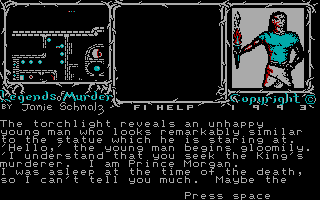
Almost everyone claimed to be sleeping or away from the castle on the night of the murder.
 |
| "Can anyone verify that?" |
Through my investigations, I discovered the following:
- A couple days before the murder, there was some kind of bustle down at the docks in the city. Morgan, the king, and two others met a ship called "The Gold Sprite" and returned with two black boxes. I found the boxes during my explorations and retrieved a magic orb from one and a magic ring from the other. I have no idea what role they played in the murder.
- The king had a queen named Raelle whose coffin is in the catacombs.
- Lady Rosylind, sleeping nearby, said she heard some weird noises the night of the murder: a "snap," a scuffle, footsteps, a bottle breaking, and silence. I recovered evidence that suggests that someone tried to garrote the king but the ligature broke, so he then resorted to smashing a bottle of poison where the king inhaled it. This jived with the Wizard's theory that the king was killed by poison. Also, the king's corpse had a bruise on the back of his neck.
 |
| Collecting testimony from an NPC. |
- I found poison in one of the bedrooms. But I had no way of identifying whose bedroom it was.
 |
| This is like CSI. |
- On the same night, someone threw a sleeping potion in the castle's water supply, and most of the guards ended up dozing off while the murder was happening.
 |
| Medieval CSI. |
- The kitchen maid said she saw a dark figure enter the dragon's room on the night of the murder and head up to the Wizard's tower.
- There was evidence that a woman with blonde hair had been recently imprisoned in the dungeon.
 |
| Ash helps put it all together. |
I frankly thought the game was setting it up that everyone conspired to murder the hated king, and that was my first (wrong) answer to Ash. But it turns out--and again I only figured this out by trying everyone's name--that it was the jester, Sayor. I have no idea how I was supposed to come to that conclusion. But when I accused him, he confessed and was exiled, Prince Morgan took the throne, and everyone lived happily ever after.

 |
| I don't remember the jester saying anything about his sister, either. |
So this was a relatively quick one-shot. Let's give it a quick GIMLET:
- 4 points for the game world, limited as it was. You understand where you fit in the world very easily, and the game gives enough information to get by. There were some books with tantalizing titles and tapestries hinting at various aspects of history and lore, none of which were really developed in this game. In this type of game, the "world" is the castle itself, and the game does a good job of thoroughly describing the rooms and giving the castle atmosphere.
 |
| The descriptions in the game are well-written and evocative. |
- 2 points for character creation and development. There's no creation but somewhat satisfying development as the game progresses.
- 3 points for NPC interaction. There are interesting NPCs, and it's vital to talk with them to complete the game.

- 2 points for encounters and foes. The monsters are mostly unmemorable. Some have special attacks, but combat isn't a big enough part of the game to really worry about it.
- 2 points for magic and combat. There's a very limited selection of damage and healing spells, and the rest of combat tactics comes down to (f)ight or (r)un.
 |
| The game's limited magic selection. |
- 3 points for equipment. There are weapons, armor, and special items to find. The game does a bad job indicating the relative rankings of weapons and armor, though.
 |
| Declining to change my weapon. |
- 0 points for economy. There is none.
- 3 points for the quest. It's an unusual quest for a CRPG, but I wish it made more sense and there were different potential outcomes.
- 3 points for graphics, sound, and interface. The graphics are just tolerable. The interface is very intuitive. But there's no sound.
- 2 points for gameplay. Brisk, but somewhat linear and ultimately too easy.
The final score of 24 is relatively respectable. I wouldn't have wanted to play a 40-hour game with such limited gameplay options and combat, but it was nice enough for a four-hour diversion.
Again, I'm hoping one of you will give it a try and see if you can figure out why Sayor is the killer. I must have overlooked some clue or inconsistency in his story or something. My feeling is that the jester's sister (referenced in the endgame text) was imprisoned by the king for some reason, and the jester killed the king in revenge and freed her. He must have sneaked into the Wizard's tower to steal the potion (accounting for Sascha's observation). I just missed whatever dialogue gave him the motive.
Developer James Schmalz would go on to work on a couple dozen other games for publishers like Epic MegaGames, Electronic Arts, and GT Interactive, including the Unreal series and the BioShock series. He currently runs his own company called Digital Extremes out of Canada. His only other RPG seems to be Legends of Murder II: Grey Haven from 1991; after that, it's all action, first-person shooters, and pinball games. I'll be curious in a couple of years to see what developments were added to the sequel.
Legends of Murder is one of several games from the late 1980s that have almost no remembrances online. There's no walkthrough, no reviews attached to its MobyGames entry, no Wikipedia entry. Google the name of the game along with the names of the NPCs in the game and you get nothing. I'm glad to have this opportunity to fill in a gap in CRPG history.
Back we go to Knights of Legend!


