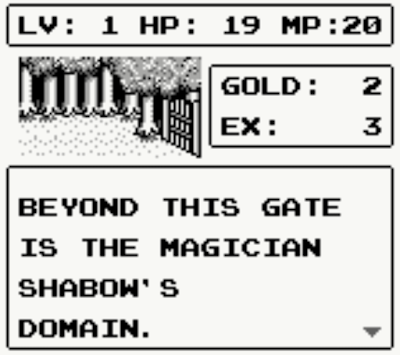
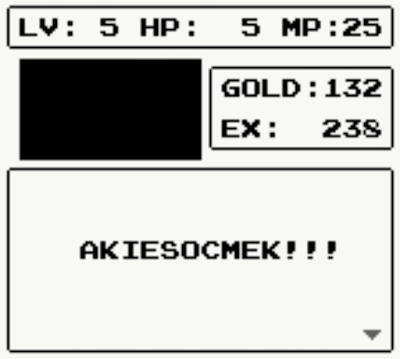
|
| Notice there is no subtitle in this version. |
Towers
United StatesReleased 1993 for Atari ST, 1994 for DOS, 1999 for Game Boy Color
Date Started: 12 January 2022
It might be derivative of other titles, but Towers offers the most interesting set of platforms that we've seen so far. It's not many games that went from the Atari ST to DOS, let alone from there to the Game Boy Color. The sequel gets even weirder: it was released the following year for the Atari Falcon (a high-end ST) and the under-served Atari Jaguar console. You don't often find a developer with that kind of programming flexibility.
The developers in this case are Jag Jaeger and Vince Valenti, two University of Nevada at Las Vegas students who teamed up in 1989 to form JV Enterprises, later JV Games. The company still has an active web site and released its most recent game in 2019 (a mobile word game called Friends & Secrets). Jaeger and Valenti are still running the company, although they've also worked other technology jobs over the years, presumably to pay the bills when game sales weren't enough. The company's early releases, like Towers, were all shareware, or rather what they called "tryware": you got a full-featured version of the game, and if you liked it, you sent them $15 for the manual. I have written to the company asking about the manual but have received no reply as yet.
 |
| I don't know whether this image is from a film or whether some SCA members got together. |
Fortunately, the backstory is told in title cards before the game begins. A company of warriors is sailing to the distant land of Diratose to join the fight against Sargon, "the man in black." A storm shipwrecks them on an island called Lamini, or the Land of Towers. The land is governed under a feudal system, with lords living in towers of varying heights according to their wealth. The shipwreck survivors are healed by the locals. To survive, they take jobs for the sheriff, who eventually tells them that Lord Baniff hasn't been heard from in weeks. Two of the companions set out on a mission to get an audience with Baniff and find out if he's all right. The entrance collapses shortly after they enter his tower. The Game Boy version of the game has a subtitle--Lord Baniff's Deceit--that serves as something of a spoiler. This subtitle does not appear in the Atari ST or DOS versions.
The player chooses from among four companions: Garand, Tasler, Merton, and Andros. Garand is described as a warrior, Merton a wizard, and Andros an acrobat. Tasler doesn't have a class in his description; he's just an able young man with "a strong will to live." I don't think the selection really matters anyway. Clicking the button next to their portraits rerolls the game's attributes--strength, intelligence, wisdom, dexterity, constitution, hit points, and mana--and the rolls seem to be random (8 to 19 for the main attributes) regardless of the stated background. Once in the game, any character can use any weapons, armor, and magic.
 |
| The four playable characters. |
As the game begins inside the wreckage of the entrance, the experienced player will immediately see its Ultima Underworld (1992) inspiration. The paper doll character looks nearly identical, it has the same sorts of inventory slots, and those slots are represented by circles rather than (for most games) squares. Health and mana are represented as containers of liquid, although here they look more like thermometer stems than potion containers. The game arguably improves upon the Underworld interface by shrinking its message window to make space for its spell syllables, so that the player doesn't have to leave the inventory view to cast spells. Even many of the item graphics are clearly based on Underworld. There are no "Talk," "Look," or "Use" options in Towers, alas, meaning probably no NPCs and no puzzles of any complexity.
 |
| Guess I can't go back that way. |
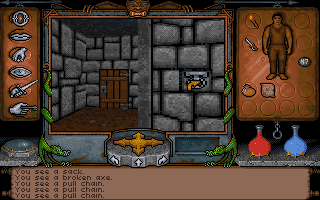 |
| The comparable interface from Ultima Underworld. |
Combat is a bit different, as we'll discuss, but the biggest difference is in movement. It would have been impressive if two college kids had successfully replicated the continuous 3D perspective, and indeed they didn't (although they seem to have figured it out for Towers II a year later). The game uses tiled movement with four fixed views from each position. You cannot look up or down. You can interact with the world by clicking in the view window; this is how you pick up items and push buttons. For combat, though, you don't swipe with the mouse like in Underworld; you click a single "attack" button in the lower right. Doing so does produce an Underworld-like animation as your weapon thrusts outward. Overall, though, the movement and combat system (as well as the buttons and levers that you interact with) feel more like Dungeon Master (1987) than Underworld. The creators were clearly inspired by both games.
 |
| Facing a little goblin on the first level. |
But they do have an unexpected treat in store for the 1992 player--one that I unfortunately cannot experience. You may recall that I said that two characters enter the tower. While the player controls only one character, two players can hook up by modem to tackle the dungeon together. Such a feature is rare even by 1993. I have no idea how it worked technically; I suspect I would need the manual to successfully replicate it, even if I figured out how to set up DOSBox with a modem.
Fortunately, unlike (say) Bloodwych, cooperative play doesn't seem to be terribly necessary. The early game, at least, is remarkably easy. For this session, I explored the first two levels, each 24 x 24, but using the "worm tunnel" approach, and with a lot of unused space. The button and lever puzzles have been simple, with buttons usually opening the nearest closed door. There were about half a dozen enemies per level, none of them terribly dangerous. Damage in this game is easily healed by resting. A hunger system discourages you from resting too often, but food has so far been plentiful (enough to feed two people!).
 |
| My map of Level 1. I'm bothered by the empty areas, but I've checked every wall for secret doors. |
I've found equipment in little piles on the floor, usually with a blood smear or a pile of bones nearby to indicate that they came from previous adventurers. The character starts with absolutely nothing (odd given the backstory) but soon accumulates leather armor and boots, food, throwing items like rocks, a bag (which you can right-click on to get more inventory spaces), scrolls, potions, and simple weapons like clubs, daggers, light axes, and short swords. The message window gives you no feedback on how much damage your weapon is doing.
 |
| A pile of loot. |
You also see no names for your foes. So far, I've faced three of them: little goblins in loincloths, something that looks like a "mud elemental," and skeletons. In combat, you click the narrow "attack" icon to thrust your weapon outward. Unlike Underworld, but like Dungeon Master, there's a cool-down period after each attack. You get a little puff of carnage when the enemy takes damage. Enemies run away when they get low on hit points, forcing you to chase them down.
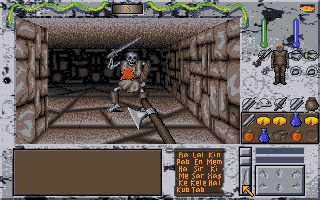 |
| Hitting a skeleton with an axe. |
The magic system uses syllables like Underworld, but you don't have to find runes to go with them. Instead, you find scrolls which tell you how to string together the syllables to make spells. So far, I've found two: ME RA KI ("Magic Missile") and KELE KI ("Fear"). There are two slots for you to prepare spells, which you then cast by clicking on them. My spells fail about half the time I try them, and I'm not sure what governs this.
The character has a level, but in two dungeon levels, I didn't level-up once. I'm not sure if it happens automatically or if there's something that I need to do. There's no separate "experience" statistic, so I'm not sure if you get experience solely from defeating foes or from other actions, too, like casting non-combat spells or solving puzzles.
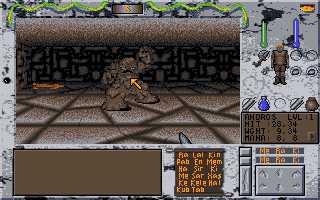 |
| A "mud elemental" approaches. I have two "Magic Missiles" waiting to cast (the ME RA KIs in the lower-right). |
On Level 1, I found a message scroll in one pile of gore. "I have been tricked!" it claimed. "Twas better to rot in prison then [sic] to die here." A scroll on the second floor offered: "Our master is as good with strategy as he is with sorcery."
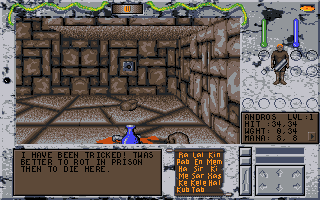 |
| Finding a message on the first level. |
The first level ended in a door unlocked by a nearby keyhole. I had to find my way there by "solving" very easy button puzzles to open a series of doors along the way. One of them led to an area with the key. There were a few secret areas, found by simply walking into walls, but all of them just led to some extra treasure. Nothing essential was behind a secret door. This was true of Level 2 as well.
The second level has been more of the same, although with multiple keyed doors, each opening to a different key. I found the stairs to Level 3 before I'd opened all the doors. I think I've explored the level exhaustively, so I assume that I'll find my way to those areas via alternate stairways or pits from above.
 |
| Opening a locked door on Level 2. |
That brings me to another aspect of the game. It follows the Dungeon Master tradition of giving some of the areas open ceilings that correspond to pits or trenches on the upper levels. There were some places on Level 2 where I could fall back down to Level 1, although none that led to new areas.
 |
| This "trench" on Level 2 . . . |
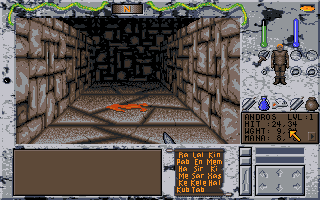 |
| . . . leads to this corridor on Level 1. |
Unfortunately, this destroyed a theory I'd been developing. Near the stairway between Level 1 and Level 2 is a little placard that reads "E2-E4." There's a similar one on the next level that reads "E7-E5." I thought this meant I was skipping two levels on the first stairway, but that doesn't make sense with the pits, and it also doesn't make sense because the second placard should therefore start with "E4." Whatever is going on with the placards, it's clear that there are more ways than stairs to transition between levels, which might open up some of the "empty" areas that I mapped on the first two levels. Either that, or there are types of secret doors other than ones that you walk directly into.
 |
| I don't know what this means. |
Other notes:
- The game is almost all mouse-driven. The numberpad works for movement, but to attack, pick up items, activate buttons, and cast spells, you have to use the mouse. It is possible that there are keyboard shortcuts I haven't found, though. I haven't tried every key in every situation.
- Items of armor go directly on the paper doll. Other items of inventory go in the various slots. One mystery is gauntlets. I've found two pairs--one regular, one Gauntlets of Strength--but I can't figure out how to use them. They don't go directly on the body. If I put them in the "weapon" slot, my fists do change appearance to be armored, so I suppose they simply might be alternate "weapons."
- In addition to doors that you can open, there are occasional windows that let you see into adjacent rooms without giving you the ability to pass through.
 |
| I'm not sure either Dungeon Master or Ultima Underworld had these. |
- Most of the doors have buttons on both sides, even when you could never have gotten to one side without opening the other. I suppose this would help if you were fleeing enemies.
- The game freezes about once every 15 minutes. Regular saves are vital.
So far, Towers has been a perfectly pleasant game if not particularly challenging. It's a nice contrast to WarWizard, for which I can't seem to make any progress because I don't know what to do, and Angband, for which I can't seem to make any progress because the game is endless. It will be nice of Mr. J or Mr. V responds with the manual (and, of course, a few other insights), but so far I've been able to figure it out.
Time so far: 3 hours