
 |
| The long-awaited third game in the series. |
Empire III: Armageddon
Released in 1983 for Apple II
Total Hours: 10
Difficulty: Hard (4.0/5)
Final Rating: 22
Ranking at Time of Posting: 157/428 (37%)
Date Started: 11 July 2021
Date Ended: 20 July 2021Total Hours: 10
Difficulty: Hard (4.0/5)
Final Rating: 22
Ranking at Time of Posting: 157/428 (37%)
The Empire series comes to a conclusion with this final entry from David Mullich. It's been a strange ride. I've previously documented my experience with Empire I: World Builders (1981) and Empire II: Interstellar Sharks (1982), both of which--primarily in their documentation--offer some of the same uncomfortably bizarre ambiance as Mullich's The Prisoner (1980). The first game chronicles the early years of an Earth-based interstellar empire, and the lives of the colonists who establish outposts on various planets. Interstellar Sharks is set at the height of the empire, with the player taking the role of a stock trader, diplomat, or pilot, ultimately trying to find his way to the imperial home planet of Triskelion. In both games, the manuals present the Empire chiefly via propaganda. The player is manifestly meant to understand that beneath the veneer of the materials, and their portrayals of the ruling Lazur family as the "apex" of civilization, lies a mysterious and corrupt bureaucracy. The enigmatic "Lord of Light," godhead of an outlawed religion, makes some cryptic appearances.
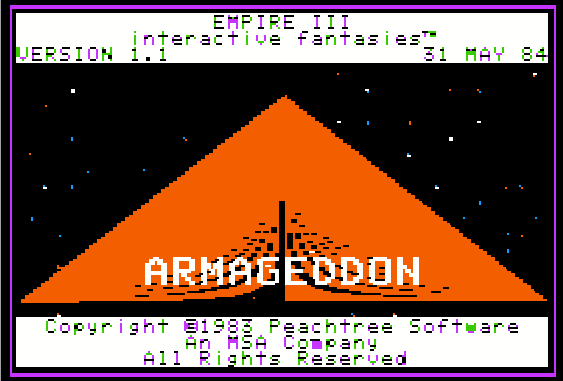
Empire III is in many ways the most obscure of the trilogy. Copies only made their way to the Internet within the last few years, and they do not include the game's documentation. I was looking forward to the manual most of all, but no one seems to have posted it, and those who claim to have a copy have been stubborn about responding to calls to scan and share it. Part of the problem is that it was released just as Edu-ware was being acquired by MSA, which ultimately only cared about educational and business software and sold the few remaining game titles in plain boxes with "educational" labels (hence the Peachtree imprint). The date of publication is in question, too. Some sites say 1983, some 1984, but the game was being sold in catalogs as early as June 1982. The title screen for the version I played has a copyright date of 1983 but a release date of 1984; however, it is a later edition. I settled on 1983 as the most likely but far-from-certain year.
The lack of documentation hurt my efforts to explore this title. The previous two games did a great job explaining the games' vocabularies and when you would use certain words. For this one, I was able to extract about 115 words that it understands via hex dump, but there's nothing about the context in which they're used. In particular, there is a potion-crafting system and a mining system that I've been unable to explore, in the first case because I think the manual offered recipes for the potions, and in the second case because I have no clue how to mine. As we'll see, this is keeping me from winning the game.
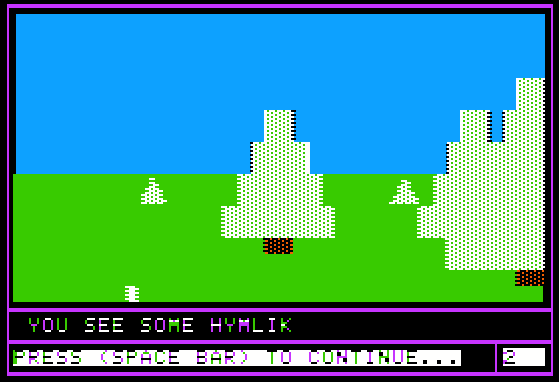 |
| This is a reagent for a potion-crafting system I don't know how to use. |
Both Empire I and Empire II blended role-playing elements with a kind of life simulation. You had to enter multiple commands in a precise order to accomplish even mundane things, like growing and harvesting crops, mining and selling minerals, or taking a ship from one planet to another. Empire III ditches most of the simulation elements and provides a more straightforward graphical RPG/adventure. This change is most acutely felt in the game maps. All of the titles have featured some movement around cities or landscapes, but usually more as concepts than actual geographies. The planets of Empire II were all linear geographies, for instance, in which all key encounters occurred along straight roads. Armageddon offers standard first-person RPG maps in which LEFT and RIGHT don't move you between nodes but actually turn and face you in those directions.
 |
| The city and wilderness maps. This is the only game in the series to feature areas that you can map like this. |
Character creation is much as in the previous game. The game randomly chooses your sex, and then one-by-one rolls values from 3 to 18 in dexterity, constitution, strength, aim, senses, intelligence, willpower, charisma, speed, and psionics. ("Psionics" has existed as an attribute in all three games, and in none of them has it been overtly called upon. [Ed. A reader reminded me that it did play a role in the missionary's job in the first game.]) You choose your background from three classes: aristocracy, technocracy, and "fremarket." Unlike the other two games, I didn't see any places here in which the choice of background made a difference.
 |
| Character creation. Trust me: you're going to want to roll a high speed. |
Each character starts with identification, 1 credit, 10 food, 10 water, and 100 units of currency in an unnamed city. Character creation (and also hibernation, where you can save the game) is revealed to have taken place in a building called the "Pyramid Club." Other buildings surround you, but most of them turn out to be unnamed "tenements." Entering them usually produces an encounter with an NPC who says, "Please leave at once," or, "Please don't hurt me." No commands really allow you to interact with NPCs. I suppose you could kill them for their meager goods.
 |
| The city is mostly "tenements." |
Moving around the game is slow at the default Apple II speed setting. It takes a few seconds for the screen to draw each step. The only review I was able to find complained about this. I had to jack up the emulator to about 5 times the normal speed to make it tolerable.
The city runs to 14 x 14 coordinates and besides tenements and the Pyramid Club contains the following buildings, most of them just a single screen:
- United Ores. Here you can buy and sell ores like obsidian, onyx, and "omnimium" and buy mining-related equipment like drills, picks, and shovels.
- Chemist. He sells four things: a spraygun, a "watercart," a "basecart," and an "acidcart." I have no idea what these things are for, but I suspect it's related to the game's potion system.
- Hybrid Foods. Here you restock food and water, which are consumed at a rate of about 1 every dozen steps, but only in the wilderness outside the city.
- General Mercantile. Buy and sell knives, ropes, torches, lamps, and compasses.
 |
| This is supposed to be a sci-fi game. I hope those are at least British-style "torches." |
- Medi-Sci. Get a current scan of your attributes and injuries, and pay to heal injuries.
- Hedonistic Services, described below.
- Neurotech, described below.
The Hedonistic Services building sounds like the place on Denieves in Interstellar Sharks, where you could gamble, buy drugs, and hire a prostitute. Here, however, it simply opens into two sub-rooms, a bedroom and a shooting gallery. Searching the bedroom produces a Medallion that various empire officials seem to wear. I put it on, but it never explicitly did anything for me. The shooting gallery, instead of allowing you to shoot anything, simply offers hints for the game:
- "Pull the plug." I have no idea what this was referring to.
- "You must rise and then descend." This refers either to the mountain or the Pyramid.
- "Seek the mountain man." More on him in a bit.
- "She is but an image." This refers to the empress; more in a minute.
- "The second password is ERGO." You might recall that I got this same hint as my "prize" for winning Interstellar Sharks. That didn't turn out to be much of an advantage unless you missed it here.
The Neurotech building is a fully-explorable dungeon. It's dark when you enter, and you need a light source to explore. It leads you to an encounter with a secret society that, if you make a charisma check (a roll of 1d20 against your charisma), invites you to join a plot to overthrow the empress. If you agree, you get a "field disruptor" and can then be trained in lock picking, chemistry, technical traps, or firearms. Training in each of these subjects takes one year and requires passing an associated attribute check. Passing the skills gets you a bomb, glyceride, a "damping" (which turns out to be a type of armor), and a dartgun in that order. I'm otherwise not sure what good the skills do for you. They don't appear on your character sheet.
 |
| The "Mechanics" enlist me in their cause. |
Once you're done with the city, you can go outside, onto a 14 x 14 wilderness map in which trees create "corridors." A river bisects the map and requires a dexterity check to successfully cross (or you drown). As you explore the outdoors, you randomly find reagents like mako, palmna, hymlik, and holly, which I assume are part of the potion-crafting system.
 |
| Drowning in the river. |
Aside from the city, there are three destinations in the wilderness map: a mountain, the ruined Nyrf Tram Station, and the imperial Pyramid, home of the empress. The mountain requires a lot of climbing, during which you have to make regular dexterity checks or take injury. I got a rope and grappling hook at some point but couldn't figure out how to use them to help with the mountain. At the top is a mountain man who tells you, "The first password is COGITO," something that Deano figured out back in our Interstellar Sharks discussion.
 |
| I approach the old man on the mountain. |
The Nyrf Tram Station is like the Neurotech building: another dark maze for which you need a light source. Like the other building, it takes you to the headquarters of a secret society that wants to overthrow the empress. This one is called the Apox, and they follow the Lord of Light. They teach traps, stealth, climbing, swimming, knives, propaganda, garrote, and camouflage, and again it was rare that any of these skills came explicitly into play even when doing obvious things like climbing the mountain or crossing the river. At best, maybe they provided bonuses to the attribute checks. Most of the skills didn't provide any items, but I did get a knife and a garrote.
 |
| Nobody seems to like the empress. |
That leaves the Pyramid, which took me longer to explore than the rest of the game combined. You have to have a field disruptor to get through the energy field surrounding it. Once inside, the pyramid is 13 levels up and at least 2 levels down. As you ascend, the levels get smaller until the top level is just one square. Every level has separate "up" and "down" elevators, but oddly you always arrive in the northwest corner of the level, not in the position of the associated elevator.
 |
| Every time I thought I must have reached the top level, there was yet another elevator. |
Guards appear randomly in the rooms as you explore. When they do, you have one round to act before they order you to halt. On the first level, they mostly just greeted me and let me pass (because of the Medallion?). On the others, they often searched me and figured out that I was a spy. When this happens, you have to make a speed check to "escape" back one room. If you fail, the game is instantly over, as the guards doom you to death in the Arena. This happens so often that sheer probability dictates that it will happen to every character, no matter how high his speed. I used save states to reload, of course, but there must be some mechanism or set of commands for players to avoid this fate that I'm not seeing--maybe the potion system, or some command that I've overlooked that calls camouflage or stealth skills into play. You can choose to FIGHT the guards in your one round, but one battle is hard enough let alone multiple times per level.
 |
| A speed check determines if I escape the guard or die. |
There are also a lot of traps in the Pyramid's corridors. Some of them you have to LOOK to find. They include heat sensors, sonic sensors, and light sensors, and in all three cases, they seem to serve as "spinners" in the typical grid-based dungeon, pointing you the wrong direction and occluding some doors. There are other traps like tripwires and pits that require a skill check--either dexterity or senses. Again, I can't help but think there must be some mechanism or tool for disarming them, especially given the "traps" and "technical traps" trainings, but I could find any combination of verbs and nouns that did anything.
 | | |
| The game checks to see if I can avoid a trip wire. |
Among the 15 levels of the Pyramid, I otherwise found the following encounters:
- On Level 1 is an audience chamber in which the empress delivers a one-line speech ("I must leave you now" or "There is a traitor among us") before she disappears. The code suggests that she's just a projected image (consistent with the hint above), but I can't quite figure out how to reveal it. When she leaves, an official remains behind in the room that you can fight and kill for his weapons, armor, and medallion.
 |
| You can't really do much in this chamber. |
- Levels 1 through 3 have multiple storerooms in which you can find items like compasses, lamps, and earmuffs.
 |
| The first level of the pyramid. |
- The two basement levels have multiple shelters which can also be searched for items, including a gas mask and absorption armor.
- Level 2 has a kitchen, where there's food and water.
- Levels 2 and 8 both have steel doors that you can open with USE BOMB. If there's another way, I don't know it. The one on Level 2 has weapons inside; the Level 8 one is empty.
- Levels 4 and 6 have vapor traps that you must be wearing a gas mask (found in the basement) to pass.
- Level 5 has a trap that causes paralysis; you have to be wearing absorption armor to continue.
- Level 6 has both a library and a laboratory. The library has a book that reads: "To pass through the computer door, you must make an explosive of onyx, corbomite, and mustard." I'm not sure about the laboratory, but I suspect it's used to either make that explosive or potions or both.
 |
| The "library" has only one book worth reading. I look forward to The Elder Scrolls series, when I'll lose hours in a room like this. |
- Level 6 also has an observatory with a book that reads: "The white rock has great powers; do not use it near the computer." You might recall the mysterious white rock in Interstellar Sharks that got me through the planetary defense shield. I stole it from a priest of the Lord of Light. The observatory also had a pair of goggles.
 |
| I'm not sure what to make of "the old imperium," which isn't mentioned in the documentation of the previous games. |
- The upper levels all have force fields that you need a field disruptor to get past, but you needed one to get into the Pyramid in the first place.
- Levels 10 and 12 have harems, including "harlots" with medallions.
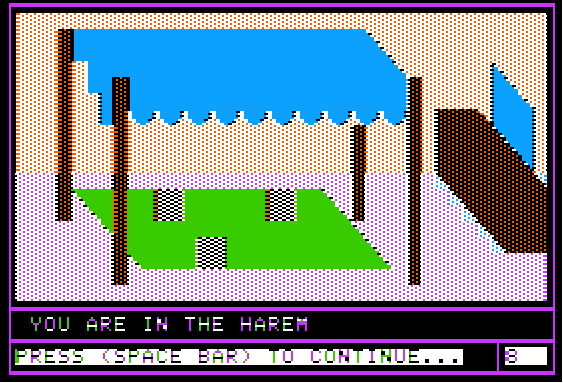 |
| Alas, this is the harem of an empress, not an emperor. |
- Level 10 of the Pyramid has a door that leads to a weird area with green corridors, seemingly not part of the level's standard level space. I found nothing in these corridors despite searching every square and bumping into every wall.
- Level 11 also has a steel door that the bomb won't work. I suspect this is the "computer door" described by the library book.
On Level 13, you can enter a room with the empress herself. It takes you directly into combat. While the empress is wielding a lasgun, she has no armor and is easily killed. She has the white rock on her.
Combat uses the same system as the previous two games, where you can FIRE with a missile weapon, close the distance and HIT with fists or STAB with a melee weapon, or take a round to AIM. Both you and the enemy have individual hit points and disabilities on various body parts. It's a strong system, but you fight so rarely that it's tough to master it.
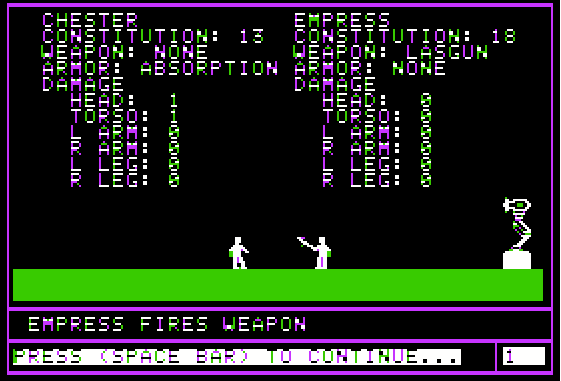 |
| I didn't expect to fight her one-on-one. I have no idea what that thing to the right is. |
The empress's death doesn't seem to change anything. You get no victory screen, and returning to the secret societies gives you no new messages. I suspect that the issue is that I must get into that computer room with the explosive. The problem is the need for "corbomite." Onyx is sold at United Ores and mustard can be found in the wilderness, but I suspect corbomite must be mined, and I have no idea where. The only places I've found where mining tools work is that odd set of caverns off Level 10 of the Pyramid, but whether I use the drill, pick, or shovel, in any of the rooms, the game simply says that no minerals are found.
 |
| The only message I get, no matter what I do. |
There are a number of other mysteries that may have something to do with the solution:
- The potion-making system, for which I can only assume the recipes must be in the manual.
- On the second basement level, there's a room that produces endless combats with rats every time I try to move through it. (There's no chance to enter a command after they appear and before combat.) I don't know how to beat them once and for all. I wonder if the manual didn't give some recipe for rat poison as part of the crafting system.
- The game's code references a torture chamber that I never found. Perhaps it's on the other side of the rats. You can apparently be caught and tortured, and there's a chance that you'll spill the beans on the Mechanics or the Apox.
- The code also references a "kennel" that I never found.
- The economy in general is a mystery. Everyone refers to the game's currency as "credits," but you start with only 1 "credit" and 100 "money." Purchases are deducted from "money." You never find money anywhere, not even on slain foes, so the only way to make any is to sell items to the stores. But stores only buy what they sell, so you can make a few bucks selling extra compasses or torches, but there's no store that sells weapons and thus none that buys them. The only way I could make enough to afford mining equipment was to GET water in the river and sell it for 3 credits each at the food shop, but that takes a long time. Meanwhile, United Ores sells "Omnimium" for about 6,000 credits. I have no idea how you'd make that much or why you'd want it.
- Verbs and nouns I never found any use for (and that don't seem to be part of the potion-crafting system or buying/selling): CAREFULLY, CUSTODIA, DEXTER, DRESS/UNDRESS, GARROTE GLYCERITE, GIVE, JADE, LOAD, LOCK, NOTE, PROJECTOR, PUDEE, ROCK, STASIS, STEAL (it doesn't work in any of the shops), WAGER, WOOD.
- There are also creatures listed in the game's code that I never encountered, including bandits, drunks, pilgrims, dogs, lizards, snakes, crocodiles, and bandersnatches. These might be leftovers in the code from World Builders. I did discover that trying to "enter" the trees can get you attacked by a bear.
 |
| You want to avoid walking too close to trees. |
Based on what I was able to experience, I would give this game on the GIMLET:
- 2 points for the game world. The story has a lot of originality, but the game never really feels like it's set on the capital of an empire. This will probably go up if I had the backstory in the manual.
- 2 points for character creation and development. The creation process is RPG standard. I can't say much for development, as the series has no experience and no mechanisms for leveling except the skill-learning parts of this game, which seem to do nothing.
 |
| Learning skills is one of the few ways to "develop," but I'm still not sure what it did for me. |
- 1 point for NPC interaction. They exist, but of all the commands the game offers, you'd think some kind of GREET or TALK option would be available.
- 3 points for encounters and foes. I give most of this to the variety of encounters that require an attribute check, although the accumulation of them makes the game too hard for the player not using save states.
- 3 points for combat. As I mentioned above, it's a good system; it just isn't used all that often.
 |
| Fighting an official of the empire. |
- 2 points for equipment. Most of it is for puzzle-solving.
- 2 points for the economy. Maybe the manual will untangle some of the mystery and bump up the score.
- 2 points for a main quest. No side quests, no options.
 |
| You could say I "won" in that I accomplished my misssion. |
- 2 points for graphics, sound, and interface. The graphics are serviceable, the sound non-existent. The text parser works okay but could use some Infocom-style shortcuts like "G" for "repeat the previous command." I might lower this to 0 if I played at era speeds, which would have been a dealbreaker.
- 3 points for gameplay. The challenge and length are good, but it's more linear than its predecessors and I don't see much replayability.
That gives us a final score of 22, a bit lower than the 29 I gave Interstellar Sharks, which I thought had a more compelling plot and more interesting character options (again, however, I had the manual for that one).
I suspect the manual will show up eventually, or we'll otherwise figure out the answer to the endgame, but rather than take that chance, I'll simply describe the ending as I understand it from an inspection of the code: If I could find or mine the corbomite and craft the explosive, I can blow open the door to the computer room, which I believe is the one on Level 8. There, I would encounter the "Empire III Computer." I would have to enter the two passwords: COGITO and ERGO. (SUM oddly does not appear in the code and is not recognized in the vocabulary.) The final message only seems to appear if you have the white rock:
I AM THE LORD OF LIGHT. TO HAVE SURVIVED THE GREAT PYRAMID, YOU HAVE LEARNED THAT MAN IS THE GREATEST FORCE IN THE UNIVERSE, AND ALL ELSE IS SUBSERVIENT TO HIM. I BANISH THE SHARKS INTO NETHERSPACE AND COMPLETE THE CIRCLE OF HISTORY. GO FORTH AND AGAIN BUILD A WORLD.
"Build a world" and "sharks" are references to the subtitles of the previous games; this final message seems to be a suggestion that everything is cyclical and you're supposed to start over at the beginning. It's a slight let-down for all the build-up that the series has been doing. For instance, I went into this game thinking that the empress was a puppet and I'd probably have to rescue her rather than kill her. There's no evidence of language to support this idea, though, and there's no pause to enter a command when you enter the empress's room before she attacks.
I've spent a number of years baffled about this series. I'm slightly appreciative of games that offer something new and unusual, but also slightly confused as to what the author was trying to accomplish. Were we supposed to understand references and subtext in this plot? Was Mullich articulating some kind of philosophy or just telling a story?
I failed to remember that I had the answers to some of these questions in a 2014 e-mail exchange I had with Mullich. I never reported on it because he didn't respond to the e-mail in which I asked his permission to do so. Nonetheless, looking over his answers now, I can't believe he'd mind if I reported on at least some of the insights that he sent me. First, when Edu-Ware asked him to make the trilogy, they gave him the three subtitles. His goal, he says, "was to create scenarios that were appropriate to each title." His influences included Asimov's Foundation series, Star Trek, and Robert Heinlein's Time Enough for Love (1973). He said that despite common belief, he had never read Roger Zelazny's Lord of Light--something that Zelazny himself apparently inquired about. Most important, he reported that he had nothing to do with the manuals, which were written by Edu-Ware's marketing director. (I don't know whether the marketing director was Steven Pederson or Wendy Peterson, both of whom have manual credits on the series.) Thus, what I perceived as an intentionally bizarre contrast between verbose manual and austere game seems to have a mundane explanation.
I'll update this entry if we ever get the documentation. Until then, let's continue clearing out some of these early 1980s titles.


