|
| See below for the inspiration. I have no idea why there is a jawa in the background. |
L'Anneau de Zengara
France
Ubisoft (developer and publisher)
Released in 1987 for
Amstrad CPC, possibly for Atari ST
Date Started: 30 April 2017
Date Ended: 1 May 2017
Total Hours: 9
Difficulty: Moderate (3/5)
Final Rating: 16
Ranking at Time of Posting: 36/253 (14%)
Ranking at Game #457: 88/457 (19%)
Not so long ago, I made fun of Ubisoft's humble beginnings with an RPG called
Fer & Flamme (1986), a bizarre title with a horrid interface and a combat system I couldn't figure out despite multiple tries and several commenters trying to help me. I gave up on it without having made much progress, hoping I would never see its like again.
Well, here we are with
The Ring of Zengara, Ubisoft's follow-up, credited to the same developer (Hervé Lange), using the same interface and overall design and mechanics. Although it does not appear to be a direct sequel to
Fer & Flamme, it does support importing a character from the earlier title, but only one, as this game features a single protagonist instead of a party. It is scaled down in ambition in other ways as well, with only a single city (of three areas), one structure to explore, and no outdoor areas.
 |
| This image is literally the best part of the game. |
The game takes place in the legendary
city of Zengara, capital of its kingdom, and home to the Palace of a
Thousand Dreams. The only fly in the ointment is a thief lord named
Shadar, who lives in an impenetrable tower in the city. The bandit is so
powerful, enigmatic, and undefeatable that the kingdom has basically
given up trying.
The
protagonist is given as an adventurer who one day came upon a wounded
man. As he tried to tend to the man, the victim's ring slid off his
finger and attached itself to the adventurer's, refusing to come off.
Before dying, the man whispered that salvation could be found in
Zengara.
 |
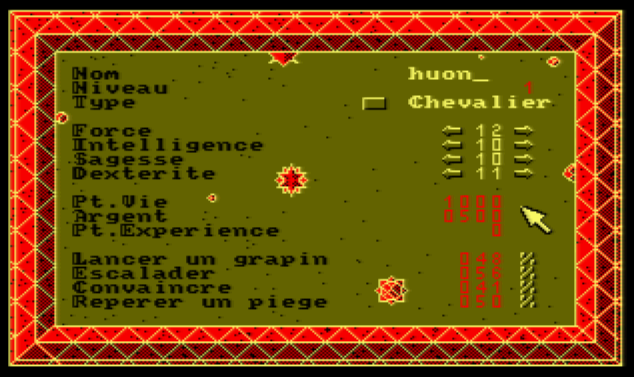
| I will later come to rue that strength total. The game doesn't allow you to capitalize the first letter of your character's name. That should be worth -5 points. |
Character creation options seem roughly the same as
Fer & Flamme. You can be a warrior, magician, elf, thief, knight, cleric, dwarf, or "tinigen," apparently the French answer to hobbits or halflings. Attributes are strength, intelligence, wisdom, and dexterity, assigned from a pool of 40-45 points. Together, these determine your chances to throw grappling hooks, climb, persuade, and find traps. Those skills are all new to this game and, as far as I can tell, completely unused except for perhaps finding traps.
As its predecessor does, the game gives you the ability to purchase armor (coat, helm, and shield) during the creation process, but the armor isn't with you when you start the game. The initial purchase just adjusts your armor class score and subtracts from the money you have to spend in the game itself. Spellcasting types can also choose from a selection of spells during this process.
 |
| Choosing from various spells. |
The game starts at the gates to the city, and it's not a very big city. You can go right to a provisioner's store, left to an old wizard named Valdor who has some lore to impart, and straight ahead to the tower entrance. Four squares, total. I was expecting a huge, sprawling city like the one in Fer & Flamme.
 |
| The player enters the city. |
The provisioner sells a small selection of weapons--dagger, sword, and axe, of which the sword is best--a vest, and a grappling hook. He buys items, too, but since he's the only one who sells anything, I'm not sure why you'd need to amass gold.
 |
| The merchant and his paltry selection. |
The old man fills in the story of the ring. In the distant past, a King Turkas had it fashioned for his beautiful wife, but enchanted so that if she ever cheated on him, a demon would appear to kill both her and her lover and damn their souls to wander eternally in limbo. Unfortunately, she cheated. When Turkas found the massacred bodies, he touched his dead wife's hand, and the ring slid to his finger, and the curse passed to him, as it has passed from person to person through the generations, each one damned to wander limbo upon death because of the queen's original sin.
 |
| The game does a decent job with its dialogue options. |
At some point, one of the ring-bearers, a wizard, devised a spell to break its curse. He wrote it down on a scroll, but the scroll was stolen, and he eventually died like all the others. The implication is that Shadar stole the scroll, and I need to brave his tower if I want to save my own life.
Therein lay my first problem: getting into the tower. The front gates are guarded by an orc, and my knight couldn't defeat him no matter how many times I threw myself at him. Unlike Fer & Flamme, which similarly didn't allow me to win a single combat, this game at least showed that the orc was taking damage. I just couldn't kill him before he killed me.
 |
| The death screen came up a lot in the game's few combats. It says that you're doomed to wander limbo and never find the peace due to a valiant warrior. |
Combat is pretty simple and boring. When the screen first loaded up, I thought I was in for a Karateka-style action sequence, but it turns out that the screen is static. You can choose some preparatory options like equipping a different weapon, casting a spell, or checking your stats, but after that (unless you flee), you just hit "combat" and watch the messages go by indicating who hit, who missed, and how much damage they did. Damage not only depletes your original pool of 1,000 hit points but also your strength, which can be recovered by resting.
 |
| An orc guards the way in. |
Combat might take 20-30 turns to resolve, and annoyingly, you can't just hit "combat" and go make a sandwich or something while this happens. The game runs the turns in batches of 1 to roughly 6, and after that you have to keep choosing "combat" if you want to proceed. I guess this is to allow you to flee if things aren't going well. I don't really understand other aspects of what's happening in combat. Sometimes it will show several successful attacks from one side or the other, but no one loses hit points for the round.
Unable to defeat the orc with my first character, I tried a few other options, including a magic user whose spells didn't seem to do anything. Finally, I had luck with a warrior who had 20 strength, 18 dexterity, and hardly any intelligence or wisdom. With the orc dead, I was able to enter the tower.
 |
| My character attacks and misses. |
The game's interface is as obnoxious as Fer & Flamme, relying entirely on the mouse. Moving left or right with the joystick, you scroll through the available cursors at the bottom, with options to move in each of the four cardinal directions or up and down, check inventory, check health, check the character sheet, search the room, pick up or leave items, purchase or sell items, open a door, give something to an NPC, fight, cast a spell, talk, use an item, or save the game. The developer couldn't even be bothered to map the directionals to the keypad arrows. But there are places where you have to type answers, so it's not like you can ignore the keyboard entirely.
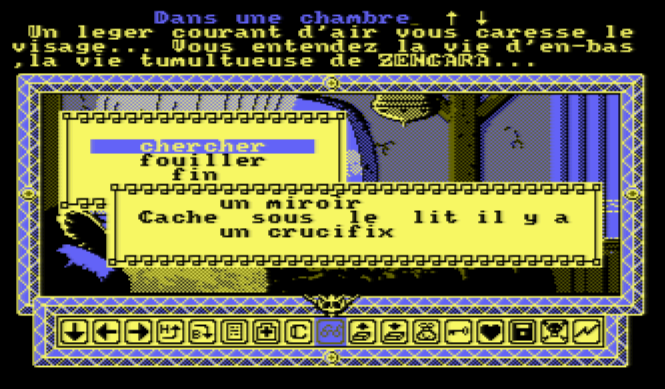
The tower levels aren't very big. The first one only had 10 rooms. A key dynamic when exploring rooms, just as in Fer & Flamme, is to repeatedly search them. This game breaks down its search options into chercher and fouiller, which translate the same ("search"), so I don't know what the difference in quality is in French. In the game, chercher basically tells you what you've already discovered, or is immediately visible, and fouiller conducts a more in-depth search of the room for items and traps. Annoyingly, you have to choose fouiller repeatedly in most rooms before you find anything, and even then, you may not have found everything. I adopted the practice of selecting the action about 12 times before giving up, and if I found anything, I'd select it 12 times again just to be sure.
 |
| In a bedroom, several searches found me the mirror (which is never used), but it took me a dozen more to find the crucifix, too. |
Some traps took me up to 30 searches, but if I missed them, I'd die, reload, and keep searching until I found them. This is perhaps the one place in the game that uses one of the four skills on the character sheet.
 |
| This took me like 5 minutes of pounding the same command. |
Some of the objects you find are food and drink, and you need them because you get hungry and thirsty over time, and unlike the previous game, this one offers no place to buy nourishment.
 |
| My inventory on the second level. I don't think that grappling hook ever comes into play. |
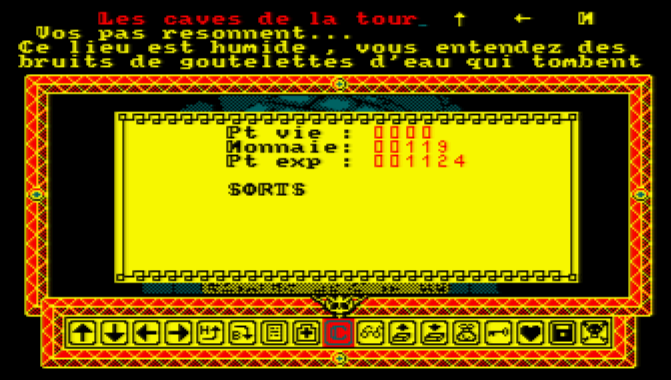
At this point, I should mention that the game introduced a game-breaking bug when I entered the tower: passing through the door wiped away all my hit points. I assume this wasn't intentional, because I'm pretty sure that initial pool of hit points is supposed to carry you through all of the game's combats, perhaps with a boost from an occasional healing potion (I found one on Level 1). As I explored, I kept dying randomly as I moved from room to room, and I realized it was because hunger and thirst deplete 1 hit point per move, and I didn't have any.
 |
| My hit points are all gone for no reason. |
This made my next combat, with another orc, interesting to say the least. I had to win by save-scumming, capturing a save state every time I did damage to him, and reloading if he did damage to me. Later, when I encountered a werewolf, that strategy became untenable, and I had to edit a save state with a hex editor to give myself an adequate number of hit points to proceed.
The indoor areas are generally banal rooms showing several potential exits, but a small percentage of them have more carefully composed "scenes," often with an NPC to talk with. These scenes are more likely to contain items to search for. Like Fer & Flamme, indicators on the top of the screen show which way you can go from each room, but the indicators don't include locked doors, so you have to watch for those and open them with the key icon.
 |
| One of the "scene" rooms. |
Along with some food and valuables I'm not sure I need, I found a key on the first floor (there were no monsters) that brought me to the dungeons, where there was another combat against an orc.
 |
| I hit the orc and do 52 damage. |
The dungeons held two prisoners. First, a crazy mage named Krook insisted that Shadar was his master, and that the thief lord might not be human. It is rumored that his father is a demon named "Procus" and that he is immortal. The tower is supposedly only 6 levels (I don't know if that includes the dungeons.) He repeated word-for-word some of the things that Valdor said about the ring.
 |
| Any thoughts as to what he means by "le secret de l'ombilic"? I get "the secret of the umbilical cord." |
The second prisoner was a "lovely young woman" named Shahela. She said she was starving and I gave her some bread. She said she was from Thulynte (the kingdom from Fer & Flamme) and that Shadar had kidnapped her after murdering her father. She had overheard that there might be a werewolf among Shadar's guards.
 |
| Shahela wants me to stop asking her questions and give her some food. |
As I left her cell, she followed me, and from then on piped up occasionally with a comment.
 |
| I'm beginning to grow on Shahela. |
Level 2 of the tower had some bedchambers, including a nice scene from a balcony.
The way up to Level 3 was guarded by a face on a wall. The only thing I could figure out to do with it was to "mount a cross" (which I'd found in one of the bedchambers) on the wall. When I did, it came to life and posed a riddle.
If see it, it is not for me
If use it, I do not pay for it
If make it, I do not use it
If live in it, I have no choice
I'd like to say I'd figured it out via logic and creativity, but I'd heard this one before. I typed in the correct answer (COFFIN) and moved forward.
 |
| I'm not sure what the cross had to do with anything. |
Level 3 brought me face-to-face with a loup garou, which seems to be a mandatory monster in French RPGs. When I faced it the first time, I hadn't yet hex-edited my character, and he slaughtered me in one round. I had no chance of using the save-scumming trick with him, so I gave myself the hit points I thought I deserved and was able to defeat him in a couple of tries.
 |
| I battle a werewolf while Shahela cowers to the rear. Pick up a sword, woman! |
In a nearby armory, I found another sword and dagger. The sword's statistics indicated it was twice as powerful as my original.
 |
| This upgraded sword would only be used in one more combat. |
The fourth level is where I hit a dead end. The level is a small maze. I couldn't find any items within it. There is one locked door I cannot get through. There are three staircases up, but they just go to two 3 x 3 areas on the fifth floor with nothing in them. A hint file I later found on an Amstrad CPC site suggests I was supposed to encounter a thief on the level, but he never appeared.
 |
| The Level 4 maze where my experience ended. |
By this point, it was clear that the game wasn't much of an RPG. I had been amassing experience from the few combats (you get experience with every successful blow, in fact), but my character remained at Level 1. The hint file suggested there was only one more combat to come, with Shadar himself. I saw no place in which the grappling, climbing, and persuasion skills would have come into play. (If you try to even use the grappling hook anywhere, the game chastises you about doing that indoors. This happens even if you're outside.) There's no point in trucking any of the valuables you find back to the shop for sale because he doesn't sell anything that you can't afford at the very beginning anyway. Even the inventory-style adventure puzzles aren't good. The game simply doesn't make use of all of its limited mechanics during its short, unsatisfying plot. In that, it reminds me of the later
Saga. Perhaps the developer intended the engine to support further adventures to come.
 |
| The CPC site points out that the main game screen was clearly inspired by this Conan cover. |
We can piece together what should have happened from the hint file and one screenshot. It appears that I was supposed to meet a thief on Level 4 and give him some money to join my party. In return, he would open the locked door I couldn't open. At some point after that, I needed to remove a grille covering a way up, a feat that apparently requires 15 strength, so screw you to anyone who started with a character lower than that. Some more navigation would follow, bringing me face-to-face with Shadar. It sounds like this wouldn't have been a regular combat (meaning there are only 3 normal combats in the game); instead, he was going to try to stab me but Shahela would have intervened, and perhaps then I would have killed him through the regular combat screen. The shot below shows some lingering messages from the combat screen, in any event.
I found a winning screen on the same site with the hint file. It indicates that Shadar is dead, his wealth belongs to you, you've found the scroll that will release you from the curse of l'anneau de Zengara, and you get to make out with Shahela. I was really hoping it was going to turn out that Shahela was Shadar (they share the same first syllable and everything), but the game wasn't quite that clever.
 |
| The winning screen, which I did not achieve. |
30 years later, this company somehow has the Assassin's Creed and Might and Magic franchises.
L'Anneau de Zengara earns an 16 in my GIMLET, doing best in "game world" for its decent (if unrealized) plot and NPC dialogue system (both 3) and worst in its lack of character development, featureless combat, boring monsters, and useless economy (all 1). I found the graphics at least..."intriguing"; well-detailed if not well-composed. I subtracted two points for making it seem like a variety of characters could do well in the game, when in fact you need an ultra-strong he-man to even get past the first battle.
 |
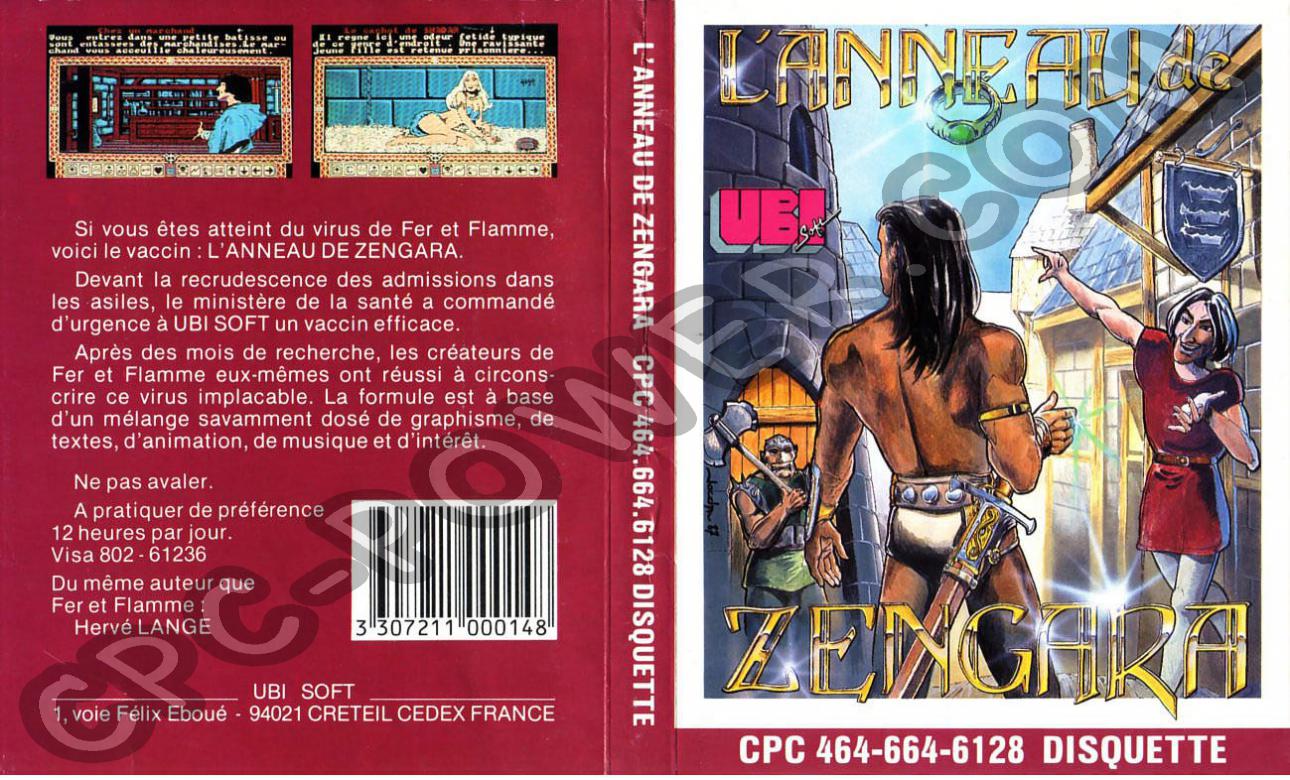
| The box emphasizes the connection to Fer & Flamme as if that was a good thing. |
Reviews at the time were pretty poor as well, judging from comments Lange made in a
2011 article. He never really "got it." His next pseudo-RPG,
B.A.T. (1989), would have a lot of the same problems (see
my coverage), including a host of RPG attributes and skills that never play a role in the game, a paucity of combats, and a senseless plot. That game also features NPCs who tag along with you and occasionally pop their heads into the frame to comment.
We'll be continuing to check out the state of French RPGs in 1987 with at least three more titles, maybe four, continuing with something called Inquisitor: Shade of Swords. Up next, though, we'll see if I can make heads or tails of a rare-for-the-era Japanese RPG with a western PC release: Cosmic Soldier: Psychic War.