Monday, June 24, 2013

The Land of Make Believe

The lone adventurer has become a party.

I didn't want to post again on The Land until I've won, but about nine hours invested in that effort this week has not produced that outcome, and the game has gotten annoying enough that I'm not sure I'm going to continue.

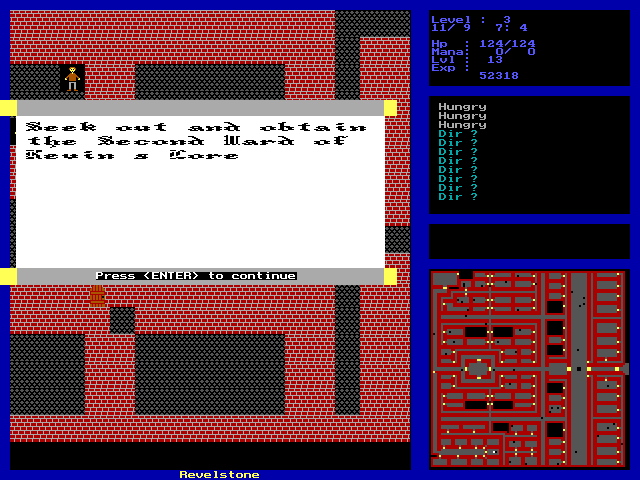
When I closed last time, I was trying to find the Third Ward of Kevin's Lore, and now I'm trying to find the Sixth. But there was more than just Four and Five in between; after the Third Ward, I had to find Berek Halfhand's Staff, Kevin's Sphere, and the Adant of Damelain before I continued with the Fourth Ward, meaning I've solved six quests since I last posted. They have been exceedingly repetitive and mostly uninteresting, following the same formula:

1. Get the quest from Lord Morham.


2A. Wander around and talk to people until someone gives you the lore that tells where the item is. Keep talking until you get a different lore that tells you the Word of Power necessary to break through the barrier around the item. Or:

2B. Go to the library in Revelstone and pay $1,500 for a "lore search." This is a neat invention that I hadn't really understood until recently. After paying the fee, you enter a keyword and you get whatever lore is associated with the term that you normally would have gotten from talking to people. This allows rich players to avoid bumbling around until they get lucky with the right person, and I've essentially used it exclusively since I found it. The game glitches and just shows you a blank screen when you do the search, but the lore shows up in the "lore log" that you can access with SHIFT-L.

Searching for lore on my latest quest in the library. I like this idea, though the broken economy (thanks to the broken gambling system) also breaks this.

3. Travel overland to the dungeon entrance.

4. Battle hordes of monsters as you search for staircases and slowly descend through the levels. The "Clairvoyance" spell, which I got at Level 11, helps by revealing unexplored areas, so it's a little easier to find the staircases down.

5. On the last level--always Level 10 until this last quest--find the barrier surrounding the quest object. Use the Word of Power to break through and grab it.

Finding the Adant of Damelain. I don't think "adant" is a word.

6.  Zip your way to the surface and get out of there. This got easier when I discovered a Word of Power (ABAKAAL) that allows you to jump up a level, and it got a lot easier when I discovered a Word of Power (MINTAAL) that automatically whisks you to the exit. Thus, most of the effort in the dungeon is just getting down.

This was a nice quest reward.

7. Return to Morham for the next quest.

As repetitive as all this is, I had gotten used to it, so the game's changes to the current dungeon, where I'm trying to find the Sixth Ward, are unwelcome. It has 15 levels instead of 10, and the barrier and item aren't on the last level. I'm slowly trying to work my way up and search every level, a process greatly complicated by enemies supremely talented at killing me.

The big change since last time is that the game got hard. For the first four quests, I was unnaturally beefed up in equipment and skills thanks to my gambling winnings. I simply charged through the dungeons and slaughtered the pitiful denizens wherever they appeared. This period of gameplay reminded me unfavorably of Ultima II, with its legions of enemies lining up to be slaughtered. Then I started to notice they were getting harder, and doing significant hit point damage as I barreled through them with abandon. So I slowed down a bit, watched my hit points, and healed myself when necessary.

Before long, though, they got so tough that I started dying every once in a while. I compensated for this by starting to use a bow and sniping them from afar. But soon their own magic missile attacks began to outclass my own, and more important, they started attacking in groups. Instead of fighting them individually in the main dungeon window, I entered the special combat map used in outdoor areas to take on more than one enemy at once.

At first, they attacked in pairs. Then triplets. The numbers kept growing, and now I routinely face six or seven of them.

During this period, I managed to get a "party" of my own. I figured out what I'd been doing wrong, at least in the game's own logic. When you encounter an NPC in a town or dungeon, he'll either talk to you and give you lore or join you. He won't do both. My mistake had been to talk to them first. What I needed to do instead was run right up and hit the (J)oin command.
The NPCs are of varying quality. The mount--a pegasus--is most important, as it greatly limits the time taken in overland travel. Some of the others have died almost instantly. A few have lasted a while and do pretty good damage to enemies with spells and melee attacks while I sit in the back and shoot at them. I feel bad about using the NPCs as cannon fodder this way, but I die, the game's over. Can they say the same?

Group-on-group combat.

There really isn't much you can do with NPCs. They make their own combat choices, although you can give them a broad command as to whether to generally attack or generally evade (I chose "evade" for my pegasus). They gain their own experience from the kills that they make (often stealing it from me!) but I noticed their hit points and levels don't actually increase from this process.

The party command screen.
 
In this last dungeon, the enemies have been too tough for me even with a barrier of NPCs. Some of them are capable of wiping me out with a few missile shots. Thus, combat has become much more tactical. I have a few resources at my disposal:

  • Terrain. The pathfinding for enemies in this game is pretty much this: if there's no direct path between the enemy and the victim, the enemy jams himself behind a barrier until there is. (The same bad pathfinding applies to party members, too, who tend to bunch up behind each other in combat.) This makes it possible to rest, heal, and use the horn strategy below. Also, enemies won't step on traps or cross certain dropped objects. They can shoot magic at you from behind these objects (and at this point, almost every enemy is capable of doing that) but not if they can't see you. So one strategy is to get them trapped, go off-screen, and fire arrows or spells down the hallway until the enemy dies.
  • Spells. I started accumulating one per level (and occasionally a bonus one based on a scroll) when I switched to the "Loresraat" class. I have a few dozen now. Of them, I use "Cure Serious Wounds," "Identify," "Clairvoyance," and "Fireball" most often. "Lesser Summoning" replaces an NPC temporarily if one dies. "Continual Light" is an odd one; when I cast it the first time, it created a light like a torch, only it's never burned out in six hours of gameplay.

My current spell list.

  • Items and Words of Power. Through lore, I've discovered the Words of Power that work with certain items (liberally dropped by enemies) to convey healing, protection, and offensive spells. For instance, MELENDRI used with a Sphere of Protection increases my armor class. I'm still confused by a lot of these, though; many don't work as advertised. For instance, a Lore Staff is supposed to heal me when used with MELEN, but it doesn't.
  • Horns of Blasting. These are a strange addition to the game that have been the only things keeping me alive. When you blow the horn of blasting--each of which has hundreds of charges--it damages anyone within a four-square radius. My survival strategy is to try to lead enemies to areas where some barrier blocks them from getting at (or shooting at) me and use the horn to destroy them.

From here, I'm able to hit multiple groups of enemies with the Horn of Blasting. I know they're dead when the status window shows that I've collected their experience points A glitch in the game keeps their icons on-screen even when I've eliminated the parties.

The horn strategy might not work for the rest of the game, though, as I'm running out of them. Enemies in this game tend to drop treasure specific to their level (or the level of the dungeon). In the first few dungeons, healing potions and food were dropped in abundance, but at this time (when I could really use lots of the former) I hardly ever see them. Horns of Blasting existed for about two dungeons when I was Level 17-18, and I haven't seen them since.

As you know, I do generally like tactical combat, and there is a vague NetHack-like feel to my current game state, when every time I see an enemy I have to figure out which combination of terrain, spells, and items work best. Unfortunately, this process isn't nearly as enjoyable as NetHack for two reasons:

1. There are one billion enemies per dungeon. Seriously, I think that might not even be hyperbole. They're relentless. You kill half a dozen packs of 'em, walk four steps, and face half a dozen more. Even the most joyful NetHack player who loves outwitting vampire lords would lose patience if he had to face 600 per level.

2. The enemies themselves aren't interesting enough. They come in two basic varieties--those who use melee attacks and those who use magic attacks--and nothing else differentiates them but icon and difficulty level. There are some theoretically capable of casting "Sleep" and "Fear," but I've never noticed any effect from these spells on my characters. In general, there are no enemy-based special tactics or strategies.

One other weird thing that's happened is NPCs have started showing up in packs with enemies. It was already odd enough to find NPCs in the middle of dungeon levels, but now it's worse because although they might be friendly, their companions certainly aren't, and once combat starts, my other party members don't make any distinction between them. NPCs also keep getting caught in my Horn of Blasting radius. I'm not 100% sure, but I think every time I kill an NPC, it damages my "Oath" and makes my "service" due faster.

Leveling has slowed considerably, with millions of experience points now required between each level. I get about one per dungeon. Leveling randomly increases skills and attributes. For me, strength is the most important. I'm carrying around so many quest items that I barely have room for any equipment, and each increase in strength gives me more carrying capacity.

I feel like I'm close to the end, so I don't want to give up now, but between slowly exploring and reloading when I die, it's taking more than half an hour to clear each dungeon level, and if I have to explore all of them to find the quest item, that could easily come to more than seven hours per dungeon. If I can find the Sixth Ward soon, I might have a go at the Seventh Ward (this is all putting New Orleans on my mind) and see if it ends the game.

I recorded some video below that demonstrates the various gameplay elements and combat mechanisms I talked about:
 
 
It starts in Revelstone, with a couple of examples of talking to NPCs and shops. At 00:41, you see overland travel and an example of multi-enemy overland combat. At 01:03, the game re-sizes the screen (it uses a shorter vertical screen for inventory) and you see some of this posting, in draft, behind it.

At 01:11, I enter Mount Thunder, an early dungeon, and use "Clairvoyance" to expand the map. The combats that follow are indicative of early dungeons in which you just have to charge at enemies and beat them to death. At 02:07, I kill an enemy with a "Fireball" spell and a few others with arrows. At 02:33, I use the Word of Power to exit the dungeon.
When I enter the Westron Mountains next, things change. At 02:58, you see me maneuvering enemies into barriers so I can repeatedly use my Horn of Blasting and wipe them out. A few such combats follow. At 03:49, you see me maneuver enemies against a trap so I can fire at them repeatedly off-screen without them continuing to advance. Even though these icons are showing just one enemy, there are actually multiple enemies behind them, and if I approach them and engage them in melee combat, I enter party-style combat as in 04:55. At first, my character uses arrows but at 05:16, he charges into melee range and uses his sword. He can't survive many combats in such circumstances, and at the end of the video, he dies.

Before we go, we have to deal with my next game, Fire King. I really need to trim some games off the list, and Fire King seems like a good candidate. I read the manual and played it for a little while, and as far as I can tell, it doesn't deserve its "RPG" label. It has no character development, only the most basic action-game-style inventory, and combat is solely based on the speed of the player's maneuvering and clicking. If someone would like to defend it as an RPG, you have a few days.


Wednesday, June 19, 2013

Cheats and Liars

Today I learned that if you win more than 1 million monetary units in gambling, The Land takes over and forces you to bet ridiculous amounts until you're knocked back down to a sensible level.

My employment of the ridiculously favorable gambling odds in The Land prompted a fun and interesting discussion on what does and does not constitute "cheating" in computer role-playing games. This subject has been on my mind since at least December, when I capitulated to looking at spoilers for NetHack.

But before I even begin to discuss these issues, I want to emphasize at the outset that I know it's just a game. All right? I don't want to see the comments flooded with people who feel like they need to tell me to "chill out, it's only a game." By even reading this posting, you're acknowledging that a blanket of triviality covers everything I'm about to say.

I do think, however, that it's worth thinking about right and wrong behavior even in something that's "just a game." Human beings have a limited amount of time in their lives, but unlike other animals are blessed with an abundance of choice in what to do with that time. Rule #1 of a good life is probably to invest that limited time in things that matter. If they don't matter because of their nature, then we can make them matter by the way we engage in them.

This is a topic perhaps better discussed in specifics rather than the abstract. Consider my second-favorite pastime: crossword puzles. The end result of a crossword puzzle--that I've managed to fill in 80 or so squares with letters--matters to absolutely nobody, and has no effect on the world except that I've spent however long it took me to do it. If I came running up to you with a crossword puzzle and said, "Look! I've filled a bunch of letters in these boxes!" you wouldn't be remotely impressed.

But the method by which I fill out a crossword puzzle can matter a great deal. If done right, it can exercise my mind, increase my capacity for lateral thinking, and teach me about new subjects. And when I come running to you and say, "Look! I finished the Saturday New York Times crossword in ink without any hints!," you're more likely to say "wow!" (Or, if you're Irene, "Weren't you going to fix the bathroom sink this morning?")

Now, if all I care about is filling in the blocks, there are a number of things I can do:

  • Fill them in with pencil, so if I realize I've made a mistake, I can erase it
  • Consult a crossword puzzle dictionary
  • Consult an actual dictionary
  • Use Wikipedia for the proper names
  • Go onto crossword puzzle forums and get hints from other solvers
  • If the solution has already been published, simply look at it 

These are in rough order of what I would consider least offensive to most offensive. I do most of my paper crosswords in pen, but only because I rarely carry around a pencil. Most crossword aficionados don't consider pencil even mildly cheating, and indeed pencils are used in the American Crossword Puzzle Tournament. A pen admittedly adds to the difficulty and would be akin to a "conduct" in NetHack.

A crossword puzzle dictionary only helps you with possible words given the positioning of various letters. You still have to match the right word to the clue. An actual dictionary might help you with definitions for unfamiliar clue words, but again, you still have to figure out the right answer. Wikipedia is more likely to just deliver the answer for proper names, historical references, and such, but at least you've learned something in the process.

In the last two examples, you're just looking up the answers, and you've circumvented anything positive that could come from the experience for the empty satisfaction of filling in the grid. You've taken time that you could have regarded as "invested" and turned it into time that you've simply "spent."

There are, similarly, a lot of ways to cheat at computer games, and it's easy to fall into the trap of thinking that that winning screen is all that matters. There are few games in which it is particularly impossible to get that screen. Heck, if you have the computer skills, you could just peek into the source files and load it up. Even if you want to get there with your own party, there's no end of mechanisms: saved game editors, walkthroughs, cheat codes, bug exploitations, console commands, online hints, debug modes, save scumming, start scumming, inventory scumming, and a host of other tactics depending on the game. And in the end, you realized you didn't actually earn that "won!" screen, and the taste of victory turns to ashes in your mouth.

"So what?!" cry those of you who didn't internalize my first paragraph. "It's just a game!" No, it's not. It's a game that you spent 20 hours playing! If you want to trivialize the process, why do it at all?

Now, this isn't to say that every game needs to be a Sisyphean nightmare. There are, naturally, degrees of circumventing the intended difficulty of the game, some of them within the intended mechanics of the game, and some of them inescapably "cheating." They vary from game to game and platform to platform. I would like to suggest that there are five levels to consider, from the admirable to the reprehensible:

1. Adhering to a conduct. I'm taking this term from NetHack and applying it to other games. In NetHack, it refers to playing an already-difficult game with additional restrictions, such as "atheism" (never praying to a god or employing altars) to "vegetarianism" (never eating animal corpses). Examples in other games might include:

  • Playing on the highest difficulty level throughout the game.
  • Severely limiting the frequency of saved games.
  • Deliberately role-playing a challenging party combination.
  • Refusing to use certain in-game resources, such as quest logs or auto maps.

Of these, I only typically do the second one with most games, though I wish I'd done the last one with the last two Elder Scrolls games. I did play Skyrim on the highest difficulty from the outset--it was the only way to make the game truly challenging--but that can be a killer in other games.

2. Not cheating. It's not cheating when the player uses in-game elements in a way intended by, or easily foreseen by, the developer, and consistent with the ideas of role-playing. CRPGs, like all games, are meant to supply certain avenues and advantages to the player to make it possible to win. Simply using these avenues as intended, even if it makes the game a bit easier, even if it makes the game a lot easier, is not cheating. Any in-game avenue that makes the game absurdly simple is  a matter of poor game design, not poor player ethics. Examples:


  • Grinding against any creature that the game offers as a matter of course. This includes "pudding farming" in NetHack, no matter what NetHack purists may say.
  • Using the full maneuverability that the game gives you, for instance to bob and weave around enemies in Dungeon Master.
  • Setting the difficulty level (if the game offers one) to whatever you prefer at the outset of the game.
  • Outfitting yourself with the best equipment available (including hammering your armor to godlike levels of protection in Skyrim).
  • Reaping the rewards of gambling in games that have gambling.
  • Stealing lots of things in games that have a theft mechanic.
  • Saving at reasonable intervals if the game allows saving-at-will.
  • Taking external notes and making external maps (another area in which I disagree with some NetHack purists).
  • Asking other players for hints (including limited searches of walkthroughs and FAQs) when you've honestly reached a point that you're stuck and cannot otherwise continue after exhausting all options you can think of.

I have to regard my use of gambling in both The Land and Questron II as not cheating. The programmers deliberately put in gambling systems that offered absurdly favorable odds to the player, and in the case of The Land, the developer had 12 years of updates to fix it. I can only imagine that it was intentional (the advantage conveyed by it only held for a few dungeons, as you'll hear about next time). In neither case was I doing anything that the game manifestly did not intend.

I would argue the same about the Cuisinarts in Might & Magic II. It's a clear mechanic of that game that enemies respawn, and the player is clearly meant to engage in some level of grinding against them. The inclusion of an enemy who is so easy to defeat and conveys such ridiculous experience rewards was a bad decision on the developer's part; it's not the player's fault for just wandering into their square. A player who wants a challenge wouldn't fight them more than once, but he's not doing anything wrong if he does.

This is poor game design, not cheating.

3. Playing like a jackass. These are things that are not technically "cheating," and they would normally be allowed under my categorization above, except that they constitute a certain abuse of the flexibility that the developers have provided, or they break the idea of role-playing. They're lame rather than dishonest. Examples:

  • Creating characters, stealing their equipment and gold, and deleting them.
  • Murdering NPCs for their equipment (possibly defensible in some games if you have a particularly apt evil role-playing reason).
  • Saving constantly and re-loading just because you don't like the outcome of a decision.
  • Using walkthroughs and hints with abandon instead of putting in the time to solve problems yourself.
  • Changing the difficulty level of the game in the middle of combat.
  • Exhaustively consulting material on the game before you start with the intention of creating an "optimal" character or party instead of using the clues the game gives you and living with both strengths and weaknesses.
  • In some modern games like the Neverwinter Nights franchise that allow transferring characters aross multiple modules, starting a character in a module that immediately elevates him to a high level, then saving him for use in a lower-level module.

This would qualify in this category if it wasn't so damned funny.

4. Exploiting. The player exploits the game when he takes advantage of a bug or game mechanic that the developer clearly didn't foresee or intend. Examples:

  • Using item-duplication glitches to give all your characters long swords +5 (Curse of the Azure Bonds) or load up on expensive inventory to sell (Diablo).
  • Abusing glitches that allow you to turn in the same quest multiple times and get the experience and gold rewards. There's a famous one in Might & Magic VI.
  • The old Ultima IV trick by which if you "accidentally" put in the wrong disk during certain loading times, chests spawned everywhere.
  • Killing shopkeepers and reloading to get their inventories to reset in Skyrim.
  • Repeatedly restarting your party to take advantage of the skill point reward in the Dragon Wars underworld.

In the original version, you could click on "Quest" as many times as you wanted and get the experience for finishing the quest over and over.

I see exploits as only slightly less dishonest than outright cheating, and it's probably done by people who simply don't know how to use hex editors and console commands. I suppose, however, there's room for someone who accidentally stumbles on an exploit and doesn't realize what's happened until it's too late to undo it. At that point, I grant that the player isn't obligated to restart the game or anything, as long as he doesn't continue taking advantage of the exploit.

5. Cheating. Outright "cheating," to me, is when the player uses external resources to actually modify the game program or files. The examples should be obvious:

  • Using a hex editor or special "character editor" program to improve attributes, experience, or gold.
  • Backing up saved games in games where permadeath is intended.
  • Using emulators with save states to circumvent the game's intentions about where you save.
  • Cracking the game files to look up information that you're not intended to have.
  • Employing console commands to kill enemies, improve the character, or otherwise circumvent some part of the game's difficulty.

With this category, though, we almost come full circle, as there are legitimate and defensible applications of the above. For instance, I've used save-state emulators in playing the early Apple II games simply because I've found the saving process so glitchy that I risk losing my progress otherwise. Console commands can help resolve unfixed bugs in complex games like Skyrim. Without an external patch, I wouldn't have been able to leave the first level in Bloodwych. It's unclear in some early games (like the Wizardry franchise) whether the developers intended that you create copies of your saved games. Ian Kelley's walkthrough of Knights of Legend describes how he would compensate for the game's broken training system by using a hex editor to increase his weapon skills while simultaneously decreasing his adventure points and gold by a commensurate amount. I could see a good argument for using a save-state version of DOSBox for Knights of Legend to be more in the "playing like a jackass" territory than all the way up here in "Cheating." There are times, no doubt, where it feels like the game "forces" you to play like a jackass, exploit, or cheat.

Me cheating at Mission: Mainframe.

My playing has not always been pristine. Despite my rules, I've occasionally dipped into a walkthrough when I was completely stymied, and I relied on walkthroughs entirely to get out of Wizardry V and Drakkhen. I used a hex editor to see the ending of Mission: Mainframe. I "won" Omega by taking advantage of a game bug. I save-scummed on Mike's Adventure Game. Though everyone seemed to agree it was okay, I looked up spoilers for NetHack. Some of these abuses were in the name of documenting the endings of otherwise-obscure game, but all constitute cheating under my own rules. Nonetheless, I've played 101 games at this point, and if I've cheated at less than 10% of them, I feel like I'm doing well. The one thing I haven't done, however, is lie about any of the above. When I've broken my own rules, I've been up front about it.

Again, you may ask, what difference does it make? Isn't the point to have fun? Perhaps. But once again, I am of the mind that if you're going to spend any amount of time on an activity, you might as well do it right. Even in the most purely hedonistic pursuits, there are ways to do them that demonstrate class and character, and there are ways to do them that demonstrate tactlessness and disrespect. I'm sure that in their lives, Humphrey Bogart and Lauren Bacall got just as drunk as David Hasselhoff and Lindsay Lohan, but there's a reason we don't remember Bogart and Bacall as national jokes.

I suppose that in the end, you could argue that what you do in the privacy of your own gaming room doesn't matter to anyone but you. But by coming on sites like this and talking about these games, we make ourselves part of a community, and that community ought to have some shared expectation of what constitutes an accomplishment. It was for this reason that I was so determined to win NetHack honestly. It's a silly thing to be proud of, but I'm nonetheless proud of my winning streak for the last 22 winnable games. I'd have no right to that pride if I'd won them by hacking and exploiting the games, no more than an "artist" who simply runs a photograph through PhotoShop's charcoal drawing filter, or a marathon runner who takes the subway to the finish line, or a woman who joins a book club and just watches the films.

I acknowledge that these opinions are all my own, and there's plenty of room for debate in here, as well as extra examples in all of the levels. I look forward to your comments.

Tuesday, June 18, 2013

The Land of the Lost

Looking up a map of The Land is probably a spoiler, but I figured most fans of the series would already have this at their disposal.

The Land is proving to be a long game, perhaps needlessly long, without much becoming clearer on the main quest. It seems to be shaping up into a series of quests to find the seven "wards of lore" left by Lord Kevin. I tried to look up some of this stuff online, and it sounds like Kevin was Lord of Revelstone who created some kind of horrific magic ritual to destroy Lord Foul and sealed away his knowledge in seven "wards" so it wouldn't be destroyed by the ritual, too. I guess the ritual didn't work, and Kevin ended up dying instead.

I don't know exactly how the plot of the game is following the plot of the books. There's some indication that I'll eventually hook up with Thomas Covenant. I got some lore about him, and there's an icon representing him in the tileset.

What about me?! I'm the one doing all the work!

The first quest, taking me to the dungeons beneath the giant city of Coercri, gave me a peek at the game's approach to dungeons. They're huge (all maps seem to take up all available map space), multi-leveled, and randomly-generated. The game regenerates levels as you go up and down, so every time you want to ascend or descend, you have to go through a process of finding the stairs again. The random generation creates oddities such as doors that go nowhere or doors right next to openings.

Each time you visit or re-visit a level, the game tells you how many experience points are to be found there, which is kind of silly because the number isn't really fixed. If you go up and down again, you'll get a new map with a new experience point total. This does mean, however, that once you "clear" a level, you don't have to worry about enemies regenerating (that is, until you leave and return).

There are multiple creatures to be found in the dungeons, and as you slay them, they drop food, weapons, armor, potions, torches, staffs, scrolls, and gold. You also find these things laying around. The scrolls give you the same types of lore that you might get from people in towns, although there are occasional scrolls that give you an extra spell and Scrolls of Identification. Much like NetHack, potions are color-coded and items are given generic descriptions, but once you identify them once, the identification holds for every subsequent item that you find of that color or class. You need torches to get around and the occasional meal to keep healthy, but these are both so plentiful that you don't need to worry about bringing a stock with you.

Gideon fights a little creature while the detritus of previous battles--a staff, a sword, and a bit of food--lie around him.

Unlike the wilderness areas, combat is all on the main screen. I removed much of the fun and challenge of the game with my casino haul. Because I bought so much gear, I wasn't remotely interested in 90% of what enemies dropped (food and the occasional potions were the exception), and I've only found one enemy who was remotely dangerous to me (see below). Part of me wants to start over and experience the game "straight," but that's kind of like a guy who insists on continuing to work a menial job after winning the lottery.

NPCs show up randomly in dungeons, too, imparting the same sort of lore that they do in towns. In the second dungeon I explored, they included centaurs, but they said the same things that humans did.

Gideon trades "hellos" with an NPC. Note the nonsensical doors all over the place.

Because of the random regeneration every time you leave a dungeon level, there's no point trying to explore everything. In the first dungeon, I reasoned that the quest item would be on the last level, so I just kept moving downward every time I found a set of stairs. Eventually, I mapped the tenth level exhaustively and had found no stairs, so I knew that was the last one.

The tenth level of Coercri was also the only level to feature something other than generic corridors. At first, I thought it was some kind of water, but later I reasoned that it was a barrier. I didn't know what to do with it, but I fired up my lore and started trying all of the "words of power" that I had learned. One of them, MELEN, opened a passageway through the barrier and to the first ward.

After that, I slowly made my way up the 10 levels, having to find the staircases all over again, and returned to Revelstone. There, the lord who had given me the original quest (Lord Mohram) told me to find the second ward.

I think I'm sensing a pattern.

A bit of lore said that the second ward was under Mount Thunder, but I had no idea where that was. I spent a while wandering around The Land trying to find it, and I quickly discovered that time passes very quickly while wandering around the wilderness. My character aged from 20 to 22, I burned a ton of food, and I had to return to Revelstone to perform my "service," which is nothing more than entering the city, hitting "O," and watching as eight months burn away. I really don't understand the purpose of this feature.

Wilderness combats also started presenting me with multiple foes at once.

During my wanderings, I explored the forest city of Revelwood, where I ran into an NPC named Corimini, who asked if I wanted to join the "Loresraat." I said sure, why not, and found myself having changed classes (I had forgotten that Loresraat was a class). It re-started me at 0 experience points, but I kept all my skills and hit points from leveling up as a Warward. One advantage of the change was that I got access to spells; every level-up let me select a new one.

"Know" in the biblical sense?

This is great in theory, but so far I haven't needed to use any of them; my regular attacks and armor defend me fine. Even poison, which some creatures are capable of inflicting, lasts only a few turns.

The icons in the left-center show that my character has cast "Protection," he has quaffed a potion of fire resistance, and he has a torch lit.

In addition to spells, there are supposedly items (Gems of Brightness, Crystal Balls, Staffs of Curing) that work in response to various words of power. I've not been able to get any of them to work, though. If I wield the item and speak a word, nothing happens. If I "use" the item, nothing happens.

Still lacking the location of Mount Thunder, I caved and looked at a map of The Land online that would have been published in one of the Thomas Covenant books. I followed the features to the indicated location, but there was no obvious entrance to a mountain. I tried standing on random squares in the middle of the mountain and hitting the "down" key, and one of them took me into the dungeon. Horrible game design there.

The entrance to the mountain is a couple squares to my southeast. Is it just my colorblindness screwing me again, or am I right that there's nothing there?

As in the previous dungeon, I headed down as quickly as possible, but my explorations of the bottom level didn't turn up the ward--just an NPC named "Drool Rockworm" who I couldn't hit and was capable of killing me in about three hits. None of the other foes in the game have been even remotely dangerous, so this was a bit of a change.

For a little guy, he sure packs a punch.

I ran away from him, started exploring upward, and found the ward on Level 9. I had been previously alerted by an NPC or scroll that "the power of the wards is unlocked by the previous wards," so I tried the word that I had received at the first ward--MELANKURION--and got passage through the barrier to the second. Here, I was relieved to receive a word of power (ABAKAAL) that automatically transports me upward in dungeons. Exploring downward is still a pain in the neck, but at least returning to the surface is a lot faster.

Thank god for the "lore" window because I wouldn't be able to read what that word is otherwise.

Returning to Lord Morham, I received a quest to find--you guessed it--the third ward. (Is the game over when I've found all seven, or is this just a prologue?) A bit of lore suggested that was in a place called Doriendor Corishev, somewhre in the south. Getting there was a bit of a nightmare. Navigating through mountains isn't easy in this game: when standing among mountains, you often can't go certain directions, but there's no graphical indication where the "barriers" are. You have to blindly feel your way through them.

Navigating a path through the mountains.

Once I reached the area where the dungeon should have been, I found that it was just like Mount Thunder: no visible entrance. I had to wander around testing a bunch of random squares of mountain and grass before I finally found it, about a half hour later. I later discovered that the small-scale map (in the lower right) has a little black square where dungeon entrances are, so as long as you have the general area, it's not as hard to find as I've been making it out to be. As I close, I'm working my way down through the levels.

I'd like to get far enough to where I get additional party members. The "party" screen suggests I can have up to five of them, but everyone I ask to join me says "no."

Gideon sits at the head of an empty party.

Again, I'd love to hear from anyone else who has played this game, and any context to this plot from anyone who has read the books. I feel compelled to stick with it for at least a little while longer. It was clearly a labor of love for developer Mike Riley, and there isn't much about the game online except an article at RogueBasin. I'd like to be among the first to show the winning screenshot or post a little gameplay to YouTube. (I might be missing stuff that's out there, but it's hard finding articles for a game with as generic a title as The Land. Nothing came up when I tried to Google the types of terms that would show up in a walkthrough.) I'm just sorry I don't understand more about the context of the game.


Sunday, June 16, 2013

Game 101: The Land (1985-2009)

Presenting the worst font ever.
     
The Land
United States
Independently developed and published
Multiple versions released between 1985 and 2009
Date Started: 16 June 2013
"One word more," Foul said, "a final caution. Do not forget whom to fear at the last. I have had to be content with killing and torment. But now my plans are laid, and I have begun. I shall not rest until I have eradicated hope from the Earth. Think on that, and be dismayed!"
--Lord Foul's Bane, Book 1 of The Chronicles of Thomas Covenant, the Unbeliever, Page 20.

My reaction.

I suppose I should give Stephen Donaldson's The Chronicles of Thomas Covenant another try. A lot of people I respect seem to like the books, they apparently deal with complex themes in a fantasy backdrop, and the idea of a protagonist with leprosy is fascinating. But wow, the writing in the first book was awful. That quote above came at the end of about three pages of awkward exposition that you have to read to believe. I half expect that at the end, when Covenant wins, Lord Foul says, "You beat me?! I am destroyed."

The Land is set in the world of the books, called by its inhabitants...wait for it..."The Land." The geography, city names, monster names, and character classes are all drawn from Donaldson, giving non-readers a slight disadvantage. The game gives you no clues as to the story and quest, although the manual says that the latter will become clear during gameplay. As I cover this game, I won't mind at all if those of you who have read the books chime in with a little context.

"Lord Osondrea" is a character in the books, but damned if I know what role she plays.

You begin by naming your character, distributing 20 points among the six standard D&D statistics (all of which start at 10), and choosing from among seven race/class choices that are unique to the game. There are starker strengths and weaknesses among the classes than in, say, NetHack, with certain classes unable to use certain magic or spells. "Ramen," for instance, fight unarmed and unarmored and can never ride horses. "Warwards" can use any armor and weapons except for artifacts. "Loresraats" can use anything, magic or spells, but advance very slowly in experience.

My first character.

The game is often classified among roguelikes, but the tag is slightly debatable. It has a vague roguelike feel to it, especially in the selection of keyboard commands and the inventory. I don't know if early The Land influenced Omega or if Omega influenced later versions of The Land or if they have a common ancestor, but they seem very similar. (Certainly, they didn't independently come up with the idea of an "Up in Air" slot in the inventory.) It also has a certain randomization to some maps, and you only uncover areas as you move through them. On the other hand, it has a nice graphic tileset and some bloopish sounds, and there's no permadeath. Like Omega, it has an overworld and multiple towns and dungeons. You can apparently get other party members to join you, though I haven't gotten that far yet. In general, the game feels more like Ultima I or Ultima II than a traditional "roguelike."

Roguelikes and other freeware games are often difficult to peg to a specific date because they undergo continuous development throughout their lifetimes. I "solved" that problem with NetHack by breaking it into six "editions" and planning to play each one in its appropriate year. But I'm not going to do that for every roguelike. In the case of The Land, version 1.0 was released in 1985 and version 5.0 was released in 1996. I'm playing it among 1989 games because MobyGames said it was released in 1989; I'm guessing they got this from the version 2.3 release date, which was the first release to the public at large. The release notes suggest that not much changed between 1989 and 1996 except for bug fixes and a conversion to VGA, so I don't feel like I'm playing it significantly out of order. 

Exploring "The Land."

Combats come upon you unannounced--enemies don't have icons that approach you while you explore. You're taken to a separate combat screen at that point (again like Omega, at least in its outdoor areas), where you can cast spells, attack with ranged or melee weapons, or flee.

Fighting a "cavewight type."

The game has a few other staples of roguelikes, including a hunger system and an encumbrance system. Its inventory system is a little confusing; removing items from packs puts them in the "up in air" slot, at which point you have to either put them back in the pack, use them, or assign them to an appropriate place on the body. I've found that if you hit the wrong key during this process, you can lose the item for good.

Shopping in town.

I don't know if all towns are like this, but the first town I explored, Revelstone, was huge and featureless, with multiple shops, NPCs selling equipment, and NPCs who would offer a bit of lore. Aside from buying things, the primary purpose of towns seems to be the accumulation of "lore" about the locations of various items and towns and the uses of various objects.

With a name like "Lord Foul," could he be anything else?

Revelstone also had a college with various "courses" you can take to increase skills, which is a nice use of the economy, although the economy is broken (see below).

Increasing skills in college.

The Land has a reasonably interesting skill system, with 16 separate skills for different types of weapons (edged weapons, pole weapons), travel and wilderness skills (scouting, hunting, riding, boats), and magic and lore. You start with 0 in all of these categories, but you can increase them by paying for training. As you level up, your skills increase randomly (an aspect of the game I don't like).

There are some other neat innovations in the game. Like any roguelike, it has good in-game documentation of icons and commands:


The main screen makes good use of its real estate. There's an odd "oath" system by which every class has to render a certain amount of "service" per year to his or her profession, done by returning to the home town. Characters age and, I guess, can die. The game keeps track of each piece of lore that you learn and displays them with SHIFT-L.

I'm not sure how the items in white (at the bottom) differ from the ones at the top.

Balancing these innovations are some "features" common to 1980s freeware games with only one developer. The manual is extremely scant (perhaps by design). You can't fully explore cities because you can't actually enter shops (they activate when you "open" the door), and because they activate automatically, you can't explore rooms across the way from them.

One of these doors has a shop. What's behind the other one, I don't know, because every time I try to (o)pen it, I end up back in the shop.

Hitting an unexpected key frequently produces an error and kicks you to the DOS prompt. This would have been rage-inducing in NetHack, but I suppose it's not so bad in a game that allows you to save anywhere. The font used in dialogue is absolutely unreadable, mitigated a bit by the game keeping track of what's said.

A lore staff is used with WHAT?!

Soon after entering Revelstone, I found an astonishing game-breaking mechanic: the gambling system at taverns and inns. There are two games: "dragon dice" and "die square." "Dragon dice" is a bad investment. You roll three dice, and some of the possible combinations pay out at different ratios. I calculated the rate of return at about 0.81 to 1.

It's not as bad as it looks, as the game organizes the rolls in order, so 6-6-3 pays out whether you roll that, 6-3-6, or 3-6-6.

 "Die square," on the other hand, would bankrupt any casino that tried it. You have a nine-square grid, and each square can roll one of two symbols. If the pattern of any one type of symbol makes an "X" or "+", it pays out 25 to 1; if it makes a square (only the one in the middle a different symbol), it pays out 50 to 1, and if all 9 squares end up the same symbol, it pays 100 to 1.

The economy-breaking gambling game.

We don't really have to work out all the probabilities to see why this system breaks the game. Pretend that the game only pays out on an X. The odds of getting an X for one symbol, which involves 5 squares, is 0.5^5, or 0.03. But it pays out if you get either symbol in an X, so multiply that by 2, and we get 0.06. That means you'll win on an X 6% of the time. If the game paid 100/6 or 16.67-to-1, you'd break even over the course of time. But it doesn't pay 16.67-to-1; it pays 25-to-1. The rate of return on this symbol alone is over 1.5 monetary units for every 1 spent.

The probability of a + is the same. Add to this the more remote probabilities of a square or full grid, and you're getting a ridiculous payout. The proof is in my pocket. Within five minutes, I went from 590 gold pieces to over 300,000.

This win gave me 250,000 monetary units from my 10,000 wager.

Questron II was bad, but not this bad. I think there might have been spending caps with that one. In this case, I was able to take my new found wealth and purchase some badass equipment and training.
 
My post-winnings inventory.

The obvious solution, if you want to play the game straight and struggle for your money, is "don't gamble." But I'm a big believer in the notion that it isn't cheating if the game gives you the ability to do it without resorting to obvious bug-exploiting. If the game seems a little too easy after this, I'll know why.

A lord in Revelstone seemed to give me the first quest: "go get the first ward of Kevin's Lore" in Coercri. Other characters told me that Coercri is on the east coast of Seareach, Seareach is northeast of Sarangrave Flats, Sarangrave Flats run along the east of Landsdrop, and Landsdrop separates the upper and lower lands. I suspect if I wander around a bit, I'll find one of these other features and thus get a bead on where to go.

I think that says "Ward," anyway.

I feel a little crippled without having read the books (the only wiki online is woefully incomplete), but I'll see what I discover in my initial six hours.


Saturday, June 15, 2013

NetHack 3.0: Final Rating

Hey, that's how I roll.

NetHack (3.0 series)
United States
The series includes 11 public releases between July 1989 and February 1991
Date Started: 24 June 2012
Date Ended: 12 June 2013
Total Hours: 262
Difficulty: Hard-Very Hard (4.5/5)
Final Rating: 44
Ranking at Time of Posting: 76/96 (79%)

In the 1990s, I had a six-year enlistment in the U.S. Army Reserves. When I first joined at the age of 17, I was weak and pudgy. I had never done any serious exercising or bodybuilding in my life. Shortly after signing the enlistment paperwork, I read in the literature that on the first day of basic training--three months to come--I would need to perform 20 pushups; otherwise, they'd send me to a remedial physical training course for some extra weeks. I didn't like the sound of that.

I dropped to the floor and did pushups until my arms were exhausted and I physically couldn't lift them anymore. Specifically, I did four pushups. After that, I got up and began scanning my paperwork for any loophole that would get me out of my enlistment.

It's not that I didn't realize there was such a thing as training; it's just that the distance between 4 and 20 seemed so vast--my body so exhausted after those four--that I couldn't conceive of a time in which, no matter how much training I did, my body would be capable of 20 pushups, let alone the 52 I would have to do to pass the physical fitness test at the end of the 13 weeks.

But, having no way out of it, I worked at it, and in the next three months, I built myself up to the point that I could easily do 20 on the first day, and after that to the point that I was able to do not 52 but 80 in the final test. After that, pushups didn't seem so hard. I haven't done any in over a year, but  I just dropped and managed to coerce my old, out-of-shape body into 28 of them.

That should have been a lifelong lesson, and yet it still surprises me how often in life we mentally deem things as "unachievable" until we actually achieve them. Upon achieving them, it's like our brains instantly re-wire, showing us maps and paths and patterns where we couldn't see them before. It's like those "magic eye" pictures where until you cross your eyes the right way, you can't believe there's a 3D image in there, but once you find it the first time, you almost can't stop doing it.

While I was doing pushups, every time I hit a new record--10, say--my mind interpreted it as "the most I'm able to do right now, and perhaps the most I'll ever be able to do." But when I hit that goal of 20, 10 just became "the halfway point." Essentially the same thing happened in NetHack. My brain rendered every new achievement as, "Okay, I've reached the highest level I've ever achieved. Now when am I going to die?" But now that I've won, and I can "see" the game in its totality, it doesn't seem that hard.

Last year, blithely getting to character level 10 and dungeon level 13 would have seemed unthinkable. Today, I accomplished it while screwing around just to take screen shots for this posting.

It seems absurd to say this only a few weeks after comparing myself to a monkey who would never ascend given infinite time, but now that I've won, now that I know how the entire dungeon maps out, now that I realize what's possible and how to do it, I think I could ascend (in this version, at least) at least once every 20 characters. (Maybe if I kept at it, I'd get so good that I'd have to play with "conducts" like never eating meat or never killing another creature directly. These strike me as insane the same way that ever ascending at all struck me as insane a month ago.)

Many commenters had been explaining these realities about the game for the entire year, but there's a difference between "knowing" something and "getting" it. Reading over my old NetHack postings makes me cringe a bit. I wish I could send comments back in time to myself. I've been thinking about what I'd say to ensure that 2012 Chet really gets the game, and this is what I've come up with:

1. A character with greater than 17 strength or dexterity, more than 70 hit points, less than -10 armor class, telepathy, poison resistance, a blindfold, a decent stock of throwing weapons, and a unicorn horn is essentially invincible for the first 25 levels. Immediately work towards these at the outset. Of these, poison resistance is probably the most important, so you don't have to worry about what you eat, and thus don't have to worry about starving.

The intelligence delivered by telepathy and a blindfold was vital to my ascension. Here, I see a squad of "Mordor orcs" coming through the doorway.

2. Once you get these things, or at least most of them, The first half of the dungeon is your playground. Go up and down liberally, kill whatever you can, and start to tick off items (both equipment and intrinsics) on your "ascension list." Once you're down to only a few items, you can head to the Castle and use the Wand of Wishing to get the rest.

3. Carefully note locations of altars (especially co-aligned altars), fountains, sinks, and shops. You will return to them throughout the game to test the blessed/uncursed/cursed status of items, figure out what different items likely are, and create holy water. (Incidentally, to me most potions are worth more diluted and turned into holy water than fulfilling their original functions.)

Sacrificing a Potion of Object Detection to make a Potion of Water.

4. The most important intrinsic/extrinsic combination to acquire is teleportation/teleportation control. It will get you out of a ton of jams and make navigation much easier (and this was before I knew about CTRL-T!).

5. Don't obsess about not being able to identify things. With the exception of weapon bonuses, almost everything in the game can be identified through some combination of careful testing and noting the results. As far as weapons go, your level and strength matter much more than the type of weapon you have. (I ascended without even knowing what I was carrying.) Don't start thinking about suicide every time an acid blob corrodes your sword.

6. Items don't generally disappear. Make caches for yourself, using boxes when you can. Backup weapons, missile weapons, food, armor, pick-axes, and unicorn horns will all become extremely valuable once the Wizard of Yendor starts cursing your stuff.

7. Once you exhaust the possibilities of the shops, stop hauling around gold. It just takes up weight you need for other stuff. Cache it if you really want it, but it's hardly necessary to win the game.

The nature of randomness in NetHack can't be overstated. I think everybody understands that the levels are random, so they never look the same from game to game, and the distribution of equipment is random, but simply stating that doesn't convey how this randomness fundamentally changes the game from character to character. I've had games where I found blindfolds on Level 1 and games where I never found one and had to wish for it; games in which I've quaffed six "Potions of Gain Level" before reaching the castle, and games (including the last one) in which they never appeared; games with shops on every level between 3 and 7, and games with no shops at all; games in which I never found a co-aligned altar; games in which I've found enough wands to crack the world in half, and games where wands were a rarity. Whether you encounter the Wizard on Level 50 or Level 41 (as I did) makes a huge difference as to the difficulty returning to the surface.

Chester gets lucky with a blindfold on Level 2.

Despite its randomness, we have to observe, with something approaching marvel, that NetHack is an extremely "tight" game. There are tons of items in the game, and thousands of different ways in which they can interact with each other, but the developers seem to have anticipated every potential interaction. Consider the way that you can bash or pry chests with weapons, dilute potions and "blank" scrolls in fountains, make pets out of enemies by throwing food at them, and throw potions at enemies (with a chance that they'll splash back at you!). The developers not only bothered to program different effects for scrolls based on their blessed, uncursed, or cursed statuses, but also have a different effect for reading each scroll while "confused." The self-polymorphing system allows you to turn into just about any monster and gain their special attack and defense skills while doing so. You can turn enemies to stone while wielding the corpse of a cockatrice as a weapon, something only possible while wearing gloves.

This logic unfortunately also applies to death. When I first started this blog and announced it on Reddit, I knew nothing about NetHack. Some of the commenters started talking about it, and one of them remarked:

I made it to the plane of fire before drowning in lava because I took off my ring of levitation to eat a corpse...To be fair, that was an extremely stupid mistake on my part. I had plenty of food in my pack, but I wanted to eat a fire giant to gain some more intrinsic strength that I didn't even really need.

Can you imagine what this sounds like to someone who hasn't played the game? I remarked that it sounded "terrifying." Imagine trying to keep up with all of the possibilities hinted by those couple of sentences. And all in a game where everything is represented by ASCII characters.

These combinations--and hundreds more--make each game of NetHack essentially unique, with the exception of a few fixed levels and of course the endgame. They make hearing about each character's experience, even deaths, relatively interesting.

Given all of this, I can see how people become addicted to NetHack. Every time you step into the dungeon and start exploring the first level, you wonder, "What am I going to find? What unique challenges will the game throw at me this time?"

But ask me if I really "enjoyed" the 262 hours I spent over the past year ascending, and I don't know how to answer. Part of me says that it's a crime, really, that a game this clever, this innovative, this engaging turns off so many players with the specter of permadeath. I realize permadeath is a staple of roguelikes, and most roguelike players wouldn't trade it, and that it introduces a tactical depth to the game that wouldn't exist otherwise, and that it makes the final ascension all the more exhilarating...but let's be frank: someone shouldn't have to invest more than 250 hours in a game to win it. That's just crazy. Imagine what else I could have accomplished in that time. I certainly could have finished any of the numerous books I have half-started. I might have been able to make a good dent in my dissertation. At worst, I could have watched every film on IMDB's "Top 100" list, and still had 62 hours to spare.

All right. This has been a very long intro. Let's see how the game rates on the GIMLET. I should mention that I already rated the "early NetHack" series in January 2011, having experienced much less of the game, but I'm not going to look at that while compiling the scores here.

1. Game World. I've never experienced a roguelike in which the story, lore, and history was well-defined. It's not generally the priority of the genre. In NetHack, you're not really told anything about the game world, and although there are some vague hints in things like the names of gods, they never come together in any kind of "story." (At least, not in this version.) Score: 1.

2. Character Creation and Development. The creation process isn't much--name and class--but the development process is pretty satisfying. Rewards for leveling up, which happens very swiftly in the early game, are welcome and tangible, at least through about Level 10 (after that, the experience requirements get so large that you essentially need to find Potions of Gain Level or to eat wraith corpses). Perhaps more important are the aspects of development that come from eating corpses to gain intrinsics (fire resistance, poison resistance, teleportitis) and those that improve statistics. Unfortunately, there aren't many ways (in this version) to improve anything other than strength, which is admittedly a pretty important one. The whole point of the game is to make yourself more powerful, and it offers you plenty of opportunities to do so.

Chester gains the "resist cold" intrinsic.

The game could stand to do a little more with class-specific role-playing. The character choice determines starting attributes and equipment, and I suppose this choice still matters late in the game to the extent that it's hard to get a high intelligence score unless you start with it. There are a few alignment-based conducts that affect luck (e.g., lawful characters shouldn't use poison arrows). But overall, it doesn't feel like class "matters" much in this version. I understand that changes later with class-specific quests. Score: 6.

3. NPC Interaction. There really aren't that many in the game. The "chat" command is woefully under-utilized. There's the occasional shopkeeper, the Oracle, and some priests that can matter, but your interactions with them aren't very deep. I suppose it deserves a few points for the bonuses you get from the priest and the things you learn about the game from the Oracle. Score: 2.

Chester "chats" with a friendly orc.

4. Encounters and Foes. The game throws a dazzling array of obstacles in your path to ascension, including curses, various debilitating conditions, and dozens of monster types organized into a handful of classes. These monsters have enough strengths, weaknesses, and special attacks to make the game reasonably tactical, and it even has nice one-paragraph descriptions of certain special monsters. I love the variety of the encounters: floating eyes freeze you, leprechauns make off with your gold, nymphs seduce you and steal your equipment, were-creatures can give you lycanthropy, fire elementals can cause your scrolls and potions to catch fire or boil. Every new letter occasions a rush to your notes or the NetHack wiki to figure out how to best deal with it. There are deeper encounters with vault guards, Keystone Kops, the Wizard of Yendor, and other situations that are rare but fun. There just aren't many role-playing options in all of this. Score: 6.

I had my gold ring stolen Monday, Wednesday, and twice on Friday...

5. Magic and Combat. The magic system is underpowered in this version, even for spellcasting classes. You rarely find spellbooks, and you need multiple readings to get very proficient with the spells. Even then, they fade after you cast them a few times. Combat, on the other hand, is enormously tactical despite only a single "attack" option. Knowing when to attack, when to use a spell or item, and when to flee is both an art and science, and it takes dozens of hours of study to figure it all out. There's even some limited use of the "terrain" in combat, such as finding choke points where only one enemy can attack at a time, luring enemies into traps, shoving boulders into their paths, and locking doors to keep them from getting to you. Pets add an entirely new dimension that I never explored. Score: 7.

6. Equipment. Easily the best and most well-written part of the game. There are so many things to find, use, wield, and wear that it's hard to keep track of them all, and the game features a highly original system by which you either have to identify the items (via spell or scroll) or intuit what they are through practice or experimentation. I love games that give you lots of armor options, and this one has armor, helmets, shields, boots, gloves, and cloaks to keep me happy. The testing process can sometimes be laborious; some of my least-fond memories involving killing an entire barracks full of soldiers, lieutenants, and captains, then hauling loads of their gear to the nearest altar to ensure it's not cursed before systematically testing it for its effects on my armor class.

Chester won't be wearing that cap.

The whole blessed/uncursed/cursed process adds even greater depth to the equipment system. Scrolls of Genocide wipe out monsters; blessed Scrolls of Genocide wipe out entire monster classes; cursed Scrolls of Genocide create the specified monster. The latter isn't always a bad thing. Also notable is how armor and weapons can increase in level or degrade through various scrolls and monster attacks.

Equally important, as I noted above, is the way in which the different items you can find work together. You can dilute potions into potions of water, then turn them into holy water by placing them on an altar, then use them to bless or un-curse your items. A Ring of Teleport Control with a Cursed Scroll of Teleportation can take you anywhere in the dungeon. Magic markers can create scrolls if used with blank paper. I'm sure I didn't find even half of the possibilities. Only a lack of in-game item descriptions keeps NetHack from a perfect score here, but otherwise it's the best equipment system of any CRPG so far. Score: 9.

7. Economy. Not so good. Gold can be useful in the early stages at shops--if the game bothers to generate any--and in donations to a co-aligned priest--if he appears. It's useful when you encounter the Oracle (again, if you find one in your game). Otherwise, all it affects is your final score. The game has piles and piles of gold everywhere, and I wish there was more to do with it. Score: 4.

Teleporting out of a shop without paying floods the dungeon with "Keystone Kops" while the shopkeeper obsessively follows you around, demanding his two dollars.

8. Quests. The game has a single main quest which isn't even very consistent, since you never hear of the "Adventurer's Guild" again after embarking. I think there's only one outcome to the main quest, and this version doesn't feature any side-quests. No real role-playing and not the strongest part of the game. The Amulet is basically a MacGuffin, and the plot is all about personal gain. Score: 2.

9. Graphics, Sound, and Inputs. I've said this before, but I don't see anything particularly appealing or noble about the "raw purity" of a soundless ASCII game, and everything I liked about the game, I would have liked better with a proper tile set and sounds. In fact, I'd vastly prefer actual sounds to the messages describing what you hear--messages that flash too fast while you're moving around. I know some developers have created proper graphics applications to sit on top of the game, and I may try one in the next version.

The interface is good enough. I don't like having capital and lower-case versions of the same letter do different things, but there's really no way around it in this game, and for the most part, the commands were intuitive and easy to remember. I had constant annoyances with having to hit SPACE to continue messages, and I know I could have solved this by frigging around with the configuration options, and I just never bothered. Score: 2.

10. Gameplay. NetHack seems linear at the outset, until you realize you're not really constrained to rushing inexorably forward. The dungeon levels aren't large enough to create a truly "open" gameworld, but it's relatively open within its confined space. It goes without saying that the randomization of the dungeon, distribution of equipment, and distribution of special encounters (including the location of the Wizard of Yendor) makes the game extremely "replayable" except in the sense that it's so hard to win that you never fully play it during each excursion.

With respect to legions of fans who feel otherwise, permadeath just sucks. I wouldn't mind limited save points--even extremely limited save points, like once every 4 hours or something. I wouldn't mind deaths that cost you dearly and take a long time to recover from. But you have to be extremely masochistic to burn through 262 hours and a few dozen characters in your effort to win the game without "save-scumming," and I'm not sure it's worth it. This will always be a complaint of mine with roguelikes, and I'll likely never rate them particularly high in this category for this reason. Score: 5.

I note that the final rating of 44 is 2 points higher than I gave the previous version. My understanding is that future versions will develop more in the quest, character development, and encounter categories.

Despite ascending, I still don't feel like I "mastered" the game. There are a host of things I didn't experience or didn't think about until after I won. Here are some:

  • I never made use of a pet. They were always too annoying to me. I realize the watchword in this game is "patience," and juggling a pet is the ultimate test of patience, but I'm not that patient.
  • I finally read up on how to use scrolls of blank paper and magic markers to create scrolls, and I was looking forward to it, but I never found a single magic marker among my last eight or nine characters.
  • Never did much with luck. I realize that sacrificing corpses on altars and throwing gems at co-aligned unicorns increase your luck, but as I never found a luck stone (I'm not even sure they exist in this version) to preserve it, it seemed like a waste of time.
  • Never did much with artifact weapons. I think maybe a couple of my characters found a special axe once or twice, but I'm not even sure special weapons like "Excalibur" exist in this version.
  • I realized very belatedly that it would make a lot more sense to delay getting the Amulet of Yendor until I'd explored all of the maze levels and found the paths between the stairs--in fact, I should have used my pick-axe to hack shorter paths between the stairs before getting the amulet.
  • Spells strike me as incredibly useless in this game, and I never did much with them. You exhaust them after a few castings, you rarely find spellbooks, and you have to read the same spellbook multiple times to get the spell to a high enough "level" to be useful. But it's possible I missed something and should have concentrated more on spells.
  • I stayed away from self-polymorphing, even though I understand there are some cool effects you can achieve with it, including the ability to eat rings as a rust monster and turn them into intrinsics.
  • I used ELBERETH on occasion to save my life, but there are other ways you can use it to confine and route monsters, and I never really explored that.

I look forward to exploring these options more, and seeing the game progress, in the 3.1 series. My understanding is that it's the first edition to feature dungeon "branches," a series of elemental planes, and special levels of Hell (renamed Gehennom). Mind flayers and some other monsters appear for the first time. There are more options to improve (and degrade) attributes. Getting the Amulet is tougher, requiring multiple sub-quests; most notably, the Wizard of Yendor no longer has the amulet himself.

I'll reach this version in 1993, which might not occur for another three or four years in my current rate of play. I don't know how I'll feel by then, but right now, it's almost impossible to imagine investing another 262 hours in the game. (Though in accordance with my boast above, I suspect I won't need to.) We'll see then whether I insist on playing honestly or play on "explore" mode long enough to experience the changes and then move on.

I accomplished my NetHack goal of ascending within a year, but there's no way I'm going to make my second goal of finishing all 1989 games within a year. Perhaps without my side-trips to NetHack, though, things will go a little more quickly. Let's move on to The Land and see what happens.

That is, I'll move on to The Land after Chester the Barbarian dies. I created him just so I'd have someone to create screenshots with for this posting, but he's doing pretty well.