

Okay, The Curse of the Azure Bonds is awesome. All of the "Gold Box" games are awesome. So let's get out of the way, right at the beginning, the one way in which they completely suck: level maximums for non-human characters. Pool of Radiance had them, too, but the max levels for everyone were low enough that you weren't really sacrificing anything by playing a dwarf or elf.
It gets considerably worse in Curse of the Azure Bonds. The max level for a fighter for a human is 12, but the class that can achieve the next-highest level is the dwarf, who maxes at 9. Gnomes and halflings max at 5--that's lower than most Pool of Radiance levels--in everything except the thief class. Certain races simply can't choose certain classes: no elf clerics, dwarf rangers, gnome magic-users, or anything-but-human paladins.
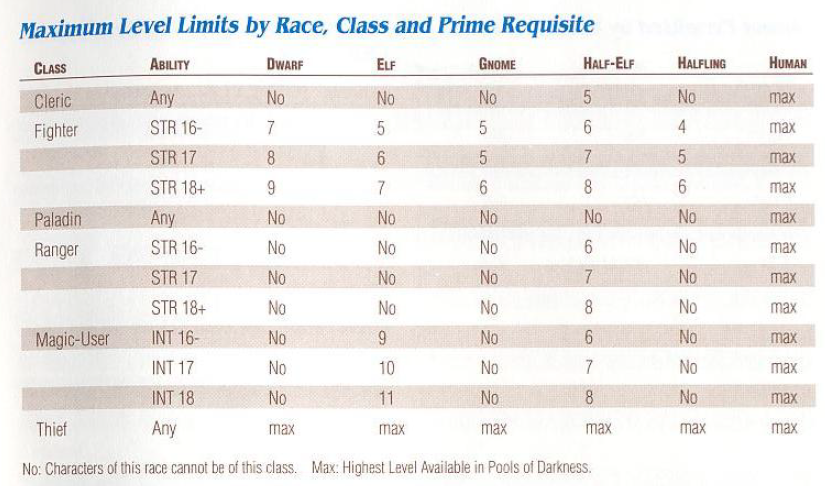 |
| Level limits for Pools of Darkness, the fourth game in the series--a game where playing with a dwarf fighter who maxes out at 9 would be absurd. |
Even if you'd be willing to play with that kind of handicap for this game, you'd be screwing yourself for the sequels. Max mage level for elves in Curse? 11. In Secret of the Silver Blades? 11. Pools of Darkness? 11. Even if you could live with the stifling lack of character development for three games, you couldn't...well, live. The same is true of every non-human race/class combination except one: any race can max out in thievery.
The result is that you'd have to be crazy to include any non-human characters in your party, except for the sole thief. Why would they include such a dumb rule? Well, because the first edition of Advanced Dungeons & Dragons included it. But the way I understand it, those level caps were gone in the second edition, which came out in 1989. Even if we allow Curse the excuse, we can't extend that to Secret of the Silver Blades or Pools of Darkness.
 |
| My tragically-fated Pool of Radiance party. |
So, let's take a look at my imported Pool of Radiance party and see what we have. A dwarf, two half-elves, an elf, and two humans. Petrus, congratulations: your avatar (a human fighter) gets to continue on in Curse. Koren the cleric (the only one I didn't name after a reader) also stays. Everyone else is fired.
In a way, it's for the best. Curse introduced two classes that Pool of Radiance didn't have: the paladin and the ranger. That makes exactly six classes for six party slots. Except that with these new classes, the plain old fighter seems redundant. I can't see any advantage that he has that the paladin and ranger don't have (weapon specializations aren't a thing yet). Thus, I think I'll dual Octavianus to something more useful--maybe a cleric--later, but that command isn't available from the starting menu. Everyone else is new. My final party is:
- Bolingbroke, a lawful good male human paladin
- Goldeneye, a chaotic good female human ranger
- Octavianus, a chaotic good male human fighter (to be dualed to a mage as soon as I can)
- Koren, a neutral good female human cleric
- Pimm, a chaotic neutral female gnome thief
- Yorsh, a chaotic good male elf magic user (elves can achieve the max mage level in this game; I'll boot him for the next one)
Character creation is much the same as in Pool of Radiance: you specify a race, class, and alignment, roll a set of attributes, name the character, and customize the icon. Afterwards, you have a chance to "modify" your character's statistics to "match a favored AD&D character," which legions of 1980s gamers simply used to jack up every statistic to the maximum. I resisted that temptation but it wasn't much of a temptation; none of my rolls came under 10, and with just two or three re-rolls, I had this for my paladin:

New characters start at Level 5, which does offer a significant advantage for the Level 6-8 characters that arrive from Pool of Radiance, but nothing a little grinding can't make up.
I always spend a little too much time on the icons. Since I can't see a lot of color variance, the "primary color" and "secondary color" selections don't mean a lot to me, and I try to just go with something solid that will make each character stand out. Far more important is the weapon selection; by choosing a different weapon for each character, it's easy to remember who's who on the battlefield.
 |
| A character with the two-handed sword icon always feels like he does more damage, even if the icon has nothing to do with it. |
With the party created, Octavianus and Koren simply pretended that the other four had been with them in Phlan, instead of treating them like the rank newcomers that they were.
The Story
Curse of the Azure Bonds takes place shortly after the events of Pool of Radiance, with the action shifting to the southwest side of the Moonsea, in an area called the Elven Court--a region formerly populated by elvish civilizations before the elves got sick of all the humans popping up in the area, and emigrated off to some place called Evermeet. The area is now home to a series of petty kingdoms and monsters, all of whom have flooded in to fill the vacuum the elves created.

Having saved the city of Phlan from the menace of Tyranthraxus, the party of mercenaries has embarked for the city of Tilverton (southwest in map above) to find the daughter of King Azoun of Cormyr, Princess Nacacia, who a year ago fled an arranged marriage and ran off with a cleric named Gharri of Gond. But on the way to Tilverton, the party is attacked by invisible brigands and knocked unconscious. Awaking in Tilverton, the party members find that their equipment is gone (convenient, that), and their arms are branded with a series of five azure symbols.
 |
| Waking up in a strange place, bereft of equipment, with strange markings on my arm. This is eerily similar to my 2007 trip to New Orleans. |
A quick look at the Forgotten Realms Wiki's entry for 1357 DR, the year in which the game takes place, illustrates how I'll never become very fluent in the lore surrounding the game. There's simply too much of it. Various game guides, books, modules, and magazine articles have established the extraordinarily detailed history, setting, and personalities at work here. The wiki tells me that Azoun is a warrior king who has ruled for 20 years and will be killed in another 14 in the Goblin Wars. Nacacia is short for Alusair Nacacia Obarskyr, a hotheaded fighter/ranger and leader in Cormyr's armies, the Purple Dragon Knights. Tilverton, where I've just awakened, is due to be completely razed in 15 years by the armies of some place called Thultanthar.
More important, the entire setting is drawn from a book called Azure Bonds by Jeff Grubb and Kate Novak, published the year before the game. It concerns the adventures of the similarly-azure-bonded Alias, a female sell-sword and walking example of both the "1980s hair" and "cleavage window" tropes:
 |
| Wouldn't want that armor to protect the sternum, would you? |
I've purchased the book on my Kindle, but I'm honestly not sure if it's better to read it now, wait until the end of the game, or wait until I encounter Alias in-game (yes, that one was spoiled for me).
It's possible that this will change throughout the game, but at the beginning, I'm not quite as compelled by the main quest as I was in Pool of Radiance. Solving your own problems seems less heroic than saving a city. But maybe we'll get to do both.
Gameplay
The gameplay is instantly familiar to anyone who's played Pool of Radiance or any other "Gold Box" series game. It mixes first-person exploration with isometric tactical combat in an adept adaptation of the AD&D rules. Both views are turn-based and tiled.
 |
| Exploration view. Sunrise is oddly at midnight, and the sun stays in one place throughout the day. |

 |
| The tactical combat screen, which I maintain is one of the best ever created for CRPGs. |
I encourage you to read my Pool of Radiance entries, but as I go through the game, I won't assume you have. So far, except for the addition of paladins and rangers, and the ability to dual-class, I've only seen a few differences in Curse. One is a particularly welcome change: in the encampment menu, there's a "Fix" command that automatically goes through the process of memorizing "Cure Light Wounds," casting it on the characters that need it, and re-memorizing it. Unless you're in a safe area, there is a chance of a random encounter during this process. I used the command immediately to heal Octavianus and Koren, who had been imported from Phlan with less-than-perfect health.
Beyond that, there are bits of furniture in the tactical combat screen, and you no longer have to specify "move" before moving in combat--you just start walking. I'm sure I'll encounter a few more differences as I go along.
Like its predecessor, this game comes with a paper "Adventurer's Journal" to which you are referred throughout the gameplay, starting from the moment you wake up in the inn in Tilverton. This process minimizes the amount of text on screen and allows for images that the developers didn't want to have to program into the game.


It comes with a codewheel, too, but the game doesn't include the same codewheel-based copy protection as Pool of Radiance, so I haven't had a reason to play with it yet.
From the moment I started the game, I was having fun, and everything I loved about Pool of Radiance came flooding back, from the little minor role-playing options you frequently get....
 |
| I don't know if I want to start committing crimes so soon. |
 |
| If I were role-playing honestly, my party is in a pretty lousy mood... |
 |
| I'm glad I went shopping before I came here. |
 |
| Oh, no. I learned that lesson in Spielburg. |
...to the absurdly large selection of every AD&D weapon in the shop...
 |
| I'll bet that no starting player, not once, has bought a "jo stick." |
...to the descriptors that you receive as you visit certain areas...
 |
| This refers to a big dragon attack in the area a couple years prior. |

But the graphical paucity remains notable. Coming off of Drakkhen and Hero's Quest, which had lovingly-crafted screens, the relatively blank tiles of Curse of the Azure Bonds require the player to mentally supply most of the details. I don't recall that the Gold Box series ever gets any better at this, although I barely remember this game, let alone any of the others.
I haven't decided how much attention I'm going to give to mapping this game. I like the process of map creation, but it does tend to slow things down, and my Pool of Radiance map book was full of areas that I never revisited. The "area map" supplied by the game doesn't show doors or very much useful, but it does help you keep track of where you've been in simple areas, and I might rely on that for a lot of zones.
 |
| An area map of Tilverton. |
Tilverton
My party isn't the only hard-luck cases in the inn: the room next door is occupied by a dissheveled man ranting in his sleep about a flaming giant, "plants that walk," and other assorted nightmares. An inn employee tells me he was found that way by a sewer entrance.

A note in the journal said that despite waking up with no equipment, "we have found a stash of coins." The stash was equivalent to 1,500 gold pieces per person, more than enough to buy all the weapons and armor I could possibly want, so I feel bad for whatever poor sap left it in the bedside table. There was an armor shop across the street from the inn. I went with some standard choices, keeping in mind the usual class restrictions (magic users can have no armor and no throwing weapons but darts; clerics can't used edged or pointed weapons; thieves can't wear anything metal).
After my purchases, I returned to the inn and had my cleric and magic-user memorize their spells (I'll revisit Vancian magic in a later posting). I was pleased to see that my magic user started with "Fireball" as his single third-level spell; I accompanied that with a couple "Stinking Clouds," "Magic Missiles," one "Charm Person," and one "Sleep." As usual, I deemed it a waste of time for the cleric to memorize any first-level spells other than "Cure Light Wounds" except one "Bless" spell. I took several "Hold Persons," "Prayer," "Dispel Magic," and one "Cure Disease."

Leaving the inn, I tried to check out the city's exit, but it was blocked by the equivalent of the Cormyr Secret Service. I'm guessing that's a "Purple Knight" on the guard's armor--a fact that would have been meaningless without that wiki.

At the inn, I was booted out after one drink because a "special customer" arrived--a woman in a purple dress who I'm guessing was Nacacia. I heard a scuffle in the alley on the side of the inn, but when I arrived, the only evidence was an ornate knife that happened to look a lot like one of my tattoos.

Returning to the bar, I noted that the bartender now had a black eye and his arm in a sling. He got very nervous when he saw my sigils and claimed that he just tripped over the bar. It appears to me that whoever wielded those ornate knives kidnapped the Princess from the bar and injured the bartender in the process. But I couldn't get anything else out of him.
I nearly skipped the training hall--after all, I had just started--but I was delighted to find that Koren (who had been collecting experience in Pool of Radiance beyond her level cap) was able to ascend to Level 7. She only gets three more levels in the entire game, though. I was displeased to find that Octavianus could only dual to a cleric (his stats weren't high enough for thief or magic user), and I decided not to push that just yet.
During a service in the Temple of Gond (God of the Smiths), I overheard a snarky comment about Cormyr's presence in Tilverton. I visited the high priest, thinking that he might be able to remove the bonds, but when he tried, everyone ended up writhing in pain. Clearly, it's not going to be that easy.

1. The Fire Knives, a group of assassins whose base was recently destroyed in Westgate. She didn't know where they were operating from now.
2. The god Moander, who was recently banished from the world but "reappeared as a pile of filth" and laid waste to the city of Yulash.
3. The Zhentarim (incorrectly spelled "Zhentrim" in the book), an evil mercenary company out of Zhentil Keep. I tangled with them in Pool of Radiance when one of the councilors tried to get them to kill me.
4. A crescent moon symbol that "bears a disturbing similarity to a powerful sage in Shadowdale," but "for her own safety," she wouldn't say any more. I assume the "powerful sage" is Elminster, one of the most famous Forgotten Realms figures.
5. An unknown flaming symbol that she knew nothing about but that gives me a bad feeling.
I didn't have long to wait to determine what the azure bonds actually do. When I left the sage and headed for the city exit again, the royal carriage appeared. My bonds started glowing, and I was unable to resist the compulsion to attack it!
 |
| Maybe the book will explain what this means. |
After the combat, a group of red-robed men jumped into the carriage, hauled out the scared young man, and dragged him into an alleyway. Before I could pursue, some more guards appeared and I surrendered to them rather than slaughter more innocents.
I didn't have long to spend in jail (and, oddly, they didn't take my weapons). Some thief opened a secret door in my cell and let me into the headquarters of the thieves' guild in the sewers.

The guildmaster explained that the Fire Knives had kidnapped the Princess and were hiding her in their base in the sewers. While he was talking, however, Fire Knives infiltrated the guild...

...and killed the guildmaster. Within seconds, I was in battle again. The combat was long, and exhausted many of my spells. At the end, all of my characters were alive. I retrieved a map of the sewers from the body of the guildmaster. Now, I have to get out of here, rescue the Princess, and see if I can find some answers.


