 |
I have a feeling some of my commenters aren't going to be so happy.
|
To recap, my Ambermoon party has found that what's threatening the planet of Lyramion is not the return of a dark wizard--he's reformed and in the party!--but rather some lizard aliens from one of Lyramion's moons. We're not on that moon, though, but a different one--one occupied by dwarves, who were tricked by the lizard men into exiling themselves after building a machine back on Lyramion. We need to find a Navigation Stone to take our airship anywhere, and this dungeon by process of elimination was the only place to go.
We join the action on a level titled "Antique Area 3," where the party has found a bunch of teleporters, elevators, energy barriers, and switches to turn them on and off. We're being attacked by large groups of futuristic enemies called "Guardians." I suspect we're meant to trap them by turning off some energy barriers, leading them awry, and then turning on others. Alas, I have no such patience, and I just end up killing them all with "Iceshower," the most damaging mass-damage spell in the game.
 |
I guess I could have trapped them between the barriers? The movement interface doesn't work well enough for such tactics.
|
Another elevator takes us down to Antique Area 4. We soon find three receptacles on the wall that contain blue, yellow, and green "carved discs." There are a lot of them, so I only take a handful of each. In the next room is a pair of machines connected by glowing balls. One of them accepts one of the disks and the other accepts pieces of amber. They fuse them together and deposit them on a nearby pedestal. Every pair of disk and amber piece creates a Navigation Stone, in blue, yellow, and green varieties. I make three of each.
 |
| Finally! |
I'm about to head up back to the surface when I find another room with a dead teleporter and a machine connected to it. The machine looks like the one that takes the discs, but this one doesn't. I am able to feed it a metal globe that we find on a nearby skeleton. The teleporter comes to life. We enter, and find ourselves in a dungeon with plain gray brick walls and, as the game has it, an "impression of being somehow incomplete and unfinished." The level is titled, "Gadlon, Cellar 2."
We are soon attacked by a party of four floating balls with eyes. They are called "energieglobes." They're not terribly hard to kill, but they have a lot of hit points, and there are a million of the little bastards on the two floors of the dungeon.
 |
You look familiar. Turn sideways.
|
I recognize the floating balls from
Dragonflight, Thalion's first game, which
I reviewed a lifetime ago in 2014, but I don't remember the name "Gadlon," and it doesn't show up in my search of those entries. Eventually, I reach the ground floor, where I meet an elf mage named Aderin. We cannot understand him until he gives us a piece of fruit that magically enables translation. Aderin sheepishly explains that they use the fruit to talk with animals. When we ask where we are, he says we're "in Gadlon, the old school of magic." When pressed, he says "we are near Pegana, on the main continent of Ontaflareth." "Pegana" does show up in my
Dragonflight coverage. What seals the deal is the news that the school of magic is led by Rinakles, one of the party members in
Dragonflight.
 |
Nice title. Maybe lose the space.
|
It's a cute diversion, but Ambermoon doesn't really do anything with it. There are some chests in the area, but they don't have anything useful, just a little gold, a couple of potions, and weapons and armor worse than what we had in the 12th hour of the game. We meet Rinakles, and he summarizes the events of Dragonflight before powering up a teleporter to send us back home. I suppose the episode does accomplish a little world-building; clearly, this universe once had an ancient race capable of teleporting between planets, and multiple worlds were united in an "Amberverse." It gives Valdyn some hope, I suppose, that we might find a teleporter to his world.
I'm hoping that Rinakles's teleporter takes us to the surface of the moon, but no, it dumps us back on the same dungeon level, so we have to travel the long way to the surface. When we get there, I visit both dwarven leaders, show them our Navigation Stones, and try various keywords to alert them to the fact that we can now leave the moon. Nothing works. I guess they don't really want to leave.
 |
Your loss.
|
Before we head off in the airship, I can't help but see if any more of the Forest Moon is used. I had previously noted that coordinates went from (0,0) to (300,300), but the places I've found have only used about half of that space. I save at the airship and then head off to see if I can find any more places. It takes a while, especially dodging all of the waiting insects. Eventually, the expedition becomes more about confirming that there is nothing to find than it is about finding something, at which point I decide to relax my rules a bit and look up an online map. Imagine my surprise when I find a tower in the northwest quadrant of the map.
It takes a while to get there, because the tower is surrounded by impassable, dangerous plants (they lash out at us and kill us), and there are insect combats threaded throughout the area. Eventually, we find ourselves in a ruined tower with more puzzle doors, teleporters, and elevators. We're attacked by several parties of gizzeks. We find a lot of doors with colored circle, triangle, and square patterns. Finally, we find a corpse with a book that gives us clues about how to decipher the shapes and colors. I realize that I was supposed to find these ruins before the Antique Area, which would have made it easier to figure out the door combinations.
 |
I'm not sure what the lines mean, but I never had to decode a door with a line.
|
Finding nothing else in these ruins, I don't feel like walking all the way back, so I reload next to the airship and continue on from there.
I enter the ship and find the receptacle next to the sign that reads "LYRAMION." The blue Navigation Stone works here. In moments, we are back on our home planet!
 |
Hello, Lyramion!
|
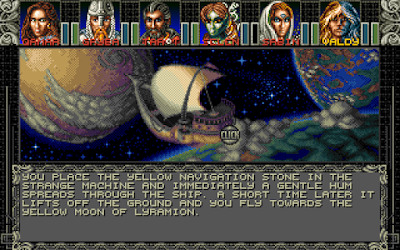
Then I think about it for a few minutes and realize that we have nothing in particular to do on Lyramion. So after taking a save, I re-enter the airship and use the yellow Navigation Stone next to the receptacle for "MORAG." Within moments, we land on Lyramion's yellow moon.
 |
Bye, Lyramion!
|
Like the landing pad back in the Temple of the Brotherhood, the mooring here is surrounded by giant crystals. No sooner have we left this area than we disappear in a flash and reappear in a cell with an ailing lizard magician. He introduces himself as S'Riel. He explains that he teleported us from the hangar and he gives us a brief history of his people. They have long merged technology and magic to create marvels, but at the expense of their moon's environment. Somehow, they used up their water, and their world, always arid, became a desert. This is particularly bad for the lizard men, or "Moranians," because their bodies require water every day, or else they decompose into dust and bones.
 |
It's almost a palindrome.
|
They figured out inter-system travel and visited the Forest Moon, but its water is poisonous to the Moranians. They then visited Lyramion. Some of the Moranians wanted to work in harmony with the races of Lyramion and ask for asylum, but they were outvoted by the faction that wanted to steal Lyramion's water. They tricked the dwarves into building a machine that would siphon water from Lyramion to Morag. It will begin operation in "the very near future," and Lyramion will die.
The machine is hidden behind a crystal wall, "which can only be removed by certain sounds." To accomplish this, we will need to find seven crystal harp strings from seven palaces owned by members of "The Committee" on Morag. We'll then have to fit them to a harp and strum it at the crystal wall. (A quick check of my inventory confirms I still have the harp I bought ages ago.) He finishes by teaching us the Moranian language and casting a spell that disguises us as Moranians. He then teleports us to his own palace.
 |
I know you're just the messenger, but this sounds annoying.
|
No sooner do we arrive than we're confronted by a mage named S'Arin and eight magic guardians in two parties of four each. He sees right through our disguise, leaves us to fight the guardians, and teleports away.
We fought magic guardians back in the Temple of the Brotherhood, mostly by blasting them with ice spells. It turns out that water-based magic doesn't work on the moon. Neither do many of the navigation spells like "Map View." Even the automap fails. So it takes us a while, and several resurrections (the guardians are very lucky with critical hits) to destroy the two parties.
 |
Why? Someone just wanted to be a jerk.
|
Further into S'Riel's palace, we find a chest with his crystal harp string, a "map" that actually has a textual description of all the coordinates for the seven palaces and one town on Morag, and a key to "Palace S'Orel."
 |
This is handy, but as we'll see, not handy enough.
|
The rest of the palace isn't very big, so we soon find ourselves outside on a desert landscape. I decide to head for the town before trying the palaces. Sand lizards attack as we move across the landscape. They attack individually, have a lot of hit points, and cast mass-damage tornadoes.
We reach the city of S'Angrila as night is falling, camp for the night, and enter in the morning. It turns out we were already at the city. It has the hangar with our airship plus the prison, where S'Riel is now just a skeleton.
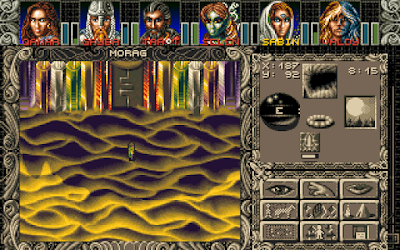 |
The desert is rather pretty.
|
Talking with NPCs in the town, it's clear that The Council is at odds with the populace. They hog water for themselves--the highest councilor even has a moat--and leave the common people to sicken and die. For being an alien city, it otherwise looks exactly like a city you'd find on Lyramion. It has an inn, a food shop, a repair shop, and a general store, where we spend some money on attribute potions and a pair of Lightning Boots. A bottle of water in the store costs 6,000 gold.
 |
Things aren't well for the Moranians.
|
We then head out, following the coordinates to the Palace of S'Orel, fighting lizards along the way. We killed S'Orel a few sessions ago back on Lyramion, so we're not surprised to find it deserted--except for copious magical guardians. By the end of this palace, I'm thoroughly sick of fighting them, and I still have a lot to go. They typically attack in parties of four, and every battle is mostly the same: After one round of melee attacks, they're all lined up in front of my characters. I then hit them with five melee attacks and "Firestorm," my best "linear damage" spell. After four rounds, Qamara and Gryban are generally below half health, so I have to have Sabine stop attacking and start healing each round. After eight rounds, they're all dead. One battle in every two, I then have to leave the palace and camp so that Sabine can raise at least one of the characters who met the unlucky end of a critical hit.
 |
My god, these guys are annoying.
|
We skirt some spike traps. The key we found in S'Riel's palace opens a door, behind which is a chest containing another chord, a bunch of spell scrolls, and the key to Palace S'Arin.
I lost patience with the game somewhere in the Palace of S'Arin, where there were hidden globes and number puzzles in addition to another interminable series of combats with magic guardians. Somewhere around hour 80, Ambermoon officially wore out its welcome. I had been hoping for just one big fight on Morag, not a
linear, seven-piece "Dissasembulet of Yendor" quest right when the game
should be coming to a swift end. Not to mention a pointless two-hour
Easter egg.
 |
I guess I actually met S'Arin, even. My mind was elsewhere at this point.
|
About this time, an Evil Thought occurred to me. It was one of those thoughts that, once you've allowed your mind to fully express it, you realize--sometimes to your despair--that you are now powerless against it. We've all had these thoughts: "Maybe I'll call in sick to work tomorrow" when you haven't taken a sick day lately; "Maybe I'll get a cheeseburger from Five Guys" when you're on a diet; "Maybe I'll sit on the couch all day playing video games" when you have a lot to do this weekend. Part of you thinks, "I should resist this!" but you know you simply don't have the willpower, and any attempts you make are just for show. Don't pretend you don't know what I mean. People who do have that kind of willpower aren't reading this blog.
My particular Evil Thought centered on something a commenter told me months ago. It involved making my way back to S'Angrila and the airship (after verifying that Morag is 200 x 200), flying it back to Lyramion, exiting the Temple of the Brotherhood of Tarbos, calling for the giant eagle, and flying it back to grandfather's house. I then rooted around my chests until I found Netsrak's Staff, which I had found behind the fireplace oh so many hours ago.
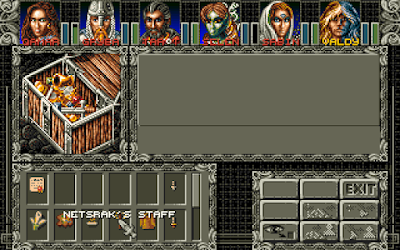 |
"Netsrak" sounds almost dirty, but in a confusing way.
|
I took the staff to Spannenberg, found the dead-end alley with the message proclaiming "Karsten was here!" and waved the staff in front of the message.
 |
I think it's possible I would have found this even if a commenter hadn't spoiled it.
|
We were instantly transported to a top-down map called "Thalion Office." As I walked through the doors, a voice welcomed me to the "secret map of Ambermoon" but warned me that to avoid spoiling the game, I should play the game "without the help of this map."
 |
The brickwork is nice.
|
The map is of course a replica of Thalion's offices, including some in-jokes: A weak elevator, someone humming upstairs. You can meet:
- Karsten ("Netsrak") Koeper, the game's designer, a 26-year-old "Thalionic" mage.
- Erik Simon, the game's producer, a 500-year-old dwarf warrior.
 |
I guess Karsten was a bit of a workaholic.
|
- Christian Jungen, a programmer, a 29-year-old elf mystic.
- Jurie ("Mando") Horneman, a programmer, a 22-year-old elf thief.
- Monika Krawinkel, the graphic artist, a 24-year-old human healer.
Any of them will join the party. They're all at their level caps of 50, and they all have maxed attributes and skills. I otherwise couldn't get them to respond to any keywords.
 |
And they speak every language.
|
I wasn't here for them, though. I was here for the chests in one of the offices. Among them, they held a copy of every unique item in the game, including the elf's harp, the 7 harp strings, and a completed copy of the harp with the strings attached called the Crystal Harp. That's what I snagged. I noted that the bottle of water from Morag was one of the items in the chest. Is that actually used somewhere? I thought it was a joke. There were some other objects I don't remember, including a silver hand and a hill giant's head.
 |
I could have cheated less by just taking the strings, I suppose.
|
I rode the eagle back to the Temple of the Brotherhood, entered, and stood before the crystal wall. I strummed the harp. The wall (in a text message) cracked and then shattered. A passage with a stairway lay beyond. I cast my buffing spells and continued.
 |
Billiard parlor walls come a-tumbling down!
|
The passage beyond had battles with magic guardians and Morag dragons--tough customers, but I had access to all my spells again, plus some scrolls to burn.
 |
I got plenty more where that came from.
|
Finally, we came to the machine, which was . . . kind of stupid. For some reason, it had eyes and legs, and was capable of attacking the party on its own. It had more than 999 life points ("Monster Knowledge" just showed asterisks), high statistics, and a small critical chance. Its attack was 240, by far the highest in the game. But it was still just one enemy. It was resistant to magic but not immune. I kept up with healing, fed my spellcasters potions, and had Tar blast him with "Iceball" every round while Selena worked through a stack of 18 scrolls of the same name.
 |
This is going to take a while.
|
It took about a dozen rounds. When we killed it, we got 5,333 experience points. The party members hit their final levels: Qamara at 48 (two levels from the maximum) and the others between 36 and 42.
The death of the machine caused the chamber to collapse. We ran for a staircase behind it.
 |
Sabine is narrating the radio version of the drama.
|
Triumphant music blared forth. A long text scroll commenced over attractive graphic stills. I'll summarize it, but I'll show at least one shot from each graphic. In the ensuing narrative, we learned:
- The Temple of Tarbos exploded and collapsed, but the airship was thankfully undamaged. We escaped on the eagle.
- We brought elven and human leaders to the island to show them what happened.
- A lot of people wanted to go to war with the Moranians.
- But we convinced them that the Moranians already had enough trouble.
- A peace treaty was signed between Lyramion and Morag, the latter planet now represented by a new government since we (as far as anyone knows) slaughtered the members of the old Council.
 |
Yep, they were all destroyed. In their palaces. None left alive.
|
- The ultimate treaty involved at least some water being sent to Morag by airship. There was no word on what we got in return.
- A large airship was sent to Kire's Moon to retrieve the dwarves, but those residing in Dor Grestin decided to stay. The dwarves that returned repopulated Gemstone.
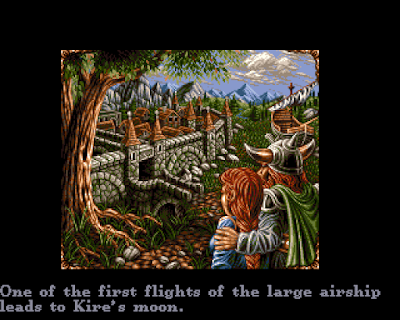 |
They could have come back with me. It would have been more poetic if they had destroyed the machine.
|
- Valdyn went to S'Angrila and worked with Moranian scientists to develop a way for him to get home. Eventually, they were able to replicate an orb that would send him back to his world. He returned home after a fond visit with his former companions.
 |
Just "friendship?" We could have had a beauty-and-the-beast situation here.
|
- The party dissolved as members went off to "follow their personal desires and goals."
It was one of the better endgame narratives, satisfyingly cleaning up a number of loose ends. I would have liked to see individual stories for the other party members; Selena, for instance, needed to go home as badly as Valdyn did. What does Tar do with the rest of his life now that he's free of the demon? What will be Gryban's new purpose?
Even though a sequel was planned, nothing ominous set it up during this epilogue. I remain confused about whether the technology we found on Kire's Moon and Morag belongs to the Moranians or some older race that predates all of us.
 |
And this shot clearly shows that the Lyramonic Isles are only a small part of the globe. Why does the world wrap, then? Is the rest all water? If so, we can afford to be generous with the Moranians.
|
For the final entry, I'll do my best to collect information about what the third game (Ambercomet? Amberasteroid?) would have looked like, and I'll cover the things that I "evaded" in winning this way. I suppose I might be persuaded to reload and do it "right." Is anyone really bothered?
Final time: 82 hours


