Monday, May 19, 2014

Lord of the Rings: Exploration Angst

You existed before the rain? Does that mean you existed before the earth had a hydrosphere? What did you drink back then?

Lord of the Rings has me asking a question that I rarely ask when playing an RPG: How do I know I'm encountering all the important stuff?

CRPGs have a variety of ways to ensure that players don't simply bypass key NPCs, encounters, and items:

1. Limited number of tiles. The default for the first decade of RPGs was to construct a world with a limited number of explorable tiles. If the player wants to make sure he hits everything, he just makes sure to step on each tile. This dynamic is found mostly in first-person games like Might & Magic and Pool of Radiance, but we occasionally see it in a top-down game like Tunnels & Trolls: Crusaders of Khazan.

2. Environmental signaling. So you have a continuously-moving world or even a tile world so large that you probably can't hit every tile (such as most top-down tile-based RPGs from the 1980s). How do you ensure that the player hits every encounter? You make the people and icons with which he can interact extremely visible, standing out against the overall bland background. Examples include the very obvious towns and keeps of Ultima IV and Ultima V and the way that key NPCs stand out from drab commoners in Baldur's Gate

This game in no way signaled me that this tree was important. I just happened to be lucky enough to walk up to it. How many important trees have I missed?

3. Facilitate exploration. For large, continuously-moving worlds where some of the encounter locations might be non-obvious, the game can assist you in a variety of ways that facilitate exploration, including automaps that slowly reveal, obvious paths and routes of travel, and breaking the game world into small, discrete maps that are easy to explore in their entirety. This is the most common strategy in adventure games and hybrids, like Elvira and Hero's Quest; we also see it in a lot of modern games, like Dragon Age.

4. Quests. Quest-oriented games make things easier by letting you know there is a specific person to talk with, or a specific thing to find, within a map--ensuring that you won't stop searching until you locate it. Some games even provide obvious quest markers.

5. Making the consequences of missing something unimportant. I suppose some players embark on a game like Skyrim insisting that they will talk to every NPC, find every item, and solve every quest, but they must get exhausted fairly quickly. In a huge and open world like Tamriel, the developers simply have to make most items, people, and encounters ancillary to the main quest--fun if you stumble upon them, but not tragic if you don't.

Various games mix and match these strategies. Baldur's Gate and its sequel both have relatively small maps with automaps (#3) and highlight chests and barrels you can actually open when you hit the ALT key (#2). NetHack has both a limited number of tiles (#1) but also lets you see from a distance what you're likely to find on those tiles (#2). Oblivion's dungeons (as opposed to the overworld) are small enough to systematically explore (#3); it has markers for the quest locations (#4); and it makes it clear which items are indispensable relics and which you can save inventory weight by not picking up (#5).

Lord of the Rings has been giving me a lot of angst, and I realize it's largely because it has none of these features. The maps are continuously-moving and huge, so they're tough to explore systematically. There are no quest logs or lists that let you know what you still have to do in an area. There's no automap. It's impossible for me to separate key quest items from spurious junk. I suppose the only saving grace is #5--perhaps a lot of the encounters I'm missing are entirely optional, and have no bearing on my ability to win the game. But I simply don't have that kind of faith yet.

Luckily, I happened to walk into the right area to find this item. If I'd skirted the north part of the cave, I would have missed it.

Many key encounters are triggered by happenstance when you wander into a particular section of the map, and even then only under certain conditions. For instance, in the last post, I noted about finding the elves and the ELBERETH word, "the area where I encounter them seems to have a certain probability of producing a Nazgul . . . and a certain probability of triggering the elf encounter." A reader alerted me that, in fact, the elf encounter always happens if you're walking west when you enter the area of trigger pixels, and the Nazgul encounter always happens if you're walking east. This is on top of having to stumble into the right set of pixels in the first place. I now know what an anonymous commenter meant when he said that this game "can be very unforgiving to players without a walkthrough."

There are other sources of angst. There seems to be no reliable way to heal all my characters (save making the long walk back to Hobbiton to purchase rations). Throughout this last expedition, every combat bled a few more hit points from one or more party members, until I was at the point I was constantly reloading because every hit was killing me. At some point, however, my hit points did all spontaneously regenerate for no reason I could tell. I didn't even notice when it happened. I don't like this kind of inconsistency and unpredictability. I like games where I know I can periodically return to town, sell my excess equipment, buy new equipment, train, and heal.

When I wrote last time, I was stuck in the Shire because I'd missed a key gate to the Old Forest and the only other exit was blocked by a Nazgul I couldn't defeat. When readers alerted me to the gate, I visited it, found out I needed a key, returned to Brandy Hall, found it, and ultimately let myself out.

I wish more parts of the game were this overt in their hints.

Leaving the Shire produced a multi-screen cartoon sequence recounting the fate of Fatty Bolger, who had stayed behind, posing as Frodo to throw off the Nazgul. (I guess he's in the book but not the films.) Meanwhile, my party arrived in the maze of the Deep Forest.


The game oversold the perils of the forest a bit. I didn't even have to follow the long set of directions I'd received from a book in Brandy Hall. I just had to go east for a few minutes and help a songbird tied to a tree. As a reward, he opened a secret door out of the forest. But this was yet another encounter that I had to be lucky enough to trigger by walking close to the relevant tree. I could have easily missed it entirely.
 
The "previously unseen" hole is apparently large enough for three hobbits, a dwarf, and a pony.

The rest of the map consisted of four major encounter areas:
 
1. A long road leading across the north of the map from the Shire to the next map (Bree, I assume). This is where I would have emerged if I'd defeated that Nazgul instead of taking the forest gate. The road was full of encounters with wolves and bandits that sapped my hit points. (I had the option to give my gold to the bandits, but who does that?)
 
What if I do want trouble?
 
2. "Sharkey's Shipping," a couple of buildings whose owners are apparently in league with Saruman. There was a store on top and a couple of dungeon levels beneath the main building where I fought a bunch of guards and orcs, freed a hobbit prisoner named Nob Appledore, destroyed an evil book, and recovered an artifact called the "Golden Wheel" that the orcs had been desperate to dig up. It apparently has something to do with finding "Durin's Axe" in Moria.
 
The "White Hand" appears again as an item you can buy in a store. Saruman's allies aren't doing a very good job concealing their presence.
 
On this map, Athelwyn revealed herself to be a witch in league with Grimbosh, the manager of the place. When I entered his room, she left my party and switched sides. Fortunately, she didn't use magic in the ensuing combat, and I killed her. I'm curious what would have happened if I hadn't wandered into this particular room. Would she have stayed with me until the end?

If you surrender the Ring, the game immediately ends.

After I left the main "Sharkey's Shipping" building, I found a journal in another building that gave me a password that would have prevented some of the battles with humans and orcs. The danger of doing things out of the game's chosen order.

3. The Barrow Downs, which I remember from the book. I had a bunch of encounters with barrow wights that occasioned many, many reloads before I defeated them. I recovered a variety of treasures from the barrows, but I'm not convinced I hit every encounter or did everything the most optimal way. Among other things, there's this barrow I can figure out no way to enter:
 
 
At one point while I was exploring, the entire area became shrouded in gray and my party members disappeared one by one. Eventually, I was taken, too, and I awoke in a barrow with a wight about to sacrifice me. The only way I could figure out to escape (after multiple deaths) was to use the HELPHELP word of power, which summoned Tom Bombadil, who freed me and helped me against the wights before disappearing at the exit. He didn't cleave in their heads with an axe or anything; he drove them away with some goofy song.

Using a word of power.

4. The residence and environs of Tom Bombadil, perhaps (let the flame wars commence) the most idiotic character in Lord of the Rings. My advice for writers is that if you're going to invent a near-omnipotent character who's supposed to be older than any other living thing, don't name him "Tom." It breaks the suspension of disbelief a bit.

In the game, Tom asks me for the Ring. If I give it to him, he does a little trick and makes it disappear, then gives it back to me. The game plays some triumphant music at that point, but I don't know what I accomplished. Did he steal it and give me a replacement? That would be a neat twist.
 
If he's so damned powerful, why doesn't he take it to Mordor?
 
I never got to fully explore dialogue options with Tom, as the moment I left his room, he disappeared and never returned. Despite his great age and power, he seems unaware that his wife, Goldberry, is deathly ill upstairs in the bedroom. She asked me to find some lilies to cure her.

Unfortunately, the nearby pond where she normally gets lilies is frozen over, and the only place to recover them is from the spirit of Withywinde in a cave. Withywinde asks for some kind of token from the person who sent me to her, and this is where I'm stuck. When I first encountered Goldberry, the paragraph read:

Tom's wife, the beautiful Goldberry, is here. She is lying in bed, ill. Beside her, a blackened willow leaf floats in a bowl of stinking water. "My lilies..." she whispers. "My special pool lies south of this house. Please...bring me lilies. Take this token and whatever you may need from this house." She offers you her token, a golden leaf pasted against oak bark.
 
Sounds great, but this token never appeared in my inventory, and it's not in the room when I use the "get" command. Without it, I don't think I can get her lilies. I have no idea if this is a vital quest to progress, but it's emblematic of the frustration I have with the game. I'm currently dithering around, trying to figure out whether to restart, move on, or keep trying to find an alternate solution.

There's also this wall of ice I can't get past. Torches don't melt it.

A few miscellaneous notes:

  • Yes, Frodo can wear the Ring and does turn invisible. Fortunately, the game doesn't pester me with a flaming eye shouting "I . . . see . . . you" everywhere I go. But using the ring costs me 1 willpower point every time I put it on, and enemies still happily attack my other party members, so the utility of the item seems limited.
  • My pony can attack enemies in combat. I don't know whether he's biting them or using his hooves.

 
  • Perhaps even more nonsensically, the pony accompanies me into every building, room, and dungeon. When my characters use "sneak," he somehow sneaks.
  • Similar to encounters not triggering unless you hit a particular area of pixels, you can't collect items from a room until you get the message that "you have found something that you can use," and you can't interact with locked chests until you get the message that you've found them.

I could see it from a screen away!
 
  • In combat, if characters fall below 6 life points, they go "unconscious" and lose a point every round until they hit 0, when they die. But if the party finishes the combat before that happens, the characters will regenerate to a minimum of 6 points and automatically wake up.
  • The manual indicates that there is no mechanism to resurrect dead characters. I guess no particular character, not even Frodo, must survive, but it seems wrong to let canonical characters stay dead. I've been reloading.

In good conscience, how could I continue without Sam?

  • In one of the barrows, I finally found some decent weapons: "barrow daggers." Most of my party members are equipped with these; Druin has his axe; Pippin has a bow; and Sam now has a "spider sword" I found in a cave. I have an extra sword awaiting another character getting the sword skill. I still have no decent armor.
  • Even as a non-fan of the books, I object a bit to the idea of the little hobbit band doing so much fighting and killing before they even get to Rivendell. Sam is supposed to slowly and reluctantly evolve from a gardener to a warrior, and I have him killing humans within the first few hours of the game.

He even looks depressed about it.

  • Mystifying items in my inventory: various gems (can I sell them later?), a "springstone" that I dug up on one of the barrows, a "leaf belt" that I can't equip; a red acorn; a signet ring that I found way back in the Shire.
  • I hope there are stores in Bree because I have a ton of cash.
  • Torches never seem to run out.
  • I like that some puzzles have non-obvious solutions that you have to suss out based on your inventory or skills. Destroying this evil book, for instance, was a matter of selecting "use" on a torch. I suspect there were other solutions, too.


  • I still can't tell you much about magic. I only had a spellcaster (Athelwyn) for a brief time, and I only had her cast a couple of spells (which deplete life points) before she betrayed me and died.

The game has some good elements, but I'm already getting frustrated with it, so I might divert to something else for one post while I wait for any hints about Goldberry and/or decide what to do next.

Saturday, May 17, 2014

Lord of the Rings: A Different Shire

What? Already? I thought we had to go through the battle of Helm's Deep first!

Lord of the Rings (the game) recaps Lord of the Rings (the book) without any sense of urgency, and with lots of changes to the plot even in the opening area. Frodo understands the importance of destroying the Ring, knows the Black Riders are searching for him, and has been given specific instructions to get to Bree as fast as possible, but instead he lingers around the Shire for weeks, finding lost children, rescuing stray dogs, and otherwise running errands for his neighbors. 

In this, the game is no different from a host of other RPGs in which the hero temporarily but repeatedly ignores an apocalyptic threat to retrieve a family heirloom from a dungeon or collect 16 bushels of wildflowers for an alchemist. We've all been in this situation plenty of times. It's just odd to see it in an established plot. It's also odd to see Frodo joined by rangers, wizards, and dwarves that don't appear anywhere in the books.

As a game, I'm finding Lord of the Rings to be fun with a few flaws. As some of my commenters warned, the sheer size and sparseness of the maps recalls Faery Tale Adventure, which I described as "huge, boring, and empty" before quitting it. Fortunately, although LOTR has a lot of empty territory and structures that seem to serve no purpose, it's not quite as bad as Faery Tale Adventure. It might take 5-10 minutes between interesting encounters rather than 20-30.

A good 60% of the game consists of just this.

The opening map is big enough that I found it tough to explore systematically. The game starts in the upper left-hand corner, and normally in such situations I'd keep the western border visible as I moved methodically south to the bottom border, then move one screen east, then move to the top border, and so on, investigating any structures or people that I encountered on the way. LOTR makes this impossible by putting all kinds of rivers, walls, and hedgerows in the Shire, some of them long enough that you've become utterly lost by the time you get around them. I eventually resigned myself to following first the perimeter and then the road network, hoping that between the two, I encountered all the stuff in the middle.

An unfordable river.

Several interface issues significantly mar the game. The first is the inability to move diagonally, which extends the already-long journeys between points. The second is the music, which keeps playing unbidden. There's an option to tun it off, but it only silences it temporarily; it always returns later. Very annoying. The third issue is the horrible inventory and character selection system. Let's say I want to have Merry give Frodo some rations and have him eat them. This is the key sequence:

-SPACE to enter the command interface
-C to change characters
-4 to select Merry
-U to enter the "use" menu
-3 to enter the "trade" menu
-1 to trade to Frodo
-Then the number associated with the item I want to trade
-X to exit the trade menu
-X to exit the "use" menu
-C to switch characters
-1 to switch back to Frodo
-U to enter the "use" menu
-2 to enter the "equip/use" menu
-The number of the rations to eat them

Complicating this is an inability to quickly view a character's inventory, so in reality it often means repeating the first few steps multiple times until I find the character who actually has the rations.

Aside from those issues, it's a reasonably pleasant game with a lot of features that I like about RPGs, including lots of NPCs to interact with, lore to collect, side-quests to solve, and puzzles to unravel, usually using the game's skill system. It doesn't particularly excel in any of these areas, but together they make for a decent RPG experience.

This week, I explored the Shire, solved a variety of side quests, and assembled a party of companions bigger than the book's Fellowship. In doing so, I encountered areas, places, and characters that I generally recall from the films and what I read of the books--Hobbiton, Bucklebury Ferry, Buckland, the Green Dragon Tavern, the Brandywine Bridge, and so on. They seem to correspond imperfectly to maps of the Shire taken from the books, but otherwise they were familiar.

Some of the side-quests that I solved include:

  • Anson Goodbody's dog had run away. I found it nearby and used the "charisma" skill (it took me a long time to figure this out) to get it to follow me back to him. He gave me a shovel for my troubles.

If only I'd paid attention to his warning.

  • Two children missing in the "East Forest." It took me a long time to solve this one because the East Forest was one of the last areas I visited owing to my exploration pattern. The children were found in different places, surrounded by monsters. Returning them got me some rations from one family and a pony companion from the other.

Saving one of the children from a spider.

  • A dwarf in the Green Dragon was looking for someone to find his ancestor's axe, lost in some ruins. I found it while solving the "missing children" quest above, gave it to him, and got him to join me.

Equipping Druin with the axe I retrieved for him.

  • A songbird trapped in a spider web in a cave. I killed the spider and freed it, and it gave me some hints as to finding and dealing with some elves.
  • The elves in the southwest regions of the map who told me the magic word ELBERETH, which has the power to drive away Nazgul. It took me a while to find them. The area where I encounter them seems to have a certain probability of producing a Nazgul (which kills me practically instantly) and a certain probability of triggering the elf encounter.

Notice he says "TIMES of need." Not just one time. More on that below.

  • A ranger named Hawkeye who appeared in the southwest. He joined my party and I thought he'd be a permanent companion, but he only lasted a few seconds before we were attacked by Nazgul at the entrance of a cave, and he told me to run away while he held them off. I heard him die in the distance.


  • In a building called Brandy Hall, I got a ghost to leave by giving him some pipeweed. He had been haunting the library, and once he left, I read the books and got a lot of hints for future map areas.

Happily, he accepted pipeweed instead of his pipe.

Solving each quest not only produced (occasionally) a tangible reward, but also made subtle adjustments to my characters' attributes: dexterity, strength, endurance, luck, life, and willpower. There is otherwise no experience or levels in the game.

The game's combat mechanism isn't very good so far, but it has the potential to get better. When attacked, you enter a special combat mode and do the fighting from the regular command interface, where you can move, attack, use a word of power, cast a spell, use an item, or use a skill. At these opening stages, most of my characters have no weapons except torches and fists, no armor, and no magic. I haven't experimented enough to figure out what skills, if any, really help in combat. I could see the mechanism supporting much more tactical combats later in the game.

Note this game's conception of orcs. It looks like something I remember from a cartoon but can't quite put my finger on.

Post-combat, the only way I've been able to find to heal characters is to eat rations, which restore a couple of hit points but only once per day. There's no "rest" mechanism. Apparently, I'll later find a spell called "Kingshand" and some "kingsfoil" herbs, but not yet.

One possible side-quest that I didn't solve had to do with a large, ugly mill, apparently owned by Lotho Sackville-Baggins, guarded by three humans. The humans kept throwing me out the moment I entered, and none of the skills I had helped me. The episode seems to refer to the book, where Lotho allies with Saruman to take over and industrialize the Shire. I suspect that in the book, the process didn't start while Frodo was still in the Shire, but perhaps I'm wrong. In any event, I couldn't figure out what to do with the place.

My refusal to give Lobelia the key to Bag End came to haunt me later in the game, when she suddenly appeared near Bucklebury Ferry and demanded it again. When I walked away a second time, the "Shirriff" arrested me and threw me in jail to await the inevitable arrival of the Nazgul.


When the game otherwise ends through combat death, it's accompanied by an image of Sauron putting on the Ring and using it to conquer the world.

Sauron looks a lot like popular conceptions of Satan.

As I finish my explorations of the opening area, my company consists of Frodo, Sam, Pippin, Merry, Druin the dwarf, a pony, and a female wizard named Athelwyn. Druin and Athelwyn are clearly non-canonical additions to the party; also non-canonical is the way they refer to my party as "The Fellowship," which hasn't actually been established yet.

(This would be a good place to mention that One Wiki to Rule Them All has been my constant companion, filling in details about minor characters and places, and helping me understand which characters are from the book and which are invented by the game.)
 
At this point, I'm a little stuck and could use a hint. The only way out of the Shire seems to be a path guarded by a Nazgul (they appear in scripted locations rather than randomly), and I can't defeat him because I used ELBERETH to get by a different Nazgul on the bridge leading into Buckland. The manual had warned, and I had forgotten, that each word of power can only be used once. I think what I needed to do was to cross the river via Bucklebury Ferry rather than the bridge, thus avoiding the first Nazgul and saving ELBERETH for the second one.
Using ELBERETH on the first Nazgul.

The Nazgul doesn't seem impossible to defeat, just really really hard. He basically kills my characters with one blow, but they are capable of wounding him, and I suppose with a lot of luck, I might be able to eventually defeat him with only three or four characters lost. Obviously, I'd rather get out of the Shire with almost everyone alive. Suggestions welcome.

If I end up having to start over, I'll change my exploration pattern and see if I find anything new. For those who have played the game, these are the items that I'm carrying right now. If I'm missing anything, I'll take a light hint about it: The Ring, a sword (which no one can use), something called a "bladepart," a signet ring, a "White Hand" (no idea what it actually is), a "ghost ruby," rations, pipeweed, a "star key," a shovel, torches, a prybar, a bow, mushrooms, and an axe.

None of the discontinuity between the book and the game bothers me terribly because I don't have any particular fondness for the book. I'm curious how true Tolkien fans have felt while playing this game. Do you hate Athelwyn the same way some fans hated Arwen in the films? Or do you just shrug and go with it?

If Gimli had known as much about the loss of Moria as Druin, the Fellowship would have been saved a lot of trouble.


Monday, May 12, 2014

Game 144: Lord of the Rings, Vol. I (1990)

The game is listed as J.R.R. Tolkien's Lord of the Rings, Volume I on the 1993 CD version, but the original omits Tolkien's name from the title.
     
The Lord of the Rings, Vol. I
United States
Interplay (developer), Electronic Arts (publisher)
Released 1990 for DOS, 1991 for Amiga, FM Towns, PC-98. Enhanced version re-released in 1993 for DOS on CD-ROM. A 1994 SNES title of the same name is an entirely different game.
Date Started: 12 May 2014
    
My feelings about Tolkien run hot and cold. I admire the extensive world-building in which he engaged, but I think he was a mediocre—sometimes terrible—writer and I've never been able to force myself to finish Lord of the Rings. I respect his place at the forefront of both written fantasy and, through Dungeons & Dragons, fantasy role-playing, but I'm sick to death of Tolkien references everywhere (e.g., games like Moria, Angband, Orthanc; the sword Orcrist in NetHack; whatever-Hai in a ton of games). I even regard the films with two minds, loving them for their visuals but constantly ridiculing them for their dialogue.

Nonetheless, I've always been surprised that there aren't more games based explicitly on the Tolkienverse, especially CRPGs. Prior to 1990, there were a handful of adventure games that basically just recapped the plot (The Hobbit, The Fellowship of the Ring), and one strategy game that aspired to some RPG elements: War in Middle Earth (1988), which I reviewed in March 2011 briefly before concluding that it wasn't enough of an RPG. This game and its 1992 sequel are the only real RPGs set in Middle Earth until the films created an explosion of new games starting in the early 2000s.

To me, there's a right way and a wrong way to adapt licensed titles. The right way is to use the setting to introduce original characters and tell an original story. Champions of Krynn, Spirit of Excalibur, and Buck Rogers: Countdown to Doomsday do a reasonably good job in this regard. 

Most Tolkien-based games go about it the wrong way. Instead of using the setting of Middle Earth to tell an original story, or perhaps one with characters ancillary to the main plot, they use the same characters and plot that everyone already knows. I guess it must be exciting for fans of the books to play as Frodo or Aragorn, but the pre-determined plot, to me, removes some of the excitement, not to mention the role-playing. Worse, attempts by the game to introduce other conventions of CRPGs, like the ability to loot the houses in the Shire or accept various side-quests, create a kind of dissonance with the original material.

Frodo and his party wander around a surprisingly-large hobbit hole.

Thus, going into the game, I already had reservations about the plot. As a game, though, Lord of the Rings, Vol. I shines, making excellent use of VGA graphics and contemporary sound. So far, Ultima VI and Lord of the Rings are the only two games of 1990 that really make me feel like we've been kicked into a new era. It's unsurprising, then, that both games feature a similar interface and gameplay elements. Both are isometric, continuously-scrolling games with redundant mouse and keyboard commands (using both mouse buttons) in which you control a lead character but party members dutifully follow behind you. Both have keyword-based conversations, a day/night cycle, and a combat screen integrated with the main exploration window. The games have some differences—and ultimately, Lord of the Rings is the poorer of the two—but the upgrades in the game experience are welcome.

The opening screen from the 1993 CD-ROM version of the game.

Volume I exists in two versions: the 1990 original release and a 1993 release on CD-ROM. I've played a bit with both. The main difference is that the 1993 version replaces carefully-drawn exposition screens with movie clips from Ralph Bakshi's 1978 animated film. I guess some find the clips to be a bit of a bonus, but I don't like the animation style in the films, and I find that the clips go on for a bit too long. I rather prefer the nice-looking static screens from the original. Moreover, since the animation clips weren't created specifically for the game, they sometimes feel a bit out-of-place even when covering the same plot exposition.

Another major difference is that the 1993 version replaces printed journal text (a la the Gold Box games) with on-screen text. This is a more welcome change, but I think I might stick with the 1990 version anyway. (Rest assured, I'm playing version 1.3, not the buggy 1.0.)

Several shots from the 1990 version's introductory exposition.

The earlier version starts with more information for those who don't know the plot. A series of screens recounts Bilbo's birthday celebration, Frodo's inheritance of the ring, and Gandalf's later revelation that Bilbo's ring is the One Ring. Gandalf explains the history of Sauron and the rings to Frodo, outlines the main quest to destroy the Ring in the fires of Mount Doom, and tells Frodo to head to Rivendell. The game begins as Frodo sets out with Sam and Pippin.


The 1993 version, on the other hand, has the clips from the film that illustrate the history of Middle Earth, Gollum's acquisition of the Ring, and Gandalf's visit to Frodo at Bag End. But it doesn't make it explicitly clear what Frodo is supposed to do (head to Rivendell, eventually find a way to destroy the Ring).

A small bit from the 1993 CD-ROM version, with clips from the 1978 Bakshi film.

As far as I know, the sequel, Lord of the Rings: The Two Towers (1992) didn't get the CD treatment. Part of me hopes that I don't end up really liking the saga, because there was no third installment. In this, it shares some characteristics with the Bakshi film, which concludes near the end of The Two Towers and never had a sequel.

The beginning of the game for the player is the same in both versions.

The gameplay begins with Frodo, Sam, and Pippin standing outside Bag End, with a note that Merry is waiting at Buckland Ferry. Although the two other hobbits start standing next to you, you still have to talk to them and "recruit" them into the party. Frodo starts with only the Ring and the key to Bag End in his possession; Sam and Pippin have nothing.

I naturally turned around and went right back into Bag End to see what I could loot. The Bag End map is rather spacious, with numerous bedrooms. I'm not sure how it was described in the books. In any event, the game has an odd approach to finding and looting items. You don't walk up to specific chests, shelves, or such. Rather, the moment you enter a room, you're alerted that something of value lies within, and you use the "Get" command.

This turned out to be a ration and a torch.

For the most part, you explore on an unobstructed map window, only bringing up the command interface when you need it with the SPACE bar or by right-clicking. The command bar has 10 options: attack, view character attributes, get items, use or trade items, use a skill, cast spells, talk, change the party leader, change the active character, and exit. On the keyboard, these actions are mapped to sensible keys (e.g., "T" for "Talk"), but I wish they'd made it so that the command bar goes away when you hit SPACE again instead of typing "X." It's hard to understand until you play how this one little change would have made the interface more intuitive and less frustrating. The other major interface element I dislike is no ability to move diagonally. But I like the redundant mouse and keyboard commands, allowing me to move flexibly between them, just as in Ultima VI.

Bringing up the command bar while talking to Lobelia Sackville-Baggins.

Bag End offered the first opportunity to use the "skills" system employed by the game. The manual lists 26 skills, divided into "active skills," "combat skills," and "lore." Apparently, combat skills and lore come into play automatically, but the 13 active skills are employed directly from the skills button. Skills are binary—you either have them or you don't; there's no leveling—and my three hobbits start with several of them. Frodo has climb, hobbit lore, jump, perception, read, elven lore, and dwarf lore. Sam has brawl, charisma, hide, read, hobbit lore, and jump. Pippin has brawl, sneak, climb, jump, and most importantly, picklock. I used the skill when the game alerted me to a chest Bilbo had left locked, and we retrieved several silver pennies.

The skill menu.

Using the "read" skill in Bilbo's library gave me a couple of text paragraphs and a note from Gandalf instructing me to go to the Prancing Pony in Bree and use the name "Underhill." The paragraph system works much as in the Gold Box games or Wasteland, with numbered entries representing text in the accompanying manual. The first entry just described the library and my disappointment that Lotho would soon have access to it. The second was a note from Bilbo that suggested asking the Brandybucks about the Old Forest, accompanied by the "Lay of Leithan," which conveyed upon me the magic word "Luthien"—more on magic in a later post.

After clearing out Bag End, I set about exploring the other hobbit holes in the area. My next door neighbor was named Griffo Boffin, apparently a very minor character in the book. Talking to him introduced me to the dialogue system used by the game, which is a bit like the Ultima series. After "questioning" the NPC, you can type any keywords that you like. But the dialogue is sparser than the Ultima games. Everyone responds to NEWS and perhaps a few keywords relative to their response, but it lacks the full-fledged conversations of Britannians.

I'm pretty sure he's supposed to be in the other book.

My conversation with Griffo went as follows:

  • NEWS: They say that a drunken dwarf is at the Green Dragon Inn in Bywater, asking for a burglar.
  • DWARF: You know how odd those folk can be. Certainly not like sturdy Hobbiton hobbits.
  • GREEN DRAGON INN: The ale at the Green Dragon isn't as good as it used to be.

Everything else produced a stock response: "I don't know any more than you do about that." I should also note that the text parser is a bit less forgiving than in the Ultima games. DRUNKEN DWARF and GREEN DRAGON returned no answer; the question had to be phrased very exactly.

Other neighbors had more to say. May Brownlock (invented for this game?) told me about Black Riders in the area. Bingo Chubb (also invented for the game?) said that wolves were stalking the ruins in the East Wood. Daddy Twofoot notes that in the Green Hills, some bird is singing Gandalf's name. Lobelia Sackville-Baggins stood at the end of the road demanding the key to Bag End, but she hit me with an umbrella—actually costing me a hit point!—so I declined to give it to her. Let her break in. Sam's Old Gaffer alerted me to some lost kids that people are talking about at the Hobbiton Inn. Anson Goodbody wants my help finding his lost dog.

The countryside around the Shire is quite large but interspersed with dense, impassable foliage that creates somewhat awkward, artificial barriers to movement (in fairness, no different than Ultima VI). Based on the thick foliage to the north and west, I suspect Bag End is in the northwest corner of the map. Just to get a sense of the scope of the game, I started wandering around randomly and I saw dozens upon dozens of buildings and NPCs across a map that takes 10-15 minutes to cross at full speed. I suspect it will be a long time before my little party even gets out of the Shire.

A house next to some hedge rows.

The day/night cycle chugs along mercilessly while you're standing still, even when a menu is active on the screen. The only way to pause the game is to choose that option from the "options" menu. I'm not sure if there are any consequences to too much game time passing. One thing I like is that when it gets dark, the screen just gets darker. It doesn't do any of that Ultima VI nonsense by which the periphery of the screen is blocked from view. On the negative side, the cycle doesn't seem to have any influence on the positions of NPCs, who are always rooted in the same location and will happily talk with you no matter what the time.

That's about all I can report on the first brief outing. Let's see if I can get to Bree for next time.
    
****
    
Further Reading: The first official game based on Tolkien material was War in Middle Earth (1988). The Lord of the Rings series continued (and ended) with Lord of the Rings, Vol. II: The Two Towers (1992). Interplay's history before this game includes The Bard's Tale (1985), The Bard's Tale II: The Destiny Knight (1986), The Bard's Tale III: The Thief of Fate (1988), and Dragon Wars (1989) and would later include Swords and Serpents (1990), and The Bard's Tale Construction Set (1991).
 

Saturday, May 10, 2014

Expedition Amazon: Final Rating

The bottom level of the ruins. I'm sure the entrance to Ka was somewhere in here, but I never found it.

Expedition Amazon
United States
Penguin Software (developer and publisher)
Willard Phillips (author), Greg Malone (graphics), Dave Shapiro (programming)
Released 1983 for Apple II, 1984 for Commodore 64, FM-7, PC-88, PC-98
Date Started: 15 April 2014
Date Ended: 5 June 2014
Total Hours: 15
Difficulty: Moderate (3/5)
Final Rating: 21
Ranking at Time of Posting: 35/142 (25%)
Ranking at Game #456: 154/456 (34%)

[Edit from 5 June 2014: I wrote this posting before figuring out how to win the game. You can read my account of the endgame here. After winning, I updated the values above.]

I didn't intend to offer a second posting on Expedition Amazon, but I continued playing it for about six hours after the first posting, so this allows me to make something of that time while easing myself back into the blog after a regrettable, unanticipated absence.

The game has some interesting ideas but isn't, in 2014, very fun. The basic dynamic is to stock up on as much stuff as you can carry in the town, explore until your supplies run out, and return to the city. The party can only lug 200 bullets, 8 grenades, 4 lamps, 4 spare batteries at a time, so your expedition is over after about 10-15 combats or 2 game days of tunnel-crawling. Random events (e.g., some creature smashing a lamp, natives stealing grenades) can lead to faster depletion. Very rarely, you find needed supplies on slain enemies, but for the most part, you have to be careful lest you find yourself fighting with fists or bumbling through dungeons in the dark.

After the first couple hours of gameplay, by the time the characters reach Level 4, there is very little danger from combat. Your hit points are high enough that even when enemies repeatedly ambush you (and get a free round of attacks), they don't pose any risk of death. Combat is a horribly rote affair by which your party members either throw grenades (killing a maximum of 10 enemies) or shoot a pistol (killing a maximum of 6). Technically, the "guard" character can also fire an assault rifle, which kills a maximum of 20 enemies, but the guard always goes last, and there are never so many enemies that you need him to shoot that many bullets by the time the first three characters have acted. Combat swiftly became extremely annoying, and I groaned audibly every time "jaguar cult priests!" appeared in the dungeon while I was just trying to get from one place to another.

My party status not long before I gave up.

I don't know if there's a maximum number of levels, but every character maxed at 40 hit points, so further leveling didn't really do anything for me.

With combat posing no challenge, the only real threat to the party in the dungeons are the traps, which can kill a party member (or the entire party) instantly and are impossible to detect, disarm, or avoid. Every death requires a reload or a trip back to Iquitos for a Level 1 substitute. I typically chose the former.

I'd like to give the game credit for including some obscure element from Incan mythology, but I can't find any evidence that "Imatu" wasn't just invented by the game developers as a vaguely Incan-sounding name.

In the first post, I talked about overland exploration and the process of "completing" a map by exploring every available square, at which point the map is saved permanently. The party gets experience for every new square explored as well as every sector completely mapped. This dynamic continued in the dungeons, although the game mercifully allows you to complete a sector without stepping on the trap squares. There were a couple maps that I couldn't complete even though I hit every visible square. I suspect there were secret doors somewhere, but the game doesn't have a mechanic to search for secret doors, and no amount of bashing into the walls seemed to produce any.

With as much time as I invested in the game, it's annoying not to be able to win it. But I've explored every square multiple times, and I just can't see what I'm missing. There are no walkthroughs online, but a few hints gleaned from a variety of sources suggest that somewhere, something was supposed to convey on me the ability to read Incan runes, and all those gibberish pieces of paper I'd been recovering from natives would start offering clues instead. This never happened. One place suggests that you have to wait in a "poison room" until three of the four party members are dead before you can find the door, but I never found this location.

One of the unavoidable--and thus unfair--traps.

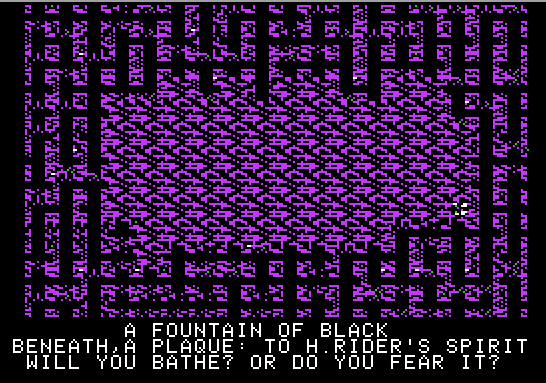
Viewing the game files in Notepad does offer the clues that I was supposed to be getting, but they're pretty cryptic and don't really help: "SEQUENCE IN PAIRS TO FIND THE PATH"; "LEFT IS MORE FROM 4 OVER 4"; "SUCCESS BEGINS AT THE BOTTOM"; "A BATH IS NICE, BUT TWICE?"; and so on. The last two probably refer to the map at the top of this post: a weird maze on the bottom level that keeps shifting paths every time I move from square to square. There's an encounter on the map with a "fountain of black," where you have the option to bathe, which depletes all but 10 hit points. A second bath kills you, so that makes sense. But if success was supposed to begin here, it didn't do me any good.

In a quick GIMLET, I give it:

  • 3 points for the game world. The back story is idiotic, but the game deserves some credit for offering a modern South American setting with themes from Incan mythology. This isn't the first RPG to offer a non-fantasy setting (that would be 1978's Space), but it is the first to offer a contemporary setting.
  • 3 points for character creation and development. Expedition Amazon offers a Starflight-like approach by which each character occupies a role, and if he dies, you can no longer perform the functions of that role. It also offers a rare mechanic by which you accumulate experience through simple map exploration as well as combat. But the only obvious benefits of the experience--hit points and increased combat skill--max out fairly quickly.
  • 0 points for no NPCs.
  • 2 points for encounters and foes. There are a lot of "encounters" both outdoors and indoors, such as snake attacks, ambushes by natives, traps, and pits, but there are no role-playing options, or really any options, associated with them. You just take the damage and suck it up, or hope some piece of equipment saves you.

Sometimes, stepping on a random square causes a volcano to explode and kill everyone.

  • 2 points for combat. As I described above, there are only a few options, no tactics, and very little danger. Combat is more about resource management (conserving bullets and grenades) than strategy.
  • 3 points for equipment. You have a variety of equipment to help you explore, and the basic dynamic of the game is to manage it and make sure you return to the city before key items deplete. There just isn't much that's interesting about it.

Playing the game is a process of routinely returning to this screen to replenish stocks.

  • 3 points for economy. You get money by finding and selling artifacts, but after a few hours of gameplay, you have more than you need. The most expensive items in the game are unnecessary.
  • 1 point for having a main quest, though with a silly premise.
  • 2 points for graphics, sound, and interface. The graphics and sound are both very primitive (as was common in 1983). The interface is simple enough, but at the default speed, everything, from movement to waiting for the results of a combat action, takes too long.
  • 2 points for gameplay. It's relatively linear and offers limited replayability. The basic game mechanic is a bit too easy, although clearly some aspects are too hard, since I couldn't figure out how to win no matter how much time I invested.

The final score of 21 is about par for the course for these early-1980s, mostly-forgotten offerings that never had a DOS port. Since I did a u-turn with my "new plan" back in November, I've met a few non-DOS offerings that I'm glad I experienced (e.g., Dungeons of Daggorath, Sword of Fargoal), but none that I've felt are truly great RPGs, even for their eras. What will be the first, do you think? Questron?

What interests me is how well these authors thought they were replicating the tabletop role-playing experience. Some commenters have noted that game magazines made no distinction between "adventure" games and "role-playing" games in the early era; this may be true, but game developers clearly did make distinctions. Perhaps the earliest commercial RPG, Dunjonquest: The Temple of Apshai, begins with a long description of role-playing and how Apshai replicates the experience on the computer. So does Expedition Amazon. The manual opens with a section titled "What is a Fantasy Role Playing Game?," and it mentions all the conventions of the genre--attributes, character development, player identification with the character, economy, equipment--while carefully skirting the fact that Expedition Amazon makes poor use of all of them. Though, as always, we have to remember the technology limitations of the time.

A reviewer named Johnny Wilson covered Expedition Amazon in the August 1984 Computer Gaming World, calling it "a very enjoyable game that doesn't take itself too seriously," but he goes on to say, "For me, it's much more satisfying to adventure in this manner than to deal with a limited parser in a text only game," suggesting that he didn't have a lot of basis for comparison. His review does provide an interesting window on what players thought was fun back in the early 1980s:

One of the most satisfying features of this adventure game was that by having four player characters, I could have a group over and play the game together. We had great fun laughing at each other's misfortunes; harassing one another for inept shooting; and generally suggesting mutiny toward whoever happened to be piloting the boat or leading the expedition. We would name at least one of the characters for someone we didn't like and would absolutely refuse to give medical aid to them, regardless of what happened to them.

The limited gameplay doesn't remotely support this depth of engagement. It doesn't even really treat the four party members as individual characters, and harassing someone for "inept shooting" is to harass him for the outcome of a 1d6 roll. The idea of four friends huddled in front of an Apple II, hooting and hollering about the twists of fate in Expedition Amazon--not to mention what the review calls "sparkling graphics and gags"--makes me want to cry a little.

Cue peals of laughter from four desperately lonely individuals.

I wish I knew more about the game's author, Willard Phillips. MobyGames doesn't have him credited on any other titles. [Later edit: Mr. Phillips later commented below, and I have more information about him in a later posting.] As I noted in the opening post, Greg "Moebius" Malone and David "Dr. Cat" Shapiro, both of whom would go on to work at Origin Systems, are credited in the Apple II version. At first, I thought this was quite surprising, but it turns out that Penguin Software's stable of employees or contractors included a lot of future Origin employees, including Dallas Snell, Denis Loubet, and Richard Garriott himself (he's credited for graphics on 1985's Ring Quest). Penguin (later Polarware) has only one other RPG on its list: 1984's Xyphus.

If any later reader comes along and knows the secret to winning Expedition Amazon, feel free to drop a comment and I'll see if I can pull off a victory screen. [Later edit: I did it! On my own!] Until then, it's time to move on and get back into a regular schedule. It's been so long since I played Tunnels & Trolls: Crusaders of Khazan that I no longer remember what I'm doing. I'm thinking it makes sense to start the game over with a new party; I'm also motivated to do this because my characters seem to have suffered an irreversible loss of attributes. But I don't want to do that right away, so I'm temporarily removing the game from the active list and moving on to Lord of the Rings, Vol. I to the next position. I'll come back to Khazan later in the year.

Sorry for the long silence, everyone. I can't promise it won't happen again, but I'll do my best.