Showing posts sorted by date for query legends of murder. Sort by relevance Show all posts

Friday, November 13, 2026

Ravenloft: Strahd's Possession: Summary and Rating


Ravenloft: Strahd's Possession
United States
DreamForge Intertainment (developer); Strategic Simulations, Inc. (publisher)
Released in 1994 for DOS, 1995 for FM Towns and PC-98
Date Started: 14 August 2026
Date Ended: 30 October 2026
Total Hours: 36
Difficulty:  Moderate (3.0/5), but with a lot of variance across maps.
Final Rating: 44
Ranking at time of posting: 529/591 (90%)
      
Summary:  
    
Based on early 1990s revisions to the classic 1983 module, Ravenloft starts with an Eye of the Beholder template (first-person, four-characters, action combat) but adds some upgraded features, including continuous movement, voiced dialogue, more complex graphics, and an excellent automap. Though lacking the puzzles of Beholder (and thus moving further away from its Dungeon Master roots), it exceeds the earlier game in lore and atmosphere. 
   
****
       
Since I started this project, I've played plenty of games that were flawed. (I suppose you might even say that all of them were flawed, none of them managing to earn a score of 100 on the GIMLET.) Some games are flawed in their very conception; they introduce elements or mechanics that never had any hope of being any good. They took a wrong turn and hit a dead end.
       
Other games are flawed because even though they're on the right road, they just weren't able to go far enough. That's Ravenloft. There's nothing about it that by itself is a bad idea. It has a storied, atmospheric setting, and interesting blend of created PCs and joinable NPCs, decent mechanics for character development and equipment, "banter" from the party members, visuals that enhance the ambience, and a fast, exciting approach to action combat. Reading through that list, you probably wanted to say, "Okay, but . . ." a few times, and I agree with you. There are ways in which the combat doesn't really work well. The NPCs stop being personalities once they join the party. The "banter" is not customized to the speaker. The inventory system is a bit of a mess. Perhaps most important, the graphics and sound aren't quite where they need to be to realize the developers' vision. But almost all of these deficiencies are matters of improvement on good foundational elements. If anyone wanted to remake Ravenloft, they would need to enhance, not start over.
       
A grand step up from the bland textures of previous RPGs.
           
Over the years, I've suggested a few modifications to the GIMLET that have never really stuck, such as the Bolingbroke Outcome-to-Hours Ratio (BOTHR) and the Range of Suffering to Enjoyment Score (ROSES). Ravenloft has a low BOTHR; stuff is always happening. It also has a low ROSES score; its worst elements aren't much worse than its best elements. Lower in both cases is better. Here's a metric in which higher is better: the Bolingbroke Expectations-to-Experience Range (BETER), or the distance between what I expected when I started the game and what I rated it at the end. Going into Ravenloft, I expected something like 35, solely on the basis that it doesn't seem as well-known as Eye of the Beholder (1991), which I rated a 41. But aside from its approach to mechanical puzzles (which I can enjoy but don't consider central to my RPG experience), I find Ravenloft reasonably BETER than Beholder, with an expected a GIMLET of around 50. That won't hit my Top 10 list or anything, but it's always nice to beat expectations by 15 points. [Ed. Or 9, as the actual result turned out to be.]
   
One of the elements that I enjoyed about Ravenloft is its epistolary storytelling. It's one of the most compelling reasons to explore. No longsword +3 excites me as much as a scroll or journal that fills in some part of the game's lore. Even better is when a game can combine epistolary storytelling with visual storytelling. Think of the edict against spreading "rumors" about Sergei's murder and Tatyana's suicide coupled with the painting in which a man's head has been scratched out. The only thing that would make it better is if the graphics had been clear about what the painting was showing.
       
My bread and butter.
             
It really is too bad that this was one of the final SSI/TSR pairings. I would have liked to see where they went with it. But even without any enhancements, I enjoyed this game enough that I'm really looking forward to Menzoberrranzan later this year and Ravenloft: Stone Prophet in 1995, which I understand use essentially the same interface.
    
I took a look at the official cluebook for the game, and it doesn't appear to me that I missed anything significant. I met all the NPCs, explored all the maps. I was curious how I was supposed to get into one missed area of the Old Church, Lower Level 1, but the guide wasn't any use there. It did tell me that the only thing I missed on the other side was "a number of useful cleric scrolls."
   
The guide did inform me that there were significant differences between the CD-ROM and floppy disk versions of the game. The entire paladin side-quest was missing on the disk version, as well as two NPCs: Velika and Ryszard. There were fewer graphical distinctions between monsters of the same basic type (e.g., zombies and zombie lords looked exactly the same) and items of the same type, when dropped on the ground. The disk version had no digitized voices, more limited cinematics, no wandering villagers (not that they added much), and no "atmospheric rats, bats, and crows," which I have to admit I barely noticed. The disk version did have one advantage: a scroll of "Improved Identify" near the beginning of the game.
          
Cut for space.
       
I either missed a scroll of "Invisibility" somewhere or one of the mage NPCs that I didn't take had it natively. It apparently trivializes the game, allowing the player to kill enemies with impunity with missile weapons.   
      
I'm curious whether it's at all possible to defeat Strahd without the Holy Symbol of Ravenkind. My attacks were doing 1 damage to him. That should make it theoretically possible to winnow him down to 0 as long as the party can survive that long. Maybe he regenerates, though. 
      
I still don't like writing the long GIMLET paragraphs, but fine, I'll concede to everyone who doesn't like the table by constructing it like this:
   
1. Game World: 7 
    
Assets
  • An evocative setting with a full backstory made relevant by the game's encounters, such as the skeletons on stakes and the villagers huddled in their homes. 
  • Solid epistolary and visual story telling.
  • Something different from the standard high fantasy setting.
  • Clear role for the characters in the story. 
Liabilities
  • Requires some knowledge of outside materials to fully appreciate
  • World doesn't change much based on player decisions. 
2. Character Creation and Development: 4
    
Assets
  • Fairly standard AD&D character creation process, which is reasonably good.
  • Nice selection of character portraits.
  • Typical experience point/leveling development, though see negatives.
Liabilities
  • No gameplay elements or dialogue specific to character classes.
  • Not much for a thief to do.
  • No quest experience. 
  • Leveling is the same non-event as a typical D&D game for non-spellcasters. 
3. NPCs: 5
    
Assets
  • NPC encounters offer full-sentence dialogue.
  • A variety of joinable NPCs to compensate for character weaknesses, each with a backstory and goal.
  • Joinable NPCs and PCs have in-party dialogue throughout the game. 
  • Other NPCs really flesh out the game world.
Liabilities
  • NPCs lose personality once they join the party. No particular acknowledgement of their goals or the completion thereof.
  • Full-sentence dialogue options are not really "options," just an exhaustive list of things you can say. No choices = no role-playing.

The NPCs have unique personalities, at least until they join the party.

      
4. Encounters and Foes: 5
    
Assets
  • The D&D bestiary always has interesting monsters with a variety of strengths and weaknesses.
  • Each foe is well-described in the game manual. 
  • A few non-combat encounters like the priest trapped in the mirror and the banshee in the cemetery. 
Liabilities
  • The way that enemies just charge right at the characters limits the tactical possibilities inherent in their strengths and weaknesses.
  • Most non-combat encounters are essentially NPC dialogues and thus rewarded there.
  • Not many puzzles except for the lock-and-key type. 
  • Enemies respawn, but not enough to allow for any significant grinding. 
5. Magic and Combat: 4 
    
Assets
  • Fast and exciting.
  • Terrain offers some tactical possibilities. 
  • Usual solid combination of D&D offensive and defensive spells. 
Liabilities
  • Action combat doesn't work terribly well with D&D rules.
  • Offensive spells tough to use in combat.
  • No restoration spells in a game with level-draining undead. 
  • Most "terrain" possibilities feel like cheating. 
6. Equipment: 5 
    
Assets
  • Good variety of items to find/equip.
  • Generally easy enough to evaluate items, but see "weaknesses." 
  • Equipment from dropped party members automatically transfers to replacement. 
  • Sensible encumbrance system.
Liabilities
  • Could have used more spell scrolls.
  • Lack of identification options other than a single "Improved Identify" makes it hard to evaluate stuff. 
  • Items all appear at fixed locations. 
7. Economy: 0
 
There is no economy.    
 
8. Quests: 4 
    
Assets
  • Compelling, somewhat low-stakes main quest.
  • A few side quests along the way.
Liabilities
  • No role-playing opportunities in quests.
  • No alternate endings. 
      
Solving one of the side quests.
      
9. Graphics, Sound, and Interface: 5 
    
Assets
  • We're past wall textures. Graphics help make the world feel more real with furnishings, decorations, and details (this asset also contributed to "Game World").
  • An excellent, detailed automap with the ability to make notes.
  • Smooth movement with step movement as a possibility. 
  • Some decent atmospheric sound effects. 
  • Developers tapped as voice actors try their best. 
  • Quick save/Quick load. 
Liabilities
  • Graphic quality is typical mid-1990s, in the unfortunate valley between high-quality abstract graphics and high-quality immersive graphics. 
  • The 3D environment is very basic—no up/down, no slopes. Can't put items on top of things.
  • Voice acting is pretty bad.
  • Sound has no sense of modulation or direction; some effects get repetitively annoying.
  • Interface could have used more keyboard shortcuts.
  • The game really needed to pause when the spellbook was invoked. 
  • Annoying to transition to and from inventory during combat.
      

Some of the cutscenes were quite nice.

       
10. Gameplay: 5 
    
Assets
  • Some mild replayability with different character classes and NPC choices.
  • Just about a perfect length for its content.
  • Good average difficulty. 
Liabilities
  • Mostly linear except in a few minor ways.
  • Not very replayable. 
  • Significant difficulty range. It mostly comes down to individual battles, since the game is a bit too generous with resting.
Final score: 44
      
Well, that was a surprise. I really thought it would rate significantly higher. I actually thought it was possible that I'd give every category a 5. I guess I was forgetting the lack of economy, which some of you wouldn't have included at all, but I wouldn't have minded if the game had offered fewer potions on the floors and gold instead. Barovia should have had a little shop where the player could identify items and perhaps buy magic scrolls. It would have also been nice if the church had offered healing services, including resurrection (with no constitution loss) and restoration. 
 
But I don't see anything I want to adjust, so 44 it is. It still rates higher than any of the Eye of the Beholder games, which I agree with. A rating of 50 would have put it on the same level as Betrayal at Krondor or Dark Queen of Krynn, and yeah, I guess that would have been a stretch.
      
Ads at the time went in heavy on the graphics. They were good for 1994.
      
For the past few years, every time I've opened an issue of Computer Gaming World, I have been relentlessly mocked by the same ad for Wolfenstein 3D: Spear of Destiny (1992), making me feel like I'm making no progress. Finally, for the issue that I go to consult for a review of Strahd's Possession (June 1994), it is gone. It has been replaced by an ad for Disciples of Steel, which I played eleven goddamned years ago. Yes, I realize the DOS port didn't come out until 1993, but still.
   
I was a bit disappointed to see that Scorpia hadn't covered the game, but I agree with the reviewer that did, Petra Schlunk, about 75% of the time. That nudges up to about 80% given her review of Strahd's Possession, and to the extent I don't agree with parts of it, it has more to do with the intervening 32 years than the literal text. For instance, she mentions all the positives of NPC dialogue but none of the lack of role-playing, but then again, not many games were giving true dialogue options in 1994. She enjoyed the graphics and sound more than I did because she didn't know that better versions of both things were just a few years away. She complained about a couple of technical issues that have been solved since then. Otherwise, her review reads so closely to my GIMLET that I'd forgive you for thinking that I cribbed from it.
    
Reviews accompanied by ratings tended to place Strahd's Possession in the low B range, which I think is fair. T. Liam McDonald gave it 82% in the inaugural issue of PC Gamer (June 1994, which I'd better keep at hand because it also includes a review of Pagan). "In terms of graphics, cinematics, story, and sound effects," he wrote, "It is an ambitious and satisfying endeavor—one of [SSI's] best yet." The worst he could say is that AD&D mechanics (weapons, spells, attributes) were getting kind of old. Computer Game Review, which I'm not sure I've ever consulted before, had three competing reviews in its June 1994 issue, with ratings at 85%, 83%, and 77%. Graphics and sound rated highly among the reviewers; interface and playability had no consistency; "replay value" was universally low. The reviews are interesting because at least two of them were familiar with the tabletop module and were judging the game by how well it evoked that experience. "It is a game only for reminding yourself of what might have been," said the worst reviewer; the top reviewer was a bit optimistic: "Some of its ideas will help usher along the next generation of CRPGs." 
         
One of an increasing number of games with endgame credits.
         
The primary designers of the game are listed as Thomas J. Holmes and Christopher L. Straka, the co-founders (along with James Namestka) of Event Horizon/DreamForge Intertainment. Both had worked for Paragon Software before jumping ship around 1990. We've seen their early work with DarkSpyre (1990), Dusk of the Gods (1991), The Summoning (1992), and Veil of Darkness (1993). My understanding is that DreamForge had a bad experience publishing their first two games and approached SSI with The Summoning and Veil of Darkness. SSI was impressed enough that when they sought a new developer after parting ways with Westwood Studios, DreamForge was the obvious choice. Their first job was developing Dungeon Hack (1993) based on the Eye of the Beholder interface. That experience must have proven vital for the later development of Strahd's Possession, which feels very little like DreamForge's early titles.
 
[Ed. I'm reminded in the comments by RandomGamer that SSI produced the U.S. release of Legends of Valour (1992) from Synthetic Dimensions, an early continuous-movement game published the same year as Ultima Underworld. Valour and Strahd's Possession even share a producer, Nicholas Beliaeff. Although the interfaces are quite different, it's possible that SSI was inspired to insist on continuous movement in Strahd's Possession based on their previous experience with Valour.]
    
Strahd's Possession apparently sold well enough to justify two more titles using the same engine: Menzoberranzan (1994) and Ravenloft: Stone Prophet (1995), the latter of which would be either the penultimate or final D&D title from SSI (I'm not sure whether it came before or after DeathKeep). The Ravenloft setting would have one more incarnation, in Take-Two's Iron & Blood: Warriors of Ravenloft (1996), but I'm given to understand that it's a pure action game. Apparently, next year's Warlock: Dungeons & Dragons will feature some Ravenloft (or at least Demiplane of Dread) content, but again as an action-adventure.
      
Strahd's Possession wasn't an epic experience, but it was a solid one, and it occurs to me that I might say the same thing about a lot of 1994 games so far, including Al-Qadim, Yendorian Tales, and The Elder Scrolls: Arena. Maybe that will turn out to be the theme for the year: games that don't seem to be well-remembered but don't deserve to be entirely forgotten.
    
****
   
   
Further reading:    

11/14/2026 

Saturday, March 14, 2026

Game 572: The Elder Scrolls: Arena (1994)

 
The title screen has "Chapter One" in the title and a "The" before "Arena," but the game box and manual do not. My policy is to go with any two of those sources that agree.
         
The Elder Scrolls: Arena
United States 
Bethesda Softworks (developer and publisher)
Released 1994 for DOS
Date Started: 9 March 2026
         
It is with a little trepidation that I begin Arena, the first entry in the RPG series that I would likely choose if some psychopath told me I could only play one RPG series for the rest of my life. And probably the only reason I'd hesitate is because of another (now) Bethesda series: Fallout. It's not so much that I think Bethesda makes superlative RPGs but rather that I think they make superlative games that happen to have RPG elements. I am addicted to RPGs, yes. I hope the "Game 572" part proves that without further elaboration. But in addition to RPGs, I'm addicted to open-world, sandbox games full of histories, mysteries, and lore. That's why when I'm not playing Morrowind or Skyrim or Fallout 4 on my console, there's a good chance I'm playing Red Dead Redemption or Far Cry or Assassin's Creed. Put them together, and I don't need the RPG part to be perfect. I just need another obscure tome speculating on the inhabitants of Akavir, a battered journal with notes on the disappearance of the dwarves, or an NPC waxing about the true nature of Sheogorath.
      
I have tempered my expectations and don't expect to find much of this in Arena. I know the game takes place across the entirety of Tamriel, but my guess is that it's pretty shallow. (Even still, I nearly squealed when I opened the game map and found that the geography and names of the provinces were all established here in 1994.) I'm guessing that much that I like about the series' mythology will be absent, underdeveloped, or contradictory. I will try to focus on it as its own game rather than the beginning of a series. But a part of me can't wait to see what bits of lore—like those province names—that were established right here at the beginning. 
     
A map of the world from the character creation screen. It is essentially unchanged 32 years later. 
        
The name most associated with the Elder Scrolls, Todd Howard, wasn't present for this first outing. He wasn't hired until several months after it hit the shelves, in time to spend some time playtesting the CD-ROM version released later that year, but not to contribute to any of its story and mechanics. Most of the credit goes to developers Ted Peterson, Vijay Lakshman, and Julian LeFay (what a great name for someone developing fantasy worlds), who started with the intention to create a game about traveling gladiators who would fight in—you guessed it—arenas. Somewhere along the line, an idea developed to let the gladiators engage in RPG-style side quests in between gladiatorial matches. Then the side quests took over the game (apparently too late to print new boxes and marketing materials). The developers were longtime fans of tabletop RPGs as well as Synthetic Dimensions' Legends of Valour (1992), so perhaps the change was somewhat inevitable. 
 
This quote comes after the title screen and seems more appropriate to the original vision for the game.
        
(Lakshman left the company after Arena, LeFay after Daggerfall, and Peterson after Oblivion, but the trio reunited in 2019 to form OnceLost Games and to announce The Wayward Realms, a "spiritual sequel" to Daggerfall. LeFay died of cancer in July 2025, but the game is still reported to be in development.)
         
It was Bethesda's first role-playing game. The company was eight years old by then, having been started by Christopher Weaver in his Bethesda, Maryland kitchen, funded by a cash infusion from the profits of his engineering and media consulting firm. In between contracts, Weaver and his employee, Ed Fletcher, began messing around with a football simulator that they later sold as Gridiron (1986). For the next eight years, they specialized primarily in sports games (Wayne Gretzky Hockey; NCAA: Road to the Final Four) and action movie tie-ins (Home Alone; The Terminator). In fact, their Terminator series featured smooth continuous-movement and a three-dimensional perspective during the same year that Wolfenstein 3D and Ultima Underworld were getting all of the accolades.
             
The start of the backstory. I didn't realize Tiber Septim was canon from the beginning.
      
It was a bit thrilling to experience the opening cinematic and read the opening paragraphs of the manual, full of names, places, and terms that would become as familiar in the mouth as household words: Gaiden Shinji, Tiber Septim, Uriel Septim, Tamriel, the Amulet of Kings, "Last Seed." The backstory awkwardly explains the title of the game: During the wars that unified the empire under Tiber Septim, the land became so violent, existence so much of a struggle, that the people forgot the world's original name, Tamriel, and began calling it "the Arena."
      
It is now 492 years later, and Emperor Uriel Septim VII (whose death will later kick off the events of The Elder Scrolls IV: Oblivion) is betrayed by his own Imperial Battlemage, Jagar Tharn. Tharn imprisons the emperor in another dimension, where time passes much more slowly than on Tamriel. (Why doesn't he just kill the emperor? Because the Amulet of Kings serves as some kind of alarm that would alert the High Council that the emperor was dead.) Tharn has also killed his own apprentice, Ria Silmane, to prevent her from warning the High Council. Adopting the emperor's guise, Tharn sits on the throne and begins his malevolent rule.
        
Me: "Who's this Talin doofus?"
      
I was surprised to see that the player character has a canonical name and backstory: He is Talin, leader of the imperial guards. Tharn has Talin thrown into the imperial prison after the opening events. He is awakened (here we shift from the opening cinematic to the manual) by the ghost of Ria Silmane, who tells Talin what has transpired, conjures a key to the cell door, and tells the bewildered guard to escape through a magical gate in the southwest corner, which will take him to another city. ("Teleportation between cities is common enough," Silmane says. I was about to object to this, but I then remembered the Mage Guild's teleportation chambers in Morrowind. They were gone by Skyrim, but then, so was the Mage's Guild.) Talin steels himself and opens the door. I suppose if you create something other than a male named "Talin," you can imagine that Talin immediately died, and Ria Silmane moved on to the next cell.
         
Right. "Captured."
      
The next pages of the manual explain that the main quest is to rescue the Emperor by recovering the eight pieces of the Staff of Chaos. But after introducing this fact, it spends a couple of pages encouraging the player to ignore the main quest if he or she wants to. These paragraphs are the father of the Bethesda "open world" approach:
   
If you wish to become a thief who robs innocent nobles, fine. If you wish to play a warrior who makes it his mission in life to kill these thieves, that's fine, too. All we did is give the computer all the parameters of the Land, from NPCs and their motivations, to monsters and their treasures, to nobles and their quests. The rest is up to you.
         
The Elder Scrolls games that I'm familiar with, Morrowind through Skyrim, make this kind of ignore-the-main-quest freedom a real possibility with meaningful side content and interesting mechanics and graphics. I'm curious if Arena does the same. 
       
Is this a daedroth?
       
Back in the game, we enter character creation. The game offers 18 character classes, a list that will remain mostly unchanged until Skyrim: acrobat, archer, assassin, barbarian, bard, battlemage, burglar, healer, knight, mage, monk, nightblade, ranger, rogue, sorcerer, spellsword, thief, and warrior. (Morrowind changes burglars to "agents" and rangers to "scouts" and adds "crusader," "pilgrim," and "witchhunter.") I enjoy the deft blend of classic RPG classes (e.g., warriors, thieves, mages) with some interesting archetypes we see rarely if ever, particularly the acrobat, burglar, nightblade, and spellsword.
     
You can choose the class through one of two ways: just picking it directly or going through an Ultima IV-style questionnaire. I thought I'd do the latter and see the result.
   
Your father delights in telling you stories of his travels in his youth. In one memorable tale, he tells you about a primitive island he visited where a young child was sacrificed once a year to appease Arius, the God of Fire. Whenever the natives neglected the sacrifice, the island volcano would erupt, killing hundreds of villagers. You immediately tell your father:
 
a) You do not believe in any such volcano God. Civilized men should intervene, find the nature cause behind the eruptions, and stop the sacrifices.
 
b) The God Arius must be evil to demand child sacrifice. The villagers should find some way to combat this god, instead of just giving in to his demands.
 
c) It is tragic, but the death of one small child is preferable to that of many villagers. If it works, they should keep the tradition. Gods are not to be toyed with.
   
My answer would be (A) in the real world, but in a fantasy world in which some kinds of supernatural powers exist, I have to go with (B). Deontology! 
     
One month after Tales and Tallows, you look at the horde of treats you have collected and find lots of brandied plums, a treat you particularly dislike. You know your younger sister likes them. Do you:
       
a) Give her all your brandied plums?
      
b) Trade the brandied plums for something she does not really like but you do? 
     
c) Pretend that they are excellent brandied plums and see if she will give up something really good in exchange? 
 
I like to be generous. I go with (A), but I'll accept a trade if she offers it. Honestly, though, I think I would really enjoy brandied plums.
     
You and your best friend buy your first daggers together, a matched pair. You loan him the amount since he doesn't have enough gold, and he agrees to pay you back later. After leaving the shop you and he sit down to marvel at your new weapons. To your dismay you notice that there is a small notch on the blade of the dagger you selected. Your friend asks you to please watch his weapon for him while he runs an errand. Do you:
 
a) Wait for your friend's return then point out the flaw in your dagger and return to the weapons shop to demand a refund.
      
b) Switch the daggers, rationalizing that since you paid for them you should get the first choice, and that if your friend ever notices the notch, you could always take him back to the weapon shop and get a refund?
      
c) Keep his dagger safe until his return, then switch the daggers with your best friend's knowledge, justifying it with the fact that you paid for them, and then offer to accompany him back to the weapons shop?
      
Which friend? Corey's the only one I know who would like a dagger, and he never pays me back for anything. Screw Corey. But I'm not going to be surreptitious about it: I'm going to switch the daggers while looking him right in the eyes. (C). 
           
I didn't take many screenshots of these questions. Here's one.
      
You are at weapons practice with Armsmaster Festil. He is very old now, but takes his teaching very seriously. In fact you have heard him comment that it is all he has left in life. Today he has ceaselessly taunted you at every mistake. Finally he asks you to attack him with the same technique you just did, in an effort to show you the proper execution. Do you:
     
a) Do the technique just fast enough so that he can block it, knowing that it is more important to allow the master to retain dignity, regardless of your personal feelings?
      
b) Attack him at full speed, knowing that you could probably score the hit and justify his unfair treatment of you by showing the class that you were actually doing it right?
      
c) Refuse and leave practice, unable to compromise your anger with his dignity, and realizing that whatever course you choose would cause you to lose respect for either him or for yourself?
     
This feels like a toxic relationship. Best just to walk away. (C). 
           
Your mother is terribly ill and you have been sent with a few gold pieces to buy some rare, medicinal herbs for her. As you reach the door to the apothecary's, you realize there is a hole in your purse and all the gold has fallen out. Do you:
      
a) Enter the store, tell the apothecary your dilemma, and promise on your honor to pay him back for the herbs your mother so desperately needs.
      
b) Attempt to steal the herbs from the apothecary's. You know the old man who works in the store will not be able to catch you, and your mother lies sick. 
      
c) Run back home and admit the loss, hoping that your father will have more gold. You know you'll be punished, but you will neither be in debt to the apothecary, nor will you be a thief. 
    
Jeez, Arena. Way to hit close to home. I'll trust the apothecary and I can come to some kind of arrangement and choose (A). There's no follow-up question to ask what I'd do if the apothecary said no. 
    
Your parents are having a party for several relatives. While helping around the house, you see your cousin slip into a darkened room. Curious, you follow and discover him slipping a silver candlestick into his jacket. He is an honorable boy, but you know his family has suffered some recent financial hardship. He has not seen you yet, do you:
      
a) Clear your throat and tell him to put the candlestick back, reassuring him that your parents can help him if his family is in trouble, but he should not resort to stealing.
     
b) Close the door behind you and say nothing. Your family can live without the candlestick, but your cousin's family obviously cannot.
       
c) Treat him like any other burglar. Lock him in the room and call for your father. If he chooses to be merciful because of your cousin's poverty, that is his decision. It is your father's candlestick, after all.
    
I can already hear my reaction: "Come on, man. If you need money, just say so. What you're doing is just pathetic." (A). 
     
The senior student in your weapons class has trounced you unmercifully for the past several years. Today is the Tournament of Students and you find with dismay that you are paired against him for your first match. As you prepare your friend approaches and offers to tell you of an injury the senior student suffered in yesterday's sparring class, which you missed. Do you:
      
a) Accept the offer, knowing that it would allow you to concentrate on the injured area and greatly increase your chances of beating him?
      
b) Refuse the offer, knowing that win or lose you would rather do it through your own skill and not some extra knowledge in what should be a fair and honorable fight?
      
c) Accept the offer, reasoning that it is better to have the knowledge in case you need it, and realizing that having the knowledge does not necessarily mean using it?
    
In order, I would rather a) win honorably; b) win; c) lose honorably. Thus, (C) seems like a good option. Plus, the other guy's probably collected lots of intelligence on me. 
       
Armsmaster Festil introduces a new student to the class: a small, awkward boy named Tys who does not seem to have any natural talent at all. The class is divided into two sides for a mock battle and, as one of the "generals," you are to assign your soldiers to positions. Tys is one of your men. You decide to:
      
a) Put Tys at the frontline with the other fighters, rationalizing that in any realistic battle, he would probably be a casualty anyway, and that there must be some sacrifices. 
       
b) Use Tys as a scout, rationalizing that because of his small size he would probably be good at sneaking in and gathering information on the enemy. 
      
c) Assign Tys to several posts during the course of the battle, staying near and helping him so he can gain valuable experience and improve.
        
The character begins the game alone in a dungeon cell.
      
It's funny that all these scenarios could fit within the life of a single person. I'm starting to get a picture of him: upper-middle class, parents probably involved in professional positions at court in some way, trained and tutored from a young age, generally privileged. There's a version of these questions that go: "You have a slice of bread and a dead rat; which, if either, do you feed to your little sister?" But I'll keep working in this paradigm. In this case, answer (B) comes to mind before I even read the answers, so that's what I go with.
        
Entering town you find that you are witness to a very well dressed man running from a crowd. He screams to you for help. The crowd behind him seems very angry. Do you:
      
a) Rush to the man's aid immediately, despite your lack of knowledge of the circumstances?
     
b) Rush to the town's aid immediately, despite your lack of knowledge of the circumstances?
      
c) Stand aside and allow the man and mob to pass, realizing that it is probably best not to get involved?  
         
I don't like any of these. I agree that acting without knowing the circumstances is a bad idea (C), but that doesn't mean I have to stand aside. I'd put myself between them, demand in a loud voice that everyone calm the hell down, point to someone, and ask him to explain what's happening. Lacking that option, I guess one guy needs defending more than a crowd. (A). 
       
You are told that a young man has been caught by the village guards and accused of murder. Apparently, his brother was killed by a group of four ruffians in a local tavern, and in his grief, the young man tracked each of them down and murdered them. Upon reflection, you believe that:
     
a) The young man acted honorably in avenging his brother's death. The village lord should let him go free. 
    
b) Even as you sympathize with the young man, vigilante law cannot be tolerated if there is to be peace.
      
c) The young man's only mistake was getting caught while exacting vengeance. For that, he now must accept whatever fate has in store for him.
    
Twenty-First Century developed world: You let the police handle it. "The Arena":  I'm impressed by the man's initiative. (A). Let me note here how thankful I am that Bethesda went with "you are" rather than "thou art" (or "thou durst," as the author of Ring of Elanor might have said).
     
Finally, the game tells me that I would do best as a battlemage, a balance between a mage and a warrior, with very little thieving ability. Consulting the manual, I see that battlemages can use any weapons, some shields, and only leather armor. They specialize in offensive spells. I worry about how I'll get doors open, but it otherwise sounds good to me. Incidentally, the materials are inconsistent as to whether it's "battle mage" or "battlemage." I prefer the latter, so that's how I'll render it.
          
It's also inconsistent as to whether the class should be capitalized.
        
There is an extent to which Arena is doing nothing more than the recently-completed Dark Designs: Passage to Oblivion by offering a long list of classes that are basically just combinations of the core classes. For instance, a nightblade is something of a mage-thief, while a spellsword is a warrior-mage. The answers to the questions above are aspected to the three "core" classes: warrior, mage, thief. If you overwhelmingly favor one, the game assigns you to that pure class. Every other class is based on combinations. I became a battlemage by offering six "mage" responses and four "warrior" responses. If I had done the opposite, I would have been (oddly enough) a barbarian. Six mage responses and four thief responses would have made me a nightblade. An even spread would have made me a monk (3,3,4), spellsword (3,4,3), or acrobat (4,3,3). You can find all the combinations at the Unofficial Elder Scrolls Pages.
      
These formulas do not quite mean, however, that each class is purely defined as a combination of mechanics from its constituent classes. Although there are no skills in the first outing (characters in Arena gain levels through traditional experience), each character class does have different starting attribute ranges, rates of experience gain, levels of health and mana, and types of weapons, armor, and shields they can use. I think some classes get bonuses on certain types of activities; for instance, thief-derived classes gain a bonus when using the "pilfer" action. 
       
The next options are name, sex, and race. Looking for a slightly more dignified name than my real one, I go with "Rochester." I make the character male. The race takes me a little while. The same races that all Elder Scrolls fans are familiar with are all here, except for orcs and imperials. (The Imperial Province exists, but you cannot click on it to choose your race.) Khajiit and Wood Elves are natural thieves; Nords and Redguards are natural warriors; Bretons and High Elves are natural mages. Argonians blend magic and stealth while Dark Elves blend magic and weapons. The manual details specific bonuses that the races receive; for instance, Nords take half-damage from cold attacks, and High Elves are immune to paralysis. As with later games, it's hard to beat the Breton's 50% immunity to all magic, with a further chance of shrugging it off entirely.
     
The game's description of Bretons.
     
It's worth noting that the beast races are very different here than in later Elder Scrolls games. Khajiit are not cats, but rather humans with cat ancestry who sometimes paint their faces to look like cats. Argonians have scaly skin but also hair, and they don't seem to have tails or tridactyl feet. 
       
An Argonian (left) and a Khajiit (right), the latter of which looks like a superhero named Cat Man.
      
The last bit involved in character creation is to distribute a bonus pool of points to the eight attributes: strength, intelligence, willpower, agility, speed, endurance, personality, and luck—a list that will remain unchanged until Skyrim jettisons attributes completely 17 years later. (Let us now stop to contemplate a time in which Bethesda released five Elder Scrolls games in a period of 17 years.) You can reroll stats as many times as you like. The attributes are on a scale of 0 to 100, with plenty of room to grow. I re-rolled about 20 times just to get a sense of the range, and I never got a score lower than 36 (strength) or higher than 68 (intelligence). My combined attribute total, including bonus points, ranged from 406 to 434. I guess the Breton drags strength down a bit, so I put most of the bonus pool into that attribute.
       
The game suddenly gives me a "thou wilt" when it comes to changing the appearance. I got 10 possible heads for my Breton battlemage, none of which I liked. I finally went with the guy with an eyepatch.
             
Come on, Bethesda. Don't go down that road.
         
The game transitions into a cinematic of Ria Silmane speaking to me, relating substantially the same material as written in the manual. The full-motion video is accompanied by voice dialogue; reportedly, Bethesda programmer Jennifer Pratt played the character. (I have the CD-ROM version of the game from later in 1994; I'm not sure whether the voiceover accompanied the original or not.) When the narration finishes, the character is alone in his cell, and I can start playing.
         
What is this land, some kind of arena?
       
Some readers will want me to mention the music, which is more atmospheric than melodic. The title screen theme is almost all percussion, suggesting a march towards a perilous duty. Once the game begins, the score is characterized by long minor-mode chords, isolated notes, and distant rattles—very moody and appropriate to a dungeon. It feels very similar to something I've heard before. I turned it off, of course, but I promise that I listened for a good two or three minutes first. I'm a bit annoyed to find that it won't actually turn off; even at a volume level of 0, you can still faintly hear it.
    
The graphics appear to owe a lot to Ultima Underworld, as does basic movement. You can move and turn with the arrow keys or numberpad, or by  clicking on the edges of the visible screen. The rest of the interface is original enough, with buttons for brandishing weapons, viewing the automap, stealing, checking the date/time/location, casting a spell, viewing the journal, using an item, or camping. Controls are kept to a minimum (no redundant GTFO cluster) so as to maximize the exploration window, which is significantly larger than either Ultima Underworld or Legends of Valour. 
          
I'm sure I've seen that wall moss and blocky stone furniture before.
       
Most mouse commands have redundant keyboard shortcuts, with the sole (and important) exception of attacking, which must be done with the right mouse button. 
    
The world isn't quite as interactive as Ultima Underworld. For instance, when you see an item, you can double-click on it to take it, but you cannot drag it from one place to another. I'm not sure the engine supports pulling on chains, flipping switches, or otherwise manipulating puzzle mechanics.
   
I unlock the cell with my key and start exploring the world. Combat, which I will naturally cover in more detail later, comes upon me almost immediately, in the form of two goblins in the hallway outside my cell. The character attacks by brandishing a weapon and swiping with the right  mouse button, different gestures doing different attacks. He casts by clicking the spell icon, choosing a spell, and clicking the screen. Easy enough. Skyrim isn't so different. 
     
Killing my first goblin.
         
The automap is based entirely on Underworld, complete with a quill pen and the ability to write your own notes. It lacks an eraser, alas. There's also a logbook, but it's empty for my character.
      
Even the fonts are the same.
         
Over the next few minutes, I kill a few goblins and a few rats, I find pieces of armor that my battlemage cannot use, plus some gold, several castings of the "Mark" spell, and an elven longsword.
       
I was excited about this pile of treasure outside my cell door, which seemed to have a bit of everything. But it turns out that all treasure looks like this, regardless of what the pile actually contains.
        
To equip items, you go to a separate character window, accessed by double-clicking the character portrait. It has a "paperdoll" figure, but instead of dragging items to the doll, you double-click on them in the inventory.
    
     
I hit Level 2 and get five points to invest in my attributes. My hit points get  low, and while I'm trying to rest to restore them, a goblin shows up and finishes me off. 
         
Ria appears again when you die.
         
That's good enough for the first session. I'll hear everyone's opinions about character classes and restart fresh next time. Good start. The reason for the name would not have convinced me even as a teenager, though.
   
Time so far: 1 hour 
    
****
   
   
For Further Reading:
 
The two primary influences on The Elder Scrolls: Arena:
 
05/06/2026

Monday, January 8, 2024

Worlds of Legend: Emperor Avenged

 
The title and the description don't seem to really match.
        
My first entry on this game seems like a lifetime ago. For this one, I'm starting over, conceding to my commenters' suggestions to import characters from Legend. The import process worked smoothly. I don't know why I said last time that your equipment imports with you. It does not. Instead, it's replaced with a standard set of gear for each class (barbarian, assassin, troubadour, and runemaster). But nothing else changes about the character. You have the bard songs, spell runes, reagents, attributes, and gold that you left Legend with, making Worlds absurdly easy for imported characters, at least in the opening stages. Hit points double, perhaps a concession to those who (like me) thought Legend was too hard.
     
My imported berserker.
          
My characters, who did not complete the previous game, are only Levels 6 or 7. Characters who won would import somewhere between 14 and 16. All my characters are female:
 
  • Meschiya Bighorn of Gert, berserker
  • Banu Fritzel of the Bywater, troubadour
  • Sophie the Cat of Frest, assassin
  • Chloe the Sylph of Feoranzo, runemaster
     
As a reminder, these four characters, fresh off their Legends victory in Trazere, have been summoned to the Empire of the Moon, the home of the assassin character, whose father, the emperor, has just been assassinated. The game begins in Imperia at the house of Sophie's aunt, Sushiana. She suspects the emperor's advisor, Tri-Mann MoChun, who has seized power. Sushiana wants the party to find the four shards of the Eternal Amulet to somehow save the empire.
    
The only other things to do in Imperia are to buy horses and enter "the Vaults," the dungeon where Tri-Mann MoChun resides. I had thought that this was just a starter dungeon for new characters, but I guess it might be necessary for everyone.
     
The usurper threatens us as we enter his domain.
      
I completed the dungeon this session. It consists of almost 100 screens, both rooms and hallways, organized into two levels. The path through them is relatively linear, as you have to pass through a series of locked doors and choke points to get to the end. I got a little lost a couple of times but otherwise didn't need to map. 
 
I've mentioned a couple of times that Irene and I have spent the last year playing Gloomhaven and Frosthaven, the quasi-RPG dungeon-crawl board games from Cephalofair. There are some similarities in the approaches. All of the rooms in both series are assembled from a library of assets, including wall textures, floor textures, and furniture. (I suppose this is true of a lot of games, but it seems more obvious here.) None of the rooms are fully realized graphically; instead, bits of furniture, braziers, chests, and other game elements provide hints as to what they're supposed to be, with your imagination filling in the rest. In the computer games, almost all of those objects can potentially hold treasures, so you have to search every one.
       
There's just enough here to give the sense of a "bedroom." Note that I found the items in the bed.
        
With my imported characters, combat was so easy that it wasn't even an issue. I put the emulator into warp mode a few times just to get it out of the way. Enemies rarely overcame my defense values and didn't do much damage when they did. The few hit points I lost were rapidly restored with the "March of the Bold Ones" bard song. I didn't cast any spells in combat except to screw around and remind myself how the system works. I'll thus save a longer account of combat, magic, and bard songs for a later entry in which I faced more challenging foes.
       
Combat with some orc-like things, some skeletons, and some beholder-like things.
      
Among the items of furniture, I found a few equipment upgrades, including gauntlets, iron boots, and a battle axe, but most of the other items--potions, scrolls, horns, rings, duplicate weapons--just crowded my inventory, and I ended up dropping a lot of it.
        
Looting a chest.
      
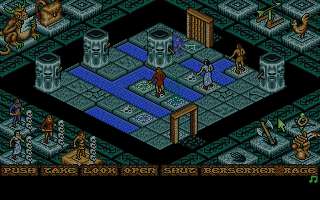
With combat so easy, the only real challenge came in the form of puzzles. Worlds features the same sort of puzzles as Legend, in which you have to experiment with a variety of mechanics like teleporters, switches, rotating pillars, and missile-shooters to figure out the right sequence to open a door or get to the other side of a room. Some of them are fair, with the elements behaving in a consistent, empirically determinable manner; others seem random to me.
   
The first puzzle room I found was relatively easy. The goal was to get to the other side of a patch of water. Each side of the water had one teleportation square and one pillar with a button, and in the (inaccessible) back corner was a pillar that shot fireballs along with two squares at the end of the pillar's range, each with a "Damage" rune.
        
The first "puzzle room."
      
You solve puzzles like this by taking a save and starting to mess around, noting what each element does. It turns out that the first button causes the pillar to fire a missile. The second causes the pillar to rotate. When the missile reaches the southern "Damage" rune, it teleports anyone on the first teleportation pad to the second. When the missile reaches the eastern "Damage" rune, it causes the eastern door to open. The solution is to have someone stand on the first teleportation pad, have someone else press the first button, have the first (now teleported) character press the second button to rotate the pillar, and then have the second character press the first button again.
    
Some of the puzzles have multiple teleporters in succession but don't teleport someone if another character is already on the destination pad. There are times that the solution is to block the destination pads to keep someone from teleporting. 
      
In this room, I had to block destination squares.
       
Out of four or five puzzle rooms in the dungeon, only one gave me any serious heartache. I figured it out without a hint, but the fact that I nearly caved bodes ill for what I'm sure are more complicated puzzles in the future. It was the only puzzle that required me to cast spells--specifically, to cast "Missile Damage" ("Forward Damage" might have also worked; I didn't try) on a "Damage" rune to get a missile pillar to fire. The shot below shows the setup.
       
One of the more difficult puzzle rooms.
      
When the missile pillar initially fires, it teleports any character on the teleportation pad to the other side of the screen. After that, the solution is to:

  • Have the teleported character stand on the glowing "Damage" rune between the pillar and the "Damage" rune in the southwest corner.
  • Hit the "Damage" rune on the east side with another damage spell. This causes the pillar to fire, hit the character instead of the rune, and then rotate to face east.
  • Have the telepored character stand on the "Damage" rune directly east of the pillar.
  • Hit the "Damage" rune on the east side with a third damage  spell. This causes the pillar to fire east and hit the character, which somehow causes the southern door to open.
   
Note the inconsistencies. Why does intercepting the missile cause the pillar to rotate in one case but not the other? Also note that the two "Damage" runes that the character has to stand on have no backgrounds, and two of them have different-colored backgrounds. I can barely discern the colors and I'm not sure if they're telling me anything anyway. (As an aside, Irene got me those Enchroma glasses for Christmas. They definitely help when I need to be able to distinguish two colors, but they do it by suppressing other colors and making the entire scene look dim and weird. I probably won't be using them much.) Actually, after typing this, I guess I figured it out. It's not the missile hitting the character that causes the pillar to rotate, but the character's interception causes the missile to do damage to that particular square. In any event, figuring this one out was a bit harder than the others and took a couple of reloads.
     
This room gave me some trouble, too, but I didn't take any notes on it. (I did most of this a month ago.)
       
All that's left is the story, such as it is. As you enter the dungeon, Ti-Mann Mochun appears to threaten you, apparently confirming his role in the old emperor's death. As you go through the dungeon, signs on the walls update you on various plot points. None of them are supposed to be literal signs, as it would make no sense for someone to have written any of them. They're just the only way the interface has to give the player some text.
   
"Upon entering the imperial citadel," one says, " you immediately see the lack of human occupants. Fierce beasts roam the ancient halls." As you penetrate deeper, the game tells you that, "you feel that some dark power was involved in the foul murder of the Holy Emperor." When you head downstairs, a sign says that, "Like the upper halls, the imperial dungeons have been invaded by creatures of darkness." 
         
MoChun must have been confused every time he walked past this sign.
       
Eventually, you find your way, via multiple locked doors and keys, to "the private chambers of his Imperial Majesty Ti-Mann MoChun." In the chamber beyond, MoChun attacks, alone, and the battle was over so fast I didn't even get a screenshot. "The evil usurper is defeated," a sign says, "but the secret of his power is still a mystery."
  
Stairs lead up to an isolated part of the first floor, where (past more locked doors and keys), you find MoChun's treasure chamber. One of its chests has The Book of Skulls, "a practical guide to the summoning and controlling of elemental beings." This book is snatched by Sushiana when you return to the surface (the long way, which annoyed me). "With this," she says, "we may be able to save the Empire." She provides a key to the next dungeon, the keep of Kishyai.
       
I thought the amulet was going to save the empire.
                 
I admit I'm surprised we killed MoChun in the first dungeon. I thought he'd be the final boss. I'm not sure why the party needs to "save" the empire at this point. Can't the normal rules of succession just take over now?

Miscellaneous notes:
   
  • Every character started the game with a "pass." I don't know what they're for.
  • The dungeon had a room with some symbols on the floor, a button on a pillar, and a note reading: "Reforge thy bones." I assume this is where you can resurrect dead characters.
       
The party wraps up a battle in the resurrection chamber.
     
  • I keep accidentally hitting ESC while in the dungeon. This causes the party to flee.
  • Aside from some of the names and the occasional taijitu (yin-yang symbol) or mini-pagoda, the game hasn't made much use of its oriental theme. 
  • At least in the starting dungeon, the game has solved one of my complaints from Legend: that a lot of the rooms had random symbols on the floors that weren't used for any puzzles. There are still a few, but they're very muted and clearly not active.
    
It's time to head outside Imperia, explore the outdoor map, find a store, and find a trainer. The party left the dungeon about 11,000 gold pieces richer (from a starting treasury of about 4,000 gold). The berserker earned 10,000 experience points, which would have been almost enough to carry her to Level 4 if she had started at Level 1. Thus, I expect the next dungeon will be at least a little closer to my level.
    
Time so far: 5 hours