Showing posts sorted by relevance for query Fate - Gates of Dawn. Sort by date Show all posts

Sunday, February 18, 2018

1991/1992

            
1991 was, on balance, a depressing year. It took me nearly 3 years and 1,201 hours to get through its 37 games, nearly a quarter of that spent on Fate: Gates of Dawn. When it was all over, Ultima V from 1988 still stood at the top of the list and only four games had broken a rating of 50 all year, three of them sequels to games that had higher scores. The average rating was 2 points lower than 1990 and 3 points lower than 1989.

Games in 1991 got longer but not better.
        
Even the highlights had asterisks. There were four Gold Box games this year--Pools of Darkness, Death Knights of Krynn, Gateway to the Savage Frontier, and Neverwinter Nights--but still none of them managed to exceed Pool of Radiance, and for the first time I began to wish SSI had better balanced quality with quantity. Might and Magic III was good but not as good as I remembered. Fate was memorable but lasted more than 200 hours beyond the point I should have stopped playing.
          
This screen was not worth the equivalent of 7 full-time work weeks.
      
I did continue to appreciate the growing geographic diversity of our developers. There were more countries represented this year than in any previous year, including Canada (Ancients 1: Death Watch), Switzerland (Antares), Denmark (Chaos in Andromeda), Germany (Die Drachen von Laas, Fate: Gates of Dawn, The Ormus Saga, Dungeons of Avalon, Spirit of Adventure), Australia (Dungeon of Nadroj), Japan (Knights of Xentar), the UK (Moonstone, Heimdall, HeroQuest, Knightmare), and Italy (Time Horn). What's more, none of these games totally blew it. In fact, they all had moments of innovation and brilliance, even if they didn't always achieve high final scores.

I'm also satisfied with my "won" rate for the year. I only gave up on Antares, The Ormus Saga, Dungeons of Avalon, and the sample game with The Bard's Tale Construction Set, and I took both Ormus and Avalon as far as I could. They both still bother me.

The only major theme I can draw out of the year is the surprising persistence of low-quality Ultima clones. Between Quest for Tanda, The Rescue of Lorri in Lorrintron, The Ormus Saga, and Legend of Lothian, I've really had my fill of independent game with iconographic interfaces.

Game of the Year Nominees

Part of me wants to reach down to mid-list for "Game of the Year." Knights of Xentar--at least was different. The limited but satisfying Shadow Keep. Twilight: 2000, because no other RPG has let me drive a tank through Poland. But no, I can't nominate any of them with a straight face. So instead, here's my half-hearted list of nominees for "Game of the Year":

1. Disciples of Steel. The clear victor if I chose based on rating alone. It was the top-rated game of the year and the one I authentically enjoyed the most, despite its many flaws. In a year of blah, this one-hit wonder managed to anticipate dozens of future trends, including multiple interweaving quest threads, multiple modes of gameplay, and lots of player choice. Its character development and tactical combat systems, adapted from Wizard's Crown, are near-unsurpassed, and it gave solid attention to other mechanics of quality RPGs, including a tight economy and a diverse set of equipment. I was sorely tempted to replay it at the end of the year, favoring a completely different approach this time, seizing cities by force and maximizing the use of the optional strategy game hiding beneath the surface. My biggest quibble: it sold about 12 copies and left no mark on the future.
           
Despite hundreds of battles, I never got bored with Disciples of Steel's tactical combat system.
         
2. Pools of Darkness. Technically, as Gold Box sequels went, Death Knights of Krynn ranked higher. But Pools of Darkness took the Gold Box to new levels, maxing out spell capabilities and allowing characters to rise to god-like levels. It told a compelling story, featured one of the most memorable maps of the series (Moander's corpse), and concluded everything with a truly-epic final combat. While not the Omega of the Gold Box games, it's close, and it makes a worthy bookend with Pool of Radiance.
       
The final battle of Pools of Darkness is legendarily difficult.
         
3. Might and Magic III. I don't think it's the best of the Mights and Magics even among the first three, but it demonstrates New World's commitment to pushing the envelope and updating its interface with new technologies. The mechanics often feel unbalanced, and the game world is sometimes a little goofy, but it's still loads of fun. Between its million side quests, the dozen items of equipment that every character can strap on, and its constant sense of character development, no one else was offering anything exactly like it. The Might and Magic series has always, in my opinion, exceeded its sources (principally Wizardry) and competitors (principally The Bard's Tale), but this was the first year that it truly left them in the dust.
         
Combat in Might and Magic III is turn-based, but through sound and graphics manages to evoke a real-time feel.
          
4. Fate: Gates of Dawn. The game that embodies "go big or go home." Out of nowhere, developer Olaf Patzenhauer took an Alternate Reality base and made the largest physical RPG seen so far, with more monsters, more spells, more character classes, more items, more everything than any of his competitors. More isn't always better, of course, and in the end, Fate is ludicrously, unconscionably, almost maliciously long, with only the thinnest plot and an absurd ending, but it's hard to beat the mechanics of the first 50 hours. As whole, Fate re-defines "epic" and paves the way for Germany's ascension in the RPG world in the 1990s.
         
I managed to map most of the 640 x 400 game world.
            
5. Eye of the Beholder. It's easy to forget that up to this point, the Gold Box series has offered the only truly successful adaptation of the most famous tabletop RPG system. Every other attempt at the D&D license has resulted in something forgettable at best and execrable at worst. Eye of the Beholder comes along and, though flawed, shows that there is another way to do it. It kept Dungeon Master-style gameplay alive and managed to produce its own sequel during the same year.

Honorable mentions: Technically, Death Knights of Krynn rated higher than Pools of Darkness, but who gives GOTY to the middle game in a three-part series? Spirit of Adventure was a surprisingly effective improvement on its Bard's Tale template but didn't really leave a legacy. I had a ball with Conan: The Cimmerian despite it lacking in several core RPG areas. MegaTraveller 2: Quest for the Ancients was a poor game overall, but it was an important step to truly open worlds and lots of player choice in how to achieve objectives.

1992 Preview

While we let those percolate, let's look ahead to 1992. If 1991 was a disappointing year, 1992 promises to be the absolute opposite. I'm practically giddy at the list before me. Every franchise had a release this year. We get the final D&D Gold Box title (aside from the Unlimited Adventures construction set) with The Dark Queen of Krynn. The Ishar series begins. The Realms of Arkania series begins. We get the second Interplay Lord of the Rings title. We get the third Magic Candle title. We get a Might and Magic, a Wizardry, a Quest for Glory, and two Ultimas! And in between these surefire hits are a ton of titles that I feel like I've heard good things about, among them Amberstar, Black Crypt, Darklands, Four Crystals of Trazere, and Spelljammer: Pirates of Realmspace. Surely, one of these games is destined to unseat Ultima V at the top of the list.

Here's the bad news: there are 65 games. This is, in fact, the peak year for RPGs.
         
      
The following year, 1993, has one game fewer, and after that the number drops back to the 30s and 40s for most years, averaging 43 between 1994 and 2009. But 1992 is a definite hump, and I can only be glad that so many of the titles look promising. Given the sheer number, you'll need to understand when I'm relentless with my definitions. I'm tempted to start right now by axing B.A.T. II; the first one was hardly an RPG at all.

Despite the sheer number, there's not a lot of new geographic diversity with the 1992 titles. The USA and Germany remain strong. Canada and the U.K. contribute a few. A few more leak to the west from Japan. Hungary contributes its first RPG with Abandoned Places: A Time for Heroes, and Finland offers its first RPG since SpurguX (UnReal World). In terms of platforms, I'm going to be able to abandon most of my emulators. There are four Amiga-only games (Antepenult, Black Crypt, Dungeons of Avalon 2, and Warriors of Releyne), two Macintosh-only games (Darkwood and Minotaur: The Labyrinths of Crete), and a lone C64 game (Telnyr II). The other 58 have a DOS port.

We're going to be entering 1992 slowly, because I've decided to double up on 1988 and 1989 games until I clear the "old" list and can work off of 1992 exclusively. There are 38 games remaining on that "old" list, although I can tell a lot of them are destined to be cut.

Year-End Superlatives

Total games played: 37 (from an original list of 45)

Highest-rated games: Disciples of Steel (57), Death Knights of Krynn (54), Pools of Darkness (52), Might and Magic III: Isles of Terra (52), Gateway to the Savage Frontier (49).

Longest played (hours): Fate: Gates of Dawn, at 272. It's hard to write that without feeling like I need therapy. The average was 31 hours per game and the total was 1,201 hours.

Longest played (start to finish): Martian Dreams, which was on my mind between October 2015 and March 2017 despite only taking 35 hours.

Percentage won: 89%

Hardest game: Knightmare, the only game to which I've given a full 5/5 for difficulty.  I question whether it's possible to win without a hint guide. Even then, it takes more than 400 hits to kill the final enemy, who can kill you instantly if he hits once.

Highest category score: The 8 awarded to Disciples of Steel in "gameplay" for its nonlinear approach and replayability. It was a little too hard at the beginning for a perfect 10.

Best game with a bad category: The damned Gold Box games still can't get the economy right. Death Knights of Krynn and Pools of Darkness came in at 2 and 1, respectively, in that category despite breaking 50 in general.

Worst game with a good category: Playing Neverwinter Nights offline, I could enjoy all of the strengths of the Gold Box engine with none of the content. Knightmare was a beautiful-looking game that was absolutely enraging.


Game of the Year
          
          
In a year where I'm lukewarm about all my choices, I've chosen Might and Magic III: Isles of Terra less for the specific title and more as a representative of the overall series. If I don't give it here, you can imagine what will happen: IV will lose to one of the Ultimas, or Darklands, or one of the other awesome 1992 titles. V will fall to something like Betrayal at Krondor. VI, perhaps my favorite of the series, had the misfortune of being released the same year as Baldur's Gate and Fallout 2; VII came out the same year as Planescape: Torment. No way is VIII or IX getting it.

I liked Terra less than its predecessors, but I still liked it quite a bit. It continues to exemplify an approach that hardly no one else is taking: an open world that may reward or punish you for exploring in a non-obvious order; lots of side-quests (seriously, when do these become standard?); a heavy dose of lore attached to individual maps and areas ("Corak's notes" were particularly brilliant); and copious methods of character development. I love its contrast with development in, say, D&D, where a character's attributes remain (mostly) fixed his entire life and his reward for slaughtering a thousand orcs is four extra hit points and one new spell slot. A Might and Magic III character, in a fifth of the time that it took that D&D character to go from Level 5 to 6, will stumble upon a fountain that raises his strength 5 points, upgrade 6 items of equipment, gain 8 new spells, come across an amulet that doubles his hit points, and turn in a quest item for 3 levels' worth of experience points. I hasten to add that Might and Magic's approach isn't universally the better one--there's something to be said for more spartan character rewards--but it sure feels more rewarding when playing.

You also have to admire the engine, which manages to feel fast and action-oriented despite being turn-based and tactical. It offers a nice halfway point between Dungeon Master and Wizardry.
       
There are problems, of course--see my "Cabbage Theory" in my final entry. The rest of the game has long outgrown 16 x 16 maps. And the creators' inability to craft a plot with any gravitas remains a significant liability. But more than most developers of the era, you sense that New World has the capacity to learn from these mistakes and grow. We will soon see the results. Well, not soon--in like 100 more games. It is highly likely that I'll end 1992 and start 1993 with the IV/V pair. Whether I try them independently or combined remains to be Xeen.


Let's jump right in to 1992. In choosing the play order for the year, I often think of John Cusack's advice on making mix tapes in High Fidelity: "You got to kick it off with a killer, to grab attention," but it can't be the best, because you have to leave room to "kick it up a notch." Thus, I've chosen Ultima Underworld. It's a groundbreaking game that makes us feel that we've stepped into a new era, but parts of it haven't aged well, and I thus doubt it will be the highest-rated game of a very competitive year.

Monday, April 1, 2024

Revisiting: Fate: Gates of Dawn (1991)


Fate: Gates of Dawn
Germany
reLINE Software (developer and publisher)
Released in 1991 for the Amiga and Atari ST
     
It's hard to believe that it's been over seven years since I wrapped up Olaf Patzenhauer's epic Fate: Gates of Dawn. As longtime readers may recall, I left the game with an unfinished map, which has always gnawed at me. It was time to take a second pass and really get into the meat of this seminal title.
      
What unique encounters lurk within that white space? Time to find out.
            
Fate, as you may recall, is based on Alternate Reality: The City, a game with epic intentions but little follow-through. Fate follows through, offering considerations of hunger, thirst, disease, drunkenness, fatigue, and a host of other potential conditions, as well as effects of weather. Its cities are sprawling, with multiple entrances and exits, stores, and guilds. NPCs wander the streets and the player has about as many options for interacting with them as a person does in real life. 
      
Instead of entering a virtual reality created by aliens like in Alternate Reality, the main character in Fate actually travels across different dimensions. In Fate, players start off as Winwood, a young person who owns a record store in the 20th century. Winwood enjoys his job but feels tired from working long hours. One day, while taking a nap on his sofa, he starts having nightmares about an old sorcerer casting spells. When he wakes up, he realizes he's not on his sofa anymore but in a dirty room above a tavern. He puts on some medieval-style clothes he finds nearby and goes downstairs to the bar. By listening to the conversations of the people there, he figures out that he's in a different version of human history where magic is powerful and technology developed differently.
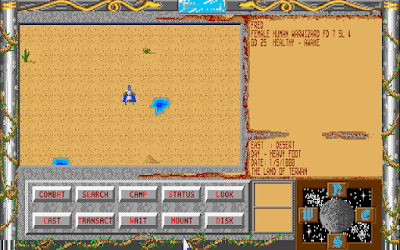
      
The main character is lost in the woods as the game begins.
      
Winwood leaves the tavern and narrowly escapes a massacre carried out by Thardan's henchmen. He learns that Thardan, the mage from his nightmare, is searching for a "traveler between worlds." Suspecting that he's the one being sought, Winwood hides in a tree for a day. Eventually, he approaches an old man exploring the inn's ruins. This man, Naristos, is a seasoned fighter who shelters Winwood for the night and provides some information. Naristos reveals that Thardan is indeed an evil wizard with an army of henchmen and monsters. Thardan likely brought Winwood to this world through a portal to use his knowledge of advanced technologies for his own gain. Naristos advises Winwood to keep moving and find allies who think like him. He then directs Winwood toward the nearby city of Larvin.
       
The game starts with Winwood alone in the forest, wearing everyday clothes and carrying a dagger, 6 water bottles, 4 lunch rations, and 1,355 coins. He has no instructions where to go, but if he searches for a while, he'll inevitably find a road leading to the nearby city of Larvin. Having played the game before, I had a map showing the locations of valuable pieces of equipment, so I decided to make a few pit stops before heading to the city.
     
No reason not to make use of prior intelligence.
    
Once in the city, I decided to try to fill out my party as quickly as possible. As the game goes on, you meet NPCs with much better statistics than the average denizen of the city, but until then, a party at half-strength dies more often than is necessary. The game takes an interesting approach to NPCs. The copious options in the right-hand menu bar include "Chat" and "Ask for." "Chat" takes you to a screen where you can insult, adulate (compliment, basically), enchant, curse, joke, brag, tell fibs, or just introduce yourself. "Ask for" gives you more substantive dialogue options like "Name," "Profession," "Hint," and "Being." Back on the main menu, you can also ask NPCs to join you. You have to find the right approach for each NPC, which depends a lot on their class. Fighting classes tend to look for blunt honesty while magic classes are more responsive to flattery. Thieves appreciate guile.
         
My attempt to persuade this young lady doesn't work.
      
As I wandered, I was reminded of the game's excellent approach to sound. It's rare to find one that puts sound effects before music, and even rarer to find one that offers no music at all. Instead, Patzenhauer introduced the chirping of birds, the patter of rain, howling winds, and footsteps. 
      
The City of Larvin. Many of these areas are inaccessible at the beginning of the game.
       
I leave you as I explore the grand city of Larvin. Between NPCs and random combats, I hope to have a fleshed-out, equipped party in a few hours. Then we'll see what new surprises the world has to offer!

Friday, April 22, 2016

Game 220: Fate: Gates of Dawn (1991)

Not a very fantasy-looking opening screen.
      
Fate: Gates of Dawn
Germany
reLINE Software (developer and publisher)
Released in 1991 for the Amiga and Atari ST
Date Started: 21 April 2016
    
In the hours that I spent re-visiting Alternate Reality: The City a few weeks ago, I was actually grateful for the game's lack of a main quest. Despite its fame and reputation, I simply didn't warm to the game, and I had no interest in exhaustively mapping the entirety of the enormous Xebec's Demise. I was happy that I could quit playing when I felt like quitting rather than spending dozens of hours following a meandering plot to its end. I thought that the game was far more intent than achievement.
   
Fate: Gates of Dawn is what we get when a developer makes good on the original intent of Alternate Reality, including an integrated city, dungeons, and wilderness and a main quest. The connection between the two games is so obvious that I'm surprised it hasn't come up on my blog before. Almost everything about the game has a clear basis in Alternate Reality, including the main plot, the size of the cities (or, at least, the starting city), the multiple types of each establishment, the importance of "guilds" to learning magic, the copious options for NPC encounters, the types of gear you can buy and equip, the root of the combat system, and the way you have to manage hunger, thirst, and fatigue. Heck, even the damned rain looks the same.
   
The rain falls during my first visit to the City of Larvin.
   
Alternate Reality wasn't the only inspiration, I hasten to add--among other things, there's a clear Bard's Tale influence on combat--nor did the developer lack for his own ideas, but overall Fate is clearly a love letter to the earlier game. This isn't just my guess: in an interview on a fan site, developer Olaf Patzenhauer explicitly says, "I played Alternate Reality and I liked the atmosphere of the game. Since the story was bad, I wanted to create a game with atmosphere and story."
   
Banks offering interest on investments also appeared in Alternate Reality.
    
The question is whether, given the story, I'll ultimately like it better than Alternate Reality. My reactions so far are mixed. I admire everything that Fate manages to cram into floppy disks and the sound is fantastic, but the interface so far is a bit of a nightmare. More important is the length. From the comments on my blog and my initial scouting of the Internet, it's obvious that the game is legendarily large. The opening city alone is a staggering 54 x 54 squares (roughly, anyway--I screwed something up somewhere), and I guess the wilderness extends so far that it can take hours of real-time play just to walk from one place to another. Estimates for the time it takes to win the game top 200 hours, which, if true, is going to be good news for my efforts to catch up on the non-DOS 1980s games.
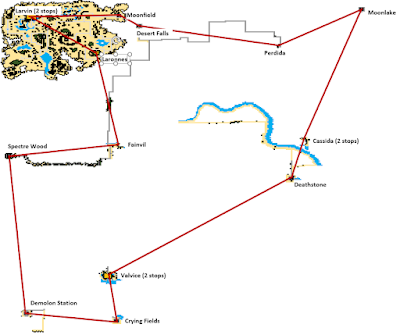
Let's start with the basics. Fate is a first-person "blobber," based on tiles, with action progressing in real time except for combat. It was developed primarily by Olaf Patzenhauer and Heinrich Stiller at reLINE Software, the same company that published The Legend of Faerghail, although the only name that the games share is graphics designer Matthias Kästner. I'll have more about Patzenhauer in the final entry on the game, but for now suffice to say that he died in 2011 of a heart attack at age 50, so we won't see him comment on my blog.

In its backstory, the game is ironically truer to the title Alternate Reality than the original game. Where Alternate Reality had the player enter an alien-created virtual reality, Fate has the protagonist literally cross dimensions. There is no character creation in the game. Instead, everyone plays (at least initially) as Winwood, a young 20th-century record store owner happy with his work but a little tired of its long hours. (I've been enjoying the thought of John Cusack's character from High Fidelity playing the protagonist.) One afternoon, he lies down to take a nap on his sofa and begins to have nightmares involving an old sorcerer casting some kind of spell. When he awakens, he is not on his sofa but in a dirty room above a tavern. Dressing himself in the medieval-style clothes he finds in a nearby wardrobe, he heads down to the bar and listens to the patrons' conversations long enough to determine that he's found his way to some alternate timeline of human history, in which the development of magic skewed the balance of power and the growth of technology.
   
The opening screen starts Winwood lost in the woods.
   
Winwood wanders outside the tavern just in time to avoid a massacre of all its inhabitants, carried out by henchmen working for a mage named Thardan. He overhears that Thardan is looking for a "traveler between worlds" and surmises that Thardan is the mage of his nightmare. He hides in a tree for a day or so, then takes a chance on approaching an old guy poking around the inn's smoldering ruins. The old fighter, Naristos, takes Winwood in for the evening and fills in some holes. Thardan is indeed an evil wizard, in command of an army of henchmen and monsters, who probably brought Winwood through a portal to exploit his knowledge of advanced technologies. Warning Winwood to avoid staying too long in one place and suggesting that he find some like-minded companions, Naristos kicks him out and points him in the direction of the nearby city of Larvin.
   
That was a freebie.
   
The game begins with Winwood alone in the forest, clad in regular clothing, armed with a dagger, carrying 6 water bottles, 4 lunch rations, and 1,355 coins. There's not much of an indication of where to go. I bumbled about for a while, fighting successful combats against rats, finding a few random treasures (including a short sword upgrade), before I finally found a road.
    
Killing rats wasn't hard.
But not all the combats ended well.
    
I followed the road a ways, and a group of signs started directing me to the city of Larvin. I had to reload a few times after getting killed by bandits (human enemies seem beyond me at this point), but eventually made it into the city. Larvin is apparently one of four large cities in the game world. There are also five small villages and an unknown number of dungeons. The manual warns you not to bother entering the dungeons unless you have a particular reason to be there.
   
I guess I won't head here just yet.
   
I tried just wandering the city at first, but its walls offer no more safety than those of Xebec's Demise. Robbers, burglars, and evil mages kept attacking and killing me. I thus started to carefully map so at least I'd have something to show. Before long, I realized I'd kill a couple of game sessions just mapping Larvin. For this first entry, I managed to get most of the perimeter mapped, but I must have missed a square on the west side, because the squares didn't come together right on the east side. I'm sure that will take a while to work out.

What I've mapped so far.
   
The city has a variety of inns, taverns, equipment shops, banks, temples, and guilds. I've been annotating their locations, but I otherwise haven't done much with them. I've won a small minority of combats, but I'll save a posting on combat for later. About a dozen squares produced some random treasure.
  
I could afford it, but I think I need to save more money first.
  
I also ran into a number of non-hostile NPCs. The game takes an interesting approach to NPCs. The copious options in the right-hand menu bar include "Chat" and "Ask for." "Chat" takes you to a screen where you can insult, adulate (compliment, basically), enchant, curse, joke, brag, tell fibs, or just introduce yourself. "Ask for" gives you more substantive dialogue options like "Name," "Profession," "Hint," and "Being." Back on the main menu, you can also ask NPCs to join you.

In general, NPCs have been friendly but not helpful. They'll tell me their names, but when I say something like "Help," they say, "Why should I help you!?"
   
If this was the default response to JOB in Ultima IV, it would have been a really short game.
   
Over time, however, I got two of them to join me: a mage named Dolly and a mercenary named Auzack. It appears that there are quite a large number of NPCs who will join the party--I guess you can even have multiple parties--so every player's specific composition is going to be different than every others'.
   
The stats for one of my new party members.
   
I read somewhere that if you get stuck, NPCs start offering you clues as to how to proceed. Late in my wanderings round Larvin, Winwood suggested that we start talking to more mages. I'll let you know if that produces any results.
   
You just got here. What do you know about anything?
   
I don't really care for the interface which, like most Amiga games I've encountered, is all mouse-driven. As if the keyboard wasn't just sitting right there in front of the player. Technically, you can hit the number keys to correspond with the menu options, but since they're not numbered on screen, it doesn't help very much. It's very easy to click on the wrong option with the mouse, and you end up insulting an NPC instead of adulating him.

On the plus side: oh my god, the sound. Finally, finally, finally we have a game that could care less about music (there is none) and has instead invested all its efforts into sound effects. They're fantastic. You get birds chirping, rain falling, footsteps, and howling wind in the background, and fun clangs and swishes in combat. This is only the third game I can remember that features decent ambient sound; the other two--Legend of Faerghail and Dungeons of Avalon--were also German games for the Amiga.
  
I can't show sound, so here's a nice shot looking across a lagoon in the middle of the city.
   
There's much, much more to cover in subsequent postings. I haven't even touched on the game's races (they include "Morons" and half-Morons), magic, combat, or equipment. Even if I don't finish, this is going to be a long one.

Friday, February 17, 2017

Fate: Gates of Dawn: Summary and Rating

   
Fate: Gates of Dawn
Germany
reLINE Software (developer and publisher)
Released in 1991 for the Amiga and Atari ST
Date Started: 21 April 2016
Date Ended: 3 February 2017
Total Hours: 272
Difficulty: Moderate (3/5)
Final Rating: 42
Ranking at Time of Posting: 200/239 (84%)
Ranking at Game #455: 392/455 (86%)

Fate was conceived as a successor to Alternate Reality, which had promised much--a city, a wilderness, an arena, a palace--but delivered little. In that, Fate succeeded. Not only did it retain most of the logistical considerations of Alternate Reality--hunger, thirst, fatigue, nutrition, encumbrance, disease, and so forth--as well as the complex NPC interactions, it allowed multiple characters in the party, created a full game world, and added a main quest.

The problem is that the game didn't know when to quit. I recommend that modern players, if they want to play Fate, end when they solve the Cavetrain quest. Up to that point, it's a great game. Different NPCs create a very different experience in combat and exploration, as in the beginning each one only has one or two spellbooks. You get to explore a large city, a large wilderness around it, a smaller sister city, and a large, complex, 7-level dungeon with a variety of navigational puzzles. Leveling is relatively swift and rewarding, and the economy still holds some value. Hints are plentiful, and the main quest is adequate. Seriously, play it this way. Don't read the backstory. Some mage has cut the city of Larvin, enclosed by mountains, from the outside world. Winwood is the son of a tavernkeeper whose family was murdered by marauders looking for supplies, since no goods are coming in from the outside world. Your only quest is to restore the function of the train. You'd have a 60-hour RPG with decent mechanics, and you'd walk away happy.

Instead, the game continues for another 200 hours, with senseless plot developments, character development that becomes less and less important (my characters ended the game with dozens of improvement slots), and combat that becomes either mindlessly easy (outdoors) or absurdly deadly (indoors). Equipment upgrades slow and then stop, the economy spins out of control, and the player spends dozens of hours just getting from one place to another. What would have been high GIMLET scores for Fate: Quest of the Cavetrain start to bleed away as the game gets more sprawling and pointless.

Yes, I got seduced by the map. It's happened before, often at work. With major projects on my "to do" list, I'll get sucked in by some boring, menial, seemingly-incompletable task and I'll have to tear myself away from it. "Chet, that report was due last week!," I'll hear, and respond, "Sorry! I'm busy coding some variable I'll probably never use across 200,000 records!" The process of filling in those little boxes became an opiate. I'm glad I stopped myself before insisting that I finish. I will admit that the map is pretty cool. The developer could have set an excellent RPG there, full of lore and side quests. He just didn't.

The plot of Fate starts out intriguing. Winwood is transported from the real world and current year to an alternate Earth in the year 1932 in which magic is real and other races exist. The agent behind his transport seems to be an evil wizard named Thardan. Thardan uses one of his followers to disable the Cavetrain and block Larvin's access to the rest of the world, ostensibly to keep Winwood from escaping the starting area.

It's not a bad beginning, but from there the game doesn't develop the plot at all. Thardan's motives are never revealed. Unlike the much later Lionheart: Legacy of the Crusader, Fate doesn't try to put real-world analogues into its alternate Earth. (And I'm not suggesting that Lionheart is a particularly good game; it's just the only other one I know set in an alternate history.) Neither the maps nor the names of the cities suggest an alternate Earth. The only real "plot twist"--having Winwood whisked to the dungeons beneath Cassida via the wand on Naristos's body--isn't explicitly part of Thardan's plot. If it is, it was a stupid idea, as it was the only way that Winwood came into contact with Bergerac and Morganna.

Morganna, the deus ex machina, comes out of nowhere with a compelling back, but no compelling backstory. Thardan comes to a swift and ignominious end without even the traditional villain's exposition. He remains a passive villain the entire game.
    
Fate officially jumps the shark.
   
The hint system, which starts out strong in Larvin, requiring only that the player find the right class of NPC, completely disappears by the end, where the player has to make several nonsensical leaps of logic.

The name of the game remains a complete mystery throughout. What are the "gates of dawn," exactly? What "fate" is at stake here?

I don't even know what to expect from a GIMLET at this point.

1. Game World. The backstory of the alternate Earth is clumsily explained and never referenced in-game. As noted above, Winwood's part in the world starts out intriguing and ends stupid. On the other hand, the developer did a good job with the design and mechanics of the game world. The cities feel like huge places, populated with hundreds of NPCs. The map is exquisitely detailed, if light on the thematic content. The day/night cycle and changes in the weather pattern have meaning and consequences in the game. A mixed bag overall, but I suppose a step up from the typical RPG of the era. Score: 5.

2. Character Creation and Development. There's no creation, but the game gets some credit for the variety of ways that you can develop your party by selecting different NPCs. The strengths, weaknesses, and abilities of the various classes create a fundamentally different game for each player, particularly in the opening stages.

The races are entirely unreferenced and unused. The guild-based development system, supplemented with boosts from the altar in the Alarian Vaults, is only "okay." I saved my development slots the entire time I was in Larvin because commenters told me it was more efficient to use the better guilds outside the city. Once I did so, I really didn't notice that much improvement in my characters' performance, even though in some cases their attributes (like strength, dexterity, and skill) went from the 20s to the 90s. Acquiring spells is the more important mechanism of development, but even this stops being important after each character has 3 or 4 books.

I also give the game credit for the multiple-party system, which I really didn't exploit the way I could have. For instance, instead of circling my single party around the world to look for hints, I could have kept several parties in convenient locations. Since all party members get experience from all kills, it wouldn't have diluted my leveling very much; in fact, it would allow you to develop a party explicitly for grinding and to keep them in a convenient grinding location (near an inn and tavern in Katloch would have worked well), switching to them periodically to add a couple of levels while everyone else explores.

I don't know whether to regard the various logistical challenges--hunger, thirst, nutrition, fatigue, sins, conditions--as part of character development or not. Either way, the game made them too easy. Trivial amounts of money and time take care of them, and by mid-game you can deal with them all with various spells. Score: 5.
     
Fate features a large number of attributes and statistics to develop.
     
3. NPC Interaction. NPCs make up a major part of the game. You need them to join your party, give hints, train your characters, and further a variety of steps on the main quest. A complex system of gaining their favor with various chat options is undermined by a system that allows you to simply bribe most of them. Like most things, it's stronger in the beginning game than the ending.

I do like that once characters join the party, they have some wants and preferences of their own. They occasionally pipe up with hints or random comments. They may refuse to give their money in bribes, to hide in combat, to yell, or to go off on their own in taverns. I look forward to later games that develop these unique personalities deeper and allow more role-playing encounters with the NPCs. Score: 6.
    
A party member refuses to follow orders.
    
4. Encounters and Foes. There is a huge variety of monsters in the game, and it follows the old Bard's Tale tradition of using the same graphics for many different monsters, some of which are trivially easy and some of which are bafflingly hard. The inclusion of monsters that never die from any hit point loss, no matter how many rounds, was inexcusable, as was making an initiative system in which some groups of enemies always go ahead of the party. Overall, the various strengths and weaknesses of the foes never really impressed me or led me to create different tactical templates for dealing with them, beyond simply bashing weak monsters and using my few NUKE options against tough ones.

I do admire the various pre-combat options, which allow some limited role-playing and additional encounter tactics. Again, though, these are terribly unbalanced. "Prayer" shouldn't work as often as it does, nor should it be necessary as often as it is.

Then we have the various non-combat encounters with objects and buttons and such, all of which use the same set of menus. Since the correct selection is often nonsensical, you learn to just try every option, often with every party member, before the solution is revealed. The various button and lever puzzles never rise to the level of even the weakest Dungeon Master knock-off. Score: 4.
    
These types of special encounters were nice, but rarely offered much in the way of role-playing.
     
5. Magic and Combat. "Overblown" is probably the best word to describe the combat and magic systems. I like systems that have lots of options, but only when those options come together to create real tactical decisions. I never found any use for "Grope," "Steal," "Warcry," or "Mock," even when they worked. Many of the spells, as I covered extensively, are essentially useless, or duplicates of each other. Straight attacks become overpowered when you get "greater melee weapons" that damage all creatures in one attack.

And yet, we have to give credit for the sheer number of options, even if they don't all work. As with everything, the first third of the game does best here, as you gingerly approach each new party and try a variety of actions to create "tactical templates" to use against different foes. When each character only has a couple of spellbooks, you find yourself experimenting more than when all characters have half of them. Some of the spells are highly-original and fun. Score: 5.
    
Towards the end of the game, combat difficulty got pretty nutty.
    
6. Equipment. This category is perhaps Fate's strongest. I always like games in which you regularly get equipment upgrades, and this only happens when the game offers numerous equipment slots or numerous characters. Fate does both. Each character gets two weapons, two pieces of body armor, a helmet, gloves, and boots, plus a variety of potions and special items. Multiply that among 7 characters in a single party and potentially 28 characters in all parties, and you find that the game never stops giving regular rewards except in the final act.

Fate also has solid mechanics here. Examining each item tells you most of what you need to know about it, including who can equip it and how it affects your statistics. Encumbrance becomes a real concern as the best armor tends to be quite heavy. My strategy was generally to equip the best item and deal with the encumbrance effects by discarding other things, but it's possible I could have done better by equipping lighter armor and keeping a greater variety of weapons in inventory, for instance.

Fate gets the highest score here that I can offer without complex item interaction (a la NetHack), detailed item descriptions (a la Might & Magic VI-VIII), or item crafting. Score: 7.
    
Rarely do games give you this kind of detail to help with equipment choices.
     
7. Economy. I like games that give you plenty to buy. Early in the game, Fate sets a tone like Alternate Reality in which you need gold just to survive. You might find yourself murdering a peasant for enough cash for your next meal, or a night in the inn. If you find a nice weapon, it's a real dilemma whether to keep it or sell it for enough rations and water to keep you going for the week. Above those basic needs are a variety of shops selling weapons and armor, healers, chapels selling indulgences, and of course new spells and character upgrades. Offering "alms" to NPCs also burns through the cash very quickly.

But having a lot of things to spend money on is only fun if money itself is scarce. From the moment you wander outside, kill your first dwarf, and get 1,500 "piaster" for the deed, you generally have as much money as you need the moment you need it. There was never a point in the game that I worried about going broke, and because of that, I never bothered to sell a single piece of equipment--I just dropped it when I was done with it. You saw how I bought about 6 redundant ships (perhaps the most expensive item in the game) and shrugged off the loss of over $7 million towards the end.
     
Towards the end of the game, when you have millions of piaster, the most expensive potions--such as this one that restores all spell points--only cost a couple of thousand.
    
The imbalance in the economy is perhaps best illustrated by the uselessness of the banking system. The developer spent a lot of time positioning banks with various investment opportunities throughout key cities, but you'd have to be daft to bother with them. Just go kill some more dwarfs. Score: 3.

8. Quests. The game only gets credit for having a main quest, and a rather stupid one at that. There are no alternate paths or outcomes, no opportunities for role-playing, and worst of all, no side quests throughout the enormous game territory. Oh, I suppose you could argue that it has some "side-areas" that improve character development, but anything it would gain here would be lost in light of the idiocy of the main questline. Score: 2.

9. Graphics, Sound, and Interface. The graphics and sound are perhaps the best that they could have been for the era. The developers put a lot of effort into well-composed monster and NPC portraits, outdoor settings, and little mises-en-scène in the taverns, shops, and train. They certainly pass the "good enough" point that I require for this category. The sound effects go beyond that; not only are the clashes and zaps of weapons and spells done well, the game is one of only a few to offer evocative background sounds, so well-composed that I sometimes confused them for the real thing.
     
A diverse group awaits the Cavetrain.
     
The interface is the only place that I had real trouble. The game is meant to be used with a mouse--which makes me hate it already--but even worse, you have to click on very small menu options and frequently double-click by accident. Although you can use the keyboard in a limited sense, you have to mentally number the menu options to select the right key; an explicit numbering would have partially redeemed it. Too many options that you might want to use in concert are on different menus. All told, a bit of a nightmare. Score: 6.

10. Gameplay. Fate offers extensive map non-linearity but not plot non-linearity, and I prefer to see both together to really enjoy myself. (The 7-part Moonwand quest, which you can do in any order, was the exception and probably the high point of the post-Larvin part of the game.) I definitely would not call it "replayable." You'd have to be insane. In difficulty, it starts with a nice moderate level but goes off the rails after the Cavetrain quest, alternating between very easy and very hard. For "pacing," we of course award a big, scrawled "F" for being way, way too long. Score: 2.

This gives us a subtotal of 45, which puts it fairly high on my existing list. I'm not sure how to feel about that. On the one hand, the game does so well mechanically that you absolutely have to recommend it. For 1991, it is a wonder to behold, and when I first started it, exploring Larvin and its environment, every hour I discovered some new nuance that led me to admire the developer even more. On the other hand, the inability of the developer to know when to quit seems like it ought to count more than a few points in the final GIMLET category. And it's especially bad for offering an ending that isn't worth reaching, and for hints and directions evaporating towards the game's end. In the end, comparing it to the other games on the list, I feel better knocking off 3 points and kicking it down to the level of Knights of Legend, which had similar problems, at a final score of 42.

But let's talk for a moment about the game-within-the-game: Fate: Quest of the Cavetrain. Not only does it not lose those 3 additional points, it gains 3 more in the "gameplay" category for not being too long, 1 more in the "quests" category for not being stupid yet, 2 more in the "economy" category for not having gone out of control, and 1 more in "character creation and development" for development being more significant, and 1 more in both "combat" and "encounters" for not yet becoming bland and rote. Fate: Quest of the Cavetrain is a solid 54-point game, 9th-highest on my blog so far, better than everything except titles that offer extensive side-quests and more detailed role-playing options, and an obvious candidate for 1991's "Game of the Year." Don't cheat yourself out of this excellent game. Just don't worry about where the Cavetrain leads.

I say all of these things coming from an era in which 200- or 300-hour games are hardly uncommon. Steam tells me that when I last played Oblivion on my PC, it took me 213 hours. Skyrim took 278. (Neither totals count the multiple times I played both games on my console.) But of course these titles are packed with content, including so many side quests and faction quest threads that it's hard to keep track of them all. Even if you don't take a single quest, simply exploring each dungeon or structure and learning its individual story provides more rewards than the totality of Fate's plot.

On top of this, I have a sneaking suspicion that Fate was actually supposed to take even longer. I base this on the horribly unbalanced initiatives of the monsters towards the end of the game. Certainly, the developer didn't intend for the player to "pray" away every fight, right? Certainly, he didn't intend every encounter with the wandering demons to completely wipe out the party. Given that Morganna joins the party at Level 105, I wonder if the party wasn't supposed to be of a comparable level (my characters topped at around 60) before braving the Cassidan dungeons in the first place. That would have required an insane amount of grinding, but the game is already pretty insane.
   
Before any of my characters even had a chance to act.
    
I was therefore curious how reviews of the time treated a game of such unprecedented length. I scanned reviews offering both the best rating (89/100, from Amiga Joker in March 1991) and the worst rating (26/60, from Aktueller Software Markt in November 1991). Of the two, the Amiga Joker reviewer seems to have gotten the furthest--screenshots show scenes that could only be in Mernoc or Katloch, plus hit-point totals that suggest Level 50+ characters, which is pretty impressive. While recognizing that the game will involve "months of play," he doesn't seem to attach much quality to that, though he does warn of the game's overall difficulty. He particularly seems to enjoy the graphics and sound, and like me, he praises the background effects. (I only translated parts of the review, so if any German-speaking readers would like to read the entire thing and offer more details, I'd be grateful.)

The ASM reviewer, on the other hand, manages to make most of his negative points not about the gameplay or length but about the very graphics that everyone else seems to like. Only Amiga magazines would take a game with graphics as well-composed as this and find some way to bitch about them--in ASM's case, the complaint is that they're not animated. This is the 1991 version of modern reviews that, faced with a game like Fallout 4 where you can count individual blades of grass, conclude that the graphics "suck" because the blades don't cast individual shadows. ASM also seems to have issues with the scope of the game, at least in terms of numbers of party members, spells, and dungeons.
 
I'm hard-pressed to find any contemporary reviews of the English version. I understand reLINE was going out of business (although later recovered) just as the English version was published. It's possible that it barely made it to English players' Amigas, let alone American ones. This is unfortunate, because--no offense to my European readers--American players had the most experience in 1991 with actual RPGs, and it would have been fun to see their reactions to both the length (Scorpia surely wouldn't have been able to finish the game before turning in her review, which would have galled her) and the clear foundation in Alternate Reality mixed with The Bard's Tale. Most European reviews focused on its relationship with Legend of Faerghail (1990), reLINE's previous RPG, which also showed a heavy Bard's Tale influence and also featured graphics by Matthias Kästner.
  
 
Fate's auteur was Olaf Patzenhauer, who apparently began working on the game around 1986, after some experience with Alternate Reality, The Bard's Tale, and some of the Ultima titles. I otherwise haven't been able to find very much about the man, such as age, education, or previous employment. He died in late 2011 or early 2012, some sites say from a heart attack but I was unable to find a specific obituary. Fate and a 1992 strategy game called Dynatech seem to be Patzenhauer's only non-adult games, and as we've seen, even Fate had plenty of adult material. His post-Fate credits include Penthouse Hot Numbers Deluxe (1993) and Biing!: Sex, Intrigue, and Scalpels (1995), described by MobyGames as "an erotic hospital-management simulation," which raises a number of questions I do not want answered.

From what I can gather from message boards, mostly in German, sometime in the early 2000s, Patzenhauer wrote a Fate 2 but never published it. Instead, he sent a personalized copies to friends and fans with the stipulation that they not share them. Accounts suggest that the game was never finished and had no main quest. (If any German-speaking reader would like to browse the forums here, you might find more information about the game than I did.) I've seen some sites that say the source code was destroyed upon Patzenhauer's death, as per his will, and others that say he lost the game in a computer crash before he died. (On one message thread in 2006, Patzenhauer talks about a computer crash but later says he recovered his data.) What everyone does seem to agree on is that the game featured plenty of manga-influenced graphics and nudity, if not outright hentai gameplay. (By his own account, Patzenhauer developed a deep interest in all things Japanese in the post-Fate years.) The image below, minus the black bars, came up in an RPG Codex thread in 2008, for instance. (As for the black bars, the images in my "won" posting are as explicit as a I dare get without worrying that Google will require me to turn on the "adults only" flag.) There are some rumors of a fan sequel in-progress called Fate 3.
     
Purported screenshot from the privately-distributed Fate 2.
    
It's going to be weird not having the occasional Fate session on my "to do" list, and I have a feeling that my memories of the game are going to be wrapped up in my memories of a weird year in which Irene and I moved 4 times. I played Fate in the cramped study of a temporary apartment in Boston, and on the porch of a beach house we rented for a few months on the North Shore. I had it going on the kitchen table of a one-bedroom in Portland as the summer breeze came through the window, and in the comfy office of the condo we eventually bought near Bar Harbor, as the snows fell on the harbor outside. Perhaps the instability of my living situation explains why I took refuge in the stability of mapping square after square of the huge game world. And perhaps it also explains why I was so personally offended at its shaggy-dog ending. Despite a relatively high score, I'm glad to be done with it and moving on.


Sunday, January 9, 2022

WarWizard: Mapping from Above


My map of the game world so far.
         
The above is all I've accomplished in about eight more hours of WarWizard gameplay. I can't tell you how much I hate trying to map top-down games. There's no easy way to do it. I've tried the "stitch together screenshots" method, most notably with Shadow Keep (1991), but that takes forever, and if you're not pixel-perfect in matching overlapping or adjacent areas, you create errors that compound fast.
   
Of course, the same is true of the alternate method, which I'm using here: trying to replicate things tile by tile. I typically do it in rows. The WarWizard screen is 11 x 7 tiles with the character in the center. I start in a random part of the world and map all 77 tiles around me, then add one row or column at a time as I move. This method can result in essentially the same problem. When you finish your circumference of the world and the tiles don't match, finding and fixing the source of the problem is about four times as difficult as in a first-person game.
   
My map of 2088: The Cryllan Mission (1989). This one was more difficult because the world wraps.
       
Mapping is even harder in WarWizard than the typical tiled game because the graphics are advanced enough that the tiles are drawn not to look like tiles. There isn't a "water" tile and a "grass" tile the way there is in, say, early Ultima games. There are instead, for instance, "75% grass that blends into a 25% water" tiles, "mostly grass but with a hint of water in the southeast corner" tiles, and "half-grass, half-forest" tiles. I don't have the capability to figure out how to map those literally, so I have to pick the dominant feature, but that creates issues. For instance, the creators often use four "mostly desert but a hint of water in the corner" tiles stitched together in a cube to make it appear that there's a pond where the four corners come together. That pond functionally isn't "there"; it doesn't impede movement, as each for the four tiles is "really" a grass tile. Do I not map it all? If not, I lose an important navigational landmark. Do I make them all water? That makes the pond more like a lake, and suggests I can't step on those squares. Do I choose one of the four squares at random? That creates confusion that might screw up my map later.
        
This "pond" is actually four grass tiles with bits of water in the corners. It doesn't really "exist," as I can walk on all four tiles. Do I map it or not?
       
There are lots of other ways to make mistakes. I'm mapping new rows and columns when they show up on the edge of the screen, either (in this game) three or five tiles away. Sometimes I misjudge size and distance. You can see it in the map above on the eastern shore. I'm relatively sure that the coastline is supposed to be even all the way down, but something I did gave an extra column starting about 25% from the top. Probably there were a line of "half-water, half-land" squares that I interpreted as "water" at the top and "land" further down.
     
I probably would never have become a CRPG addict if I had to do this for every game. Fortunately, having to map a top-down game is a rare occurrence, as there are lots of ways that developers relieve you of the responsibility. These include:
   
  • Making a first-person game instead. First-person games tend to be easier to map because you're only mapping a couple of squares at a time. They tend to occur in areas of fixed size (e.g., the Gold Box's 16 x 16), so it's hard to go too far astray. Most important, they tend to be smaller. For WarWizard, I've already mapped coordinates up to 126 x 83,  which by itself is over 10,000 squares, and I haven't even found the northern and western shores. Wizardry, in contrast is only 4,000 squares total.
  • Making the maps small and easily-navigable. Ultima is a good example of this. Although its game world is a relatively large 168 x 168, it is organized into small islands that are easy to explore. There aren't a lot of natural barriers to block you otherwise, so once you have a hovercar, you can explore the entire world in strips.
  • Providing a world map. Even a rough outline of a continent is generally enough to prevent me from having to make my own maps. Once I have a sense of size, shape, and relative distances, I can divide the map into smaller areas and identify an optimal exploration pattern for each, annotating towns, castles, and dungeons as I find them.
      
 
One of my early maps of Fate: Gates of Dawn (1991). It wasn't important that I map everything--just enough to identify key locations and help me figure out an exploration pattern for other areas.
     
  • Provide a mechanism for determining coordinates. Even if the game doesn't come with a world map, some method of identifying your coordinates in the game world is usually enough to keep me from having to make a comprehensive map. I might still throw together a basic map anyway to plot cities and dungeons and judge relative distances, but I usually don't feel like I have to map everything, particularly since you don't need an unbroken line of terrain from one point to another to ensure accuracy. Fate: Gates of Dawn (1990) is a good example. Although that was a first-person game, it had a world the size of a top-down game. I mapped more of it than was necessary, but I could have gotten by with just mapping key locations and a little of the terrain around them.
  • Have an in-game automap. This is the most obvious solution, of course, but it's rare for this era.
       
I don't know how many CRPGs I've encountered that have lacked all of these features, but it's probably fewer than 12. And because I find mapping top-down games so annoying, I'm usually willing to take a peek at someone else's map when I get lost. So if we're talking about games that lack all of these features and are so obscure that no one has posted a map online, we're down to the single digits. Unfortunately, WarWizard is one of them.
       
As you can see from the map I've already created, however, WarWizard''s world is anything but simple. The land is riven with mountain ranges and waterways that prevent easy point-to-point exploration. Mountains and forests block your view of what's beyond. Important cities and dungeons are found in the middle of dense swamps and forests at the ends of hidden mountain trails. Finally, the hunger and fatigue mechanics discourage you from getting lost and having to do much backtracking. This is the sort of game for which you do need an accurate map.
         
This is what happens when you put cartography above everything else.
       
Unfortunately, my focus on mapping destroyed the other progress I had made with the game. While mapping, I was only concerned about uncovering the next row of tiles, not keeping my party fed and healthy. They started to starve and eventually died. I simply shrugged, reloaded, and went in a different direction. But since the game saves periodically as you play, the periods I could explore after reloading got shorter and shorter, until at last my only saved game was a party literally steps away from death.
  
When I do start again, I will probably see if I can make something of the places I've already discovered rather than continue with the map. I'm pretty sure I've identified the only dungeon "southeast" of Caer Tiran, which should let me finish at least the first quest. 

Do any of you have solutions for mapping or navigating top-down games that I'm overlooking?

Time so far: 11 hours