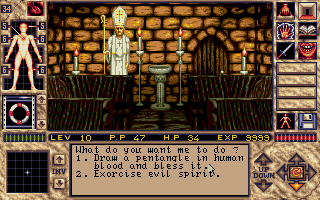
The first Elvira was a better game than a game inspired by a schlock late-night character had the right to be. As I played, I kept catching myself having fun--only to be reminded that the game was, in some fundamental sense, about Elvira. I don't hate her or anything, but centering an RPG around her makes as much sense as basing one on Dave Letterman or the Church Lady from Saturday Night Live. Every time she entered the frame, it broke any sense of immersion the game had otherwise managed to build up.
(For more background on Elvira and her inexplicable appearance in computer role-playing games, check out my coverage of Elvira: Mistress of the Dark, starting with the first of four posts.)
It's a bit worse in this game, because the protagonist is explicitly presented as Elvira's boyfriend. I've had to role-play evil characters before, but never a character that just has really bad taste. That's nothing against Cassandra Peterson, who is lovely, and everything against the character she created, who, while comical, strikes me as a bit gross. When I played Elvira, you made me watch her 1988 film, in which this weird, black-clad, ash-skinned, wig-wearing, cleavage-baring creature moves to Massachusetts. The movie gives her the most square, conventional love interest possible, and then just expects us to sit back and pretend that the pairing makes any sense. Now I have to pretend to be such a guy in a game.
No mention is made in the manual or opening screens about the events of the first game. Elvira is inexplicably back in Hollywood, running Black Widow Productions, producing films with titles like House of Horror and It Came from Beyond the Grave. Somehow, the demon dog Cerberus ends up on her set, kidnaps her, and plots to sacrifice her at midnight. The protagonist, her boyfriend, starts the game hanging outside the studio, waiting to pick her up for a date.
Your only character creation choice is whether you're a stuntman, private eye, computer programmer, or knife thrower, the choice of which affects your attributes (weapon skill, accuracy, willpower, magic resistance, strength, constitution, poison resistance, and intelligence) on a scale of 6 to 10. The stuntman is naturally quite high in weapon skill, strength, and willpower but low in accuracy, magic resistance, and intelligence. The computer programmer excels in magic resistance, poison resistance, and intelligence, but has low constitution, strength, and weapon skill. I went with the private eye, who has 8s and 9s in everything--no very strong strengths or weaknesses.
For some reason, the developers significantly increased the RPG credentials of the second title. Elvira's only method of character development was an incremental increase in weapon skill over the course of the game's many combats. Here, not only do we have more attributes and an actual character creation choice, but also a beating heart that helps diagnose fear and injury levels, actual experience levels, a system of tracking injury to individual body parts, and a choice of combat styles that tweak the mostly-action system.
The PC begins with Elvira's spellbook, a small knife, a pendant that Elvira lost the other night, an empty wallet, a set of keys, a ballpoint pen, a used piece of chewing gum, a penknife, and a small silver crucifix. I don't know if he brought one along because he knew Elvira was in trouble, or just because he's fully aware of who he's dating.
The first puzzle of the game involves getting through the locked outer security gate. I spent a while trying to pick the lock with the penknife when Elvira exploded in another vision and suggested that I try using "the rock by the road." I returned to the road area, looked around, and finally found the "rock" she was referring to--a barely discernible set of pixels in the background. So that's how this game is going to be.
Throwing the rock through the door glass, I was able to enter the security office. I grabbed a security jacket and hat from the wall and put them on. A bunch of notices on a corkboard didn't seem to offer anything useful.
A dead security guard fell out of a closet when I opened it, and a couple of pixels on his belt delivered me a "small security key." This unlocked a nearby panel, which prompted me to my first use of the game's copy protection system to find the right security code. The game came with a codewheel, and occasionally you have to line up various rings representing symbols, spells, and monsters to get numeric codes. Fortunately, there's this awesome online version.
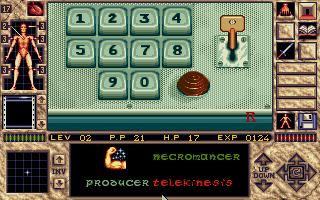
Somewhere along the line there, I got enough experience to level up. Already Level 2!
A nearby computer monitor showed surveillance camera images of other parts of the studio. None of them seemed to be important.
Back outside, the security gate was now open. It led to a parking lot, where there was only one car--Elvira's. I opened the trunk and got a wrench and some pliers.

With nothing else to do, I opened the door and entered the studio. I immediately recognized a room I'd seen on one of the security monitors. I grabbed a fire extinguisher from the wall. A desk held nothing of importance that I could find. A pair of doors lead to restrooms with toilets; the game let me fiddle with the lid and gave me 4 points for flushing it for no reason that I could see. The bathrooms otherwise had nothing.
A door led out of the entry room to three other doors, labeled 1, 2, and 3. I left them alone for now and took the other exit: an elevator, which offered stops at Levels 1 and 2 or the basement. I went down to the basement.
There, sitting crosslegged on the floor, was a strange-looking guy. But in my attempts to investigate the room, I accidentally walked forward into...I don't know...a boiler room? There, a giant hand came out of a doorway and killed me instantly. I hadn't been saving, so I need to start over.
A few other notes:
When I wrapped up my coverage of the first Elvira, I noted:
This wasn't exactly a complaint, since I'm a fan of neither Elvira nor schlock horror films, just an observation that the character was oddly displaced into something that felt like a generic adventure castle. This game seems to have learned from the past by filling the screens with references to the character and the films that she glorifies. Because of this, it promises to be a better "Elvira" game, though not necessarily (from my point of view) a better game.

I had hoped to get to at least one dialogue and combat in this first outing, but I guess they'll have to wait for future posts, as will a discussion of the spell system. I don't mind an adventure game--I haven't played one in a while--but Elvira II is definitely feeling more like an adventure game than an RPG so far.
*****
You're probably wondering how Elvira got elevated to the next spot all of a sudden. Here's the rundown:
 |
| By having pictures of Elvira literally everywhere, this game breaks the immersion quite frequently. |
(For more background on Elvira and her inexplicable appearance in computer role-playing games, check out my coverage of Elvira: Mistress of the Dark, starting with the first of four posts.)
It's a bit worse in this game, because the protagonist is explicitly presented as Elvira's boyfriend. I've had to role-play evil characters before, but never a character that just has really bad taste. That's nothing against Cassandra Peterson, who is lovely, and everything against the character she created, who, while comical, strikes me as a bit gross. When I played Elvira, you made me watch her 1988 film, in which this weird, black-clad, ash-skinned, wig-wearing, cleavage-baring creature moves to Massachusetts. The movie gives her the most square, conventional love interest possible, and then just expects us to sit back and pretend that the pairing makes any sense. Now I have to pretend to be such a guy in a game.
 |
| Is this the CRPG Addict getting upset about boobies again? No. The issue is more that she's a butter...everything else. |
No mention is made in the manual or opening screens about the events of the first game. Elvira is inexplicably back in Hollywood, running Black Widow Productions, producing films with titles like House of Horror and It Came from Beyond the Grave. Somehow, the demon dog Cerberus ends up on her set, kidnaps her, and plots to sacrifice her at midnight. The protagonist, her boyfriend, starts the game hanging outside the studio, waiting to pick her up for a date.
Your only character creation choice is whether you're a stuntman, private eye, computer programmer, or knife thrower, the choice of which affects your attributes (weapon skill, accuracy, willpower, magic resistance, strength, constitution, poison resistance, and intelligence) on a scale of 6 to 10. The stuntman is naturally quite high in weapon skill, strength, and willpower but low in accuracy, magic resistance, and intelligence. The computer programmer excels in magic resistance, poison resistance, and intelligence, but has low constitution, strength, and weapon skill. I went with the private eye, who has 8s and 9s in everything--no very strong strengths or weaknesses.
 |
| The game begins with a character creation process. |
For some reason, the developers significantly increased the RPG credentials of the second title. Elvira's only method of character development was an incremental increase in weapon skill over the course of the game's many combats. Here, not only do we have more attributes and an actual character creation choice, but also a beating heart that helps diagnose fear and injury levels, actual experience levels, a system of tracking injury to individual body parts, and a choice of combat styles that tweak the mostly-action system.
 |
| The private eye's attributes are on display as he examines a cork board. |
The PC begins with Elvira's spellbook, a small knife, a pendant that Elvira lost the other night, an empty wallet, a set of keys, a ballpoint pen, a used piece of chewing gum, a penknife, and a small silver crucifix. I don't know if he brought one along because he knew Elvira was in trouble, or just because he's fully aware of who he's dating.
The first puzzle of the game involves getting through the locked outer security gate. I spent a while trying to pick the lock with the penknife when Elvira exploded in another vision and suggested that I try using "the rock by the road." I returned to the road area, looked around, and finally found the "rock" she was referring to--a barely discernible set of pixels in the background. So that's how this game is going to be.
 |
| Do you see that rock? |
Throwing the rock through the door glass, I was able to enter the security office. I grabbed a security jacket and hat from the wall and put them on. A bunch of notices on a corkboard didn't seem to offer anything useful.
 |
| The plot thickens. |
A dead security guard fell out of a closet when I opened it, and a couple of pixels on his belt delivered me a "small security key." This unlocked a nearby panel, which prompted me to my first use of the game's copy protection system to find the right security code. The game came with a codewheel, and occasionally you have to line up various rings representing symbols, spells, and monsters to get numeric codes. Fortunately, there's this awesome online version.

Somewhere along the line there, I got enough experience to level up. Already Level 2!
A nearby computer monitor showed surveillance camera images of other parts of the studio. None of them seemed to be important.
Back outside, the security gate was now open. It led to a parking lot, where there was only one car--Elvira's. I opened the trunk and got a wrench and some pliers.

With nothing else to do, I opened the door and entered the studio. I immediately recognized a room I'd seen on one of the security monitors. I grabbed a fire extinguisher from the wall. A desk held nothing of importance that I could find. A pair of doors lead to restrooms with toilets; the game let me fiddle with the lid and gave me 4 points for flushing it for no reason that I could see. The bathrooms otherwise had nothing.
 |
| I'm trying to envision a scenario in which I'll need to come back with a coin. |
A door led out of the entry room to three other doors, labeled 1, 2, and 3. I left them alone for now and took the other exit: an elevator, which offered stops at Levels 1 and 2 or the basement. I went down to the basement.
 |
| Might as well get the scary basement out of the way. |
There, sitting crosslegged on the floor, was a strange-looking guy. But in my attempts to investigate the room, I accidentally walked forward into...I don't know...a boiler room? There, a giant hand came out of a doorway and killed me instantly. I hadn't been saving, so I need to start over.
 |
| Death comes with no warning. |
A few other notes:
- The game uses the same pseudo-3D as the first one. You can't really turn and look in all directions except from a few screens. When you do turn, you don't necessarily occupy a fixed location; the game might move you slightly closer or further away from important objects.
- It's really easy to accidentally move forward when you just intend to click on something on the screen.
- As in the first game, you can pick up a bunch of things in Elvira II that probably have no value to carry around.
 |
| I'm not sure if I need two fire extinguishers plus a portrait of Elvira. |
- While the graphics are okay, I can't tell you anything about the sound, because I spent this playing session in the middle of an airport lounge with no headphones. Hopefully, I'll be able to talk about that next time.
- The game offers some of the first real interactivity with the environment that we've seen in an RPG, though perhaps not in games of other genres. You can flush toilets, turn faucets on and off, and operate the hand dryer in the bathrooms, for instance.
 |
| Water flows from the sink as I press the tap. |
When I wrapped up my coverage of the first Elvira, I noted:
While they crafted an interesting and relatively enjoyable game, the developers missed opportunities to truly make it an Elvira game by incorporating more elements from the types of shlock horror films associated with the character. The puzzles and enemies are mostly generic fantasy and horror tropes, and with the exception of Vampira, they don't seem to draw any obvious inspiration from B films.
This wasn't exactly a complaint, since I'm a fan of neither Elvira nor schlock horror films, just an observation that the character was oddly displaced into something that felt like a generic adventure castle. This game seems to have learned from the past by filling the screens with references to the character and the films that she glorifies. Because of this, it promises to be a better "Elvira" game, though not necessarily (from my point of view) a better game.

I had hoped to get to at least one dialogue and combat in this first outing, but I guess they'll have to wait for future posts, as will a discussion of the spell system. I don't mind an adventure game--I haven't played one in a while--but Elvira II is definitely feeling more like an adventure game than an RPG so far.
*****
You're probably wondering how Elvira got elevated to the next spot all of a sudden. Here's the rundown:
- I have Antares sort-of working in the Amiga Forever application, but it keeps taking me to a black screen during loads and not loading the content. Typical experience trying to play an Amiga game. No, don't bother writing with suggestions--nothing any of you say ever makes any sense, and it's always filled with phrases like "easy" and "just..." and "all you have to do is...," all of which make me want to redirect the time I spend blogging to ruining your lives. I'll either figure it out for myself or I won't.
- Dragon Slayer---can't find a PC-88 version. Anyone have one? I was hoping to avoid having to learn an MSX or FM-7 emulator.
- Quest for Tanda: Only a couple of sites even attest to this game's existence, and if it wasn't for some screen shots on MobyGames, I'd frankly doubt that it was a real game. I can't find it available for download anywhere. It went to "not playable" status until I learn more.