Showing posts sorted by relevance for query Elvira - Mistress of the Dark. Sort by date Show all posts

Tuesday, January 7, 2014

Game 131: Elvira: Mistress of the Dark (1990)

     
Elvira: Mistress of the Dark
United States
Horror Soft (developer); Accolade (publisher)
Released 1990 for Amiga, DOS; 1991 for Atari ST, Commodore 64; 1992 for PC-98
Date Started: 6 January 2014

Elvira is one of those characters of whom, like Pee-Wee Herman or Super Dave Osborne, I've always been vaguely aware, but without actually understanding their contributions to entertainment or culture. I had to look up her Wikipedia page just to understand what Elvira actually did. I had this idea that she used to introduce movies on USA, but I think I had her confused with Rhonda Shear.

It turns out she used to introduce B-films for a Los Angeles television station in the 1980s (re-broadcast on a New York station). She developed that into a home video series. She got her own film in 1988 with Elvira: Mistress of the Dark, and I can only assume I knew about her from seeing the video repeatedly while browsing my local Blockbuster.


I watched a little of her shtick on YouTube, and I confess I don't really get it. Sure, there's the cleavage, but even in the 1980s, there wasn't a lack of that on television. I can't imagine wanting to watch a film called Count Dracula's Great Love anyway, but if I did, I'd probably just want the film to begin. Back when I watched films on television, I used to get annoyed with nonsense like this, whether it was Annabelle Gurwitch making sloppy joes during breaks in The Shawshank Redemption or Nick Clooney delaying the first scene of Bringing Up Baby with some anecdote about Cary Grant wearing a woman's dressing gown. Plus, I have the whole problem with camp. As someone who's never understood the appeal of The Munsters, The Addams Family, the song "Monster Mash," or The Rocky Horror Picture Show, I'm clearly not in her demographic.

I realize this is a snobbish thing to say, but if Netflix's "best guess" for how much you'll like Elvira: Mistress of the Dark is more than 2.5 stars, I think you have to re-evaluate your entertainment choices.

Even if you like Elvira and her type of campy humor, it's difficult to imagine someone watching her TV show or film and saying, "this really needs to be a computer role-playing game," but nevertheless here we are. 

The manual sets up the story with a series of diary entries written by the Elvira character. She's inherited Killbragant, a Gothic castle on the English moors, and she hopes to turn it into a spooky bed-and-breakfast. The story is full of silly but sometimes clever references to B-movie characters and themes: "a kitchen that's better equipped than Dr. Frankenstein's lab"; "a heap of legal papers big enough to hide Rodan"; "the place has been deserted since the Bloody Mary days." Anyway, it transpires that in days of yore, the castle's mistress was a witch named Emelda. She fell under the spell of an evil wizard named Beremond, slaughtered her people, murdered her husband Sir Elric, and reanimated corpses and skeletons in the catacombs. Before she died, she left instructions for her resurrection in a "Scroll of Spiritual Mastery," locked in a chest with six locks. She gave the six keys to her underlings, who later died in the castle.

Elvira's presence in the castle apparently causes Emelda's spirit to stir, and soon the place is crawling with ghosts, goblins, and gremlins. Elvira's plan is to find the ones who have the keys, open the chest, and figure out how to stop Emelda's return. In this plot, she has enlisted a "freelance ghostbuster" from a nearby town, and the game begins as he, the player, shows up at the castle gates.


Despite my skepticism as to the subject, I had already heard that Elvira had won Computer Gaming World's 1991 "Role-Playing Game of the Year," so I figured it must have really good gameplay. Even before I started playing the game, I was anticipating a pivot point in this review, where I'd say something like, "Given my ambivalent feelings about Elvira and her campy humor, you might expect me to completely pan her RPG. But guess what? It's a fantastic game!" Unfortunately, I can't quite say that. In fact, it's a little baffling to me that this would be the "RPG of the Year" in any year. It doesn't bode well for the upcoming crop of games on my list.

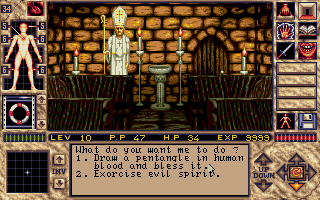
I'm not saying that it's a bad game. There are some promising elements. The graphics are quite nice, for one thing. They're well-integrated into a layout that makes the castle look and feel like a real place--a refreshing change from the featureless rooms and hallways of games like Wizardry VI and Buck Rogers. The interface offers an inoffensive blend of RPG and adventure game elements, perhaps a little better than B.A.T. and The Third Courier, but not as good as Hero's Quest or even--gods help me--Keef the Thief. I don't particularly care for the combat system, and character development promises to be scant.

There's no character creation. Every player starts nameless, with the same attributes: 50 strength, 10 resilience (like constitution), 80 dexterity, 99 life points, and 0 experience points (which, in this game, represent the percentage of the game completed more than any character development). The last attribute is "skill," which changes depending on the weapon currently wielded. I don't yet know if or how strength, dexterity, and resilience change, but skill increases as you land successful blows in combat--not a unique dynamic, but still rare for the era. The manual leaves the gender of the player ambiguous (clumsily covering by using "they" as a third-person singular pronoun), but I'm not sure why they did that, since the screenshots repeatedly show the player as a brown-haired male. I guess he's explicitly British, too, which makes for an RPG first.

The game offers some appropriately eerie music, and it's fun for a few refrains, but I turned it off fairly soon. Turning off the music is one of only a couple things you can accomplish with the keyboard; the game is otherwise entirely mouse-driven. The mouse ends up working well for things like inventory, but I don't know why it would have been so hard to program navigation to the keypad.

I've taken an axe from the wall and am preparing to take a shield.

The player can encounter an armory and get a battleaxe and shield just a few steps into the game, but there's really no point, as before you have a chance to enter the castle, you get a scripted encounter in which a guard hauls you to the undead captain of the guard, who strips your equipment and throws you in jail.


In a fun call-back to Elvira's TV appearances, which always seem to begin with her in a doorway, beckoning the viewer into her lair, Elvira then appears in the cell door to free the player.


At this point, we get a long bit of exposition in which Elvira reclines on a couch and tells the PC that he must stop Emelda, starting with finding a "strange guy in a sack" who stole her spellbook. She offers a few spells that she created before it was stolen and equips the player with a healing potion and a dagger. With some words of encouragement ("Now get out of here and do what you're being paid for!") she sends the player to the courtyard to begin his adventure.

This sequence involves the first use of embedded video that we've seen in an RPG. I think. I don't know enough about the technology, and it's tough to tell. I suppose it could just be a high-quality animation. Either way, it's only a couple of seconds on a continuous loop.


If you restart the game, you can just hit the SPACE bar during the beginning sequence to skip everything and start in the courtyard with the items Elvira gives you. That's a nice touch.

As you explore the castle, you fight occasional combats with random guards and fixed monsters. The combat system is action-based, though it is dependent partly upon the chosen weapon (at the beginning, of course, there is no choice) and partly the weapon skill. Mostly, it depends on player reflexes. Combat rounds are divided between attack stages and defense stages. During the attack stage, you can "lunge" or "hack." Once your opponent successfully blocks your attack, you enter the defense stage, where you can "block" or "parry." When you're successful at either, you go back to attacking, and so on.

Fighting an undead castle guard.

There's a clear choice about when to block or parry: when the enemy swings from his left (your right), you parry; when he swings from his right, you block. Sounds easy enough, but it takes a little time to learn how to interpret the attacks and anticipate which direction they're coming from. I haven't gotten good at it. I'm not yet certain whether there's some clear way to determine whether you should lunge or hack during the attack phase, so I've just been alternating between the two. I'll have more to say about combat when I understand it better.

The sounds during combat are fun, with the weapons appropriately clanging and the enemy screaming when hit. If you die from combat, you get a brutal death screen, and it seems to change depending on what type of enemy killed you. When a werewolf killed me, I was treated to an image of my throat ripped out.

Poor English lad.

Though you can rotate and turn as you explore, the game isn't quite fully 3D. You can't face every wall of every room. Instead, it's made up of a collection of static screens, some of which happen to be situated within turning radius of each other. You can click on most objects on the screen for a description . . .


. . . and you can pick up a ton of the objects, including paintings and lamps. I started collecting everything before I realized it would make more sense just to annotate their locations and return when I needed them.


Right now, I'm going through the familiar process of mapping each area, noting the objects, and annotating the puzzles. As in most adventure games, I expect I'll field a number of characters before I find the optimum path through the game. This, it occurs to me, is one of the distinguishing characteristics between an adventure game and an RPG: in an adventure game, you don't expect to win with your starting character.

Sunday, July 5, 2015

Elvira II: Won!* (with Final Rating)

I don't like the sound of that last bit.

Elvira II: The Jaws of Cerberus
Horror Soft (developer); Accolade (publisher)
Released 1991 for DOS; 1992 for Amiga, Commodore 64, and Atari ST
Date Started: 20 June 2015
Date Ended:
04 July 2015
Total Hours: 21
Reload Count: 44 (mostly from trying alternate solutions to puzzles, not death)
Difficulty: Moderate-Hard (3.5/5)
Final Rating: 34
Ranking as of Game #349: 238/349 (68%)

If nothing else, Elvira II helped me clarify why I'm a CRPG addict and not an adventure game addict. Although I value puzzles in RPGs--the occasional riddle, mystery, inventory puzzle, or navigation puzzle--I don't like games that are all puzzles. I don't always want to have a puzzle on the board, waiting to be solved. Rather, I want my puzzles to be punctuations after moderately-long periods of dungeon crawling and tactical combat. This probably explains why I'm not a huge fan of Dungeon Master-style games, where unsolved puzzles tend to rack up pretty fast.

As I wrapped up last time, I was preparing to navigate out of 6 levels of catacombs so I could grab some items of makeup and then navigate back through 6 levels of catacombs and fool the evil sorcerer into thinking I was his apprentice. As I had done with the mad scientist's assistant, I studied the picture that looked like a wizard's apprentice and dressed up in the appropriate garb, hat, and facial hair.

This was fun the first time.
        
Fortunately, it occurred to me to take all the makeup items back with me, in case I'd made a mistake, because I did. I forgot the fake nose. If I hadn't brought everything, I would have had to trek up and back again, and that probably would have killed my interest in finishing the game. (Later, though, when it became clear that I missed some fish bones needed for a "buoyancy" spell, I did have to trek down four levels again.) As it was, they were pretty annoying. Frequent traps pop up in your path, so you can't get into a rhythm where you're constantly moving forward, because this happens:

     
Instead, you have to pause after every step to make sure there isn't a trap ahead, and if there is, you have to click on it and "avoid" it.

      
Anyway, fooling the wizard just made him go away, allowing me to proceed into the small chamber beyond, where I found Elvira!

          
Or, at least, I thought so. The visage of Elvira turned into an acid-spitting demon. Once I dealt with it, I recovered the Indian's war lance.

It turned out that each of the three major areas--the "stages"--culminated in an encounter with "Elvira," followed by the recovery of one of the Indian's magic items. The first two times you find Elvira, she turns out to be a fake and you have to battle the creature that's taken her visage. The third time, it's the real Elvira, and after that until the end of the game, she appears in your inventory(!).


The caverns of Stage 1 were as large as the catacombs, but only four levels. They were crawling with giant mosquitoes, ants, grubs, and other vermin, but I clearly was supposed to have visited this area first, because I was way overpowered for them. Most of them died in a single blow with combat set to "berserk" mode. Occasionally, they poisoned me, but red mushrooms in the area were capable of creating the "antidote" spell.

The encounters in the dungeon were punctuated by rooms full of crystals and mushrooms that I could use to make helpful combat and healing spells. I ended up using hardly any of them because I had already conquered the place where I would have needed them most--the catacombs in Stage 3.

At the apex of the level was a giant spider and spider web. The spider was unkillable, I think, but I was able to evade him by trapping him behind an elevator door. In his web, I found a version of Elvira that turned into a hideous wasp-woman and the Indian's magic tomahawk.

Okay, enough of that.

Clearing the area meant finding a key to the elevator, and I had to look up a spoiler for that one. It wasn't obvious to me that a couple of pixels on an image of a dead man wrapped in a spider's web held a necessary item, or that I would need to use the "Telekinesis" spell to obtain it rather than simply cutting it out of the web. There are quite a lot of puzzles in the game that are like this.

Do you see anything obvious to try to take?

During my explorations of Stage 1, I maxed in level (10) and experience (9999). Even though I took multiple passes through the catacombs, I still think it was a bit too easy to hit the cap well before the end of the game.

Fighting a giant worm. Note all the crystals and mushrooms in my inventory.

With Stages 1 and 3 clear, I had to return to the haunted house at Stage 2 and figure out what I hadn't finished there. It turned out I had to bring Frankenstein's monster to life by casting "Summon Storm" on the house's roof and letting it strike a copper rod I inserted in a barely-visible slot. Again, I was relying on a walkthrough at this point.

The storm brought the monster to life, but what ensued was the most annoying puzzle of the game. Basically, you have to do two things with the monster: remove his headband, scalp, and brain, and get him away from the door that he's blocking when you first find him. This means that you have to animate him long enough to get him to walk a few steps from the door, but then stop him (by pulling out his brain wires) before he has a chance to kill you. The timing is hard to get right, and if you don't realize there's a door behind him in the first place, it's easy to put yourself in a "walking dead" scenario by taking his brain before he's moved away from the door.

Disassembling the monster.

Behind the door was, in my case, the real Elvira, along with the Indian's magic bag.

I don't suppose I could just leave her here?

I took all of the magic items to the Indian and he, one by one, in a series of identical animations, infused them with magic power.

You'd think a man of such ability could find a better job than janitor.

I now had all the items I needed for the summoning and binding ritual to kill Cerberus, described at length in one of the library's books, but I needed a holy man to draw the pentagram, and that meant resurrecting the dead cleric. Fortunately, now that I was at Level 10, I could mix the "resurrect" spell. I'm sure the ingredients were among the library's many tomes, but I just tried various mixtures of likely-sounding items (brain, heart, spleen, holy book, holy water, etc.,) until I got it right.

Trying various items to mix the "Resurrect" spell. Note Elvira sitting there in my inventory (second from the left). Could I have used her to mix a spell?

With the cleric revived (no word on how a clearly-Catholic priest felt about being resurrected via arcane arts), he took my chalice full of blood (I honestly can't remember where I got it) and went off to the parking lot to draw a pentagram. At this point, relying on the instructions in the book and a little help from the walkthrough, I completed the ritual necessary to kill Cerberus: light a series of 10 candles around the pentagram, use the magic bag to summon the beast, cast "Bind Demon" at him, throw the Indian's spear at his head, and hack his heart with the tomahawk. It took me a few tries to get it right because he kept killing me while I was trying to find necessary items in my inventory.

You'd think he could just do #2, but he just says "I don't perform that mumbo jumbo sort of religion."

The endgame animations were pretty good, and it's worth watching the video below of the entire sequence. Note the constant music. I played the game with sounds turned off on my computer; how long would you have been able to last with music like this playing incessantly?


Like the first game, this one ends with Elvira beckoning you to your ribald reward.

I'm not sure I like the look of that dagger.

I hope that the folks at The Adventure Gamer get to this one eventually, because I'm curious what they'd say about it from an adventure game perspective. I thought that some of the puzzles were rather obscure and illogical, and that there was too much screwing around trying to make sure you had the right inventory items in each situation. Add to this a number of "walking dead" situations (avoided in my case by breaking my rules and looking at spoilers), and I'm not sure it performs well as an adventure game.

On the other side, the role-playing aspects were under-developed. You do get notably stronger with each level-up, but the dungeons are long and boring and the combats bereft of anything you might call "tactics," so for me the role-playing elements were somewhat unwelcome. They mostly just padded the time.

It might score higher in a GIMLET than the first one just because it has more elements, but I can't honestly say I enjoyed it more. Let's see.

  • 6 points for the game world. This is one category that's notably better than its predecessor. It makes good use of horror movie tropes and characters by having the sets literally come to life. Elvira felt more like a standard fantasy game in Elvira's clothes; this one felt closer to a horror RPG.
  • 3 points for character creation and development. Definitely better than the first. You get noticeably stronger as the game progresses and you gain experience and level up. I like that you get experience for a variety of actions and puzzle-solving, not just combat. But there are no meaningful character choices throughout the game; even the initial selection of "profession" is staggeringly unimportant.
  • 5 points for NPC interaction. Between Elvira, the Indian, Frankenstein, and the sorcerer, there are a handful of NPCs with dialogue options, some of them even involving a small amount of role-playing (e.g., whether to insult the Indian by asking for "fire water").

Elvira's interpolations were usually unwelcome.

  • 5 points for encounters and foes. A variety of monsters undone by a lack of true strengths and weaknesses, plus puzzles that tended on the too-tough side. Balancing this were some occasional puzzles different than anything I've seen in a CRPG or adventure game. I like the use of spells as puzzle-solving tools.
  • 4 points for magic and combat. The combat system is arguably worse than the first game, but either way it's just a click-fest. I did like aspects of the magic system, such as being able to create "Fireballs" from a combustible material. This would be a fun dynamic in an open-world game where items replenish. Here, because there were so many "walking dead" scenarios, I was reluctant to fully exploit the magic system. I could have gone the entire game without running out of "Herbal Healing," for instance, but there was only a single item available to cast "Telekinesis." Good thing I didn't waste it.

Killing a giant mosquito, like everything else, is just rapid clicking.

  • 3 points for equipment--a handful of weapons and armor. The game gives you no clues as to the damage or protective value of the items you wield and wear.
  • 0 points for no economy.
  • 2 points for the main quest, which offers only one outcome and no player choices.

Tossing a spear at Cerberus to win the game.

  • 3 points for graphics, sound, and interface. The graphics are lovely, but the relentless music is unbearable and makes it impossible to enjoy the other sound effects. And I can't excuse the all-mouse interface. If a game is going to feature long series of mazes, I want to be able to move through them with the arrow keys.

A well-rendered giant spider chomps me to pieces.

  • 3 points for gameplay. I like the non-linearity during the central acts, but I'd say it's just a little too hard and quite a bit too long.

That gives us a final rating of 34, a little higher than Elvira but not enough to cross into "recommended" territory. Elvira II is definitely a better RPG than Elvira, but being a "better RPG" doesn't count for much if you're still not a good RPG.


I've run out of ways to make fun of Dragon giving everything 5 out of 5 stars, but they did it again here. You'd think a magazine focused on role-playing would recognize that Elvira II had some definite weaknesses in this area, but instead they offered a review that could have doubled as an advertisement: "From the opening screens, you'll be on the edge of your seat trying to rescue the beloved Elvira. This is a 'must' purchase."

Scorpia offered a more sober look in the March 1992 Computer Gaming World. Her primary problems are the "walking dead" scenarios: she was unable to complete the game because she'd used a crucifix needed to ward off a vampire in a spell; even if she could have gotten past this, she also used the matches needed to light the candles on a "Fireball" spell (which I also did; thankfully, I had VK to warn me). She also mentions the Frankenstein one. The entire second half of her review, in fact, is taken up with complaints about this specific issue, and I can see why. I was also happy to see that she complained about the music. On the other hand, she goes on for a while about a lack of save slots, which baffles me a bit. The game allows 48 different save slots in an era where the default is usually one. I only used 6 slots, but I grant you I tend to be overly conservative about this.

I'll tell you this: I wish there were more horror-themed RPGs. To that end, I'm going to be happy to give the Horror Soft/Accolade team another chance with Waxworks, coming up in 1992. Judging by the screen shots, it uses the same engine as Elvira II, but perhaps it improves elements of the gameplay. Either way, the setting looks pretty cool.

That will, alas, be Horror Soft's last game. The company renamed itself Adventure Soft in 1992 and produced the Simon the Sorcerer series but never tried again with an RPG. Of the three primary developers on Elvira II--Alan Bridgman, Michael Woodroffe, and Simon Woodroffe--only Simon Woodroffe seems to be active today, with some 2010s credits on action games produced by Sega. Michael Woodroffe last shows up as managing director of Call of Cthulhu: Dark Corners of the Earth (2005), and Alan Bridgman last contributed to Simon the Sorcerer 3D (2002).

My acquaintance with the Mistress of the Dark was brief, but I can't say that breaks me up. It's time to finally get serious about Antares.

****

Further reading: My series of posts on Elvira: Mistress of The Dark from early 2014. YouTube user Lemm has a 3 hour and 20 minute LP that takes the game from beginning to end, and as a bonus you can check out Javier Juan Castro Sanchez's compilation of all of the game's death scenes.


Monday, January 13, 2014

Elvira: Won! (with Final Rating)


Elvira: Mistress of the Dark
United States
Horror Soft (developer); Accolade (publisher)
Released 1990 for Amiga, DOS; 1991 for Atari ST, Commodore 64; 1992 for PC-98
Date Started: 6 January 2014
Date Ended: 11 January 2014
Total Hours: 9
Difficulty: Moderate (3/5)
Final Rating: 29
Ranking at Time of Posting: 65/131 (50%)

At it's core, Elvira is an adventure game, not an RPG, and like many adventure games of the 1980s and early 1990s, it has the virtue of brevity. It took me about six hours to fully explore it and figure out the puzzles, and another two and a half hours to win it with a fresh character. I've found that this divide between learning and execution holds for a lot of adventure games and adventure/RPG hybrids. When I replayed all the games in the Zork series in the mid-1990s, they each took about a week of banging my head against the wall trying to figure out the puzzles, followed by about three paragraphs of text to actually beat the games from start to finish. A player who already knows the territory and puzzles could get through B.A.T. or Hero's Quest in 90 minutes each. When I played "The Case of the Sultan's Pearls" scenario for SwordThrust, it took me about two hours to fully explore the castle, only to find that the winning series of commands, when starting fresh, is:

>N. N. ATTACK BUTLER. LOOK BUTLER. GET SULTAN'S PEARL.

There are very few straight RPGs that you could finish in such a speed run. Even if you had all the maps for Pool of Radiance or Dungeon Master in front of you, you still have to invest the time to fight the combats and build the characters.

I won the game with only 60/100 "experience points." I think the others would have come from mixing the other spells offered in the game. As I indicated last time, only a handful of spells are actually necessary to win. The others are optional and help with combat, but until you reach the endgame and know what reagents you need for puzzles, you're afraid to waste them on spells that aren't necessary.

I ended my last narrative having found all of the six keys needed to open Emelda's chest. The difficulty was finding the chest. For a while, I was stumped. I had solved every puzzle that I knew about and had visited every location that I could find. Then I remembered the cannon at the top of one of the turrets.

Lighting the cannon was the only puzzle in the game that I felt was unintuitive, and even it wasn't that bad. I first had to find a pair of tongs in the castle basement. The only problem was that every time I tried to take them, the ghost of the torturer would kill me.


The solution I came to, mostly by accident, was to put the tongs into my canvas sack. From an anonymous comment thread on my last post, I gather this was an unintentional workaround. What I really needed to do was to take the bones of the torturer (I originally thought they were from one of his victims) to the catacombs and lay them to rest in an empty coffin, then return and get the tongs. I did lay the bones to rest eventually, but I didn't tie the two things together.

Anyway, with the tongs in inventory, you can use them to remove a piece of coal from the stove in Elvira's kitchen. You take the hot coal to the cannon and use it to light the fuse. In another fun animation, the cannon blasts a piece out of another turret.

Two feet to the left and I would have blown up the chest. Then where would we be?
 
For reasons I don't really understand, destroying half the turret allows you to go up into it. It was blocked before. There lies Emelda's chest. You use the six keys and retrieve from it a Scroll of Spiritual Mastery and a ceremonial dagger.

 
After this, there was another interval in which I didn't know where to go to find Emelda. Eventually, I thought to use the "Alphabet Soup" spell on a rune stone I'd discovered in the catacombs, and it suggested there was a secret room within the catacombs. I returned and explored a bit more, and finally noticed a hole on the floor of one of the corridors. The hole was just big enough for the rune stone. When I inserted it, the floor broke apart, revealing a passage big enough to climb down.

Confronting Emelda in her throne room.
 
Emelda was in the room below, and she started draining my life force the moment I entered. Defeating her was a three-part process of inserting the Crusader's Sword into the stone in front of her, using the Scroll of Spiritual Mastery (which stripped away her glamour and revealed her undead nature), and stabbing her with the ceremonial dagger. The first part stumped me for a while, and it took several reloads for met to get it all right.

Some things apparently run in the family.

After my victory, the screen changed to a shot of Elvira beckoning me, and the endgame text vaguely suggested some kind of ribald reward:

Elvira beckons to her hero to follow her so that she can show you how grateful she really is for saving her from the evil powers of Emelda. Follow your mistress and collect your just reward.


It would be true-to-character if the next scene showed Elvira giving me a check for $50 and then demanding that I leave her castle. But the game isn't that witty. Instead, the credits roll and the player has the option to start again.

Overall, I feel like Elvira was a bit superfluous to the proceedings, and for a while I wondered if the game wasn't originally constructed without her. It wouldn't have taken much effort to add her to the framing story and the few in-game places in which she appears. The back story doesn't even jive with the film, really: in the movie, she inherits a mansion, not a castle; it's in Massachusetts, not England; and at the end of the film, it's destroyed. However, it's clear that Adventure Soft had obtained the rights to use the Elvira character at least a year earlier (I'll talk about this at the end), so this seems unlikely.

Regardless, while they crafted an interesting and relatively enjoyable game, the developers missed opportunities to truly make it an Elvira game by incorporating more elements from the types of shlock horror films associated with the character. The puzzles and enemies are mostly generic fantasy and horror tropes, and with the exception of Vampira, they don't seem to draw any obvious inspiration from B films. If I wanted to make a real Elvira-inspired game, I'd modify the plot a bit. The castle is haunted, but in such a way that it creates its horrors based on things it finds in the subjects' own minds. When it delves Elvira's mind, it finds decades of awful horror movies and populates the castle with Blacula, The Blob, intelligent rats from Willard, and perhaps a Killer Tomato or two. I guess that might have run into some copyright problems, but the point is the game doesn't quite have the campy humor or irreverent sensibility that you'd associate with Elvira, and most of the enemies and puzzles are played straight.

If they had made a game like this, I'd probably be complaining that I didn't like it because I don't like goofy, campy humor. Nonetheless, I think it would have been more true to the character. As it was, it felt like a decent horror game in which Elvira--a character I don't particularly like but also don't particularly mind--played a tangential part.


In my GIMLET, I give it:

  • 3 points for the game world. I give it credit for its horror theme and its tightly-constructed castle architecture, and a little for the back story involving Elvira's ancestor.
  • 1 point for character creation and development. It mostly fails in this vital RPG category. There's no character creation, and the only development is with the incremental increases in weapon skill.
  • 2 points for NPC interaction. Elvira herself is really the only NPC; other characters are encounters to be defeated. She's...there. I guess I cracked a smile at a couple of her lines.
  • 6 points for encounters and foes. In adventure/RPG hybrids, I tend to use this category to evaluate the quality of the puzzles, which serve as "encounters" in such games. I liked the puzzles in Elvira. They were difficult, but difficult for minutes rather than hours, and generally fair. The enemies were fun to look at but not very different when it came to combat.

I could only defeat this guy with the Crusader Sword.

  • 3 points for magic and combat. Combat is fast-paced but utterly non-tactical. As I outlined last time, the spell system was intriguing but mostly optional. I give it some credit for the variety of spells and the game dynamic associated with finding their reagents, but I wish the game had done more with the spell system.
  • 2 points for equipment. There's a lot of stuff to carry, but most of it is for solving puzzles, and I already gave the game credit for that. The small selection of weapons and armor is another blow to its RPG aspirations.
  • 0 points for no economy.
  • 2 points for the main quest, which offers only one outcome and no player choices.
  • 5 points for graphics, sound, and interface. I quite liked the graphics. The sound in the DOS version was sparse, mostly limited to combat attacks. I give it a little credit for the music even though I don't really care about game music. Mostly, I was surprised at how well I took to the interface. As you know, I'm normally not a fan of a mouse-only interface, but it worked surprisingly well here, even if there were times I wished I could just go forward and turn with the arrow keys.


  • 5 points for gameplay. It was nonlinear in the order that you can tackle the puzzles. I thought it was pitched at just the right level of difficulty and lasted just about the right amount of time.

That gives a final rating of 29, which sounds like I didn't like it very much, and I didn't--as an RPG. It's a decent adventure game, the presence of Elvira notwithstanding, but it lacks the combat, economy, and equipment that would have made it a true hybrid.

I guess Horror Soft knew what its selling points were.

Alas, not everyone felt this way. As I discussed in my first post on the game, Computer Gaming World famously gave it "Role-Playing Game of the Year" in November 1991 after considering J.R.R. Tolkien's Lord of the Rings, Wizardry: Bane of the Cosmic Forge, Worlds of Ultima: The Savage Empire, and Eye of the Beholder. I haven't played any of these games besides Bane, but to call that one alone an inferior RPG to Elvira is just absurd. Meanwhile, the same issue put Quest for Glory II: Trial by Fire in the "adventure" category and had it lose to King's Quest V; I wonder what would have happened if they'd switched Quest for Glory and Elvira and put them in their appropriate categories.

Those of you who are excited about Elvira, never fear, you'll get to hear all about her continuing adventures in Elvira II: The Jaws of Cerberus (1991). From its description, it sounds like it incorporates more RPG elements, including a choice of starting classes and more combat tactics. 1991 also saw a side-scrolling platformer called Elvira: The Arcade Game in which the player actually controls Elvira and kills enemies. I note that this is the same year that produced The Simpsons arcade game, which had Bart and Marge wielding a skateboard and vacuum cleaner as weapons, and a Hudson Hawk title in which the protagonist beans enemies with baseballs. Clearly, this is an era in which audiences looked at their comedy figures and said, "these characters are funny and all, but what I'd really like to see is them killing people."

Elvira was developed by the U.K. company Adventure Soft under its Horror Soft label, and the interface for Elvira is a clear update of the label's first adventure game, Personal Nightmare (1989):

Personal Nightmare has the same commands and approach to inventory, but it doesn't have the combat system or attributes.

Interestingly, the box cover for Personal Nightmare (also known as . . . A Personal Nightmare) prominently features Elvira. Clearly, Adventure Soft obtained the rights not just to make a video game based on Elvira, but to use her likeness for its Horror Soft series. In addition to Elvira II, we'll see Horror Soft again with Waxworks (1992). Three of Elvira's developers--Alan Bridgman, Michael Woodroffe, and Simon Woodroffe--worked on all of these horror titles, as well as the Simon the Sorcerer series from Adventure Soft.

Next we'll be returning to the 1980s with a review of Dungeons of Daggorath. I've removed Angband from the "upcoming" list because it's going to take me longer than I thought to offer my posts on Moria first. Sorry for those who were looking forward to it; we'll get there eventually.


Saturday, June 20, 2015

Game 191: Elvira II: The Jaws of Cerberus (1991)


The first Elvira was a better game than a game inspired by a schlock late-night character had the right to be. As I played, I kept catching myself having fun--only to be reminded that the game was, in some fundamental sense, about Elvira. I don't hate her or anything, but centering an RPG around her makes as much sense as basing one on Dave Letterman or the Church Lady from Saturday Night Live. Every time she entered the frame, it broke any sense of immersion the game had otherwise managed to build up.

By having pictures of Elvira literally everywhere, this game breaks the immersion quite frequently.

(For more background on Elvira and her inexplicable appearance in computer role-playing games, check out my coverage of Elvira: Mistress of the Dark, starting with the first of four posts.)

It's a bit worse in this game, because the protagonist is explicitly presented as Elvira's boyfriend. I've had to role-play evil characters before, but never a character that just has really bad taste. That's nothing against Cassandra Peterson, who is lovely, and everything against the character she created, who, while comical, strikes me as a bit gross. When I played Elvira, you made me watch her 1988 film, in which this weird, black-clad, ash-skinned, wig-wearing, cleavage-baring creature moves to Massachusetts. The movie gives her the most square, conventional love interest possible, and then just expects us to sit back and pretend that the pairing makes any sense. Now I have to pretend to be such a guy in a game.

Is this the CRPG Addict getting upset about boobies again? No. The issue is more that she's a butter...everything else.

No mention is made in the manual or opening screens about the events of the first game. Elvira is inexplicably back in Hollywood, running Black Widow Productions, producing films with titles like House of Horror and It Came from Beyond the Grave. Somehow, the demon dog Cerberus ends up on her set, kidnaps her, and plots to sacrifice her at midnight. The protagonist, her boyfriend, starts the game hanging outside the studio, waiting to pick her up for a date.

Your only character creation choice is whether you're a stuntman, private eye, computer programmer, or knife thrower, the choice of which affects your attributes (weapon skill, accuracy, willpower, magic resistance, strength, constitution, poison resistance, and intelligence) on a scale of 6 to 10. The stuntman is naturally quite high in weapon skill, strength, and willpower but low in accuracy, magic resistance, and intelligence. The computer programmer excels in magic resistance, poison resistance, and intelligence, but has low constitution, strength, and weapon skill. I went with the private eye, who has 8s and 9s in everything--no very strong strengths or weaknesses.

The game begins with a character creation process.

For some reason, the developers significantly increased the RPG credentials of the second title. Elvira's only method of character development was an incremental increase in weapon skill over the course of the game's many combats. Here, not only do we have more attributes and an actual character creation choice, but also a beating heart that helps diagnose fear and injury levels, actual experience levels, a system of tracking injury to individual body parts, and a choice of combat styles that tweak the mostly-action system.

The private eye's attributes are on display as he examines a cork board.

The PC begins with Elvira's spellbook, a small knife, a pendant that Elvira lost the other night, an empty wallet, a set of keys, a ballpoint pen, a used piece of chewing gum, a penknife, and a small silver crucifix. I don't know if he brought one along because he knew Elvira was in trouble, or just because he's fully aware of who he's dating.

The first puzzle of the game involves getting through the locked outer security gate. I spent a while trying to pick the lock with the penknife when Elvira exploded in another vision and suggested that I try using "the rock by the road." I returned to the road area, looked around, and finally found the "rock" she was referring to--a barely discernible set of pixels in the background. So that's how this game is going to be.

Do you see that rock?

Throwing the rock through the door glass, I was able to enter the security office. I grabbed a security jacket and hat from the wall and put them on. A bunch of notices on a corkboard didn't seem to offer anything useful.

The plot thickens.

A dead security guard fell out of a closet when I opened it, and a couple of pixels on his belt delivered me a "small security key." This unlocked a nearby panel, which prompted me to my first use of the game's copy protection system to find the right security code. The game came with a codewheel, and occasionally you have to line up various rings representing symbols, spells, and monsters to get numeric codes. Fortunately, there's this awesome online version.


Somewhere along the line there, I got enough experience to level up. Already Level 2!

A nearby computer monitor showed surveillance camera images of other parts of the studio. None of them seemed to be important.

Back outside, the security gate was now open. It led to a parking lot, where there was only one car--Elvira's. I opened the trunk and got a wrench and some pliers.


With nothing else to do, I opened the door and entered the studio. I immediately recognized a room I'd seen on one of the security monitors. I grabbed a fire extinguisher from the wall. A desk held nothing of importance that I could find. A pair of doors lead to restrooms with toilets; the game let me fiddle with the lid and gave me 4 points for flushing it for no reason that I could see. The bathrooms otherwise had nothing.

I'm trying to envision a scenario in which I'll need to come back with a coin.

A door led out of the entry room to three other doors, labeled 1, 2, and 3. I left them alone for now and took the other exit: an elevator, which offered stops at Levels 1 and 2 or the basement. I went down to the basement.

Might as well get the scary basement out of the way.

There, sitting crosslegged on the floor, was a strange-looking guy. But in my attempts to investigate the room, I accidentally walked forward into...I don't know...a boiler room? There, a giant hand came out of a doorway and killed me instantly. I hadn't been saving, so I need to start over.

Death comes with no warning.

A few other notes:

  • The game uses the same pseudo-3D as the first one. You can't really turn and look in all directions except from a few screens. When you do turn, you don't necessarily occupy a fixed location; the game might move you slightly closer or further away from important objects.
  • It's really easy to accidentally move forward when you just intend to click on something on the screen.
  • As in the first game, you can pick up a bunch of things in Elvira II that probably have no value to carry around.

I'm not sure if I need two fire extinguishers plus a portrait of Elvira.

  • While the graphics are okay, I can't tell you anything about the sound, because I spent this playing session in the middle of an airport lounge with no headphones. Hopefully, I'll be able to talk about that next time.
  • The game offers some of the first real interactivity with the environment that we've seen in an RPG, though perhaps not in games of other genres. You can flush toilets, turn faucets on and off, and operate the hand dryer in the bathrooms, for instance.

Water flows from the sink as I press the tap.

When I wrapped up my coverage of the first Elvira, I noted:

While they crafted an interesting and relatively enjoyable game, the developers missed opportunities to truly make it an Elvira game by incorporating more elements from the types of shlock horror films associated with the character. The puzzles and enemies are mostly generic fantasy and horror tropes, and with the exception of Vampira, they don't seem to draw any obvious inspiration from B films.

This wasn't exactly a complaint, since I'm a fan of neither Elvira nor schlock horror films, just an observation that the character was oddly displaced into something that felt like a generic adventure castle. This game seems to have learned from the past by filling the screens with references to the character and the films that she glorifies. Because of this, it promises to be a better "Elvira" game, though not necessarily (from my point of view) a better game.


I had hoped to get to at least one dialogue and combat in this first outing, but I guess they'll have to wait for future posts, as will a discussion of the spell system. I don't mind an adventure game--I haven't played one in a while--but Elvira II is definitely feeling more like an adventure game than an RPG so far.

*****

You're probably wondering how Elvira got elevated to the next spot all of a sudden. Here's the rundown:

  • I have Antares sort-of working in the Amiga Forever application, but it keeps taking me to a black screen during loads and not loading the content. Typical experience trying to play an Amiga game. No, don't bother writing with suggestions--nothing any of you say ever makes any sense, and it's always filled with phrases like "easy" and "just..." and "all you have to do is...," all of which make me want to redirect the time I spend blogging to ruining your lives. I'll either figure it out for myself or I won't.
  • Dragon Slayer---can't find a PC-88 version. Anyone have one? I was hoping to avoid having to learn an MSX or FM-7 emulator.
  • Quest for Tanda: Only a couple of sites even attest to this game's existence, and if it wasn't for some screen shots on MobyGames, I'd frankly doubt that it was a real game. I can't find it available for download anywhere. It went to "not playable" status until I learn more.