Showing posts sorted by relevance for query Dungeon Master. Sort by date Show all posts

Thursday, January 24, 2019

Black Crypt: Won! (with Summary and Rating)

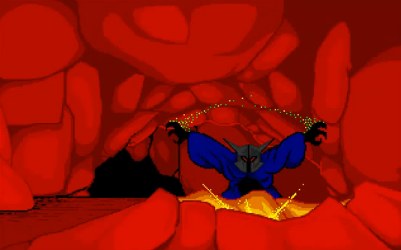
The box prominently featured the Ram Demon, the easiest of Estoroth's lieutenants.
              
Black Crypt
United States
Raven Software (developer); Electronic Arts (publisher)
Released 1992 for the Amiga
Date Started: 27 December 2018
Date Ended: 20 January 2019
Total Hours: 29
Difficulty: Moderate-Hard (3.5/5)
Final Rating: 37
Ranking at Time of Posting: 243/316 (77%)

Summary:
Black Crypt is a descendant of the Dungeon Master (1987) line. The player controls four characters of fixed classes (fighter, druid, cleric, and mage) on a quest to find four ancient artifacts necessary to defeat an ancient evil named Estoroth. Gameplay takes place across 28 levels of varying sizes, up to 40 x 40. Like its predecessors, it couples first-person, tile-based movement with fast-paced, real-time combat. Character development occurs by leveling and acquiring new spells and equipment, but (as with all games on the Dungeon Master tree) standard RPG considerations frequently take a back seat to a variety of mechanical puzzles involving buttons, switches, pressure plates, teleporters, and other navigational obstacles. Although fun, it breaks little new ground and thus offers few reasons to play it over the games that influenced it.

******

I should never underestimate my readers. I had resigned myself to putting together this final entry based on YouTube videos and had actually drafted a "Summary and Rating" without the "Won," but Zardas came through. He did a bit of surgery on my save disk and put together a save that worked out of non-corrupted parts of the disk.

Having found the four artifacts, I only had to solve a pressure plate puzzle on Level 13 to get access to the final levels, 27 and 28. The mechanical puzzles disappeared on those final levels, and they were small enough that I didn't bother to map them.

Level 27 had a couple of conflicting messages, one suggesting that Estoroth couldn't be damaged by magic, and one saying he could only be damaged with magic.
              
    
The "Reveal Truth" spell showed that the first message was the accurate one. Enemies on the two levels are completely immune to spells. That was a bit disappointing. I don't know what purpose it serves to render that aspect of character development meaningless on the final level. 

On Level 27, I had to defeat six skeletal guardians. Their magic attack was too powerful for my party to withstand more than two blasts, so I had to waltz them to death. (For new readers, the "combat waltz" is a maneuver by which you attack then quickly side-step and turn before the enemy can retaliate.) I can't see how it would be possible to beat them otherwise. All the videos I consulted online showed the players doing exactly that. I suppose I could have used two Potions of Invincibility on my front characters, but I was saving those for Estoroth.
              
These guys were so hard I couldn't stop for a screenshot without dying.
            
I can't remember if I mentioned in a previous entry that waltzing is a little harder in Black Crypt than other Dungeon Master clones, largely because the enemies don't follow a predictable pattern. You can't side-step until the enemy has already committed to turning and facing you; otherwise, he could easily go the other direction. For some players, this would mean simply adjusting their fingers and switching the direction of the waltz. For someone less manually dexterous like me, it means flailing randomly at the keys and, in a best-case scenario--running to the other side of the dungeon so I can catch my breath, settle down, and figure out a new pattern.

Once the guardians were defeated, I armed myself with the four artifacts and took a stairway down to Estoroth himself. At this point, I naturally forgot to use my Potions of Invincibility, but Estoroth was curiously easy. After I'd hit him just a few times with my melee weapons, the weapons began to sparkle. This was a sign to use their special attacks. It took a few tries to get the order right. Protector (the shield) protects the party from further damage; Soulfreezer (the staff) holds Estoroth in place; Vortex (the sword) opens a portal to another dimension; and Forcehammer (the hammer) sends him through.
           
Sending Estoroth to hell.
        
The endgame text is first a short paragraph:
           
What made this banishment of Estoroth successful permanently?
         
But afterwards, the player gets a scene-by-scene recap (about 15 scenes total) of the major game moments, including the various "boss" creatures defeated along the way: the Ogre, the Dracolich, the Medusa, the Possessor, the Ram Demon, and the Waterlord.
           
In case we had forgotten.
         
After one final concluding paragraph . . .
               
The final screen shows the Black Crypt destroyed.
            
 . . . the party has the option to reload the final save and just poke around the dungeon. There really isn't anything to do, but you can find the four ancient heroes' skulls on Level 28, plus a few high-powered items.

I had a reasonable amount of fun with Black Crypt. It's a clone, but there's nothing inherently wrong with clones. Without them, we'd have about a dozen total RPGs, and half of those would be weird one-off French titles. Clones allow you to get started without any confusion, let you settle in to familiar territory with a contented sigh. And despite the term, no "clone" is a 100% likeness. It's fun to see the different variations the developers take with a common template, like listening to a new jazz band improvise on a number you've heard a million times. Even when it's worse, it can still be interesting.

But Dungeon Master-style games face a unique challenge when it comes to this improvisation, because they're mostly about mechanics. They tend to feature framing stories--that is, stories that have few references in the game itself, and could easily be swapped with a different frame--and no NPCs. With an Ultima clone, even if the game plays the same as Ultima III or IV, you can still enjoy the new story and the variety of NPCs. Lacking such narrative options, a Dungeon Master clone has to rest all its improvisation on combat, exploration, and puzzles. That's where Black Crypt falls a little short.
            
Just like Dungeon Master, all I can tell about a weapon by looking at it is its weight. At least the door image is cool.
         
Only in its somewhat extensive ending does Black Crypt really distinguish itself from its predecessors. Oh, its graphics and sound are marginally better, but these are the things that an RPG fan--particularly a Dungeon Master fan--ought to care about least. Some of its puzzles also went in different directions, but rarely to the game's credit. More often than in Dungeon Master or Eye of the Beholder, I found it difficult to judge the results of various actions. I particularly didn't like the invisible pressure plates. There's little point to mechanical puzzles if you can't see the elements that make up the puzzle. 

Meanwhile, Black Crypt fixed none of the problems that I had with Dungeon Master--inability to see equipment statistics and a needless food system among them. Even worse, it went in Eye of the Beholder's direction with character development, while offering none of Beholder's improvements, such as NPCs and side quests. The magic system is done a bit differently here, although in the end I found it neither better or worse than its predecessors. For all of these reasons, I expect it to GIMLET lower than Dungeon Master or Beholder.

1. Game World. As usual, we have more of a framing story than a backstory--a fact not changed by a few call-outs within the game (mostly in the form of messages from Estoroth that you find). The plot is derivative, and like most Dungeon Master clones, there isn't much of a "world" here. But the levels are well-designed, with both textures and puzzles organized around themes specific to individual levels or small groups of levels. Score: 5.

2. Character Creation and Development. As noted, it takes a fairly major step back. You have to play four fixed classes. There are no significant choices during creation except for the portrait. Because the dungeon is linear and the number of enemies is mostly fixed, characters level at fixed intervals, and leveling doesn't really do very much for them. I vastly prefer Dungeon Master's action-based leveling, in which each character can attain various levels in all "classes," to Crypt's (and Beholder's) experience-based leveling. Score: 3.
             
Using single classes and experience-based leveling was a regression.
            
3. NPC Interaction. There are no NPCs in the game. Score: 0.

4. Encounters and Foes. There are about as many different enemies as the typical game of this genre, with about as much variety in strengths, resistances, and special attacks. Most of the monster types and portraits are original to this game (or at least not taken directly from its sources). I just wish they had names. As is my custom, I'll also use this category to throw in a couple of points for the puzzles, which serve in the place of role-playing "encounters" in this sub-genre. As above, I didn't always like them, but they were pitched at the right difficulty. Score: 5.

5. Magic and Combat. I'll never love combat that relies more on manual dexterity than attributes and tactics. Dungeon Master at least provided a variety of different types of attacks with its weapons, plus hand-to-hand combat, plus a more useful in-combat spells system, plus the ability to attack from the inventory screen, plus other useful tricks, like the ability to swing around and use the two rear characters to attack the rear. Black Crypt's only innovations are to make waltzing (and similar patterns) more difficult and to introduce a different take on the spell system. Its lack of buffing spells is also a negative. Still, it offers an arguably better experience than Eye of the Beholder, where you never got feedback on attacks, and waltzing made it possible to win with a single character. Score: 4.

6. Equipment. I liked the variety of equipment slots but almost nothing else. Looking at items offers less information than even Dungeon Master. I guess I'll give a point for some originality with the "false" messages and the ability to right-click on most weapons for a special attack. Score: 5.
           
As with most RPGs, I ended this one with plenty of unused equipment.
       
7. Economy. As usual for a Dungeon Master clone, none. Score: 0.

8. Quests. The main quest has some fun stages, with various boss creatures every two or three levels. It also offers a little nonlinearity in the order you approach Estoroth's lieutenants, but it otherwise has no choices, no alternate endings, and no role-playing. In this it under-performs its predecessors. Score: 4.

9. Graphics, Sound, and Interface. Some improvements here. The game is still a bit too mouse-heavy for my tastes, but at least you can customize the movement keys. I feel like there were a few more sound effects and slightly better graphics than Dungeon Master, at least, but perhaps not enough to make a difference in the score. The auto-mapping system is a nice addition, and I like how it's logically integrated with the spell system (even if it took me a while to figure out). Amiga-philes will want me to note that the game uses an enhanced graphics mode ("extra half-bright") that allows for 64 colors instead of the usual 32, but even the original 32 colors is about 24 more than I can discern. Score: 6.

10. Gameplay. It's as linear as most dungeon crawlers, but at least offers some flexibility after Level 13. Unfortunately, the fixed character classes make it less replayable than its counterparts. Otherwise, difficulty and length were both good. Score: 5.

That gives us a final score of 37, just north of my "recommended" threshold, but below the 41 I gave to Eye of the Beholder and the 47 I gave to Dungeon Master. (I must say, reviewing my Dungeon Master scores, I was a bit generous in several categories and I think it would likely rate closer to a 43 if I rated it now. I didn't have a lot of perspective during my first year.) Fans of this subgenre would argue (not entirely without a point) that perhaps it shouldn't be faulted for lacking NPCs, a dynamic game world, and an economy, since that's not what this subgenre is about. If it thus makes you feel better, you can think of it as rating closer to a 44 (and Dungeon Master closer to a 58) with those categories eliminated and the rest of the values rescaled accordingly.
            
As an Amiga game, Black Crypt was heavily promoted in Europe.
           
Computer Gaming World offered a "sneak preview" of the game in the February 1992 issue, but it never seems to have offered a review. The preview, written by Allen Greenberg, is extremely positive. Nothing he says is wrong, exactly, but he suggests that the game is better than Dungeon Master, and I find it difficult to imagine any fan of this subgenre agreeing with that. In particular, he seems too infatuated with fairly modest improvements in graphics and sound. Greenberg sets up the review by suggesting there's a war brewing between keyboarders and mousers, so I'm at least glad to see that the interface issue was heavily debated in the day. Amiga-specific magazines tended towards high scores, with .info coming in at a perfect 100 and Amiga Action giving it 93/100. Non-English Amiga magazines were, as usual, a bit more conservative, with scores in the 71-90 range.

Black Crypt was the first title from Wisconsin-based Raven Software, which still exists as a subdivision of Activision (it was sold in 1997) and is currently in charge of the Call of Duty series. The company's co founders, Brian and Steve Raffel, reportedly began outlining the game in the 1980s. They enlisted two programmers, Rick Johnson, and Ben Gokey, and had a demo ready for the 1990 Gen Con, where it was picked up for distribution by Electronic Arts. (I had originally thought that Crypt owed its lineage to Dungeon Master via Eye of the Beholder, but the game would have been mostly finished when Beholder came out.) It was the first game for almost everyone on the team.

An Amiga-only game in 1992 was bound to make a small splash in the United States, which probably explains why the company abandoned the platform for future titles. At the same time, they also mostly abandoned RPGs in favor of first-person shooters, some with light RPG elements. Whether we ever see them again on this blog depends how I rule on games like ShadowCaster (1993), Heretic (1994), Hexen (1995), Mageslayer (1997), and Hexen II (1997), all of which are on my list preliminarily. Today, the company is better known for its Soldier of Fortune (2000-2003) and Call of Duty (2010-2017) titles as well as its work on later entries in id Software's franchises including Quake 4 (2005) and Wolfenstein (2009).

Any RPG fan is going to want to read Jimmy Maher's survey of Dungeon Master descendants, published a few weeks ago. Based on his review, we only have four left (at least until a more recent surge of "retro" games): Lands of Lore: The Throne of Chaos (1993), Dungeon Master II: Skullkeep (1993), Eye of the Beholder III (1993), and Stonekeep (1995). (And maybe Liberation: Captive II [1994]? I'm not sure if it uses the same engine and approach as Captive.) It doesn't sound like any of them are likely to outperform the original. It's too bad that this subgenre never reached a true peak before it was subsumed by real-time movement in the vein of Ultima Underworld (1992), but given its forthcoming demise, I'm not sorry that it had one decent 1992 entry.


Saturday, February 16, 2013

Chaos Strikes Back: Final Rating


Dungeon Master: Chaos Strikes Back
United States
FTL Games (developer and publisher)
Released 1989 for Atari ST, 1990 for Amiga, FM Towns, PC-98, and Sharp X68000. Ported to Windows in 2001 by Paul R. Stevens
Date Started: 17 January 2013
Date Ended: 13 February 2013
Total Hours: 38
Difficulty: Hard (4/5)
Final Rating: 45
Ranking at Time of Posting: 67/82 (82%)
Raking at Game #455: 404/455 (89%)

I've mentioned before that in addition to a "CRPG Addict," I'm also an avid crossword puzzle solver. Like most American cruciverbalists, my favorite site is The New York Times crossword puzzle section (there are a few outliers who prefer The L.A. Times or The Wall Street Journal, but they're as deluded as people who prefer the Stormcloaks in Skyrim).

My rules for completing crosswords aren't terribly dissimilar to my rules for completing CRPGs. I give myself a minimum time limit, so I can't give up in frustration too quickly; aside from doing today's, I work through a list of past crosswords in chronological order; and I don't allow myself cheats or spoilers. The moment I realize I need Wikipedia or a dictionary to progress, the crossword is "done"; I record my time, count my blanks and errors, and log my score. Then I use Wikipedia and the dictionary to teach me something new.

The New York Times crosswords get progressively more difficult from Monday to Saturday. (Sunday is a special, larger puzzle pitched at a Wednesday-Thursday difficultly level.) My favorite days are Wednesday and Thursday. They provide enough of a challenge to stump me momentarily, but I almost always complete them. Monday and Tuesday are just about speed; there's no question I'll finish them, so I just try to beat my average time. Saturday is a "given" for the other reason: I've logged more than 500 solving times and errors in a spreadsheet, and I have never--not once--completely filled in a Saturday Times crossword without help. [Ed. How much changes with practice. Nearly 10 years after I wrote this, I routinely complete Saturdays, and now I look forward to Fridays.] So I do it just for the challenge. Monday, Tuesday, Wednesday, Thursday, Saturday, and Sunday: I love them all for their own reasons.

But not Fridays. If I was a Battlestar Galactica character, I would call them "Fracking Fridays," so you can imagine what I really call them. My solve rate is about 35% with them. Every time I open one, it sits there, mocking me, making me wonder how it's going to beat me, how it's going to make me feel stupid, how it's going to highlight my inadequacies as a solver. It might lure me in with an easy top right, in which I quickly fill in every square, and then smack me across the face with a bottom left in which I can't get a single clue. I've never had it tested, but I'd bet my pulse and blood pressure rise whenever I even think about firing up a Friday. It's so bad that in the roughly one-third of the time that I finish it, I'm almost pissed at the puzzle, like it let me win.

Come on! You're not even trying!

Chaos Strikes Back felt like a Friday puzzle. By my third posting, I began to seriously question whether I would be able to finish it. Did any of you notice that I was padding the hell out of my postings? Both "A Spot of Violence" and "Lessons in Maneuverability" represented a couple of dozens squares of actual movement, so I framed them in all kinds of philosophical stuff--I even repeated a lot of the material from the first in the second--just so I'd have something to put out.

Eventually, I got over the hump, but throughout the game I was dreading the final area. I kept thinking, "If the puzzles are this hard on the lower levels, what's the top level going to be like?" and I'd have to go take an antacid. When I finally ventured up there, it was about 23:00 on Wednesday, about time to go to bed, and I told myself just move one square at a time, take notes, map carefully, and you can call it a night the moment it gets frustrating. Only it never did, and I won the game about 30 minutes after arriving on the top level.

This last area was essentially the only area where combat tactics saved the day. Fortunately, I'd been hoarding my magic boxes, bombs, poison potions, and other goodies, and I decided to throw them in abundance against the enemies. At the time, I was figuring I'd just get past them to map the area beyond, check things out, and reload so I wouldn't have wasted all my magic on a dozen enemies. Little did I know that I would soon find a key, open a door, and win the game.

Some of my inventory before the final area.

Thanks to my commenters and some walkthroughs, I realize that I missed a lot of the challenge of the top level, and there was a very creative and difficult puzzle that would have made this area both harder and easier. But when you're playing the game blind, there's no sign that says, "Hey, go this way for a more challenging but more satisfying experience!" So when I won, it felt a little like a Friday puzzle that didn't really try.

Rating the game is going to be difficult. In a 2004 review, Roger Ebert tried to explain his star rating system with a quote that seemed perfectly sensible to me:

[T]he star rating system is relative, not absolute. When you ask a friend if "Hellboy" is any good, you're not asking if it's any good compared to "Mystic River," you're asking if it's any good compared to "The Punisher." And my answer would be, on a scale of one to four, if "Superman" (1978) is four, then "Hellboy" is three and "The Punisher" is two. In the same way, if "American Beauty" gets four stars, then "Leland" clocks in at about two.

And that is why "Shaolin Soccer," a goofy Hong Kong action comedy, gets three stars. It is piffle, yes, but superior piffle. If you are even considering going to see a movie where the players zoom 50 feet into the air and rotate freely in violation of everything Newton held sacred, then you do not want to know if I thought it was as good as "Lost in Translation."

Because you were curious.

But in my blog, I've generally adopted the opposite approach: my rating is meant to reflect, as accurately as possible, my relative enjoyment of the game, and I rank 1978 low-res games alongside modern masterpieces. I don't give games the benefit of the doubt based on the technology of the times, I don't give them points for being "a classic," and I don't give them points for achieving exactly what they set out to achieve. Beyond Zork set out to be a goofy text-CRPG hybrid, and succeeded wildly, but it lost points with me for a) being goofy; and b) having no graphics.

When I reviewed Dungeon Master, Georges called me on this. He wondered why I couldn't give an "N/A" instead of a 0 to the game in the "NPCs" and "Economy" categories, reasoning that "a non-existant element is not necessarily a badly implemented or designed one." It's a fair point, and constructing the GIMLET to average, rather than sum, the scores would have accomplished what he suggested. I thought about doing that. I thought about doing it again while playing Chaos Strikes Back, but I couldn't justify it when I took the idea to its logical extreme. What if a game featured only one of the GIMLET categories but did it exceptionally well? I'd have to give it a high final rating based on an averaging system, but it wouldn't be a great CRPG.

Thus, in defense of what is to follow, I offer my reply to Georges at the time:

The purpose of the scale is no more and no less than to rank how much I,personally, enjoyed the game as a CRPG. In the [GIMLET posting], I tried to outline the elements that would make a "perfect" CRPG if the game scored a 10 in all of them. By your proposed revision, a game could get a perfect score even if it didn't have these elements, but without them, to me, it wouldn't be a perfect CRPG. Thus, if Dungeon Master had featured ANY NPCs, even bad ones that resulted in a very low score, it would still be a better CRPG (to me) than it is with no NPCs at all.

I still think this is true. If Chaos Strikes Back had featured even one NPC--Lord Chaos--and there had a been a few dialogue options with him when you encounter him on the top level, I think it would have enhanced the game. But I realize it would have been contrary to the developer's purpose, so before I begin the GIMLET, let's be clear about one thing: Chaos Strikes Back achieves precisely what it sets out to achieve, and it achieves it perfectly. If you read my entries on the game and you thought, "This sounds like the kind of game I would enjoy," you should absolutely play it. Chaos Strikes Back is the unbeatable example of a Chaos Strikes Back-style game.

A "Chaos Strikes Back"-style game being the type of game where you have to figure out how to use a keyhole, a coin slot, and a teleportation field while simultaneously fighting respawning eye-ghosts.

Whether it's a great CRPG is a different story. The game isn't even much like its predecessor. Instead, it uses a CRPG engine to offer a very different sort of gameplay experience. In this, by the way, it is also a perfect game. There are only so many things that the Dungeon Master engine allows, but Chaos Strikes Back uses all of them to construct its puzzles. Once you know the possibilities of the engine, you have all the information you need to suss out the solution to the puzzles. This is in contrast to a lot of modern games that suddenly introduce new code or a new interface for their puzzles. I got annoyed when Dragon Age: Origins suddenly introduced a puzzle involving sliding floor tiles, for instance, since nowhere else in the game can you fool around with moving items on the ground.

All right, let's do this. Since so many aspects of the game are similar or identical to Dungeon Master, it might make sense to read my final rating of that game, too.

1. Game World. Chaos Strikes Back is one of those games that technically has a framing story, but it plays so little role in the game that you could easily construct a completely different story and have it fit logically with everything you encounter during gameplay. Drakkhen was another recent one (in fact, with that game, you essentially had to construct your own story). But with Dungeon Master, the developers at least tried to have the story make sense, while in Chaos Strikes Back, they dropped all pretense. "Here's some nonsense written by my wife; just go play the game," seems to have been the attitude. In-game, there's nothing to distinguish the story from a hundred other dungeon-crawlers, but I suppose I should give it points for at least having one, and making things like "the four paths" and the Corbum ore clear at the outset. But the one really good thing about the game's "world" is that it's persistent,and every change you make--moving items, killing enemies, opening doors, solving puzzles, and so forth--lives on. Score: 4.

Even the Amiga animation showing Chaos "forging" the "ore" doesn't make any sense.

2. Character Creation and Development. I utterly fail to understand Dungeon Master's system of "reincarnating" or "resurrecting" existing heroes rather than just creating your own characters, and the process suffers a little more in this game than the first, because you have such a weird variety of bestial characters to choose from (contradicting the previous game). The skill-use-based development system, on the other hand, remains very good. Although leveling doesn't come as rapidly as in the first game (my characters gained maybe 2 or 3 wizard levels, 1 fighter level, 1 priest level, and no ninja levels) if you import characters, it's extremely satisfying when it does, and there are nice rewards in terms of statistics. I like that you can choose to make characters specialists or generalists this way. This game introduced a new element by aspecting the paths to these various skills, making it rather important to have an experienced wizard on the DAIN path and competent fighters on the KU path. There are still no real role-playing choices, but I was otherwise very satisfied with this area of the game. Score: 6. (Note: I realize I gave Dungeon Master a 7 in this category, but in retrospect I feel like I ranked it too high. Read the bullet points in the original GIMLET posting to understand why.)

Not bad for an old man.

3. NPC Interaction. Still none, which still makes it a lesser CRPG if not necessarily a lesser game. Score: 0.

4. Encounters and Foes. Dungeon Master bucks the usual trend of the era (the D&D games being a notable exception) by introducing extremely memorable enemies who have a wide variety of strengths and weaknesses. You develop visceral reactions to the chortling of Gigglers, the screech of Couatls, and the clanking of Death Knights, and you gear up for the right strategy the moment you see any of them. It has some old "favorites" from Dungeon Master but also introduces some new ones. There were places I didn't regard their respawning as bonuses the way I often do, but they certainly gave you plenty of opportunities to grind.

On the "Encounters" side, the game doesn't really offer any good role-playing encounters the way I described in the fall. But as with many games, the puzzles serve as a kind of "encounter," and this game does better than Dungeon Master by even giving you a few choices in how to solve them. They're not role-playing choices (based on characters), exactly, but they do allow you to play in a certain style. Score: 7.

5. Combat and Magic. I was less enchanted by it in Chaos than in Dungeon Master, mostly because the game didn't really seem to expect you to engage in it with a straight face. There were too many places in which creatures endlessly spawned, too many creatures that were essentially undefeatable without screwing around with dodging and stair-scumming. But I gave the category a high score in Dungeon Master and I have to give it a high score here. Although the game is real-time, it offers real tactics in its combat, from deciding the right attack with a particular weapon to adjusting the formation of the characters to, yes, actually moving around and even using the environment (the right maneuvering means that enemies pound each other with fireballs instead of the party). Some creatures could be taken out by turning the dungeon's own traps against them. On the magic side, though, I wish there had been some new spells. I guess there was in the Amiga version. Score: 7.


6. Equipment. The game has much that I like in this category: a wide variety of weapons and armor items, including many places to equip and wear them; many magic items to use; puzzle items; and items partly randomized throughout the dungeon. There are logistics associated with item weight and balance, but not so much to be annoying. But it loses many points with bafflingly dumb elements, including the inability to determine (in-game) the armor class of certain items or the uses of others. Even the relative damage and speed of weapons needs to be determined through careful observation and recording. And since this game twists around on itself, you can't be sure that a weapon you find on Level 8 is better than one you found on Level 3.

The spoiler list for the items shows that things are even worse. A falchion dropped at one location will open a door at another; a cape dropped at one location will activate a teleporter at another. Leather boots in the inventory hold open a wall. Another item improves luck, which you can't even see. Random items prevent the spawning of some enemies. If you have to crack the source code to see this kind of thing, then I'm sorry, but it's stupid. Score: 4.

7. Economy. This gets one better than Dungeon Master by having a slightly more robust economy. There's no "cash," but you do find individual coins as inventory items, and you can use them to get a selection of items at a couple of locations. It's not as good as a real shop, but it's better than nothing. Score: 2.

 8. Quest. One fairly nonsensical main quest; no side quests. Unlike Dungeon Master, there isn't even an alternate ending. Score: 2.

9. Graphics, Sound, Interface. There's nothing new to say about this. Both the graphics and sound are very good--not just for the era, but good in general--with enemies making unique sounds in both movement and attack. Many of the animated creatures look very cool. I still hate all the clicking. Score: 6.

10. Gameplay. Before Chaos Strikes Back, I didn't think a nonlinear dungeon crawler was even possible, but wow, does this game blow that notion out of the water. Not only can you take the four paths in any order, but even within the paths there are so many stairways, hallways, doors, and pits, that it's virtually impossible to visit every square in the game. (I think I missed about a quarter of them.) This, plus the randomness with which the game deposits your characters after leaving the junction of the ways, and the ability to solve puzzles using different means, makes Chaos Strikes Back enormously replayable in a way that Dungeon Master wasn't.

My GIMLET bullets for this category say that for a perfect score, "Game has the right level of difficulty: challenging without being exasperating." On one hand, I want to say that the "right" level of difficulty needs to be interpreted a different way for this game. The developers intended to make an extremely challenging game; players love the game specifically for that reason; and without the challenge, it wouldn't be Chaos Strikes Back. On the other hand, there are a couple of puzzles that seem extraordinarily unfair. On a third hand, the game really helps you out of those situations with the oracle--if you're standing on the right square when you consult it.

I'm going to give it a high score here but not a perfect one, for one primary reason: I don't like games that force me into a choice between reloading a lot or wasting a lot of time. The game "rewards" too many risks by dropping you down pits and teleporting you back to the starting area or the "Junction of the Ways," and at that point only the most masochistic players would suck it up and wander all the way back to where they were--only to likely have it happen again. Score: 7.

This produces a final score of 45, slightly below Dungeon Master's 47, but look: I don't care how much you love this game, I think you have to agree that Dungeon Master was better as a straight "CRPG."

They really played up the hint oracle.

Extremely hard CRPGs were a rare exception in this era, so I was very curious to see contemporary reactions to the game. Computer Gaming World from May 1991 features a mostly-negative review. The reviewer notes that:

The monsters, traps, and puzzles presented within are all of the most heinous, unforgiving sort, and will surely crush the bones and spirits of all but the dungeoneering elite. Chaos Strikes Back is a game which allows for only two types of players, the "quick" and the "dead" (p. 39).

This is true, and not necessarily a negative thing as we discussed. But he spends most of the review bemoaning how nothing has changed in the game engine since Dungeon Master, which drives me crazy. Using the same engine to tell a new story is a longtime staple of games, and there's absolutely nothing wrong with it as long as the engine is good. Chaos Strikes Back fans will especially love this paragraph, which seems to forget that the review is covering a 1989 game in 1991:

This gamer cannot help but to chastise Software Heaven and FTL Games for this long awaited rehash [his emphasis] of the original Dungeon Master. The "living dungeon" approach to RPGs is fast becoming commonplace, with titles like Bane of the Cosmic Forge, Captive, Bloodwych, and Eye of the Beholder improving on the Dungeon Master system...One wonders how long Dungeon Master and its chaotic sequel will survive before sinking into the mists of software history.

Yeah. It's a good thing I was here to blog about them, or probably no one would know about these games any more.

Most other reviews, however, were more positive than I expected, with Advanced Computer Entertainment calling it "ahead of its prequel," "unreservedly recommended," and "well worth every minute of the wait" (was waiting three years for a sequel really that long in the 1980s?). The One said that "it's enthralling, exciting, original, and unique. Another classic." Zero actually recommended that players go back and play the original, just to have characters for the sequel. The reviews have far fewer obscenities than I would have expected.

Our adventures in...whatever setting the Dungeon Master games supposedly take place...aren't over. Dungeon Master II: Skullkeep comes along in 1993 with an updated engine and the ability to explore outdoors, but otherwise the same look and feel as the original. I may pop in to Return to Chaos (2001), which updates the games to Windows and presents all three of the previous games as modules. I will not be playing Dungeon Mater: Theron's Quest (1992) for the TurboGrafx console or Dungeon Master Nexus (1998) for the SEGA Saturn console.

What mystifies me are all the fan-made remakes of both Dungeon Master and Chaos Strikes Back. I can understand updating games that have great stories (e.g., Ultima IV, Ultima V) to modern engines the same way I can understand remaking great movies with modern settings and special effects. But when a game is all about mapping and puzzles and has virtually no story, why remake it? Why not just play it in its original engine? Or create a new game with similar gameplay to the original, as an homage?

Not that I'm anxious for many more games like this. I'm looking forward to a significant change of pace with a couple of RPG/adventure hybrids, starting with Tangled Tales.

Saturday, December 29, 2018

Game 313: Black Crypt (1992)

           
Black Crypt
United States
Raven Software (developer); Electronic Arts (publisher)
Released in 1992 for Amiga
Date Started: 27 December 2018

Games of the Dungeon Master variety will never be my favorite of the CRPG subgenres. I like my RPGs to have meaningful NPC interactions, economies, more role-playing options, and less linearity. I prefer creative puzzles requiring some lateral thinking to purely mechanical puzzles. I want immersive stories rather than framing stories. If you've been with me through Dungeon Master, Chaos Strikes Back, Bloodwych, Captive, and the Eye of the Beholder series, you've heard all of my complaints before.

On the other hand, Dungeon Master clones rarely offer a bad experience. They particularly satisfy my need to map. And they do one thing very well--something that fewer of the Wizardry or Bard's Tale variants do, even into the early 1990s: they actually show enemies in the environment.

It's weird to think how long it took this feature to appear. You forgive its absence in Wizardry, when CRPGs were new and games had to ship on a single floppy. You got used to just stumbling on enemy parties while exploring featureless corridors. But as the years go by and the subsequent lineage of games--The Bard's Tale, Might and Magic, the entire Gold Box series--fails to give you any environmental indication of upcoming combats, it becomes less and less forgivable. I'm not looking for these games to adopt Dungeon Master's real-time combat system--just to show me when a party of dragons is 10 feet away. Fortunately, Might and Magic III and Fate: Gates of Dawn finally united the lineages in 1991, and actually being able to see your foes became the norm thereafter.

Black Crypt is a decent game in the Dungeon Master line. It preserves most of the things people like about Dungeon Master and Eye of the Beholder (it seems to draw primarily from the latter) and introduces a few new innovations besides. I'm curious what a true Dungeon Master fan thinks of it. I could see preferring Dungeon Master's action-based leveling systems to Crypt's reliance on more traditional experience points, and Crypt's spellbook-based magic is less creative than Dungeon Master's rune system. I'm enjoying it about as much as I enjoyed Dungeon Master the first time, but I suspect I'd enjoy a replay of Dungeon Master a little more than this.
         
A bit of opening narration explains why we find equipment everywhere.
        
The framing story, written as an eight-page novelette, hardly breaks any new ground. Estoroth Paingiver, a former student of the Cleric's Guild, went evil, raised abominations, summoned demons, et cetera, and attacked the land of Astera. (Hypothetical dialogue among the Cleric's Guild faculty: "Hey, do you suppose that 'Paingiver' fellow is going to be bad news?") Astera's four guilds united to face the threat and succeeded in banishing Estoroth to another dimension, but the guilds' four champions died in the process. The Black Crypt was raised to inter their bodies and enchanted weapons. Now, Estoroth seems to be in the process of tearing his way back through the dimensional barrier, so four new champions are needed to enter the Crypt and retrieve the magic weapons.
           
Creating the four characters.
          
The player creates four characters: a fighter, a cleric, a magician, and a druid. A pool of excess points is allocated among strength, intelligence, dexterity, wisdom, and constitution. Names and portraits are chosen. Although some of the portraits are bestial or supernatural, they don't seem to have any impact on gameplay. The process is quick, and the player finds himself on Level 1 of the starting dungeon within a few minutes. Each character begins with a melee weapon suitable to his profession and a little bit of food.
         
Starting out. Right away, we find a shield and some food.
      
In defiance of any sensible rules of capitalism, the creators included 30 "cluebook" pages in the game manual. Each dungeon level is fully detailed. I'm avoiding these pages, naturally, but I glanced at them long enough to see that the Black Crypt is a whopping 28 levels, the largest occupying coordinates up to 40 x 40. Fortunately, there are a lot of small levels, too. The game adopts the "worm tunnel" approach to mapping (meaning that there's at least one square of "dead space" between adjacent walls), which also functionally shrinks the maps. Still, it's a big game.
          
Level 1 goes up to 26 x 21 but doesn't use anywhere near all those tiles.
        
The controls are okay. The game's primary strength is allowing you to map your own movement options. This is the first time I remember such a setting appearing, and I'm grateful for it. When you have to play with one hand on the keyboard and the other on the mouse, neither arrow keys nor the numberpad make for a comfortable configuration. I re-mapped movement to WASD, which works a lot better. But aside from this customization and the use of F1-F4 to swap between character inventories, there's no use of the keyboard. There are little annoyances like being able to enter a character's inventory with F1 but then having to right-click to get back out, or being able to enter the disk menu with ESC but then having to click on the appropriate option to leave. There are still no keyboard options for executing attacks, which is something I'm always hoping for in Dungeon Master games.

One particular issue is going to dog me until late in the game and then probably screw me up for the next Dungeon Master-style game. The creators made it so you click on the character portrait to execute the primary attack rather than the weapon. Since Dungeon Master, Eye of the Beholder, and just about every other game does it the other way, I'm constantly clicking on weapons, which takes them out of the inventory slot so you can drop or trade them.

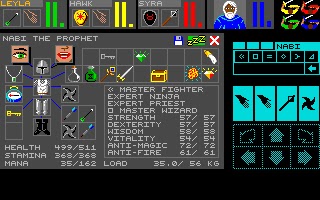
On the positive side, the inventory screens are well-organized. The lower-left corner has options for various containers: a backpack, a small chest, a large chest, a bag, and a quiver. You populate these spaces as you find the containers, then click on them to view their inventories. For wearable items, there are three screens, toggled by clicking the torso in the upper-right corner. The first has items of clothing, the second wearables like rings and belts, and the third the actual armor.
            
I face a locked door as I look at my fighter's inventory. He has a chest, a backpack, and a bag. I have the chest open, and I'm looking at the armor screen that shows the outer armor.
          
There's a food and water system, and I suspect it's going to be an annoyance until the cleric gets "Create Food." The mechanic really doesn't accomplish anything except impart a sense of urgency. If you want to explore carefully, you have to make a save, do your exploration and mapping, and then reload and cover the level faster, "for real." But it's worse than that because there's only one meter to track both food and water, but the game clearly considers them separately in non-visible statistics. When you find a fountain, you can't just gorge yourself on free water until the meter returns to its maximum because you need food, too. And if you don't eat but only drink, the characters will start losing points for hunger even though the meter is nowhere near the bottom.

The first couple of levels were moderately-sized, going into the 20s on both axes. Combats were infrequent--maybe 15 enemies total on the two levels--and there were really only two types of enemies: giant worms, and giant worms capable of casting some kind of "Magic Missile"-like spell. Many of the classic Dungeon Master tricks work here, including attacking and then darting away before the enemy can respond, backpedaling down a corridor as you fire missile weapons, "waltzing," and so forth. The famous "combat waltz" itself (check the glossary) seems a little harder here, it might just be a matter of getting used to a new game's timing. Crypt keeps one annoying characteristic of Eye of the Beholder in which once an enemy casts a spell, you're frozen until the animation completes.
            
The animation for the worms has them opening and closing their mouths. I only ever got screenshots when their maws were closed.
         
What you can't do--and this was a serious shock--is smash enemies in doors. That's such a longstanding trait of Dungeon Master-style games that not including it borders on sacrilegious. I'm not sure if enemies can fall victim to other environmental effects or not. I haven't encountered any others yet.

Killing enemies rewards you with traditional experience points, and levels increase automatically. I got to Level 4 on the first two levels. Leveling increases hit points and spell power, but otherwise there aren't any choices. Attributes are increased by occasionally finding items that do so.
          
My druid levels up.
         
Each spellcaster comes with Level 1 spells for their classes. Further levels must be found in spellbooks; you don't get them upon leveling up. There are only 5 levels and only 4 spells per level. You can "prepare" up to four spells and then cast them by clicking on them in the slate. I find the system a bit easier than both Dungeon Master, where you had to remember runes in the middle of combat, and Eye of the Beholder, where you had to fiddle around with that little book. You also frequently find scrolls with multiple spells that can be cast in lieu of learning them.

Among the first two levels, I experienced a variety of navigation puzzles and other mechanisms that I'm sure will last throughout the game. These include:
         
  • "Alcoves" with treasure stashed in them. These go back to Dungeon Master. Items can appear on the floor, too.
           
I apparently found the Ogreblade here.
         
  • Messages in plaques on the wall. Some can only be read after the druid casts "Read Rune."
  • Scrolls that give you hints. But some of them are "false scrolls" and should be ignored. You can reveal these by casting the cleric's "Reveal Truth," which causes false scrolls to dissolve. 
         
This turned out to be a "false" scroll, but I think I could have figured that out.
         
  • Locked doors that only open with certain keys.
  • Pressure plates that open walls.
  • Spinners. There's an obvious "transition" animation when you step on them, though, so it's hard to get fooled.
  • Force fields that require you to cast "Dispel" to pass them. You don't have this spell at the outset, so you have to rely on found scrolls.
  • Teleporters. They also have a clear "transition" animation.
  • Buttons or switches that open secret doors or make pillars disappear.
  • Buttons or switches that activate teleporters
  • Buttons or switches that change the destinations of teleporters.
          
It's hard to tell what this will do.
        
  • Holes in the floor. Falling through them takes you to a lower level and causes damage.
  • One-way walls.
  • "Glyphs" in the middle of corridors that serve as traps. You have to cast "Remove Trap" on them.
          
Dispelling a glyph trap with a scroll.
          
  • Walls that open and close on a cycle.
  • Doors that won't open until you pass a copy-protection exercise.
          
The "copy protection" riddle breaks the illusion a bit.
         
The second level had a two-headed ogre who is impossible to defeat with regular weapons (they don't even hit him). A message on the first level warns you about him: "The one below is his own twin. Only a magic blade will pierce his skin." This refers to an "Ogreblade" on the first level, though you have to get there via a teleporter on the second. (A "false" scroll warns you not to pick up the Ogreblade.) Until you find it, exploring the second level is tough because the ogre is constantly chasing you and pounding you to goo every time you pause for a few seconds. Once you have the sword, it doesn't take long to kill him, and he drops the key necessary for the next level.
         
The ogre kills us as we try to crush him in the door. Apparently, you can't do that in this game.
        
Miscellaneous notes:
             
  • The opening theme, which you can hear at the beginning of this video, is catchy. I found myself chair-dancing to it. It's credited to Ken Schilder, who stayed with Raven and is credited on a couple dozen other titles. But it always surprises me that composers so often went with rock and techno themes for title music, when an older style would better fit the setting. There's a "special topics" post in here some day.
  • The fighter has an ability, activated by clicking on his "glyph" in the inventory screen, that tells your current coordinates. The glyphs are otherwise used to activate class-specific objects.
           
Checking my position.
         
  • A lot of the game's messages are delivered as scrolling text at the bottom. It's annoying and hard to screen-capture.
  • The manual brags about making use of the Amiga's "halfbrite" mode that apparently allows for more colors than normal. The Wikipedia page on the mode shows two photographs, and they look exactly the same to me. This is why I don't talk about graphics that much.
  • A trait that I wish the game hadn't adopted from its predecessors: I have no idea about the relative damage on different weapons. On the first two levels alone, I'm juggling hammers, warhammers, axes, and swords. Should I keep the Ogreblade--is it effective against non-ogres?--or dump it for a more conventional weapon? No clue. If the cluebook had that information, I wouldn't be able to help but look at it.
  • There's an auto-map, available with the magic user's "Wizard Sight," but it shows so little detail that I can't imagine not making my own maps.
            
Level 3 is patrolled by invisible enemies and a (true) scroll on the level warns you not to try to engage them until you've found the "Mask of True Sight" on a lower level. (A false scroll on the same level encourages you to attack the unseen enemies after removing all of your weapons and clothing.) Other than a couple of other locked doors, there wasn't anything to do on the level, so I pressed on to Level 4.
         
This message wasn't kidding.
         
Remember the annoying gigglers in Dungeon Master? Well, Level 4 of this game has similar creatures who steal your stuff. Worse, they teleport away after stealing it, so you can't chase them. I hope they turn up later in the level, or I'm out of shields.
           
Level 4 also has these monsters that walk on the ceiling.
          
In the end, I suspect I'm going to find that the game is too long and too confining. I mean this not just in terms of physical space but also in character development. To require that the player have four specific classes and offer so few options in both creation and development largely means that every player arrives at the same place with essentially the same party. But for now, it's fun enough, and with a dungeon crawler, you don't waste a lot of time puzzling over your next move. It's always the next unexplored square.

Time so far: 3 hours