Showing posts sorted by relevance for query Disciples of Steel. Sort by date Show all posts

Saturday, February 13, 2016

Disciples of Steel: Final Rating


Disciples of Steel
United States
MegaSoft Entertainment (developer and publisher)
Released 1991 for Atari ST; 1993 for DOS
Date Started: 3 December 2015
Date Ended: 8 February 2016
Total Hours: 94
Reload Count: 52
Difficulty: Moderate-Hard (3.5/5)
Final Rating: 57
Ranking at Time of Posting: 201/208 (97%)

Think about the different RPG eras in terms of the key questions of the time. In the early days (c. 1978-1983), that key question was, "How do we best adapt tabletop RPG mechanics to the computer?" Dozens of titles stood up and said, "Like this!" The best of them--the Wizardry series, the Ultima series, some of SSI's early efforts--advanced to the front of the class. Some of those that didn't make it to the forefront were a mess--fundamentally misunderstanding what was engaging about RPGs--and many introduced mechanics that simply didn't work in the long run.

In the late 1980s, the question changed to, "How can we improve upon the success of Wizardry (or Ultima, or any other previous successful title)?" And again, dozens of developers responded with their own answers. We fondly remember the best of them: Ultima's own sequels, Might & Magic, Dungeon Master, and Pool of Radiance. Again, there were a lot that we don't remember because their answers didn't make sense. We just saw that with Xyphus.

So what was the framing question of the early 1990s? Keep in mind that we've entered an era of hard drives, CD-ROMs, improved hardware for graphics and sound, and memory measured in megabytes instead of kilobytes. I think the key question developers faced was, "What are we going to do with all this extra stuff?" Consumers were demanding games that met the potential of available technology, and developers had a number of ways to respond, including greatly expanded content, better graphics, better sound, more detailed mechanics, and more complex artificial intelligence.

Disciples of Steel feels like a game in which the developers started with Wizard's Crown in mind (although I'm not ready to give up on the idea that they'd been exposed to Knights of Legend, Sword of Aragon, or both), asked the question, threw a bunch of ideas on the board, and tried to implement all of them at once with only the slightest coordination.

The resulting package is intriguing, excellent at times, but oddly disjointed and incomplete. We have fully-voiced audio for a few seconds in the opening screens (the first time I've ever seen this in a PC RPG, although I haven't played a lot of 1980s titles yet) and never again. We have high-quality animation for the opening, a nonsensical final scene, and a few shops in between, but never where it really matters. We have a fully-designed strategy game combat mechanic that hardly ever gets used unless you already know what you're doing. There are hundreds of evocative, atmospheric text messages as you explore--and hundreds of spelling errors. There are three ways to end the game--something you hardly ever see in this era--and yet no real ending.
 
Seriously, what was this about?
  
To be a fan of Disciples of Steel--and I am an unequivocal fan--is to forgive an awful lot of things that just don't work. There's a food and water meter that never budges, conversation options with NPCs that never tell you anything, a "search" function in the dungeon that never finds anything, "parley" options that never work, skills and spells that have no use, an unnecessary theft mechanic, an unnecessary haggling mechanic, a mechanism for setting the formation of your characters that doesn't matter because enemies are always scattered randomly when combat starts. As much as I liked the tactical combat, I was never able to get the hide/backstab mechanic to work, nor do I understand why there's a "search" option and the ability to pick up dropped treasure in the middle of a battle. I forgot until the end of the game that you can actually change which part of the enemy's body you target; it turns out that you have an equal chance of hitting each body part, so the head (the default) makes the most sense anyway.

And yet, despite failing in so many things that it tried to do, Disciples of Steel performs excellently in the core areas that make a good RPG: tactical combat, magic, equipment, character development, and quests. I'm hard-pressed to think of a single game previously in my chronology that gets as many things right as Disciples. Perhaps the Gold Box games come closest, but they lack the satisfaction of Disciples character development system, and they have a far worse economy.

Complete non-sequitur. I just like this image. The text makes it sound like "The Balor" is the name for this section of the hallway.
    
In content, Disciples also excels. I love that the game world is so open at the outset, allowing you to blunder into difficult areas before you're ready, allowing you to solve quests before they've been given (although this introduces its own problems if you don't know to keep the quest item). I thought the expedition-and-return quest system was excellent, as well as the way each kingdom had its own questline that integrated well with the backstory. I wish there had been more meaningful choices and more ways to role-play factions or choose sides in disputes, but you can't have everything. The game does offer you the option to just overthrow every kingdom--or ignore the kingdoms entirely and head right for the final dungeon--if you want to make an extreme choice.

The GIMLET is thus going to be a mixed bag. I expect that it will score high in the end, but let's see.

1. Game World. Disciples follows the lead of the best games of the 1980s by setting up the game world in a detailed manual and then following through with in-game events and characters that make sense given the backstory. It does a good job giving a different "character" to each kingdom on Lanathor and setting the events of the game in motion. I'm also giving credit here to all of the flavorful on-screen text descriptions that make the otherwise-bland dungeon corridors seem interesting.

But as with most things, it doesn't do it perfectly. In particular, "Variz" comes out of nowhere, and his relationship to Rathadon is unclear until the end. (The "forces of Rathadon" are given as the game's antagonists, but the king of Rathadon doesn't seem to be aware of Variz's existence.) Score: 5.

2. Character Creation and Development. Simply excellent. You start with the usual race/sex/class templates, but through the skill systems, you can essentially define who you want your characters to be. For instance, you can load up your warriors with armor and put a lot of points into that skill or keep them lithe and put your efforts into "dodge." Mages can specialize in bows and hang back on the battlefield, or you can give them points in edged weapons and armor and make them battlemages. Any class can develop skills in any school of magic, and the different magic systems mean that each character has a stronger sense of role. The ability to dump experience directly into skills (and attributes, though I never did that) means that development is constant and palpable.

I'm also a big fan of the way experience is earned, by successful action rather than just kills. It's a joy to watch the effects as your skills increase: more attacks per round, more spells per round, more damage, increased frequency of critical hits and stunning, and characters who dodge and block attacks instead of getting eviscerated by them. Until the advent of games where classes really make a role-playing difference and we start to see perks and special abilities, I can't imagine a better system. I was disappointed when the game ended because I hadn't gotten all my characters to their target skills. Score: 7.

3. NPC Interaction. Alas, a weak spot. The various lords serve as NPCs, as do some of the shopkeepers, who will occasionally have a useless bit of dialogue. While some of these NPCs were unique and memorable, a couple of dialogue options would have gone a long way towards cementing Disciples in the "great" category. Score: 3.

I kind of liked this guy.
   
4. Encounters and Foes. In addition to NPC dialogue, a major deficiency of Disciples in encounters. While I appreciate the pre-combat dialogue that precedes many of the key battles, there really is never anything to do on these screens but fight or run ("threaten" sometimes works, but "be amicable," never). Except at the macro-level (do the quests or conquer the kingdoms by force), there are no meaningful role-playing options.
   
Monsters are about as varied as a Gold Box title but with fewer defenses ("Power Word: Stun" shouldn't work against everyone) and no descriptions at all in the manual. Score: 4.

5. Magic and Combat. SSI had the best tactical combat systems, and Disciples of Steel is the first non-SSI game that seems to recognize that. Throughout the entire game--nearly 100 hours of gameplay--I never got sick of the combat system until the final dungeon, where the sheer number started to overwhelm me. And right then, I got "Wrath of God."

The combats in this game are either easy--in which case your characters satisfyingly mow through the enemies and finish in seconds--or quite hard--in which case you have the satisfaction of plotting detailed tactics. The magic system is excellently balanced; there are extremely powerful spells, but you need time (or expensive mushrooms) to recharge after casting them. I think part of the satisfaction of combat comes from the skill development system; even when slaying the lowliest, most pathetic orc, you know that you just earned a couple of dozen points to channel into your favored skill.

A few days ago, I might have tried to argue that Disciples of Steel is the best game to occupy this category so far in my chronology. But upon reflection, I still have to give a slight edge to the Gold Box series. First, Disciples lacks the interesting buffing spells that are important to the combat tactics in other games. Second, while there are a small number of items to use, we don't have the more robust wand/potion/scroll/grenade options that SSI gave us in the Gold Box. Still, it comes awfully close. Score: 7.
 
You don't scare me, Air Elemental.
   
6. Equipment. As I pointed out in my post on the topic, I really like games that give you lots of items to equip and use, and Disciples offers more than most, with separate items for the head, body, arms, and legs, as well as melee weapons, shields, missile weapons, ammunition, rings, potions, and occasional special magic items like Phasecloaks and Boots of Speed. The "quality" and "condition" dynamics added an additional complexity.

Disciples is one of the earliest games to introduce us to a dilemma that we still see today: plenty of shops sell good gear, but it's so much more satisfying to loot it from the battlefield. And while the locations of artifact items are fixed, it's not impossible to find a Potion of Strength or some other major boon among the detritus from a random battle.

I wish there had been more weapons with special effects (e.g., nothing does fire damage or increases the odds of a critical hit), and better item descriptions, but in general this was a very satisfying part of the game. Score: 6.

Some of my warrior's late-game gear.
   
7. Economy. If there's one area in which Disciples blows past the Gold Box titles, here it is. The economy in the game is actually meaningful. You get money from solving quests, looting opponents, selling gear, and setting taxation rates in conquered cities. You can even put unused mage points into "Lead to Gold." On the "spend" side of the equation, we have a variety of equipment and transportation, item repair, healing, the all-important mushrooms, and...oh, yes...the ability to raise, equip, and field vast armies.

As I reported in my last postings, I didn't fully engage the economy and thus couldn't take advantage of the "army" options, but I'm glad it's there and it would be fun to go that way on a replay. Score: 7.

8. Quests. A truly fun set of individual quests of varying length and difficulty, all culminating toward a main quest with several options for ending it. I supposed technically you could ignore all the questlines and just go kill Variz in his dungeon, but to me this kind of flexibility only enhances the game. There are even a few side-dungeons with valuable items to explore on your own time. Score: 6.

9. Graphics, Sound, and Interface. The animated graphics on the encounter and shop screens are attractive. I thought the iconographic views were less interesting but by no means bad. Sound effects are sparse but well-composed and fun. I mostly had no problem with the interface, but I did have some complaints, including the inability to use the keyboard fully on some menus and the necessity of having to acknowledge every critical hit in combat. I give an extra point for the voiced introduction. The dungeon's automap works great--perhaps the first one we've seen that didn't make me feel like I also had to map things manually. Score: 6

Simple animations accompany most encounter and shop screens.
  
10. Gameplay. Back to "excellent" territory again. Vast, open, nonlinear, and challenging, I thought the game struck the perfect chord here. Yes, at the beginning, when I didn't know if it was ever going to get better, I found the combat a little too hard. But at the end, I don't really mind having gone through the experience. (Creating a patch to start characters with 1,000 experience points was a good idea.) It falls short of a perfect score by being a bit too long, but it scores high on the "replayability" scale; I'd enjoy trying it again with different class/skill combinations and making better use of the army options. Overall, it ties with other games for the highest score I've ever given: 8.

This gives us a subtotal of 59. That would be the seventh-highest score I've ever awarded, and the highest in almost two years. But what do I do with all of those bugs? What do I do with the horribly unsatisfying ending? What do I do with the manual, whose writer ought to have been quartered for failing to explain so much about such a complicated game? What do I do with the time limit, which was long enough for me but apparently was sprung upon many hapless players without warning?

On the other side, what do I do about the strategy game add-on? I managed to make it through the entire GIMLET without event talking about it. Disciples is a perfectly satisfying RPG without it, but we can't ignore that there's an optional strategy game lurking in the background, with the same sorts of considerations of equipment, training, and unit composition as excellent RPG-strategy hybrids like Sword of Aragon. (A lack of in-battle magic use makes Disciples not quite as good, but still.) That such large and complex mechanic is offered and made optional is almost baffling.
    
I barely explored this game-within-a-game.
    
(Aside: the basic problem with the strategic combat in Disciples is that there are no small battles. To overthrow any of the kingdoms, or even their ancillary cities, you have to raise, equip, and train a couple dozen units at no small expense. There is therefore no way to "ramp up" to this part of the game.)
    
In the end, the positives don't quite equal the negatives, and I've got to hack off a couple of points. Two should do it. A final score of 57 keeps it in my Top 10 but puts it between Might & Magic II (which I agree I liked more) and Champions of Krynn (which I agree I liked slightly less).
     
If the quality of the manual was part of my GIMLET, Disciples would get a 0. The army combat system and options aren't mentioned at all. It has a section called "World Inhabitants" that most games would use to list each monster, but Disciples only has a paragraph saying, "They're all dangerous. Be careful."
   
However much I subtracted, Disciples of Steel definitely does not deserve a place among the "worst RPGs of all time," and Computer Gaming World's designation in that category, without having published a preceding review, was shameful. It was a decision made by someone who played the game for a few minutes rather than a few hours. They didn't even get the facts of the game right; they list it as a 1993 title and give its publisher as FormGen, which was simply the Canadian distributor.

[Edit from 02/14/2016: I was wrong in the paragraph above. As covered in the comments, CGW did review Disciples of Steel, in the July 1994 issue. Reviewer Petra Schlunk wasn't able to finish the game in time for the review. She complained about the inadequate manual--a perfectly valid complaint--and the game's detailed logistics, which she compared to "micromanaging." Like me, she had trouble with combat at the beginning. She noted the similarities to the Gold Box titles but seems to have completely overlooked the Wizard's Crown base. The overall review is negative: "Statistics are the best thing about this game, but only those looking for a 'stat-o-matic' role-playing game will be satisfied with the assiduous attention to uninspiring detail in Disciples of Steel."]
    
I haven't been able to find a single contemporary review of Disciples, which makes me wonder how widely MegaSoft distributed or advertised it. [Edit: see the comments for a couple, including a positive one.] Judging by the company's appearance in some computing magazines in the mid-1980s, and its location in a retail area of tiny Webster, Texas, it appears that the company was a brick-and-mortar computer store that entered the publication business for this one title (although it's possible that there were other non-game titles).
    
The two principals on the game--coordinator Kevin Henderson and programmer Martin Kruse--have no other credits. Graphic artist Patrick Wilson appears later on Daggerfall and some 2000s action games, and game tester Sean Clark has a bunch of later titles as an executive. But these are common names and MobyGames has a way of conflating people with the same name, so I'm not entirely sure that it's the same Wilson and Clark on all the later titles. [Edit: By e-mail, Kevin Henderson told me that these must be different people; the Wilson and Clark from Disciples never worked on other games.] In any event, they're only credited on the DOS version. None of the graphic and sound artists on the original ST version have other credits.
    
If any game deserves a sequel that could build upon the lessons learned from its predecessor, it's Disciples of Steel, and the title screen, calling it "the first tale" of the Chronicles of CyHagan, suggests that one was planned. I'd love to find out what the developers had in mind for it. Kevin Henderson commented briefly on a "let's play" at RPGCodex a few years ago; his profile indicates that he was 22 when Disciples was published. I did some searching for both him and Martin Kruse, but I wasn't able to identify them among many other people of the same names, so I can only hope that they eventually find my posts the same way they found the RPGCodex thread [Ed. And, of course, they did!].
    
Thus ends our two-month journey into this flawed-but-amazing overlooked game--the very sort of game that I started this project hoping to find. But now I'm ready for a slightly shorter title; if Vengeance of Excalibur is the same scope as its predecessor it should qualify.

****

Further reading: Check out my coverage of the game that inspired Disciples' character development system and combat mechanics: Wizard's Crown (1985).

Thursday, December 3, 2015

Game 205: Disciples of Steel (1991)

     
Disciples of Steel
United States
MegaSoft Entertainment (developer and publisher)
Released 1991 for Atari ST; 1993 for DOS
Date Started: 3 December 2015    
     
"Role-playing with all of the tedious details and none of the fun" is how Computer Gaming World, in its November 1996 issue, described Disciples of Steel upon naming it the 48th "worst game of all time." Based on my playing so far, this review seems a little unfair. Disciples is a somewhat derivative game, sure, but sometimes that's what you want. 1990 and 1991 are full of games that over-reached; that eschewed traditional RPG mechanics only to offer something worse in their place. Consider the recent Antares, where almost every original deviation from its Bard's Tale roots was also kind of stupid. We need--or, more specifically, my blog needs--games like Disciples of Steel to provide occasional anchors.

Disciples of Steel, the only game from Texas developer MegaSoft, is at least original in one regard: it is the first non-SSI game that I can identify that is clearly inspired by SSI mechanics. The Gold Box series had managed to field 8 titles through 1991, and I've been waiting for other developers to start replicating its tactical combat mechanics. (In contrast, we've seen dozens of derivatives of Wizardry, The Bard's Tale, and Dungeon Master.) But Disciples isn't based on the Gold Box. It is instead a love letter to an early, more complex predecessor: Wizard's Crown (1985). I gave up on Wizard's Crown early because of its difficulty and because I didn't know what I was doing during my first year (I'll give the game another chance when I swing back through 1985), but I never stopped admiring its dedication to details and statistics, even when they became a little overwhelming.

Graphics have significantly improved, but I'm convinced that Disciples of Steel (below) is based directly on Wizard's Crown (above).
  
From Crown, Disciples takes its basic approach to combat, including the large number of options, the expenditure of movement points, the importance of facing direction and the ability for enemies' blows to cause characters to suffer bleeding damage from round to round (fortunately, unlike Crown, bleeding characters don't immediately die if you exit combat while they're still bleeding). As in Crown, accumulated experience points are spent directly on improvement of skills an attributes. Some of the weaknesses are here, too, including a sense of micromanagement that I admit might leave my final review echoing CGW's if the game lasts too long.

I'm still in the process of researching the origins of Disciples. By all accounts in databases, it was released for the Atari ST in 1991 before getting a DOS port in 1993 or 1994. In this, it is a bit of an oddity. Almost all Atari ST releases on my list also have Amiga releases, and by 1991 the platform was already waning in popularity, particularly among U.S. developers. (The majority of RPGs released for the ST after 1990 are from European developers.) One suspects that the company realized it had bet on the wrong horse after a lukewarm original release and scrambled to port the game to a more popular platform over the next couple of years.

A warrior enjoys an open fire in his house as the game begins.

I'm playing the DOS version even though the time between ports gave me a few pangs. When I fired up the game and saw the opening screens with animated graphics and fully-voiced (if badly-acted) audio, it seemed more indicative of a 1993 or 1994 game than 1991. However, apparently these things were present in the 1991 version as well. This isn't quite a first, although it might be the first RPG with voiced audio of this length. It seems to be more common in 1991, and it's hard to say what titles were released first. In any event, I had trouble with the ST files, and judging by online video and descriptions, the gameplay elements seem similar enough to the DOS version that I'm still getting an authentic 1991 experience by playing it.

When I saw the game coming up on my blog, I assumed it would be futuristic or post-apocalyptic. I must have had the Brotherhood of Steel on my mind. In fact, it's set in a fairly generic high fantasy kingdom. A combination of the manual text and the introductory screens sets up the story. The game takes place among the nine kingdoms of Lanathor, historically at war with each other. Twelve years ago, a greater threat emerged: a horde of orcs and goblins gathered in the Unthar mountains on the border to the kingdom of Rathadon. Three of the kingdoms united and commissioned a hero named Ustfa Nelor to deal with the threat. He, in turn, formed an elite army called the Disciples of Steel. His campaign destroyed the army and sent King Krighton Krigg of Rathadon fleeing. It was a Pyrrhic victory, as only 11 of Nelor's men survived, and all of them (including Nelor) disappeared on the return journey.

"Behold!"
      
The manual casts the player as Nelor's step-son, convinced he is the Chosen One who will unite all the kingdoms and drive out the evil for good. His high opinion of himself is bolstered when, one night while he's at home polishing his sword, an old seer comes to his door. This part is animated and voiced in the game's introductory screens. "It is time for the Disciples of Steel to rise once again," she rasps. "You and those like you have been chosen. You must triumph where your ancestors have fallen!" With a "behold!" she shows an image of an army marching into the mountains to confront some sort of demon mage who either threatens the seer (DOS version) or proclaims that the world is his (Atari ST version).

Character creation is fairly boilerplate, although the game errs on the side of plenty in the number of races and classes. You pick from human, elf, half-elf, dwarf, gnome, halfling, ogre, and troll races, all with the typical strengths, weaknesses, and class restrictions. Classes are warriors, knights, priests, mages, illusionists, rogues, monks, rangers, and blacksmiths. Attributes are strength, intelligence, wisdom, accuracy, intuition, constitution, charm, and luck. (The manual insists that "dexterity" is important for warriors and knights and then doesn't offer dexterity as an attribute; I assume this was changed to accuracy late in the game.) The party allows for eight characters, so you can have one of every race but not one of every class. I eschewed the monk. I like finding and upgrading weapons and armor too much to support someone who fights without them. This is the first game in my chronology (I think) to emphasize "illusionist" as a gnomish specialty.

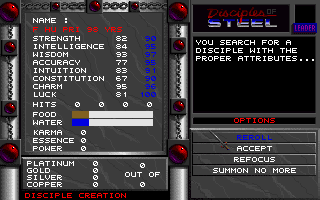
Attributes are on a scale of around 40-110; the lowest roll I saw was 42 and the highest was 103. The game rolls these for you, although you can re-roll indefinitely. One thing I noticed is that the game randomly sets the character's age before rolling the stats. The manual notes that certain races only live to certain maximum ages, and if you weren't paying attention, you could easily end up with a character just a few years shy of that age. Unfortunately, to reject an age you have to discard the character and start over.

Rolling a character. The game has made my human priest 98 years old, meaning he's likely to just keel the moment I create him. I'd better start over.

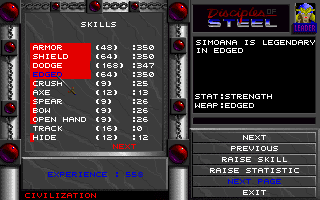
After you accept the attributes, "a complex relationship between various statistics and the disciple's class" determines where he or she stands in 11 skills: armor, shield, dodge, edge weapons, crushing weapons, axes, spears, bows, open hand, tracking, and hiding. You finish by selecting the portrait. The overall character creation process is quite long and took me almost an hour for my eight-character party:

  • Simoana, a female human knight
  • Boanergo, a male ogre warrior
  • Didymus, a male half-elf ranger
  • Steuermann, a male elf rogue
  • Nialphe, a female halfling mage
  • Thaddaeus, a male gnome illusionist
  • Fanatica, a female human priest
  • Octavianus, a male dwarf blacksmith
        
The new disciples.
    
Finally, before you embark, the game has you arrange the characters in a default formation, including both position and facing. I did my best, but naturally I'll want to edit this as I discover more about combat.

  
Characters start with no gold and a small selection of basic weapons and armor suitable to their classes. Gameplay begins on a road near a castle.

The party embarks.
    
I spent quite a bit of time wandering around the castle trying to figure out how to actually get in--more on that in a bit--and in doing so triggered my first combat with a group of "jabberlings."

Has any player ever chosen "beg for mercy" on a screen like this?
   
I'll naturally have more on combat when I have some more experience with it, but in brief terms anyone familiar with Wizard's Crown or Shard of Spring, perhaps even the Gold Box titles, would understand it with little problem. Each character and each monster moves according to an initiative order and can do things like attack, defend, and cast. If you cast a spell, you choose how much power to put into it; I can't remember if this was an option in Wizard's Crown, but it was by the time of Shard of Spring and Demon's Winter.

Each body part has an individual armor class and takes individual damage; it appears that attacks that overcome the armor will then cause injury and "bleeding" damage that characters must heal (each character has a different first aid skill level). Actions like moving, attacking, healing, and casting expend movement points, which are dependent on attributes and encumbrance. SSI is the only other developer I can think of (so far) to feature this "movement points" system in combat, and they got rid of it for the Gold Box games to adhere to D&D rules.

Attacking in melee combat.

And casting a spell.
  
The fight against the jabberlings took surprisingly long. At first, it looked like there was only one of them, but later I realized there were a lot more off-screen. A few of my characters were wounded and their armor damaged, but after combat I found a few silver and copper pieces and a handful of armor pieces that lent upgrades to my characters. I only got 13 experience points for the combat, but even that's enough to add a point or two to some of my skills.

One of a small number of games where you spend experience points directly on skills. The second column has my current level and the first has the number of points needed for the next level.
  
Something became clear in combat: the controls are going to be a bit of a nightmare. The game theoretically supports an all-keyboard interface, but the way the commands work is inconsistent. In some places, you hit the initial letter of your choice (e.g., [V]iew character), but in others you have to arrow through commands and hit ENTER to activate them. Even using the mouse, the choice of commands isn't always clear. It was late in combat before I realized that you could right-click on characters to get a full list of commands. In the wilderness, right-clicking on the party ended up being the mechanism to enter a city.

The manual doesn't document the commands, or anything, very well. The "combat" section lasts two pages, and the actual mechanics of combat, like moving and attacking, are described in general terms in just two paragraphs. Perhaps there was some additional document that came with the game that I haven't discovered.

Equipping some new items.
  
Anyway, after combat, I had my blacksmith fix my damaged armor, equipped the new armor I'd picked up, and then headed into the city of Farnus, capital of the kingdom of Farnus, one of the nine kingdoms. The others, I should mention, are Tobruk, Rathadon, Delinor, Constantium, Denias, Sesserna, DeMata, and...Serbia. (Serbia was still part of Yugoslavia in 1991, and rarely mentioned in American media before 1992, so perhaps it sounded archaic and exotic to the creators.) Anyway, Farnus is named in the manual as the most powerful of the kingdoms, although a lot of people seem to think that King Leonidas Krassus is too old and too benevolent and his son, Aaron, is weak. Farnus has been at war with Serbia for some time, with both countries trying to control the Mithril-rich Sellenist River. Attempts to ally with Constantium have failed because the emissaries keep getting assassinated.

Getting the first quest.

In the palace, the king--who didn't look very old to me--gave me my first quest: find a survivor of the Battle of Unthar, rumored to be living in the city of Teal to the southeast. I'm to find him and any information about the fate of Ustfa Nelor.

The largish city also included a shipwright, a weapons shop, an armor shop, a temple, and the Disciples of Steel guild. In the latter, you can store and retrieve money, food, and water; rest; and get "spy reports" indicating the population and military composition of the current city. This is fairly cool, although the report for Farnus alone, detailing each unit, was 40 pages. The manual promises a whole mechanic by which you can raise armies and attack cities, assassinate leaders, and otherwise bring kingdoms under your control, and I assume this intelligence will be important for that purpose.

Couldn't I just have them all in one spreadsheet or something?
 
The screens that accompany each location are animated, and some of them include sound. For instance, at the weapons shop, an animation shows a blacksmith pounding a weapon on an anvil, with accompanying clangs. We've seen animation in shops going all the way back to The Bard's Tale, but it's still pretty rare and better done here than in any game I can remember.

The animation even has the glow level of the sword increase and decrease
   
There were no NPCs or any special encounters within the city--probably true of all cities--so I did wish after a while that the developers had just made it a menu town instead of requiring so much walking. At least you can leave the town by just right-clicking on the party and choosing "Leave."

Wandering around the large city.
  
I didn't have enough money to dramatically increase my equipment, so I decided to rely on what I had and head southeast in search of Teal. Within four steps, I came to a large body of water, so it's not going to be as easy as I'd hoped. About two steps after that, I got surprised by a group of assassins and thugs who killed my entire party in the first round. Wow. I guess the jabberlings had let me a little complacent.

How am I fighting enemies of this difficulty this fast?
   
Upon full-party death, the game gives you "a glimpse of Hell," which seems a little unfair to my nobly-intended party. Then it returns you to the game screen, but you can't move or do anything because everyone is dead. You either need to reload or dump party members and make new ones.

Adding to the confusion, I have no idea what the things in the lower-right corner are telling me.

I think I'll close there, but there are a lot of game elements that I haven't covered that hint at a deeper game. I'm not sure how spell points work, exactly--each spellcaster seems to have a pool, divided into "karma" (priests), "essence" (mages), and "power" (illusionists), but they also seem limited in the number of spells they can cast per combat round. There's a food and water system, and the whole business of controlling cities that I don't yet understand. Dungeons apparently use an entirely different, first-person interface. Disciples of Steel promises to be a fairly large, long game.

Sunday, February 18, 2018

1991/1992

            
1991 was, on balance, a depressing year. It took me nearly 3 years and 1,201 hours to get through its 37 games, nearly a quarter of that spent on Fate: Gates of Dawn. When it was all over, Ultima V from 1988 still stood at the top of the list and only four games had broken a rating of 50 all year, three of them sequels to games that had higher scores. The average rating was 2 points lower than 1990 and 3 points lower than 1989.

Games in 1991 got longer but not better.
        
Even the highlights had asterisks. There were four Gold Box games this year--Pools of Darkness, Death Knights of Krynn, Gateway to the Savage Frontier, and Neverwinter Nights--but still none of them managed to exceed Pool of Radiance, and for the first time I began to wish SSI had better balanced quality with quantity. Might and Magic III was good but not as good as I remembered. Fate was memorable but lasted more than 200 hours beyond the point I should have stopped playing.
          
This screen was not worth the equivalent of 7 full-time work weeks.
      
I did continue to appreciate the growing geographic diversity of our developers. There were more countries represented this year than in any previous year, including Canada (Ancients 1: Death Watch), Switzerland (Antares), Denmark (Chaos in Andromeda), Germany (Die Drachen von Laas, Fate: Gates of Dawn, The Ormus Saga, Dungeons of Avalon, Spirit of Adventure), Australia (Dungeon of Nadroj), Japan (Knights of Xentar), the UK (Moonstone, Heimdall, HeroQuest, Knightmare), and Italy (Time Horn). What's more, none of these games totally blew it. In fact, they all had moments of innovation and brilliance, even if they didn't always achieve high final scores.

I'm also satisfied with my "won" rate for the year. I only gave up on Antares, The Ormus Saga, Dungeons of Avalon, and the sample game with The Bard's Tale Construction Set, and I took both Ormus and Avalon as far as I could. They both still bother me.

The only major theme I can draw out of the year is the surprising persistence of low-quality Ultima clones. Between Quest for Tanda, The Rescue of Lorri in Lorrintron, The Ormus Saga, and Legend of Lothian, I've really had my fill of independent game with iconographic interfaces.

Game of the Year Nominees

Part of me wants to reach down to mid-list for "Game of the Year." Knights of Xentar--at least was different. The limited but satisfying Shadow Keep. Twilight: 2000, because no other RPG has let me drive a tank through Poland. But no, I can't nominate any of them with a straight face. So instead, here's my half-hearted list of nominees for "Game of the Year":

1. Disciples of Steel. The clear victor if I chose based on rating alone. It was the top-rated game of the year and the one I authentically enjoyed the most, despite its many flaws. In a year of blah, this one-hit wonder managed to anticipate dozens of future trends, including multiple interweaving quest threads, multiple modes of gameplay, and lots of player choice. Its character development and tactical combat systems, adapted from Wizard's Crown, are near-unsurpassed, and it gave solid attention to other mechanics of quality RPGs, including a tight economy and a diverse set of equipment. I was sorely tempted to replay it at the end of the year, favoring a completely different approach this time, seizing cities by force and maximizing the use of the optional strategy game hiding beneath the surface. My biggest quibble: it sold about 12 copies and left no mark on the future.
           
Despite hundreds of battles, I never got bored with Disciples of Steel's tactical combat system.
         
2. Pools of Darkness. Technically, as Gold Box sequels went, Death Knights of Krynn ranked higher. But Pools of Darkness took the Gold Box to new levels, maxing out spell capabilities and allowing characters to rise to god-like levels. It told a compelling story, featured one of the most memorable maps of the series (Moander's corpse), and concluded everything with a truly-epic final combat. While not the Omega of the Gold Box games, it's close, and it makes a worthy bookend with Pool of Radiance.
       
The final battle of Pools of Darkness is legendarily difficult.
         
3. Might and Magic III. I don't think it's the best of the Mights and Magics even among the first three, but it demonstrates New World's commitment to pushing the envelope and updating its interface with new technologies. The mechanics often feel unbalanced, and the game world is sometimes a little goofy, but it's still loads of fun. Between its million side quests, the dozen items of equipment that every character can strap on, and its constant sense of character development, no one else was offering anything exactly like it. The Might and Magic series has always, in my opinion, exceeded its sources (principally Wizardry) and competitors (principally The Bard's Tale), but this was the first year that it truly left them in the dust.
         
Combat in Might and Magic III is turn-based, but through sound and graphics manages to evoke a real-time feel.
          
4. Fate: Gates of Dawn. The game that embodies "go big or go home." Out of nowhere, developer Olaf Patzenhauer took an Alternate Reality base and made the largest physical RPG seen so far, with more monsters, more spells, more character classes, more items, more everything than any of his competitors. More isn't always better, of course, and in the end, Fate is ludicrously, unconscionably, almost maliciously long, with only the thinnest plot and an absurd ending, but it's hard to beat the mechanics of the first 50 hours. As whole, Fate re-defines "epic" and paves the way for Germany's ascension in the RPG world in the 1990s.
         
I managed to map most of the 640 x 400 game world.
            
5. Eye of the Beholder. It's easy to forget that up to this point, the Gold Box series has offered the only truly successful adaptation of the most famous tabletop RPG system. Every other attempt at the D&D license has resulted in something forgettable at best and execrable at worst. Eye of the Beholder comes along and, though flawed, shows that there is another way to do it. It kept Dungeon Master-style gameplay alive and managed to produce its own sequel during the same year.

Honorable mentions: Technically, Death Knights of Krynn rated higher than Pools of Darkness, but who gives GOTY to the middle game in a three-part series? Spirit of Adventure was a surprisingly effective improvement on its Bard's Tale template but didn't really leave a legacy. I had a ball with Conan: The Cimmerian despite it lacking in several core RPG areas. MegaTraveller 2: Quest for the Ancients was a poor game overall, but it was an important step to truly open worlds and lots of player choice in how to achieve objectives.

1992 Preview

While we let those percolate, let's look ahead to 1992. If 1991 was a disappointing year, 1992 promises to be the absolute opposite. I'm practically giddy at the list before me. Every franchise had a release this year. We get the final D&D Gold Box title (aside from the Unlimited Adventures construction set) with The Dark Queen of Krynn. The Ishar series begins. The Realms of Arkania series begins. We get the second Interplay Lord of the Rings title. We get the third Magic Candle title. We get a Might and Magic, a Wizardry, a Quest for Glory, and two Ultimas! And in between these surefire hits are a ton of titles that I feel like I've heard good things about, among them Amberstar, Black Crypt, Darklands, Four Crystals of Trazere, and Spelljammer: Pirates of Realmspace. Surely, one of these games is destined to unseat Ultima V at the top of the list.

Here's the bad news: there are 65 games. This is, in fact, the peak year for RPGs.
         
      
The following year, 1993, has one game fewer, and after that the number drops back to the 30s and 40s for most years, averaging 43 between 1994 and 2009. But 1992 is a definite hump, and I can only be glad that so many of the titles look promising. Given the sheer number, you'll need to understand when I'm relentless with my definitions. I'm tempted to start right now by axing B.A.T. II; the first one was hardly an RPG at all.

Despite the sheer number, there's not a lot of new geographic diversity with the 1992 titles. The USA and Germany remain strong. Canada and the U.K. contribute a few. A few more leak to the west from Japan. Hungary contributes its first RPG with Abandoned Places: A Time for Heroes, and Finland offers its first RPG since SpurguX (UnReal World). In terms of platforms, I'm going to be able to abandon most of my emulators. There are four Amiga-only games (Antepenult, Black Crypt, Dungeons of Avalon 2, and Warriors of Releyne), two Macintosh-only games (Darkwood and Minotaur: The Labyrinths of Crete), and a lone C64 game (Telnyr II). The other 58 have a DOS port.

We're going to be entering 1992 slowly, because I've decided to double up on 1988 and 1989 games until I clear the "old" list and can work off of 1992 exclusively. There are 38 games remaining on that "old" list, although I can tell a lot of them are destined to be cut.

Year-End Superlatives

Total games played: 37 (from an original list of 45)

Highest-rated games: Disciples of Steel (57), Death Knights of Krynn (54), Pools of Darkness (52), Might and Magic III: Isles of Terra (52), Gateway to the Savage Frontier (49).

Longest played (hours): Fate: Gates of Dawn, at 272. It's hard to write that without feeling like I need therapy. The average was 31 hours per game and the total was 1,201 hours.

Longest played (start to finish): Martian Dreams, which was on my mind between October 2015 and March 2017 despite only taking 35 hours.

Percentage won: 89%

Hardest game: Knightmare, the only game to which I've given a full 5/5 for difficulty.  I question whether it's possible to win without a hint guide. Even then, it takes more than 400 hits to kill the final enemy, who can kill you instantly if he hits once.

Highest category score: The 8 awarded to Disciples of Steel in "gameplay" for its nonlinear approach and replayability. It was a little too hard at the beginning for a perfect 10.

Best game with a bad category: The damned Gold Box games still can't get the economy right. Death Knights of Krynn and Pools of Darkness came in at 2 and 1, respectively, in that category despite breaking 50 in general.

Worst game with a good category: Playing Neverwinter Nights offline, I could enjoy all of the strengths of the Gold Box engine with none of the content. Knightmare was a beautiful-looking game that was absolutely enraging.


Game of the Year
          
          
In a year where I'm lukewarm about all my choices, I've chosen Might and Magic III: Isles of Terra less for the specific title and more as a representative of the overall series. If I don't give it here, you can imagine what will happen: IV will lose to one of the Ultimas, or Darklands, or one of the other awesome 1992 titles. V will fall to something like Betrayal at Krondor. VI, perhaps my favorite of the series, had the misfortune of being released the same year as Baldur's Gate and Fallout 2; VII came out the same year as Planescape: Torment. No way is VIII or IX getting it.

I liked Terra less than its predecessors, but I still liked it quite a bit. It continues to exemplify an approach that hardly no one else is taking: an open world that may reward or punish you for exploring in a non-obvious order; lots of side-quests (seriously, when do these become standard?); a heavy dose of lore attached to individual maps and areas ("Corak's notes" were particularly brilliant); and copious methods of character development. I love its contrast with development in, say, D&D, where a character's attributes remain (mostly) fixed his entire life and his reward for slaughtering a thousand orcs is four extra hit points and one new spell slot. A Might and Magic III character, in a fifth of the time that it took that D&D character to go from Level 5 to 6, will stumble upon a fountain that raises his strength 5 points, upgrade 6 items of equipment, gain 8 new spells, come across an amulet that doubles his hit points, and turn in a quest item for 3 levels' worth of experience points. I hasten to add that Might and Magic's approach isn't universally the better one--there's something to be said for more spartan character rewards--but it sure feels more rewarding when playing.

You also have to admire the engine, which manages to feel fast and action-oriented despite being turn-based and tactical. It offers a nice halfway point between Dungeon Master and Wizardry.
       
There are problems, of course--see my "Cabbage Theory" in my final entry. The rest of the game has long outgrown 16 x 16 maps. And the creators' inability to craft a plot with any gravitas remains a significant liability. But more than most developers of the era, you sense that New World has the capacity to learn from these mistakes and grow. We will soon see the results. Well, not soon--in like 100 more games. It is highly likely that I'll end 1992 and start 1993 with the IV/V pair. Whether I try them independently or combined remains to be Xeen.


Let's jump right in to 1992. In choosing the play order for the year, I often think of John Cusack's advice on making mix tapes in High Fidelity: "You got to kick it off with a killer, to grab attention," but it can't be the best, because you have to leave room to "kick it up a notch." Thus, I've chosen Ultima Underworld. It's a groundbreaking game that makes us feel that we've stepped into a new era, but parts of it haven't aged well, and I thus doubt it will be the highest-rated game of a very competitive year.

Sunday, February 7, 2016

Disciples of Steel: Out of Ideas

If only this were true.
  
Ever since I started Disciples of Steel, people have been warning me about a "time limit" that the game imposes--supposedly, you have to have your act together (and I'm not entirely sure what that entails) by a certain date, or the forces of darkness sweep over the world or something. Aware of this, I've been apprehensive with every month that passes. But after this last, long--so very long--session, I have the opposite problem: all the time in the world, and nothing to do with it.

In my last post, you learned how I had started to reach the end of the rulers' questlines, usually getting control of their kingdoms--and the ability to set tax rates and raise armies--in the process. On a monthly basis, I started getting notices about the amount of money my taxes were raising in each city.

Nice of them to bring it to me in the dungeon.

The ends of the rest of the questlines were relatively swift. The elf king had me rescue his kidnapped daughter from a set of caves only a few steps from the city, then kill a demon called a "Sethnor." When I was done with the latter quest, he warned me that a wizard who survived the Battle of Unthar, "once the weakest but now the father of lies," was preparing to march his army from the Isle of Kulm, north of Rathadon. He named the wizard as "Variz" and said that the elves would be with me when the time came. This will be important in a minute.


I then turned my attention to Constantium's last quest: kill a dragon menacing the countryside from a cave. I'm including the screen shot of the exterior just to give another sense of the ubiquitous "flavor text" that the game throws at you:
  

The dragon was easy. He attacked me without backup, and a single "Power Word: Stun" kept him immobile long enough for me to kill him with melee weapons.

Thaddeus prepares to stun the dragon.

I returned to Pallasade with the dragon's body. Like the elf king, the ruler of Constantium declined to hand over his kingdom. But he did warn me that an evil army was gathering and that he'd be on my side when the time came.

Up next was Denias. The king told me that his regent in the nearby city of Warig was in rebellion, and I'd need to assassinate him. I had tried the "assassination" mechanic before--you walk up to the palace, right-click on the party, and choose "assassinate," which brings you to a large battle inside the palace--but when I was far weaker. This time, I was able to win with a bit of effort. The battle featured a lot of strong guards and mages, but the battlefield was sectioned off into several rooms, so it was easy to clear one room at a time and then lure enemies individually around corners and through doors.

Killing the regent.

It turned out that this same map is used for all palace attacks, and I had several more to fight before the end of this session. 


In any event, when I returned to Cartha, the king abdicated and gave me the kingdom to control. As was my normal routine by the time, I set a tax rate of 5% but didn't raise any armies just yet.


My final set of quests, before heading into Rathadon itself, was for Serbia. There, the king had me overthrow a Rathadon outpost (involving another palace battle) on the western side of the land. As with Constantium, he didn't hand me the kingdom but he did promise aid against Variz.

At this point, I wasn't entirely sure what to do next. Rathadon had its own questline, but since the king was so manifestly evil, it didn't feel right to follow it. But lacking other ideas, I decided to visit Krighton Krigg and see if he asked me to do anything terribly objectionable. 

"My orcs speak constantly of the power of the man who lives under the fire," Krigg said, and demanded that I go find out who his orcs are talking about. I had a pretty good idea that this person was the previously-named Variz, indicating that while Krigg might be evil, he isn't the Big Bad of the game. Thus, I journeyed to the volcanic island to the northwest of Rathadon (by now, I'm using the priest's "Teleport" to move just about everywhere). Here, upon discovery of a cave, the game warned me that I had discovered "the source of all evil that walks the face of Lanathor."

What is it with evil guys and volcanoes?

I'll pause here to note that throughout these adventures, as well as a couple of side-dungeons that I explored on a lark, my characters continued to steadily improve. Thanks to potions that increased my spellcasters' primary attributes, I unlocked a set of powerful spells, like "Ice Storm," "Deathstrike," "Destruct," "Mass Invisibility," and "Wrath of God"--the latter of which we're going to have to talk about in a minute.

The best treasure cache in the game.

Every time my party members accumulated 1,000 or more experience points, I spent a few minutes on skill improvements. My knight, armed with a "+20 Sly Sword" taken from a Death Knight and wearing a set of Boots of Speed, had become an unstoppable killing machine, absolutely mowing through enemies. (The "Sly Sword" is probably a reference to that ridiculous contraption in The Sword and the Sorcerer [1982]. The creators of the game missed an opportunity by not making it a ranged weapon.) Because of this, she started getting more experience than anyone else per battle, which I then channeled back into even better statistics. By the time she had "edged," "armor," "body," and "dodge" skills above 300, I think she could have won most battles by herself.


So I entered the "source of evil" pretty confident. Between my last post and this moment, I had been playing for maybe another 6 or 7 hours.

I spent the next 20 hours of feverish gameplay in this single dungeon. It was big enough to make up an entire game by itself. There were random encounters every few steps, and though I did my best to evade most of them, I ended up having to fight a pitched battle every 5 minutes or so. About 1 in 6 combats--particularly those with giants--killed a character and forced me to reload. The prevalence of random encounters was exacerbated by the need to turn and face every wall to look for secret doors, since these were plentiful (although towards the end, my ranger got high enough in the "perception" skill that he started finding them automatically). I did gain thousands of experience points, which was good, but the expedition cost me almost two game months. Throughout this entire long, painful process, I wasn't even entirely sure that I needed to be there.

Early in the dungeon, a voice whispered to me that Variz "will attack before the year is out," which turned out not to be true, as I entered the dungeon in December and left in February, and there was no attack in between. Soon after, in a large area with multiple jail cells, I found the body of legendary warrior Ustfa Nelor.

Or "Uthor Nelor" as only this one screen has it.

He had written in blood on the wall, "Only in unity will you find Variz," which turned out to be the password to a couple of places later. In a nearby alcove, I found a sword that a voice told me was capable of defeating Variz. I assume it was Nelor's sword.

CyHagan is the witch from the game's intro screen who prompted the re-establishment of the Disciples of Steel in the first place. She has otherwise been absent from the game until now.
   
Those were the only major plot-based encounters for a long time. For over a dozen hours after this, I just fought wave after wave of giants, elementals, demons, and Rathadon forces (don't know what they were doing here since the king didn't seem to be aware of Variz). Several hallways had traps every step. There was a whole area of undead encounters that never led to anything important, and rooms full of guards and demons that turned out to be dead ends.

At some point, my priestess's "karma" skill got high enough that she got a new spell: "Wrath of God." To call this spell "overpowered" doesn't go far enough. When cast at maximum power, it simply kills every enemy in the battle--on-screen, off-screen, hiding in corners, whatever. Only the fact that spell points take so long to regenerate keeps this one spell from completely breaking the game. I used it liberally on giants, who I otherwise had to micro-manage with multiple castings of "Power Word: Stun" to survive, and my priestess started to overtake my knight as the party's primary experience-hogger.

"Wrath of God" works its way methodically through the enemies.

Eventually, things started to get weird, and I'm sure there were bugs involved. I found a passage that opened into the negative space between and outside the dungeon's walls. This area, probably not meant to be explored, allowed me to approach stairways from angles unintended by the developers, which took me to similar areas on other levels. I got lost in this vast emptiness for a while, and while there were no fixed encounters here, the random encounters never stopped.

I don't think stairways are supposed to work this way.
   
Before we get to the end of the dungeon, we have to talk about another bug: occasionally, the monster pictured on the encounter screen (and fought on the subsequent combat screen) doesn't match the textual description. For instance, the description might say that you face "numerous undead," but instead you get attacked by a handful of trolls. Here's an obvious example:


This bug may be behind my inability to get to the endgame. Eventually, through multiple secret doors, twisty passages, and fixed combats, I made my way to a nondescript room that the game informed me was "Variz's quarters." Variz said: "Welcome, Disciples. You have managed to succeed where others have failed. But let it be known I refuse to give up, and only I shall leave this room alive!" The game then informed me that "Variz and his minions attack."


The problem is, the portrait shows a storm giant, and that's what I got in the ensuing battle: a single storm giant. I killed him without too much trouble and nothing happened. I tried re-loading the game and re-entering the chamber, but the same thing happened.

I'm not sure what would have happened if I'd fought Variz and his minions anyway. Would that have been the end of the game? If so, what was all the kingdom-conquering and army-building about?

In my case, I returned to the surface discouraged and returned to the king of Rathadon. His reaction was simply, "a wizard!" I'm not sure if the game thinks I defeated the wizard or if I completed the quest just by discovering that the man in the dungeon was a wizard. Either way, Krighton Krigg gave me 60 experience points.

This ended his questline. When I asked for another quest, he said that after consulting his seers, I needed to "leave his palace and never return" or he would kill me.

That's gratitude for you.

At this point, the only thing I could think to do was attack and conquer Rathadon. I decided to try it by building an army back in Farnus. Thanks to my adventures in the dungeon, I had about 350,000 copper pieces among my party members and another 200,000 back in the vault. (It turns out, by the way, that the Disciples of Steel guilds and the castles all share the same vault.)

Raising an army took more of this sum than I would have believed. It took 1,000 just to define the army and about 75,000 more to staff it with 50 "veteran" soldiers and 40 "elite" soldiers. Equipping the troops with weapons, bows, armor, and mounts took almost another 100,000. Nearly 2/3 of my wealth was gone when I finished this one army, and the game informed me that I would need a monthly outlay of almost 30,000 copper just to maintain the force.

Buying mounts for the "Army of Chet."

When I was done, I chose to take my new elite force on the road with me. On the way to Rathadon, I tried to enter the dwarf city just to see what would happen, and it told me that they refused entry. I guess I can't be too offended by that.


Upon reaching Rathadon, I chose to attack the capital city. The game warned me that if I was defeated, the Disciples would be killed. I acknowledged this. What followed was  strategic game map not unlike Sword of Aragon but with far fewer options. I was given a choice of placement for my one army, after which the enemy armies started appearing. And appearing. And appearing. Yeah, it turned out that Rathadon had about 30 units to my one.

At least there are some convenient crucifixes.
 
I barely got to explore the army combat options before my force was wiped out. Clearly, attacking with 90 soldiers wasn't going to win the day and my current gold reserves weren't going to cut it.

I don't quite blame the game on the gold issue. I stopped bothering to take equipment for sale a long time ago, which undoubtedly has contributed to my financial straits. I also haven't been exploiting the mage's "Lead to Gold" spell, which generates the equivalent of 2,000 copper with every maximum casting. Some of the wealth is clearly meant to come from taxation, which I've probably been setting a bit too low.

I clearly wasn't going to take over Rathadon with an army for a long time, so I did it the easier way: I dumped my army at the nearest friendly garrison, returned to Rathadon, and attacked the palace with just my party. A single casting of "Wrath of God" killed everyone except Krighton Krigg himself, and he went down with a few melee rounds.


But taking over the capital didn't reward me with any endgame text. I also conquered Rathadon's secondary city, Devil's Way, but also got nothing.

So what now? Does the bug that failed to produce the battle with Variz mean that I can't win the game? Or is he still going to attack, eventually, and I just need to find something to do until that date? (To check the obvious, I forced my party to wait until one year had passed since the beginning of the game--which is harder than it sounds--but nothing happened.) I wouldn't mind explicit spoilers on this one. It's going to be horribly disappointing if I got all this way into the game and can't win because of a bug.

In the meantime, some commentary on various encounters:

I couldn't help but think how disappointed David Bradley would be playing this game.
Here's another one where the text writer didn't communicate well with the graphic artist.
Just some awesome flavor text.
I'm not sure this guy really understands what it means to be a "skeleton." Seriously, this is what happens when, unlike in Dungeons & Dragons, monsters have no obvious immunities.

This whole time, I've been worrying that Disciples of Steel would screw up an excellent set of game mechanics with a nonsensical, confusing, or buggy endgame. It's now appearing that, more likely than not, that is the case. I guess by next time we'll know for sure.