Curse of the Azure Bonds
United States
Strategic Simulations, Inc. (developer and publisher)
Released 1989 for DOS, Apple II, and C64; 1990 for Amiga and Macintosh; 1991 for Atari ST and PC-98
Released 1989 for DOS, Apple II, and C64; 1990 for Amiga and Macintosh; 1991 for Atari ST and PC-98
Date Started: 25 December 2012
Date Ended: 7 January 2013
Total Hours: 21
Difficulty: Moderate (3/5)
Final Rating: 60
Ranking at Time of Posting: 79/83 (95%)
Date Ended: 7 January 2013
Total Hours: 21
Difficulty: Moderate (3/5)
Final Rating: 60
Ranking at Time of Posting: 79/83 (95%)
Ranking at Game #455: 449/455 (99%)
So far in the history of CRPGs, we have only seen a handful of games with sequels. They include:
- Ultima
- Wizardry
- The Bard's Tale
- Phantasie
- Questron (including Legacy of the Ancients)
- Might & Magic
- Shard of Spring/Demon's Winter
- Pool of Radiance/Curse of the Azure Bonds
Which of these things is not like the other? It's Ultima. Every other franchise, so far, has featured essentially the same game engine between games, with perhaps some minor improvements in graphics, sound, and the interface. There have been variances in the quality of updating--Wizardry is indistinguishable from Wizardry V, while Might & Magic had some more significant changes--but generally speaking, each game in these series "feels" like it's part of the series. Ultima remains the curious exception throughout its history: they reinvented the game engine for every iteration (with the exception of the two Worlds of Ultima spinoffs from Ultima VI).
Naturally, then, the games in each franchise have very similar ratings. Wizardry I, II, III, and V are all within one point of each other. The variance between the two Might & Magic games is 2 points; the three Bards Tales are within 3 points; the Phantasies are exactly the same. It's to be expected. With the same (or almost the same) game engine, there are limited ways that a game can significantly improve (or screw up). We did see it in Demon's Winter, which had a significantly better story, less linearity, better NPCs, and more role-playing than Shard of Spring despite looking and feeling very similar.
I'm saying all of this to explain why I don't think my rating for Curse of the Azure Bonds is going to look much different than my rating for Pool of Radiance. Curse feels like what it is: a continuation of Pool. I'm writing what appears below without reviewing my Pool of Radiance final rating, but off the top of my head, there were a few interface elements I liked better in Curse but a better story and side-quests in Pool, and I'd be surprised if they don't end up with almost identical final scores.
1. Game World. This franchise is unique in that it takes place in a much larger game world with an enormously detailed history and lore, thanks to countless books, game manuals, magazine articles, modules, and other computer games. Each time you fire up a game set in the Forgotten Realms, you're amid a host of references and allusions to history, characters, and legends. There's nothing comparable to it in this era of CRPGs except perhaps the one BattleTech game.
I have to say, though, that I don't find the Forgotten Realms very compelling. It feels like there's too much in the setting--too many lands, too many races, too many monsters, too many gods. Every type of monster and mythology that could exist does exist; everything that could happen has happened; every plot twist has already been twisted. I was recently playing Forgotten Realms: Demon Stone which concerns a Githyanki general and a Slaad lord vying to see which one of them is going to lay waste to Faerûn. It's supposed to feel epic, but I wanted to tell them, "Guys, you're going to have to get in line behind about three thousand other arch-wizards, demons, gods' spawn, cult leaders, shadow druids, ancient lizard people, Drow matrons, disaffected half-breeds, dragon kings, fallen deities, and interlopers from other planes."
 |
| The Dalelands are only a small part of a much bigger world. |
What the Realms lacks is a strong "core," like spice in Dune or the Force in Star Wars. Some of D&D's other settings have that core: Ravenloft's gothic horror, Dark Sun's dying earth, Planescape's "rules."
On the other hand, it's a good place to set a generic high-fantasy adventure, and once you're familiar with the way things work in the Realms, you can carry that knowledge to dozens of other games. Black dragons breathe acid, basilisks stun you, a platinum piece is worth 5 gold pieces, paladins are lawful good and can lay on hands, thieves can't wear metal armor, gnolls are evil, you can trust Elminster, and anything to do with Bane is bad--no matter whether you're playing Curse of the Azure Bonds, Eye of the Beholder, Neverwinter Nights, Baldur's Gate, or Icewind Dale.
I'm going to talk about the ties to the book at the end, but aside from Azure Bonds, the creators did a great job outlining the political situation of the area, the history of the Dalelands, and the nature of the various factions. With the possible exception of Tyranthraxus, it makes sense that these five power groups have entered into this uneasy alliance to bond the party for their own ends.
The game also does a good job evolving the world. When you first start playing, and you have all of the bonds on your arms, factions allied against Zhentil Keep treat you rudely and sometimes even attack you. (My party needed to be told about something called "long sleeves.") After you finish Zhentil Keep and lose the bond, those factions become friendly--but Zhent troops now have you on their "Wanted" list and attack on sight. After Silk made my ranger a Swanmay, several characters commented on it. River pirates remain cowed and stop attacking after you kill some of them. In a couple places, the game takes the convenient way out and simply blocks you from returning to places, but overall, it makes you feel like you're effecting permanent changes on the Dalelands. Score: 8.
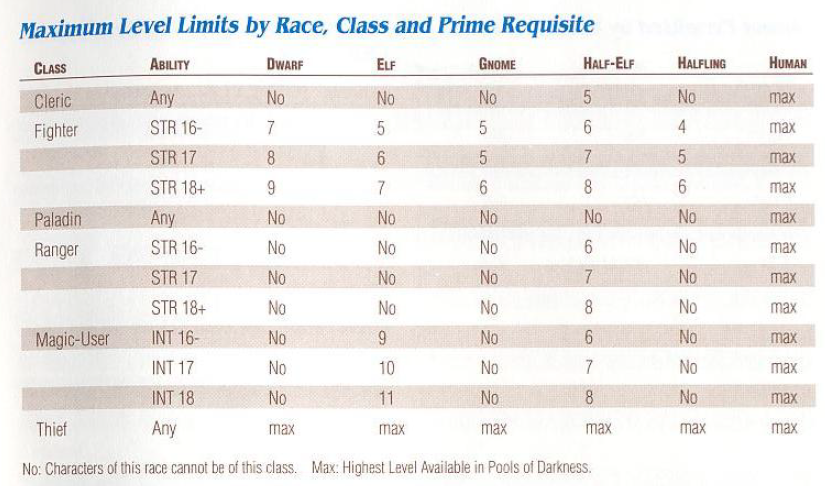
2. Character Creation and Development. Curse did a good turn by introducing the paladin and ranger classes, and by introducing dual classes. The character system is otherwise indistinguishable from every other D&D game. As with Pool, I liked the ability to customize the icon. (We lost the character portraits, but they were goofy anyway.) My biggest complaint here is the lack of advancement. Imported characters from Pool of Radiance might only be able to advance three or four levels over the course of gameplay. The level caps ensured that my characters maxed well before the end of the game. There is no way to role-play alignments, classes, or races--the latter of which is a good thing, since the literal adaptation of first-edition rules means that you probably don't want anything but humans anyway. But for the few levels that you have, it feels good to get extra attacks and spells, higher backstab multipliers, and other benefits. Score: 6.
 |
| My winning mage was a victim of her own "Haste" spells. |
3. NPC Interaction. There are about as many NPCs in Curse as in Pool, with the difference that many of the ones in this game were drawn from the Azure Bonds book. There are no dialogue options with NPCs, but the game does retain the "attitude" system, which sometimes works (rakshasa leave you alone if you're "haughty"), and there are frequently options other than dialogue.
I missed the hirelings from Pool of Radiance, and I wish there were more NPCs in this game that you could actually take into your party. But the few that do join you have interesting things to say about themselves and the environments. Score: 6.
4. Encounters and Foes. One thing I can say about the Forgotten Realms is that it has an interesting menagerie of creatures, and this game featured an awful lot of them--the manual lists about 40. The developers did a good job programming each monster's unique attacks, although as we discussed, the AI sometimes isn't up to par with these abilities. Having played about a billion hours in Forgotten Realms games, I didn't have to look up descriptions of my foes, but the manual did have them, with even an assessment of their relative difficulty levels (dogs are lowest, dracoliches highest).


(Just as an aside: it occurs to me that aside from the dracolich, there isn't a single undead in this game. That's a little unusual for a D&D game.)
The quality of the pre-combat and non-combat encounters was on par with Pool of Radiance, which makes it better than most of the games of the era. I liked the little choices: attack the dragon horde or talk with them; loot the crypts or restore them; punch the bartender or buy a drink; burn the trolls or watch them reassemble; help the rogue rakshasa prove that his comrades are cheating at gambling or just attack him; attack the hookah-smoking Drow or leave them alone. There were a dozen or so small but satisfying encounters along the roadways, including stopping an invading army, removing a displacer beast threat, and saving a farm from ettins. At the same time, though, I felt there were more cases in this game in which the choice was obvious, or the outcome was the same no matter what I chose. Score: 7.
5. Magic and Combat. I still think that the Gold Box system of combat is one of the best ever created. It has everything I like: a turn-based, tactical map; multiple attack and defense options; even some fun animations and sound. Magic is an integral part of the tactics of the game, and you need to carefully select spells to memorize and cast. Backstabbing and wiping out enemies with fireballs and lightning bolts literally never gets old.
Everything I could possibly say here is a rehash of what I said in my "Turn Based vs. Real Time" posting and my Pool of Radiance review, so I'll just conclude with the same thing I said about the first "Gold Box" game: "There are hardly any other games--ancient or modern--that achieve such a
perfect blend of melee combat, spells, item use, morale, and (albeit
limited) special abilities." That said, the AI limitations were more apparent in this game than its predecessor. Score: 7.
 |
| A tough beginning. These priests are capable of high-level spells and I need to damage them all quickly so they can't cast in the first round. There isn't enough space in this corridor to cast "Fireball" without hitting my own party. They're not lined up in the right way for "Lightning Bolt." "Stinking Cloud" would incapacitate maybe three of them. Since there are only five, I could try to have my party take them one-by-one in melee, but if they have better initiative, or I miss one of my attacks. at least two of my party members are getting "Hold Person" cast on them. |
6. Equipment. Standard D&D fare, which is generally good. There was a wider variety of equipment in Curse than in Pool, including more rings, girdles, gauntlets, wands, and scrolls. As almost always happens, I was too conservative with my wands, and I ended the game with enough wand power to level a city. Every new map brought one or two equipment upgrades, and a few of them, like the Ring of Wizardry and the Girdle of Giant Strength, were unmitigatedly awesome. But we still don't see any detailed item descriptions, and where the heck are the helms and boots?
 |
| My ranger's final equipment list. |
I must voice this complaint about this game and many others like it: all the good stuff appears in fixed locations. Why does it have to be this way? I think it would be far better if each reward cache had a random selection of the special items in the game. In the Fire Knives' hideout, you find a long sword +3 frost brand every single time. Why couldn't it occasionally be the Ring of Invisibility, or the long bow +3? It's not like there's a plot-related reason that the long sword has to be there. It would enhance replayability enormously if the items were mixed up. Score: 5.
7. Economy. Almost so bad the game might as well not have had one. Pool of Radiance had a glut in the economy, but at least you had to struggle a bit in the beginning. Curse of the Azure Bonds starts you with enough gold to buy everything in the equipment shop in Tilverton and still have enough left over for training. After that, battles and treasure hauls throw so many gold pieces, gems, and jewelry at you that you find yourself abandoning more than 90% of it--that isn't remotely an exaggeration--and you still have more than you know what to do with. The game did one thing better than Pool by including a magic shop, but even with that, I could have bought everything they stocked multiple times over. I don't understand how a game that does everything else so well could do this aspect so poorly. Score: 2.
 |
| There really isn't any point. |
8. Quests. The main quest in Curse is more personal than in Pool, but it's still interesting. As with the previous game, there's a certain humility to it: your adventures take place in a small corner of the Realms, and you're basically determining the outcome of some factional strife, not saving the world.
I did like the quests in Pool better, though. The way the clerk fed them to the party, you felt like you were slowly accomplishing the revitalization of Phlan, not just hitting waypoints on the way to the final battle. Curse also doesn't have side-quests in the same way that Pool does, although it does have a few side-dungeons, including the memorable Beholder Corps. There is only one ending to the main quest, and not many quest-based role-playing choices along the way. Score: 6.
9. Graphics, Sound, and Interface. No strong complaints. Once I figured out how to enable the Tandy sound, it was actually quite good. There's a certain graphical paucity to the dungeon corridors and rooms, but the monster portraits and icons are good enough. The keyboard controls were intuitive. The "Fix" command was a welcome addition, and I hope the next game straightens out some cumbersome aspects of the combat interface. Score: 6.
10. Gameplay. As I discussed in my Dracandros posting, there is a refreshing nonlinearity to the gameplay. Although you have to do the Fire Knives first and Tyranthraxus last, you can do the three middle stages in any order, and intersperse those with the various optional dungeons and encounters. It doesn't have quite the same world-openness as Pool, but it's better than a lot of games.
Being too nonlinear comes with a price, and I found it in what seemed like excessive difficulty in some areas. But overall, I thought that the difficulty of the game was pitched very well. The pacing was also good; I felt it lasted exactly as long as it needed to.
As for whether it's "replayable," I'd have to say not very. By choosing a different route or different character classes, you might be able to alter the tactical challenge, but you'd have to be really into the game to want to do that. Score: 7.
The final score of 60 actually puts it 4 points below Pool of Radiance but still fairly high; only Ultima V, Pool, and The Dark Heart of Uukrul rank higher. That feels right. Fundamentally, I liked Pool of Radiance better for its story, quests, encounters, and a slightly better (if still bad) economy.
 |
| I don't know exactly what this ad is promising, but a teenaged me probably would have been disappointed. |
This game throws an additional ingredient into the mix by basing itself
on a specific book and introducing NPCs from that book to the game. I'm not sure how well that worked. When Nameless, Olive Ruskettle, and Akabar Bel
Akash appear, the game is clearly winking at you, and you feel out of
the loop if you don't know who they are. But expecting the reader to go
through a 400-page book seems a little unfair. I'm not subtracting points for it, but I'm glad that not many CRPGs are based directly on books. It was a weird decision, really; surely, even when the game was new, only a fraction of the game's players would have read Azure Bonds.
I was hoping that Scorpia would corroborate the slightly "left out" feeling in her review, but she didn't mention it at all instead, in a curiously ornery review in the September 1989 Computer Gaming World, she bemoans that little has changed since Pool of Radiance, "combat still predominates," and there isn't much actual role-playing. (I'm not sure what games in this era she was playing in which there was actual role-playing.)
Best of all, though, she complains that the die rolls seem to be weighted in favor of certain monsters and against the party, and she goes into a long example involving otyughs to prove it. I was beginning to think that she might need a long vacation away from her computer, but the review is supplemented with a memo from SSI programmer Scot Bayless who says that she's right. He explains that they included hit and damage modifiers based on the terrain and environment without necessarily being explicit about it in the game: "Like all good DMs, our authors bend the dice to suit the story."
I'll be back in the Realms, with this party, in less than a year with Secret of the Silver Blades--a game that few of you seem to like--and in 1991 with Pools of Darkness. Four games in four years sounds like a lot, especially by modern standards, and that's just the "Pool of Radiance" series. SSI knew they had something with the Gold Box engine, and in 1990, they also launched the Dragonlance Gold Box series with Champions of Krynn, followed by Death Knights of Krynn in 1991 and The Dark Queen of Krynn in 1992. The two "Savage Frontier" games appeared in 1991 and 1992 respectively, and the company used the engine in a non-D&D context with Buck Rogers: Countdown to Doomsday (1990) and a 1992 sequel. As much as I like the Gold Box engine, it'll be a miracle if I'm not thoroughly sick of it by the end of 1992.
The next game might be a bit of a surprise. I'm still trying to figure out the controls for Dragons of Flame. I just bought a game controller, which I've never used on a PC before, and I'm not sure how easy or hard it will be to get it to mimic a 1980s joystick. Dungeon Master: Chaos Strikes Back was never actually released for the PC, so I have to figure out whether to use a fan-made DOS port or learn another emulator. The next game might simply be the one that gives me the least grief.
The next game might be a bit of a surprise. I'm still trying to figure out the controls for Dragons of Flame. I just bought a game controller, which I've never used on a PC before, and I'm not sure how easy or hard it will be to get it to mimic a 1980s joystick. Dungeon Master: Chaos Strikes Back was never actually released for the PC, so I have to figure out whether to use a fan-made DOS port or learn another emulator. The next game might simply be the one that gives me the least grief.