Showing posts sorted by relevance for query Conan - The Cimmerian. Sort by date Show all posts

Tuesday, July 25, 2017

Conan: The Summarian

The box features artwork by the incomparable Boris Vallejo. I had two books of his paintings before my mother found them and threw them away.
      
Conan: The Cimmerian
United States
Synergistic Software (developer); Vigin Games (publisher)
Released in 1991 for Amiga and DOS
Date Started:  9 June 2017
Date Ended: 14 July 2017
Total Hours: 24
Difficulty: Easy-Moderate (2.5/5)
Final Rating: 42
Ranking at Time of Posting: 213/255 (84%)

If nothing else, the Conan game has interested me in Conan mythology. Prior to this week, I had never read any of Robert Howard's original stories. I had seen the Arnold Schwarzenegger films, but about 30 years ago and in bit and pieces as I caught them on UHF stations. 

I was surprised to find Conan already King of Aquilonia in Howard's first Conan story, "The Phoenix on the Sword." He is restless in the position, particularly since the populace has begun to romanticize the tyrant that Conan killed to get the throne in the first place. The plot concerns a conspiracy of nobles, an assassin, and a minstrel to sneak into Conan's chambers at nighttime and kill him. Conan is alerted to the threat by the spirit of a long-dead sage named Epemitreus, who brands Conan's sword with the symbol of the phoenix.

Thoth-Amon is long-fallen from power, ever since he lost his Serpent Ring to a thief, and now serving as the slave to the assassin Ascalante, who is working with the conspirators but secretly plans to kill them and take the throne for himself. On the fateful night, Thoth-Amon finds that a fellow servant of Ascalante's actually has his Serpent Ring. Thoth-Amon kills him, reclaims his ring and his power, and summons a demon to kill Ascalante.
      
This plot point also plays a role in the game.
     
The climax takes place in Conan's chambers, where he stands armored and waiting for the 20 assassins as they burst in. As he slays them one-by-one--reluctantly in the case of Rinaldo the Minstrel, as Conan admired his music--Thoth Amon's demon shows up and enters the fray, killing Ascalante. The story ends with the wounded-but-victorious Conan convincing the priests of Mitra that he really was visited by Epemitreus.

The text is a bit thickly-written for my tastes, although there are some memorable lines, such as this explanation for Rinaldo's involvement in the plot: "Poets always hate those in power. To them perfection is always just behind the last corner, or beyond the next." Of Conan's style, we learn: "He was no defensive fighter; even in the teeth of overwhelming odds he always carried the war to the enemy." And of course the text that opens the story is wonderfully evocative:
           
KNOW, oh prince, that between the years when the oceans drank Atlantis and the gleaming cities, and the years of the rise of the Sons of Aryas, there was an Age undreamed of, when shining kingdoms lay spread across the world like blue mantles beneath the stars—Nemedia, Ophir, Brythunia, Hyperborea, Zamora with its dark-haired women and towers of spider-haunted mystery, Zingara with its chivalry, Koth that bordered on the pastoral lands of Shem, Stygia with its shadow-guarded tombs, Hyrkania whose riders wore steel and silk and gold. But the proudest kingdom of the world was Aquilonia, reigning supreme in the dreaming west. Hither came Conan, the Cimmerian, black-haired, sullen-eyed, sword in hand, a thief, a reaver, a slayer, with gigantic melancholies and gigantic mirth, to tread the jeweled thrones of the Earth under his sandalled feet.
         
The game's abbreviated version misses a lot of the poetry.
              
I didn't realize until looking at summaries of Howard's other stories that Conan's adventures jump around in time, and that "The Phoenix on the Sword" is one of his last tales in Conan's internal chronology. Howard wrote it at the same time as "The Frost-Giant's Daughter," one of the stories earliest in Conan's life. I read it and found it a little less compelling than "Phoenix"; it's basically about Conan chasing a woman through the tundra so he can have his way with her.

As for the movie--it wasn't what I remembered or expected. It replaces Howard's over-wrought prose with equally over-wrought music and set pieces, far more pompous and stylized than other sword-and-sorcery films of the era, like The Beastmaster or The Sword and the Sorcerer. (Oliver Stone is credited on the script and part of the directing.) The film re-writes Conan's history, turning him into a survivor of a massacred village, a slave, and a gladiator before beginning his adventures. (Side question: Why does his master free him? There's no explanation in the film for it.) He is far less intelligent and articulate than in Howard's stories--perhaps inevitable with early Schwarzenegger. Everyone's hair is ridiculous, and man has cinema come a long way in the realism of fight scenes.
      
I remembered the line about Conan being "destined to wear the jeweled crown of Aquilonia on a troubled brow," and I assumed he was "troubled" because he was too intellectually inferior to properly grasp statecraft. Howard's original stories make it clear that the trouble is more a case of wanderlust, and Conan is actually quite smart.
      
There are some highlights. I somehow remembered Sandahl Bergman as being unattractive; either I was thinking of someone else or I had really bad taste as a kid. Bergman, James Earl Jones, and a scenery-chewing Max von Sydow are the only ones who actually seem to be "acting" in the film (which must top out at less than 50 lines of actual dialogue). Schwarzenegger only seems mildly annoyed at being crucified. Mako is . . . Mako.

But it was useful, because it helped me understand how much of the game is based on the film rather than the original stories. Conan's origin story is virtually the same, with Thoth-Amon destroying Conan's village in the game, in place of the film's Thulsa Doom. (In the original stories, Thoth-Amon is a sorcerer of Set but not the leader of a horde, and he barely crosses paths with Conan. Conan is a blacksmith's son who just decides to start adventuring.) The use of giant snakes as enemies, and the importance of stealing the Eye of the Serpent, also seem to be inspired from the film, and there are a lot of stylistic similarities between the game's and film's versions of Conan's visit to the ancient king's tomb and retrieval of his sword.

I guess Bergman's character, named "Valeria" in the credits but never in the movie itself, appears in Howard's "Red Nails," but has attributes more in line with Belit, "Queen of the Black Coast."
        
I think the "riddle of steel" from the game's copy protection only appears in the film.
     
Returning to the game: I liked the wide open first chapter amidst the large city, where despite my exhaustive explorations I managed to miss several side quests. The rest of the game's episodes were a bit too linear and short, although if they'd all been as broad as the opening, I'd still be playing the game until October. Character development and combat remain weak until the end--a theme that goes all the way back to Robert Clardy's earliest titles--but the economy is quite strong. I expect it to GIMLET higher than the two Excalibur games, and slightly in "recommended" territory. Let's see.

1. Game World. Given the richness of the setting, you can't possibly go wrong with an RPG set in the Hyborian Age. The backstory and ongoing narrative are both quite fun, and the map of Shadizar with its temples and quarters evinces much of the compelling nature of Howard's introduction. How do you look at a map with labels like "Thieves' Quarter" and "Bazaar" and "Inn of the Veils" and not get a tingle? I talked in an earlier post about how there are almost too many buildings in the city to visit every one, which is nice. It's just too bad that the game world didn't adapt much to the plot. NPCs still dismiss Conan with, "You insult me, barbarian!" long after Conan should have been famous. Score: 6.
      
The final game world consisted of 6 locations.
      
2. Character Creation and Development. A low point. Conan starts the same for everyone. There is no reward for combat, only for completing each stage, and even then it's just a measly +5 to his "defense" score. The only way you really develop is by spending money on training, and you can only afford to do that a couple of times during the game. Why the developers didn't award a point or two of combat skill for each victory is anyone's guess, but it would have made several aspects of the game much better. Score: 1.

3. NPC Interaction. You learn a lot about the backstory and about available quests by speaking to and bribing the various NPCs, and I like that NPCs can shift between NPCs and enemies depending on their dispositions. There are no real role-playing or dialogue options, but no one is really offering those yet. Score: 4.

4. Encounters and Foes. The game has a simple but effective stable of enemies, many with special attacks or defenses that need a particular approach to defeat. Non-combat encounters are frequent and informative although lacking in any choices or role-playing. The few puzzles are on the easy side, but still offer some welcome variety instead of making everything about raw combat. Score: 4.

5. Magic and Combat. There's no magic system, and the combat system--when it works at all--involves selecting a combat style and swinging away until you or the enemy is dead. It's boring and predictable. Score: 1.
       
Only the visuals redeem the game's approach to combat.
       
6. Equipment. A strong point. You can find and buy a nice variety of items, including sword upgrades, magic items, potions, and typical adventuring gear like ropes and torches. A generous but not-infinite number of inventory slots makes prioritization important. It's too bad there isn't any armor, but I guess maybe it would go against Conan's raison d'etre to wear any. I like that most of the items you can buy, you can also find, and most useful quest items (like the Gem of Sight) have duplicates elsewhere. Score: 4.

7. Economy. Another strong point. There's a real incentive to burgle as much wealth as possible, because even after you've purchased all the required equipment, you can always sink money into training. Conan is explicitly named as a thief, and thus plundering treasure chambers is both rewarding and keeping with Conan's mythos. I just wish slain enemies had offered a few gold pieces. Score: 7.
      
Spending money on some late-game character development.
      
8. Quests. A clear main quest paired with rewarding side quests and optional areas. There are no choices (except, I suppose, whether to keep some of the quest items or turn them in) nor role-playing, but in general this game does as well in this category as any game in the era. Score: 5.

9. Graphics, Sound, and Interface. No complaints. To me, the graphics are excellent, with each of the interior "scenes" well-composed and detailed. Sounds are sparse but realistic. The game supports redundant mouse and keyboard controls, which is all I ask for. Score: 5.

10. Gameplay. It starts nonlinear and becomes linear, but even in the later chapters, you can break off and spend some time exploring the city. I just chose to do most of my wandering during the first chapter. Unfortunately, I don't see it as very replayable, but the level of difficulty was moderate, and the overall length of the game was perfect for its content. Score: 5.

Our final score is 42, making Conan a rare game that manages to top 40 (which marks roughly the top 20% of the list) while scoring miserably in the two categories I prize the most in RPGs. Nonetheless, it reflects the overall fun I had with the game despite its flaws, and it out-performs Spirit of Excalibur (33) and Vengeance of Excalibur (34).
        
          
Charles Ardai's review in the February 1992 Computer Gaming World is oddly fixated on the fact that you're role-playing Conan's origin story, instead of a mature, skilled Conan. He has the same complaints that I do about limited character development and lame combat. "It is perhaps the most rudimentary role-playing game ever made," he says, a sentiment that echoes my scores of 1 in the two most vital RPG categories. But like me, he praises the game's aesthetics and concludes that it's relatively uncomplicated, undemanding, and fun.

The aesthetic attention, I should add, goes beyond the game. The manual has 7 full-page illustrations of Conan rescuing maidens and fighting monsters and whatnot. Since they're uncredited, I assume they're original to the manual rather than adapted from classic sources.
          
Conan must still be Level 1 in this image.
     
I'm a little jazzed about Conan now, which is too bad, since we won't encounter him again on my blog until Age of Conan: Hyborian Adventures (2008), an MMORPG which I guess has a single-player campaign. A handful of other licensed titles from 2004-2017 are action-only. Maybe I'll honor him by being better-predisposed to playing a barbarian in other games.

This won't be our last experience with this engine, which Synergistic called "World Builder." They adapted it for multiple characters in Warriors of Legend (1993), as well as for the non-RPG The Beverly Hillbillies (1993). I love the fact that Lancelot, Conan, and Jethro can all go on adventures in the same game engine.

Going all the way back to the "Campaign" series, Synergistic doesn't do things quite the same way as any other RPG developer. This has produced both bad and good results, and Conan fortunately balanced on the "good" side.

****

Further Reading: Check out the other games made with Synergistic's "World Builder" engine: War in Middle Earth (1988),  Spirit of Excalibur (1990), and Vengeance of Excalibur (1991).


Friday, June 9, 2017

Game 253: Conan: The Cimmerian (1991)

A gruesome opening screen foretells an equally-gruesome campaign setting.
        
Conan: The Cimmerian
United States
Synergistic Software (developer); Virgin Games (publisher)
Released in 1991 for Amiga and DOS
Date Started:  9 June 2017          
      
Until just recently, I was familiar with the character of Conan primarily through the Arnold Schwarzenegger films, where I was 100% certain he was described as a "Sumerian." Thus, the moment I saw the subtitle to this game, I said, "Where the hell was 'Cimmeria'?" and embarked on a flurry of Googling that filled in some major gaps in my pop-culture knowledge.

The character was created by pulp fiction author Robert E. Howard in 1932 for a story called "The Phoenix on the Sword," published in Weird Tales magazine (1923-1954). Howard ultimately published 17 stories featuring the titular barbarian before committing suicide in 1936 at the age of 30. Afterwards, ownership of the character passed through several hands and resulted in numerous magazine stories, books, comic books, films, television series, role-playing games, and of course video games. Today, the character is half-in, half-out of public domain depending on when and how various stories were published, and in what countries, and who you ask. In any event, it's clear from my research that we owe Howard credit for dozens of sword-and-sorcery tropes that I've always just taken for granted, or mistakenly ascribed to other authors like Tolkien. A strong argument could be made for Howard as the grandfather of all modern heroic fantasy.
      
The original version of Conan had some body-building to do.
     
Uninterested in historical research, and limited by the availability of decent libraries near his home in rural central Texas, Howard set his tales in the "Hyborian Age," which follows the destruction of Atlantis and pre-dates the rise of known historical civilizations. Various authors have given the dates of the age from 33,000 BCE to 10,000 BCE. "Cimmeria" is meant to be the ancient British Isles, before they were isles, although confusingly the word is known to history as an early name for Crimea.

(As an aside, I find this time period extremely compelling. Modern homo sapiens emerged around 100,000 years ago, and yet the first civilizations from which we have historical records emerged only about 12,000 years ago. Imagine the countless generations within those 88,000 years--people with minds as developed as yours and mine--whose thoughts and deeds have been lost to history. Imagine all the heroes and villains, geniuses and leaders, who must have existed during that time. Imagine all the societies and cities that must have risen and collapsed, the inventions tried and abandoned, the science discovered and lost, the songs and poems composed and forgotten.)
      
A fantastic manual illustration evokes the art from the 1930s pulp magazines.
     
I don't know if I'll ultimately come to like Conan, but it was clearly created by people who loved the original legends, principally Robert Clardy, whose early works--Dungeon Campaign (1978), Wilderness Campaign (1979), Odyssey: The Compleat Apventure (1980), and Apventure to Atlantis (1982) were set at the dawn of the Hyborian Age. Clardy must have been thrilled to get the rights to make a Conan RPG. In programming it, Synergistic modified the game engine that goes back to War in Middle Earth (1989) and was used in Spirit of Excalibur (1990) and Vengeance of Excalibur (1991). I didn't love those games, but I recognize Clardy's and Synergistic's attention to historical and literary detail in creating them, as well as the production values they added to their documentation.

The game opens with an overhead view of Irskuld, the village in which Conan works peacefully as a blacksmith (his father's trade) and lives with his wife. Except one day, the hordes of Thoth Amon, high priest of the snake god, Set, override the village, slay Conan's wife, and knock Conan unconscious. When he comes to, he sets out on a mission of vengeance against the evil high priest.
   
The horde arrives...
A pretty cool animated scene shows the riders thundering into the city.
Thoth-Amon lightning-bolts my wife for no reason.
     
War in Middle Earth and the two Excalibur games transitioned the player from the map (campaign) level to the individual scene level. Conan intersperses between these two a "city" level in which Conan wanders around buildings and NPCs from a quasi-oblique angle. Entering buildings or engaging in combat transitions to the "scene" level of the previous games, often with individual objects to interact with. I rather like the addition of the "city" view; it's absence in the previous games created laughably small cities of only a single screen and a single NPC.
      
Map view. Apparently, more stuff will fill in as I discover it.
      
The interface has also been considerably simplified for Conan. You could play almost the entire game with a mouse, although (thankfully) there are also redundant keyboard commands. Almost anything interactable, you simply click on. Sub-menus appear when necessary.

Combat has never been a strength of this engine, and here it is relatively pathetic. You have three attack styles with your sword: thrust, swing (or side-swipe), and overhand (or chop). Each enemy has a weakness for a particular style, which you must figure out through trial and error. You start the game with no skill in anything but "swing," so a key early goal is to find a weapon master to train you in the other styles. But aside from the three choices, there are no tactics at all in combat. You just click on the enemy and keep swinging until someone is dead. Enemies don't seem to drop any loot, and so far my skill hasn't increased from fighting them, and there's no experience meter in the game, so I'm not sure there's any point to combat if you don't absolutely have to fight.
     
In combat, Conan looks appropriately barbarianish.
    
The VGA graphics at the "scene" level are very well-composed. Unfortunately, there's no sound except music, which offers syncopated rhythms that make it feel almost jazzy. (You can hear it in this video). It varies from location to location, almost mirroring Quest for Glory in the use of leitmotifs for various character types. But alas, I don't like constant game music even when it's good and have thus been playing in silence.
    
Conan's starting attributes.
     
Conan starts with 30 stamina, 50 defense, 50 "swing" skill, 60 stealth, a sword, and 30 bezants, standing on the world map just outside the city of Shadizar, for which the game box helpfully supplies a map.
     
Supposedly the largest city in the kingdom. Almost all of those buildings can be entered.
     
There are dozens of houses to enter and steal from, and I found that every successful theft raises my "stealth" skill by 1 point. Some of the buildings are locked; keys to these locks can apparently be found or purchased.
     
Conan is, canonically, a thief.
    
There are several stores buying and selling things like jewels, maps, keys, magic items, scrolls, and adventuring goods. I purchased a rope, flint and steel, and a torch, all of which sound like they will eventually be necessary. Inns sell rooms for the night for 20 bezants.
    
Stocking up on adventuring staples.
   
NPCs wander the map and tell you things about the city, Thoth Amon, or other topics, or occasionally just attack you.
      
An NPC fails to really "represent" his city.
    
Prompted by a hint in the manual, I searched the thieves' quarter until I found Master Quan Yo. He wanted 150 bezants for each training session, far more than I had, so I headed out to commit some thievery. There were times I found thieves already plundering the houses I entered, and they invariably attacked me. If I wasn't lucky enough to face a thief who responded to "swing," I invariably died.
      
Moments later, his head was next to his body.
     
The major chapters of the game are narrated by an old guy sitting around a campfire, and whenever Conan dies, there's a funny screen of him saying, "Wait, that can't be right...." before the game reloads from the last save. Sometimes these screens offer some hint as to why you died and how could survive next time ("Surely, Conan would have known to thrust against that enemy").
      
My inept playing confuses the framing storyteller.
     
Occasionally, guards catch you burglarizing a house (your sneak skill must have something to do with this), and you don't even get an option to fight. You just spend 3 months in jail and lose all your money. I'll suck that up later in the game, but at this point, when I'm trying to learn things, I'm reloading.
    
Don't do the crime if you can't reload an infinite number of times.
     
I wasted a lot of time in houses "finding" gold in urns and such, not realizing that you separately have to pick up items after you find them. Houses also occasionally delivered gems that I could sell at the gem shop.
     
Conan pawns his way to victory.
    
A few houses had rugs that, when activated, slid aside to reveal ladders going down to some tunnels beneath the city. I suspect these tunnels are key to accessing a section of the city called "Snake Alley" that appears on the map but seems to have no street access.
     
That must be a hell of a thick rug.
    
I didn't last very long in the tunnels, though. They're patrolled by some kind of lion whose weakness is definitely not "swing."
      
This encounter ended poorly for Conan.
     
At one point, a thief NPC told me to see his friend Jambal at the Shadizar Inn. Jambal might have a job for me. Unfortunately, when I visited Jambal, he just seemed insulted by my chosen sobriquet.
     
I suppose I could stand to put on some clothes.
    
Eventually, I amassed 300 bezants, returned to Master Quan Yo, and developed 50 points in both "thrust" and "chop." Now what I really need to do is systematically explore the map, particularly the labeled buildings like the Temple of Crom (my god), the Temple of Set (my enemy), and the Governor's Palace.
      
Conan engages in some of the game's limited character development.
    
Also, apparently a Master Thief wants to meet me:
    
     
So far, the game has a pleasantly simple feeling. The two Excalibur titles always had some army bearing down on you or some other kind of time limit, plus a baffling array of possibilities when it came to interacting with NPCs and the environment. Conan makes me feel like I have a lot more freedom to explore, and makes me less fearful that I'm missing something. On the other hand, I can already tell that this simplicity--particularly in combat--is going to hurt my assessment of the game as it wears on. This will be a fun 12-hour game. It will be an infuriating 40-hour game. By next entry, I should have a sense of which is shaping up to be more likely.


Tuesday, April 1, 2025

Game 546: Warriors of Legend (1993)

Fortunately, the Hyborian Age is too early for them to have been knights.
       
Warriors of Legend
United States
Synergistic Software (developer); Virgin Games (publisher)
Released 1993 for DOS
Date Started: 27 March 2025 
     
We reach the end of an era with Warriors of Legend. It isn't the last Synergistic game, nor the last game designed by Robert Clardy, but it is the last RPG using the "World Builder" engine, which debuted in 1988 with War in Middle Earth and featured in Spirit of Excalibur (1990), Vengeance of Excalibur (1991), and Conan: The Cimmerian (1991). I haven't always liked it, but it's offered something different than the typical Wizardry, Ultima, or Dungeon Master clone. 
    
It takes place in a kingdom called Lemuria, which enjoyed peace for centuries, until it was visited by sorcerers from across the desert in Lortai, "a fabled realm of sorcery and mystery." The visitors were at first welcomed for their exotic nature, strange tales, and "feats of magic," but it soon became clear that they were up to something insidious. Leaders of Lemuria disappeared mysteriously or changed their personalities overnight, "killing and pillaging in their own kingdoms." Before long, the Black Circle, Lortai's "coven of sorcerers," had completely seized power. King Osric the Great learned that the Circle planned to break an ancient artifact called the Chaos Key, opening a gateway between Lemuria and the Realm of Chaos.
    
The kingdom was later known as Madagascar.
    
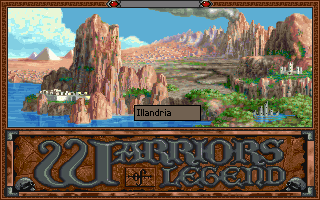
Osric put out a call for heroes, but only four showed up. They were immediately ambushed by agents of Moc Madure, the Dragon Lord, and taken to Madure's fortress. They were about to be executed when one of them, Brand, broke his bonds, and freed the others. They escaped and returned to Osric's capital at Illandria. Here, the game begins.
       
They can head to New Verdigris once they're done here.
    
It's not a bad backstory, though somewhat derivative, and I'm not sure why the capture and escape part were necessary since, functionally, the heroes end up where they started. The proper names (if not their full bios) are mostly drawn from Robert Howard's Conan stories, suggesting that Warriors is meant to exist in the same sort of Hyborian-age setting as Conan. In fact, it wouldn't surprise me if Warriors had started as a sequel to Conan before Synergistic or Virgin lost the license.
 
The game begins with a character creation, or at least character editing, process. The default characters are named Brand, Ataris, Keena, and Astrovir, but the player can re-name them. Each has values from 0-20 in strength, wisdom, intelligence, agility, and stealth. Immediately, there are some issues. The manual says that the game offers five character classes: fighter, wizard, thief, archer, and cleric. Each of these classes has a prime attribute that determines the maximum level the character can achieve. Fighters are governed by strength, thieves by stealth, archers by agility, wizards by intelligence, and clerics by wisdom.
     
The four characters.
    
So far, so good. But the character sheet doesn't otherwise identify a specific class for each character. Instead, the words "Combat," "Clerical," "Sorcery," "Archery," and "Thieving" appear on the right-hand side of the sheet. These are similar but not identical to the supposed five classes. How am I supposed to tell what class each character is? None of the words are highlighted or marked. Clicking on them does nothing. I guess the character is whatever class has the highest attribute? The manual notes that none of the characters is a cleric, but clerical abilities "can be utilized by any of them with high wisdom." But Astrovir has equally high values in intelligence and wisdom. Is he a wizard or cleric? And none of the characters is highest in agility; does that mean I have no archer? What if I adjust the default values, which the game lets you do? Am I changing the character's class? The manual is obtuse about these things, so I just shrugged and went with the default party, figuring I'll at least explore a bit. 
  
The character creation screen.
     
Gameplay begins on an overworld map seen from a side view. The party can choose to go to the city of Illandria, some ruins, the palace, Mt. Gunderbad, and a pyramid. Clicking any of these icons transitions the interface to the classic "studio" perspective used by the World Builder engine, in which the characters seem to be on a stage with no fourth wall. The first time the player visits the map screen, the game automatically selects the city of Illandria and takes the party there, so I guess that's a bit of a hint.
    
The outdoor map.
    
In "studio" view, the exploration window occupies the top two-thirds of the screen. The bottom third has the party members' names, inventories, and character sheets. The selected party member automatically acts as the lead when you move, and the rest follow. You can move with arrow keys or the numberpad, but most interaction is done with the mouse, with only a few keyboard backups.
  
Before I turn it off, I should note that there's some semi-tonal "Arabian"-sounding music, more thematic than melodic, over both the main title and the exploration window. It's credited to Christopher Barker, who also did Conan and the two Excalibur games. It's appropriate to the setting. Sound effects are otherwise relatively sparse, mostly limited to clangs and screams during combat.
      
Entering the city through the southern gate.
    
As we begin to explore the city, we bump into NPCs, and they begin talking to us. Some of them offer some light dialogue options. A few examples:
   
  • An NPC groans about how he has to carry a sack around all the time and can't stop or put it down. "It's like there's some strange force governing my every action." Funny, but it's a little too early in the genre to pretend that NPCs are self-aware. He suggests I talk to Ulg, the crippled sage, and gives me directions to his home.
  • An old man says, "Greetings, kindred spirit." This annoys the party for some reason.
     
Why are all the responses so rude?
      
  • A woman carrying buckets compliments our appearance and suggests we visit her in the Orc's Nest some night.
  • A woman asks for "alms for the poor." We give her a gold piece, and she recommends we visit Sahhar the Seer near King Osric's Palace. 
  • An old man named Crazy Eddy plays a variety of word games with us. First, he asks us a question with all the words in reverse order. We have to respond the same way. Then he puts all his words in alphabetical order, then anagrams them. At the end, he says that if we ever defeat a dragon, we should be careful to search the area before leaving.
    
He spoke to us backwards, so our answer has to be backwards.
   
  • A crotchety old woman says that the passage to Moc Madure's lair is through the great mountain to the north.
      
I don't know if any of the dialogue options are different with different characters selected as the leader. They don't seem to vary.

We also start wandering into buildings, eager for a place that might sell supplies. We started the game with 1000 gold pieces but no weapons or armor. Key buildings aren't marked, so we have to try all of them. We find:
    
  • A temple with a priestess who performs "mana restoration." We don't need it yet.
  • A residence with a woman who's plainly terrified of us.
     
I guess that's a sensible reaction to four warriors bursting through your door.
    
  • An inn where we can sleep for 10 gold.
  • A residence where a man praises us for going after Moc Madure. He tells us that Moc is "more lizard than man" and recommends that we don't try to reason with him.
  • A merchant! He sells steel helms for 20 gold, steel mail for 50 gold, steel shields for 30 gold, and leather versions of those things for 10, 30, and 20. I do some experimenting, and it doesn't seem that the non-warrior characters have any trouble equipping an all-steel kit, so I just buy that for all of them. The interface for buying and selling is a little cumbersome.
    
Keena's kit when we're done. There are spaces for a helm, shield, weapon, armor, boots, necklace, four rings, and whatever the thing in the lower right is.
    
In the next house that I wander into, some guy starts attacking me with a sword. The game switches to its combat interface, which I don't have time to figure out before he kills Keena, and wow do the party members howl when they die.
    
The party members apparently don't know how to fight with their fists.
     
The manual doesn't have a lot to offer on combat, just that you should be able to left-click for a single attack and right-click for continuous attacks. Since no clicking works, I decide that the game won't let us attack without weapons, which turns out to be true. I abandon my previous exploration pattern and start hunting for some place that will sell us weapons.
   
Around this time, I start experiencing another problem: the game won't save. The way it's supposed to work is that you click the "Save" icon, then click one of three save slots, then type a name, then hit ENTER. This works maybe once or twice with every new game, but inevitably I click in the box and it won't let me type anything but spaces, ENTER doesn't work, and there's no way to escape or get out of the box. I'm forced to quit the emulator and reload, losing whatever progress I made in the meantime. It happens so often that I can barely make any progress in the game. I try several DOSBox configurations and several versions of the game with no effect. (No one online seems to have mentioned the problem, but there is very little about the game online at all.) Finally, I re-install a DOSBox version that allows save states, and the rest of this session is dependent on those. I know from experience that they will eventually fail, so I don't know how far I'll be able to get. Suggestions are welcome.
     
There is no way off this screen.
     
I find a general goods store (Timur's Fine Junk), where I buy a lockpick set, some boots, and a couple of empty potion bottles. The merchant also sells knives, but that's not a solution to my weapon problem, as the game regards them as throwing weapons. 
     
The store interface.
     
I'm unable to find a weapons shop, but after a while, I realize that from the southern gate where you enter the city, you can run around the perimeter of the city's walls to three other entrances. 
    
An alternate way into the city.
    
It still takes me a while. The city is chaotic and hard to navigate, and I find myself wishing the game had come with a city map, like Conan did. I pop into places long enough to confirm they're not stores and then leave, ignoring NPCs and fleeing combats. I do find a pawn shop selling Thor's Hammer, but it costs more gold than I have for even one of them. The merchant in Tughril's Armory is maddeningly labeled "weaponer" but only has armor to sell. I ignore numerous shops of other types: potions, scrolls, amulets, inns, pubs. This city is big. I like that, but it shouldn't be this hard to find starting weapons.
      
It's not always easy to tell where you can walk.
    
Finally, I wander into a place called Momo's Weapons. His inventory is a bit unbalanced: he has maces for 30 gold, +3 swords for 725 gold, +4 swords for 850 gold, and +4 bows for 250 gold. No matter—at least he has the maces. I buy four of them, taking us down to 200 gold pieces, and finally settle in for exploring the rest of the city, starting with a return to the south entrance and that first battle.
     
Three very expensive items and a common one.
      
Combat works as advertised: you left-click for one attack and right-click for continuous attacks. Spells will come later, when I find scrolls and ingredients. It takes me a couple of "reloads" (restoring save states) to defeat this guy. On his body, I find a healing potion, a magic potion, and a four-leaf clover.
   
Indoor areas often reward you for clicking on pieces of furniture, tapestries, or other objects. Here, I get 9 carrots (I guess these are also spell reagents) by clicking on a tapestry and 5 bones for clicking on a bookcase. 
   
There are things hidden in the plants to the left.
      
So I guess it goes without saying that this is the sort of game where if you get attacked while burglarizing a private home, you retaliate with deadly force, and you loot anything that you can loot. Conan was like that, anyway. I don't know enough yet to determine whether it's possible to play this game virtuously.
     
A lot of doors have to be picked.
     
I finish this session by exploring the rest of the district accessible from the southern gate. In addition to what I've already described:
   
  • An old man on the street says that he once had a sword made by Momo, and he gives us directions to Momo's Weapons. Goddamn it.
     
Where were you an hour ago?
     
  • Keena picks the lock of a residence where we find a healing potion and a suit of leather armor.
  • A guardroom where a guard, while relating a story about a thief they recently caught with a bunch of keys, instills in us the importance of finding keys to unlock some doors.
  • A residence where a guy named Zamander claims to know our father. "We fought together in the Baythan Wars." He says this to all of us, so I guess we're siblings. He tells us that the sections of town have names, though he only tells us three: the Thieves' Quarter on the west, the Residential Section in the middle, and the Merchants' Quarter to the east. "Unless you're a good fighter, the easiest way to get from one to the other is to leave the city [and] go around." I'm not sure what being a good fighter has to do with it. He also tells us what to expect out in the world: The Black Witch is in the ruins by the lake; Khalimad is in the White Palace; and Moc Madure lives in the volcano.
      
Zamander reminds us about the main quest.
    
  • In a residence, a man named Yuga tells us that there's a band of barbarians in town fighting the Black Circle. "They'd make pudding out of the likes of you."
  • In a residence, a woman named Abaton offers harp lessons and offers to sell us a harp for 100 gold, although I can't find any mechanism to take her up on it. (The dialogue only says, "Maybe I'll pay.") We find 8 serpent eye potions (reagents) on her bookshelf, plus one of those Thor Hammers. It does 30 damage against the 6 done by the mace, so I guess that's better.
     
She also appears to be dancing.
   
  • In a vacant house, we have another fight with a swordsman. He leaves a serpent's eye potion and a rat tail.
  • And another battle in the next residence. He leaves a +1 mace, a knife, and some berries, and his house has some more reagents. 
      
Post-combat looting.
    
  • Haroun's Lotions and Potions offers healing, mana, cure poison, and resurrection potions.
  • In a residence, what appears to be a nude woman lying on a bed complains that she asked "Meethed" to procure 10 men for her and they're supposed to be clean, "and NOT dressed like clowns." 
  • A man named Yarra complains about his lack of fortune lately. He has a potted plant that yields a Mana Ring.
    
To be fair, I did rob him.
     
The dialogue options in these encounters are a little unsatisfying, allowing neither any role-playing nor the ability to have the character speak in a consistent voice. For instance, there's a guard who warns us not to speak to the guy in shackles (actually, a pillory) nearby. "He's a thief." The responses are:
   
  • "Really, that guy's a thief?" This elicits an amusing story about how the guards caught him poking around the king's harem "with a big, stupid grin on his face." The concubines were "all passed out, mumbling 'no more . . . no more . . .'"
  • "He looks like my old alchemy teacher." The guard warns us: "This guy could charm you into thinkin' he was your long lost brother."
    
Not the most interesting dialogue options.
    
Nothing terribly important happens in either case, and nothing stops us from re-engaging the dialogue and selecting the other option. So few games are offering full-sentence dialogues during this era that it's disappointing when one does and then trivializes it.
   
Other than saving, my biggest problem is identifying equipment. Sometimes, when you first pick up an item, it tells you what it is and gives you a little description. I can't figure out for the life of me how to get that same screen to come up once you already have an item in your inventory. Maybe you can't. Maybe if you miss it the first time, you're screwed.
 
Combat is unsatisfying, and if the creators were going to make it this unsatisfying, the least they could have done is give an "everybody attack" button so you don't have to click on the characters individually and then try to get them to click on a moving target who is often hidden behind another character. It also would have been nice to pause.
     
Brand started with only 20 strength.
     
Finally, I don't have a great sense of how character development works. The manual talks about experience and levels, but neither is made explicit on the character sheet. It does seem like strength has increased for a few characters, so perhaps attributes go up directly from exercising the appropriate skills.
     
In short, it's the typical Synergistic combination of interesting ideas with somewhat janky execution. The setting is intriguing, and I enjoy exploring the city, but we'll see if I can even restore the session next time.
   
Time so far: 2 hours