Showing posts sorted by relevance for query Chinese Paladin. Sort by date Show all posts

Monday, December 17, 2018

Game 311: Paladin's Legacy (1989)

         
Paladin's Legacy
United States
Independently developed; published by Sundog Systems
Released 1989 for TRS-80 Color Computer
Date Started: 12 December 2018
Date Ended: 16 December 2018
Total Hours: 9
Difficulty: Moderate (3/5)
Final Rating: 31
Ranking at Time of Posting: 187/314 (60%)

As we've seen before, the TRS-80/Tandy Color Computer was an under-served platform for both RPGs and games in general. To the extent that they marketed it at all, Tandy and Radio Shack marketed it as a primarily business platform. It is unique in that almost every RPG that existed for it existed solely for it; it received no ports of popular titles like Wizardry or Ultima. If you were a Color Computer owner and you liked RPGs, you suffered a lonely, frustrating existence. Only half a dozen RPGs were available to you, and half of them were Ultima clones.
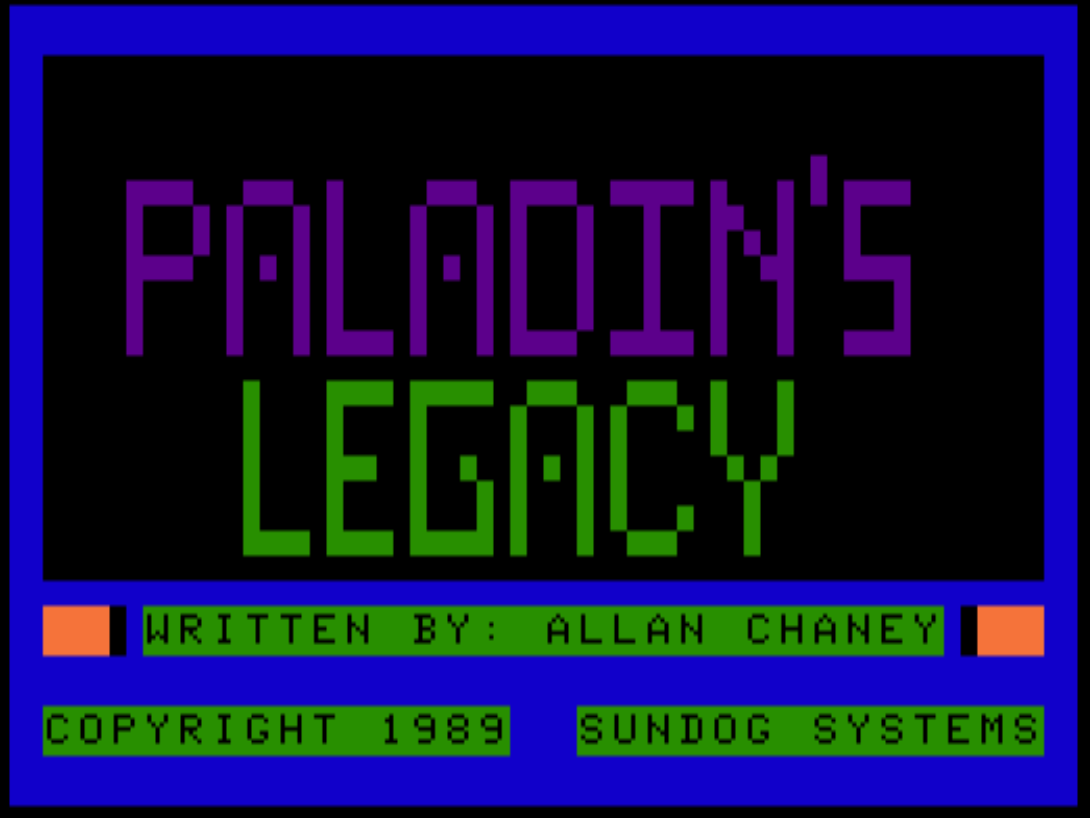
            
Stretching out the introduction gives me space to show both title screens.
           
Paladin's Legacy is one of those Ultima clones, but it's a relatively competent game that feels like it was programmed by an adult. It avoids the mistakes common to many of its contemporaries (1987's Gates of Delirium comes to mind), tells a decent story, and doesn't try to be epic.

The story takes place in the land of Tarinth. The human, dwarf, and elf populations historically left each other alone, but a few hundred years ago, the land came under attack by a mysterious flood of monsters. When everything seemed bleakest, a hero--the titular paladin--appeared and drove back the hordes with his enchanted armor and blade and his mastery of the five schools of magic. The paladin died after a long, mortal life, and he left his equipment in the hands of a mysterious being known as the "keeper."
         
A noblewoman relates some history of the paladin.
        
In the wake of the attack, the three races unified under a central government with councilors and an elected king. Five cities were established to study the different schools of magic that the paladin had wielded. All was at peace. Flash forward to today, when the monsters suddenly appeared again, invaded the castle during a council session, and kidnapped the king. It's time for a new hero to arise and so forth.

It took me a while to get it running, and like most of the time I try to play a game on one of the rarer platforms, we have Adamantyr to thank for this entry. But even with his help, I couldn't get the color settings right. When you first launch the game, it asks whether you have an RGB monitor, and then gives you a color or black-and-white version of the game depending on your answer. All of the color settings looked horrendous to me, so I played the game in black and white. I've seen screenshots in which the color looks better, so I don't know what I had wrong. I apologize for the predominantly black-and-white screenshots below.

The beginning of the game in RGB mode. It makes me want to kill indiscriminately.
The same shot in black-and-white.
        
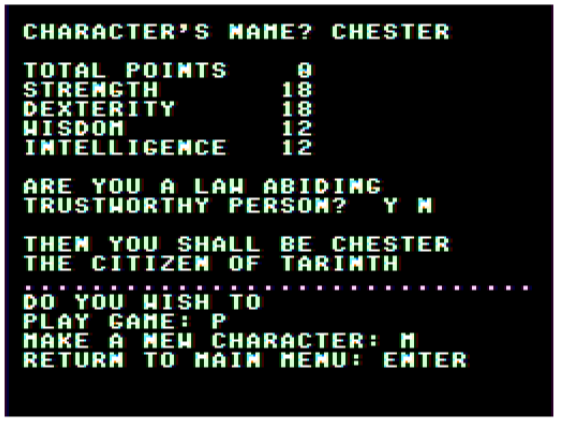
Character creation has you allocate 60 points to four attributes: strength, dexterity, wisdom, and intelligence. You can assign a maximum of 20 and a minimum of 10. The developer remarks on his web site (more below) that wisdom and intelligence aren't even used in the game. This is the title's only major sin, compounded by the fact that you can increase these values in the game, so an unknowing player may actually grind these useless attributes.
            
Character creation.
           
The last question asks whether you're a law-abiding person. Say yes, and you start as "Chester the Citizen." Say no and you start as "Chester the Thief." I'm not sure what difference this makes in gameplay. I tried both options and didn't notice any changes in dialogue or anything.

Gameplay takes place on an 80 x 80 map that I actually mapped, for no really good reason except that I was having trouble counting the squares otherwise. The MESS emulator (or the game) was inconsistent with my inputs, sometimes reading a single arrow press as two and sometimes not reading it at all. The land ultimately has nine cities, a castle, a cathedral, and a dungeon with two entrances. At the beginning of the game, only four cities, the castle, and the cathedral are accessible. Commands are easy to memorize: arrows for movement and obvious keys like (A)ttack, (E)nter, (G)et, and (T)alk for other actions. In an epic example of not reading the manual carefully, I overlooked the (R)estore command and, throughout this experience, rebooted the game from scratch on the occasions I had to reload.
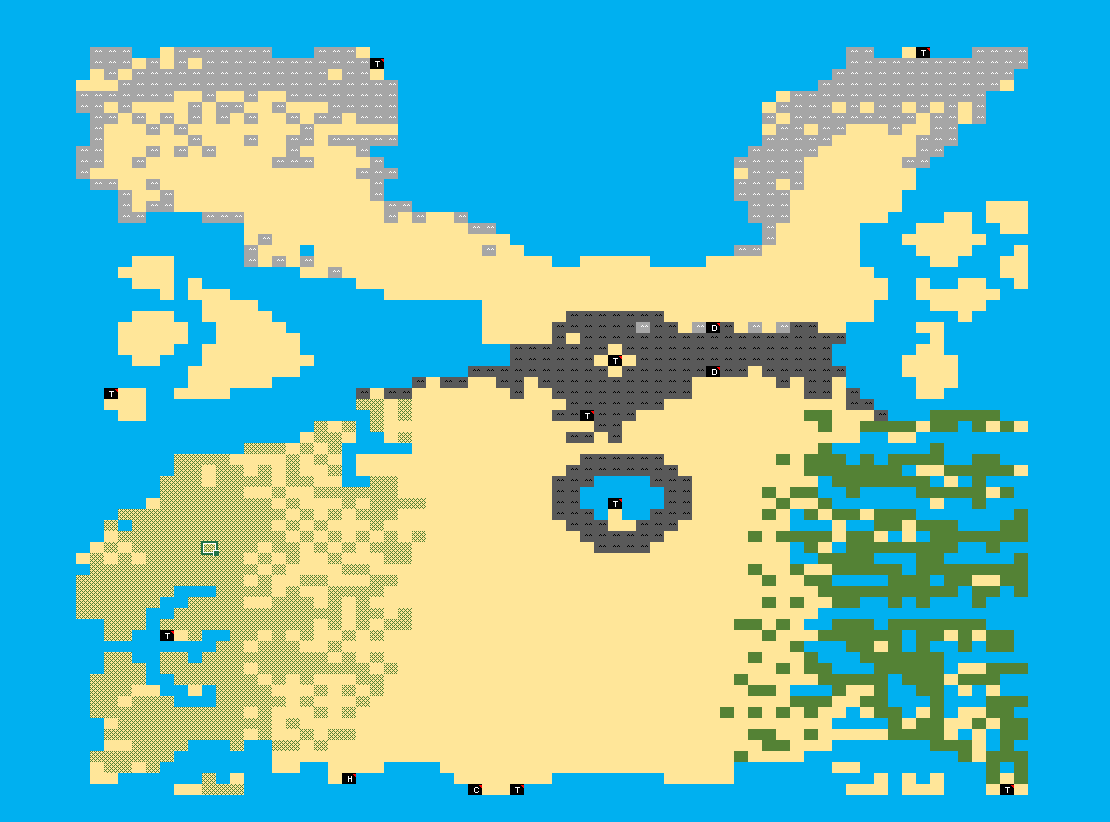
          
The game world.
          
You start with meager resources--250 hit points, 20 gold, and 50 food--but fortunately the beginning of the game isn't so tough. After you buy an affordable weapon and suit of armor, the monsters that roam the land (e.g., orcs, sprites, jackals) are easily slain, and you just have to occasionally pop into town for more food, or into the cathedral for a healing potion. Things get even easier when you find a fairy in the city of Elm who will heal you for free--if you're "pure of heart." A number of things make you impure, including stealing a boat, purchasing thieves' tools, and perhaps starting as a thief, but this condition is easily curable by donating 10 gold pieces "to the poor" at the cathedral.
            
I love how the ankh cross became the all-purpose "religious symbol" of the RPG world.
         
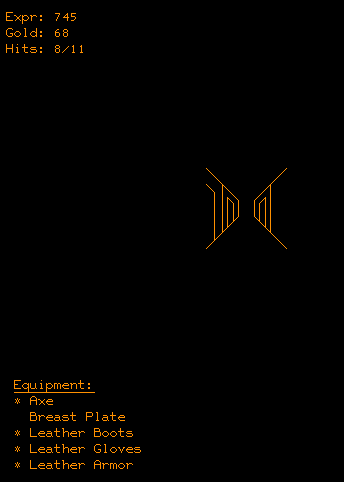
In the castle, the queen will level you up every time you achieve 1000 experience points, which takes about 10 minutes of grinding on the surface and less once you start exploring the dungeons. Leveling up increases maximum hit points by 250. Slowly, you amass more gold, buy better items, and improve your ability to survive for longer periods.
           
A mid-game character sheet.
        
Combat is unfortunately the weakest part of the game. You simply sidle up to a creature and either attack it or wait for it to attack you. You then pass the rounds by mashing the SPACE bar, watching as you trade damage. There's no way to escape, no tactics, and no spells. It all comes down to your attributes and equipment.
          
Battling an orc.
       
Most of the game's length involves circling the land's cities and getting appropriate items and clues. The thieves' guild sells three items that are vital to this process: lock picks for entering the sealed dungeon, climbing gear for crossing mountains, and snow boots for crossing snowy mountains without sliding off in a random direction. With these items, you can cross the mountains in the northern part of the map and visit the remaining cities. A boat is necessary to reach one island town; you can buy one for 1,000 gold pieces or steal one in Tabor Slyth if you find a hidden passage. Late in the game, finding a magic carpet in the dungeon makes travel--which wasn't hard in the first place--a cinch.
           
Climbing gear lets me through the mountains. Note the two entrances to the dungeon.
          
Each city contains around 6-12 NPCs who impart valuable information. The NPCs are more verbose than their counterparts in, say, Ultima II or Ultima III, but there's no complex interaction. At best, you occasionally get a yes or no question. 
            
I get a clue from a thief.
         
The cities and major encounters are:
             
  • New Tear (a possible homage to the Wheel of Time series?), the human city. It has a weapon shop, armor shop, and food shop. An NPC named Bob tells you that trade has been stifled by all the roaming monsters. A thief named Tamara relates how she lost a magical elven torch in the dungeon. John, a sailor, relates finding the city of Optus on a western island.
  • Castle Tarinth. The guards and councilors are abuzz about the recent attacks. Heckel the Historian says that the same type of attack happened 200 years ago, but the paladin was there to defeat the evil creatures. The anguished queen offers to help any hero who will agree to search for her husband.
             
The unnamed queen takes Lord British's role from the Ultima games.
          
  • Elm, the city of elves. Like everyone else, they're upset about the king's kidnapping, saying that he was the only force uniting the lands. Someone saw the king being dragged towards the old dwarven mine.
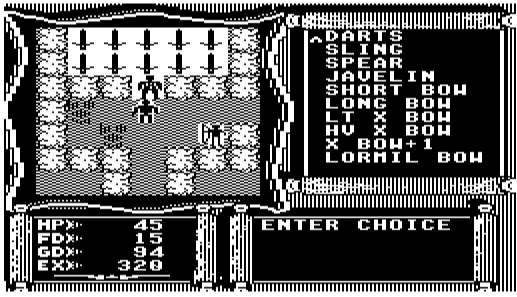
          
The selection at Elm's weapon shop.
         
  • Gindle Frey, city of dwarves. They operated a mine in the mountains until a recent explosion brought evil creatures boiling out of the earth. The mine has six levels, the first four of which the dwarves call the Great Hall, Lake Town, the Maze, and the Treasure Room.
  • Tabor Slyth, the city of thieves. It lies in swamps to the southeast. It exists to sell you crucial items at the guild, and various NPCs give hints as to why they're necessary.
  • Pawn. Locals call it the "city of perfection." It is nestled in the mountains and reachable only with climbing gear. The inhabitants study the laws of magic. A Master Gulin created a teleportation ring but it was stolen by a thief. Master Reed gives the player the Scroll of Magic if he agrees to seek the king.
  • Mendoris, city of the Eternal Flame, also surrounded by mountains. The inhabitants study wizardry, which deals with the control of demonic beings. The player learns that he can control demons if he learns their names. A quick trial (involving stepping into flames) brings the player to Master Veltic, who offers the Scroll of Wizardry and gives the name of the evil demon threatening the lands as ASHTALAM.
          
A key piece of intelligence.
          
  • Tardis. The city is on the northeast coast, surrounded by snowy mountains. The player needs snow boots or a boat to reach it. The inhabitants study thaumaturgy and the manipulation of gravitational fields. The player learns of the magic carpet and receives the Scroll of Thaumaturgy.
             
Each of the scrolls can be read for hints about the endgame. You don't really need them, however.
          
  • Amber. On the northwest coast, also accessible only with snow boots or a boat. The citizens study alchemy and tell of a potion called Aqua Regia, which dissolves any metal. The player receives the Scroll of Alchemy.
  • Optus, the island city, where the citizens study the "maxim of inner sight." The player receives the Scroll of Sorcery and learns of the Sorcerer's Eye, an artifact that allows for seeing great distances.
           
Each of the three "race" towns (New Tear, Elm, and Gindle Frey) sells special weapons and armor fashioned in race-specific ways. In New Tear, the humans are proud of their inventions of polymers; in Elm, the elves talk of wood from the rare Lormil tree; and in Gindle Frey, the dwarves fashion items from Galvamite ore. Ultimately, I think the best items are Synthetic armor from New Tear and either the Lormil Bow or the Galvamite Axe, but in all cases the items costs thousands of gold pieces and it takes several trips to the dungeon to finance an entire set. I should also mention that you can wear four pieces of armor: the main suit, a helm, gauntlets, and a shield, each piece found in different towns.
          
 A dwarf brags about his materials.
        
There is only one dungeon in the game--the aforementioned dwarven mines--accessible from either side of the central mountains with some lockpicks. The dungeon has creatures much harder than the surface, including balrons, pinchers, vampires, and stalkers, some of which can knock away 1,000 hit points in a single battle even with the best equipment. Carrying a stock of healing potions from the cathedral is vital when exploring the dungeon.
           
These guys are particularly hard.
         
The game gets a lot easier once you grow tough enough to penetrate to the dungeon's fourth level, where you find copious treasure chests. Chests can contain gold, food, attribute increases, and artifact items--including the magic carpet, the elven torch (which allows you to see in a greater radius), the teleportation ring (which allows you to move two squares in any direction), the Aqua Regia, the Sorcerer's Eye, and an invisibility cloak. Chests (and enemies) respawn when you leave a level and return, so you can grind gold and attributes to epic levels.
          
Finding the magic carpet while a "stalker" waits to attack.
           
The endgame commences on Level 5 of the dungeon. I was able to win, just barely, at character Level 15, with strength and dexterity boosted to about 60 and all the best equipment. There's a water level where you sail a boat around and teleport through a wall (using the ring) to get the Aqua Regia. You then sail into Level 6, where there's a maze. The Sorcerer's Eye helps.
            
The levels are small enough that the Eye isn't strictly necessary, but it helps.
            
At the end of the maze is a battle with balrons and dragons that taxed my healing potion reserves. Once they're dead, an iron golem refuses to let you enter a building. The Aqua Regia takes care of him.
             
If Gandalf had carried acid at this moment, the entire film series would have gone differently.

Wow, I thought golems were non-sentient. I feel bad now.
           
On the other side of the golem is a maze with more balrons and dragons. At the end, you meet the "keeper," who will allow you to pass through the gate to the Nether Region if you have the five magical scrolls. He warns that you can't take any of your items (this is a good time to suck down the rest of your healing potions), but he gives you the paladin's armor and sword to take with you.
             
Yeah, I'd better reload and drink some healing potions first.
            
On the other side of the gate is a maze of fire, where you take damage if you step off the path and into the flames--which I did constantly thanks to the key lag problems I discussed above.
In retrospect, it was probably a bad idea to try to save there.
         
Eventually, you find the entrance to a "city."
              
Classic overlord smack talk.
          
As you explore the small city, Ashtalam's voice taunts you as balrons and dragons attack. It occurred to me that the invisibility cloak might have been useful at some point, but I never thought to put it on. Eventually, you make your way to Ashtalam's chambers. He tells you that he's killed the king and says he's going to do the same to you.
             
This was a blow.

      
You have to push your way up to him as he blasts you with energy, and once you're adjacent to him, you use "The Word" to say his name.
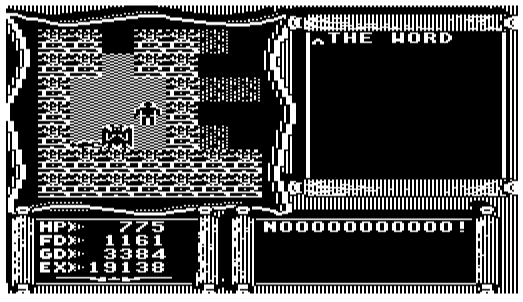
             
Chinese subtitle: "Do not want!" (Did I already make that joke somewhere? I feel like I did.)
            
The endgame text is such:
          
Thanks to you, the demon Ashtalam is no more. He presently resides in the eternal abyss. He was sentenced by higher authorities to spend several lifetimes in torment. His losses on this campaign were outrageous, and therefore much payment is due. Because of your great deeds, you have been chosen by the people to be the king and protector of Tarinth. The queen, though burdened with sorrow from the loss of her husband, has agreed to tutor you in the laws of the land. Once again the 3 nations are united. The people will undoubtedly prosper from new avenues of trade. You are the paladin king!
            
You're teleported back to the castle, and you get to wander the land with a fancy new icon. The queen has some new dialogue, but unfortunately no one else seems to.
              
My heroic new icon talks to the queen.
           
Paladin's Legacy earns a 31 in the GIMLET. The back story is solid and well-referenced throughout the game (4), it makes good use of Ultima-style NPCs (4), and it has a tight and continually-rewarding economy (5). It also does well in the "gameplay" category (5) for its moderate length, medium difficulty, and quasi-nonlinearity. The keyboard-based interface is easy to use (any game that maps each action to a separate key will always get a high score here), but the graphics and sound are only just adequate (3). Combat is the weakest category (1), particularly since the game has no magic system, and everything else is in the 2s and 3s.
           
Thankfully, approaching the castle isn't this hard in-game.
           
Paladin's Legacy was written by Allan Chaney, who maintains a site devoted to the game. Although I said that the game "feels like it was programmed by an adult," Chaney was in fact in high school when he began writing the game--then called Quest for the King of Zandor--in BASIC. A classmate helped him convert it to assembly code. Chaney shopped the game to several publishers before Sundog Systems--a Pittsburgh, Pennsylvania-based company operating out of a residential address--agreed to sell it. Chaney reports that sales were good "for about 4 months and then the Color Computer market collapsed and sales stopped." 
              
Sundog had a small catalog of games, but no other RPGs.
           
Chaney cites Ultima and Richard Garriott as his primary inspirations, although some of the navigation obstacles make me wonder if he also played Questron. He notes he was "horrified to find that there were no games like Ultima for the Tandy Color Computer," and that he probably wouldn't have bothered making Paladin's Legacy if Ultima had ever received a Color Computer port.

I left a message on Chaney's site, and I hope it might draw him here for some further comments. Otherwise, we move on to another Ultima clone for the Color Computer, The Seventh Link. It's worth noting that with the completion of this game, all games that appear at the bottom of my "upcoming" list from now on will be from the same list. (Yes, I still have to go back and clean up some pre-1992 discoveries, but we'll talk about that when I get finished with Zerg.) I'm suddenly feeling all kinds of momentum.


Monday, October 7, 2013

Game 12: Oubliette (1977)

Seeing an iPhone reference on this screen is a bit surreal.

In a week or so, U.S. CRPG addicts will celebrate Columbus Day (or maybe not; it's become a bit un-PC over the last couple of decades), which commemorates Christopher Columbus's discovery of the Americas on 12 October 1492. Armchair historians will spit out their Cocoa-Puffs in protest at the last sentence, bellowing semi-coherent phrases about the Norse, Leif Ericson, John Cabot, St. Brendan, and perhaps the Chinese. But whether earlier explorers reached the New World before Columbus, or whether Columbus even had the vaguest notion where he was, doesn't really matter. None of the earlier voyages "took." Though Columbus's voyages were flawed to the point of being comical if not for such horrific consequences to the indigenous populations, it was incontrovertibly his trips that led to the widespread knowledge of the Americas in Europe, launching the Age of Exploration. Hence, we give Columbus the credit for "discovering" America, at least from the European point of view.

By the same vein, we give PLATO the credit for the "first CRPGs," even though we don't have any evidence that this is the case. For all we know, hordes of eager young programmers were building dungeons and simulating combat rolls on IBM 5100s within months of the release of the original D&D booklets in 1974. Perhaps the researchers over at PARC created multi-user dungeons on their Xerox Altos before the first line of code of pedit5 or the elusive m199h was ever typed. But if these games existed, they were the equivalent of L'Anse aux Meadows: they didn't "take." No one remembers them, and they left no legacy.

PLATO, as a series of multi-user mainframes intended specifically to connect and educate young people, was in a much better position to develop the progenitors of the CRPG genre, and of course it did. The original Dungeon/pedit 5 led directly to The Game of Dungeons/dnd, which in turn led to a series of commercial top-down dungeon crawlers (developed off-PLATO) with random encounters. PLATO's MUDs (multi-user dungeons) are the direct ancestors of today's MMORPGs. But perhaps most important for our current purposes, the multi-character game called Oubliette inspired Wizardry, which in turn inspired Might & Magic, The Bard's Tale, Dungeon Master, and even Ultima III.

I was going to wait for my book to offer any more reviews of the PLATO games, but circumstances essentially demanded that I say something about PLATO this week because I'm here, at the University of Illinois at Urbana-Champaign, teaching a class on the same campus where it all began.

None of my professional colleagues understood why I was so excited to see this old terminal, and I couldn't explain it to them.

Moreover, I'm about to begin Wizardry VI, which starts a new generation of the franchise born 35 years ago, and...well, let's just say that some other Wizardry stuff is happening that we'll discuss later in the season. It was a good time to go back to the origins.

I've touched upon Oubliette before, in a December 2011 post about the PLATO series, and a brief July 2010 post in which I played (but didn't score) the 1983 DOS version. On PLATO, the game was continually developed between 1977 and 1982 (and at least some edits have been made as late as the current year), so I don't know how much of what I'm about to describe is from the original 1977 version.

An equipped character heads down the corridors.

Unlike the 1983 version, the original Oubliette is a multiplayer game--a shared environment, including a castle (Ligne Castle) and dungeon, in which multiple users can meet in a tavern and form parties for dungeon exploration. (A single character can adventure by himself, but it's deadly.) The amount of detail in the game is astonishing for the era in which it was created. It includes:

  • 15 character races: human, elf, dwarf, half-dwarf, half-elf, hobbit, orc, Uruk-hai, ogre, pixie, goblin, hobgoblin, kobold, Ur-vile, and Eldar elf. A cute mix of Lord of the Rings, Dungeons & Dragons, and the Thomas Covenant series.
  • 15 character classes: cleric, demondim, courtesan, hirebrand (fighter), mage, minstrel, ninja, paladin, peasant, ranger, raver, thief, sage, samurai, and valkyrie, the choice of which is dependent on minimum attribute rolls. Demondims and ravers also come from Covenant, though they aren't really classes.

The game's classes and prime requisites.

  • A fully explorable main castle of 841 squares, with various types of shops, taverns, hotels, and temples.

The castle, which I--for some reason--took the time to map.

  • The ability to retrieve and resurrect slain characters. 
  • Perhaps the first gambling mini-games in a CRPG, with choices for blackjack, craps, and a "roachrace."


  • A great selection of equipment, with the ability to simultaneously wield weapons, armor, shields, helmets, gloves, boots, cloaks, rings, and other items, both magical and non-magical.
  • An extremely detailed spell system. Each spell has an arcane name comprised of consistent syllables. There are seven levels of spells and spellcasters get additional slots as they gain experience. If this is sounding a lot like Wizardry, keep reading.

The spell list, from the in-game documentation.

  • Dozens of monsters, most unapologetically drawn from the D&D list, to which the game refers you for questions about both monsters and equipment.
  • The ability to bring a "hireling" into the dungeon with you, purchasable at various amounts from all of the game's monster classes.

Buying a robber as a hireling.

Add these elements to the game's cooperative multiplayer and chat abilities, and we've got a game that's well ahead of its time.

Character creation is a relatively simple process of selecting a race, rolling the standard D&D list of attributes, and choosing a class based on the roll.

Rolling a new character.

After character creation, you find yourself on the safe castle level, where you can spend your meager starting gold pieces on some equipment (weapons, armor, torches), try to gamble them for more, or visit a tavern to join up with a party. After that, it's to the dungeons and its random encounters with both enemies and treasures. Movement is through the WASD keys, and most of the other keys have some sort of specific option, varying by capital and lower case, such as assigning (E)quipment and (I)gniting a torch.

Surviving a trip to the dungeon allows you to spend accumulated gold on more advanced equipment at the magic shop, potions, healing, and hirelings, some of which are extremely expensive. You can also join a guild specific to your character class--necessary if you want to level up.

Beginning adventurers start with 50-100 gold pieces It will take a while before I can buy anything here, but I like the idea that money always has value.

If your character dies, he can be found, returned to the town, and resurrected by another adventurer (or dumped in the morgue)--or you can delete and start over.

I found these guys two steps from the entrance but lacked any money to raise them.

The game essentially assumes that you'll adventure with a party. It's not impossible to win a few combats as a sole champion, but it is quite difficult. When you enter combat, you're presented with a screen listing your foes. When it's your turn, the word "Options" flashes, and you have a few seconds to fight, parry, cast a spell, hide, evade, use an item, or use special abilities such as the courtesan's seduction, the bard's charming, and the cleric's dispel. When the foes are defeated, you divide the experience and treasure.

Fighting a gang of thieves.

Each party has a "leader" who controls the party's movements; other party members can basically just wait for fights and hit the combat keys. As such, it seems a little boring to go with a party, but still quite impressive for the era in which it was created. Since there were only a handful of adventurers on Cyber1 each time I logged in, I wasn't able to find any active people to join a party. I focused on building up my own character and using hirelings, but I wasn't able to get very far in the dungeon.

As far as I can tell, there's no way to "win" Oubliette, though there are hints of a greater complexity to the gameplay that I haven't been able to experience. For instance, there's a jail where you can look for other players, though I don't know what they do to get there. There's a temple where you can donate a lot of money for an audience with the high priest. There's a building called the "Ghenghis Army Recruiters" where I only get a message saying that it's closed because of loss of federal funding (did this message just appear this week?).

Oubliette's primary creator was Jim Schwaiger, apparently inspired by a previous game called either Moria or Mines of Moria (having nothing to do with the later roguelike), which I've been unable to play. In 1983, through a company called Bear Systems, Schwaiger and programmer Victor Helsing tried to market a commercial version of the program for DOS and the Commodore 64.

I'm going to go with "rite of passage."

Lacking the full power of the PLATO mainframe, the 1983 version strips some of its features. Ligne Castle is a menu rather than a fully-explorable environment, and some of the locations (like gambling) are gone. Races and classes specific to either Tolkien or Thomas Covenant were stripped. Characters join guilds immediately on creation and either graduate with enhanced abilities (and age) or die.

Most important, the game is no longer multiplayer. Rather, a single player controls up to six party members at once. Dungeon exploration has both top-down and first-person options.

Crawling through the dungeon with a re-engineered interface and a five-character party.

Beyond that, the basic gameplay is the same: descend into the dungeon, survive as long as you can, rotate slain party members for fresh ones. There's still no main quest or overarching goal.

Let's consider the extent to which Oubliette influenced Wizardry. In a history of the PLATO games, and particularly dnd, available only on Cyber1, dnd contributor Dirk Pellet has this to say:

Sometime around 1977, Robert J. Woodhead (who was non-affectionately known on PLATO as "Balsabrain") through means unknown to the dnd authors, obtained a copy of the source code to the current version of dnd (probably 6.0 or 7.0). He "created" "his" own game from it, in a file called "sorcery." It had essentially all the same features of dnd except the messages, monsters, and magic items had different names and pictures (although identical functions). Apparently the illicit copy hadn't included the charset. The elven boots were socks, among other alterations.

When the dnd authors were informed of the existence of Woodhead's copy, and took a look at it (including looking at the source code in a monitor mode with a concerned sysop), the copy was promptly deleted, and Balsabrain learned that if he wanted to plagiarize PLATO games, he would have to do it OFF of PLATO. He put that lesson to use by plagiarizing Oubliette when he "created" "his" game of Wizardry and began to market it.

I've referred to these claims in past postings, and I've declined to offer a serious opinion, but I'll try to now. First, it's obvious that Oubliette did significantly influence Wizardry. Points of similarity (excluding those obviously adapted from D&D) include:

  • The overall structure of the game, with a castle and shops on top and a first-person wireframe dungeon below
  • The specific types of shops and visitable locations on the castle level
  • The system of rolling attributes first, then determining the character class
  • The basic combat system
  • Some identical spell names and root syllables, identical spell effects, and the basic spell "slot" system
  • The traps associated with chests found in the dungeon, which are exactly the same in both games
  • Some of the character classes (I don't think samurais and ninjas were common RPG classes at the time)
  • Permadeath and the ability to retrieve slain characters in the dungeon
  • Raising in temples having a chance to fail, based on the character's constitution
  • The ability to rest in an inn to slowly restore hit points
  • Secret doors found by simply walking through a wall as if it was a regular door

At the same time, Woodhead and Andrew Greenberg (who, according to numerous sources, was also on PLATO) introduced a ton of material not found in Oubliette, not the least of which is an actual plot and quest, plus associated dialogue options, special encounters, and NPCs in the dungeons. Oubliette has only random encounters in its dungeon levels; Wizardry has numerous fixed encounters. Wizardry also features some different spells and slightly varying combat options, a system of item identification, and different enemies with special attacks. Perhaps most important, a single player controls multiple party members in Wizardry, which appears to be the first time this happened in any CRPG, unless the 1983 version of Oubliette was based on a prior PLATO version now lost.

Nonetheless, it seems clear to me that the Wizardry developers started with an Oubliette paradigm and worked from there, and certain aspects, like the spell names and trap system, can legitimately be seen as "plagiarism." What is damning is that Wizardry gives no credit to Schwaiger or Oubliette--no acknowledgement, no mention in the manual, not even a sly wink with the name of a monster or NPC. It was probably this that most raised Pellet's hackles. In an era where the makers of Questron decided to license the "look and feel" of Ultima from Richard Garriott, Woodhead and Greenberg's failure to even tip a hat to the PLATO game is slightly unforgivable. (Of course, we can't discount the possibility that they did make such an acknowledgement in a source now lost to us.) There's a poorly-sourced quote floating about that says that Robert Woodhead posted on Slashdot back in 2001, saying "Wizardry was in many ways our attempt to see if we could write a single-player game as cool as the PLATO dungeon games and cram it into a tiny machine like the Apple II." If this quote is true, his failure to mention Oubliette specifically seems like an extension of his original disservice.

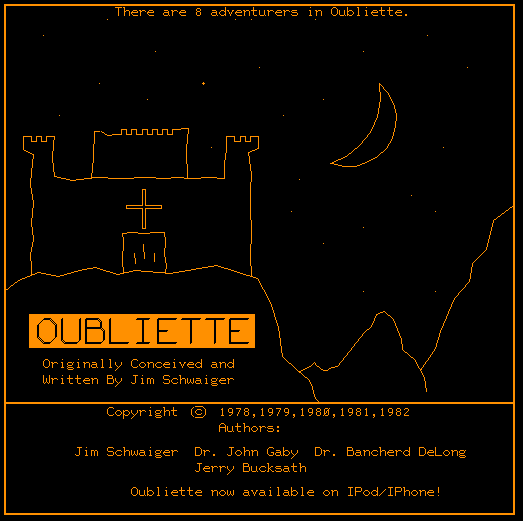
The welcome screen from the iPhone version of Oubliette.

Oubliette lives on. Schwaiger (now a radiologist) and co-creator John Gaby (a PhD/software developer) created an iPhone and Android versions through Gaby's company, GabySoft, in 2010. I downloaded the free version the other day and have had a lot of fun with it so far, finding the controls much more intuitive than the iPhone version of NetHack. (In general, the size of the iPhone screen supports first-person exploration much better than top-down.) It appears to be based on the 1983 version of the game, and in every way that I've discovered so far, it implements the same rules, just with much nicer graphics.

Fighting spiders in the dungeon.

For GIMLET purposes, the PLATO, DOS, and iPhone versions of Oubliette should probably be considered separate games, but I'm going to try to rate them all at once, noting a few variances:

  • 1 base point for the game world in the PLATO version, which gives you only the name of the world and its castle. The DOS version would get 2 for having more of a story about Tokal being a harsh and cruel place, and a great wizard named Ligne establishing the one civilized outpost.
  • 5 points for character creation and development. Experience and leveling is basic D&D-derived stuff, but the great selection of classes and races, and the ability to join a guild, put it above its competition in the era.
  • I don't know exactly how to rate NPC Interaction in a MUD. Technically, those people are "PCs," though I suppose each PC is an NPC to each other. Since it doesn't advanced the "plot" to talk to them, let's call it a 3, which partly reflects the ability to bring hirelings aboard. There are no NPCs or hirelings in the non-PLATO versions, so it would be 0 for them.

I did find two characters in a tavern at one point, but both of their users were offline.

  • 3 points for encounters and foes. There are no RPG encounters, but the enemies are varied and have special attacks and defenses that I didn't get to fully explore.

A table of some of the game's monsters. Everything in this game is well-documented.

  • 4 points for magic and combat, perhaps 6 for the DOS version where you control six characters and can explore all the options. The nature of combat varies considerably depending on whether you're a fighter or mage. If you are a mage, the mage spell selection is sufficiently eclectic and powerful.
  • 5 points for equipment. You've got weapons, helms, cloaks, boots, armor, torches, potions, and other items to buy or find. Very sophisticated for an early RPG. The game offers no information about them, however, simply referring the player to the D&D guides.

Purchasing items at the general store.

  • 4 points for economy. Gold is very valuable, but the economy isn't well-balanced. There's a huge gap between affording basic equipment and affording magic equipment or good hirelings.
  • 0 points for quests. The lack of a main quest is the major failing of this game and one of the reasons I didn't bother to play beyond a couple of levels. There are doubtless some players who enjoy the open-ended nature of games like this and Telengard, but "just play it and enjoy it" is not attractive to me. I want a mission and a defined endpoint. [Later edit: Based on a commenter's report, it appears that the iOS version might have a main quest and several "boss-enemy" sub-quests on each level. I'm primarily rating the 1977 version here, so that doesn't change the overall GIMLET, but it's welcome intelligence.]
  • 2 points for graphics, sound, and interface. The graphics are wireframe primitive, and there is no sound in any version except the iPhone one, where it would get an additional 2 points. I don't like the controls very much in any version.
  • 4 points for gameplay. Though very difficult, the game benefits from nonlinearity, replayability, and the different experiences it offers to different characters or combinations of characters.

This gives a final score of 31 for the PLATO and DOS versions (though different combinations) and 33 for the iPhone version [later edit: the iOS version might go up to 36 if there are quests]. This is the highest of any PLATO game so far, and the highest of any game at all prior to 1981, when its child, Wizardry, would trump it with slightly better encounters, NPCs, combat, and of course a main quest.


The rating might be higher or lower if I had experienced more of the game. Among other things, I barely touched upon spells. But with no main quest and such a steep difficulty curve, I just don't have any more time to devote to it. I'm satisfied that I've seen the elements that inspired Wizardry, and glad I got to stand in front of a PLATO terminal in person. Now, it's back to Massachusetts and on to Wizardry VI.

*****

Note: Why "Game 12" instead of "Game 120?" Did the CRPG Addict forget a 0? No. During my first pass, I somehow miscounted and skipped right from Game 11 to Game 13. Rather than keep listing that game as "The Quest to Solve Chester's Problem with Counting," I'm claiming that space for Oubliette, which I originally played in its DOS version around that time anyway, and would have given a proper number and GIMLET if I had been thinking.