Showing posts sorted by relevance for query Buck Rogers: Countdown to Doomsday. Sort by date Show all posts

Friday, December 27, 2013

Buck Rogers: Countdown to Doomsday: Final Rating


Buck Rogers: Countdown to Doomsday
United States
Strategic Simulations, Inc. (developer and publisher)
Released 1990 for Amiga, C64, and DOS; 1991 for Sega Genesis
Date Started: 7 December 2013
Date Ended: 24 December 2013
Total Hours: 18
Difficulty: Moderate (3/5)
Final Rating: 46
Ranking at Time of Posting: 102/123 (83%)
Ranking at Game #455: 411/455 (90%)

I wonder how my opinion of this game would vary had I ever watched the Buck Rogers TV shows or film serials or read the comics or books. Lacking any of this history, I didn't feel particularly invested in the setting, and I couldn't fill in the edges of the game with a solid understanding of the oeuvre.

It seems like a strange setting for a role-playing game, mostly because the franchise doesn't seem to be about the setting so much as Buck Rogers himself. The world, its factions, and its technologies have changed quite significantly from the franchise's inceptions, but the core appeal seems to be the fish-out-of-water story in which Buck, a man from our time and with our values, has to adapt to a very different world--or make it adapt to him. A role-playing game has to allow for other characters within this world--characters who aren't part of the same dynamic. For those characters, then, the setting is what really matters, and I found Buck Rogers to be a little anemic in this area. Sure, it has futuristic weapons and space travel and whatnot, but it lacks a real "core" to its mythology and technology.

It seems clear that the role-playing game only came about because Lorraine Williams ran TSR and owned the rights to the Buck Rogers franchise at the same time. When the tabletop RPG was issued in 1988, the television series had been off the air for seven years and it had featured a different universe anyway. I wonder how much of a market there really was for a generic sci-fi RPG in which the titular character was, at best, an NPC. I'm having trouble finding any information on how well the tabletop RPG was received at the time, but modern reviews are lukewarm at best. Blogger Julian Perez notes quite fairly that:

It's not like the character has a built-in fanbase the way Indiana Jones or the Marvel superheroes have. Buck Rogers is one of those characters, along with Paul Bunyan, where everybody's heard of him, but nobody really cares about him.

In short, it was an odd choice for an RPG and thus an odd choice for a computer game based on the RPG. Almost everything I liked about the game was due to the Gold Box engine rather than anything specific to Buck Rogers. Even in the few episodes in which Buck Rogers appeared, he seemed like a boring character. For this reason, I expect the GIMLET to come out a bit below the D&D Gold Box titles. (Check out my final ratings of Curse of the Azure Bonds or Champions of Krynn for comparison.)

I thought Buck Rogers was supposed to be something like a reckless cowboy. This is just embarrassing.

1. Game World. I spent most of the above paragraphs discussing this, so I won't belabor it here. I praise it for offering a thorough back story with some original elements, but I criticize it for being a somewhat boring setting without terribly interesting technologies. The one exception is the "digital personalities" who were not well-described or integrated into the game. I never even got to directly encounter the putative bad guy, Holzerhein. Score: 5.

2. Character Creation and Development. We're basically looking at the standard AD&D system with different races and classes plus the addition of various skills. The skills were not particularly well-implemented. Too many of the important-sounding ones were never used, or were used only once in the game, with success or failure dependent on a single roll, with no option to try again. I'm a bit baffled why the franchise doesn't feature more weapon-specific skills (the warrior gets some weapon proficiencies, but no one else does). Despite the game's assurance that I would find "etiquette," "sing," "fast talk," and "act" useful at various bars and such, I never encountered any use for them. Ditto "tracking," "shadowing," "repair weapon," and "mathematics." I don't doubt that there were individual occasions in which they were helpful, and perhaps I just missed them, but the point is that skills that require so much investment but come into play only once or twice in the game are somewhat useless.

In general, the lack of spellcasting or other special abilities (e.g., turn undead) makes the AD&D system poorly-suited to this setting, and the skills don't compensate for it. I also only found one place in the game (the Desert Runners' village) in which the choice of race, sex, or class made any difference. Score: 4.

3. NPC Interaction. Not bad. There are some NPCs who join you at various points in the game, including Buck Rogers himself. Some of them, like the Sun King, are memorable. There are a few locations in which you can have almost entire conversations with NPCs, with dialogue options that offer role-playing choices, and significant consequences for the party in terms of how the subsequent maps progress. Score: 5.

I rather hope he was caught in the explosion.

4. Encounters and Foes. Like many of the other Gold Box games, Buck Rogers does a reasonably good job offering frequent encounters with some light role-playing choices. Some of the choices are pretty obvious (save the children from drowning or walk away) but still better than nothing.

I didn't love the enemies offered by the game. There aren't many different types, and lacking spells and (with one or two exceptions) special attacks, they mostly appear to me as a series of faceless mooks. There aren't many ways to adjust tactics and strategy to specific enemies. On the plus side, there's a good balance between random and fixed encounters, and plenty of opportunities for grinding. Score: 5.

The Gold Box games are some of the few to offer options like this.
 
5. Magic and Combat. As I discussed extensively a few posts ago, the Gold Box engine remains a great tactical combat engine, but this game doesn't offer enough options and equipment to benefit from the engine's full capabilities. You understand that I'm not suggesting that a science-fiction RPG ought to feature spells, but rather that both the AD&D rules and the Gold Box engine are optimized for a world in which spells exist. Their absence in a sci-fi RPG is entirely sensible, but the game needed to offer something else in replacement, such as more special equipment or more options with the weapons.

The one real tactic in Buck Rogers is the ability to shape the terrain with chaff grenades and aerosol mist grenades. For 99% of the game, I didn't understand how they worked properly and missed out on those options. It makes me feel a little better about the game but not great.

Space combat is an interesting addition to the engine, and I think it works better here than in most of the other sci-fi RPGs we've seen on the blog, but it's still not a great system. The options are too few and the course of each battle is too predictable. Score: 4.

The enemies always threw the defensive grenades on themselves. I didn't know that wasn't how you were supposed to do it.

6. Equipment. Also a bit disappointing. There are a sensible variety of weapons and a small selection of armor and accessories (e.g., goggles that protect against dazzle grenades). Again, since this is a sci-fi RPG, I didn't expect scrolls, wands, potions, and whatnot--but I did expect some analogous replacements, and they just weren't there. What about force fields to protect against explosive weapons? Gravity boots to compensate for low "Maneuver in Zero-G" skills? Stims to temporarily increase attributes? Med kits? Ship upgrades? With some more thought into equipment, the game could have compensated for the otherwise-limited tactics dictated by the loss of spells. There also aren't any cool "artifact" weapons or any major equipment-related rewards for quests and tough combats. The lack of imagination in this area is a little baffling. Score: 3.

I wish every game had a table like this.

7. Economy. I hold out hope that one day the Gold Box series will get it right, but this game didn't even come close. There was absolutely no purpose to either of the dual-economies that the game offered, mostly because none of the stores sold any equipment worth buying. Every battle produced more and more credits, and they only thing I ever spent them on were some ammo reloads and an occasional drink. Salvage credits, which you get from space combat, are similarly worthless because everything they buy you can get for free on the Salvation base. Score: 2.

8. Quests. The game excels here. The main quest to destroy RAM's doomsday device is suitably epic and features enough original elements that I was always interested to see the plot unfold. There are no options for the quest's end, but there are plenty of options as to how you approach each of the key maps and the decisions you make at each stage. I liked that you could approach each of the three main stages (the Mars base, the Venus base, and the asteroid base) in any order. I particularly liked the large number of side-quests, and judging by the walkthroughs I consulted post-game, I didn't get to experience more than half of them. The SSI Gold Box games remain some of the few of the era to offer true side quests. Score: 6.

I love the juxtaposition. "You must save the children from the fire. In the meantime, have a cocktail."

9. Graphics, Sound, and Inputs. All quite good. The cut scene graphics in the series continue to get better and more artfully composed, and the enemy and party icons were better than we typically see in the D&D games. The corridors remain bland and featureless. The sound was good enough that I didn't turn it off. The keyboard interface remains very easy and intuitive. Score: 6.

I wish the text in the game had offered as compelling an atmosphere as the images.

10. Gameplay. The game was almost the perfect length, and although I eventually found combat a little boring, I can't say I was ever bored with the game overall. Between the opening sections on Earth and the endgame on Mercury, there was a satisfying non-linearity, and the side-quests give it some additional replayability. Though I was frustrated by a few tough combats, on the whole the difficultly level was pitched just right. Score: 6.

The final score of 46 sits 14 points below Curse of the Azure Bonds and 10 points below Champions of Krynn. As I said before, most of my satisfaction with the game comes from the Gold Box engine itself, but this setting didn't make the best use of that engine, and it simply doesn't strike me as a great setting for an RPG in the first place.

I'm not the only one to think so: even SSI seems to have had some qualms. In Dungeons and Desktops, Matt Barton quotes SSI technical director Keith Brors as saying that "the company was pressured by TSR into developing their Buck Rogers computer game against their better judgment." Barton praises certain innovations in the game, like the skill system and the weapons logistics, but I found both to be good ideas that were poorly-implemented.


In 1992, we'll see the story continue in Buck Rogers: Matrix Cubed, which only came out for DOS and apparently got quite poor reviews. I'll try to avoid learning anything else about it before I play.

Next, we'll check out the Hellfire Warrior adaption of the Dunjonquest engine before I have to head back to my Amiga emulator for Lords of Chaos.


Monday, September 7, 2020

Buck Rogers: Matrix Cubed: Won! (with Summary and Rating)

There's little that's more cringy than people actually saying, "hip-hip-hooray."
          
Buck Rogers: Matrix Cubed
United States
Strategic Simulations, Inc.
Released 1992 for DOS
Date Started: 1 August 2020
Date Ended: 29 August 2020
Total Hours: 32
Difficulty: Moderate-Hard (3.5/5)
Final Rating: 34
Ranking at time of posting: 255/379 (67%)

Summary:
Matrix Cubed is a sequel to Buck Rogers: Countdown to Doomsday (1990). Both games are based on the Buck Rogers XXVC tabletop roleplaying game and use the "Gold Box" engine originally designed for Dungeons and Dragons games, which blends first-person exploration and axonometric, turn-based, tactical combat. The "exploration" half of the Gold Box engine was showing its age by 1992, with limited graphics and map configurations, and the combat portion is less interesting in a game that doesn't have magic. Matrix Cubed feels more rushed than Countdown, with a shorter, more linear plot and without Countdown's side-missions. Space combat is completely optional, the characters don't seem to grow very much, there's little purpose to the economy. It has some positive points, particularly at the beginning, but overall it feels like a superfluous game.
    
*****
    
How sad to see a franchise fail. Buck Rogers had a good run, from 1928 to . . . well, roughly this game. Attempts to revive the character over the last quarter-century have been mostly embarrassing, its copyright holder is in shambles, and the character seems destined to enter the public domain, if he hasn't already. The problem is a lack of interest even in a free version of the character. If you're going to make a fish-out-of-time story, why not just call the character "Chet Bolingbroke"? (I demand only 8% of the gross.) Other than being a swaggering American war hero, Buck Rogers isn't much of anything. Either is his setting. It has been updated and revised so often that besides Wilma Deering and a couple other named characters, there's barely enough information to inform a franchise. In my account, did anyone honestly find NEO, RAM, and PURGE that compelling?
    
Therein lies the problem with both Matrix and Countdown. The only thing interesting about Buck Rogers is Buck Rogers himself--the man out of time--and you don't get to play him. At best, you get to meet him a few times, and those moments aren't interesting enough to carry a franchise. Contrast this with Star Trek or Star Wars or most other franchises, where the settings themselves are compelling enough that you'd be happy to play a group of unknown soldiers who only occasionally meet the famous heroes.
          
A rare space combat.
          
My last session began with a mission to find a RAM spy on NEO's Fortuna Base, which is on an asteroid. As usual, it was difficult to find a particular asteroid amidst the constantly-rotating ring. I fought a few space battles against RAM cruisers so that I could afford to re-fuel as I searched for Fortuna. Space battles are otherwise a completely superfluous part of the game, which makes it all the more ridiculous that they have a separate economy. 
  
When I finally found it, Fortuna Base was five small levels. As usual, the developers stretched things out by requiring the party to circle the area multiple times, first collecting a variety of passes and other items needed to access the full base, the second time clearing out attacking RAM forces. The spy turned out to be someone named Zachary Cebert, which we discovered too late to be of any good, since the overwhelming RAM invasion force forced us to evacuate and destroy the base.
         
Setting the base to explode.
         
Back at Salvation base, we learned that the Stormrider scientist we freed from PURGE, Dr. Makali, had already abandoned the project to help her people with some kind of revolution. The whole issue with the Stormriders was introduced very late in the game. From what I could gather from the materials, a group of humans established a colony on Jupiter's moon Amalthea, and from there created a race of genetically-modified creatures called Stormriders, which look like muscular humans with fish heads. The Stormriders live in "spherical cities that float above the high-pressure atmosphere" of Jupiter. The Amaltheans expect the Stormriders to serve as slaves for 100,000 years "in repayment" for their creation, but the Stormriders are naturally a bit unhappy about that, and the two sides are functionally at war.
   
Since we had unwisely decided to locate the Matrix project in Jupiter's orbit, the worsening tensions between the two societies were threatening the project. (It occurs to me as I type this that I'm explaining things far more eloquently than the game does.) My team had to head for Jupiter, but without a ship with enough fuel to get us there, we had to take a long route by sailing to a "fungus asteroid" near Juno, then transferring to a living ship operated by the Stormriders.
           
A ship--a living ship--full of strange alien life forms.
           
Despite some nice graphics, the "living ship" was never very well explained. As it approached the asteroid, it was clear that something was wrong. It eventually swallowed the asteroid with us on it, and we found ourselves in its guts.
           
It turned out the ship had been invaded by pirates. We had to run around the ship's six levels fighting them, freeing Stormriders, and fixing things. I have to be honest--I had largely checked out by this point, but I feel that the situation would have been confusing even if I hadn't. There were multiple places where it appeared I could facilitate some kind of truce between the pirates and Stormriders, but although I passed some of these encounters, it never seemed to affect anything. Similarly, there were numerous places where I found the ship wounded, or some of its equipment damaged, and had to pass a medical or technological skill check. Sometimes I passed, sometimes I failed, but I have no idea what the net result was.
              
This went nowhere.
         
All I know is that I kept circling the ship, and eventually I had killed all the pirates. By now, my party was relying on explosive weapons (rocket launchers, plasma launchers, grenade launchers) almost exclusively, but I never got to the point where I could just ALT-Q the combats and put them under computer control. This is because you not only have to win the combats, but do so in a good enough state that the doctor in the party can heal the damage afterwards. This means the doctor can't get knocked unconscious himself, and it's best if none of the other characters do, either.
          
After we were victorious, the Stormriders took us to one of their cities, and we met Dr. Makali. This was the last place we could train and restock ammo for our weapons. My characters were Level 8 when we started the game, and they ended at Level 11 or 12, which isn't a lot of development. My warrior only got to pick one new weapon specialization during the game, and my characters could only learn 4 new skills.
             
On my last level-up, I could choose a new weapon.
          
Dr. Makali refused to return to the Matrix Device project because the Amaltheans were planning to attack the Stormrider colony. Naturally, they attacked shortly after we arrived. We had to run around the map (a single-level 16 x 16), defeating parties of Amaltheans, defusing bombs, rescuing hostages, and putting out fires.
           
A typical encounter in this section of the game.
           
When the invasion was over, the Stormriders revealed a plan to end the Amalthean threat by releasing genetically-modified "wasphoppers" into the Genetics Foundation headquarters where the Stormriders had been created. We volunteered for the mission and were successful.
            
"Success."
          
With the Amalthean threat handled, Dr. Makali agreed to help finish the Matrix Device. We sailed with her to a "mining rig" in Jupiter's atmosphere, where Leander was overseeing the final touches for the project.

The mining rig map was the last map (except for a small shuttle). It wasn't even a full 16 x 16, but it was annoying as hell. We had multiple rounds of RAM forces arriving in the living ship (there was no information about how they had managed to commandeer it) and rappelling to the mining rig's platforms. Each round involved one battle on the platforms and then a search of the rest of the rig for additional RAM forces to clean up. Sometimes it was human troops, sometimes robots, sometimes gennies. At one point, we were overwhelmed (this was scripted) and had to retreat to a shuttle, from which we flooded the rig with efanite and lit it to burn out an infestation of gennies.
            
A typical enemy contingent on the rig's platform.
           
Dr. Makali suggested that one of the party members fly with her by jetpack to the living ship and free it from RAM control. Despite choosing a character with a skill level of 142 in "Use Jetpack," the attempt failed and, I guess as punishment, we had to fight a few more rounds of invading RAM forces.
   
Finally, we seemed to drive them away. But there was an explosion and the rig started sinking into the atmosphere. The only thing that would save it was the Matrix Device itself, which for some reason needed to be flown through Jupiter's high-pressure atmosphere at high speeds. My pilot had to do this, and I guess the game made a skill check for "Pilot Fixed Wing," a skill that was never needed before because there were no such aircraft in the game before (or the previous game). Fortunately, I'd been putting some skill points into all the pilot skills, and Starbuck must have passed. Reviews of the time are filled with stories of people who didn't, and at this point in the game had no recourse if they had failed to invest in that skill.
         
I guess this means we passed the skill check.
           
We had to endure one last attack by Sid Refuge (I have accidentally typed "Sid Vicious" at least half a dozen times), even though it made no sense that he was there. The battle involved two back-to-back combats with no resting in between, but neither was particularly difficult using our "blow the living hell out of everything with rocket launchers" strategy.
        
I admire his spunk, but fighting him is like flogging a dead horse.
         
When we had defeated Refuge for like the fifth time, his cyborg skeleton crawled into the crucible of the Matrix Device. We locked him in there and used him as the necessary matter to fuel the device, which I admit was a fun turn of events and a genius solution to the problem, akin to Doc and Marty solving their problems by cramming Biff into the "Mr. Fusion" reactor. The rig got the power it needed to return to a stable part of the atmosphere.
   
The Living Ship appeared for what seemed like another attack, but the soldiers descending from it were NEO rather than RAM. No word on how NEO managed to take over the Living Ship from RAM in such a short time, nor indeed how they managed to get here at all when we had to go through a big rigmarole. In any event, two of the soldiers were Buck Rogers and Wilma Deering. When they found that the Matrix Device was working, Buck demanded "three cheers for these heroes!" I cringed as the assembled NPCs literally shouted, "hip-hip-hooray!" three times before the game dumped us unceremoniously to the DOS prompt. That hasn't happened in so long that it was literally startling.
             
Part of the short denouement.
         
In a GIMLET, I give Matrix Cubed:

  • 4 points for the game world. I feel like I'm being generous. I couldn't have cared less about it, but I can't say it didn't have original elements or make the party's place clear. Too many of the story turns were just arbitrary, though.
  • 3 points for character creation and development. It gets most of this for creation. The system of races and classes and skills isn't terrible, but the amount of development you get in the sequel is minimal. The number of skills should have been cut in half (at least) and made more meaningful.
            
This guy feels like he should have been able to fly a jetpack.
            
  • 3 points for NPC interaction. There are some NPCs; you get journal entries from some of them.
  • 4 points for encounters and foes. Humans were just humans; "gennies" just re-skinned Dungeons and Dragons monsters without even an interesting set of attacks and defenses. There were some decent non-combat encounters involving the use of skills or even a role-playing choice here and there.
  • 4 points for combat. An engine designed with magic in mind just didn't transition well to science fiction battles. I was mostly bored with combat, which is something that I never thought I'd say about the Gold Box. I want to give it extra credit for the space combat, but it isn't any more interesting.
           
The robot enemies were generally the most difficult in the game.
          
  • 3 points for equipment. The problem is that everything is standard. There's no place in this setting for unique artifact weapons and armor. Meanwhile, a few types of grenades don't make up for all of the potions, wands, scrolls, rings, and wearables that you'd find in a fantasy RPG. The developers had no imagination here.
  • 2 points for the economy. It was useful for restocking ammunition.
  • 3 points for quests. The game had one main quest, mostly linear, with no choices or alternate outcomes. It mostly lacked the side-quests and side-areas that Countdown offered, with a few small exceptions.
  • 5 points for graphics, sound, and interface. The best part of the game was the engine, which still works as smooth as butter. Both regular and cut scene graphics were nice. I could take or leave the sound.
            
Sid Refuge's appearance was narratively senseless but graphically okay.
            
  • 3 points for gameplay. Matrix is far more linear than its predecessor. It's a bit too hard in some places, and it has no real replayability. The best I can say is that its length was right for its content.
        
That gives us a final score of 34, a dozen points lower than Countdown, and the first time that a Gold Box game has fallen below the "recommended" threshold. It mirrors how I feel, though. I tried to be positive about the game, even thinking that it might be good during my second or third session. But it just collapsed into a nonsensical narrative with boring mechanics.
             
If I knew nothing about the game, this cover would make me think that you play as Buck Rogers.
        
I knew Scorpia would be with me on this, and she was. In the May 1992 Computer Gaming World, she levies particular criticism at the way the game handled skill checks (the "Pilot Fixed Wing" issue getting a couple of paragraphs to itself), the uselessness of space combat, and the scripted moments when the party has no equipment. She had to do the same thing I did and lower the difficulty meter. She also found the final sequence repetitious and nonsensical. But her worst invective is reserved for the "three cheers" followed by the DOS prompt, which she compares to the end of Eye of the Beholder.

It was reading Scorpia's review that I was reminded that the whole business with the Sun King and his counselor De Sade never had any resolution, nor did the Mercurians attacking us on Venus. It's a measure of the game that such things happen and the player just shrugs them off.
     
Our opinions aren't universal, though. The editors of Dragon (June 1992) quite liked it, with a 4/5 star rating praising its character development, story, and combat system. I've had commenters tell me that it was better than Countdown, and I see passionate defenders of both games all over the Internet.

In my first entry on Matrix Cubed, I called it a "corporate game." The story that I've heard--without a lot of primary source references, you understand, so don't take this as gospel--is that Lorraine Williams forced SSI to make the Buck Rogers games as a condition of their Dungeons and Dragons license. (As we've covered, the source of Williams's fortune was the rights to Buck Rogers, which she inherited from her grandfather, and by in 1985, Williams gained a controlling share of TSR, owners of Dungeons and Dragons.) This strategy wasn't just to make a few bucks off the games. Rather, Williams hoped that a few successful Buck Rogers games might re-ignite interest in a film or television series, the last attempt having fizzled in 1981 after two low-rated seasons. Unfortunately for Williams and the Dille Family Trust, the two SSI games failed to serve as kindling for anything more significant.
    
Matrix Cubed isn't technically the last Buck Rogers creation. In 1995, TSR tried again by creating something called High-Adventure Cliffhangers: Buck Rogers Adventure Game, a tabletop RPG that returned Buck Rogers to his original earthbound setting. It produced only a single module before it was discontinued. Since then, there have been a few comic books and action figures, but every attempt at something more substantial has failed. This includes a 2009 web series that was announced, then canceled, then subjected to a Kickstarter revival, then canceled again when it failed to meet its funding goals. A Frank Miller-written movie in the 2000s never went anywhere. More recently, Transformers producer Don Murphy announced plans to make a film based on the first Buck Rogers novella, which has since entered public domain, which led to a suit and counter-suit with the Dille Family Trust, which filed for bankruptcy in 2017.

The legal status of Buck Rogers remains in controversy, but I end as I began, wondering: why bother? Does Don Murphy or anyone think the name "Buck Rogers" is regarded so fondly that it's going to sell tickets on its own? If not, why not make the same type of movie and name the character something else? That's basically what Farscape did, and it did fine. I apologize to anyone who really loves Buck Rogers, but in general I'm happy that most RPGs do not feature licensed characters.

Saturday, December 7, 2013

Game 126: Buck Rogers: Countdown to Doomsday (1990)


There are some regrettable gaps in my knowledge of popular culture. Ten years ago, if you had asked me about "Buck Rogers," I would have said something like, "Oh, yeah. That's the show where the guy from The Fall Guy battles the evil Cylon armies of Ming the Merciless." Then I would have strolled away, happily recalling that one episode where Buck Rogers flies through the galaxy in his TARDIS, oblivious to you falling onto the pavement behind me, your aneurysm producing some final muscle spasms in your extremities.

A year later, I would have realized that the Cylons were from Battlestar Galactica, but I otherwise wasn't much better off. Today, thanks to the almighty Internet, I have it all straight: Created by science fiction author Philip Francis Nowlan (1888-1940), Buck Rogers dates all the way back to 1928, when he appeared in the pulp magazine Amazing Stories as "Anthony Rogers." He was the subject of several short stories (1928-1929), a comic strip (1929-1967; 1979-1983), a radio program (1932-1947), several comic books (1933-present), a film serial (1939), a book series (1981-1993), and two television series (1950-1951; 1979-1981), the latter of which is the one I (barely) remember. His origin story has been retold several times, always updated for the era, but it always consists of a present-day military officer who, through some plot development, gets put in suspended animation for 500 years and wakes up in a universe in which humanity has rebuilt after a disaster and is engaged in factional warfare using whatever futuristic technologies could be imagined at the time. My understanding is that the original stories and comics featured an Earth-based Buck Rogers, but the later TV series and books have been set in space.

Various depictions of Buck Rogers over the years.

The merger of the Buck Rogers universe with TSR is an interesting story. Nowlan originally syndicated his strip through the John F. Dille Company (later the National Newspaper Syndicate), which came to own the rights to the character. (Dille himself also contributed some creative elements to the franchise.) The rights passed through the Dille family trust and ultimately to the hands of Lorraine Dille Williams, who in 1984 was hired by Gary Gygax to manage the struggling TSR. Shortly thereafter, the TSR board ousted Brian and Kevin Blume, who had mismanaged the company, and the Blumes sold their shares to Williams. Gygax tried to have the sale voided but when he failed, he said screw it and sold his own shares to Williams. She was the majority owner, and head of the company, until she sold it to Wizards of the Coast in 1997.

With Williams owning both TSR and the Buck Rogers licenses, it seemed inevitable that TSR would publish a Buck Rogers RPG, and indeed Buck Rogers XXVC came out in 1988. Since SSI got the license from TSR to produce the first real D&D CRPGs, a Buck Rogers CRPG was a natural addition to the arrangement.


The game uses the same version of the Buck Rogers universe as the tabletop RPG, created by Williams's brother, Flint Dille. Rogers is an ace military pilot who, in 1990, flies a spaceship into orbit to destroy a Soviet "space weapons platform" called Masterlink. He succeeds, but his ship is heavily damaged, forcing him to eject in space. Back on Earth, the enraged Soviets blanket the U.S. with ballistic missiles, launching the "Last Gasp War," a conflict whose destruction leaves the world so horrified that everyone hastily disarms and forms international alliances to ensure world peace. These include the Russo-American Mercantile (RAM), the Euro-Bloc, and the Indo-Asian Consortium. These three eventually join together into the System States Alliance, which pioneers nuclear fusion in spacecraft and starts to explore, mine, terraform, and colonize planets. RAM takes over Mars, the Euro-Bloc gets the moon, and the Indo-Asians take Venus.

In 2275, RAM rebels against the rest of the Earth government and starts a devastating war that leaves the fascist RAM in control of a planet reverted to barbarism. Refugees flee to Mercury (it is left unexplained how they manage to colonize a planet with no atmosphere, about 1/3 Earth gravity, and a temperature that ranges from -280 to 800 degrees Fahrenheit). A rebel alliance called the New Earth Organization (NEO) forms.

In 2456, Buck Rogers is found floating in space and is awakened from cryo-sleep. In the intervening centuries, his reputation "has been elevated to nearly mythological status by media hype--he has become a symbol as the last martyr of old Earth's foolish political struggle." Rogers soon joins with the NEO and, in a bold plan, steals a squadron of RAM spacefighters and uses them to destroy the base of RAM's power, an orbiting weapons platform called the Gauntlet. RAM abandons Earth to NEO but still launches occasional attacks and is rumored to be mustering its strength for a counteroffensive.

An inspiring speech from my commander.

I rather imagined that the player takes the role of Buck Rogers in the game, but instead you control a group of fresh NEO recruits, eager to join the struggle against the remnants of RAM. As the game begins, the recruits are in the "Chicagorg spaceport," receiving an orientation from their commanding officer, Carlton Turabian, who explains that the recruits will be given "patrol and salvage" missions at the beginning and will have to work their way up to combat. But the briefing is interrupted by a squadron of RAM ships who bomb the base and then engage with ground troops. Within a few minutes, the party is in combat on the first map.


The game uses the same Gold Box engine as Pool of Radiance, Curse of the Azure Bonds, and Champions of Krynn, with only a few changes. The graphics and fonts are more futuristic, of course (though the combat sounds are identical to Champions). Characters have blasters instead of bows. What was "bandage" in the D&D titles is "aid" here. The six core attributes are the same, though there's an additional one called "Tech," or technical knowledge. Experience and leveling proceed as per D&D, and both armor class and THAC0 are present.

The races are all different, of course. You choose from the humanoid Terrans, Martians, Venusians, and Mercurians, or from the bio-engineered Tinkers (small and monkey-like, good with tools) and Desert Runners (canine/felines known for their athleticism). The humanoid races have small adjustments to their stats, explained by differences in gravity and atmosphere, but are otherwise mostly the same. Instead of "classes," we get "careers": rocketjocks (pilots), warriors, engineers, rogues, and medics. Each has minimum attribute requirements.

The biggest difference (so far) between Buck Rogers and the D&D Gold Box games is this game's selection of skills. There are more than 50 of them, including such wide-ranging abilities as climbing, piloting rockets, picking pockets, demolitions, treating diseases, programming, and singing. (Some of them, as the manual notes, aren't even used in this game but are offered in anticipation of the sequel.) You start with a certain number of points to funnel into both "career" skills (those special to the profession) and "general" skills.

This is the kind of thing that ties me in knots at the outset of a game. I have no idea what skills will actually be valuable and which will turn out to be worthless. I have no idea how many points I have to allot to the skills before it's enough. When you read walkthroughs for games like this, you inevitably encounter notes that say something like, "Make sure you put at least 50 points into 'pilot rocket!' If you don't, you won't be able to leave the starting base, and you'll have to start over!" Or, "Don't bother with 'climb.' There isn't a single place in the game where you can use it."

Assigning skill points during character creation.

Lacking the ability to read walkthroughs, I looked over the descriptions, prioritized the skills I thought were useful, and did the best I could. We'll see how well it works out.

The manual notes that you want to have at least a rocketjock, a medic, and an engineer. So many of the skills I thought were important were tech skills that I ended up going with two engineers. My party consists of:

  • Austin, a male Terran warrior. Skills in leadership, battle tactics, jetpack use, acting, fast-talking, distracting, and etiquette. (I rolled until I had high charisma and decided to go with him as both my warrior and "party leader.")
  • Starbuck, a male Desert Runner rocketjock. Skills in piloting, maneuvering in 0G, mathematics, planetology, and astronomy.
  • Dale, a female Venusian engineer. Skills in repairing electrical and mechanical and nuclear engines, jury rigging, demolitions, and weapon repair.
  • Bonnie, a female Tinker engineer. Skills in repairing life support and rocket hulls, comm operations, sensor operations
  • Elias, a male Martian rogue. Skills in notice, bypass security, open lock, hide in shadows, move silently, pick pockets, climb, fast talk, first aid, tracking, and shadowing.
  • Theta Sigma, a male Mercurian medic. Skills in treating wounds, diagnose, treating poisoning, treating stun and paralysis, and library searching.

The character sheet.

After you set your race, career, and name, your roll for attributes (re-rolling as many times as you want), and then pick your skills. After the character is created, just as in D&D games, the game gives you the ability to "modify" any statistics that you'd like, which I'm sure many players use to jack everything up to the maximum. I resisted, but just as in the D&D games, it didn't take too many rolls to get high scores anyway.

Instead of setting weapons, clothing, hair, other parts, and their associated colors, as in the D&D games, Buck Rogers has you pick from a selection of 36 icons of characters in various poses.

The economy uses "credits" instead of gold, but in any event, characters start armed and armored with "bolt guns" and space suits.

Combat. I think those objects are just for visual effect.

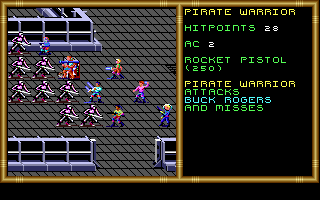
Within moments of beginning, I was engaged in my first combat with several "Terrines," or warriors bio-engineered by RAM. It was odd fighting with the Gold Box engine in a way that was mostly ranged rather than melee. There are a few variations from the D&D games:

  • Characters with high "leadership" can draw NPCs to the party's side. Sometimes they're even controllable.
  • When targeting, the game cycles only through enemies, not PCs.
  • The game remembers which enemy you targeted in the previous round.
  • There are some new commands, including intimidating enemies, flying to another place on the battlefield with a jetpack (which I don't have yet, of course), and sprinting--which allows you to cover more ground, but at the expense of not being able to attack when you're done.
  • You can throw grenades, which I suppose is analogous to using magic items in the fantasy games.
  • "Guard" in the D&D games meant that the character would stand ready and as soon as an enemy came into melee range, he'd attack. It works similarly here, but in this case the character stands ready with a rifle or pistol and fires as soon as an enemy comes into missile range.
  • At the end of combat, the medic automatically treats injured characters; the option doesn't seem to be otherwise available in the regular movement menus.

There are little icons like fuel pumps on the battlefield, and I was hoping I could do neat things like shoot them to get them to blow up and injure enemies, but I think they're just for show.

The combat victory screen. We have "divvy" instead of "share," but otherwise it's identical to the D&D series.

I'll have much more on combat later, of course, but for now suffice to say that after a few, my characters had upgraded from bolt guns to laser pistols, and from regular spacesuits to "smart suits." I also got a supply of "dazzle grenades," but I found that they generally underperformed regular attacks.

The opening map.

The opening area featured the traditional Gold Box 16 x 16 layout, with coordinates numbered 0-15 starting in the upper-left. I couldn't visit all the areas in the map--I kept getting messages that heat from the explosions was driving me back. There were numerous "atmospheric" messages noting destruction, bodies, and wounded soldiers.

Note the futuristic cityscape in the background.

At the beginning, a dying officer mumbled something about getting to missile control and turning on the disabled defenses. This was clarified by another wounded officer, who told me that it was on the east side of the compound.

The base offered repeated battles with Terrine soldiers--so many that I'm not sure there was a limit on the random encounters the way there is in most Gold Box maps. When I finally found the missile control room, I defeated a group of Terrine guards and found a technician furiously trying to program the system to fire missiles at our base.


The game gave me some cool role-playing options here, starting with whether I should fire at the technician (and risk damaging the equipment) or charge the technician (and give him more time to finish). I chose to charge. I took him out, but he threw a grenade on the ground to destroy the equipment. Here, I had another choice: take cover or throw myself on the grenade. Austin chose the latter, and fortunately, it didn't kill him; it just took his hit points down to about 50%. 

Later, I reloaded and found that if you take cover, everyone dies. So I guess maybe it isn't a great "role-playing" choice.

With the equipment saved, I was able to turn on the missile defenses and save the base. I got a nice reward of experience and money and was whisked away to the spaceport Salvation III, where Commander Carlton Turabian greeted me using a speech from the attached logbook. Impressed with my performance, he assigned me immediately to a space tug.


The spaceport works like a "menu town," where you can visit the bar, buy and sell goods, level up, get healed, and embark on the next journey. All my characters rose to Level 3 (and got attendant skill upgrades), and I dumped the excess equipment I'd been collecting.

Is it possible that we have yet another Gold Box title with a useless economy?

So far, I like the game about as much as any Gold Box title. The combat got a little boring towards the end of the first map, since with such limited equipment, I didn't have very many tactical options. I expect that to change now that I can buy new stuff. I look forward to seeing what else awaits me in the 25th century, including space combat, which promises a much different Gold Box experience.


Thursday, December 19, 2013

Buck Rogers: Countdown to Doomsday: 4

Zooming across the universe.

An interesting comment thread on my last post explored the physics associated with both zero-gravity combat and maneuvering in space when, presumably, humans have invented faster-than-light travel.

We sometimes forget the vast sizes involved when talking about "just" the solar system. Episodes of the Star Trek franchise and other shows will clearly show starships cruising through the solar system at non-warp speed and still able to clear the distance from Jupiter to Earth in a few minutes, when in reality, the two planets are about 391 million miles apart at their closest and would take just shy of 35 minutes to traverse even at light speed. The New Horizons probe made the trip in 13 months in 2007. The distance from the Earth to Mars ranges from 34 million miles to 250 million miles, yet we don't see a scene in Total Recall where Quaid has to wait a few months until the orbits better align. Everyone seems capable of jumping off to Mars on a whim.

Notice that this statement isn't followed by "it'll take him 17 months to get there."
 
It's easy to forget that travel in space is fundamentally different than travel on the surface of the planet. On the Earth, the tendency is for gravity and friction to bring everything to a stop. To keep your car moving on the highway, you have to invest constant energy (via the gas pedal), or the pull of gravity and the resistance of the air will cause you to coast to a halt. In space, the opposite is true. With no friction and no primary gravity source, a craft will travel at its acceleration speed indefinitely and actually requires an energy investment equal to the initial acceleration to stop. (Before you decide to post a comment that begins with the word "actually," consider that I'm speaking in generalities and you're about to be a pedantic pest.) Two ships that decide to slow down, hail each other, and engage in combat are being unconscionably irresponsible with fuel.

I can't wrap my mind around what kinds of technological improvements would have to happen to create a civilization in which ships zoom around casually from planet to asteroid to planet, often stopping to engage in space combat. If not some ability to "bend" space or create wormholes or whatever, such travel, it seems to me, would require three things:

  • An absurdly inexpensive and plentiful source of fuel, and a technology able to exploit that fuel
  • Technology that counters or alters gravity
  • Near-light-speed or faster-than-light-speed travel

All of these advancements are so far beyond current technologies that the physical consequences of them are essentially unimaginable. Hence, as Kenny points out in the thread, science fiction franchises that feature them get a free pass on physics. Why is fuel consumed every round instead of only during the initial thrust? Answer: the anti-gravity drive requires constant energy. Why are ships built with aerodynamic profiles when this makes no sense in space? Answer: such ships have to be capable of both atmospheric and space flight. How can ships communicate with their bases without the communications taking hours in between responses? Answer: the communications actually transmit in "sub-space," the same technology that makes rapid travel possible. I'm constantly reminded of a moment from the awesome film Thank You For Smoking:

  • Sam Seaborn: Sony has a futuristic sci-fi movie they're looking to make.
  • Harvey Dent: Cigarettes in space?
  • Sam Seaborn: It's the final frontier, Nick.
  • Harvey Dent: But wouldn't they blow up in an all-oxygen environment?
  • Sam Seaborn: ....Probably. But it's an easy fix. One line of dialogue. "Thank god we invented the, you know...whatever...device."

The interesting thing about Buck Rogers, though, is that it doesn't bother to tell you whatever was invented to accomplish all of this space travel--at least, not beyond a vague reference to "nuclear engines." I wonder if the tabletop RPG gets any more specific.

In my last post, I had just arrived at a RAM asteroid base, which was in chaos. Some genetically-modified creatures had somehow escaped their cages and were massacring the base personnel. An evacuation had been ordered. As I arrived, military personnel assumed my party was part of the base staff.


The base consisted of two enormous levels, which put to rest any idea that the game would feature uniform 16 x 16 levels like Pool of Radiance and Champions of Krynn. The coordinates ranged to 62 on the x-axis and 47 on the y-axis, though of course not all of the space was used. It took several hours to map.

My map of the first level.

Most of the squares were empty, but occasionally they served up a special encounter or role-playing option. Like other Gold Box games, the special encounters, in which you have some sort of choice, are quite frequent. On one screen, I'm asked whether I want to try to save some poisoned RAM workers or leave them to die. On another, I have the option to maintain my ruse or reveal myself as an infiltrator (necessary to explore the eastern half of the base). A third gives me the option to console a woman frantically searching for her children or to "remain silent."

One of the game's many role-playing choices.

While I like the options, they don't seem to matter all that much. For instance, in the shot above, if I choose to heal the workers, they die anyway. A couple of times, I've explored both options--just for proper documentation of the game--and I've found that they were illusory--Morton's forks that led to the same conclusions. Other things that seem like options lead inevitably to death if you choose "wrong."

If Buck Rogers doesn't do a great job in this area, it does at least have an interesting approach to story-telling. The game doesn't spoon-feed the player the relevant plot points; the player, rather, must figure out what's going on from scattered encounters and clues. In my explorations, I found a group of hiding children and agreed to escort them to their escape vessel. It transpired that the genetic abominations were freed when one of the kids tried to help some rabbits escape (we eventually saved the bunnies). The kids, impressed with my bravery and not terribly loyal to RAM, fed me several bits of intelligence, such as the password to the base's computers and the location of RAM's secret base on Mars.


The more important revelation is that RAM is building some kind of giant laser to use against NEO. The base held a miniature version of the laser, and some papers indicated that the research team building the real thing had moved to Gradivus Mons, the Mars base. I think maybe the trope of an evil empire using a giant space laser to commit acts of terrorism against a rebel alliance comes from some other franchise, but I can't put my finger on it right now.


The second level produced numerous combats with the gennies, one of which was capable of poisoning my characters. Just as in the D&D games, poisoning means instant "death" until cured by an antidote post-combat. My post-combat medical screens ended up getting a lot more complicated.

One of my less-successful combats with the genetically-engineered creatures.

Combat itself has become much more tactical, with more grenade options and enemies exhibiting strengths and weaknesses to particular weapons. This means that I have each character carrying several weapon types. I've decided to arm my warrior, Austin, with melee weapons primarily. He's deadly with his "Martian mono-sword."

As I explored the base, the AI from my ship, Scot.DOS, kept communicating with me about events on the base and helping me find key items.

In the 25th century, it's apparently impossible to deactivate a missing keycard.

Ultimately, I saw the children, their grandfather, and the rabbits safely to their escape ship and then left the base myself. Some papers in the base indicated that RAM had allied temporarily with a pirate named Talon to help defend the base. Unfortunately, Talon intercepted my ship as I left the asteroid.

There are some nice visuals in this game.

In yet another false choice, I had the option to surrender to Talon or fight his boarding party. I was victorious in the battle, but I was captured by Talon anyway. He was upset that I'd destroyed his "meal ticket" and planned to mitigate his losses by selling my party to RAM.

How did I realize that. Was it the jolly roger flags?

But calling himself a "friendly guy," he offered to fight one of us, hand-to-hand, for our freedom. I chose to fight, but the resulting battle was so one-sided that I can't imagine it's possible to win. Maybe if I'd grinded my characters up to the max level before entering the asteroid base or something. As it was, he absolutely took Austin apart and we ended up in the same place we would have ended up if I'd declined the battle in the first place.

 
Locked in my cell, I was unsuccessful with my rogue's "bypass security" and "open lock" skills, but I was surprised to be freed by none other than Buck Rogers himself. In the resulting journal entry, he indicates that he was investigating the pirate's association with RAM, and my party tells him "about the spy ship and everything [we] know about the Doomsday Device," prompting him to exclaim, "We must get back to Earth and warn NEO of this threat!" Until this journal entry, I didn't know we were calling it the "Doomsday Device," but I guess the title of the game is now clear.


The entire pirate ship episode was indicative of moments in a game that I can't stand: when you really want to return "home" but the game is prolonging you for an uncertain amount of time. It happens often, and it always annoys me even though I understand why it might be attractive to some players for the tension it creates. You think you're in charge of your navigation, able to return to the comfort of shops and training whenever you need to, and suddenly you're spun off into an unknown environment and you lose your tether back to your home base.

In my case, all of my characters were ready to level up and I was overloaded with equipment to sell. It really would have helped to train and increase everyone's "maneuver in zero-G" skill to improve my odds in combat, which had become increasingly more difficult. On the ship, I faced random and fixed battles with space pirates, most of whom threw grenades every round, some of them capable of stunning. Only Buck Rogers' presence in my party saved me from certain death. Armed with something called simply a "gun," he dished out more death than all of my party members with their laser pistols and rocket guns combined.

Note that Buck Rogers has this glass helmet around his head. Why don't any of my characters need that?

Even with Buck Rogers, though, I ended up dying in about 25% of the battles. There were certain paths that seemed deliberately designed to be impossible, though Buck warned me in such cases by noting that we were trying to keep a low profile.

The message you get when your entire party dies. Since Buck Rogers was in my party, I guess I just screwed up the entire Buck Rogers franchise.

The pirate ship consisted of 15 small levels with mostly nothing in them but random combats. I was a bit annoyed when I logged into the ship's computer and Theta Sigma, in whom I had channeled a ridiculous amount of points for "library search," failed at library search. Nonetheless, Buck Rogers again jumped in and saved the day, producing a journal entry that had maps of all the ship's levels, saving me from having to draw them all individually.


Buck also figured out the best place to set explosives to damage the ship enough that I could escape. I'm glad he came along.

In the armory, entered through the only successful use of a skill in the game so far, I found a mother lode of grenades and other weapons:


There was an option to try to attack Talon on the bridge and take over the ship, but Buck considered it "suicide," and the one time I tried it, he ditched my party, leading to a battle against a horde of enemies. Like the one-on-one combat with Talon, I can't imagine it's possible to win it, but then again I said that about the beholder battle in Curse of the Azure Bonds and had to eat crow later. Thus, I'll simply say that I'd be very interested in hearing from anyone who has ever won the bridge battle and, if so, exactly how.

It was, indeed, suicide. There are an equal number of enemies off-screen to my left and right.

The successful solution was to set off an explosion on the galley level and, while the ship was in confusion, invade the engineering level and win a very difficult combat against numerous pirates and robots that took me about six tries.

Art imitates life.

With the battle won, I smashed up the ship's controls and made my escape. On the way out, Scot.DOS told me that Talon had stolen some gennie eggs and taken them back to his secret base, and that an ex-crew member named "Garrity" on Pallas might know where the base is.

I returned to the Salvation base and got my commander's congratulations. Buck Rogers left my party. I healed, leveled up, and sold my excess equipment. At this point, I have (I think) three options for my next voyage: the RAM base on Mars, the "manufacturing base" in the "Venusian lowlands," and following up on the lead for the pirates' base. The latter seems the least of the priorities, but as we know, in RPGs you often do the least important things first in case you otherwise don't get to do them at all.

In my next post, I should be able to cover combat and equipment. I'm on vacation for three weeks starting today, so I hope I can pick up the posts over the holiday break.