Showing posts sorted by relevance for query Blasphemous. Sort by date Show all posts

Monday, February 27, 2017

Martian Dreams: Powerless

If I can get the power going again, I'm pretty sure those are transport tubes.
    
A long time ago, I upset several readers by giving up on Faery Tale Adventure (1987) because it involved too much walking across empty landscapes punctuated only by meaningless combat. It might take 20-minutes in real time to get from one place to another. Well, if I judged Martian Dreams by the same standards, this would be the last entry on the game. All I seem to do in it is to walk.

As I mentioned the last time, the developers took a fairly small landscape--with no barriers, you could probably walk around the circumference of the planet in 5-7 minutes--and sliced it up with uncrossable canals and cliffs. I didn't fully realize the extent of this until I started using and annotating the game map with greater regularity. The game starts in an area (middle of the map) completely enclosed by canals, and the only way to exit is a single bridge to the east. Late in this session, I wanted to travel from Elysium (point A on the map below) to Hellas (point B). Whether I took the clockwise route or counter-clockwise route around the canals, it was about 30 minutes of real-time walking, just holding the direction key the entire time, maybe stopping to fight some plants occasionally. Ultima VI really spoiled us with the moongates and moonstone.
    
Click to enlarge.
     
To make matters worse, each of the game's quests seems to involve a lot of backtracking, either because you need some obscure tool that you left behind, or because the very nature of the quest takes a journey-and-return approach.

Yes, travel does promise to get easier. Once I get the power restored to the planet, I can extend more bridges over the canals. Once I get those canals flooded with water, I can apparently take barges. And there are some buildings that look like they offer teleportation between cities. The power is thus my primary concern.

My visit to Olympus provided me with several notes about the power and canals, including the location of what Admiral Peary thought was a power station. Before I left the city, I talked with the leader, Jack Segal (no known historical candidate) who seemed like a bit of a blowhard. He had a copy of Machiavelli's The Prince on his bedside table. I suppose this is better than Atlas Shrugged.
   
I don't really like this guy.
    
I had to cross a bridge north of Olympus and loop around the canals to get to the building described by Peary. Sure enough, there was a central building surrounded by a bunch of broadcast towers, but I couldn't access it because--you guessed it--there was no power to the door.
    
This is what we call a "catch-22."
      
Without any particular idea what to do next, I decided to skirt around the canal to the south and visit the city of Argyre, where Rasputin is rumored to be holed up, and what looked like a building north of that next to a power tower. I soon found that Argyre's gates were shut and unpenetrable:

One suspects Rasputin is up to no good.
    
I had better luck with the other building. It turned out to be the entrance to some kind of underground coal-fed power station. Caves branching off the man-made (or Martian-made) areas showed signs of mining for coal and iron ore. A series of conveyor belts seemed to be carrying lumps of coal to a boiler room, but one of the belts was broken.
   
Yes, it's an homage to Metropolis (1927), which everyone knows about and 6 people have actually seen.
    
In the boiler room, I ran into a robot who called himself Stoker. He spoke English, of course. He related that it was his job to carry coal from the end of the conveyor to the furnaces, but the conveyor was broken. Dibbs spoke up at this time and recommended taking the broken belt to an NPC named Trippet (no known historical candidate) in Olympus. This was one of those backtracking quests I talked about.
    
Taking the broken conveyor belt...

...getting it fixed by Trippet...

...and returning it.
     
I walked to Trippet, got him to repair the belt, and brought it back. It was no effort to re-install it on the conveyor, but the system didn't immediately start up. After more discussions with Stoker, it seemed that I would need to prime the furnaces first. This took me a while because I didn't realize that the true "furnaces" were along a northern wall; I thought I had to put coal directly into the boilers. There was also some confusion about how to use the shovel to move the coal. Eventually, I figured it out. After I put a few shovels-full in the furnaces, a big lump of coal made its way to Stoker, and a cut scene showed him taking over.
     
The plant starts to operate on its own.
     
A couple of automatic doors opened in the complex, and I found a huge supply of Oxium. It may in fact be unlimited--every time I "use" a hopper, it produces 20 blobs--which will be useful when I return to Buffalo Bill for ammunition.
    
So much for the economy.
    
I figured my troubles were over, but the next door I tried to open on the surface indicated that it was still closed for lack of power, so clearly it isn't reaching the entire planet. I returned to the power station on the other side of the wall, but there the towers seemed alive and crackling. Stoker had suggested that a cable might be damaged somewhere, so perhaps that's what I'm looking for.
    
Power leaps from tower to tower in the restored station.
     
Unsure what to do next, I decided to try to visit the other cities, starting with Elysium, where Percival Lowell's party had reportedly gone mad. As I discovered, they weren't mad, just possessed. When the explorers--including Mark Twain, Wyatt Earp, George Washington Carver, Georges Méliès, H. G. Wells, Charles Lewis Tiffay, Vladmir Lenin--discovered the Dream Machine in Elyisum, they found the consciousnesses of Martians already within it. Those Martian consciousnesses replaced the humans', which remain stuck in the Dream Machine. The Martian-humans, going by Martian names like "Xichak" and "Sisik," refer to humans as "worms," although not necessarily in an insulting way.
    
    
My discussions with the NPCs in Elysium, plus a scroll I'd found in the power station, filled in most of the backstory of the game. Mars used to host a peaceful and prosperous society of plant-based life living in cities called "groves." Martians were grown from seedlings planted in the compost of their deceased forebears, allowing them to absorb the knowledge and experiences of previous Martians as they grew. Their own creation myths stressed the importance of the lushness and fertility of the planet, so as they developed technology, they tried to put as much of it underground as possible. Those structures that had to be built on the surface, they tried to make unobtrusive.
    
A scroll fills in a bit of the story.
    
Eventually, a tyrant named Raxachk came to power in Argyre and decided to become the "agrarian" (a high political position) for the entire planet. He created a plague that killed seedlings and threatened to unleash it unless the rest of the planet bowed to his will. Everyone laughed at him, so he released the plague and everyone died. A few Martians used their Dream Machines to trap their consciousnesses as their physical bodies died, and they remained there until humans showed up and started using the machines.
    
A Martian inhabiting the body of Charles Lewis (i.e., "Breakfast at") Tiffany describes Raxachk.
   
The Martians in Elysium assure us that their possession of human bodies is all temporary. They're hoping to re-grow new seedlings (assuming the plague is gone) and transfer their consciousnesses into new plants. The Martians in Hellas apparently think it's blasphemous to occupy human bodies and have refused, leading to animosity between the two settlements. I was on my way to Hellas when I got killed by some cacti or something. I hadn't saved in a while and I didn't feel like walking all that way again, so I closed the session. My attempts to win the entire game in 3 days using save states didn't work, but the regular save seems to be okay for now.

Anyway, it's clear that I'm going to have to help the Elysium Martians with fertilizer and water as part of the quest. But to get into certain buildings, I need the power back on, so we're back to that. I'll be happy to take a light hint as I check out Wizard's Lair.

Two notes:
    
  • I've been picking berries wherever I find them, but I haven't needed ESP again yet. There are at least three colors, although I can't tell two of them apart. One of them makes me sick; another reveals what's behind walls and closed doors.
    
A berry lets me see through this wall.
   
  • If the Avatar dies, he resurrects back at the capsule thanks to the ministrations of Dr. Blood. But he loses 1,000 experience points in the process, so I reload when I die.
      
I admit the story is a little more coherent than I expected, but the whole thing is still pretty silly. I almost wish the game would end with "it was all a dream" rather than shoehorn this nonsense into the Ultima canon.

Time so far: 14 hours
Reload count: 5

*******

This is a long shot, but if anyone has or knows where to get a game manual for Les Templiers d'Orven (Loricels, 1986), I would greatly appreciate it.

Friday, July 12, 2019

Darklands: Heaven Help Us

Praying to a saint causes direct damage to a demon.
          
If you were designing a real religious system from scratch, this wouldn't be a bad way for it to work. The world is governed by a large number of mini-gods, or "saints," each in charge of a different portfolio of existence. When you need to get something done that exceeds your normal abilities, you call for a saint's aid. But doing so requires that first you have been studious--that you have taken time to learn about the saint and his life, and the lessons that his biography has to impart. It also requires that you are virtuous, or the saint simply won't listen to your prayer. Finally, you can't over-rely on saints by calling for their help too often.

This is what people in the medieval period believed, and so it's what the game runs with--a system of divine magic entirely unlike anything presented to us in other RPGs. Perhaps the closest is The Dark Heart of Uukrul, which contrasted a system of deterministic arcane magic with a system of divine magic that basically put you at the god's whim. But things are more deterministic here. The saints operate on a specific formula. You have to have a minimum virtue to have any chance with them at all. Once you've crossed the threshold, your virtue determines the probability that the saint will act on your behalf for a specific amount of invested "divine favor," a statistic that is replenished largely by doing good deeds.

First you have to know about the saint in the first place. There are about 140 total saints in the game. Each town's kloster (most towns have one) teaches three or four of them, and your party can study in each kloster about once a week, imparting knowledge of a saint to a single character. You can also learn about saints at universities and from wandering hermits.
        
Part of the very long list of saints that one character has learned.
       
Once you know a saint, there are two ways to call upon him. The first is situation-specific. The game describes a situation and offers "call upon a saint" as one of the options, if you know any saints that might help. Hovering over this sub-menu gives you a list of saints that might offer something in the current scenario. For instance, St. Lutgardis might assist if you need to levitate over something, such as a city wall where the guards are looking to arrest you.
        
St. Boniface is a good one when you need to purify something Satanic.
        
But you can also call on saints at your own whim from the character menu, praying on behalf of one of your party members. For instance, the same St. Lutgardis will temporarily improve perception, virtue, and charisma for the prayed-for character. Every saint has a selection of attributes and skills that they improve.

I find myself using some saints repeatedly. If it's important that I visit a city's political leader without getting kicked out, I pray to St. Alcuin. He raises the "Read/Write" skill, intelligence, and "Read Latin." But he also makes noblemen more disposed to see you instead of kicking you to the curb. More important is St. Gregory Thaumaturg, who among other things increases the "Artifice" skill. It's only because of his help that I've gotten through the doors and chests in most of the indoor areas. None of my characters do well with this skill.
          
Praying to St. Gregory gives Bianca more "Artifice" skill.
        
I was frankly hoping for more from St. Crispin, whose day I know as sure as my own birthday. Every 25 October, patient Irene listens to me recite the speech from Henry V, though in the last few years, in the interests of time, I've taken to doing it in the shower. Anyway, I was disappointed to find that all St. Crispin does in this game is improve the quality of non-metal armor. 

In case you're curious, St. Edward the Confessor is the most laissez-faire saint in the game, responding to prayers from people with virtue as low as 5. He increases endurance, intelligence, perception, all the weapons skills, and "Riding." On the other side, St. Ita is the biggest prig. She won't give you the time of day unless you have a virtue of 85. She performs some pretty significant healing, but there are lots of saints who heal.

In my last couple of entries, I mentioned that I was trying to find information on St. Wenceslaus, to whom I needed to pray to end the constant aggravation of Wild Hunts. When I started this session, I made a list of all of the cities in the Empire and crossed them off one-by-one as I visited their monasteries and found no information about St. Wenceslaus. At first, I tried to thread these visitations with quests, but eventually I got so impatient that I abandoned all other pursuits and just ran from town to town. I finally learned about the saint at the kloster in Marienberg, in the far northeast of the map.
       
At last!
        
When I invoked Wenceslaus against the Wild Hunt, it had a satisfying ending--but an annoying promise of return.
           
That's all right: I know all the saints by now.
          
This occurred after about 6 hours of random adventuring, building my finances and my fame. I ended the session with the party's fame at 615, or "legendary heroes," which is the highest classification that you can get. Other than the usual--robber knights, artifact quests, Wild Hunts, boars, spiders, wolves, schrats, bandits, pilgrims, towns full of witches, and so forth--the only new experience was an encounter with a knight, where I had the options to challenge him to either a race or a joust. Since my characters suck in both "Polearms" and "Riding," the result was predictable.
         
A fancy game for fancy lads.
             
I solved another mine quest. This one involved a bunch of "vulcans"--basically, fire elementals--who had managed to open a gate on the lower level of the mine. I had to battle my way through them and close it. The creatures are particularly annoying because they degrade armor quality, and by the time I was done with the adventure, I basically had no armor left. If I'd had a few "Firewall" potions, the monsters would have been easier, but I just fought through them rather than leaving the mine to go buy some.
          
I want to call attention to the skillful use of dactylic octameter here. You can sing this verse to the same tune as "Out in the West Texas Town of El Paso." [Ed. as a commenter pointed out, it's dactylic tetrameter, not octameter. You count the feet in each line, not the entire couplet.]
         
During these experiences, I tested and confirmed my theories about armor. Specifically, I think it's better to have everyone wearing plate, top and bottom, accepting the consequences of over-encumbrance, than to equip lesser armor and remain below the encumbrance limit. With all my characters in plate, hardly any enemies do any damage at all, so it hardly matters if the characters are slower on the swing. To ameliorate the effects of encumbrance during tougher battles, I invested heavily in "Ironarm" and "New-Wind" potions, which raise maximum strength and endurance respectively.
          
My party hits new heights of fame and wealth.
       
In fact, I spent nearly every coin I made on potions, buying roughly three "Essence of Grace" potions to every one "Ironarm" and "New-Wind." I sold my ingredients and stopped wasting time trying to make my own. Yes, I know that you can theoretically make more powerful ones if you make your own, but it's easier just to buy two. 

I kept firing a couple of handgun volleys before each combat, and before long my characters all had near-99 skills in "Impact Weapons," "Edge Weapons," and "Missile Weapons." The handguns are a lot of fun. They're very slow, but they take the edge off demons and Templars nicely at the beginning of a battle. 
         
The temple had multiple combats with multiple plate-clad Templars.
         
When I thought I was ready, I tried my assault on the Templar compound again. The building is large and multi-leveled, with about 20 battles against knights, soldiers, hell hounds, and bears. (The random battles with multiple enemies were much harder than the two "boss" battles, described below.) There were lots of chests with treasures, including three holy relics (I hadn't encountered any until now): St. Olaf's battle axe, St. Hubert's bow, and St. Raphael's water. Is it blasphemous to equip the first two as actual weapons? Are they particularly good weapons? I guess we'll see.

It's fun to reflect on the game's treatment of Templars and witches. The manual is unapologetic about basing its depictions on 15th-century popular ideas of witchcraft. It draws a distinction between this kind of witchcraft and benign neo-paganism of the 20th century. Similar, the idea that Templars were actually Satanists comes from 14th-century persecutions of the order by the Avignon Papacy. Hundreds of Templars were arrested, tortured, and forced to confess to homosexuality, Satanism, and the worship of a demon named Baphomet. The authors of the game of course knew that none of this was true, but the average 15th-century commoner didn't, and thus that's how the game treats the order.
          
The party comes across a gathering of evil witches . . . which is ridiculous 'cause witches they were persecuted, Wicca good and love the Earth and women power and we'll be over here.
           
The battles in the Templar headquarters were difficult, but I kept the party going on enough potions to have purchased my own kingdom. Eventually, I found the chambers of the order's Preceptor and heard him talking about the seals that protect the castle of their "Master." The Preceptor attacked me alone and died quickly, leaving a high-quality set of plate armor.
          
My first two characters fight the Preceptor in melee combat while my rear characters shoot him.
           
At the top of the fortress, I met a demon in a hot room full of smithy fires. I prayed to St. Dymphna ahead of the ensuing battle, and the demon was significantly weakened. He died very quickly, and afterwards we broke the seal on the holy book that we found in the room. "Suddenly," the game told me, "you know that your ultimate fate lies south of Salzburg." I already guessed that from having stumbled upon the castle when I was searching for the witches' High Sabbat.
          
Another step solved in this quest.
        
Miscellaneous notes:
           
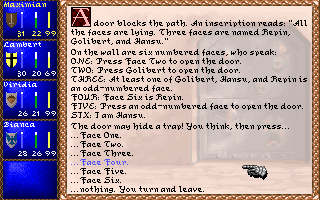
  • I really enjoy the puzzle doors in the mines. Here are a few if you want to try your skill:
            
Hope you have a Bible handy!
Svir'f fgngrzrag vaqvpngrf lbh arrq na rira-ahzorerq snpr gb bcra gur qbbe. Guerr'f rafherf gung gur guerr rira ahzoref unir gur guerr anzrf. Bar'f fgngrzrag ehyrf bhg Qbbe Gjb, yrnivat Qbbef Sbhe naq Fvk. Fvk'f naq Sbhe'f fgngrzragf gbtgure zrna gung Qbbe Fvk vf Tbyvoreg, juvpu pna'g or gur evtug qbbe orpnhfr Gjb fnvq gb bcra vg. Gung yrnirf Qbbe Sbhe.
Snprf Bar, Gjb, naq Sbhe unir qrcraqrag fgngrzragf, fb gurl'er rvgure ylvat be gryyvat gur gehgu gbtrgure. Fvapr vs Bar naq Gjb jrer obgu ylvat, gur nafjre jbhyq or qvssrerag qbbef, gurl zhfg or gryyvat gur gehgu. Fvapr tbyq pnaabg bcra gur qbbe (Snpr Sbhe), Snpr Svir vf ylvat naq guhf fb vf Snpr Guerr, fb cre Snpr Sbhe, gur qbbe zhfg or fvyire.
             
  • I figured out the nature of the bug that has prevented me from collecting any robber knight rewards in Flensburg. It's not just Flensburg. If the town doesn't have a "town hall" and the only political leader is located at a separate castle or burg, he never acknowledges that you've completed his quests.
  • I haven't played an Infinity Engine game in over 10 years, but I constantly catch myself hitting the "equals" sign (=) because that was the "select all party members" key in those games. This game doesn't even have a comparable key. 
  • I started spending more time storming robber knights' castles in this session instead of just calling them out or sneaking in and fighting them one-on-one. You get more wealth that way.
  • Going into this session, Bianca was my character with the highest "Artifice" ability at about 25. Somehow, she lost all of it--her skill is at 0. I don't think there's a non-bug mechanism that would account for this. 
  • I found yet another witches' High Sabbat and again destroyed it, but I didn't learn anything new. 
  • You can tell when a town is full of Satanists when they get something screwed up about Catholic doctrine. 
         
Basic Christianity: knowing good from evil is a bad thing.
        
Selling all the equipment that I looted in the Templar fortress netted me nearly 300 florins, which is about as much as I need to restock my potions and go for the castle south of Salzburg. I've been assuming that the witchcraft/Templar/demon plot is the "main quest" of the game, but feel free to tell me if I'm on the wrong track or if there's anything I should do before heading to what I assume is the endgame.

As I came to the end of this session, I became determined to track down a dragon. I keep hearing rumors of dragons north of one town, east of another, but every time I've searched in the stated direction, I haven't found anything. This time, I started in Flensburg, where rumors around the political center said that there was a dragon ravaging areas to the south. I rode south to Hamburg and heard the same rumors, but this time to the southwest. In Bremen, I heard south again. 

A few klicks south of Bremen, I encountered a message that "the land is sere and lifeless," the trees nothing more than "blasted stumps," a ruined village in the distance.
            
Darklands segues smoothly into Fallout.
          
Not far away, I came to the destroyed village:
              
They shouldn't have killed Missandei!
          
But I found no sign of the dragon. In Osnabrück, they said it was south. In Soest, southwest. There, I got another message that the creature destroying the landscape had also poisoned the waterways. In Köln, rumors had the creature to the east, so I felt I was closing in. But I still found nothing, and suddenly I stopped hearing rumors of dragons when I visited nearby cities. I hope I get a bead on one again. I was looking forward to seeing what dragons look like in this game.
       
Time so far: 59 hours