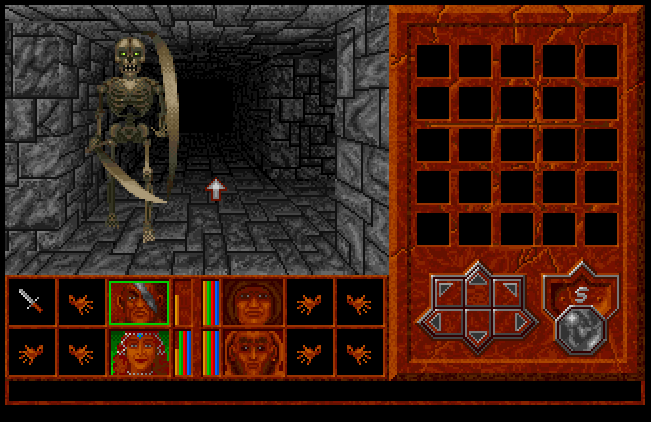
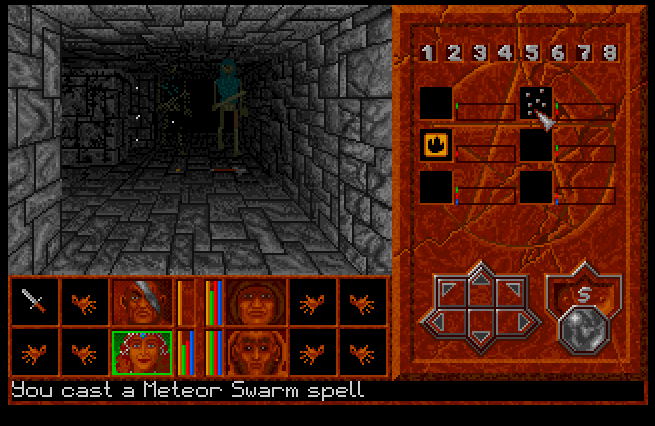
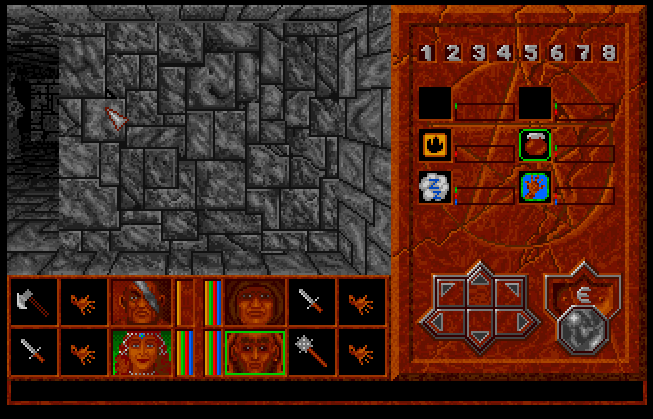
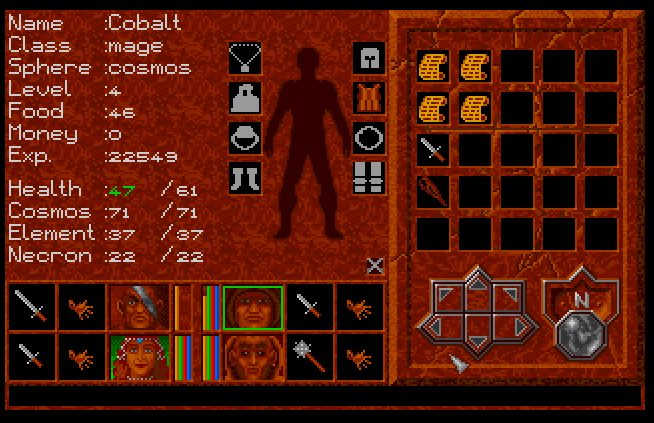
Showing posts sorted by relevance for query Abandoned Places - A Time for Heroes. Sort by date Show all posts

Thursday, May 21, 2020

Game 366: Abandoned Places: A Time for Heroes (1992)

Or A Tinne Fot Hetves if you go by a literal interpretation of the font.
       
Abandoned Places: A Time for Heroes
Hungary
ArtGame (developer); Electronic Zoo (publisher)
Released 1992 for Amiga and DOS
Date Started: 15 May 2020
         
It's nice to see a new country enter the CRPG fray. We're going to have four games from this country in the early 1990s (including Abandoned Places and its sequel) and then nothing for a decade. It's also nice to see a new take on a familiar template. I had a fun first session with Abandoned Places, and I'm looking forward to my next one. I just wish Ultima VII hadn't gotten bungled, because this would be a near perfect game to trade time with that one. 

Abandoned Places is based heavily on Dungeon Master, right down to the framing story, which has a benevolent mage going to a crypt to resurrect former heroes rather than create characters from a living population. This was the least satisfying part of the game, as I was asked to choose two warriors from a selection of six and one mage and one cleric, each from a selection of three, based on nothing more than their character portraits. I was assisted in this endeavor by Saintus's 1992 coverage of the game, in which he tried all possibilities and analyzed their strengths and weaknesses. I chose the fighters Lianon and Cromer, the cleric Felius, and the mage Pomphis. My primary concern was that I get a cleric with the "Create Food" spell because I hear that the party gets hungry fast in Abandoned Places.
         
Assembling a party.
        
The game manual has nothing on the backstory, so we have to rely on the opening animation. Information is scant. It is told from the perspective of a mage who awakens the deceased heroes.
            
The ancient scrolls have led us to the location of the Heroes, the Champions of Kalynthia, turned into living stone, waiting for the time to once again fight evil. The council emissaries will travel across land and sea to the Temple of Heaven's Fight. There, far below the surface, the Heroes are to be found, but our powers are waning and we only have the power to turn four of the heroes back to flesh and bone. No one can tell what the effects of 900 years as statues will have on them. But they are now our only hope to stop the cursed Bronakh. May luck be with us all.
     
An unnamed mage restores life to some statues.
          
The game begins as the four heroes wake up in their crypt with no equipment and a couple of gargoyle-looking things prowling the rooms. Fortunately, it's sufficiently like Dungeon Master or Eye of the Beholder to figure it out in a hurry. You right-click on hands to attack, after which there's a "cool down" period. Only the first two characters can attack in melee range, but the rear two can use missile weapons and cast spells, and the mage comes with a useful "Magic Bolt."
              
Almost immediately, the game thrusts you into combat.
        
The interface is fairly intuitive. You left-click to move objects and right-click to use them. Everything is contained in one window. The developers sacrificed exploration window space to keep the inventory and character sheet always visible. You click on the character portraits to cycle through their inventories. The character with the active inventory and character sheet is different from the character with the active combat options; you change those by clicking the number buttons right next to them. Because of the nature of the interface, you really need a mouse so that you can drag items from the floor to the characters, operate switches, and so forth. But it does offer keyboard options for commands such as movement and--thank you!--attacking. You can also specify the direction of attack with the little pad beneath the character portrait, but I haven't played with that yet.
    
The gargoyles dropped a couple of keys, and the room was scattered with rocks and torches. One of the keys went to either of two doors at the south end of the room, both of which opened the way to the same area of a higher level.
          
My map of most of the temple.
         
The temple ended up being five levels, but with only three of them taking up any substantial space. The goal turned out to be finding the exit on the bottom level, which was the largest, taking up 16 x 29 coordinates, but using nowhere near that much space. (The game uses a "worm tunnel" approach, which automatically cuts out a lot of squares.) Standing in my way were things that looked like gargoyles, skeletons, and maybe fire elementals. They were all pretty easy to kill even though I never found any armor and the only weapons I found were minor ones: clubs, daggers, and one short sword.
          
This thing looks like it ought to be harder than it was.
       
I like the way the game allocates experience, which is by successful action rather than simply killing someone in combat. Fighters get experience for each hit. Spellcasters get experience for each spell successfully cast, including noncombat ones like "Create Food." Nonetheless, by the end of the dungeon I did have a rather large experience imbalance in favor of the fighters. No one had reached Level 2 yet, though. I need to spend more time casting spells, since magic regenerates relatively quickly. As in Dungeon Master, a full spell point bar is just wasted potential experience.

Navigation puzzles were easy in the introductory dungeon, consisting of just a few keys, buttoned doors, and levers that opened new sections of hallway. Towards the end of the level, I had to avoid fire squares and water squares, although you can try to cross them quickly if you don't mind a little damage. The only thing that bothered me was that I left four locked doors on the lower level for which I never found any keys. There was also a stairway on an upper floor that was blocked somehow. Maybe these were red herrings, or maybe we'll be back to the temple later.
           
A skeleton comes out of a buttoned door.
          
There was a chest full of food on one level, but it barely did anything. If I didn't have the "Create Food" spell, my characters would have been starving for three-quarters of the expedition. Starvation causes a periodic loss of 1 hit point. I also noted that the game told me the characters were "exhausted" quite early in my explorations and torches didn't last very long. (By the way, to use a torch in this game, you have to hold a "firestone" in one hand and the torch in another and then right-click on the firestone. That took a while to figure out.) I suspect this all means that I have the cycles set too high in DOSBox. Discussion question: Is there ever a good excuse for a developer to base such considerations on CPU cycles rather than real-time or number of moves? It feels like authors in this era never considered the possibility of faster machines.
     
When we found the exit to the dungeon, I was surprised to find myself on a top-down overworld map. Well, not completely "surprised" because I'd read the manual, but still--this is an unusual addition to the Dungeon Master sub-genre. The rest of the game takes place over a reasonably large map with one large island and three small ones. The map is dotted with towns, castles, and ruins, and I assume most of them have some kind of dungeon to explore. (The overland map is similar enough to Legend from the UK that I wonder if the developers weren't influenced by it.) I like the approach, as long as the dungeons are of modest size. If they're each as large as the typical Dungeon Master clone, the game will wear out its welcome quite fast.
          
Boarding the boat from the starting island.
          
My first goal was getting off the southern island that houses the Temple of Heaven's Fight. From atop the mountain, I could see a ship making daily trips from the large island to our small one, so we headed for that ship's port of call. Along the way, the game said we found some horses. There's a button that lets you switch between various modes of transportation. When we reached the boat, we switched to that, and it brought us to the "continent."

I headed for the nearest city, which turned out to be a quiet little town called Frampton. It was home to a priest whose services I didn't need. There were no other shops.
               
The town was pretty, though.
           
Lacking any guidance about where to go--Why didn't the mage who awakened us stick around? Or at least leave a note?--I decided to work my way roughly counter-clockwise around the continent. A fortress in the middle of a lake with a long bridge leading to it looked promising. When I arrived, the game told me I was at Pedroc's Abbey, but that it was closed.
            
The overworld map has a lot of interesting-looking features. There just isn't much to do when you get there.
            
I continued moving over mountain and river until I came to a small town called Timberville, where "most of the villagers have some kind of weapon in their hands." Timberville had another healer and a tavern, where we spent the 15 gold pieces found in the temple on a meal (2.0) and lodging (2.5). I'm not sure if either did anything for us, as I stopped getting messages about hunger and fatigue the moment I reached the outdoor map.

You occasionally have to fight wilderness combats, which take you to a small 3D map crossed with bushes and rivers. The only enemies I've had to face so far are giant bugs, which drop no gold. You can't leave the fights until you've killed all the enemies, and it can be annoying to find them sometimes.
          
Fighting a giant bug in the wilderness.
          
I couldn't even find the entrance to a castle (called "Twilight" on the map) across the lake from Timberville, and two villages further along the coast, Hyde and Trailcross, had the same options as Timberville. Something called the Tower of Scions was destroyed and offered nothing to do. Cities called Iron Home and Tol Al Nerak wanted 10 gold pieces to enter, which is all I had left. I saved and tried anyway, but both just had shops that had nothing I could afford.
        
It's nice to know such things exist. I'll be richer someday.
      
I ultimately spent the gold getting into Kal Kalon, the capital of the country, where I found a guild. The guild leveled up my first fighter and mage--fortunately, for free--and said I need a few hundred experience points more for the other two. I couldn't take advantage of the other services and left.
         
Not so much "bad luck" as "uneven distribution."
       
I finally found something to do at Souls Abbey in the southwest of the main island, nearly a full loop back to where I'd started. A monk told me he might have a job for us, but he'd need us to prove our skills first. He said his guards would take us to a "place full of monsters," and that we would prove our worth by destroying all of them.
         
Our first quest.
       
We agreed, and soon found ourselves in a new, dark dungeon--the only problem being that we only have one torch left and it's hard to see in the dark. Hopefully, we'll find some more.
          
Dropped off in my second dungeon.
       
Aside from that hour where I was wandering around the land experiencing nothing, Abandoned Places has started relatively strong. To many players, Dungeon Master is perfectly satisfying on its own, but I'm rather glad to see a game that adds an overworld, an economy, and NPCs to the template. And while I always enjoyed Dungeon Master's approach to leveling through action, I'm glad to see it quantified (or perhaps I should say quantified in a way visible to the player) here. My major concerns are whether it will introduce more interesting puzzles than it has already, and whether the game world will open up a bit. It would be a waste of the overland map if you had to hit all the dungeons in a particular order.

Time so far: 4 hours

Saturday, June 6, 2020

Abandoned Places: Won! (with Summary and Rating)

         
Abandoned Places: A Time for Heroes
Hungary
ArtGame (developer); Electronic Zoo (publisher)
Released 1992 for Amiga and DOS
Date Started: 15 May 2020
Date Ended: 4 June 2020
Total Hours: 33
Difficulty: Moderate (3/5) but very imbalanced
Final Rating: 31
Ranking at time of posting: 220/368 (60%)
        
Summary:
The first game from a Hungarian developer, Abandoned Places offers typical Dungeon Master-style exploration, combat, and mechanical puzzle solving in a series of tiled 22 x 22 dungeons and dungeon levels. These locations are tied loosely together by a top-down overworld in which characters can visit a variety of menu towns and similar locations. The mostly-irrelevant story has four resurrected heroes from ancient times trying to stop the return of an ancient evil named Bronakh. The full game requires the party to defeat 27 dungeon levels, but different players will encounter different levels early in the game depending on where they pick up the main quest thread.  

*****

Bronakh's volcanic lair ended up being nine more levels, pitched in difficulty somewhere between the earlier, easy dungeons and the difficult Halls of Rage. Honestly, I wouldn't have minded if the game had just consisted of the Halls of Rage and Bronakh's fortress, maybe with a menu town on top. It would have been a tighter, more challenging game without a lot of wasted time before the main event.
          
As I mentioned in my penultimate entry, Bronakh whisked us directly from the Halls of Rage to his fortress without giving us a chance to level up. It turned out that I could just turn around, go up the stairs, and exit the volcano. In fact, the general theme of Bronakh's nine-level lair was to require full exploration of each level, but ultimately in service of finding a key that unlocked a down staircase rather close to the up staircase. Thus, even deep in the fortress, a return to town was possible with minimal effort. 
    
Bronakh's levels were more challenging than the rest of the game, but I still wouldn't say they were as challenging as Dungeon Master or even Eye of the Beholder. They were perhaps deadlier, in that fireballs and lightning bolts came flinging at my party it seems like every third step. I eventually got to the point where I just shrugged off the fact that my characters seemed to be taking constant damage for no visible reason. I reloaded a lot and took advantage of safe spaces to rest multiple times. My cleric got a resurrection spell eventually, and between that and "Heal," I could deal with most problems as long as he kept his spell points up.
            
Wandering into the wrong room in Bronakh's lair.
                     
As I explored, I tried to make a full accounting of the different mechanical devices that the game uses. They include:
           
  • Wall switches, some activated by hands, some by keys, that open walls and doors in other parts of the dungeon.
  • Floor plates that open walls and doors in other parts of the dungeon.
  • Illusory walls. Generally, you can just walk through them but "Detect Illusion" lets you see through them entirely.
        
This was a rare illusory door that looked like a regular wall until I cast the spell.
        
  • Doors that require finding keys.
  • Doors that have switches.
  • Multiple doors whose switches open each other rather than the doors they're attached to.
  • Traps that cause fireballs or lightning bolts to hit you from the nearest wall.
  • Fireballs and lightning bolts that fly out of the walls and corridors around you in absence of any trigger. Sometimes you can block these with plants, statues, or temporary walls created with the "Create Wall" spell.
  • Teleportation squares, including those that teleport you in a sequence around a particular part of the dungeon, so it's like you're on a never-ending conveyor belt.
  • Anti-magic squares.
  • Spinners, some of which spin continually, some of which turn you once or twice. It got to the point that every major intersection in Bronakh's had one of these.
  • Water squares, for which you must cast "Swimming" to keep from taking damage.
  • Squares perpetually on fire, for which you must cast "Walk on Fire" to keep from taking damage.
             
Here we have water and fire in a row.
         
  • Cobwebs, which must be destroyed with the "Fire Path" spell, which turns them into fire squares.
  • Potted plants (some of them hostile) and statues that you have to push and pull to clear paths or reveal hidden keys.
  • Pits that lead to small lower areas of the same level. You can use ropes to lower yourself without damage and "Climb" to get back up, or "Levitate" to avoid them entirely.
           
Notably absent from this list are pressure plates, and the types of puzzles that require you to weigh down those plates, either with characters or monsters. You also can't throw items into teleporters--just yourself--which limits some of the fun puzzles other games in this subgenre have allowed.
        
Through most of the game, the wall/door/switch ratio was 1:1 and one-directional, so that every time you found a switch, you could confidently activate it, knowing that it would open a door or wall that you needed open. Bronakh's got a little more fiendish by having some of its switches close areas that you needed open. It took me a while to learn to stop activating switches and instead to treat the game more like Dungeon Master where you explore first and slowly, carefully work on your switches later.
    
Both the Halls of Rage and Bronakh's did a good job of stringing these multiple options together. For instance, one of the levels has a series of pits that you needed to cross with "Levitate," only to put an anti-magic square on the pit in the middle. This caused "Levitate" to snuff out and drop me through to a waiting fire square below. I had to "Jump" to avoid this particular square..
             
Usually the game makes you fail once to figure it out, but this time it gave me a hint.
              
I don't love this kind of gameplay but I can appreciate it, and thus my only major complaint is that a couple of levels had keys allocated in such a way that you could put yourself in a "walking dead" situation if you didn't open doors in a particular order. There's never any excuse for that.
       
Enemies weren't pushovers, but they continued to be the least important part of navigating the dungeon levels, at least until Level 8, where several of the enemies were capable of frequent, high-damage fireballs. It turns out that the creators anticipated the experience imbalance between fighters and spellcasters and thus set the level requirements much lower for the latter. Everyone reached the end of the game at their maximum levels, which was 8. Inventory rewards mostly stopped after the Halls of Rage, and I found I didn't need any money after that. I only needed to retreat to town to get my last levels.
         
These dino-looking things were pretty tough.
        
The ninth and last level was large and mostly open, though with a few corridors and pillars to use for hiding and regrouping. Bronakh was the only enemy--a robed figure without much menace or character. He hit hard with spells, though, and took a long time to kill--so long that when I finally managed to kill him but had two of my own characters dead, I declined to reload and just moved forward through the final door.
         
Casting a "Toxic Cloud" at Bronakh while he hammers me with something or other.
        
The endgame cinematic showed the same sage who had resurrected the heroes sitting at his desk.
          
And so with the fall of Bronakh, the Kalynthian Empire is ready for a new age of peace and harmony: the age of union--when the lands of the world will at last be rejoined. For you it will be a time to build a new life, to meet new friends and remember old ones lost. And to watch and wait for the evil that can never sleep and must never be forgotten. The time of heroes will come again.
         
As the final words disappear, the door behind the sage opens to reveal a skeletal figure with glowing eyes just before we return to the main menu.
         
We never did find out who this guy was.
        
In the GIMLET, the game earns:
           
  • 3 points for the game world. I found the framing narrative derivative and poorly reflected in the game itself. The map was mostly wasted.
  • 3 points for character creation and development. There's no "creation" as such--just a selection from a gallery of heroes. Development is moderately satisfying, particularly in the acquisition of new spells, but forcing every player to have two warriors, a cleric, and a mage just reduces replayability.
  • 1 point for a minor amount of NPC interaction to guide the quest.
  • 5 points for encounters and foes. The game's enemies are maddeningly unnamed, and while they do have some special attacks and defenses that you might want to plan tactics around, each enemy type lasts for such a brief time that it's hardly worth analyzing them. I use this category for the quality of puzzles, which we've mostly already covered
  • 5 points for magic and combat. I like that the spells were integrated with puzzle-solving. While the game makes good use of the "cool down" system of Dungeon Master, it lacks some of the timing and punch of other games of its ilk, and for most of the game it was too easy.
           
Fighting some kind of goofy flying thing.
        
  • 4 points for equipment. You get the basics: two hand slots, armor, a ring, and a necklace or amulet. There weren't many upgrades, especially towards the end. There's no way to see weapon statistics, but at least the ability to sell weapons imparts some estimate of relative worth.
  • 2 points for the economy. The game has one, but it's not very well done. I sold a lot but hardly bought anything.
  • 3 points for quests. It has a main quest, of course, and there are a couple of different paths through the early dungeons, although which you take is more a matter of luck than "choice."
  • 3 points for graphics, sound, and interface. It gets 1 for each. I thought the graphics and sound effects were only okay, and for everything I liked about the interface (e.g., the use of function keys to execute attacks), there was something I didn't like (e.g., having to scroll slowly through the spell list). The automap, which you don't acquire until the third dungeon, stopped working in all of the later dungeons.
  • 3 points for gameplay. I have to give it a small amount of credit for some nonlinearity and some replayability, but the difficulty was too imbalanced and the pacing was horrible. 
       
That gives us a subtotal of 32, from which I subtract 1 for bugs, for a final score of 31. The "invulnerability" bug dogged me throughout the final dungeon. It seemed like whenever the processor got overwhelmed by too much happening on the screen--too many spells or flying lightning bolts or whatever--enemies just froze in place. They stopped attacking, but they were also impossible to kill and were blocking the corridors. On the positive side, I never encountered any of the bugs some other players report, such as an inability to ever find some of the dungeons.
     
It doesn't appear that the game ever had a North American release, and thus all the reviews are from European magazines, particularly Amiga magazines. I rubbed my hands and got ready to excoriate British Amiga reviewers for getting everything wrong, but they mostly gave the game a fair shake. Amiga Power said in February 1992 that: "[It] may not represent the new standard in RPGs--it's a bit too scrappy in certain areas for that--but you can bet your bottom dollar it'll be responsible for a great many hours of lost sleep among the die-hard D&D fraternity." Overall, the magazine gave it an 80. Reviews from CU Amiga in March 1992 (83), Amiga Action in March 1992 (82), and Amiga Format in February 1992 (80), all basically said the same things: the graphics are a bit rough and the game is a bit too easy, but otherwise it wasn't a bad experience. None of them seem to have made it all the way to the Halls of Rage before their reviews, however, which I imagine would have changed things. Continental reviews were less charitable, mostly in the 60s and 70s. The worst came from the German PC Player (37), but they didn't get to it until August 1993, at which point they were comparing it to Ultima Underworld and Betrayal at Krondor.
          
Some of the reviews mention bits of marketing from Electronic Zoo that said the game had "over 100" levels. Even accounting for the extra early-game dungeons that you don't experience if you take different paths, the only way that is true is if you count the little interconnected sections of dungeon levels and not the entirety of the levels. It's a disingenuous bit of marketing. Electronic Zoo also advertised that it would take more than two months to finish. It took me three weeks, but I don't really see how it makes sense to measure playing time in months anyway.
         
Abandoned Places was one of three games from Hungarian developer ArtGame. Abandoned Places 2 came along in 1993 and Piracy on the High Seas was published in 1992; it features an overworld interface very similar to Abandoned Places. Screenshots from the sequel show improved monster graphics, a redesigned interface, and first-person exploration of the overworld.
         
Travel in Piracy uses an interface nearly identical to Places.
           
If I can trust a few sites, the principals of ArtGame--including Ferenc Staengler, István Fábián, Sandor Hadas, and György Dragon--were university students when they met and decided to make games. An initial version of the game failed to find a publisher, although Electronic Arts expressed interest if the team came up with better graphics. They spent several months on a graphical overhaul, but by the time they resubmitted, EA had already agreed to publish Raven Software's Black Crypt and didn't want two games in the same subgenre at the same time. They ultimately struck a deal with United Kingdom-based publisher Electronic Zoo.
     
On a page in which Abandoned Places 2 is offered for free, Staengler recounts how he and his colleagues were treated by International Computer Entertainment, which bought the ailing Electronic Zoo and published the sequel. I'm not sure how much of this story (e.g., receiving no royalties) has anything to do with the original game and original publisher, so I'll leave off any more history until next year, when I cover the sequel and hopefully have managed to make contact with Staengler or one of the other developers. It is worth noting that even in the first game's manual, the publisher apparently made the developers anglicize their names: Ferenc Staengler became "Francis" Staengler, István Fábián became "Steve Fabian," and György Dragon was rendered as "George Dragon."
      
I found Abandoned Places underwhelming for most of its run, particularly in comparison to the better games of its sub-genre, but I do like that it tried to integrate Dungeon Master with an overworld, towns, an economy, and other features from outside the typical Dungeon Master line. There's no reason that a good dungeon crawl has to be 15 levels straight down; you can enjoy the same mechanics while still pausing for story elements and while allowing the characters to spend a night in a tavern. Abandoned Places didn't do it particularly well, but I'm glad that it tried to do it at all. I look forward to seeing if the sequel improves.
         
We'll head back to The Legacy next, of course, but whether the next game after that is a return to Ultima VII or a look at Mythos 1 depends on how far I get retracing my steps in the former.
         
***********
     
Trying something. Let's assume I have a Famicom Disk System (FDS) file and an IPS patch for it. How do I put them together? I can find all kinds of instructions for doing it with an SNES file, but not for an FDS file.
    

Monday, May 31, 2021

Game 415: Abandoned Places 2 (1993)

 
I always think it's weird when a game has a subtitle but its sequel doesn't. How hard could it have been. "Another Time for Different Heroes."
        
Abandoned Places 2
Hungary
ArtGame (developer); International Computer Entertainment (publisher)
Released 1993 for Amiga
Date Started: 22 May 2021
    
It's been about a year to the day since I started Abandoned Places: A Time for Heroes, a Hungarian Dungeon Master clone that I recall as pleasant but also a bit too easy. Right now, though, I find myself looking for exactly such a game. A Dungeon Master-style game is a nice contrast to Darkside of Xeen; while they may superficially look similar, the nature of gameplay is very different. More important, the "too easy" part would be a nice contrast with Mission: Thunderbolt, which I am still playing, one very slow level at a time.
    
Like its predecessor, Abandoned Places 2 is set in the world of Kalynithia. In the first game, four heroes prevented a demonic sorcerer named Bronakh (given as "Bronagh" in the second game's manual) from rising to power by scouring the land's dungeons for a collection of artifacts, then confronting Bronakh in his fortress. Now, four hundred years later, Bronakh's "creator," an extra-planar being named Pendugmahle, has crossed over to Kalynithia to take revenge. Once again, the Ancient Order of Arbitrion has decided to resurrect four heroes from carbon freezing, or what the game calls their "diamonised state."
    
The opening cinematic shows some kind of creature emerging from the ground and being teleported to the well of a castle. It doesn't make a lot of sense.
    
As with the predecessor (and Dungeon Master), you don't create the party so much as choose from a roster of 34 existing characters. But you can change most of the defaults, including the five attributes (strength, intelligence, wisdom, dexterity, constitution) and name. You can allocate attributes from a pool of points, though in a way that makes little sense. It takes 1 point for each increment from 1 to 7, then 2 from 7 to 8, then 1 again from 8 to 9, then 2 from 9 through 13. Going from 13 to 14 takes 7 points, and 14 to 15 (the maximum) takes 9. You could give everyone 13s across the board (with two 14s) or sacrifice a lot of points for more 14s and maybe a 15.
 
There are only two character classes: fighter and mage. The original had clerics, but in this game, clerics are just mages who specialize in a particular magical sphere. For mages, you cannot change their starting magical abilities. There are three magical spheres: cosmos, elemental, and necromancy. The manual says that necromancers are best at healing spells, which is a bit nontraditional. "Conjurers" (who use the elemental sphere; keep up) are good at attacking spells, and "voiders" (cosmos) are balanced. The original game forced you to play two fighters, a mage, and a priest, but this game makes no restrictions. I chose one fighter and three mages, one each of the three specialties. I gave them names that help me remember who they are, because that's becoming more of an issue.
         
Creating a new "cosmos" mage.
       
The characters begin with no equipment in a small room. The square leading out of the room has a text encounter in which we're told that the "master" who awakened us suffered some sort of injury or weakness from the ritual and needs a healing elixir, to be found somewhere in the same dungeon. Right away, we see something that the first game didn't offer--messages or mini-encounters triggered by specific dungeon squares. This was a feature of Eye of the Beholder, but I don't know if the Abandoned Places authors took from Eye directly. 
      
We get our first quest.
      
The game window has been redesigned since Abandoned Places. The first one arguably tried to cram too much on one screen. This one is simpler. The view window is about twice the size of the original, and the character portraits (including combat actions) are now below the window. A pane to the right is used for inventory and spell selection (alternating between the two with a right-click), with a compass and a GTFO panel to the lower right. If you need to see the full character sheet, you can toggle it on and off (it replaces the view window) with the SPACE bar. My assessment is that graphics have been improved since the original; this one offers such interesting visuals like grates and artwork that I assumed at first they must be interactive.
      
This grate and this relief are so intricately designed that it feels like you ought to be able to do something with them.
      
It took me about three hours to map the first level--a large 31 x 31, using the "worm tunnel" approach, with space between all adjacent walls. These are the moments I cherish in RPGs, setting out with no equipment and a blank piece of graph paper, slowly learning the game's conventions, taking what the game throws at you, one square at a time. It occurs to me again how integral mapping is to my enjoyment of this type of game. There are times I don't feel like doing it, or am not in a good place to do it (my process really requires two monitors), and at those times, I should probably just play something else. 
  
There were only two enemy types on the first level--skeletons and skeletons wearing some kind of armor. As with any Dungeon Master-derived game, combat is in real-time, and is largely about right-clicking on your weapons and then waiting through the "cool down" period before you can do it again. The one oddity here is the way the game handles spells. The right-hand panel allows you to browse through your available spells and cast them, but to make things quicker, you can set an "active" spell that gets cast automatically when you right-click on a spellcaster's empty hand. Right-clicking on a fighter's empty hand just makes him punch with that hand. 
      
My first combat.
    
I thought this would be confusing, but I got used to it quite quickly. It turns out that the game--or, at least, the first level--is well-suited to a mage-heavy party, as spell points regenerate fast. If you run out in a particular combat, you just need to retreat for half a dozen squares to regroup. My voider started with "Magic Missile" and my conjurer started with "Meteor Swarm" (which sounds like a much higher-level spell), both of which performed well against the skeletons. My necromancer didn't have an offensive spell to start (except "Sleep," which I assume didn't work on skeletons), leaving him to clean up with "Cure Light Wounds." My only complaint is that when you fast-cast the spell by right-clicking on the hand, it assumes you want to cast it on the necromancer himself. Only by casting it from the book do you get the option to target a specific character.
   
All four characters can attack enemies--none of this Dungeon Master nonsense where it's limited to the first two (or, worse, the Captive nonsense where if you attack with the two rear characters, they actually hit the first two characters). It seems that if you're making a melee attack, it doesn't matter if the enemy is on the left or right side of the view window. But if you're casting a spell or using a missile weapon, it does matter, so it's important to have one offensive mage on each side of the screen.
    
A "Meteor Swarm" dissolves a skeleton to the left as another approaches on the right.
       
I can't give the game an A+ in its use of the keyboard, but it's not bad. The movement panel is mapped to the numberpad, and you can select characters with the 1-4 keys. SPACE toggles the character sheet. Beyond that, however, there isn't much keyboard redundancy. I would have liked a key (TAB, maybe) to switch between the inventory and spell panes, and of course I'd always prefer keys to execute attacks in combat.
   
As with its predecessor, characters earn individual experience, but based on all successful actions rather than just killing enemies. They get experience for each successful hit and each spell cast, including non-combat spells. That said, killing enemies does seem to deliver the most experience, and by the end of the level, there was a significant imbalance. Oddly, the imbalance didn't favor my fighter (7,511 experience), but my voider (23,538), who always seemed to nail enemies with his spells. My conjurer ended with 9,548, and my necromancer with a paltry 4,534. This translated to Level 4 for the voider, Level 3 for the fighter and conjurer, and Level 2 for the necromancer.
   
One of my criticisms of Abandoned Places was that it didn't trot out any puzzles until quite late in the game, when it not only introduced them suddenly but made them incredibly difficult. This level suggests a greater use of easy to moderate navigation puzzles. Among the things that I mapped include:
   
  • "Dark" squares for which you need a torch or "Light" spell.
  • Magic missiles that speed along corridors and hit you unless you time them carefully. I haven't yet determined if these damage enemies.
  • Button doors. You can't smash enemies in them, alas.
      
The doors have a pretty funky design.
         
  • Squares with fire. I assume some spell allows you to walk in them, but I don't believe I have it yet.
      
Why would these even exist?
         
  • Water squares. You need "Levitate" to cross them. My conjurer got the spell at Level 2. I don't know what you do if you don't have someone capable of casting "Levitate," but then again, I don't think anything absolutely necessary was on the other side of those squares.
      
Getting ready to cross some water.
      
  • Pressure plates that lower walls.
  • Illusory walls that you just walk into.
  • Manual buttons that lower walls or pillars. I had to make a couple of loops through the level before I even spotted one button type; it strikes me as a bit unfair.
      
That tiny thing above my cursor is a button. At least now I know to look for it.
      
  • Magic-draining squares.
  • "Slick" squares that slide you to a destination square. "Levitate" doesn't do anything to counter them.
  • Spinners. The first level had one, and it keeps you spinning constantly until you step off.
          
It took me a few tries, but now that I know what to watch for, I think I'll be able to map further levels a bit faster.
   
There were maybe half a dozen treasure chests, and between them and items found on the floor, my inventory has grown rapidly. I need to experiment more with inventory items. So far, I've found:
   
  • Weapons: long sword, axe, dagger, two maces, two clubs, three short swords. Only the fighter can use the axe or long sword. The game gives you no information about damage, so you have to guess. Even in combat, your only feedback is visual.
  • Darts. The problem is, if I equip them, I can't cast spells from the same hands until the darts are gone. I think I'm going to make this one Dungeon Master clone where I don't waste half the game running around picking up missile weapons. I'll use my spells and melee weapons and that's it.
  • Piles of coins. You "use" these (put them in a hand and right-click) to convert them to your "money" statistic.
     
Opening a treasure chest. Only the items in the six "holes" are interactive. The skull, sword, potion, book, and chalice are all just decorative.
      
  • Scrolls. Any spellcaster can use any scroll, even if they don't have the related spell. Still, it's hard to think of a situation in which they'll be really necessary. Maybe if there's an entire area where regular magic doesn't work.
  • Staff of Water. Casts the "Globe of Water" spell, a missile spell. 
  • Food. More on that in a bit.
  • Burning oil. Casts like a spell and causes a fire square to erupt in front of the party. I haven't tried it in combat yet, but it seems cool.
  • Torches. There were only a couple of squares on this level that required them.
  • Gems and rings. I assume these are to sell later.
  • Rope. No use yet, but I'm sure some later puzzle will require it.
     
I've found only one item to go in the character's "fixed inventory," found on the character sheet. This is where you put wearable items that aren't going to change very much. I found one suit of leather armor, which I gave to my voider.
    
The character sheet shows the more permanent wearable items.
        
You supposedly have an encumbrance statistic to go with all this inventory, with over-encumbrance causing slower attacks, but it seems to be invisible.
       
I'll close this first entry with a couple of major annoyances. The first is the food system. Your characters have a "food" statistic, and if it runs out, they start going hungry and taking damage every couple of seconds. This started about 10 minutes into the game. Fortunately, I discovered that spell points regenerate fast enough for the necromancer to keep up with the hit point loss by casting "Cure Light Wounds." I just had to listen to all my characters yell "Hrugh!" with hunger pains every few seconds. The only items of food I found in the dungeon were "badberries," which seem to poison you instead of replenishing your statistic. Eventually, my conjurer leveled up and got "Create Food," and by the end of the level, all three of my mages had it. Each casting creates one food item that you can right-click to eat, restoring your nutrition. Thus, the need for food is easily solved, making the entire system just an annoyance, requiring us to stop exploration every 10-15 minutes for a round of fish and cheese. I don't mind a food system when it adds to a game's strategy, but it's silly to include it and then trivialize it.
       
This is just an image of a pillar that I thought looked cool.
       
Incidentally, I twice had to take a break while gaming, forgot to put it in "pause" mode, and came back to find all the characters dead from starvation. I don't mind real-time combat in tile-based games, but nothing else should be real-time. It punishes players who map.
    
The second problem is the game's sound. Technically, it's quite good. When enemies are near, you can hear them walking, and you can also hear sounds like the roar of fire squares. The sound designer managed to include echoes and the creative use of stereo to indicate the direction of the enemy. The major problem is that when the game begins, there are so many enemies around everywhere that you're constantly listening to what sounds like a herd of horses in the next corridor. I wouldn't have minded a bit more subtlety.
   
One thing that doesn't annoy me much but probably annoyed some era players is the speed of saving and reloading. Saving takes 1 minute and 25 seconds. Reloading requires you to first quit to the main menu, which requires a disk swap, and then hit "Continue an Old Game," which requires another disk swap. At that point, loading takes about as long as saving. All told, you're looking at about 2 minutes to reload, which you have to do after each character death in the early game. Fortunately, the game isn't that hard, and I rather like that there are some consequences to death. I'm always saying that modern games should artificially increase their reloading times so that the player is more incentivized not to die. (And yes, I know there are ways around the speed issue with the emulator; I try to avoid these unless the game is unbearable otherwise.)
    
My map of Level 1 so far.
    
As you can see from my Level 1 map, there's a blank area that I couldn't access. The game seems to be eager to take up all its available space (within the confines of worm tunnel design), so I suspect that either I missed a button, or that area is going to be accessed from another level.  
    
I spent a little time exploring Level 2. "Put your weapons here and receive a bonus fireball," a message offered soon after we arrived. There was a pressure plate nearby, but it wasn't clear at first that we were to put our weapons on the pressure plate, not on the square where we got the message. It turned out that once three weapons were loaded on the pressure plate, it lowered a secret wall nearby. I never got a "bonus fireball."
      
Weighing down a pressure plate.
      
A corridor offered a devious spinner (the type that makes it look like nothing has happened) and ended in a room that, according to a message, was called the "sauna." It cleverly had a fire square next to a water square, and a "slick square" trap forced us to traverse both before dumping us on the other side. At the end of the area, we stepped in a teleporter. I started to map the subsequent area, but it looked familiar, and I realized that we were simply back in the northeast corner of Level 1. The only other way to go on Level 2 leads to a down stairway, so either Level 2 is really small (15 x 12) or once again, we're going to find alternate stairways.
    
I'm curious to find if the sequel has the same approach to its overworld, towns, shops, and so forth as the first game. I guess I won't know until I find that elixir and get out of the starting dungeon. On we go.
    
Time so far: 4 hours

Tuesday, May 26, 2020

Abandoned Places: Empty Frame

Spider webs posed a (mild) obstacle on some of this session's dungeons.
          
A second session with Abandoned Places has shown it to be an adequate but unmemorable Dungeon Master clone. Most of the things I initially liked about it--elements in which it departed from the usual Dungeon Master template--have not really compensated for a certain lack of imagination and challenge.

You'll recall that the plot involved the resurrection of four long-dead heroes to save the land of Kalynthia from a new threat posed by a threatening figure named Bronakh. It turns out that I was missing a large part of the backstory, kept in a book separate from the game manual called The 23rd Chronicles of Kalynthia. The 40 pages of this book tell a Tolkienesque history, full of allusions, partial biographies, and heroes lost to history except for their names. It's an impressive effort, one that suggests epic ambitions for the series that were frustrated by poor sales or lack of interest.

It's probably not worth trying to summarize all of it, but I'll cover it in broad strokes. Thousands of years ago, Kalynthia was an icy world with a technologically advanced population. The manual is written from the perspective of someone who doesn't understand the ancient technology ("armored carriages that could release explosions of fire"), but the population clearly had firearms, bombs, airplanes, and tanks. Some leader named Zander united this world through a combination of diplomacy and conquest. A million-year peace followed in which the population built shining cities and fortresses, tunneled deep into the earth and built entire cities underground, and mastered the art of magic.
            
A long backstory is delivered in a 40-page book with thick text and no illustrations.
             
A warming of the world caused this ancient population to decline and vanish, replaced in dominance by the human creations of two gods, Kiri-Sam and Gardi. After several thousand years of tribal living, a figure named Drexel the Great established the first major civilization. Guilds of craftsmen and storytellers thrived in this civilization, and the most powerful of the guildmasters became the world's first kings and queens.

Several generations later, a queen named Solara ruled a Camelot-like kingdom when a mysterious, dark, charismatic stranger named Zorin became her steward. Her husband died under mysterious circumstances, and she married Zorin, bearing from him a child named Bronakh. A "strange and willful" child, Bronakh exerted a power over his mother that caused her to disown her previous children and make one desperate attempt after another to please him. As she descended into insanity, Bronakh was raised by his wetnurse, a gypsy witch named Xonia. As he grew, he became lovers with Xonia's daughter, Ellida. Anyone who spoke against him or Xonia suffered a mysterious death.
          
Here's a random shot of the guy who runs the jewelry shop in town.
          
When Solara died, Bronakh declared himself king and Ellida used enchantments to help him win the support of the people. Solara's older sons (Nikor, Igon, Drel, and Erik) raised an army to oppose Bronakh, but Ellida filled their heads with mistrust for each other, so that when the battle came, the brothers' armies turned on each other and left Bronakh unharmed and victorious. However, Bronakh was mentally exhausted by the many glamours that he'd cast to get this far, and he ended up retreating to an island in the northwest and establishing his kingdom there. On the mainland, with the help of a great Council, the four brothers established four separate kingdoms.

Generations passed and peace reigned for a while, but eventually Bronakh stirred and began sending abominations to the mainland to threaten the populace. The citizenry had to retreat into walled cities to avoid certain death. The rulers of the four kingdoms decided to commission warriors and mages to clear the world of these monsters. Lacking the resources to establish a true army, they selected the 12 most talented specialists in war, magic, and healing, commissioning a Great Contest to suss them out. Bronakh tried to sabotage the contest by sending his own son, Ignis, to compete, but King Soron discovered the plot and destroyed Ignis by pouring a jug of holy water on his head. The 12 heroes did their jobs, and ultimately Bronakh was bound and tossed into a volcano. But the rulers knew that he was immortal and would eventually return, and thus they used magic to turn the 12 heroes to stone and stuck them in the Temple of Heaven's Light to await the world's need.
     
So this is all nice to know, but what strikes me more is how little it would have affected my experience of the game if I'd never found this document. Because as with Dungeon Master, the story is simply a framing story. Telling a more elaborate framing story is like putting a more ornate frame around a painting--it may be an interesting object in and of itself, but it doesn't fundamentally change the experience of the central piece. What's annoying is that Abandoned Places at first shows every intent of abandoning the framing story as the main plot device. It has an overworld with numerous interesting-looking locations. Wouldn't it be nice if visiting those locations produced NPCs and encounters that referred back to the story? Perhaps a couple of places where knowledge of the story helps you solve a puzzle? Alas, the story hardly references actual locations on the map (it mostly contradicts it), and the places you can visit either have generic menu towns or nothing at all. You can't even visit the different dungeons out of order. Thus, the overworld just becomes an interlude between dungeon levels in a game that otherwise plays like most other games in its sub-genre.
        
I forgot to include the overworld map in the last entry. Here it is.
          
We began last session with four of the heroes awakened. It is unclear why there were only four, who awakened them, and what happened to him. The four heroes had to fight their way out of the Temple, make their way to the mainland, and visit over a dozen locations before finding anything to do at Souls Abbey. There, it wasn't even clear that the (unidentified) person who greeted them knew who they were or why they were there; he simply sent them on a "prove yourself" quest to clear out monsters from a dungeon.
     
The dungeon was a single 22 x 22 level with the same sort of navigation puzzles already described: buttons and levers on the walls, keys and keyed doors, squares of fire or water that you must avoid or take damage crossing, pressure plates, and illusory walls. There were enemies in the form of flying skulls and zombie-like humanoids.
         
How did skulls acquire wings? How do they affix?
       
When I cleared the monsters and returned to the abbey, the unidentified representative--again not suggesting that he knew anything about us--suggested we go seek the Book of the World in the "old library" at Kal Kalon. Kal Kalon is the capital of the land, with a full set of services, so I certainly didn't mind the visit. I sold some excess equipment and leveled up before clicking on the "sage" icon option. There, another unidentified old man gave me permission to enter the library.
         
Souls Abbey.
           
The library was three levels, but fragmented so that they really only took up two 22 x 22 level spaces. Other than the textures suggesting books at certain points, the only thing the dungeon introduced was furniture that I had to push out of the way and cobwebs that I had to destroy. (The only way I could find to do it was with the priest's "Fire Path" spell, but I feel like there must be other options.) Enemies included what looked like ghosts of priests and hairy monsters with long claws and razor teeth. In the end, I got the Book of the World and returned to the abbey.
         
I don't even have a placeholder name for these guys.
         
It turns out that when you activate the Book of Worlds, it activates a little auto-map in the lower right corner. But it shows only a small space and doesn't annotate puzzles or anything. I haven't been mapping very faithfully for reasons I'll discuss below, but if this were the sort of game where you really had to map, I don't think the automap would do much to help you.
          
Note the automap in the lower right window.
       
Back at the abbey, the priest finally figured out that we were four of the 12 heroes from hundreds of years ago. He then said we'd find a valuable scroll at the Steps and sent us away again.

The Steps are a mountain range southeast of the abbey. From the manual, I learned that when searching for a dungeon entrance over a large area, you need to turn the "search" option on in the overworld interface. From a commenter, I learned that you needed to be dismounted for this to work. Eventually, we found the dungeon entrance.
               
The Steps featured the first pit, and thus the first use of a rope.
            
It was another pair of 22 x 22s. This dungeon introduced a pit that we had to climb down, explore for a while, and climb back up. Ropes we'd found plus my fighters' "climbing" skills did the trick.
   
Finally, in this dungeon, we found our first item of armor--a suit of ringmail. I had begun to wonder if the game even had armor given that there's no explicit slot for it. It turns out that the character figure in the inventory section has been reflecting armor all along. When I dropped the ringmail on a fighter, he gave up his previous suit of leather.
          
My fighter wears a fancy new set of ringmail as we fight some kind of warrior.
           
Enemies in the Steps were mostly skeletons and large, armored warriors. The culmination was a scroll that I couldn't read. I took it back to the abbey, and the priest couldn't read it either. He told me to take it to the "wise" at Kal Kalon. He, in turn, said that the scroll discussed the Ruling Symbols.
            
The Ruling Symbols are some kind of magical items. They were created by a group of powerful spell casters to keep evil from Kalynthia. The work was completed too late. Evil got to them. Then after an adventurous fight of mighty heroes the items were brought back to the Council of Elders. They decided that these items may help forthcoming generations. So they cut the items into pieces, and hid them around the empire. Only the worthy ones can find them. You will need all of these artifacts to destroy Bronakh.
           
The Ruling Symbols turn out to be three items: the Sword of Darkness, the Staff of Supremacy, and the Globe of Forthcoming. Each is in three pieces, leaving nine total pieces to find. For each piece, the first one will somehow lead me to the others. The scroll describes the location of each first piece: the Broken Isles, the Sands of Fire, and Seers Point. So it appears I have a bit of freedom at this point. I can start in any of those three locations and then either finish finding an entire item before moving on to the next, or find all "first pieces" before the seconds, and so on.
            
The wise man doesn't seem to care one way or another if I save the world.
          
We've seen that Abandoned Places doesn't break much new ground, although it initially seems to, in its narrative or game world. That leaves how it plays as a dungeon crawler, and as I said before, it distinguishes itself in neither mechanics nor challenge. To start, I haven't suffered a single character death the entire game so far. In fact, I don't think any of my characters have seen their hit points drop below 50%. Enemies hardly ever hit, and when they do, they don't hit that hard.

Combat itself is unsatisfying. The cool-down period for attacks is just a little too long, so a lot of the time you and the enemy are just standing there looking at each other. Even if combat was faster and harder, the game lacks many of Dungeon Master's tactics. Closing them in doors doesn't work. Combat waltzing (check the glossary!) doesn't work because enemies are always facing you. Enemies have fixed patrol zones, so you can't do the backpedal.
          
Fighting a ghostly librarian in the library. Trying to close the door to crush him just closed it behind him.
         
Meanwhile, the puzzles have also lacked any real challenge. They've all been of the find-the-switch-here-to-open-the-wall-there variety. I've been stuck a couple of times, but mostly because I failed to note a wall switch, or because I hadn't yet tested every wall to see if it was illusory. As the game has progressed, the puzzles haven't gotten harder so much as more distant, so a switch might open a wall on the other end of the dungeon, or even another dungeon level. Usually in games like this, I map everything I can without touching anything, then start experimenting witch switches and plates. I do it carefully because you never know when a switch might be temporary, or a plate might open one door but close another. But here, the causes and effects are so rudimentary that I've started activating every switch the moment I find it.
          
The brick above the cursor is a button.
          
Abandoned Places retains two quirks of Dungeon Master that have always annoyed me: inability to see the names of your enemies and inability to see weapon statistics. At least in Dungeon Master, you could track the damage done to enemies and basically figure out which item was better, but in Abandoned Places, the only feedback you get is whether you hit or missed. Naturally, the ease of combat makes it a lesser consideration for now. My characters have upgraded from clubs and daggers to short swords, maces, and axes. I've found two magic weapons: a magic club and a magic dagger. I gave the club to my cleric, who almost never gets to act in combat and thus has the lowest experience point total of the group (he gets most of his experience from "Minor Cure Wounds" and "Create Food" spells). To help him get more, I have him attack to the rear. After my fighters attack forward in combat, I spin around and give the cleric an attack or two. My mage remains aiming forward, as she can cast offensive spells past the fighters.
 
Opening a chest with a key. You can see the mage's spell list here.
        
Miscellaneous notes:
  
  • So far, no dungeons have allowed enemies to respawn. If I did end up feeling I needed a little grinding, I'd have to do it with random encounters in the overworld.
  • The game's font makes a w look like an m. It's driving me crazy.
            
The mise maits for a second before telling me mhat is mritten. (Or the roise roarts for a second before telling me rohat is roritten.)
             
  • I've found some missile weapons, including a bunch of shurikens, but picking them up after battle is annoying even in games where you desperately need them. There's no chance I'm doing that here. 
  • I found a reasonable amount of gold in the last dungeon, plus lots of items to sell for more gold. I'm just hesitant to spend any of it.
              
This dungeon room had piles of gold on the floor.
           
  • Food depletes very fast, and "Create Food" doesn't create much. I probably have to spend 5 minutes casting "Create Food" multiple times, passing it around, and eating it to get 15 uninterrupted minutes of dungeon crawling. Once characters are starving, they periodically lose 1 hit point, accompanied by an "oof!" I'm not sure, but I think the standard hit point regeneration might be faster than the 1 point they're losing by starving, but the "oof!" is so annoying that I feed them. The whole system exists only to annoy you.
  • Half the time you try to visit some place in town, you get a screen saying that it's "closed now." Most of the time, if you acknowledge the message and try again a couple times, you can get in. Yet another thing that seems to exist solely to annoy.
  • Spellcasters get spells automatically on leveling up. So far, I've been relying heavily on the mage's "Mage Bolt" and "Mage Cloud."  My priest has a spell called "Death Clow"; I don't know if it was supposed to be "claw" or "glow," but either way it doesn't seem to do anything. There are some other mysterious ones, such as the priest's "Create Water" (characters don't need water separately from food) and the mage's "Teleport," which seems to be the "recall" part of a "mark/recall" spell except I can't figure out how to specify the "mark" part.
           
Moving from the abbey to Kal Kalon.
            
Late in this session, I was Googling around to see if I'd missed any documentation on spells. I took note of a walkthrough, checking out only what it said for the parts that I'd already played, and I realized that an entire facet of the game had escaped my notice. The Soul Abbey is one of only three possible places that you can wind up where they give you the initial series of quests. The other two are the castle called Twilight and Vo Marris on the Isle of Mists. Each one of them sends you to a different starter dungeon. The library at Kal Kalon is the same for all three, but then each sends you to a different place to look for the scroll. The three potential paths converge at the point where I am now. It's an interesting approach that enhances replayability.
        
I'm considering whether to declare that I've explored this one enough and just move on, not because it's bad, but because it seems likely to take another 20 hours without offering anything substantially different. I'll give it at least one more session and perhaps a quick scout of other sites to see if someone else has documented the endgame.
        
Time so far: 9 hours